Hello and thank you for following me as I wander. This blog is about walking but also what happens to me when I walk. That is – like with many of us – I drift, not off the path, although that often happens too (and that can be sometimes rewarding or challenging). No, the ‘drift’ that I’m referring to is the thoughts that occur as I walk. I like to refer it as slow walking. The priority is not so much the exercise or reaching the end but the experience: what I sense, think and feel.
First and foremost I love the experience of walking. The landscapes, topography, plants, wind, light, wildlife and people I meet are a never ending fascination to me but also the experience often (not always) can inspire memories, thoughts, stories and physical happiness. And sometimes I get wet, cold and miserable too. Yet that is all part of it. I’m never sure what there’ll be. It’s all about the novelty of the adventure. I hope you enjoy it too.
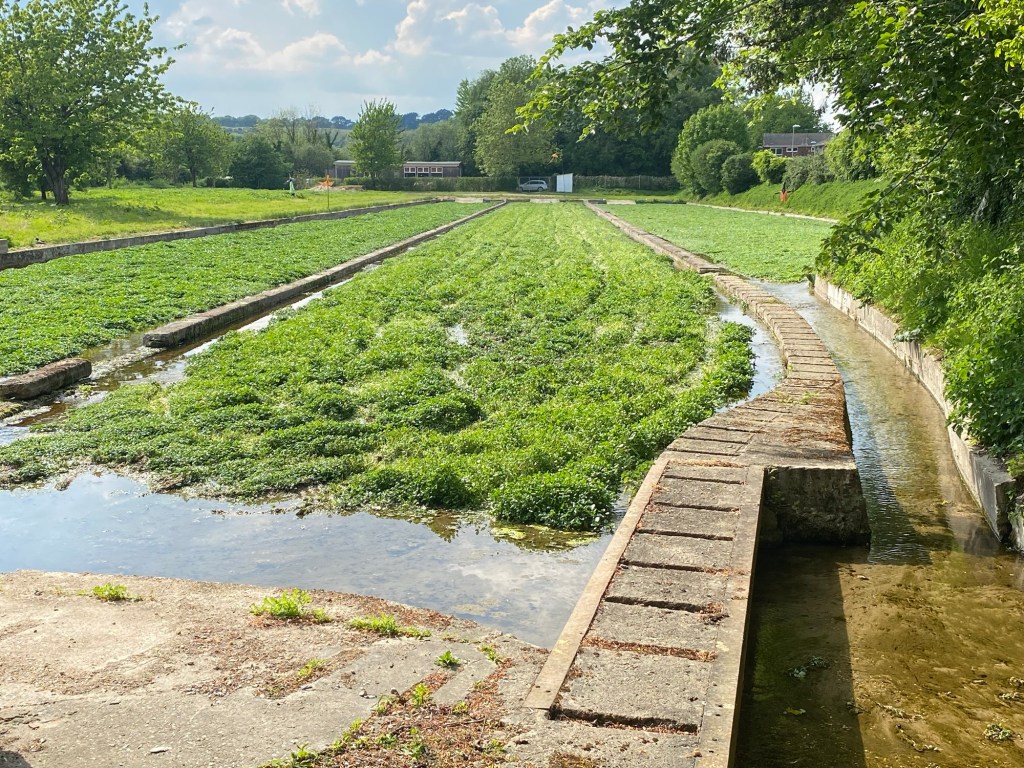
I arrived in Bere Regis just as the church tower struck four deep, sonorous notes that after the fourth chime had finished, slowly faded to silence. Minutes after starting walking I crossed the Bere Stream, another bubbling clear-flowing stream like the River Piddle that I lay down to bathe in in Briantspuddle, last time that I was on the way . As before, it was a blessing to see after having to get used to hearing about and seeing the many fouled rivers across the south west of England and beyond. Beside the stream, some way back from the road, there was a lush green meadow with two concrete walkways that ran in parallel lines 200 metres down its middle. Something about this scene made me stop without thinking why.
The blanket of green laid out before me was the same rich colour as the grass meadows that dominate the landscape here, but this was different. It was a water cress bed. Since the early 1800s water cress has been cultivated in Bere Regis and it’s grown here because of the chalk beds that provide the spring water that the cress needs to thrive. The Bere Regis website says that “it has many purported medicinal qualities; a good cure for a hangover, great for cleansing the blood and is even recommended as an aphrodisiac!” I still think I prefer mine in an egg sandwich.
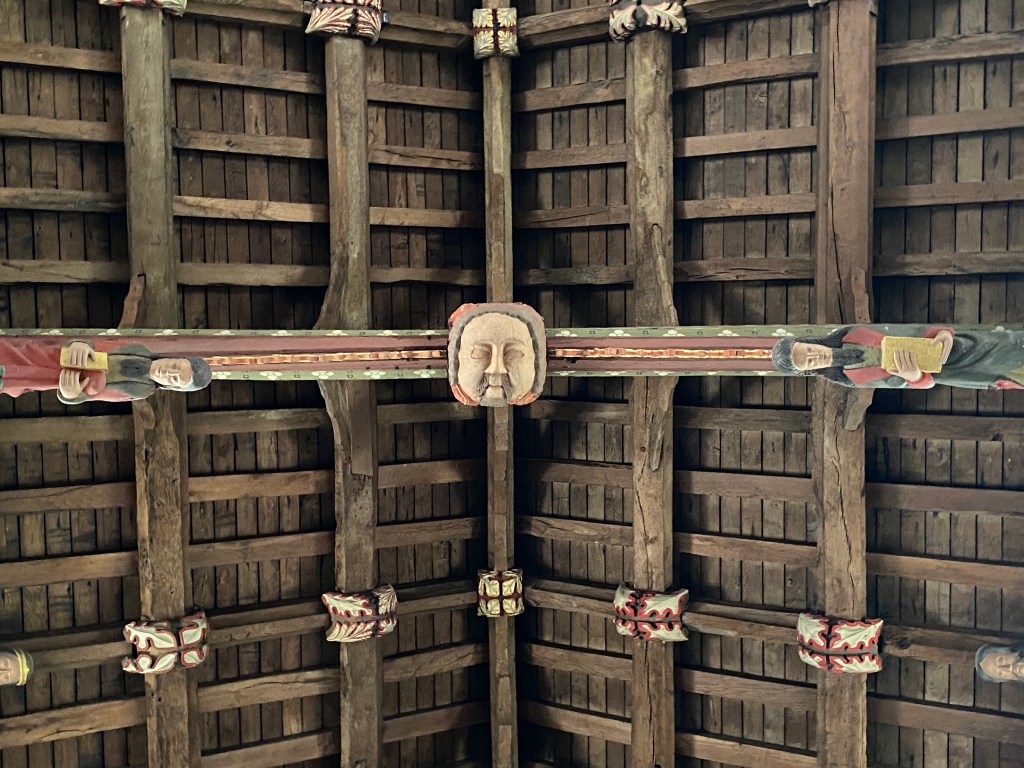
Shortly after this I arrived at the impressive grey tower of Bere Regis church, which stands on a small hill. Inside, on the roof of the nave, there were strange figures of men, pencil thin and pale faced with long black hair swept back from their foreheads – Nick Cave-like – with black goatee beards that drooped in two cables from their chins. They piously grasped hold of yellow painted books – bibles, presumably – as they stared down at the congregation. In between was a large, carved round face with thick lips and unpainted, unseeing eyes. I later found out the thin figures are apostles while the large face is supposed to be Cardinal Morton, who was born here and later became Archbishop of Canterbury.
I imagine children in the past sitting in these pews – like I used to have to in Curry Rivel Church in Somerset – staring around them while a sermon was being preached, and catching sight of these strange characters. I wonder how many childish nightmares were inspired by those staring ashen faces, although there was something comically cartoonish about them too. It was a departure from the painted angels that I am used to seeing hovering amongst the beams in the churches around me on the Somerset Levels.
Roof figures, Bere Regis Church
In the southern part of the church, behind a filled bookcase and next to a crèche covered in teddy bears and toys lay an old tomb. A glance up to the south wall also revealed a stained glass window of various shields, each one split in half. On the left of every shield was a standing red lion, its paws reaching out and a long tongue curling up from its jaws and a crown on top of its head. And then on the right hand side a different coat of arms in each shield. The lion was the arms of the Turberville family and each shield represents a marriage between a Turberville – Thomas, Richard, Robert, etc – and another family.
Any Hardy fan would recognise this name as being the inspiration for the ill-fated heroine’s name in Tess of the d’Urbervilles. In the excellent The Hardy Way – a 19th Century Pilgrimage, a guide to the way, local history and its relevance to Hardy’s works and life, Margaret Marande tells how Bere Regis is recreated as Kingsbere-sub-Greenhill in the novel. The Church of Kingsbere/Bere Regis is where after Tess’s father dies, her mother and the rest of the family come to find accommodation after they have been evicted from their cottage at Marnhull/Marlott. The family shelter under the south wall near the vaults of their ancestors and according to Marande “The fifteenth century d’Urberville window above their heads, with its heraldic emblems can still be seen and the altar-tomb on which Alec d’Urberville lay pretending to be an effigy is probably that of Robert Turberville, Lord of the Manor from 1547-59”.
On a large printed version of a family tree of the Turberville family, someone has fixed with clothes pegs a picture of Woolbridge Manor with a label underneath ‘Woolbridge Manor – once the home of the Turbervilles – and used by Thomas Hardy for the tragic wedding night of Tess and Angel Clare’.
I was so busy looking at the window that I didn’t notice a lady who had come to tend the flowers and we both gave each other a bit of a shock at the awareness of another person in the stillness and silence of the church.
Closing the door behind me, I made for the village and stopped outside a long cream-coloured, thatched house next to the Drax Arms. It was now a Nisa Local and had a crate filled with plastic footballs and multi-coloured kids fishing nets plus big green sacks of Wagg Active Goodness (it’s a type of dog food apparently). Outside a woman was getting into a big camper van with garlands of Hawaiian flowers hanging from the rear view mirror.
I heard her muttering something and then she leaned out of her window and looked at me:
‘Don’t worry I’m not talking to myself, I’m talking to my dog,’ she said, giving me a wide grin before driving off.
Moments later four people strolled past me on the pavement, with one of them wondering in a puzzled voice how his friend had run out of hay.
After picking up nuts and chocolate to keep me energised, I left Bere Regis down Blind St and crossed the A35 into meadows. The buttercups had now appeared in their thousands, sprinkling gold light amongst the meadows. There were daisys too and the puffballs of dandelions shivering in the evening breeze, sending little stars of fluff floating up to the sky. Since last time I was here only two weeks ago the cow parsley had grown huge, towering over me in the hedgerows.
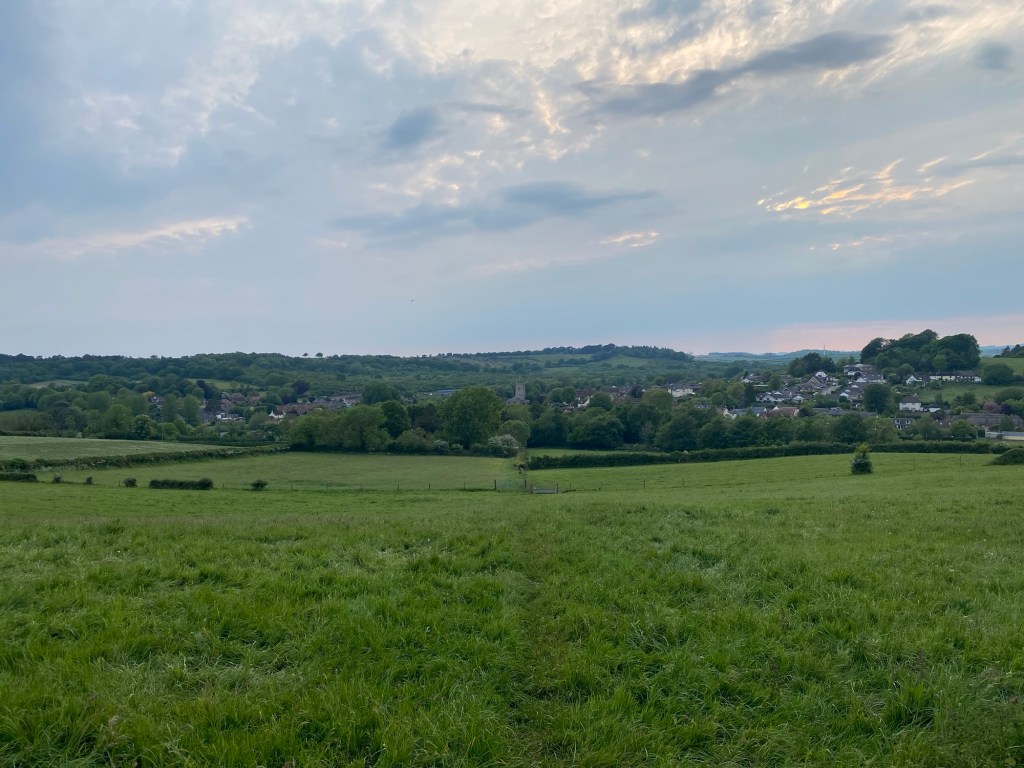
Bere Regis en route to Woodbury Hill
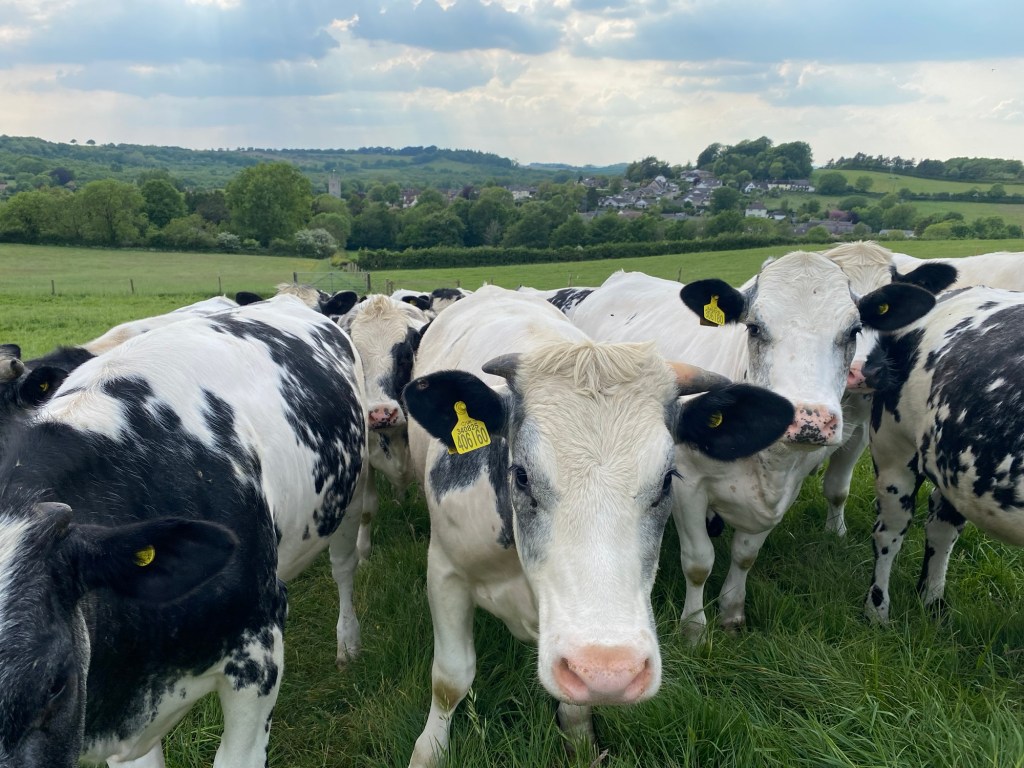
I climbed the hill east out of Bere Regis towards Woodbury Hill towards a herd of adolescent cows that were flicking away flies with their tails with metronomic frequency. One by one they rose from their lying positions and came silently to greet me, raising their noses and curiously sniffing me and trying to lick my elbow. They followed me up to the top of the field, every now and again nudging me from behind and one broke off to the side of his companions, bucking and rearing as if having a wonderful time to himself – no doubt full of the joys of Spring.
Through the trees below me I could still see the grey tower of Bere church with its St George’s flag fluttering.
Bere Regis – with entourage
At the top I crossed a road and turned north east through a meadow and past rickety barns. This was Woodbury Hill and once the ancient settlement of Woodbury. This would have been the site of the Woodbury Hill Fair, a huge event for the local community which took place over four days every September where thousands of people would come every day to buy and sell animals or to trade in all manner of goods. There would also be entertainment and eating and drinking in the way that we still have today in fairs across the south west. The fair was known to have already been taking place in the 12th century and Henry III granted charters for it to happen on various occasions in the 1200s. It continued for over 700 years until the 20th century by which time the livestock selling had stopped and it was just a fair, similar to other Dorset fairs such as the Oak Fair at Stock Gaylard or Dorset Show that happens at Puddletown. The last one took place here in 1951.
Renamed Greenhill Fair by Hardy, it features prominently in Far From the Madding Crowd. It’s where near the end of the book that the caddish Sergeant Troy reappears after he’s supposed to have died in the sea off Lulworth Cove, now working as the lead actor working for a travelling circus who are staging a play about the highwayman, Dick Turpin. He spots the heroine, Bathsheba, his ex-wife, and snatches a note from he hand so that she doesn’t find out he’s still alive. As quoted in Marande’s book it’s also where one of Bathsheba’s workers, Joseph Poorgrass, was taken to try to cure his shyness:
“They took me to Greenhill Fair, and into a great jerry-go-nimble show, where there were women-folk riding round – standing upon horses, with hardly anything on but their smocks; but it didn’t cure me a morsel”.
For a few moments I lost myself imagining the haze of dust and the sounds and smells of animals and thousands of people and stalls and cooking food and circus acts and steam-powered fun fair rides such as you used to be able to see at The Dorset Steam Fair (last put on in 2024).
And then I strode onwards, from the drowsiness of meadows into the cool stillness of Bere Wood. Here there were ranks of spruces guarding me on the right and great shocks of purple rhododendron rambling amongst them and small oaks on my left that filtered sunlight into patches of gold onto the path. There were still blue bells here – drooping and nodding their frilled trumpets at my feet. And somewhere close a mobile mast buzzed loudly.
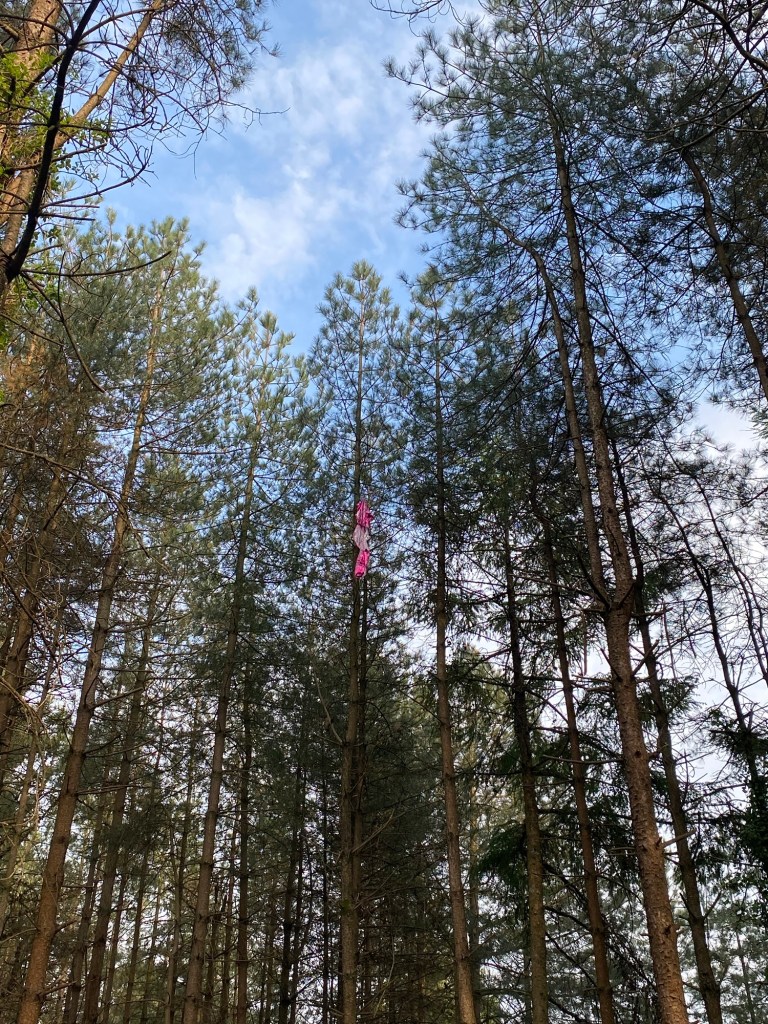
I paused to appreciate the transition (how I love a sudden change in place and atmosphere). Up in one of the spruces, some thirty feet above the ground, hanging from a thin stem like a gallows was a metre long piece of sagging plastic, still garishly pink. It was one of those foil helium balloons that people buy for birthdays or special occasions. I see those balloons everywhere but for some reason never in the situation for which they were orginally intended. I can only imagine that through a momentary lapse of concentration a hand forgets to hold on and up and off it goes, suddenly off on its own surprise adventure which is then cut short by getting stuck in a tree or a telephone wire or a river – I retrieved one from the river Parrett while swimming in it two summers ago. Collapsed and colourless it must have been there for years and would have stayed there for who knows how many more if there hadn’t been a dotty middle-aged swimmer who’d decided to take a dip next to it.
Bere Wood balloon
After passing through Bere Wood I crossed a meadow to Bloxworth as the sun started to soften. Outside the village hall in Bloxworth I sat on a bench in the sun and watched villagers come out of their houses and greeting each other on the road. Inevitably they talked about the good weather. Only a week ago the temperatures here were in single figures and the arrival of summer warmth and light evenings must still inspire a sense of relief to people as it would have done for villagers here living in the same houses in the distant past.
After eating some nuts and chocolate raisins I paused at the sparkling red telephone box opposite the village hall. Inside a sheet of typed paper announced this was the ‘Bloxworth Village Bazaar’.
Inside the one person space had been meticulously organised. In place of where the phone used to hang was a noticeboard welcoming the visitor and informing them that all items have been donated by the village to raise money for village projects. Around the noticeboard was a vine of plastic roses and then beside it a neatly fitted set of yellow painted shelves with board games, sparkling wine glasses and plates, some with ilustrations of elephants on. There were small handmade bangles hanging from hooks, a pestle and mortar, books, a doll, tote bags and even a bird feeder.
I’ve seen many phone boxes converted to different uses – normally an informal library/book store and more and more these days a defibrillator station – but this was the first time I’d seen one that advertised itself as a mini market. It felt like the world’s smallest charity shop.
Closing the door, I shouldered my backpack and headed south towards Bloxworth Heath and the town of Wool.
This was another week this summer when yet another period of intense heat descended on us. In the middle of a county which is not famed for its coastline, small pockets of human activity appear beside the slow lowland rivers that meander across the levels to the Bristol Channel. People must have been swimming in the rivers here for centuries. There are various places, known about through word of mouth, that are well known swimming haunts. Trees with horizontal branches smoothed by generations of boys’ bare feet where lads have stood before leaping into weir pools or old stone bridges where the boys line up, their faces all pointing down, and dare themselves to be the first to jump into the cool green water below. In the heat these places are like a gift from God.
Yesterday at Shepton Mallet Lido they were turning people away and had already had 160 bookings for the day when they refused me entry. Many of the rivers nearby will have a spot often hidden away near a church or a bridge which has all the mise-en-scene of the beach: young and old in shorts and bikinis, kayaks and stand-up-paddleboards dumped on the grass, rubber rings and orange armbands, towels and picnic rugs spread about, small barbecues smoking or blackened squares of grass a reminder of an alfresco meal, eaten by a different family, on a different day.
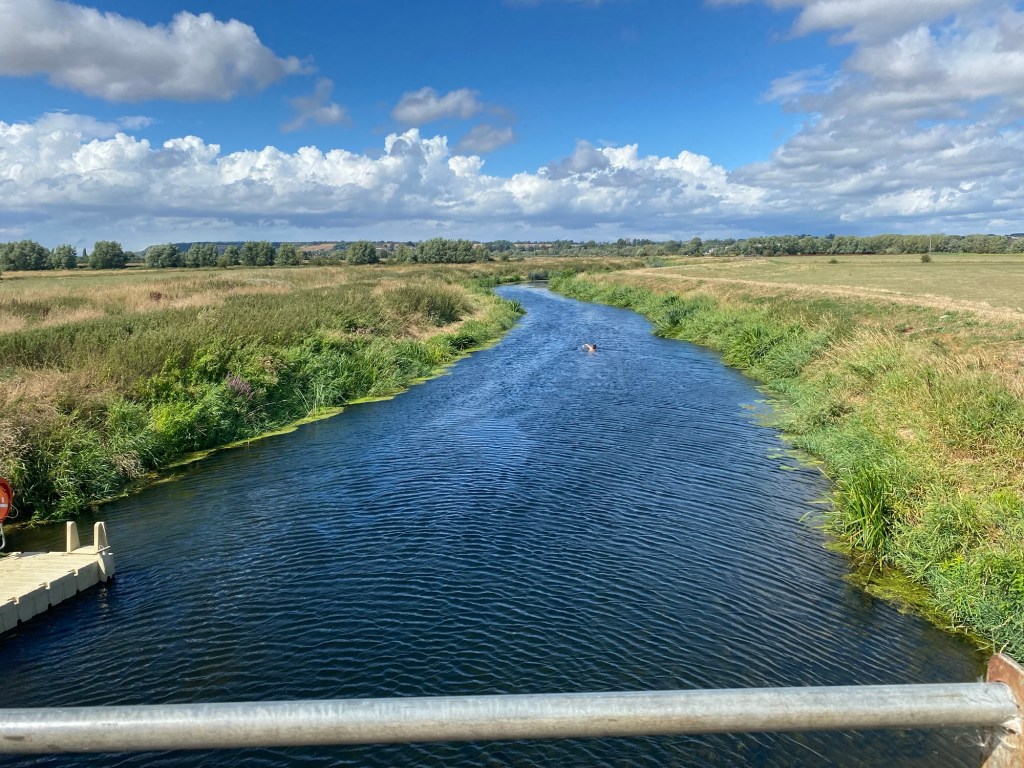
A few years ago, the council made an inspired decision – to transform a seven and a half mile stretch of the Parrett by making it navigable and encouraging people to use it for recreation. Four pontoons were installed along the river, three in Langport and one a couple of miles upstream at Muchelney Bridge to create river access. They weren’t officially opened until October 2020, a good bit of timing as we were still under Covid restrictions at the time. It’s amazing how this recent addition has transformed the river where something like 250,000 people now visit the Upper Parrett every year. A local counsellor said recently how Langport had “developed a new sense of civic pride”.
When I’m here during the summer I swim in the river at least once a day and, when it’s warm, I am one of a whole host of people who have travelled mostly it seems from within Somerset to paddle, kayak or swim. It’s strange how many people I’ve met and how I’ve never seen the same people twice. The other day I met a young man with long hair who’d cycled from Pitney who said he comes here regularly. The following day an enormous man with tattoos was showing his son how to pole fish for perch (his son was in a wheelchair having broken his leg on a school trip). When I told him I might disturb the fish when I’d be hurling myself in not far from the boy’s float the father said:
“It’s all right, it’s everyone’s river.”
Mostly people look after the spot. Sometimes I’ve picked up a scrumpled fag packet. Another time someone left a screwed up pair of trunks and a pink water bottle. When they were still there a week later I took them to the local tip at Somerton. People come and go but the next day there is little to tell people were here apart from the muddy remants of sliding feet on the ramp to the pontoon.
For several years there were eight car tyres someone had thrown into the river under the bridge (sadly, flytipping has become a frequent occurrence in this part of South Somerset where many a time I have passed old bedsteads, mattresses, piles of rubble or pots of paint growing alongside the cow parsley out of the verge of a lane). Last week the same tyres had been retrieved from the river and piled up on the bank. The day after that someone else had moved them next to the gate onto the road. Only a few days after that they had gone and only one had been left on the grass, ideal for sitting on to put my socks and shoes back on.
Back at the cottage the garden had been baked hard by the intense heat: what was once a lawn is now a dust rectangle. The rose I was given as a leaving present when I quit my teaching job three summers ago has lost its leaves and perhaps won’t come back. I sweltered some more and then decided it was time for another dip.
The three retirees in a boat I had seen this morning were gone. There was a man in his sixties with a trilby on walking up from the pontoon while 2 boys and 2 girls who were all about 7 or 8, dressed in bright orange life jackets chatted in the high pitched, high energy way that is unique to children before they’re about to jump in some water: that intoxicating mix of fear and excitement.
Next to the ramp down to the pontoon three teenage girls in bikinis lay in a row, legs pulled up, sunglasses on and devices in their hands, engaged in energetic chatting and speed swiping on their phones at the same time.
It was a scene taken from a poolside somewhere and transported to a cow field in Somerset.
There had been a strong wind the last few days blowing from the north which had gathered reeds loosened from the bed of the river and the multiple tiny round green leaves of duckweed. Sometimes it feels a bit like diving into a big bowl of pea soup but after a couple of strong strokes I was pulling down the river with Langport Church always ahead of me to the north.
Herds of cows were on both banks of the river as they always are in summer. They often walk up the banks and then gather by the road and start their mooing as they reach the gate. They are young Fresians, almost fully grown, sporting the big splashes of black and white that make their breed so recognisable. A man in a canoe with a young child in another orange life jacket was rowing backwards towards me, his eyes focused on something ahead of me. We said hello to each other, me just a head in the water looking up at him.
“I think there is a calf that’s in trouble up there.”
Sure enough, on the left bank three or four cows were inquisitively dipping their noses down to something at the water’s edge. A young heifer struggled up onto the bank and stopped as it tried to get its back legs to follow in the way old dogs struggle to get into the back seat of a car. It paused a second before its whole body slipped back into the water and it lay there, its head turned upwards showing the whites of its eyes.
The cows continued to fuss about it while I wondered what to do. I don’t know who the farmer is here but if I call Marie she’ll know and get them down here.
I had a half crazed idea to swim towards it and perhaps frighten it into climbing the bank. After I made a couple more breast strokes, it suddenly turned its body and started swimming straight for me in the same way horses swim, chin resting on the surface breathing through its nose. I’ve never seen a swimming cow before. I imagined its body underwater and its hooves pumping and I’m reminded of a time I went swimming with a girl from Cornwall and her three border collies in the Helford Estuary. It all seemed idyllic until I got too close to one of the dogs and it scratched me hard down my chest as it paddled for the shore. I didn’t want to think what a fully grown cow might do while swimming for its life.
Its eyes were wide as it came surprisingly quickly down the river, creating a bow wave ahead of it, the nostrils dilating as its breath came out, deep and loud. I was still thinking which direction to swim in to avoid it when it suddenly turned and headed straight across the river, paused momentarily at the water’s edge and with an enormous effort heaved its dripping backside up onto the bank, paused another two seconds and then scrambled up the last part of the bank, lost its footing and then finally stumbled onto the top where it stood stock still – probably in shock – then made a long low moo as if to itself and started to lick its haunches. A minute later another cow came up and did that thing where they touched noses and I wondered if this was some bovine way of comforting one another.
The whole episode must have taken less than thirty seconds. While still treading water, I turned round to look back towards the bridge and 4 bright orange blobs were now in the water and bearing down on me while excited screams and chatter travelled over the water. The canoeist had picked up the man with the trilby and the three girls were still on their backs, bronzing and chatting, clearly oblivious to swimming cows and children.
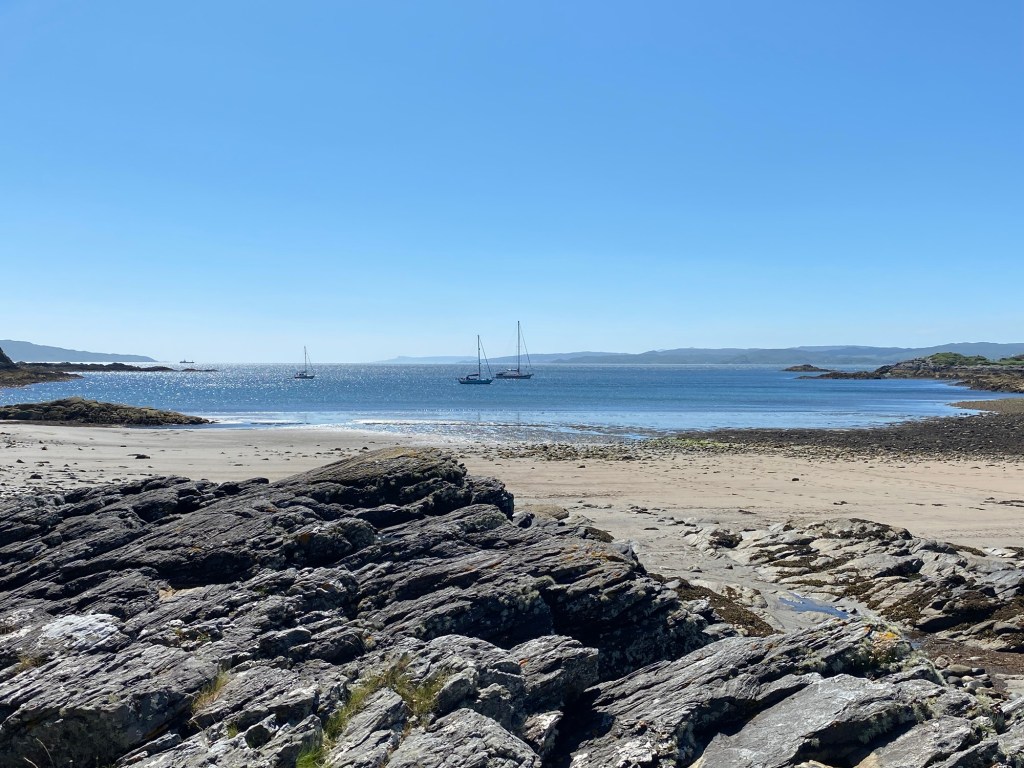
View from Sandaig towards Eigg and the south of Skye (Zuza is boat furthest to the right)
From the beach at Sandaig I am looking out over a mass of sea glitter down the Sound of Sleat, with Eigg a pale, flat form on the horizon. Its Sgurr, meaning ‘high pointed peak’, rises vertically at its southern end from a low rise of land and then tapers down to the north along the back of the island. Emily, our first mate on board Zuza, who is from the Sound of Mull, said it looks like a shark’s fin and so it does, like a leviathan risen from the depths swimming across to Skye.
In the foreground Zuza lies at anchor, a low white glistening line in the glitter, her red ensign, flapping and stretched to its full extent by a stiff northerly wind reaching down to us from the North Atlantic. Zuza is a 72 foot exploration and expedition vessel built in Cape Town in 1998. In her time,she has done voyages in the Arctic and Antarctic but is now used for live-on-board group sailing and sightseeing trips like this, the 3 day trip I have booked from Ullapool to Mallaig.
She has sleek lines, is painted white with a blue stripe down her sides and halfway down her length the deck becomes slightly raised with windows (the galley) and then at the back the cockpit rises up more so that it appears there are two raised blocks at the back of the boat which it gives it the air of a Turkish schooner, albeit with a fresh, modern design.
I joined Zuza at Ullapool the day before yesterday with five other guests and three crew. |It’s an eclectic mix – as always – and there is the usual slow burn of getting to know and used to one another. From Ullapool we motored north west under a deep blue sky through the Summer Isles, past cormorants and skuas and then down into the sea loch of Loch Ewe on the mainland for our first night. Yesterday we headed south to the west coast of the Isle of Raasay, only a few miles east of Skye and dropped anchor in Churchton Bay for our second night.
Only a couple of hours ago we had sailed through Kyle Rhea, the narrow channel that lies between the most easterly part of Skye and the remote chunk of land that is almost surrounded by water between Loch Alsh and Loch Duich to the north and east and Loch Hourn to the south. It was the most exciting part of the journey so far: setting off from Churchton Bay, passing round the southern tip of Raasay and then passing under the Skye Bridge and Kyle of Lochalsh. It was here that we turned south from Loch Alsh into Kyle Rhea. Zuza,with only her yellow foresail bulging with wind on the bow, was rushed along by a rising tide that funnels into the channel and creates strange movements on the surface of the water, like spools of thread looping and unfurling in circles and lines all around us, as the currents merge and twist over and around each other.
One of the crew said ‘It’s like lots of mini Corryvreckans’, a reference to the notorious stretch of water not far from here, near the Isle of Jura where in certain conditions an underwater point of rock creates the world’s third largest whirlpool and renders it unnavigable.
From the rocks I’m sitting on I look across the sandy and pebble strewn beach across the sound to Sleat, the southern peninsula of Skye.
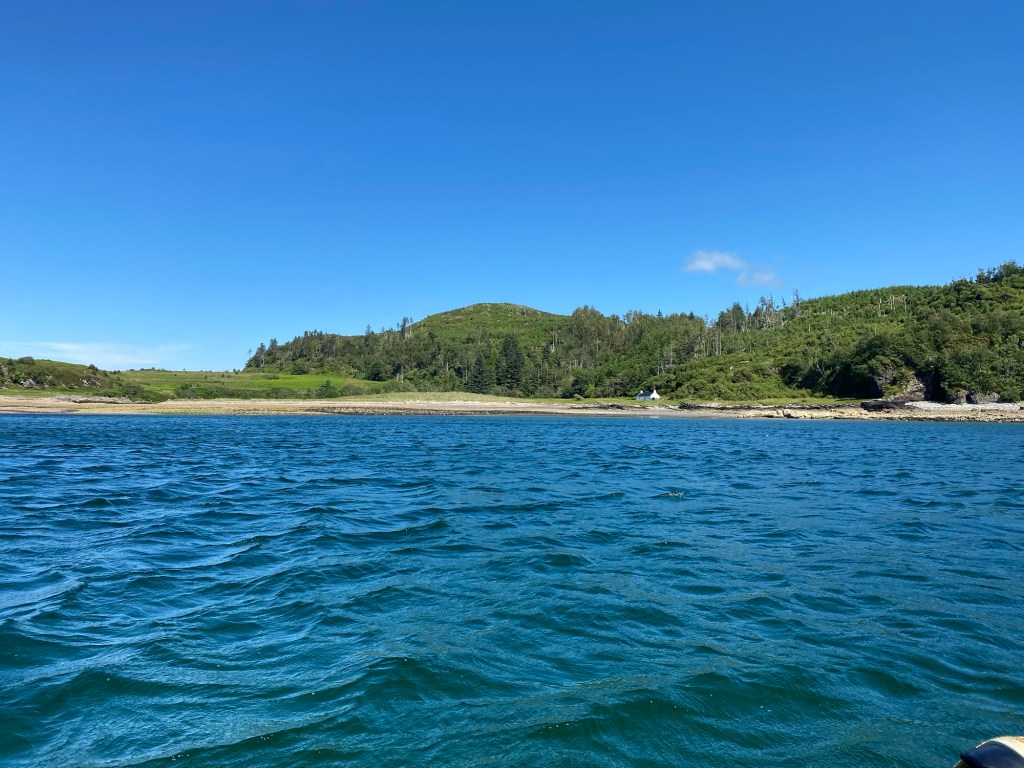
View of Sandaig beach and cottage from Zuza
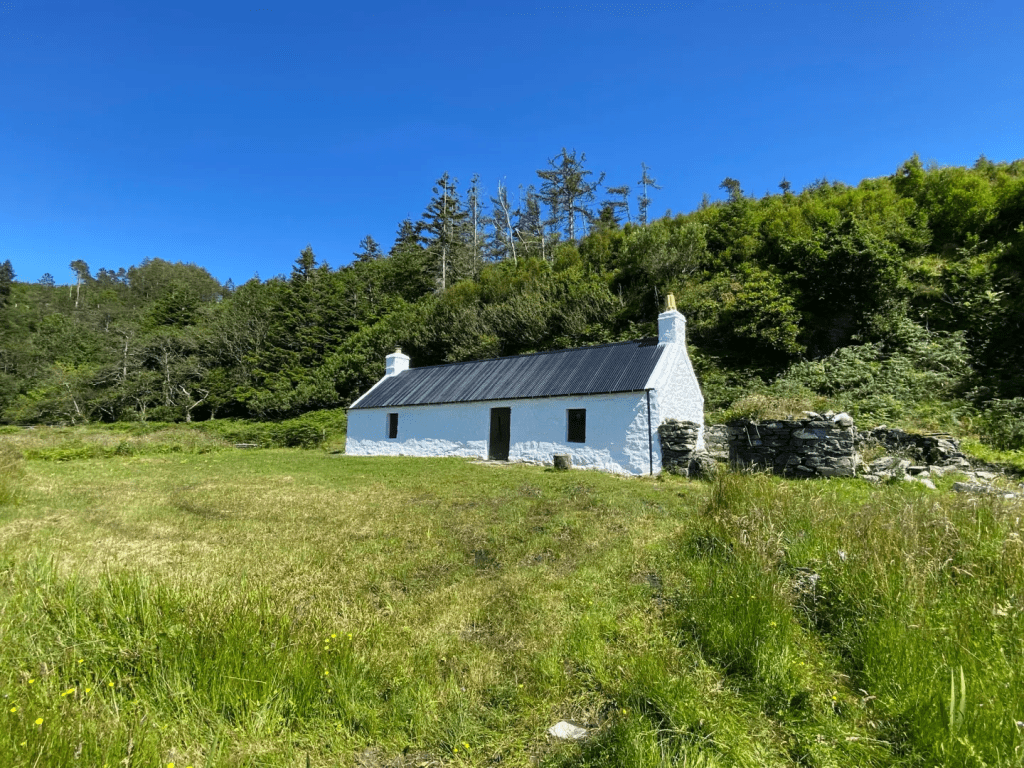
It feels utterly cut off here. There is only the sound of wind in the trees mingling with the rush of running water, which are so alike they seem to blur into one. There is a river that runs shallow through the wood and then flows out onto the beach. There is one Crofter’s cottage, end on to the beach, newly white washed but with the windows and door frame filled with rusted iron plates. It looks entirely shut up and disused and makes me wonder why it has been freshly painted.
Behind the cottage is a wood of fir and ash and just inside its perimeter the remains of another building with just the stones of the walls remaining.
The land in front of the house is covered with grasses and bracken that is being buffeted by the wind. There are also long stemmed buttercups and pink clover. Amongst the bracken are tall foxgloves nodding in unison in the wind.
It was in this wild and remote place that the writer Gavin Maxwell lived in a lighthouse keeper’s cottage and wrote Ring of Bright Water about his experience of life with his adopted otters . He named this place Camusfearna, meaning ‘bay of the alders’, and first started using it as a writer’s retreat in 1948.
The only surviving cottage at Sandaig
The book at one time was the best selling non fiction book in the UK and US and has now sold over two million copies. It was also turned into a film. It is a story about a man escaping the city and starting a new life to be closer to nature. Much of the story is enlivened by the otters’ fun and mischievous behaviour and his relationship with them.
Maxwell’s first otter, Mijbil, known as Mij, had been given to him by the great explorer, Wilfred Thesiger when they were together in Iraq, travelling and living amongst the reed marshes which formed the basis for probably Thesiger’s most famous book, The Marsh Arabs.
It was Mij that Maxwell brought back to Britain, initially to live in his flat in London but then who he brought to Sandaig as the first of his otter companions.
Being here it is tempting to imagine how Gavin Maxwell lived a life of simplicity and harmony – or perhaps this is what he craved – as the reality of his later life was far more complicated.
For many years he had a close friendship with the poet, Kathleen Raine. It was from one of her poems that the line ‘ring of bright water’ was taken, although he didn’t acknowledge this in the book. She was passionately – and perhaps obsessively – in love with him, but, being gay, he refused to have a relationship with her (he did eventually marry Lavinia Renton, a relative of Thesiger’s which added to Raine’s hurt and frustration, but it ended after a year).
Maxwell and Raine’s relationship was tempestuous and marked by frequent arguments. It was after one of these rows here at his house on a stormy night in July 1956 – exactly 70 years ago – that Maxwell threw her out of his house. Raine returned later that night and, holding onto a Rowan tree near the house, spoke a curse: “Let Gavin suffer, in this place, as I am suffering now.”
Raine later blamed herself for the misfortune that befell Maxwell at his remote Scottish outpost.
It was her who let Mijbil run wild one night and as a result he was killed by a local road worker with a pick axe handle (as described in Ring of Bright Water). That wasn’t all. In 1968 Camusfeàrna burnt down, killing another of the otters, Edal, who was shut in an enclosure, and destroying most of the writer’s belongings. It was only a year later that Maxwell himself died, by then having moved to the small island of Eilean Ban which I had passed earlier and now carries one part of the bridge from the mainland across to Skye.
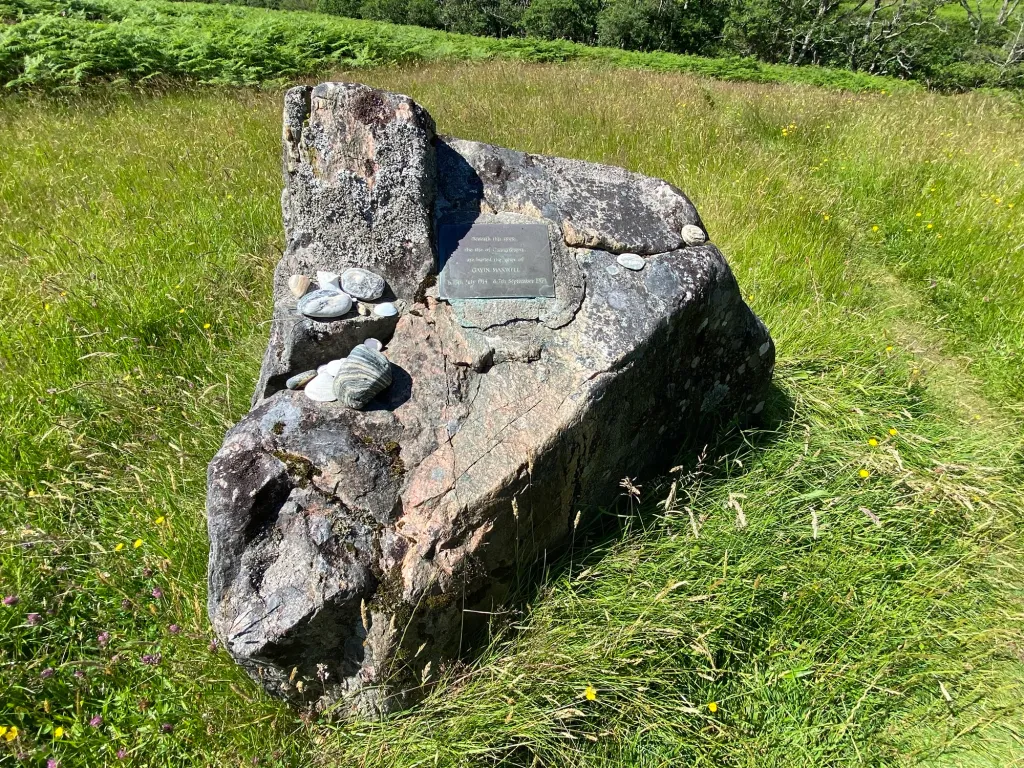
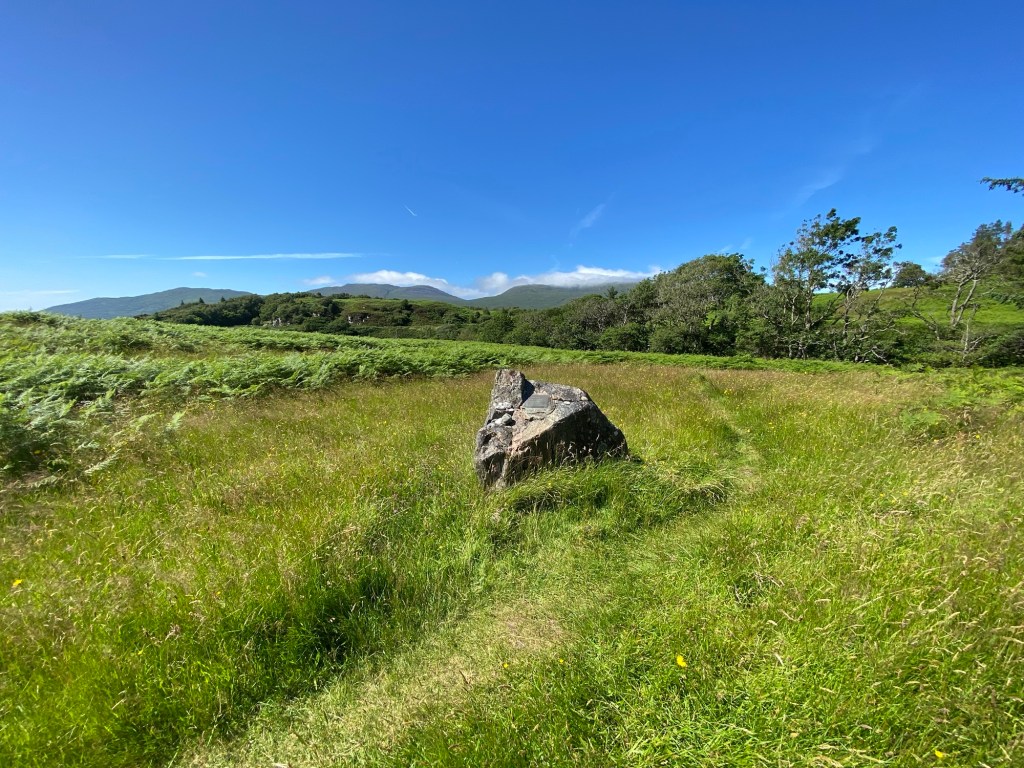
Standing here, there is nothing left to suggest there was once a house here. Now where it once stood is a boulder and a plaque under which Maxwell’s ashes have been buried. The boulder has been put in the place where his writing desk once sat; the ashes were placed here by Jimmy Watt, who Maxwell employed as an otter keeper, while the grieving Kathleen Raine looked on.
The plaque reads:
‘Beneath this stone, the site of Camusfearna, are buried the ashes of Gavin Maxwell b. 15th July 1914 d. 7th September 1969.’ Shells and pebbles from the beach have been placed around it.
Memorial to Gavin Maxwell, Sandaig
Although I don’t remember reading the book, I was aware of it when I was at school and people often talked about it. Standing by his memorial where his house once stood I felt a sudden heaviness in my chest – a great sadness about this man and his otters and their bad luck. I was struck by the contrast between the simple beauty of the place and the strange and dark story associated with it. This is where the nature writer appeared to find happiness but this was then undone by the success of the book and film as people started to visit his personal paradise. According to Terry Nutkins, the naturalist and TV presenter, who knew and worked with Maxwell, he couldn’t cope with his success: “But he didn’t want anyone to know that so he started drinking more, started smoking more”. A heavy smoker already, it was probably this that contributed to his death from lung cancer at the age of 55.
Behind the memorial to him is a large fir tree under which lies another memorial made of a stone block and topped by more pebbles and rocks. This is here to remember Edal, Maxwell’s otter, that died in the fire that destroyed his house in 1968. A quote from Maxwell on a plaque on the memorial seems to be fitting for this place and might be said to represent his own feelings about life: ‘Whatever joy she gave you give back to nature’.
With these words still in my head I feel my way through long strands of boot lace weed into clear, still and bone-numbingly cold water. Here with me once again is the familiar sharp intake of breath and the tingling sensation throughout my limbs as I lie on my back with sun sparkles in my eyes and a feeling of utter thoughtlessness.
When I surface I sit crouched in the water looking across the bay and imagine the dipping, twisting sleek shape of an otter, its coat glinting in the sun, as it dives, leaving small disturbances on the surface of the bay like the circling currents I witnessed earlier in Kyle Rhea, before the surface of the water finally flattens and lies still.
This day was one of those days that probably deserved to be described as ‘glorious’, and, as is so often the case with English weather, was not only affected by the day itself but by the days, weeks and possibly months that preceded it. It was not only the sight of Wessex bathed in sunlight but the sense of warmth that surprised me and evoked memories of past summers. Above me there was a mantle of pale blue, untouched by clouds and a faint half moon waiting patiently above the horizon in the south.
Before arriving in the village, I had walked across Briantspuddle Heath through thick forest with the intoxicating smell of pine resin and gorse. It seems like much of the early stages of the Hardy Way takes the Hardy pilgrim through forest – first Puddletown Forest and later through the larger Wareham Forest near Bere Regis.
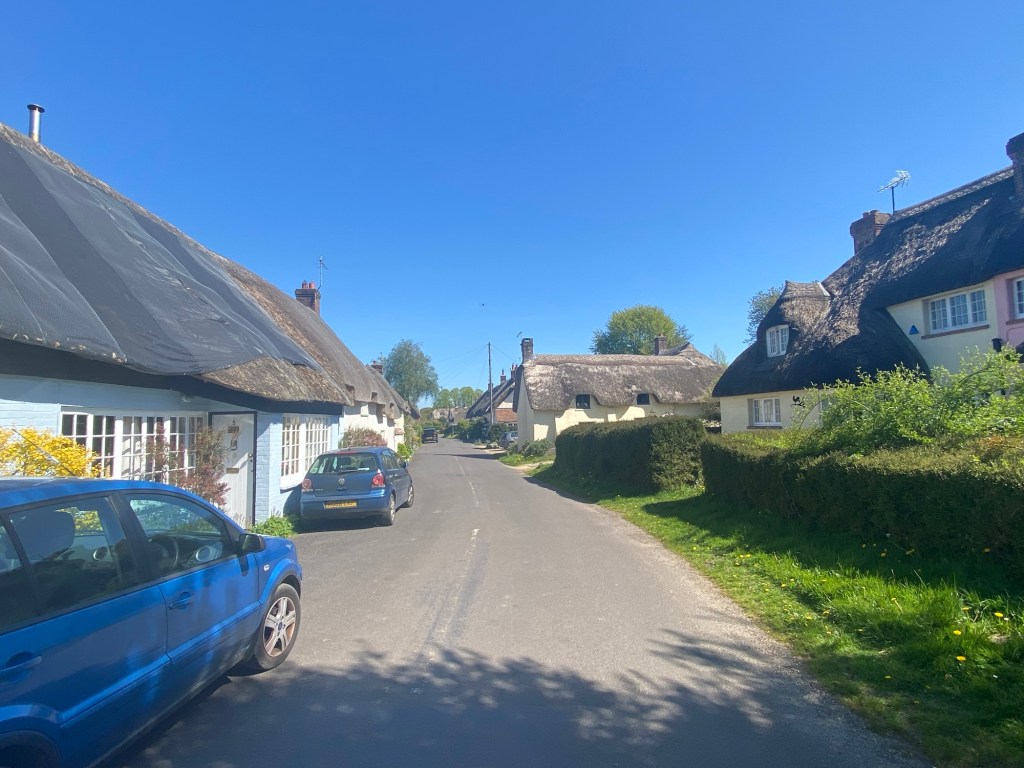
Here in Briantspuddle all was still apart from a couple quietly pruning the roses outside their cottage. And fussing crows. On the road to Throop every house seemed to be a thatch stretched low down over the top floors, shading the windows. They were cut out neatly in right angles around the window frames and reminded me of the sharp pudding bowl hairdo of Wendolene Ramsbottom, the female love interest and owner of the wool shop in Wallace and Gromit’s A Close Shave. The first storey windows were so low a tall man could reach up and grab the sill.
Briantspuddle
Jackdaws made their funny little peeping sound to each other flying overhead and landing on chimney stacks. Wisteria, lilac and clematis clung to houses. Cow parsley, buttercups and dandelion puffs had all made appearances in the hedgrows over recent days. And the trees seemed to have become greener and fuller almost overnight. Since my walk through Puddletown two weeks ago, suddenly the seasons had changed.
As I passed the Briantspuddle sewage pumping station on the outskirts of the village my mind couldn’t help but dredge through some of the awful statistics that I uncovered over the last winter about the state of our local rivers. For a few years now the full story of the wholesale disregard and despoilment of England’s rivers had started to become clear. Newspapers such as The Times had been running campaigns with regular updates on the extent of how much the water companies had been polluting our rivers. The government had promised action and fines for water companies.
Then it seemed to reach a wider audience and kicked off a new spate of press attention with the production of the docudrama Dirty Business that came out in February of this year. The drama, broadcast on Channel 4, followed the true story of a retired policeman and a university professor who undertook a 10 year investigation into the pollution of the River Windrush in Oxfordshire. After watching the first episode I couldn’t watch the rest.
Back in the early 2000s living in London with my then girlfriend we would travel out of town to the idyllic Cotswold village of Burford, stay the night and spend long summer afternoons in the water meadows on the Windrush – surely the most wonderfully poetic name of any river – swimming in a large round pool with clear water, yellow flags next to the banks and small trout flashing like burnished metal in the shallows.
Roger Deakin also spent a blissful afternoon swimming on the Windrush as recorded in Waterlog, his eccentric classic of swimming in various outdoor swimming spots around the British Isles. In the chapter on the Windrush he also found a spot near Burford where he invented what he liked to call ‘The Third Way’ of swimming where he let himself float around an ox bow in the river before getting out at the end of the bend and taking a few steps across the grass to start the ride again. Of his swim there he wrote ‘to feel the water’s balmy softness at every stroke was a kind of heaven’.
To see then that it was the sewage station at Burford that was unfit for purpose, that it had been pumping raw sewage into the river over and over again, to see that the river water was often dark and had lost its clarity and that fish were and plant life were dying was like a kind of trauma, the memory of which I couldn’t shake off.
If I’m honest with myself, I’d been living in a state of denial, swimming most days during the summer in my local river, the Parrett in Somerset. I remember, Dionne, now in his eighties who once was a poacher and now a wildlife enthusiast who has lived all his life on the Somerset levels said to me last year ‘Oh, I don’t know if you should swim in there’. I’d deliberately avoided the data until after watching that programme. But now you can go onto the ‘Sewage map’ (just put it into Google) and it will give you real time updates on where Wessex Water are polluting and when the last one was and how many DAYS (!) it went on for. The results were truly shocking as it seems hardly any river in England has been unaffected (less than 10%).
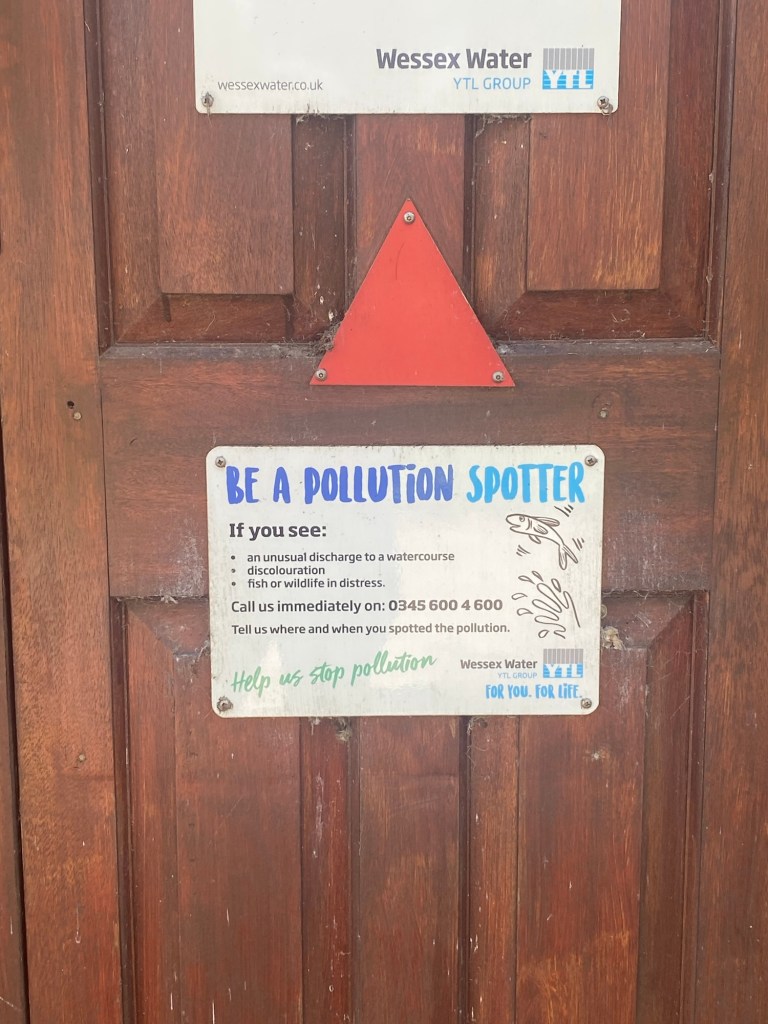
All this stuff that had stayed with me through the winter started to rise up again in me as I read the child friendly sign on the door of the pumping station. ‘Be a pollution spotter…help us stop pollution’. It’s a strange sign. Innocently asking the general public to help stop the pollution caused by those responsible for the pollution. I also couldn’t help notice the sign about Wessex Water being part of YTL Group, a huge umbrella organisation that is described on its website as a ‘global business operating in 12 countries, YTL UK Group spans multiple sectors’. Apparently, the UK is the only country in the world whose water industry is privatised. For our water needs to be in the hands of a company which ‘spans multiple sectors’ based in Malaysia seems to me to be a form of madness.
Sign, Briantspuddle Sewage Pumping Station
In the bridge over the River Piddle in Throop a middle aged man with a wet black Labrador on a lead was having an animated discussion with an older lady and three whippets wandered around in their delicate, wide-eyed way. One tentatively sniffed my hand. Two young girls were in swimming costumes and threw a stick for another dog that splashed noisily under the bridge.
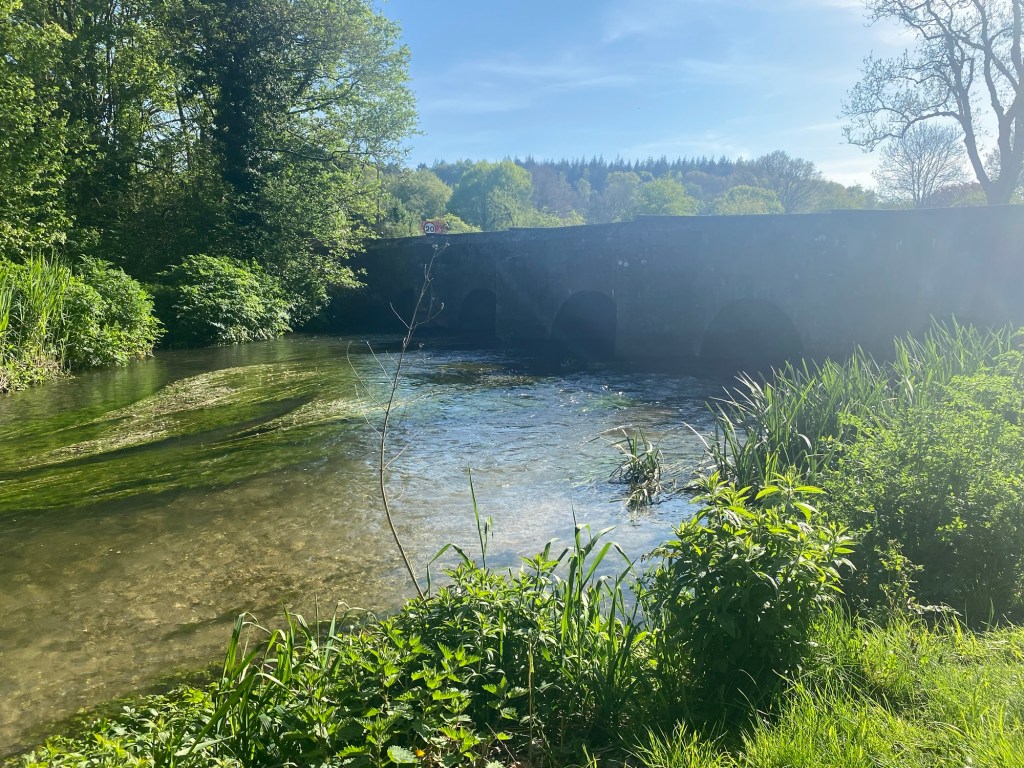
Despite my gloom over the state of our local rivers, the sight of the River Piddle reassured me. The water was gin clear, flowing shallow in many places, creating a calm liquid murmur through great tresses of water crowfoot, luminous green like an inland mermaid’s wondrous hair.
The Piddle, along with the Frome and other waterways in this part of Dorset are chalk streams, those quintessentially English rivers that rise from springs in chalk bedrock. They are normally easily recognisable for the clarity of the water and the vibrant mini eco systems they produce. The gravel beds are perfect for fish such as salmon, trout and grayling to spawn which has made them popular and in some cases – such as with the rivers Test and Itchen in Hampshire – world famous for their fly fishing.
One of the great natural wonders on chalk streams at this time of year are the annual mayfly hatches where these insects rise, sometimes in their thousands, from their nymph state in the rivers. The males fly up and down in a funny bouncing motion – known as their ‘dance’ – to attract a mate before conjoining and then dying often in less than 24 hours. In many cases the adult mayfly may only live for 5 minutes. At this time, normally occurring on warm evenings in May and June, the hatches also create a feeding frenzy amongst the trout, and fishermen use the opportunity to catch trout by using mayfly imitations which are flicked onto the surface of the river and trick a rising trout into taking it.
Throughout the history of literature it seems that writers have used the mayfly as a symbol for the shortness of life. In the world’s oldest recorded piece of poetry, the Epic of Gilgamesh, Gilgamesh’s brief life is compared to that of the mayfly. Shelley’s poem, Adonais, written in 1821, was an elegy for his friend, John Keats, who had died from tuberculosis at the age of 25. He writes ‘each ephemeral insect then, is gathered into death without a dawn’ saying later how ‘no wonder mayfly is a byword for brevity’.
These little rivers are also characterised by their abundant plant life such as water-crowfoot, water star-wort and water cress, which is often produced commercially on these rivers as I’ll discover later in Bere Regis. Globally, chalk streams are very rare with 85% of them existing in the UK. Out of the 224 designated chalk streams, the highest number, 64, are in Wessex. For me, after the slow, muddy rivers of the Somerset Levels where I live, these sparkling, bubbling and dancing streams and rivers are always a wonder.
At Turners Puddle the footpath followed a second bridge over a shallow run of the Piddle. There were cows lowing somewhere out of sight and the tall oaks and beeches in the churchyard shivered their leaves. It sounded watery like the chalk stream they look over. Pigeons cooed drunkenly. It is as if the whole land – as Hardy put it – ‘lies in a swoon’ (Tess of the d’Urbervilles).
The farm here had a red brick barn which must be 60 metres long half covered in thatch.
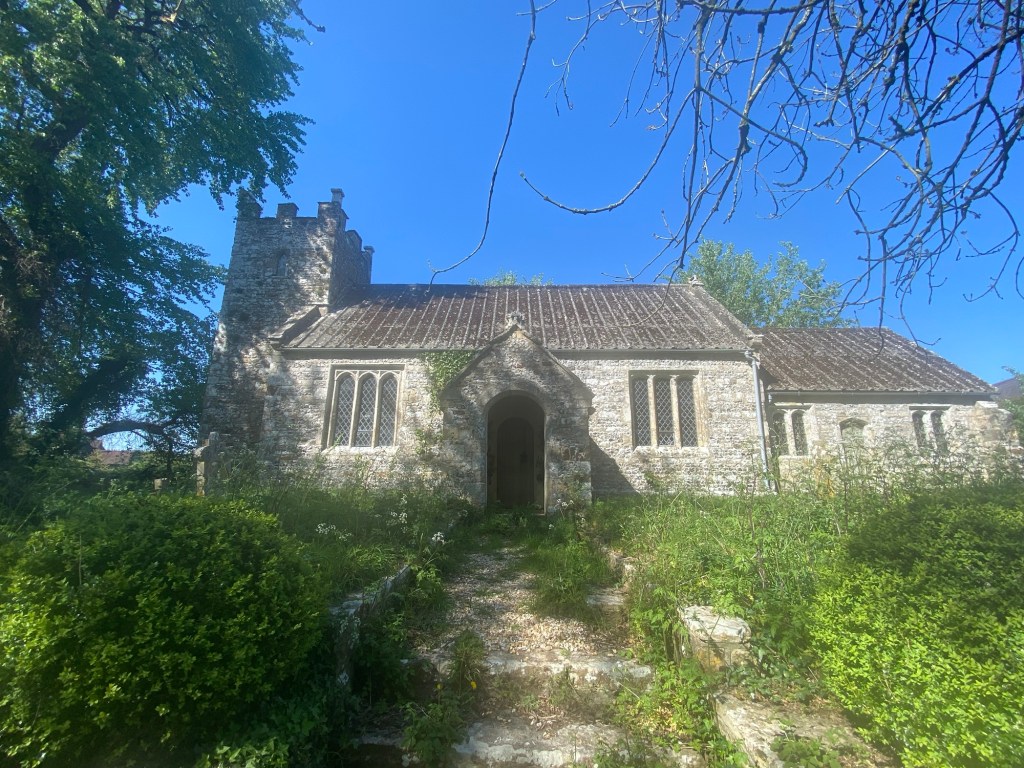
Next door was the old church with a tiny tower only a few feet higher than the roof of the nave. There were shrubs and gravel leading up to the door and otherwise the old graveyard was overgrown with cow parsley taller than I am and a few remaining graves leaned drunkenly this way and that. There was a large oak, its main branches covered with moss which was home to nesting rooks making an exaggerated din in the tree tops.
A framed printed sheet in the church porch informed me how the church was deconsecrated in April 1974 (only a few months before I was born) and is now used occasionally for weddings, funerals and concerts. There was a sign saying PRIVATE on the gate.
By now I had completed a large circle and returned through water meadows into Briantspuddle starting to feel hot and my head slightly befuddled by tree pollen. My mind turned again to water. Surely, I could find somewhere to swim in this valley of the Piddle, feeling a determination to be in outdoor water for the first time this year and to try to overcome my sadness about rivers. The only problem was that every time I saw the river it was never more than a foot deep.
At the old, arched bridge into the village there was a circle of grass with a bench overlooking the glittering river. The water must have been 1-2 foot but I donned the trunks and found a shallow scoop of water below one of the arches of the bridge. There was a gravelly bottom, and as I lay totally flat I could feel the water rushing over me – cool and clean. I kept my legs together and arms at my side to create as little resistance to the rapid flow of water as if I was rocketing down one of those tubes at an aqua park.
I also felt like John Everett Millais’s famous representation of Ophelia, now hanging in the Tate Gallery in London, surrounded by flowers and floating in a clear stream. According to the Tate, amongst many other flowers she has carried with her into the stream next to her are “Crow flowers in the foreground look similar to buttercups and symbolise ingratitude or childishness”. What ‘crow flowers’ are I do not know but they must mean water-crowfoot which means she must be lying in a chalk stream which is immediately clear when you look at the painting (apparently Millais used the Hogsmill River in Surrey, a tributary of the Thames and the model Elizabeth Siddal as the dying Ophelia).
As I slowed my breathing, sunlight flashed off the ripples of water firing off little sparks in my half closed eyes. A pair of ducks floated rapidly along the outside of the river turning their heads to watch me. And my dark winter thoughts of rivers were finally washed away.
I’m sitting on a bench in the evening sun outside the white washed walls of The Antique Map & Bookshop on the high street in Puddletown. Behind red brick walls the first sky blue bunches of Wisteria are to be seen dangling against the walls of cottages. Hawthorn trees are full of their star-shaped flowers that create little blizzards of white petals onto roads and paths, reminding me of confetti on a church path the day after a wedding. On the high street I passed the imposing old pub, The Prince of Wales, its two gables adorned with the Prince of Wales’s feathers. I was getting ready to think about sitting down, and perhaps having some refreshment when I noticed the wording on the pub sign outside:
The Prince of Wales
Apartments 1-4
It’s yet another pub which has become a home – or homes: a now familiar story in the English countryside. At least the Post Office opposite is still going.
This is the the first village I’ve come through at the start of The Hardy Way, the 216 mile circular route around Dorset that starts at Thomas Hardy’s birthplace at Higher Bockhampton and takes in many of the places and landscapes that Hardy used to inform and inspire his books. The Way ends at Stinsford, barely a mile from Higher Bockhampton, where Hardy was baptised and where his heart is buried (his ashes are buried in Poets’ Corner in Westminster Abbey).
It’s often said the Dorset landscape is so important to Hardy’s novels it takes on the role of a character, influencing the people and action at every turn. As an impressionable 17 year old I studied Tess of the d’Urbervilles for my A levels in Suffolk while falling in love for the first time with a girl who sat on the other side of the class. And I can still remember some of the descriptions of landscape off by heart:
‘Amid the oozing fatness and warm ferments of the Froom Vale, at a season when the rush of juices could almost be heard below the hiss of fertilization, it was impossible that the most fanciful love should not grow passionate. The ready bosoms existing there were impregnated by their surroundings…And as Clare was oppressed by the outward heats, so was he burdened inwardly by waxing fervour of passion for the soft and silent Tess.’
This was Hardy’s description of Talbothays Dairy, the fictional farm where Tess and Angel Clare meet and fall in love. The real Talbothays is thought to be Lower Lewell Farm in the Frome valley 2 or 3 miles south of here.
I haven’t blogged about walking for over a year, preoccupied as I’ve been with walking across Somerset for a book. This might have made good material for posts but it seemed like a good time to pause. And there will be posts about Somerset as I continue to wander around that, my home county – for its traditions, culture and people – over this summer.
And meanwhile this has become another project: first and foremost my desire to escape and explore close to home but to try to keep my mind in practice, as well as my legs.
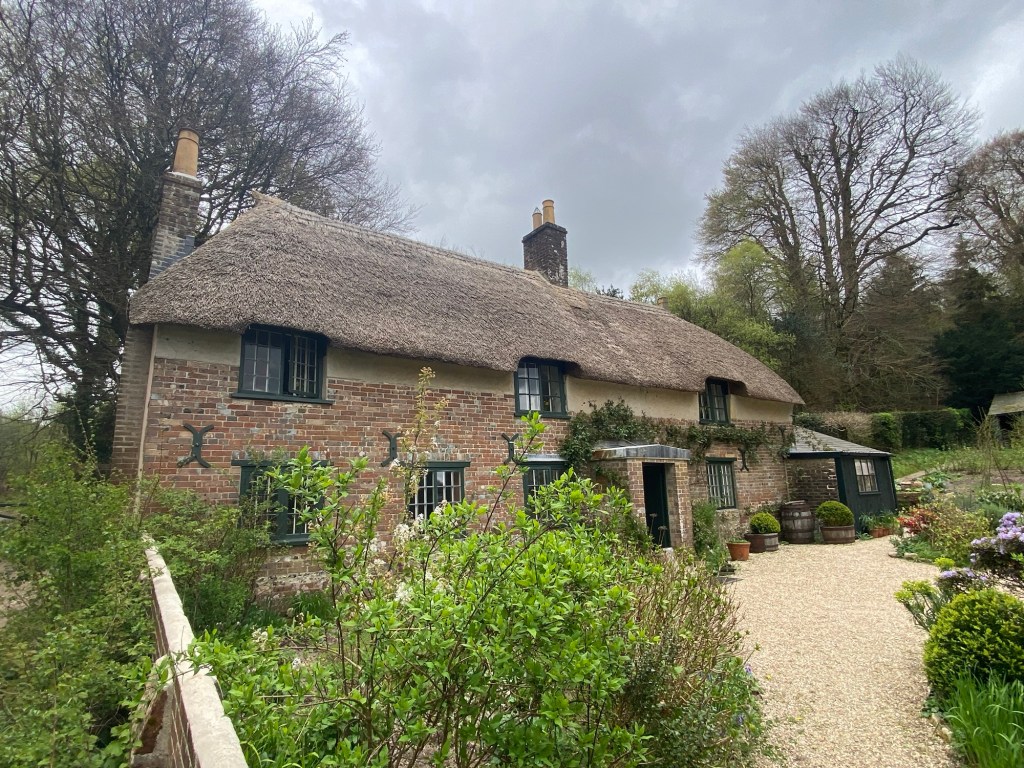
I started last week outside Hardy’s Cottage on a cold grey day during the school Easter holidays. When I got to the cottage a smiley volunteer apologised and said they’d just started the final tour of the day. Instead I contented myself with leaning over the foot gate that leads to the gravelled area in front of the cottage, imagining being a passer-by almost 200 years ago when Hardy’s parents were about to deliver this great writer about the people and places of Wessex into the world.
Hardy’s Cottage
According to The National Trust website, the cottage was built of cob and thatch by Hardy’s grandfather and it was where he was born in 1840 and lived until he was 32. It was where he wrote his two early novels Under the Greenwood Tree and Far from the Madding Crowd.
Many of the places I am walking through at the start of The Hardy Way feature in Far from the Madding Crowd. Puddletown was renamed Weatherbury and is where Bathsheba Everdene inherited her farm – Weatherbury Farm – the centre for most of the action. Like most of Hardy’s places it is based on a real life house, Waterston Manor, in Lower Waterston, little more than a mile west of Puddletown and 2 or 3 miles from Hardy’s birthplace.
Earlier I left my car down the road from the manor at Lower Waterston Farm and walked east along the winding B3142 which for a short section is also the Hardy Way. The meadows on the left of the road was the setting for the sheep washing scene from Far from the Madding Crowd where the lovestruck Mr Boldwood comes to propose to Bathsheba. It is the River Piddle that flows through the water meadows that become rich in flowers in May:
“The outskirts of this level water-meadow were diversified by round and hollow pastures, where just now every flower that was not a buttercup was a daisy” (Far from the Madding Crowd – The Sheep Washing).
That’s still a few weeks away – when the buttercups appear in their thousands across the meadows of Dorset and in the pastures thst surround me in Somerset too – reflecting sunlight as a warm gold glow.
On the road from Puddletown to Tincleton the hedgerows are starting to turn. There is that visual evidence of the seasons changing, brown stems turning green. Dandelions are protruding, their flowers like yellow cartoon explosions while neighbouring blue bells bow their bells forlornly.
A man clad all in orange overalls as favoured by road workers comes up the hill on an electric powered bicycle, one hand on the handle bar, looking nonchalant.
‘How do?’ he says even more nonchalantly.
The way takes me off the road through a gate into a meadow. I pause. In the evening light a small black and white shape is skimming close over the field, its white breast lit by the light, flashing every now and again between wing beats like a message sent from a flashlight. It’s the first swallow I’ve seen this year. There is always something joyful about the first one – this harbinger of summer and sign that winter is over.
As such, they have always held some significance in folklore. In ancient times it was considered deeply unlucky to harm a swallow or its nest. A swallow nesting in a person’s barn was said to confer good luck on one’s household. In Ireland there was a belief that they carried a small drop of divine blood which again meant they should be left unharmed.
A few years ago I was in the ancient city of Plovdiv in Bulgaria under a tree festooned with white and red decorations where a local man called Adi told me of the pagan tradition of Baba Marta. Baba Marta, meaning ‘Granny March’, was a mythical character who brought winter to an end and announced the beginning of spring. In Bulgaria it is celebrated by the wearing of Martenitsi – red and white cloth bands – that are worn around the wrist and are worn from March 1st until the wearer sees the first stork returning for summer – or the first swallow.
As it carries on back and forth flitting over the grass, I wonder where it has come from and what epic journey it has taken. Across the Sahara and the Congo (apparently the toughest leg of the journey). Across Morocco, the Mediterranean, Spain and France and the English Channel. Across conflicts, perhaps, and cultures very different from our own. A six thousand mile journey, across deserts and jungles and giant rivers and oceans. An immaculate and intrepid little traveller.
At Anniston Farm adolescent fresian calves breathe heavily in their barn, dipping their heads through the gate to see me. Their beautiful deep black eyes glisten in the sun. A song thrush repeats its patterns one after the other, truly virtuosic in its soloing. One phrase repeated after another. One is a quick tee-woo, then a machine gun burst of quick fire peeping before a louder tieu , tieu, tieu. It seems so loud in the still evening air.
Later, as I approached the A35, there is a familiar clunking sound echoing in the evening air every 30 seconds or so. It comes from the nets at Puddletown Cricket Club. There are people in their teens and twenties running in to bowl, one after the other, while a woman with a baggy grey hoody leans over a double pushchair watching. It’s another sign that summer is drawing closer.
On my way back to Waterston I cross once again the A35 as I did at the beginning of the day, passing HGVs with sleeping drivers pulled up in a layby. The dual carriageway continues to roar beneath me and on the other side in the west the light is honey gold in the hedgerows.
It’s 9am and I’m at the car park in Treyarnon. There is only one other person here – a young surfer with a red sweat shirt and green jeans checking out the surf while humming a tune to himself. It’s still icy cold on the hands and face but the clouds have now disappeared and unlike the uniform grey of yesterday, the land and ocean are lit up.
As the coast path leaves Treyarnon, grass-covered ground stretches to the edge of low cliffs. Between the line of the path and the land’s edge there are several benches in a row staring straight out to sea. Coming towards them from the south west, tightly packed lines of surf rise and then crash onto the rocks at the base of the low cliffs. I pause and listen. A gentle roar. And the low hum of the wind. And my heart beating.
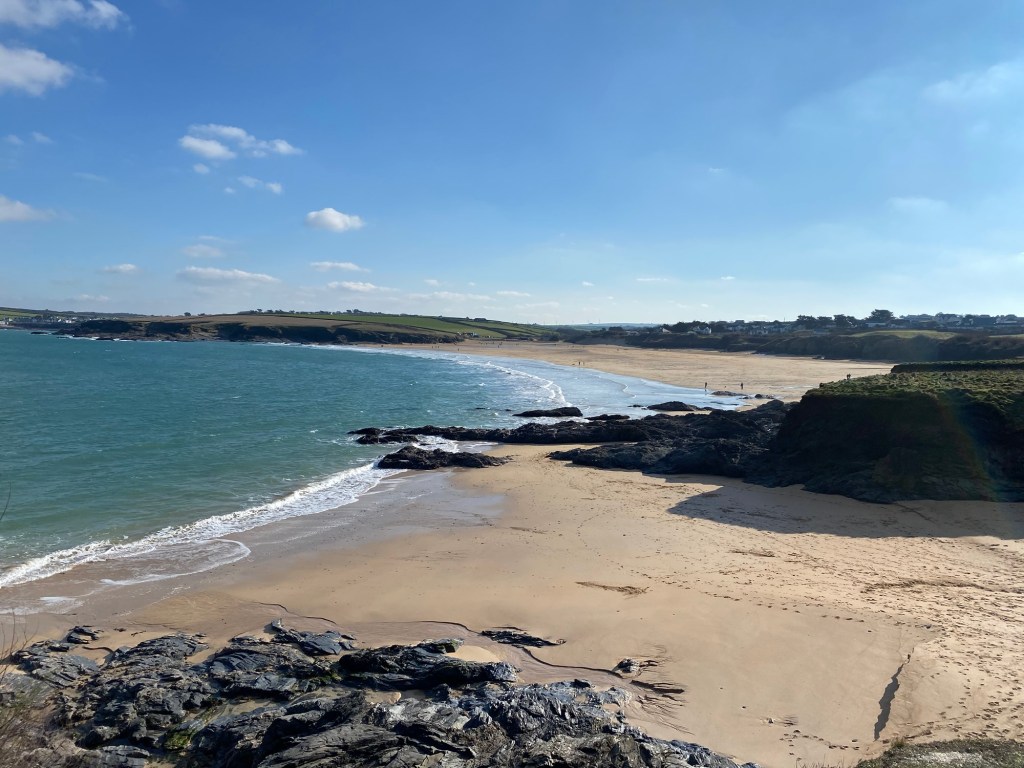
Beyond Treyarnon Point, Constantine Bay unfurls itself, a great sweep of golden sand which rises gradually from the sea up to the sea dunes that wall it in like a Roman amphitheatre. Where is the tidal pool mentioned in Roger Deakin’s wild swimming classic ‘Waterlog’? I seem to remember Deakin swimming in it with someone who lived locally and their black labrador. I furiously try to search for it on my phone but there is no signal. This is a good thing. Although I’d love to know where it is.
When I cross to the other side of the beach there is a great tangle of fishing netting. It’s at least 6 feet long with 3 or 4 ropes and a mass of nylon fishing line. I remember sailing around the Hebrides last summer on board the Dutch ketch, Steady, and her Dutch skipper, Willem, saying how the majority of the plastic pollution he sees when sailing around the UK seems to come from the fishing industry.
Constantine Bay leads into Booby’s Bay from where I start the climb up to Trevose Head. I am stopped by the unmistakable cadences of a skylark singing away in the cold air above me. Wow, he’s keen. And surely way too early? But let’s hope he finds the one. It’s a little taster of spring and I sense that I’m starting to feel that sense of expectation.
At Trevose Head I look back to Towan Head and Kelsey Head, only just visible now while thinking about the passing of time. When was it I passed there? The memories can blur, especially with so many mental images of the coastline. Here – Trevose Head – is an exposed bit of land that reaches out into the Atlantic like a small growth on the knee of the Cornish peninsula that tapers away from the rest of Britain and ends at Land’s End. The land turns east after here and I’ll turn my back on all the headlands I’ve done since going back to St Agnes Head that I went round in May of last year.
Trevose Head protruding from the ‘leg’ of Cornwall
On the point is the gleaming white tower of Trevose Head lighthouse which was built in 1847 as a guide for vessels in the Bristol Channel. It became automated in 1995 with the last keepers to oversee the lighthouse being withdrawn just before Christmas of that year. This was not long before the very last lighthouse keeper left a UK lighthouse at the North Foreland Lighthouse in Margate in 1998.
Trevose Head Lighthouse
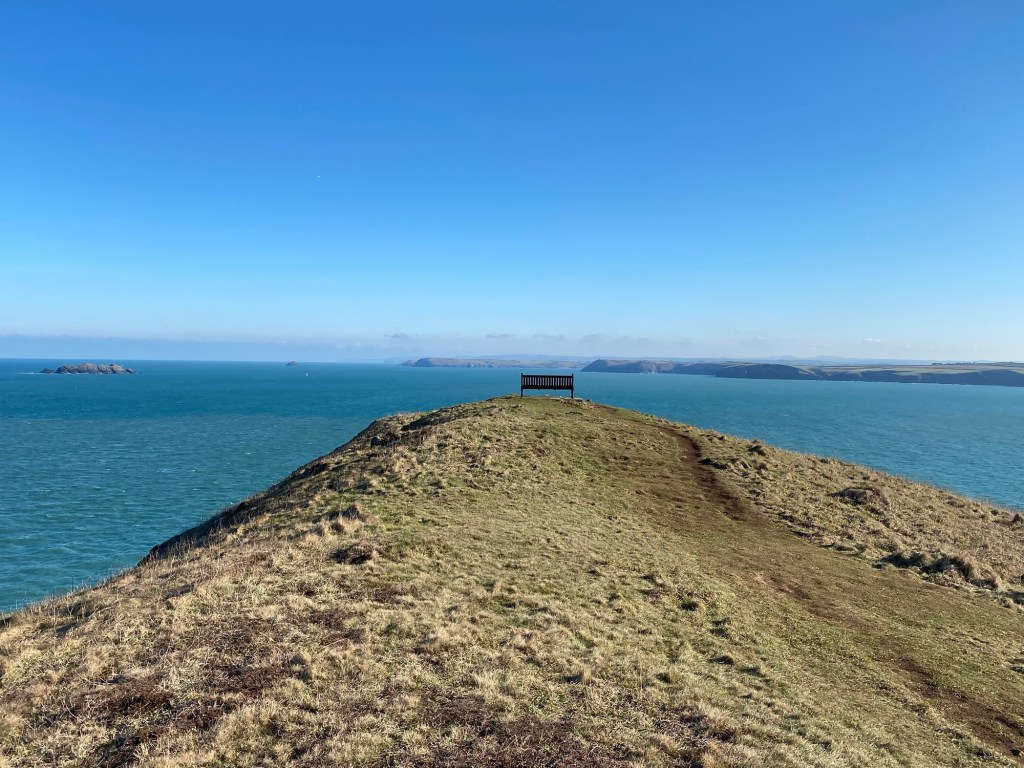
Above Merope Rocks is a seat that looks like it’s floating in the air. It is perched on a point that seems to disappear beyond the seat. With its back to me and the great expanse ahead of it, it has something of the drama of a Caspar Friedrich painting. It also reminds me of the recurring dream I used to have when I was young of me standing on a platform the size of a foot mat hundred of metres above the sea.
I sit on this bench wrapped up against the cold easterly that is blowing straight into me. The bench is dedicated to Pat and Alan Hayward ‘who loved this place’. I can see why. The land falls away on all sides so I do feel like I’m hovering in the wind above the sea; I could be sitting on the edge of the earth.
Ahead of me I have a grand vista of the Cornish coast stretching for miles to the north east. It is also a view of a journey – one of many – that will engage me for months and probably years to come. More headlands protrude into the blue green of the sea with names that will haunt and excite me as I carry on: Padstow Bay, Pentire Point, Start Point and Tintagel Head. It’s so clear today I can see these places lining up, each protruding bit of land a bit fainter than the one that lies before it.
Bench at Merope Rocks with Pentire Point and other headlands beyond.
I am now turning south down the eastern edge of Trevose Head and soon curving round to Harlyn Bay. It’s a stunning beach and one I remember well from my twenties when I used to come and surf at Polzeath with a great friend who had a caravan up at Trebetherick. We used to come to Harlyn Bay just as a place to unwind in between surf sessions.
I remember finding a faded Polaroid photo someone had taken of the beach which for years I kept in one of my first journals when I was living in London. I still have the notebook but not the photo. One person’s memory lost and left on the beach to be taken by another person who held onto it for a while before also losing that same memory.
Standing on the beach I know I’ve reached the end for today. I suddenly have one of those unthinking moments of suddenly feeling a place. It’s probably only 10 seconds but I feel like it is much longer when I come round from it and try to write it down:
A stream emptying onto the beach. Riffling over slate. Sun glitter on moving water. Hushing of waves drifting in and out of earshot. A dog barks. The brief distant scream of a child. A plane briefly overhead. Then the wind. Then the stream. And again the waves.
It’s almost three and a half months since I was last here. It’s not that I don’t like walking in winter. I love it, unless it’s heavy rain but other things have been happening and hey, as always, what’s the rush? At my girlfriend’s house I have a favourite mug with a picture of a sloth on it saying ‘Live slowly’. This mug and its advice has more benefit and wisdom in it than several sessions with a life coach or psychoanalyst but if only I could implement it. Walking the coast path seems to be the one area of my life where I do seem to have some success at being slower and thereby calmer.
My weather app is saying the daytime temperature in Cornwall is struggling to climb above freezing and the sky is the featureless blanket of grey that can often be the default setting of English weather, especially so at this time of year when a whole week can pass with the same unchanging dullness in the outside world.
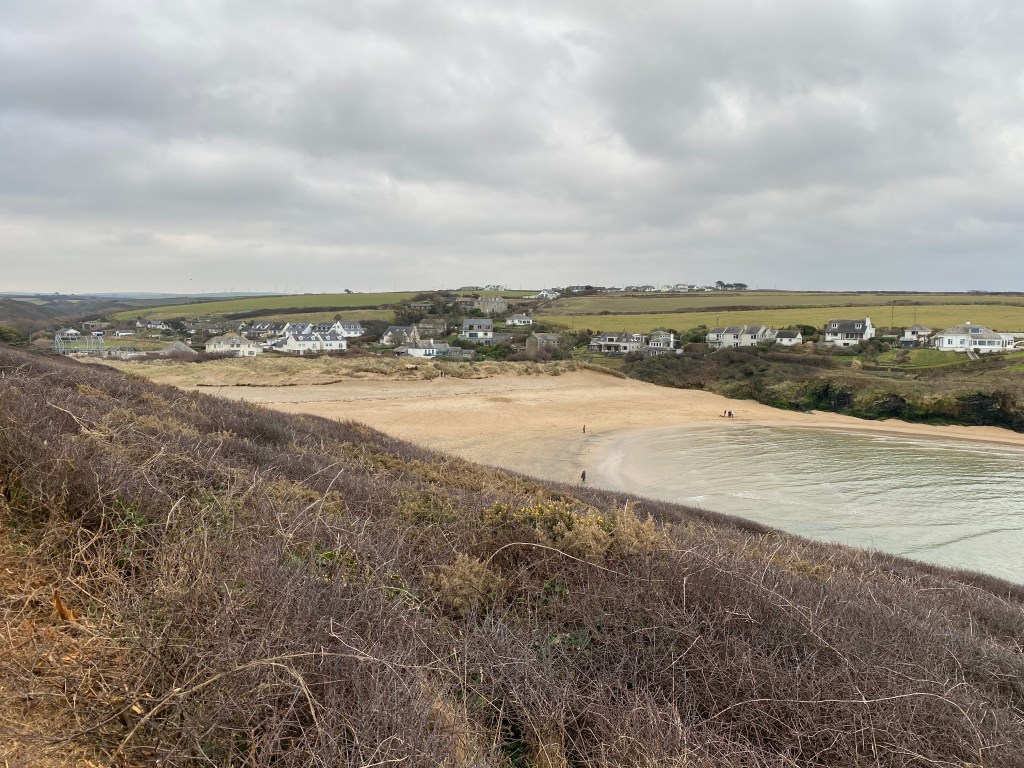
At Porthcothan beach there are only a handful of people on the beach, all wearing bobble hats and two excited spaniels with lolling tongues and tails that are wagging so fast they could be motorised. There is no sound apart from the gentle repetitive lapping of the waves on the sand. I expect most people are watching the rugby. It’s in stark contrast to the busyness and holiday vibes of October half term last time I was here. This is low season at its lowest.
The thought sends tingles through my arms and neck, an inner warmth at being utterly alone in the landscape that is hard to describe. It is an emotion I’ve always associated with adventure, or more accurately being alone with nature in its rawest form. It’s I guess what the Irish philosopher Edmund Burke referred to as the sublime. A strange and powerful thrill derived from awe and fear of nature.
In “A Philosophical Enquiry into the Origins of Our Ideas of the Sublime and Beautiful” Burke wrote:
“The passion caused by the great and sublime in nature, when those causes operate most powerfully is Astonishment, and astonishment is that state of the soul in which all its motions are suspended, with some degree of horror..”
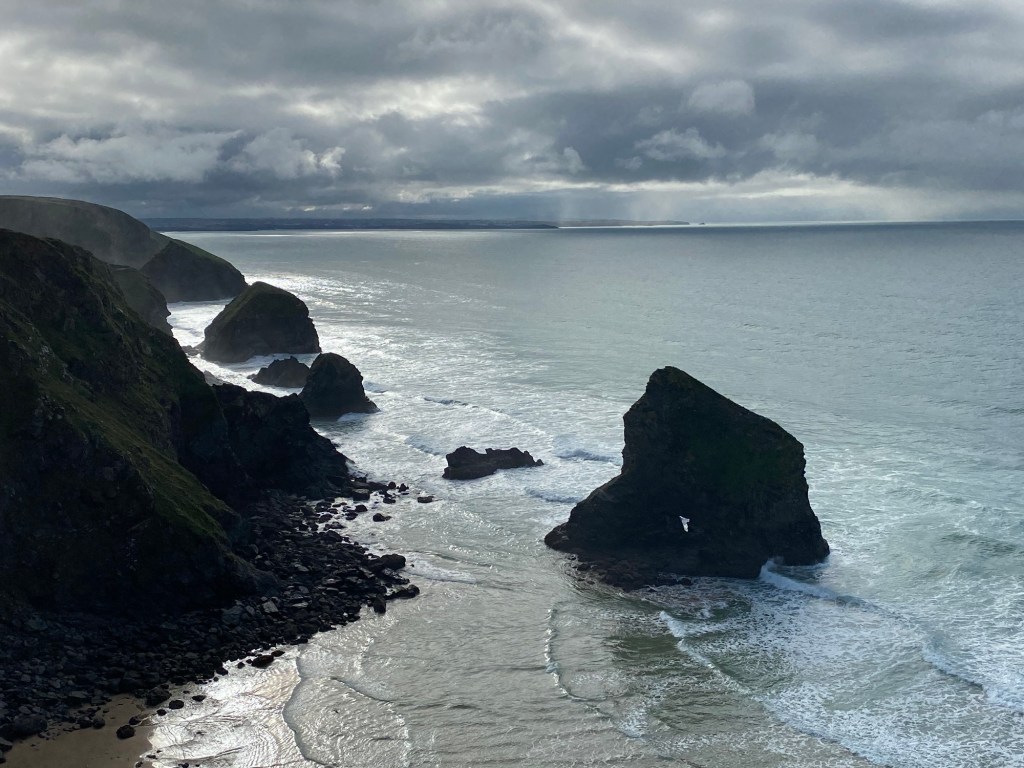
Even after all these miles walking around Cornwall the sea here still has the power to stop me in my tracks. There is no sunlight but the water colour is breathtaking, a luminous pale green like the jade ornaments that I remember seeing a few years ago in the National Museum of Taiwan. Foam in the sea meanders mysteriously along the coast in parallel lines like a track or pathway across the water until I lose sight of it.
It’s so quiet that all reminders of human activity seem incongruous and redundant like one of those post-apocalyptic films that inevitably feature zombies or the city scenes devoid of humans we can remember when we were first forced to ‘stay at home’ during the Covid lockdowns. At the water’s edge above Fox Cove a lonely bench and life buoy look out to sea at the perfect straight line of horizon and a bank of cloud that rests above it. I sit on the bench and stare at the lines – of foam and horizon and cloud. And think of nothing.
Bench and Life Buoy, Fox Cove
At Treyarnon Point, the light is starting to fade and I start imagining my hotel room at Mawgan Porth and a cup of tea. The road can lead me straight back to Pothcothan Beach.
The Bedruthan Hotel and Spa is a huge white modern block built on top of the cliff overlooking the beach at Mawgan Porth. The room was reduced and the spa might bave sold it to me (I do love a good spa). It’s only later that I read some of the hotel spiel which surely is designed to entice the likes of me. When describing the spa: “Slow down and stare over the gentle blue.” It sounds great although I seem to do an awful lot of that already (or try to). They also have something called a ‘Wanderlust’ package: “When you’re feeling exploration’s call experience our wanderlust escape”.
When I arrive at hotel it is pandemonium. There must be almost a hundred cars spread out in four separate car parks. It feels a bit like arriving at an airport. I manage to squeeze my car in a corner next to a hedge. At reception there are queues of people with dogs. Both restaurants are fully booked. A staffie with a frowning big bearded owner holding on tight to its leash unleashes a volley of rapid barking at me in the corridor on the way to my room. Both owners look at their dog incredulously as if to indicate to me this never normally happens. I smile at them. After a whole day of being alone next to the sea, Bedruthan is something of a wakeup call.
Outside below the hotel I find a terrace with an incredible view over Mawgan Porth. The only other people is a lady in an overcoat in her seventies and I guess her granddaughter, probably about 8.
As I walk past the grandmother she turns to me and says ‘Have you seen it?’
‘I’m sorry?’
‘The whale.’
‘No, no I haven’t’.
I imagine there’s some wooden whale that the hotel have for kids to play on.
‘There’s been sightings of a humpback whale all week between here and St Ives. Apparently you can see it clearly from here.’
‘No way. Thank you for telling me. I’ll keep looking out there for it’.
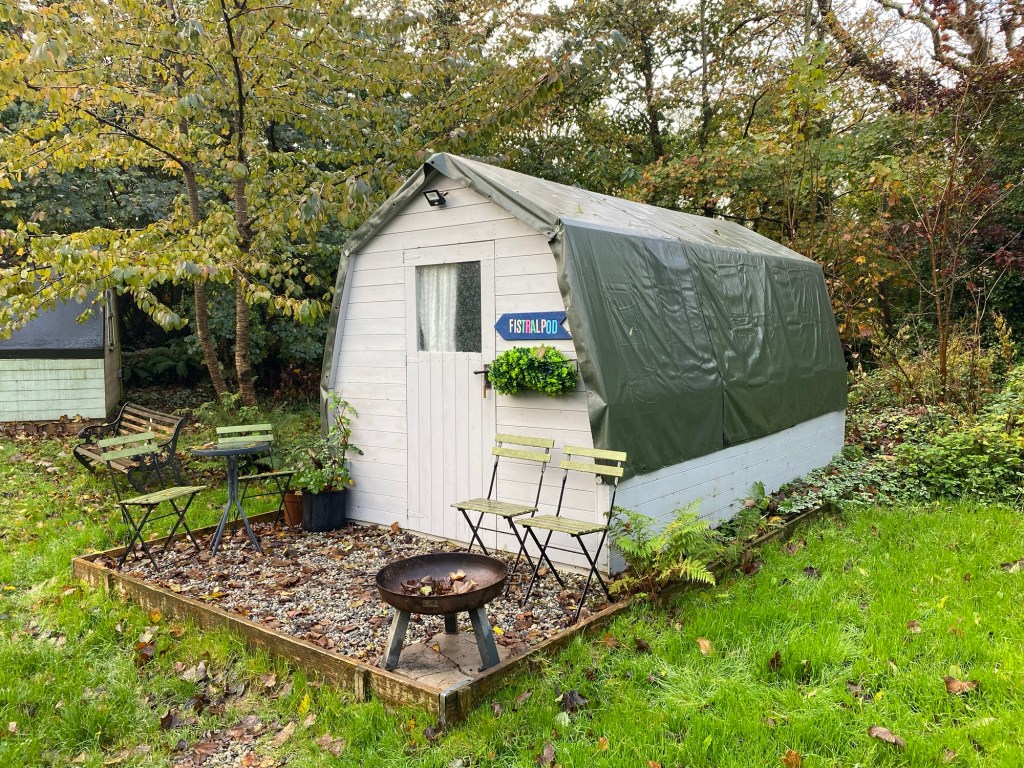
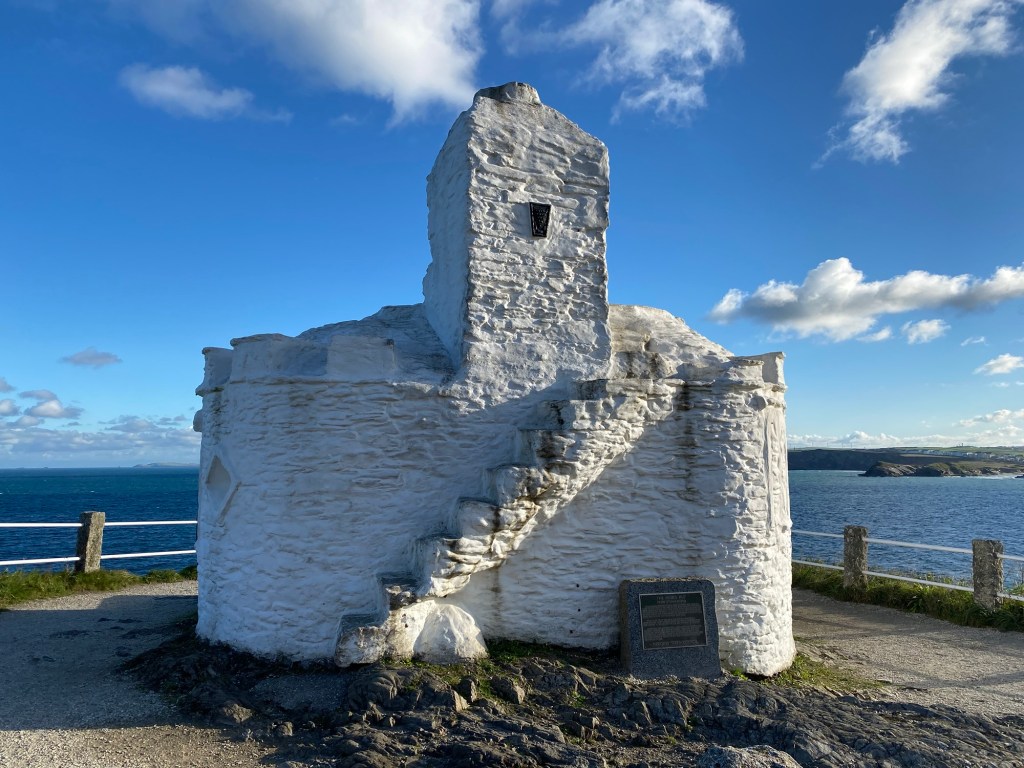
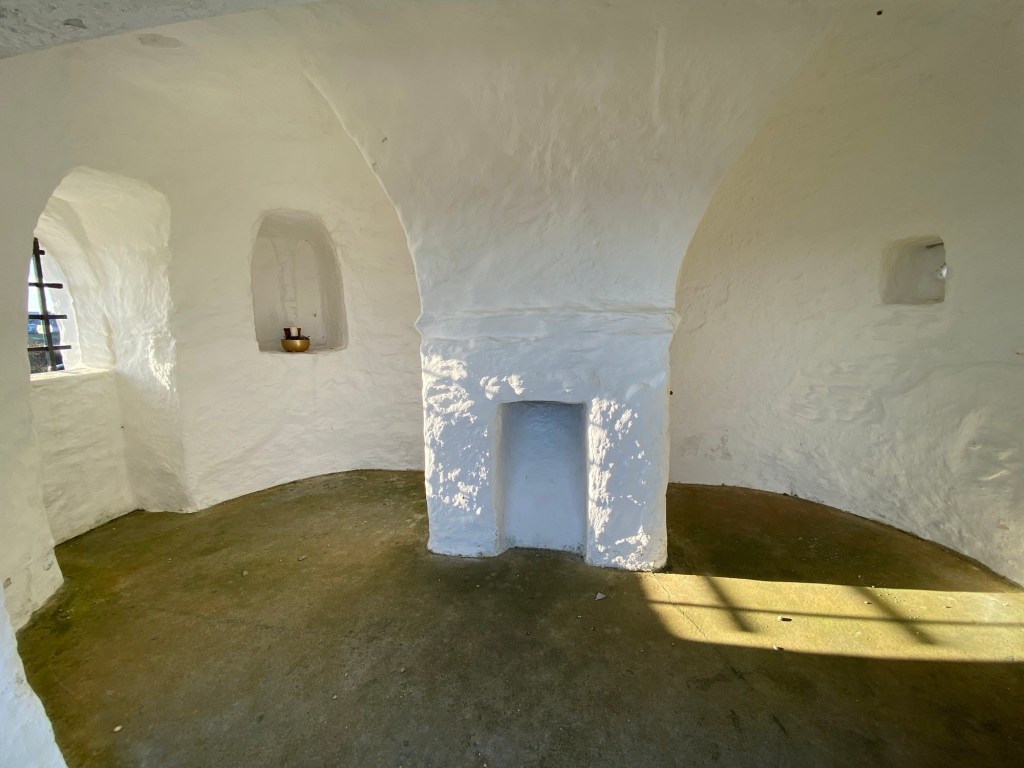
Here I am still staring at the sunbeams that lance downwards onto patches of Towan Head, the small finger of land that points out to sea west of Newquay, the green of the land brighter inside those shafts of light. I think back to Newquay and the empty road train rumbling along the High Street, the wonderful white washed huer’s hut gleaming in the autumn sun and my funny little sleeping pod inland at Newlyn East. On the coast path you can see your past, in this case lit up like a spotlight onto a stage as if a divine hand is making me aware of what came before and appreciate what I’ve seen. It’s been like this all the way round, looking back and trying to remember what had come before and where. Is it going to be 10 years next year since I started it? Can that be right? Or was it 2016? I can’t remember and it doesn’t matter.
I’m brought out of my reverie by dark figures walking menacingly along the cliff edge. There are four or five huge black birds with thick necks and large bills swaggering self consciously, their bodies leaning from side to side with each step they take, Putin-like. They are ravens, the largest of the crow family.
Not long ago I was listening to Radio 4’s series of 2 minute guides to birdsong ‘Tweet of the Day’ (surely one of the finest pieces of radio broacasting anywhere ever). This particular one was about ravens and narrated by Sir David Attenborough. Attenborough made a play on William Blake’s immortal line from Jerusalem by referring to them as having ‘dark satanic bills’. He also said you might see them on a beach eyeing you up as potential prey! I have to admit that seeing them close up like this, with their imposing size and beady eyes, did make my stomach give a little lurch.
At Park Head a family of four look thoughtfully out to sea. The daughter, who looked about 12, said in that curious way of teenagers: ‘What’s it called when two people..?’
The parents say seriously: ‘Bigamy. It’s illegal.’
The mother emphasising ‘Very much illegal’.
I pass them with a smile and set my gaze on Park Head.
Park Head is a great flat expanse of short grass that tapers down to a sharp hooked point that looks north west into the Atlantic across thousands of sea miles towards I imagine somewhere like Nova Scotia or some other such chilly place in North America. The earth here is so flat and comfortable underfoot and the view so striking that I sit down on the cliff edge like a teenager on a school field. From this angle I can now see small islands to the west of Towan Head: they are known as The Goose and The Chick. Although they appear to be next to each other they are at least a mile apart. The Chick sits south west of The Goose off the end of Kelsey Head near Holywell Beach where I slept outside the night the Aurora arrived unexpectedly in the sky over Cornwall and stunned people all over southern England with its dreamy, hazy colours. That was May.
Much closer to me but across Mackerel Cove sheep lie nonchalantly on the cliff top, their heads facing away from the sea. Do they have good awareness of being too close to the edge? Or are there quite often sheep casualties on the Cornish cliffs? It definitely seems that some are happy to take the risk.
Sheep near Park Head
Walking away from Park Head I see a bird that looks like an oversized blackbird with a longer curved beak. An orange beak. No, more like pink. No red. And the penny drops. And there is another and another. Then two more appear. Choughs again, and five of them this time. Once again a meeting with that elusive emblem of Cornwall. The only time I’ve spotted them on all my wanderings around the perimeter of Cornwall has been in this corner of the county, between here and Holywell. They mill about seemingly unperturbed by me, pecking away with those flashy beaks before flying away to Park Head.
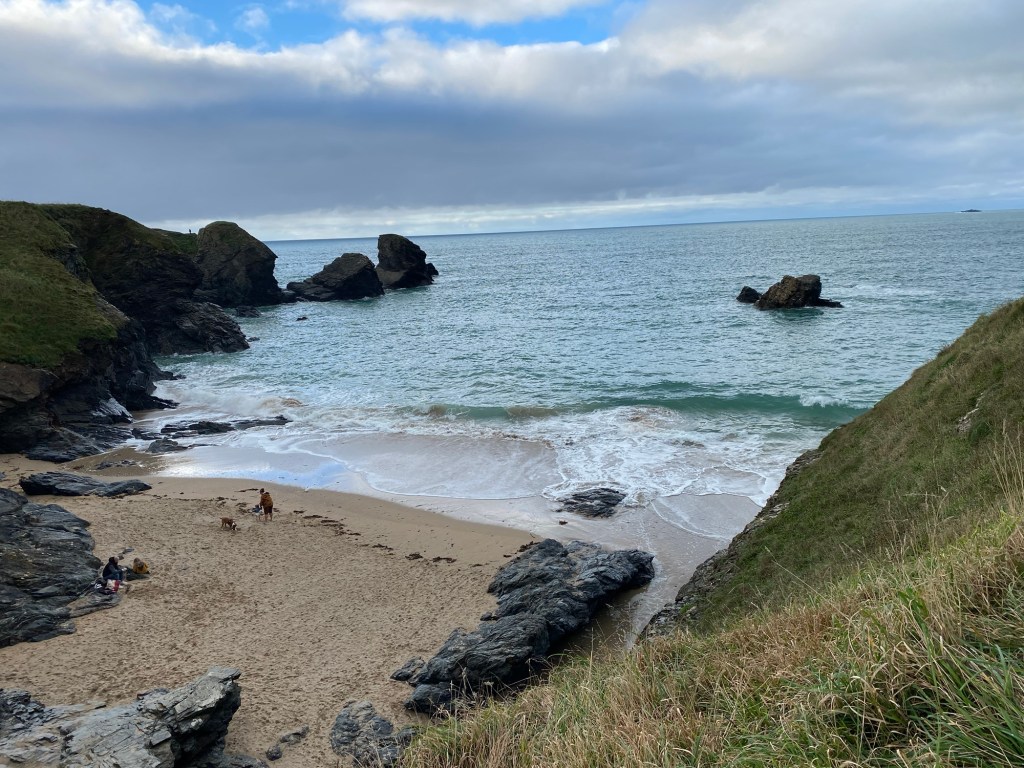
At Porthcothan I have a slight sense of trepidation before going into the sea from the small beach. The sign warns of strong currents but the water is too blue, too alluring, tempting me in like the mermaid of Zennor seducing young Mathey Trewala so that he left his earthly home and went to live with her under the waves. Or so the Cornish story goes. Maybe like him I’ll disappear into that watery world and never been seen on dry land again. The waves slide and collide sideways into each other and I bob about without thought just feeling the coldness of the water stinging my legs, my eyes wide open staring out to sea and my breath like the sound of the waves on the sand behind me. I’m totally ‘absent’. And at last – for the first time today – the sun appears and lights up Trevose Head with its white lighthouse.
When I come out smiling inanely like a madman, I’ve totally lost track of time. It’s a dash to get changed, hopping about to get into jeans, getting sand out of toes, struggling to pull socks on and into my boots. It’s a turbo walk to get to the village and finally at the end of a sand track between thick hedges I suddenly spill out onto the road. I get to the bus with 2 minutes to spare.
Up to see Jane, me squelching and slipping up the path between the tennis courts. Danni is there making tea and coffee for us.
I wait in the kitchen while I hear the buzz of her stairlift as she comes down the stairs. She is now 94. Before Christmas she told mum she really felt her age and she was getting fed up.
When I told her that I was walking lots and writing a book about it she said ‘He who walks alone walks the farthest’ which I took figuratively to mean he who walks alone discovers the most. It’ll do well as a blessing for the book.
We talked about the farm and she told me how busy it always was. ‘There were always people in the kitchen’ she told me. Not workers but tradespeople or those commercially connected to the farm. She told me about two brothers who came from New Zealand every year to help shear the sheep. One of them carried on doing it even though he was allergic to the lanolin, the waxy substance that comes from sheep’s wool. He eventually died relatively young, she thought as a result. There was also the haymaking and the netting of elvers (when they still existed in numbers), all the nets hung up to dry in the old barn at Bowden’s Farm, where Richard now lives.
As she talked sometimes it seemed a struggle and she forced the words out sometimes with her eyes closed as she cast her mind back through the years. And I felt bad for asking. Normally I stay til Danni comes back at 12.30 to make her lunch but after I’d gone to the loo about 12 I got back and Jane was asleep and I told her I’d leave. I wonder if she’s coming to the end of her own epic journey.
I sleep soundly in my little cabin near Newlyn East until I am shaken awake at 4.30 by a cockerel crowing about 2 metres from my head. It’s still raining, the pattering constant on the leaves in the trees surrounding me.
I find the breakfast room, a small whitewashed barn – or probably an old dairy – with old surfboards resting on the rafters and an aquarium bubbling away in the corner. One end of the room is a kitchen and there are plastic tubs of cereal, a kettle and a fridge for guests to make their own breakfast. Bits of printed A4 are stuck up around the place. One tells of how a local film was shot here called The Chocolate Club. Another tells the local story of St Newlina.
Apparently she was a local girl betrothed to a nobleman but refused to marry him as she was ‘pious and god fearing’. Apparently he flew into a rage and struck her head off. The story goes that where her head fell a spring appeared. ‘It was said he beheaded her a quarter of a mile due south of St Newlyn East. The sacred spring at Penhallow House is believed to be the exact spot where she was most brutally murdered and its waters are said to have healing properties as well as magical abilities for nourishing, wellness and fertility.’ The church in the village was rededicated in 1259 and since has been known as St Newlina.
A wren comes in briefly to watch me having my breakfast before flitting off. A superstitious person might suggest the wren is my spirit guide. One appeared beside me on the path yesterday just as I joined it above the Watergate Bay Hotel. It seems everywhere I go there he is – the wren – landing close by, twitching, turning, watching before flying away, his short, sharp squeak emanating from some hidden place.
I arrive at the small village of Trevarrian to pick up from where I left off yesterday. I wait in the car thinking of nothing until a shower rains itself out.
On the way across a field to the path campions shiver under a hedge, their pink star-shaped flowers shiny with rainwater.
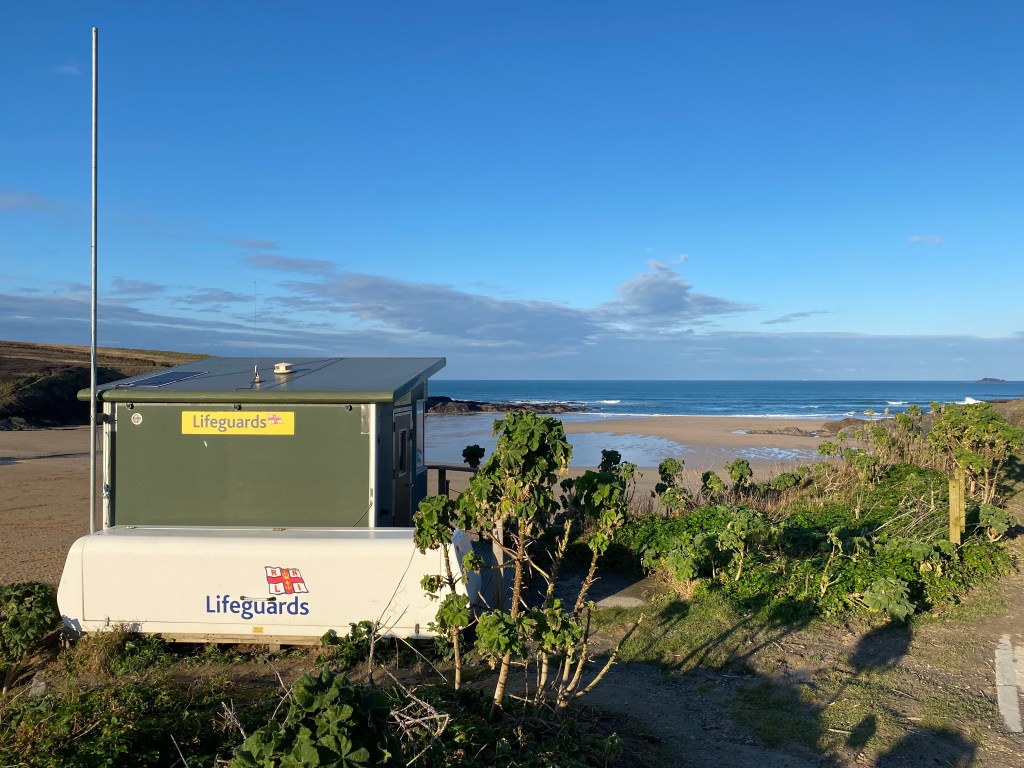
Less than half an hour later I’ve gone round Berryl’s Point and am looking down at Mawgan Porth. When I stop on the side of the cliff it seems I am surrounded by typical sights and sounds of the Cornish coast. A small blue fishing boat out at sea heaves from side to side, the pink bubbles of its buoys visible on its stern. Below there are distant screams of children in the sea – half excited, half alarmed – barking dogs and the indistinct burble of a tannoy on the back of a white RNLI pick up in the middle of the beach. A mass of beginner surfers with multi-coloured boards stand in the surf while 4 more experienced guys are taking waves from a break that starts from a large rock at the south end of the cove below me.
Light seems to be gathering strength in the sky and the wetness of the path starts to turn a pale blue as I descend.
The beach is thronging with half term activity. Dogs hurtle to and fro doing that most doggy of pastimes: chasing sticks. At the back of the beach a family sit quietly on deckchairs in front of a purple tent that declares ‘Trespass’. Good advice that. A boy and a girl are both stuck into books while an elder boy at the front eats a roll and looks out to sea. A mother sits amongst them drinking coffee from a Thermos mug. They all look to be lost in their own thoughts. A fourth child in a yellow beanie and grey hoody is building an enormous sand dam that curves in an elongated C around the front of the family as if protecting them from some imaginary incoming tide or tsunami. And not a mini screen in sight.
Near Pendarves Point there is an old wall that must have once been a drystone wall, the stones arranged in a herringbone pattern but built into earth so that great bulbous lumps of grass or moss have grown all over it. It is a living wall. To me it now appears more like a rampart around an ancient field closure. There is something comic about its ‘blobbiness’ but I suppose it still does the same job but without the need for repair. It gets me thinking about how human intervention in a landscape can combine with nature to produce positive outcomes.
Earth and drystone wall, near Pendarves Point
A few weeks ago I went to hear the nature writer John Lewis-Stempel give a talk in Taunton about his new book ‘England: A Natural History’. He gave examples of how management of the land in England has resulted in some of the most interesting biodiversity in the world. He gave the example of deer parks which were introduced by the Normans and reached their ‘heyday’ in 1350 when it was estimated there were between two to three thousand in England, equivalent to 2% of England’s land surface.
The greatest achievements of deer parks is to preserve our ancient oak trees. Apparently we have more ancient oaks than any other country in Europe and Lewis-Stempel points out that ‘35% of all oaks in England with a girth greater than 19 feet are associated with medieval deer parks’. He also emphasises their importance to biodiversity saying ‘Such old oaks are universes in themselves, abodes to more than 1,000 species of fauna and flora’ and as such uses this to warn against the popular recent trend of rewilding. These oaks wouldn’t survive as long or grow to the same extent when they grow in woods or forests. It is thanks to the management of the land that they have been able to prosper.
Pendarves Point with Newquay in the background
Above Pendarves Point I reach one of those rare moments where the walking has become so light that I can hardly feel the ground. Away to the west sunbeams angle down onto Towan Head and Newquay lighting it up like it’s on the stage of the sea as if to say ‘Now you’ve gone, don’t forget me.’ And the wind seems to breathe with me. In me. I start humming that Nick Cave song, ‘Jubilee Street’. What does he sing as the guitars get heavier and heavier at the end?
‘I’m transforming, I’m vibrating, I’m glowing I’m flying, look at me now I’m flying, look at me now’
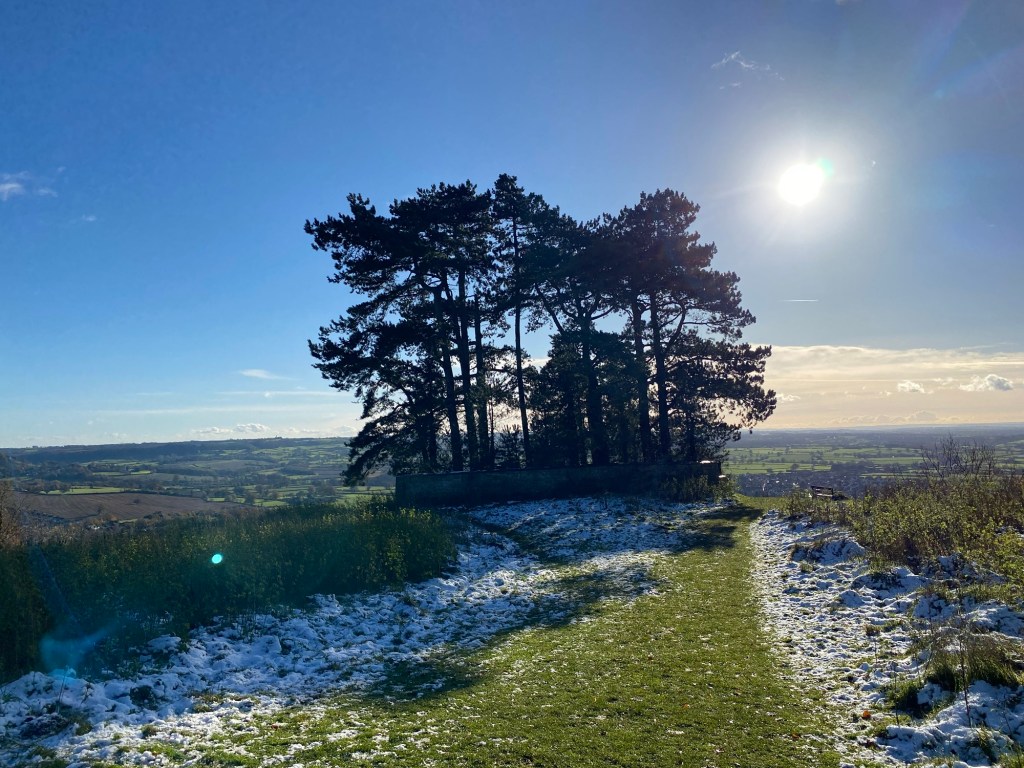
A walled clump of pine trees stands sentinel above Wotton-under-Edge. They make an undulating rushing sound like the wind itself their needles quivering in the cold air. All around their base on the east side away from the sun snow has gathered itself into drifts. The first Arctic weather has arrived for the winter and now we remember what the cold is really like.
The copse of pines look out from Wotton Hill across a flat plain towards the Bristol Channel. The Severn Bridge is visible, its white H shaped uprights silhouettes against the pale blue of the horizon. To the west mountains are cloaked in snow. The Black Mountains? I guess so. Just for today transformed into the white mountains. As I set off a man was having a sandwich in a fiat panda listening to BBC Wales in Welsh, a reminder of how close we are to the border.
Nov 27th
It’s another freezing day. No snow but a biting wind as I set off exactly a week later from when I set off last time. Since then TTT and farewell to Glemham. I climb a steep path and then road up Blackquarries Hill. A hollowed out pumpkin cut in half and so bright and real compared to the leaf litter that has been one it’s bed. at the top the sun comes up and I say hello to a man who walks his dog and says nothing in return. His loss. Or his hearing loss?
Looking north imagining the way I have come I’m greeted by the strange sight of a plane seemingly motionless in the sky like a mobile above a child’s bed or a hover fly. I look at it – entranced – for almost a minute listening to its roar. When I shift my gaze I notice great banks of cloud pushing from the north creating the optical illusion of the plane not moving. It is the background that is in flux rather than the one object of my focus. It reminds me of being 4 or 5 years old in the thatched cottage I grew up in lying on the grass and looking at the roof of the cottage seeingly falling over under the moving clouds that pass overhead.
Long Barrow. View across to dark band of pine forest. And out of a row of fir spikes the slightly taller spike of Tyndale monument. How long ago? Two weeks?b
Water logged fields storm Bert. Trees down. Flooding
The papers have been reporting that there has been only two hours of sun in the last two weeks across the UK. I have just accepted it as the changing of the seasons but today there is sunshine, but also a cold wind like a harbinger for the long winter ahead. I think back to how I had to order a fresh load of wood in the last week of April days before the traditional celebration of the start of summer. We all couldn’t believe how cold it was.
Why do some trees shed their leaves quicker than others? At Maytree House the ash at the entrance is totally bare while the young oak behind it is still completely full and filters the sun through its green and orange coat.
I went to hear John Lewis-Stempel give a talk recently in Taunton about his new book ‘England, A Natural History’. He said a funny thing, that the only thing that smells good when it is dying is leaf litter. And he’s right. It has a lovely fermenting sweetness like apples.
The old grass tennis court on the way to Windmill Cottage has abeen mowed but the net has gone. Perhaps it has finally taken retirement from its many years of hosting summer games. It’s where my grandfather used to play in the 1950s. My mum can remember him going off to play in white trousers and she could hear them playing through the trees on summer evenings after she’d gone to bed. I remember the white Slazenger balls still in their cardboard boxes when I used to explore the larder at Rose Cottage as a boy.
The top field is now ploughed and flattened. There are many stones resting in the earth. I remember Jane saying how these two fields aren’t the best for growing. Ronnie Blythe in ‘Akenfield’ wrote how before the war villagers in Suffolk would be paid to go and collect the stones off the fields. The trees that line the field are releasing leaves in a constant stream. They float down around me softly in the same manner as snow flakes and rest on the grass border that Henry – kindly – likes to leave on the edge of all his fields. It creates patches of camouflaged grass. Later in bed I read Ronnie’s ‘Next to Nature’, published for his hundredth birthday only months before he died. He writes this about leaves in November:
‘How golden bright it is outside where the lime leaves fall in their millions – well countlessly anyway..The air will be delicious, a kind of dying freshness whuich is full of movement and colour.’
An anxious looking woman appears with a very excited dog with a tennis ball in its mouth. It is a bouncing, brown mass of whiskery happiness. In stark contrast she is fretting. ‘No. No. Don’t do that. Come here. No. Come on. No. Sorry. Sorry,’ as she reaches down to grab its collar. I tell her not to worry.
I meet lots of people like this. Not in total control of their dogs and often seemingly anxious about people’s response to them. Many people I now see will stop as soon as they see me and put their dog on a lead til they are past me. I don’t know if it says something about the dogs, the owners or how people without dogs may respond to them. A lot of people would blame it – like many other things – on the ‘pandemic’.
Often there are Lynx helicopters here from Yeovilton airbase that buzz and whir overhead here doing their exercises but thankfully today it is quiet. As I look across the moors in the Isle Valley towards Isle Brewers and the Blackdown Hills beyond there is only the recycling lorry slowly trundling up Holman’s Way with only the top foot of it visible above the hedgerows declaring its message:
There is a sheen on the road leading down Tregurrian Hill from my car towards Watergate Bay. It’s nearing 4 O’Clock but instinctively I can feel the day is nearing its end. It’s the mental adjustment we all make in the days after the clocks have gone back each year (it was last weekend). We are settling into winter awareness. Setting out on a coastal walk at this time of day I have that sense of doing something slightly subversive, going against the grain, doing something which others are not. I get tingles just thinking about it.
I round a corner and the land falls away to the gun metal grey of the sea. I suddenly realise that for the whole three hour drive I’ve been anticipating this moment. Like arriving at the sea when we were children. Can you see it yet? There. There it is.
There was steady drizzle most of the way on the A30 but now a patch of blue sky has appeared above the sea while a group of beginner surfers in yellow rash vests stand in the surf in front of the Watergate Bay Hotel. As I climb the path from the road through the cabins that are part of the hotel there is the welcoming roar of the Atlantic, a sound that I have got to know well especially along this cliff-edged section of North Cornwall.
I think back, as always, to when I was last here. What I did. What has happened since. May 11th was the last proper stint I did from St Agnes Head to Crantock, that crazy bank holiday with the summer weather, the wonderful church with the man in the stocks and the epic aurora that everyone was talking about that I miraculously managed to miss!
However, I did come back on October 1st to do a small section from Crantock to Newquay. I stayed at a hotel overlooking Fistral Beach and arrived in Newquay via the golf course at Towan Head.
Overlooking the three town beaches that face north west from the town, I passed a whitewashed huer’s hut that stares out to sea. Its basic stone structure against the blue of the sky immediately reminded me of the white stone chapels that are dotted all over the Greek Islands. A plaque at its base revealed it is 14th century and was probably a hermitage before it was a huer’s hut, the person being ‘entrusted with the lighting of the beacon fire for the guidance of shipping.’
As for its later use the plaque tells how the building was ‘used as a lookout by a huer at the time of year when shoals of pilchards were expected in the bay. A call on his horn raised the hue and cry alerting the townsfolk to the arrival of the fish. By means of hand signals the huer enabled the fishermen to position their boats and encircle the shoals with their nets.’
There was something lovely about the simplicity of the building but also how it seemed visually – as well as historically – connected to the land and sea scapes around it. I walked around it several times looking at the sunlight creating shadows on the spartan interior, imagining the sounds of the huer’s horn and the vast dark shadows that would regularly appear in the blue waters of Cornwall and provided many Cornish folk with their livelihoods for most of the 18th and 19th century.
Huer’s hut, Newquay
The centre of Newquay felt like what it was: out of season. A blue and yellow road train came steaming up the high street with four carriages, all of them empty apart from one man sitting in the last one staring blankly out of the window with a microphone in his hand. Starlings on the shop roofs were making an incredibly loud whistling, the sound bending up at the end of the phrase like a wolf whistle but with a greater range. It seemed to be amplified by the narrowness of the high street. A man with a sheepskin jacket and beanie read his paper outside Cafe Nero. A bit further up the street another man sat cross legged asking passers by for money.
It seemed far removed from the hardcore tourism and partying that Newquay is known for throughout the summer months.
I’m shaken out of my memories by a sharp movement out of the corner of my eye. And I’m back on the clifftop above the Watergate Bay Hotel. A wren is flitting about in thorns on top of the cliff looking at me. They seem so busy, wrens, forever restless, like there is forever something they need to be getting on with. And it’s a reminder for me to busy myself on the path before the dying of the light.
Curtains of spray drift slowly up a cleft in one of the the cliffs like enormous ghosts. There are silvery patches on the sea where light has found a way through the cloud cover onto the sea’s surface.
The palest blush of pink has appeared a long way out there – who knows where – above the line of the horizon. Apart from the little wren I haven’t seen a living thing. There is only the wind and the roaring constant of the sea below me.
Griffin’s point is a mile north of the Watergate Bay Hotel between Stem Cove and Beacon Cove. I pass over a small wooden footbridge with a stream passing below it heading east to west, right to left. It winds its way through long grasses and then suddenly empties over the rocks into the sea.
The light is quickly fading. It’s not even 5 yet. It’s taken me by surprise and I decide to head back via Trevarrian passing a caravan site and a football pitch shrouded in mist.
Tonight I’ve booked a stay on a farm in Newlyn East. It’s glamping, something I’ve never done before unless I count my own trips using an old bell tent. It sounds fun. I arrive bumping down a long, pot holed track in darkness and pouring rain. The track finally ends in a farmyard with a big farmhouse beyond and off to the right down a path is a clearing amongst some trees with two painted, wooden huts – the owners call them pods – and a chicken coop next door.
My pod, known as Fistral after the famous surfing beach which I walked past a few weeks ago, is cosy and warm with just enough room for a double bed, a desk and a fridge. It is decorated with the sort of things I suppose people expect from glamping sites: striped bunting hanging from the roof that wafts spookily as a result of the heater, white enamel mugs hanging on a rail and many cushions in floral patterns. On a wet night in October it’s a perfect cheap option in an area which is normally expensive at the best of times.
Back in the farmyard there is a low building of whitewashed stone with an old stable door.Inside it has been made into a breakfast room where I – and any other guests if there are any – can help ourselves to tea, toast and cereal.
I have that lovely sense of coming into a little building after a long time in the dark, the feeling of having to get used to the light and the warmth, everything a bit blurry.
Feeling curious about my night in my shed I tramp through wet grass and dripping tree trunks ready for bed and my thoughts looking ahead to the path tomorrow.
Back at the cottage after a fantastic two days in Snowdonia as a belated 50th birthday present.
Perhaps in a cliche of other middle aged men around the world focusing on their health I have become a ‘hoffer’, a follower of Wim Hof and his breathing method and crazy cold water treatments.
I’ve always been into swimming but last week there I was suddenly launching myself into glacial Welsh lakes and sitting there surrounded by forests and mountains looking like I was watching the news.
It might sound bonkers but, God, does it feel good.
Thus on my return to Somerset yesterday on one of those dark, dank evenings that remind us what English wintertime is capable of I left C watching Paddington 2 and set off in shorts and flip flops to go to my summer swimming spot at Muchelney.
Parking at the bridge something seemed amiss.
Under the bridge there were the wooden posts that lead to the river pontoon that had been funded by EU money back in the day. Aside from the posts a muddy gash beside the river and then nothing but the grey water of the river.
A man with a beanie, a walking stick and a football team app on his phone told me they get taken out for the winter.
‘They come out at the end of october and then they put them back in May.’
‘Last year when the water rose it started to buckle the metal poles that hold the pontoon in place. The one at Langport is also out for the winter.’
It makes sense. Besides what fool would want to be using the river in winter anyway?
I’m now committed though so onwards to the slipway at Black Bridge in Langport.
There I found a few cars in the car park, a man fishing with an old fashioned reel and a white van at the top of the slipway. A young girl was sitting in the passenger seat.
The man at the back was tall with restless eye and demeanour. He was called Dave. He had bought a tiny rowing boat ‘after a few pints in the pub for £100’. He shows me in the back of his van. He also had bought an outboard for £45. His daughter probably aged about 8 has appeared beside us and is looking a bit pouty.
‘We almost sunk’, she tells me. And he says nothing. Was that half an eye roll behind his back as he explains his enthusiasm for his boat? I wonder if she learned that from her mum.
‘Are you going for a swim?’
‘Yep’.
So they watch me and we chat about young people who are causing a problem at the east end of Langport and he tells me his wife was at school I used to work in although I can’t remember her name and the daughter looks on amusedly now and asks the obvious question.
‘Is it cold?’
On the way back I start thinking about the myriad possibilities of cold water dipping in Somerset, a place which has always been smothered with water. A place where as Roger Deakin put it everywhere seems to have a watery name such as Frog Lane and Water Street. And I feel like Deakin as he starts getting into the idea of his watery mission (in ‘Waterlog’) to swim across the British Isles by poring over maps and looking at the abundance of water.
Well I could say the same for me as I start picking out potential spots close to me now the pontoons have been taken out. Oath Weir. The Sowy at Oath. Under the bridge at Langport. Pibsbury Weir. The Hambridge Mill stream (where my mum used to swim as a little girl). the River Isle at Hambridge. I have the same childlike excitement I used to have when I asked my grandfather for detailed maps of the Somerset moors when I was a child to plan my fishing jaunts.
Although now it is me who is the fish wanting to be immersed in the cold, ancient waters of The Levels.
Beautiful chilly day. 11 of us to have English heritage tour around the stone circle. Sun is still strong and scores of swallows swoop above stubbly fields while jets start their descent to Briz.
Great black drums glint in the autumn sun at Norton Malreeward and heat haze above the grass makes the houses behind it shudder slightly like I’m looking at them through a riffling stream. Beyond the pale brown of fields and the lush green slopes of the Mendips.
Join three peaks way. Mast off to the south west over Wells where I used to work. Reminder of burn out. Breathe out in relief.
Cross a bridge and as I get closer to the circle pass the first people. A man in a singlet and cap sits in the middle of meadow with his hands in a backpack next to him. Another man with a grey ponytail walks slowly looking into the water of the river.
‘Big BPM crew’ sticker stick on one of the footpath signs.
All those in the group I would say fit into the same demographic. Couples. Over 60. Most have been to Avebury and Stone Henge, the rock stars of ancient sites and both conveniently situated an hour from here.
I ask one man if he is an ancient site regular. ‘I’ve been to a few’ and after a pause ‘but I’m not a Druid’ perhaps because of his long flowing white hair and earring.
We are pilgrims of sorts – people drawn to places by an interest in the past and looking for a connection with the past.
Our guide tells us ‘People were gathering together in communities doing whatever they were doing.’
And what were they doing? Travelling and gathering at a special place. Pilgrimage.
The guide talks about there being a lot of people coming here on the solstices. ‘There was a coven from Spain and people with sound bowls and bells and crystals’
One man points out ‘this circle here lines up with the one there for the lunar standstill. The lunar one only comes about once every 23 years’ the moon wavers from side and side and reaches the furthest northwards’
Our guide says that some of the stones sparkle when the sunlight catches it. Is it quartz.
In the middle of the main circle someone has created a circle of yellow and red flower petals. There are pale pink crystals in the grass inside the circle.
A perfect Autumn day. The first of the year. Rain water on the blue lias wall outside the cottage. The last of the pink roses droop over it reaching almost into the way of anyone who might walk past. The flower heads nod deliberately and have drops of moisture that catch the light. Everything is still green and we’re thankful for how full of life the near world seems.
White cyclamens crowd outside Wiltown cottage.
Old Father Time stands solidly above the red post box on the barn as he has for as long as o can remember. His face is a bit vague and his scythe and hour glass are peeling and most unfortunate of all he has lichen growing in his groyne area. Marked by the passage of time. He needs a bit of sprucing up.
On Furlong Lane the only sound is the whispering of leaves. The first are falling onto the tarmac. The horse chestnut is already brown. This is where Dad asked mum to marry him. Was it Autumn? I think so. It would have been 1968.
Under the pines with their low hushing sound as the wind blows through its branches. It could be the sound of the sea from a cliff top.
The striped fields between here and Burrow Hill are mostly brown now. Ploughed. With one band of bright green in the middle distance. In May those stripes are bright yellow when the rake seed are in flower and sometimes a pale blue when it is linseed that is being farmed.
Jane’s daughter pulls into her drive up from Devon. I wonder how she, Jane, is doing. 94 and still completely mentally together.
Always the sound of water rushing next to Holden’s Way as it descends the hill. And still reminders of the summer: a bee buzzes past noisily, a cabbage white flutters its way frantically over the hedge. A minute ago a hornet veering to and fro amongst the branches of the pines.
My mind keeps turning to a pitch or a lesson I need to do or a stress from last week but I bring it back to this place, this moment, this light, this sound.
A panel of St Abraham’s Offering, St Carantoc Church, Crantock
I’m still cursing myself for missing last night’s freak aurora as I look down onto Crantock Beach.
In my experience of walking the coast path in Cornwall it seems to be typical to have protracted periods of time alone with the path, the sea, the sky and then rare occasions when I’m suddenly thrown into the melee of Cornwall in peak holiday time mode. It’s true that it’s not the summer holidays but the sudden burst of summer sun has transformed the weekend into what appears to be an August bank holiday.
Love it.
The path winds its way along the western edge of Crantock beach, dips between high hedges and then spills out into a packed car park. Two girls with red National Trust T shirts and walkie talkies talk to each other from different ends of the car park looking perplexed. As I head up the lane into the village I count 20 cars queueing.
After a cold pint of Korev at The Old Albion Inn I wander past a great big man strimming between the graves and into the coolness of The Church of St Carantoc.
Named after a Celtic saint who apparently had a small oratory on the site of the church, St Carantoc has a fantastic rood screen with fine carving. A quote from the church history says of the church ‘The principal beauty is its very rich High Church fittings, dated mainly from 1897-1907. They include a splendid screen with coving, loft and rood, which incorporates a few medieval parts..The pews have good carved ends in the late medieval manner. The largely renewed roofs have fine colouring above the rood and the sanctuary.’
Rood screen, St Carantoc
These are treasures indeed but the best carving of all – for me – lies hidden around the back of the church.
Here under a purpose built shelter sits the original village stocks and behind it a panel which tells a story that could probably only come from Cornwall.
It tells the story of the last man to be placed in the stocks, William Tinney, ‘a smuggler’s son and vagabond’ from West Pentire who was placed in them within the church tower in 1817 for a brutal crime where he apparently ‘robbed with violence a widow woman of Cubert Parish’. That is not all though. The story develops into something worthy of a James Bond-esque blockbuster. The panel continues ‘By negligence or design he was insufficiently secured and shortly afterwards appeared on the top of the tower. He had cut the rope from the tenor bell and by this he lowered himself to the nave roof. Climbing to the eastern gable of the choir and sliding down it he dropped to the churchyard grass and in the sympathetic view of certain village worthies bolted, got off to sea and was never brought to justice or seen in the neighbourhood again.’
A carving of Tinney sitting in the sticks presides over the panel of his story. He has a beautifully carved branch of oak behind him. His arms are folded belligerently, his face staring at the viewer under a cap with a feather while his luxuriant hair curls over his collar and his bare feet poke comically out of the stocks. It’s a cracking yarn and has all the romance of a great prison break story and contains the best ingredient of any story – mystery. For hours afterwards I can’t helping thinking whatever did happen to William Tinney of West Pentire?
Crantock stocks and the story of William Tinney, St Carantoc church, Crantock
Back at Crantock beach a temporary brightly coloured community has settled on the beach. White flesh covered for cold month after cold month is suddenly revealed. Blue, red and yellow windbreaks mark the beach at various points all the way beside Pen Pol creek. The scene looks like it’s been deliberately put together by an artist, not just a scene of random tourists. Dogs bark. Children squeal. Ed Sheeran belts out ‘I’m in love with the shape of you’ and I wonder if anywhere in the world has the Brits’ ability to have a good time when the sun decides to shine.
Crantock Beach
As advised by Paul at the cafe – he who said ‘You must have been sparko!’ when I told him about me sleeping through the northern lights last night – I take a dip in Pen Bol Creek which separates Crantock from Newquay. It is green with a sandy bottom and a few rocks. At low tide there are pools which are 6 feet and it’s perfect for wallowing in. I am a hippo relaxing. On one side thick trees cover the hillside their leaves sparkling, whooshing and swaying in the wind. On the other a variety of grand houses – some Victorian, others modern – look across the creek.
I lose myself in a heady mix of warm wind, sparkling waves, the rushing of leaves. It is like a waking dream.
Pen Bol Creek
It’s time to move on, to return to my car which seems like it could be hundreds of miles away and last seen….how long ago?
On the bus two holidaymakers chat to a local man with a lined face, matted hair and beard.
The visitors are sounding incredulous.
‘At Watergate campsite it was £470 for 5 nights for a bit of grass and shower block’, they are saying.
The Cornishman replies: ‘It’s because of Air BnB. A lot of people here are jumping on that bandwagon’.
I leave the bus at Perranporth and walk back to the relative wilds of St Agnes Head where my car waits alone on the cliff top. Before I get to it I hear a cuckoo nearby and calling its two note song over and over. It’s so clear it sounds electronic. I look at the two islands of Man and his Man and further south in the distance there is a beautiful white dome half lit in the sun like a half moon. It is the radar tower I passed at Nancekuke Common at the start of the year. I pause, taking in the scene, trying to hold onto it knowing it’ll slip away soon and then unlock the car door.
It’s 8.30am when I arrive at the Holywell Beach Cafe. A tall couple from Holland are seated on the bench outside smiling, chattering and looking about – the telltale signs of those excited to explore a new place. A young woman with dark hair dressed in white is calmly getting things ready behind the counter while her son, probably 4, sits at a table eating a bowl of cereal and talking to her in that direct, inquisitive way of students with a certain way of thinking that I’ve known in schools.
Although they’re not properly open yet she says she can make me some breakfast. I enjoy the simple pleasure of a cushioned chair and a cold glass of water as I watch the comings and goings of the cafe waking up. The coffee machine being prepared, another girl with tattoos arrives to start a shift and a lorry delivering fruit and veg has pulled up outside.
The delivery driver comes in and starts speaking to the girl in white.
‘Did you see the lights?’
‘They were amazing – I saw them with my mum and dad’.
I can’t work out what they’re on about – sounds like a UFO sighting.
It’s only when I go up to pay that she shows me. Scrolling left on her phone I can tell it’s the sky but transformed into otherworldly colours. Many of them show the sky a psychedelic purple like an alt rock album cover from the 1960s. There is the distinctive wavy effect like swirling liquid or vapour that I recognise of photos I’ve seen of the Northern Lights.
But these are hundreds of miles south than where they normally appear. The following week while talking about it in Somerset – like everyone seems to be – they say ‘It’s probably global warming’ but it’s not that at all. There are just greater storms occurring on the sun than usual sending huge eruptions that then interfere with particles in the atmosphere to create these incredible displays of colour.
And I missed it.
What better place to have witnessed a once in a lifetime view of the aurora than camping out on a cliff top in a bivvy bag with a view for miles and miles and a clear, unpolluted view of the sky. And for once in my life I was asleep by 10.30 and woke up at first light. Oh dear.
As I pack up to leave the cafe, Paul, the owner, comes out wearing an apron. He asks me what I’m doing and when I tell him doing the path he nods with approval and says he keeps meaning to do it.
When we get onto ‘the lights’ as everyone is calling them he cracks a rye smile and says in a Cornish accent:
‘Bloody ‘ell, you must have been sparko!’
Above Porth Joke ewes and their lambs munch grass determinedly a few feet from the cliff top and a rope placed to guard against people getting too close to the edge has become like a reclining seat/cum massage chair where they like to rub their backs. I watch one of the older lambs rubbing its rump back and forth making the rope bounce up and down. As a result the rope has what look like woolly hand holds all the way along it like you might get in a rope to help you climb down a cliff.
Cliff top rope near Porth Joke
Porth Joke is one of those picture perfect coves that you might only come across when walking. Sapphire sea. Yelllow flags. Little hidden coves around its edges where you can sunbathe or just sit and reflect. And nothing else. Just a camp site hidden away up the valley.
Bluebells, buttercups and campions make a beautiful range of blues, yellows and pinks amongst the grass.
I meet another wave of path walkers on this stretch, most of them women. A couple of Aussies from Perth ask me about crossing the Pen Bol Creek from Crantock to Newquay which can only be done at a crossing that appears at low tide. I apologise and say I don’t know. A Spanish girl in full Lycra walking kit. And another woman in her twenties with the laminated map and backpack that indicate she’s doing the whole path – all 630 miles – probably in one go. I’m always full of admiration for these people who want to take up the challenge. It’s a great achievement and not one I could complete without a great deal of training.
I wake to the feeling of cool air on my face, feeling the dawn before I see it. It always takes me back to camping trips as a boy – that initial strangeness of waking up OUTDOORS, as exciting as the feeling of waking up in a new country.
I sit up in my sleeping bag and let the sea air slowly bring me round. My breathing is slow, my mind blank. I want to prolong my dream state, reaching back to dredge up the strange images that were thrown onto the screen of my nighttime mind, dreams somehow always more vivid when sleeping out. Now I can’t remember what was going on, just that I was travelling somewhere.
I am in a small, narrow bowl in the land, granite and tussocky grass rising up behind me. After an hour of looking in the fading light last night it was the most sheltered spot I could find. In front of me there is as good a view as any beachside villa. Leading in a line at roughly 1 o’clock west from me where I sit the path threads its way to the end of Ligger Point. Ahead the sea is a dark blue until it meets a zone of haze where it merges with the pale blue of the sky. To my left Perran Beach stretches about 3 miles south towards Perranporth where a few lights still blink in the half light.
Sleeping spot, Ligger Point
I have woken up to lines. Below me dark creases in the sea emerge a few hundred metres out and then break into creamy white lines. Similar lines form, break and thin out all the way back to Perranporth. There are also lines above – a huge X has been painted on the blue canvas of the sky, the vapour trails of planes flying from the west silently marking their passage with their wakes. Where have they come from? The Americas? It must be as there is nothing else west of here.
My bivvy bag is wet and covered with little yellow snails drawn by the moisture at night. Once I’ve done my best of brushing off the snails I am quick to get packed (I’m dressed already).
A long distance runner with a baseball cap and arms covered with tattoos appears from nowhere. He has a double take when he sees me, no doubt looking a bit early morningish.
‘Morning’ he says between breaths then adds ‘You all right?’
‘Yes, thank you’.
I smile at the camaraderie shared fleetingly on the path.
My mind is cast back to yesterday. Perranporth was in full summertime swing like it was mid August. The weather was unseasonably warm – well into the twenties – and people had gone berserk. The beach was heaving. Wind breaks. Romping dogs. Ice creams. Barbecues. Music. People would run into the sea (me included) only to remember it’s early May and realise the water temperature is still in the teens. Minutes later they’d be running back again shining and glowing and grinning.
The sounds of Perranporth slowly faded away as I padded barefoot up Perran Beach, surfers and the dropping sun my only company. Step after step in the damp sand. Thousands of my footprints fading back into the low mist that was starting to settle over the beach. The sun got lower and started to lose its shape like molten metal and finally dropped below the line of the sea. And then I was alone. It took me another hour to make my way up the steep slopes of Ligger Point, a stiffness starting to creep into the backs of my legs before I found the small scoop in the land.
Sunset, Perran Beach
As I walk along the narrow hulk of Ligger Point I hear the lilting, high-pitched song of a sky lark. There is something immediately uplifting about it. At dusk last night when the light was almost all gone a solitary skylark sang on and on over one of the headlands looking over Perran Beach. I could still hear him 10 minutes after I’d passed singing his intricate melody. When I was feeling a bit panicked about finding a place to sleep it lifted my mood and felt like some company in this otherwise remote spot.
I think of another of Ronnie Blythe’s pieces about the Essex/Suffolk countryside that he wrote about so perfectly for so long: ‘Returning, the larks cover me with their song. Decade after decade, since Edmund or whoever it was, these dizzy birds in the blue air making a singing canopy for the early toilers’. Well today I’m one of those ‘early toilers’ and I think of Ronnie looking down on me from a pastoral other place saying with a smile ‘Yes, that’s right.’
I return to my breathing and think of the many times I alternate between the sounds of my breathing, the ‘breathing’ of the sea as the waves meet the land and the sound of the wind. On the path those sounds are a constant. Before I reached Perranporth yesterday I stood for ages staring at Shag Rock where I could see and hear water sloshing lazily over the rock and see the soft rise and fall of water. Then every few seconds a great blast of spray would be ejected from a hole in the base of the cliff somewhere just out of sight, so similar in sight and sound to the spouting of a whale, that sudden release of air they make when exhaling from their blowhole. I had a strange moment where I envisaged myself walking on the back of the land as if it was some vast and ancient beast.
Water ‘spouting’ near Shag Rock
After Ligger Point I come across the sad, abandoned Nissen huts of Penhale Camp. They are a bleak grey against the morning sky. Windows are boarded up and those that aren’t are often broken. It’s spread over a large area between Ligger Point and Holywell, the size of a big sized village.
Penhale Camp
I notice a developer must have bought up this land and have staked their claim by putting up a sleek sign advertising their name, Cabu. It stands out in stark contrast to the abandoned and broken buildings that surround it.
Later I find an article from Cornwall Live written in 2022 that reveals there has been a battle going on between the developers who want to build a holiday camp and ‘the friends of Penhale’ over 400 people “concerned with the ecology of the site”. There’s some interesting stuff in the article. Apparently the Nissen huts were built in 1943 by the United States Army Corps of Engineers ‘as part of the buildup to Operation Overlord, the D-Day landings’. 23 people were killed here when it was bombed by the Luftwaffe.
The article continues ‘When peering through the broken windows one can see bedside tables and cabinets left abandoned and half broken, while some of the buildings also sports signs warning not to disturb the various species of bats which roost inside.’
Apparently the site is home to all sorts of rare flowers and animals such as bats, barn owls and my new friend, the chough.
Not all of it is abandoned. Behind the fence there are more up to date buildings surrounded by razor wire and CCTV cameras. According to the article ‘these are rumoured to be active listening posts for enemy submarines’.
It all adds to the rather surreal and spooky atmosphere of certain parts of Cornwall.
This isn’t uncommon. My dad always said he found something unsettling about the Cornish landscape. And the writer Tim Hannigan, author of the excellent ‘The Granite Kingdom’ about Cornwall, its identity and its representation throughout history told me that DH Lawrence was intrigued by the landscape near Zennor but Katherine Mansfield was disturbed by it and swore never to return.
As I turn away from the abandoned wartime camp, as if just waiting in the wings for his cue, another chough comes boldly striding along the cliff top next to the path. I can’t believe it. Having been looking for them for years I manage to see 2 less than 24 hours apart. He makes a brief croak while he looks this way and that.The bright red of his beak and legs are striking next to the shiny black of his head and body. It’s the most wonderfully bold matching colour combo and I wish I had a better camera to try and do him justice.
Within minutes of arriving at St Agnes Head I almost step on a chough. I had just got out of my car to look at the sea and there he was strutting around right in front of me looking like he owned the place. As Cornwall’s national bird he probably has good reason to behave like this land is rightfully his and probably has a bigger claim to being Cornish than most people around here. He looks resplendent with his red legs and wonderful red hooked bill. He gives me what I read as a withering look and then proceeds to pick about for food in the heather. I think back to my friend with the sailing cap at Godrevy Head in October shouting ‘Look out for the choughs!’ And think at last I’ve found one.
Suddenly – following months and months of endless rain – a period of freakishly warm weather has descended on the UK. The sudden change threw me. 2 days ago I was lighting a fire in my fleece. And then yesterday I was having to dig around for unfamiliar stuff like sun tan lotion and shorts.
Beside the remote St Agnes Head car park a half naked middle aged man is sunbathing with huge earphones on. He slaps out a beat on his belly while a seagull stands between us staring at me, the odd feather ruffled by the westerly coming off the Atlantic. Two bald men sit in deckchairs eating their lunch. There is nobody else and over us hangs a blue sky, bold and awe inspiring after the days and days of grey. In the distance I can hear a cuckoo: wa-woo-wa-woo wa-woo. At last it feels like summer might be here.
I look back towards Chapel Porth where I started the last section of the path in March. The view is the sort of scene that comes to mind whenever I think of Cornwall. Green hills drop towards the sea and merge into the black of granite cliffs. These then meet the pale gold of the sand and beyond that the shimmering blue green of the sea with dark lines that magically appear like veins beneath the its skin. Amongst the moving lines are the black specks of surfers sitting, waiting and then every now and again taking off, a glistening black shape gliding along a crumbling white line. Even though it is a scene that I have seen many times before it makes me hold my breath and immediately makes me curse at not bringing my wetsuit.
This morning in the few seconds it takes to come round from sleep I was tingling with the thought of another trip along the path: the anticipation of what I’d see, who I’d meet and where I’d sleep. And the knowledge that I would be surrounded by the wildness, history and rough beauty of this land at the end of the land. It is the same feeling that I used to have on the first day of a summer holidays. Even then I would be dreaming of going west, to Cornwall or Somerset.
I set off with the seagull now standing on top of my car seeing me off. As always the sea is my only companion now on my left as I head east. I pass the coastguard’s hut and a man in a white shirt gives me a big wave with both arms. It makes me smile. The coast/path leading up to St Agnes Head goes due north and then around the point turns east. A mile out to sea Bawden Rocks, also known as Man and his Man are like a parent rock with its child, the one on the left the size of a four bedroom house and then its replica, the same shape but a fifth of the size. White foam froths at their feet and beyond that nothing there is nothing but deep blue ocean.
Bawden Rocks
I don’t know why but here there are several walkers on the path. I know it won’t be like that for long. 90 per cent of the path I have done without seeing a soul. I pass a couple who don’t respond to my hello, then a middle aged Dutch couple who cut off their enthusiastic chat (in Dutch) to say hi. A minute later a well built man in blue with the unmistakable twang of the Antipodes says nonchalantly ‘Gday mate’. I smile for the second time in 10 minutes.
It’s only a couple of miles to Trevaunance Cove and St Agnes beach, another of those classic Cornish beaches that are secreted amongst the cliffs and suddenly appear into view when arriving from around a bend high above.
A steep hard standing takes me down to the beach past a few dinghies pulled up onto the concrete and past a small ice cream shop and then a pub right on the beach. The beach itself is another lovely swathe of sand with rocks that border its edges. On the western side is a great pile of grey blocks and rocks that once was a harbour. The effort that the locals here put into trying to have a safe place for their boats was extraordinary.
Between 1632 and 1916 no less than 5 harbours were built here but each was destroyed by winter storms. The first was never completed before it was demolished. The second took months to build in 1684 but then apparently came apart in a matter of hours. The third, built in 1699 was made by the same people who built the Eddystone Lighthouse. It lasted 20 years before it too was completely destroyed.
In 1793 an act of parliament was passed for ‘erecting and making a pier and harbour in the cove of Trevaunance in the parish of St Agnes’. According to the trusty information board on the way to the beach ‘The outer walls were made from large, dressed granite blocks drilled from top to bottom and laid so they were overlapped allowing iron bars to be driven the holes locking the blocks together. An inner wall was built and the cavity between filled with rubble and mortar made from stone and lime.’ This harbour lasted for over a hundred years and apparently was well used. The info board continues ‘Many goods were landed there including lime, slate, wine and most importantly, coal from Wales for the local mines. A major export was copper to Wales for smelting.’
A granite block washed away in 1915 and within a year once again the power of the sea had taken apart St Agnes harbour.
Now all the harbour is good for is to hold my towel and backpack as I rush into the cold water and feel the fire of adrenaline coarsing around my body. As I lay in the sea mesmerised by the sparks of light striking off the surface I think of the challenges of trying to live off the sea while living beside the sea. A great beauty, a great mystery and also a great threat. For many people living a coastal existence I suppose the sea is the giver but also the taker of life.