This day was one of those days that probably deserved to be described as ‘glorious’, and, as is so often the case with English weather, was not only affected by the day itself but by the days, weeks and possibly months that preceded it. It was not only the sight of Wessex bathed in sunlight but the sense of warmth that surprised me and evoked memories of past summers. Above me there was a mantle of pale blue, untouched by clouds and a faint half moon waiting patiently above the horizon in the south.
Before arriving in the village, I had walked across Briantspuddle Heath through thick forest with the intoxicating smell of pine resin and gorse. It seems like much of the early stages of the Hardy Way takes the Hardy pilgrim through forest – first Puddletown Forest and later through the larger Wareham Forest near Bere Regis.
Here in Briantspuddle all was still apart from a couple quietly pruning the roses outside their cottage. And fussing crows. On the road to Throop every house seemed to be a thatch stretched low down over the top floors, shading the windows. They were cut out neatly in right angles around the window frames and reminded me of the sharp pudding bowl hairdo of Wendolene Ramsbottom, the female love interest and owner of the wool shop in Wallace and Gromit’s A Close Shave. The first storey windows were so low a tall man could reach up and grab the sill.
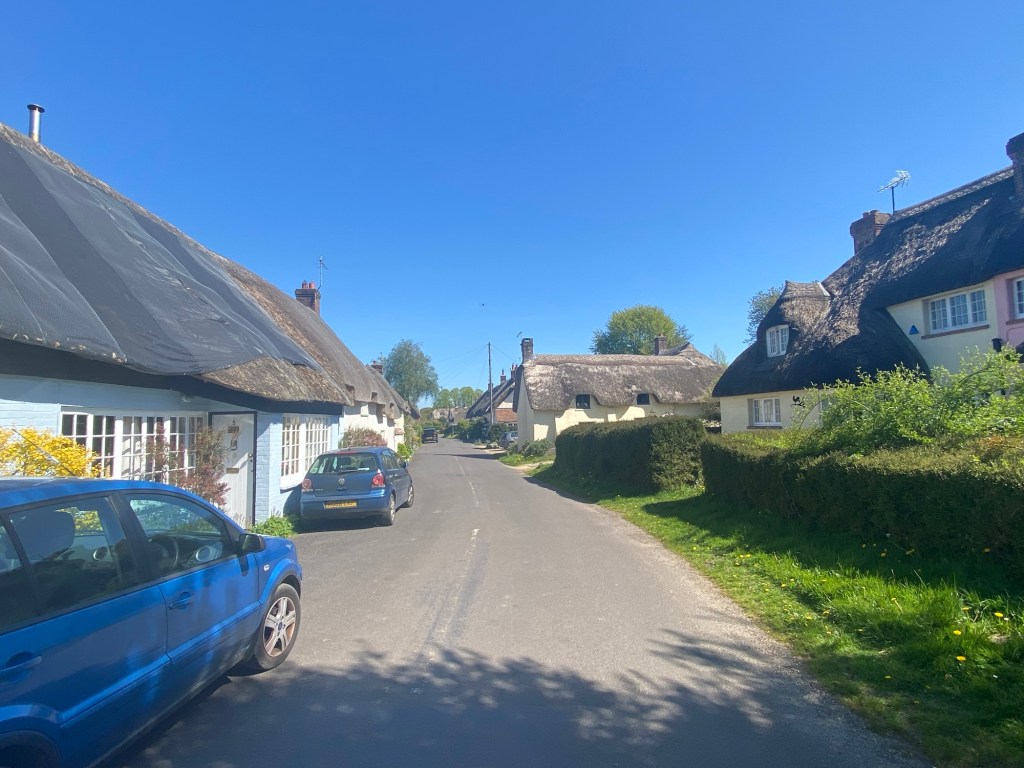
Jackdaws made their funny little peeping sound to each other flying overhead and landing on chimney stacks. Wisteria, lilac and clematis clung to houses. Cow parsley, buttercups and dandelion puffs had all made appearances in the hedgrows over recent days. And the trees seemed to have become greener and fuller almost overnight. Since my walk through Puddletown two weeks ago, suddenly the seasons had changed.
As I passed the Briantspuddle sewage pumping station on the outskirts of the village my mind couldn’t help but dredge through some of the awful statistics that I uncovered over the last winter about the state of our local rivers. For a few years now the full story of the wholesale disregard and despoilment of England’s rivers had started to become clear. Newspapers such as The Times had been running campaigns with regular updates on the extent of how much the water companies had been polluting our rivers. The government had promised action and fines for water companies.
Then it seemed to reach a wider audience and kicked off a new spate of press attention with the production of the docudrama Dirty Business that came out in February of this year. The drama, broadcast on Channel 4, followed the true story of a retired policeman and a university professor who undertook a 10 year investigation into the pollution of the River Windrush in Oxfordshire. After watching the first episode I couldn’t watch the rest.
Back in the early 2000s living in London with my then girlfriend we would travel out of town to the idyllic Cotswold village of Burford, stay the night and spend long summer afternoons in the water meadows on the Windrush – surely the most wonderfully poetic name of any river – swimming in a large round pool with clear water, yellow flags next to the banks and small trout flashing like burnished metal in the shallows.
Roger Deakin also spent a blissful afternoon swimming on the Windrush as recorded in Waterlog, his eccentric classic of swimming in various outdoor swimming spots around the British Isles. In the chapter on the Windrush he also found a spot near Burford where he invented what he liked to call ‘The Third Way’ of swimming where he let himself float around an ox bow in the river before getting out at the end of the bend and taking a few steps across the grass to start the ride again. Of his swim there he wrote ‘to feel the water’s balmy softness at every stroke was a kind of heaven’.
To see then that it was the sewage station at Burford that was unfit for purpose, that it had been pumping raw sewage into the river over and over again, to see that the river water was often dark and had lost its clarity and that fish were and plant life were dying was like a kind of trauma, the memory of which I couldn’t shake off.
If I’m honest with myself, I’d been living in a state of denial, swimming most days during the summer in my local river, the Parrett in Somerset. I remember, Dionne, now in his eighties who once was a poacher and now a wildlife enthusiast who has lived all his life on the Somerset levels said to me last year ‘Oh, I don’t know if you should swim in there’. I’d deliberately avoided the data until after watching that programme. But now you can go onto the ‘Sewage map’ (just put it into Google) and it will give you real time updates on where Wessex Water are polluting and when the last one was and how many DAYS (!) it went on for. The results were truly shocking as it seems hardly any river in England has been unaffected (less than 10%).
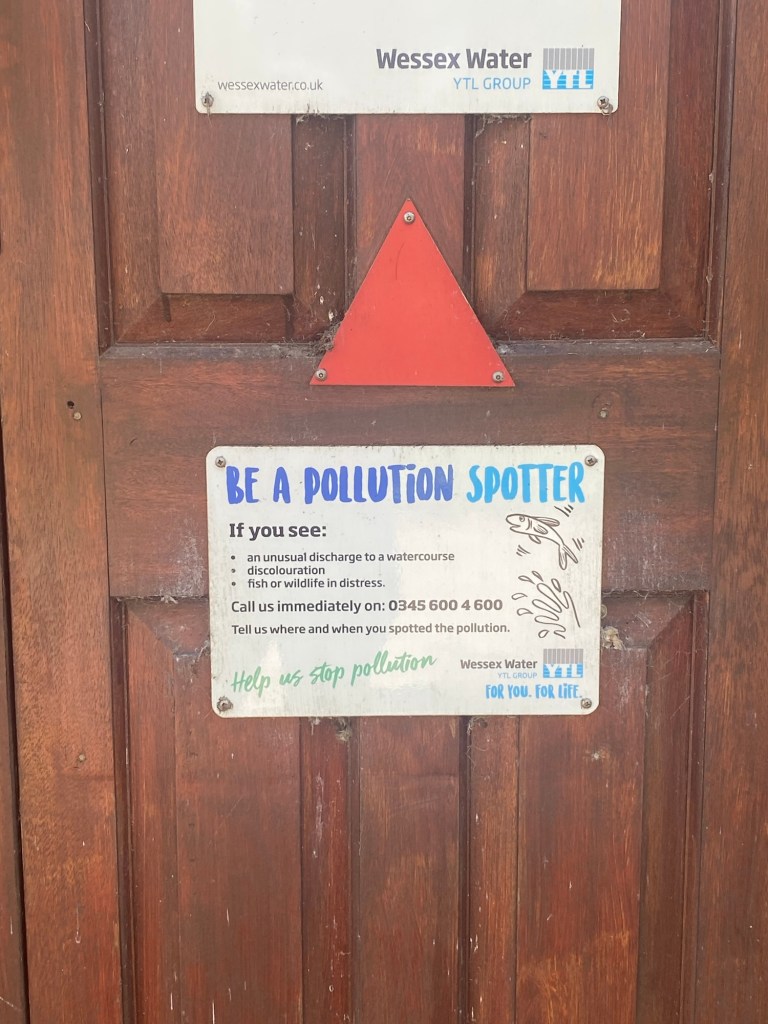
All this stuff that had stayed with me through the winter started to rise up again in me as I read the child friendly sign on the door of the pumping station. ‘Be a pollution spotter…help us stop pollution’. It’s a strange sign. Innocently asking the general public to help stop the pollution caused by those responsible for the pollution. I also couldn’t help notice the sign about Wessex Water being part of YTL Group, a huge umbrella organisation that is described on its website as a ‘global business operating in 12 countries, YTL UK Group spans multiple sectors’. Apparently, the UK is the only country in the world whose water industry is privatised. For our water needs to be in the hands of a company which ‘spans multiple sectors’ based in Malaysia seems to me to be a form of madness.
In the bridge over the River Piddle in Throop a middle aged man with a wet black Labrador on a lead was having an animated discussion with an older lady and three whippets wandered around in their delicate, wide-eyed way. One tentatively sniffed my hand. Two young girls were in swimming costumes and threw a stick for another dog that splashed noisily under the bridge.
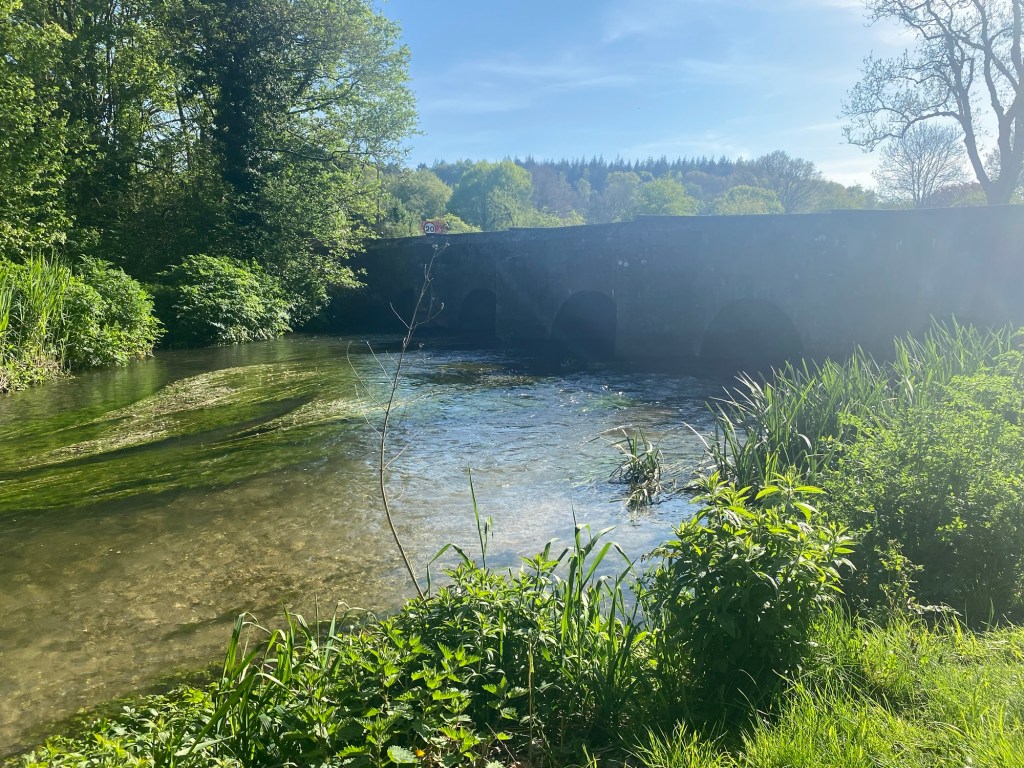
Despite my gloom over the state of our local rivers, the sight of the River Piddle reassured me. The water was gin clear, flowing shallow in many places, creating a calm liquid murmur through great tresses of water crowfoot, luminous green like an inland mermaid’s wondrous hair.
The Piddle, along with the Frome and other waterways in this part of Dorset are chalk streams, those quintessentially English rivers that rise from springs in chalk bedrock. They are normally easily recognisable for the clarity of the water and the vibrant mini eco systems they produce. The gravel beds are perfect for fish such as salmon, trout and grayling to spawn which has made them popular and in some cases – such as with the rivers Test and Itchen in Hampshire – world famous for their fly fishing.
One of the great natural wonders on chalk streams at this time of year are the annual mayfly hatches where these insects rise, sometimes in their thousands, from their nymph state in the rivers. The males fly up and down in a funny bouncing motion – known as their ‘dance’ – to attract a mate before conjoining and then dying often in less than 24 hours. In many cases the adult mayfly may only live for 5 minutes. At this time, normally occurring on warm evenings in May and June, the hatches also create a feeding frenzy amongst the trout, and fishermen use the opportunity to catch trout by using mayfly imitations which are flicked onto the surface of the river and trick a rising trout into taking it.
Throughout the history of literature it seems that writers have used the mayfly as a symbol for the shortness of life. In the world’s oldest recorded piece of poetry, the Epic of Gilgamesh, Gilgamesh’s brief life is compared to that of the mayfly. Shelley’s poem, Adonais, written in 1821, was an elegy for his friend, John Keats, who had died from tuberculosis at the age of 25. He writes ‘each ephemeral insect then, is gathered into death without a dawn’ saying later how ‘no wonder mayfly is a byword for brevity’.
These little rivers are also characterised by their abundant plant life such as water-crowfoot, water star-wort and water cress, which is often produced commercially on these rivers as I’ll discover later in Bere Regis. Globally, chalk streams are very rare with 85% of them existing in the UK. Out of the 224 designated chalk streams, the highest number, 64, are in Wessex. For me, after the slow, muddy rivers of the Somerset Levels where I live, these sparkling, bubbling and dancing streams and rivers are always a wonder.
At Turners Puddle the footpath followed a second bridge over a shallow run of the Piddle. There were cows lowing somewhere out of sight and the tall oaks and beeches in the churchyard shivered their leaves. It sounded watery like the chalk stream they look over. Pigeons cooed drunkenly. It is as if the whole land – as Hardy put it – ‘lies in a swoon’ (Tess of the d’Urbervilles).
The farm here had a red brick barn which must be 60 metres long half covered in thatch.
Next door was the old church with a tiny tower only a few feet higher than the roof of the nave. There were shrubs and gravel leading up to the door and otherwise the old graveyard was overgrown with cow parsley taller than I am and a few remaining graves leaned drunkenly this way and that. There was a large oak, its main branches covered with moss which was home to nesting rooks making an exaggerated din in the tree tops.
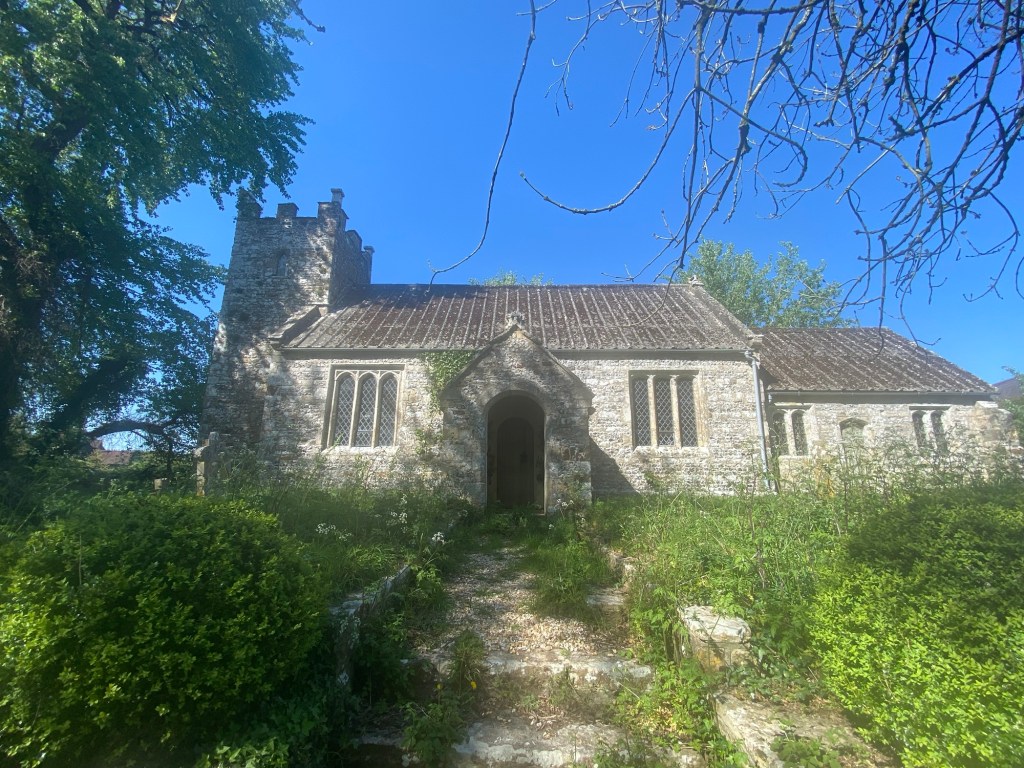
A framed printed sheet in the church porch informed me how the church was deconsecrated in April 1974 (only a few months before I was born) and is now used occasionally for weddings, funerals and concerts. There was a sign saying PRIVATE on the gate.
By now I had completed a large circle and returned through water meadows into Briantspuddle starting to feel hot and my head slightly befuddled by tree pollen. My mind turned again to water. Surely, I could find somewhere to swim in this valley of the Piddle, feeling a determination to be in outdoor water for the first time this year and to try to overcome my sadness about rivers. The only problem was that every time I saw the river it was never more than a foot deep.
At the old, arched bridge into the village there was a circle of grass with a bench overlooking the glittering river. The water must have been 1-2 foot but I donned the trunks and found a shallow scoop of water below one of the arches of the bridge. There was a gravelly bottom, and as I lay totally flat I could feel the water rushing over me – cool and clean. I kept my legs together and arms at my side to create as little resistance to the rapid flow of water as if I was rocketing down one of those tubes at an aqua park.
I also felt like John Everett Millais’s famous representation of Ophelia, now hanging in the Tate Gallery in London, surrounded by flowers and floating in a clear stream. According to the Tate, amongst many other flowers she has carried with her into the stream next to her are “Crow flowers in the foreground look similar to buttercups and symbolise ingratitude or childishness”. What ‘crow flowers’ are I do not know but they must mean water-crowfoot which means she must be lying in a chalk stream which is immediately clear when you look at the painting (apparently Millais used the Hogsmill River in Surrey, a tributary of the Thames and the model Elizabeth Siddal as the dying Ophelia).
As I slowed my breathing, sunlight flashed off the ripples of water firing off little sparks in my half closed eyes. A pair of ducks floated rapidly along the outside of the river turning their heads to watch me. And my dark winter thoughts of rivers were finally washed away.

