I’m sitting on a bench in the evening sun outside the white washed walls of The Antique Map & Bookshop on the high street in Puddletown. Behind red brick walls the first sky blue bunches of Wisteria are to be seen dangling against the walls of cottages. Hawthorn trees are full of their star-shaped flowers that create little blizzards of white petals onto roads and paths, reminding me of confetti on a church path the day after a wedding. On the high street I passed the imposing old pub, The Prince of Wales, its two gables adorned with the Prince of Wales’s feathers. I was getting ready to think about sitting down, and perhaps having some refreshment when I noticed the wording on the pub sign outside:
The Prince of Wales
Apartments 1-4
It’s yet another pub which has become a home – or homes: a now familiar story in the English countryside. At least the Post Office opposite is still going.
This is the the first village I’ve come through at the start of The Hardy Way, the 216 mile circular route around Dorset that starts at Thomas Hardy’s birthplace at Higher Bockhampton and takes in many of the places and landscapes that Hardy used to inform and inspire his books. The Way ends at Stinsford, barely a mile from Higher Bockhampton, where Hardy was baptised and where his heart is buried (his ashes are buried in Poets’ Corner in Westminster Abbey).
It’s often said the Dorset landscape is so important to Hardy’s novels it takes on the role of a character, influencing the people and action at every turn. As an impressionable 17 year old I studied Tess of the d’Urbervilles for my A levels in Suffolk while falling in love for the first time with a girl who sat on the other side of the class. And I can still remember some of the descriptions of landscape off by heart:
‘Amid the oozing fatness and warm ferments of the Froom Vale, at a season when the rush of juices could almost be heard below the hiss of fertilization, it was impossible that the most fanciful love should not grow passionate. The ready bosoms existing there were impregnated by their surroundings…And as Clare was oppressed by the outward heats, so was he burdened inwardly by waxing fervour of passion for the soft and silent Tess.’
This was Hardy’s description of Talbothays Dairy, the fictional farm where Tess and Angel Clare meet and fall in love. The real Talbothays is thought to be Lower Lewell Farm in the Frome valley 2 or 3 miles south of here.
I haven’t blogged about walking for over a year, preoccupied as I’ve been with walking across Somerset for a book. This might have made good material for posts but it seemed like a good time to pause. And there will be posts about Somerset as I continue to wander around that, my home county – for its traditions, culture and people – over this summer.
And meanwhile this has become another project: first and foremost my desire to escape and explore close to home but to try to keep my mind in practice, as well as my legs.
I started last week outside Hardy’s Cottage on a cold grey day during the school Easter holidays. When I got to the cottage a smiley volunteer apologised and said they’d just started the final tour of the day. Instead I contented myself with leaning over the foot gate that leads to the gravelled area in front of the cottage, imagining being a passer-by almost 200 years ago when Hardy’s parents were about to deliver this great writer about the people and places of Wessex into the world.
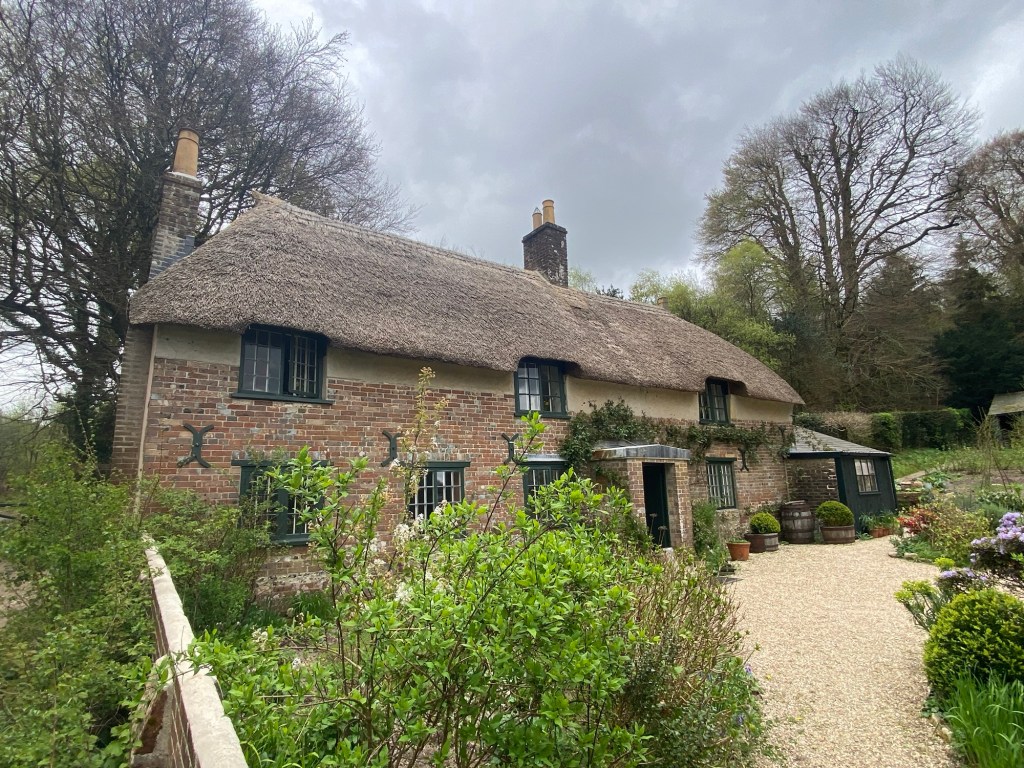
According to The National Trust website, the cottage was built of cob and thatch by Hardy’s grandfather and it was where he was born in 1840 and lived until he was 32. It was where he wrote his two early novels Under the Greenwood Tree and Far from the Madding Crowd.
Many of the places I am walking through at the start of The Hardy Way feature in Far from the Madding Crowd. Puddletown was renamed Weatherbury and is where Bathsheba Everdene inherited her farm – Weatherbury Farm – the centre for most of the action. Like most of Hardy’s places it is based on a real life house, Waterston Manor, in Lower Waterston, little more than a mile west of Puddletown and 2 or 3 miles from Hardy’s birthplace.
Earlier I left my car down the road from the manor at Lower Waterston Farm and walked east along the winding B3142 which for a short section is also the Hardy Way. The meadows on the left of the road was the setting for the sheep washing scene from Far from the Madding Crowd where the lovestruck Mr Boldwood comes to propose to Bathsheba. It is the River Piddle that flows through the water meadows that become rich in flowers in May:
“The outskirts of this level water-meadow were diversified by round and hollow pastures, where just now every flower that was not a buttercup was a daisy” (Far from the Madding Crowd – The Sheep Washing).
That’s still a few weeks away – when the buttercups appear in their thousands across the meadows of Dorset and in the pastures thst surround me in Somerset too – reflecting sunlight as a warm gold glow.
On the road from Puddletown to Tincleton the hedgerows are starting to turn. There is that visual evidence of the seasons changing, brown stems turning green. Dandelions are protruding, their flowers like yellow cartoon explosions while neighbouring blue bells bow their bells forlornly.
A man clad all in orange overalls as favoured by road workers comes up the hill on an electric powered bicycle, one hand on the handle bar, looking nonchalant.
‘How do?’ he says even more nonchalantly.
The way takes me off the road through a gate into a meadow. I pause. In the evening light a small black and white shape is skimming close over the field, its white breast lit by the light, flashing every now and again between wing beats like a message sent from a flashlight. It’s the first swallow I’ve seen this year. There is always something joyful about the first one – this harbinger of summer and sign that winter is over.
As such, they have always held some significance in folklore. In ancient times it was considered deeply unlucky to harm a swallow or its nest. A swallow nesting in a person’s barn was said to confer good luck on one’s household. In Ireland there was a belief that they carried a small drop of divine blood which again meant they should be left unharmed.
A few years ago I was in the ancient city of Plovdiv in Bulgaria under a tree festooned with white and red decorations where a local man called Adi told me of the pagan tradition of Baba Marta. Baba Marta, meaning ‘Granny March’, was a mythical character who brought winter to an end and announced the beginning of spring. In Bulgaria it is celebrated by the wearing of Martenitsi – red and white cloth bands – that are worn around the wrist and are worn from March 1st until the wearer sees the first stork returning for summer – or the first swallow.
As it carries on back and forth flitting over the grass, I wonder where it has come from and what epic journey it has taken. Across the Sahara and the Congo (apparently the toughest leg of the journey). Across Morocco, the Mediterranean, Spain and France and the English Channel. Across conflicts, perhaps, and cultures very different from our own. A six thousand mile journey, across deserts and jungles and giant rivers and oceans. An immaculate and intrepid little traveller.
At Anniston Farm adolescent fresian calves breathe heavily in their barn, dipping their heads through the gate to see me. Their beautiful deep black eyes glisten in the sun. A song thrush repeats its patterns one after the other, truly virtuosic in its soloing. One phrase repeated after another. One is a quick tee-woo, then a machine gun burst of quick fire peeping before a louder tieu , tieu, tieu. It seems so loud in the still evening air.
Later, as I approached the A35, there is a familiar clunking sound echoing in the evening air every 30 seconds or so. It comes from the nets at Puddletown Cricket Club. There are people in their teens and twenties running in to bowl, one after the other, while a woman with a baggy grey hoody leans over a double pushchair watching. It’s another sign that summer is drawing closer.
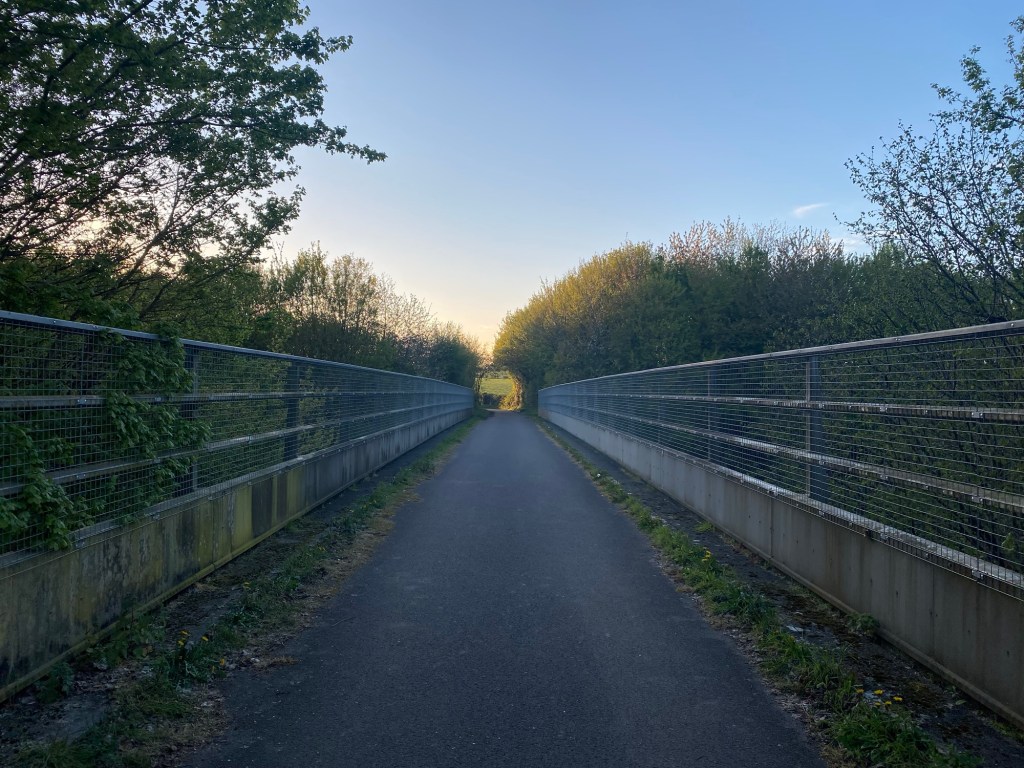
On my way back to Waterston I cross once again the A35 as I did at the beginning of the day, passing HGVs with sleeping drivers pulled up in a layby. The dual carriageway continues to roar beneath me and on the other side in the west the light is honey gold in the hedgerows.

