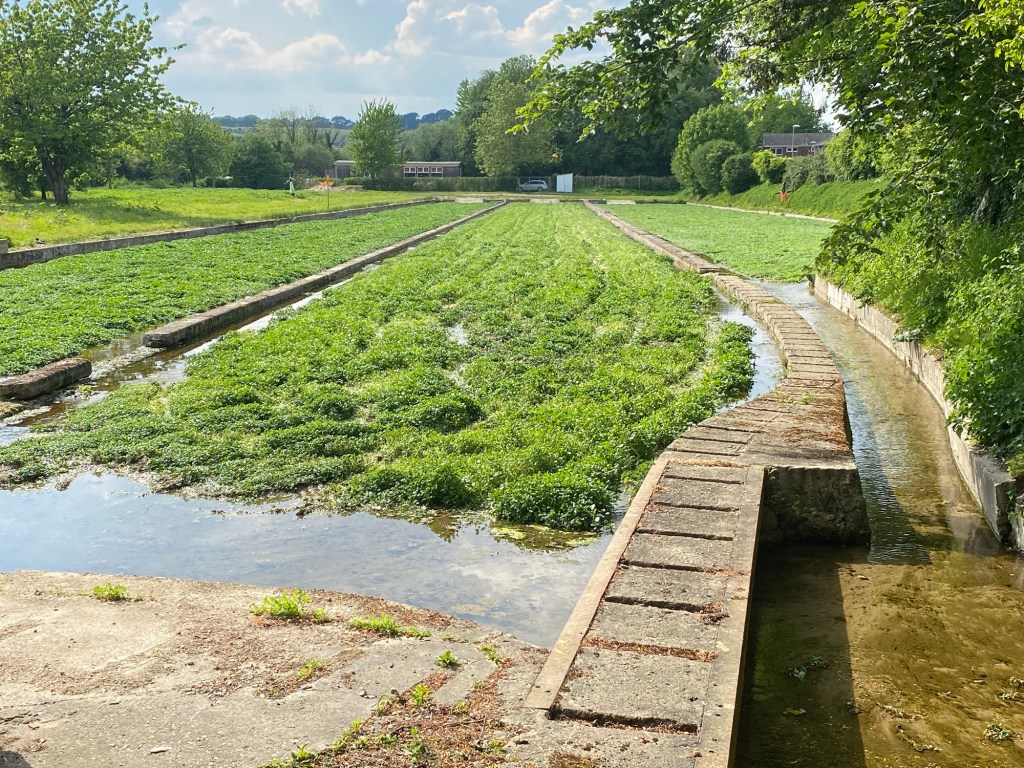
I arrived in Bere Regis just as the church tower struck four deep, sonorous notes that after the fourth chime had finished, slowly faded to silence. Minutes after starting walking I crossed the Bere Stream, another bubbling clear-flowing stream like the River Piddle that I lay down to bathe in in Briantspuddle, last time that I was on the way . As before, it was a blessing to see after having to get used to hearing about and seeing the many fouled rivers across the south west of England and beyond. Beside the stream, some way back from the road, there was a lush green meadow with two concrete walkways that ran in parallel lines 200 metres down its middle. Something about this scene made me stop without thinking why.
The blanket of green laid out before me was the same rich colour as the grass meadows that dominate the landscape here, but this was different. It was a water cress bed. Since the early 1800s water cress has been cultivated in Bere Regis and it’s grown here because of the chalk beds that provide the spring water that the cress needs to thrive. The Bere Regis website says that “it has many purported medicinal qualities; a good cure for a hangover, great for cleansing the blood and is even recommended as an aphrodisiac!” I still think I prefer mine in an egg sandwich.
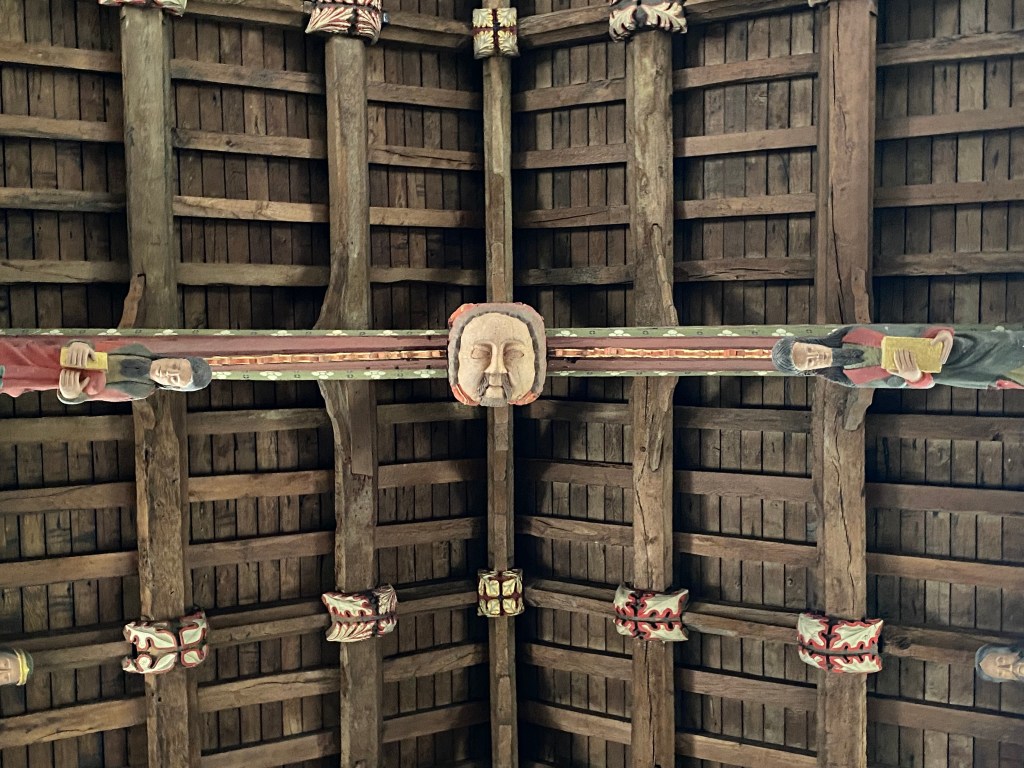
Shortly after this I arrived at the impressive grey tower of Bere Regis church, which stands on a small hill. Inside, on the roof of the nave, there were strange figures of men, pencil thin and pale faced with long black hair swept back from their foreheads – Nick Cave-like – with black goatee beards that drooped in two cables from their chins. They piously grasped hold of yellow painted books – bibles, presumably – as they stared down at the congregation. In between was a large, carved round face with thick lips and unpainted, unseeing eyes. I later found out the thin figures are apostles while the large face is supposed to be Cardinal Morton, who was born here and later became Archbishop of Canterbury.
I imagine children in the past sitting in these pews – like I used to have to in Curry Rivel Church in Somerset – staring around them while a sermon was being preached, and catching sight of these strange characters. I wonder how many childish nightmares were inspired by those staring ashen faces, although there was something comically cartoonish about them too. It was a departure from the painted angels that I am used to seeing hovering amongst the beams in the churches around me on the Somerset Levels.
In the southern part of the church, behind a filled bookcase and next to a crèche covered in teddy bears and toys lay an old tomb. A glance up to the south wall also revealed a stained glass window of various shields, each one split in half. On the left of every shield was a standing red lion, its paws reaching out and a long tongue curling up from its jaws and a crown on top of its head. And then on the right hand side a different coat of arms in each shield. The lion was the arms of the Turberville family and each shield represents a marriage between a Turberville – Thomas, Richard, Robert, etc – and another family.
Any Hardy fan would recognise this name as being the inspiration for the ill-fated heroine’s name in Tess of the d’Urbervilles. In the excellent The Hardy Way – a 19th Century Pilgrimage, a guide to the way, local history and its relevance to Hardy’s works and life, Margaret Marande tells how Bere Regis is recreated as Kingsbere-sub-Greenhill in the novel. The Church of Kingsbere/Bere Regis is where after Tess’s father dies, her mother and the rest of the family come to find accommodation after they have been evicted from their cottage at Marnhull/Marlott. The family shelter under the south wall near the vaults of their ancestors and according to Marande “The fifteenth century d’Urberville window above their heads, with its heraldic emblems can still be seen and the altar-tomb on which Alec d’Urberville lay pretending to be an effigy is probably that of Robert Turberville, Lord of the Manor from 1547-59”.
On a large printed version of a family tree of the Turberville family, someone has fixed with clothes pegs a picture of Woolbridge Manor with a label underneath ‘Woolbridge Manor – once the home of the Turbervilles – and used by Thomas Hardy for the tragic wedding night of Tess and Angel Clare’.
I was so busy looking at the window that I didn’t notice a lady who had come to tend the flowers and we both gave each other a bit of a shock at the awareness of another person in the stillness and silence of the church.
Closing the door behind me, I made for the village and stopped outside a long cream-coloured, thatched house next to the Drax Arms. It was now a Nisa Local and had a crate filled with plastic footballs and multi-coloured kids fishing nets plus big green sacks of Wagg Active Goodness (it’s a type of dog food apparently). Outside a woman was getting into a big camper van with garlands of Hawaiian flowers hanging from the rear view mirror.
I heard her muttering something and then she leaned out of her window and looked at me:
‘Don’t worry I’m not talking to myself, I’m talking to my dog,’ she said, giving me a wide grin before driving off.
Moments later four people strolled past me on the pavement, with one of them wondering in a puzzled voice how his friend had run out of hay.
After picking up nuts and chocolate to keep me energised, I left Bere Regis down Blind St and crossed the A35 into meadows. The buttercups had now appeared in their thousands, sprinkling gold light amongst the meadows. There were daisys too and the puffballs of dandelions shivering in the evening breeze, sending little stars of fluff floating up to the sky. Since last time I was here only two weeks ago the cow parsley had grown huge, towering over me in the hedgerows.
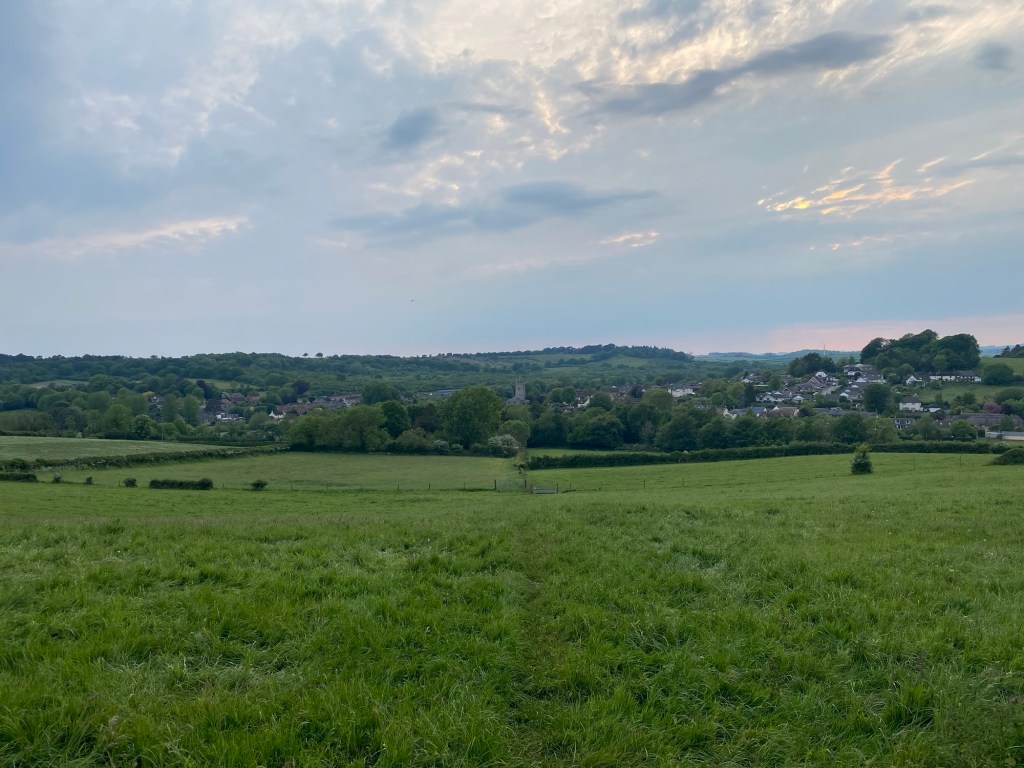
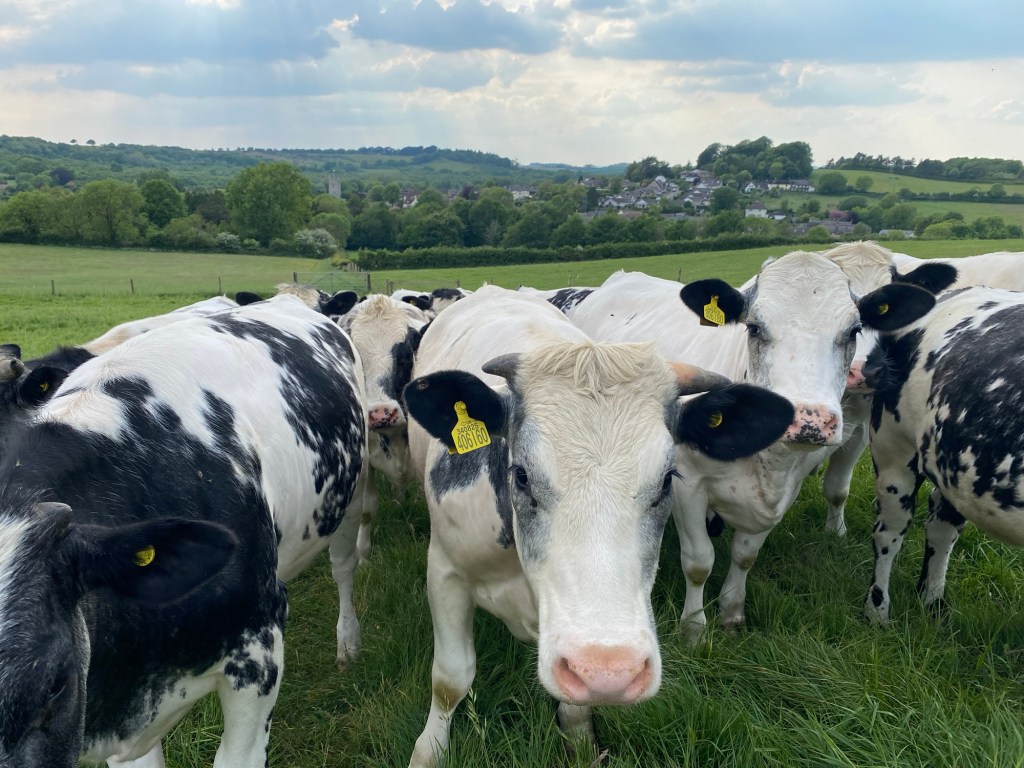
I climbed the hill east out of Bere Regis towards Woodbury Hill towards a herd of adolescent cows that were flicking away flies with their tails with metronomic frequency. One by one they rose from their lying positions and came silently to greet me, raising their noses and curiously sniffing me and trying to lick my elbow. They followed me up to the top of the field, every now and again nudging me from behind and one broke off to the side of his companions, bucking and rearing as if having a wonderful time to himself – no doubt full of the joys of Spring.
Through the trees below me I could still see the grey tower of Bere church with its St George’s flag fluttering.
At the top I crossed a road and turned north east through a meadow and past rickety barns. This was Woodbury Hill and once the ancient settlement of Woodbury. This would have been the site of the Woodbury Hill Fair, a huge event for the local community which took place over four days every September where thousands of people would come every day to buy and sell animals or to trade in all manner of goods. There would also be entertainment and eating and drinking in the way that we still have today in fairs across the south west. The fair was known to have already been taking place in the 12th century and Henry III granted charters for it to happen on various occasions in the 1200s. It continued for over 700 years until the 20th century by which time the livestock selling had stopped and it was just a fair, similar to other Dorset fairs such as the Oak Fair at Stock Gaylard or Dorset Show that happens at Puddletown. The last one took place here in 1951.
Renamed Greenhill Fair by Hardy, it features prominently in Far From the Madding Crowd. It’s where near the end of the book that the caddish Sergeant Troy reappears after he’s supposed to have died in the sea off Lulworth Cove, now working as the lead actor working for a travelling circus who are staging a play about the highwayman, Dick Turpin. He spots the heroine, Bathsheba, his ex-wife, and snatches a note from he hand so that she doesn’t find out he’s still alive. As quoted in Marande’s book it’s also where one of Bathsheba’s workers, Joseph Poorgrass, was taken to try to cure his shyness:
“They took me to Greenhill Fair, and into a great jerry-go-nimble show, where there were women-folk riding round – standing upon horses, with hardly anything on but their smocks; but it didn’t cure me a morsel”.
For a few moments I lost myself imagining the haze of dust and the sounds and smells of animals and thousands of people and stalls and cooking food and circus acts and steam-powered fun fair rides such as you used to be able to see at The Dorset Steam Fair (last put on in 2024).
And then I strode onwards, from the drowsiness of meadows into the cool stillness of Bere Wood. Here there were ranks of spruces guarding me on the right and great shocks of purple rhododendron rambling amongst them and small oaks on my left that filtered sunlight into patches of gold onto the path. There were still blue bells here – drooping and nodding their frilled trumpets at my feet. And somewhere close a mobile mast buzzed loudly.
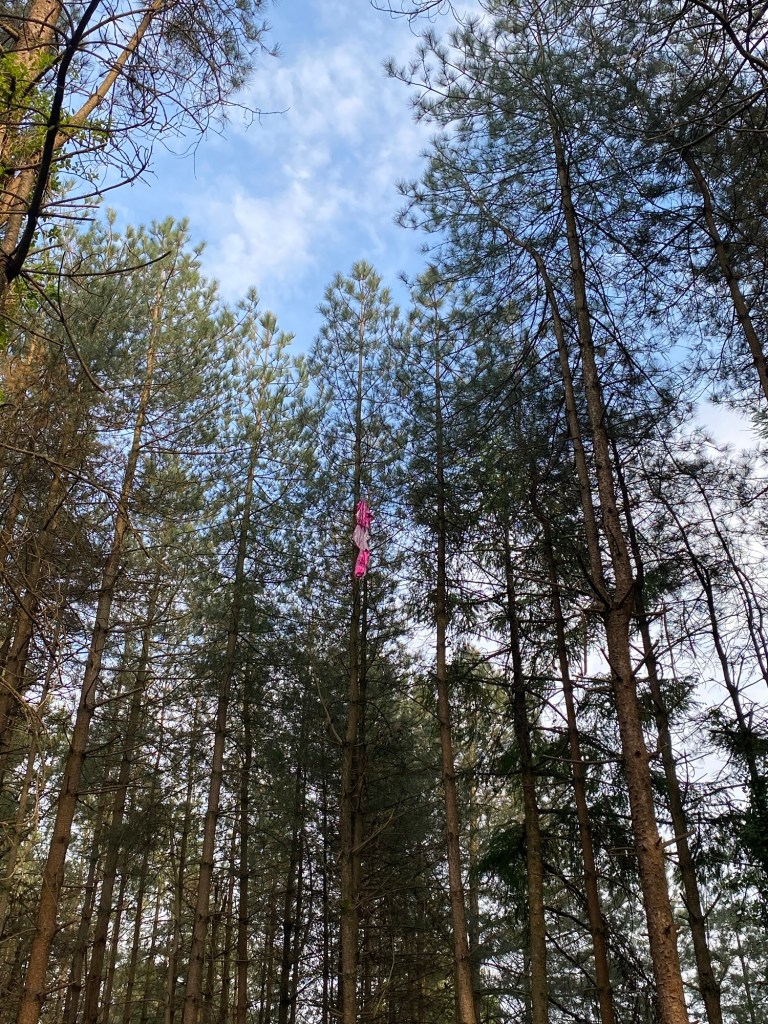
I paused to appreciate the transition (how I love a sudden change in place and atmosphere). Up in one of the spruces, some thirty feet above the ground, hanging from a thin stem like a gallows was a metre long piece of sagging plastic, still garishly pink. It was one of those foil helium balloons that people buy for birthdays or special occasions. I see those balloons everywhere but for some reason never in the situation for which they were orginally intended. I can only imagine that through a momentary lapse of concentration a hand forgets to hold on and up and off it goes, suddenly off on its own surprise adventure which is then cut short by getting stuck in a tree or a telephone wire or a river – I retrieved one from the river Parrett while swimming in it two summers ago. Collapsed and colourless it must have been there for years and would have stayed there for who knows how many more if there hadn’t been a dotty middle-aged swimmer who’d decided to take a dip next to it.
After passing through Bere Wood I crossed a meadow to Bloxworth as the sun started to soften. Outside the village hall in Bloxworth I sat on a bench in the sun and watched villagers come out of their houses and greeting each other on the road. Inevitably they talked about the good weather. Only a week ago the temperatures here were in single figures and the arrival of summer warmth and light evenings must still inspire a sense of relief to people as it would have done for villagers here living in the same houses in the distant past.
After eating some nuts and chocolate raisins I paused at the sparkling red telephone box opposite the village hall. Inside a sheet of typed paper announced this was the ‘Bloxworth Village Bazaar’.
Inside the one person space had been meticulously organised. In place of where the phone used to hang was a noticeboard welcoming the visitor and informing them that all items have been donated by the village to raise money for village projects. Around the noticeboard was a vine of plastic roses and then beside it a neatly fitted set of yellow painted shelves with board games, sparkling wine glasses and plates, some with ilustrations of elephants on. There were small handmade bangles hanging from hooks, a pestle and mortar, books, a doll, tote bags and even a bird feeder.
I’ve seen many phone boxes converted to different uses – normally an informal library/book store and more and more these days a defibrillator station – but this was the first time I’d seen one that advertised itself as a mini market. It felt like the world’s smallest charity shop.
Closing the door, I shouldered my backpack and headed south towards Bloxworth Heath and the town of Wool.

