Suffolk Coast Path – Hollesley to Boyton November 23rd 2019

Lines of the Ness

There’s a stark beauty to the Suffolk coastline. In fact many might question that it’s even beauty. In certain places on certain days it is the lack of definition – the emptiness – that is profoundly moving. Maybe it’s just my state of mind.

Dad would have walked along here, I’m sure. He loved walking and conservation. He spent many years working for The Suffolk Wildlife Trust. He’s Suffolk born and bred and there’s still so much I want to ask him. I’ve made several recordings of us chatting but there’s never enough time and often now he’s too tired.

I cast my mind back to August and the beginning of September.

At the start of the Summer holidays Dad seemed a bit distant, forgetful and prone to mental blanks. I wondered if he was just getting older. He’s 79 after all. After I went to Greece I’d hoped he’d be better and sometimes he was but then at others he would sit in silence with a faraway look in his eye which I hadn’t seen before.

In the last week of the holidays – the last week of August – we started to notice other little quirks of behaviour which were outside the norm: while Mum and I talked about my brother, he confused him for my brother-in-law. Was it his hearing? Was it dementia? And in the afternoon he would sit in his deckchair in the sun outside the conservatory looking at the ground and then look up at me – that intense gaze he’s always had, unflinching but also somehow now unknowing. There was something about those moments that I couldn’t bear and I’d leave the house and run away to the sea.

Incredibly we had arranged a family photo shoot for Wednesday August 28th, the first time we’d ever done something like this. It was a present from us children to him and mum for their Golden Wedding back in April. There we all were – Mum and Dad, the children, husbands and wives and grandchildren – now sitting in a row with champagne in the conservatory saying cheers to the camera. Then wandering round the garden swinging my little niece, her face alive or bouncing my nephew, still too young to comprehend the pathos of the situation. All of us in scenes of family joy, with genuine attachment, but with our minds somewhere else wondering what was going on.

And now here were Mum and Dad standing close together, holding each other in the vegetable garden , his vegetable garden with the runner beans that were too late because he’d forgotten to plant them until later in the season, and him suddenly looking old and frail and me having to look away with that feeling like something is caught in my throat and the now familiar heat in the eyes.

It was so lucky that we timed it then to have those photos but I suppose there’s no getting away from that will always be a reminder of the start of the end.

That same day – weird to think of it now – we had a meeting with mum about their lasting power of attorney but it was also a moment where the 4 of us agreed that it was clear something was wrong and that he needed to be checked out.

The following day – Thursday – mum got active and they started a whole round of tests at the GP. One day that week – I can’t remember which – he had been mowing and had fallen over. Was it the Thursday? I think it might have been. Then it happened again the following day when he was unlocking the church.

Friday was the last day of the Summer holidays (or the last day at home before going back to Bristol). It was always a sad day anyway – a reminder of the days of being a schoolboy and having to go away to a boarding school I hated. I was woken up by mum, her climbing the little staircase to the room next to the attic where I’ve slept since I was 7 years old.

She told me calmly that Dad had fallen over while trying to get out of bed and he couldn’t get himself up off the floor and she didn’t have the strength to help him up. My father, always strong and unphazed, was lying prostrate next to the bed. ‘Oh J, this is ridiculous’, he said to me with his face turned sideways on their cream carpet.

The GP decided that he had to be admitted to hospital and they called an ambulance to take him.  My last day of the Summer I watched him walk himself into the back of the ambulance, well dressed and handsome as he always has been, and sit down on the little seat they have behind the driver. I said goodbye and drove back to Bristol in silence.

Not knowing a diagnosis when you know something is wrong is dreadful. Your brain tells you not to think the worst when all along your brain is thinking the worst. And it really couldn’t have been much worse. Glioblastoma is a particularly aggressive form of brain cancer that affects or infects only 1 or 2 in every 100,000 people. But what a thing: by the end of my first week back at school they had spotted it, diagnosed it and it had grown to 6cm long in 2 months. ‘It is the size of an egg’ Mum told me over the phone. The image makes me feel sick.To think that throughout this lovely Summer, where I’ve felt so good about life and had such fun, that thing was quietly but rapidly growing, waiting to be discovered and then turn our world upside down. It would have started at the beginning of July when we first noticed he wasn’t his usual self.

I drove straight from school on Thursday evening 5 days after he’d first been admitted and still without a prognosis although we knew it was a brain tumour. Walking through the door I tried to sound chirpy: ‘Hi!’ expecting it to be mum on her own. This would be how it would be some day soon.

‘Hallo!’

Dad was home. That was a surprise. Mum caught me before I walked down the corridor to hug him. She looked frightened.

‘They’ve said he can come home but it doesn’t look good. He’ll explain.’

I sat on the sofa in the same place and the same room where we have gathered for almost 40 years: birthdays, Christmas,  parties for their friends or ours or just a place to be together to chat or watch TV.

They sat in armchairs one on each side of me and spelled it out between them, clearly worried how I would react.

‘It’s very aggressive.’

‘Treatment is difficult and could be risky.’

Pause

‘They say 3-6 months, possibly a year if they can operate.’

There is no noticeable effect on me. The room doesn’t start spinning. The clocks keep ticking. We keep talking as we normally would.

But everything has changed.

This is what countless generations of people who have come before have had to endure. The loss of someone close. It’s so simple, so obvious. It’s everything that I’ve read about or seen on stage or screen but nothing can prepare you for it. Already I see my life up to this point as an innocent, unknowing time. Who was the poet who talked about how we throw away our youth like toffee wrappers? What do we know about life? Nothing. How woefully unprepared we are for this entire misadventure. They don’t tell you these things in school but one day life will let you down and you won’t know how good something is until it’s gone.

****

I set off from where I ended up 2 weeks ago at the end of a dirt track next to the prison car park. There’s a strange satisfaction I get from arriving back at exactly the same place wondering how I was then and what has happened since. The continuity of the path and the passing of time. Arriving here once again I had driven through the prison buildings and fences of Hollesley Bay Colony with big signs ‘No access to inmates’ and not a soul about. No people on the paths. No cars in the car parks.

How I like this. The cosiness of being alone with my thoughts on a Winter’s day.

The greyness is strange, distorting the edges of reality. Sheep grazing in a field merge with their background. A ship out at sea, not far from the coast appears as a ghostly vast lego block, more like an upturned table than a ship. Sky, river and sea are all grey. The sky has such subtle changes of the same colour it is almost impossible to tell, let alone describe.

Trudging across Hollesley Marshes wrapped up in my thoughts I am immediately aware of the sea’s crashing out of sight to the East. It sounds like white noise in a wind tunnel. Something is making the sound bend. The bank in front of me hides the end of the land.

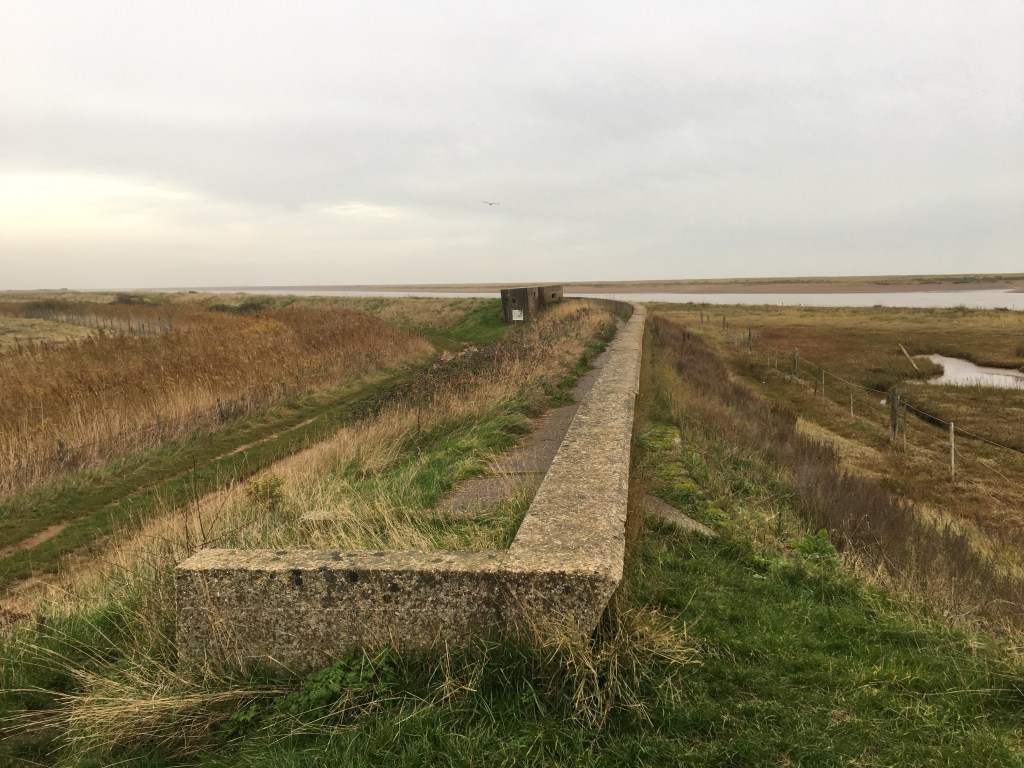
The greyness is manmade too. Sea defences appear at random, lurking on the edge of the path. Further back on the path near Bawdsey a whole pill box had ended up on the beach half sunk in the sand, its corners sticking up awkwardly and out at a strange angle. It’s now the sea that poses the biggest threat here.

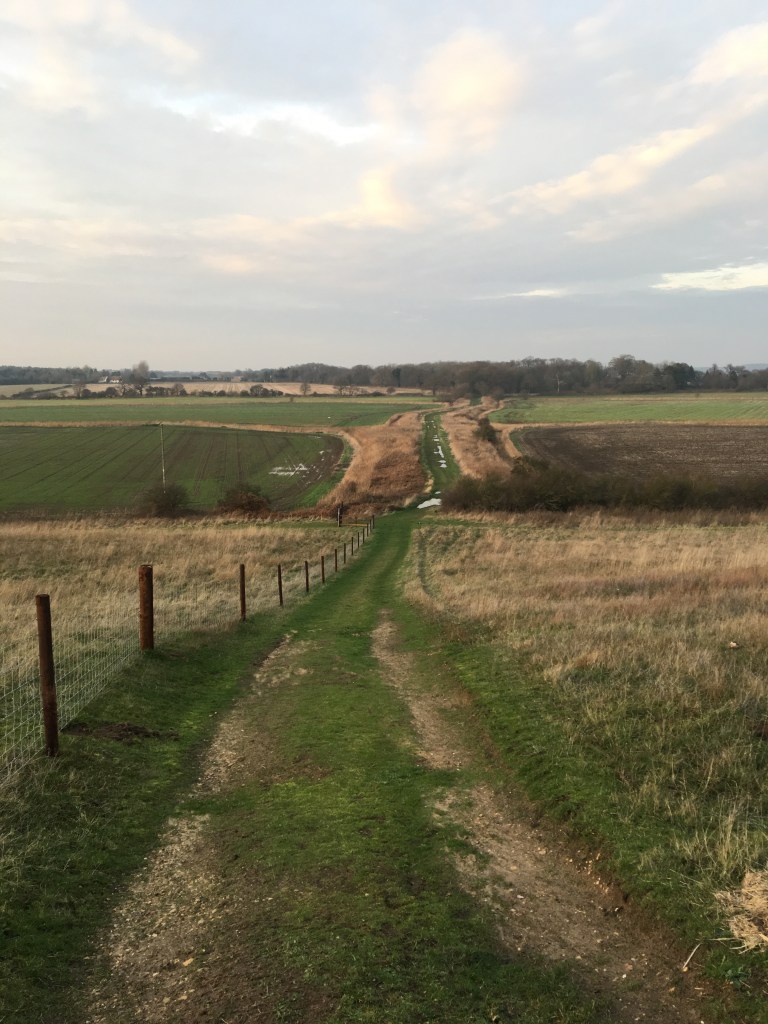
Coast Path leading North towards Boyton

I quicken my pace. It’s mild today but I want to get into the groove of walking and then the thoughts will start to become louder and clearer. It will clear the thoughts of home where Dad lies silent in his armchair.

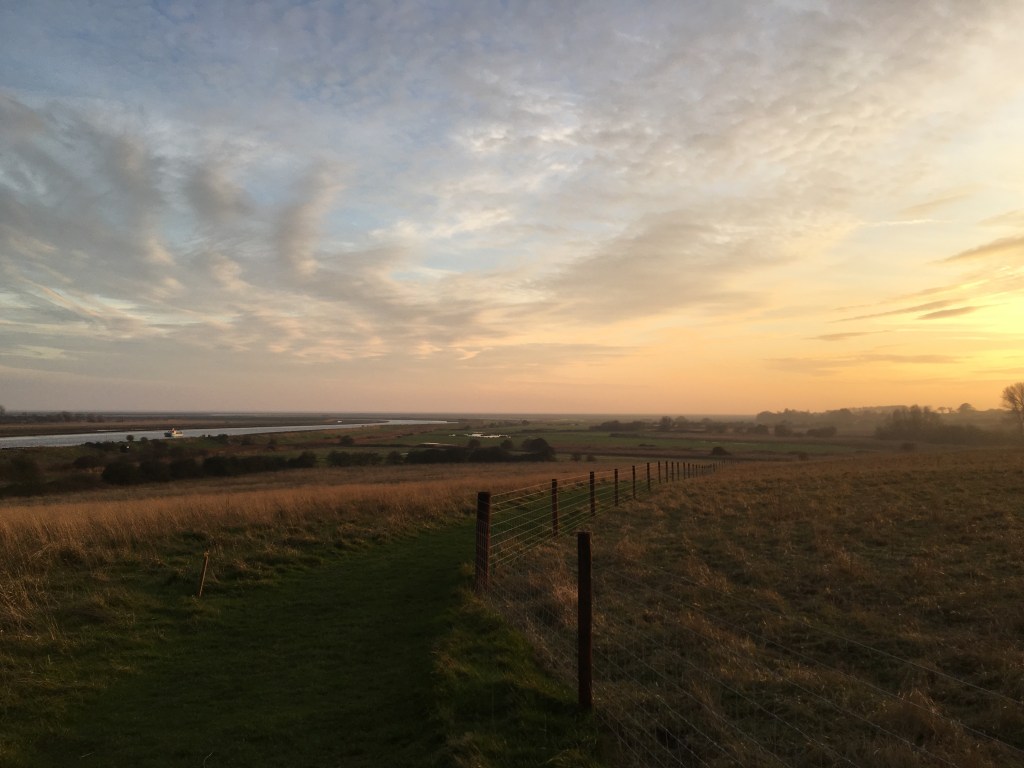
I stick to the narrow spine of the grass bank that follows the river as it rushes down from Aldeburgh.

The only colour apart from the grass is a fisherman, bright orange in a wooden dinghy with an outboard turning around in the river far ahead in the distance.

The wind is to my back from the South and a slight change in the sky suddenly reveals some light above me. My mood changes. I have one of those moments. Time is frozen and I’m entranced by the wind and light. Not thinking, just feeling. It reminds me of hiding from the winter wind in a bush when I was little like a young leveret or bird. I feel the same now as I did then.

A transition. Something new. Simpson’s Saltings is a 25 hectare nature reserve consisting of marshland and beaches but is home to many important and rare species of plants.

I run down through the sea campion to the beach and jump into the pebbles turning south into the wind. There is something here that breaks the smooth lines of beach, water and plants. Upturned boats and a winch left for the Winter.

Simpson’s Saltings

Onwards, Northwards. A boy runs past me and then stops behind another pill box on the path to get his breath back. Then shouting suddenly ‘Ella, Come on!’ before suddenly turning inland towards a line of trees although there is no path. I have a thought about the fearlessness of youth.

After the trees, I turn my back on the sea and cross a narrow channel parallel to the river. A transition and another Suffolk scene: a flat field stretching to a thin line of trees, skeletal dark forms filled with a mass of black birds silhouetted against the sky. My immediate assumption was that they were crows or rooks but, as I saw a flock coming into land, I realised they were cormorants with their white underbellies and yellow throats.

The great bird lover and writer Adam Nicolson has referred to the cormorant as ‘the most sinister bird in English literature’, a reference to the cormorant being mentioned in ‘Paradise Lost’ but also, according to Nicolson, ‘Aristophanes, Plutarch, Chaucer, Erasmus, Shakespeare: everyone has given this bird his evil part’. Being faced by this wall of black shapes sitting amidst the bareness of the trees in the fast fading light did produce a little rush in my chest. I carry on.

Like the last time I had the same incongruous experience of going from the wildness and openness of sea, beach, marsh, meadow to the starkness of fence, barbed wire, CCTV, prison block as the path passes the main detention centre at Hollesley.

Yet somehow there is a conjoining. It seems absolutely obvious that the prison – grey, austere, remote – should be here on this featureless East Anglian shore. There is a certain symbiosis to these 2 seemingly alien environments. They’re made for each other.

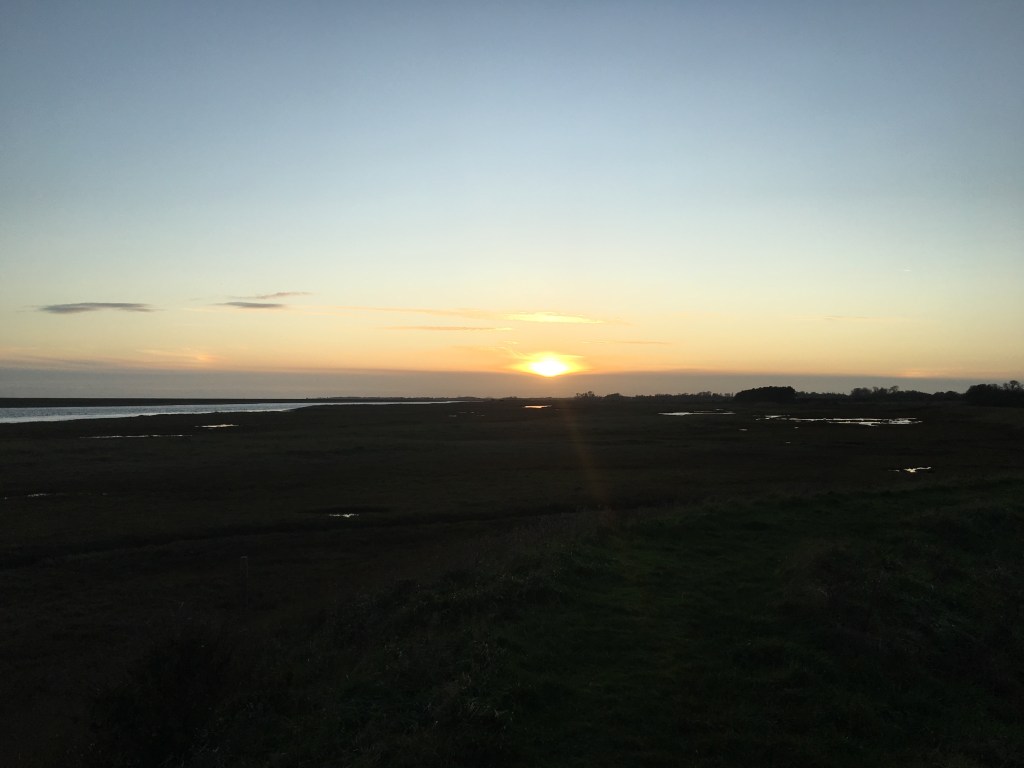
The light has all but gone apart from a pale patch over the Western horizon. Head bowed I arrive back at the car. Refreshed somehow I’m ready to return home to have a drink with Dad and tell him what I’ve seen and done. I know he’ll be polite and genuinely interested but it must tear him up – he, the wildlife lover, the explorer – knowing that he’ll never do anything like that again. How would you stop yourself thinking that it’s all downhill from here?

I always kick myself when I first arrive home and automatically ask ‘Are you OK?’ To which he always responds in the same frank, honest way with no pity for himself:

‘Not really.’

Suffolk Coast Path – Hollesley November 8th

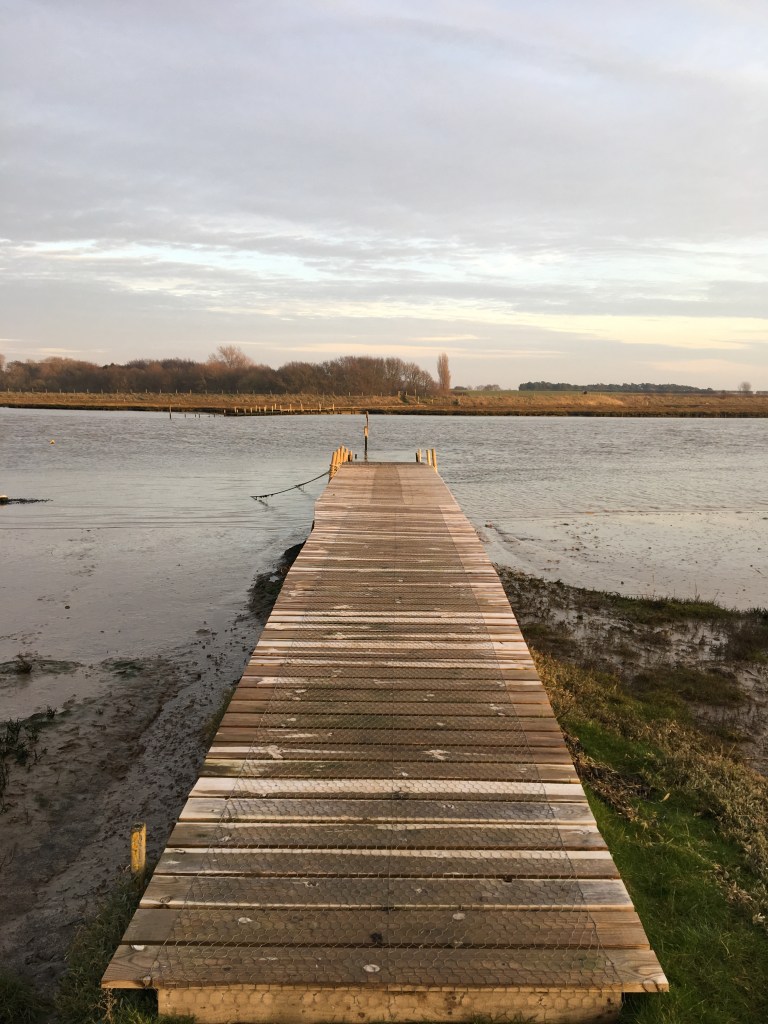
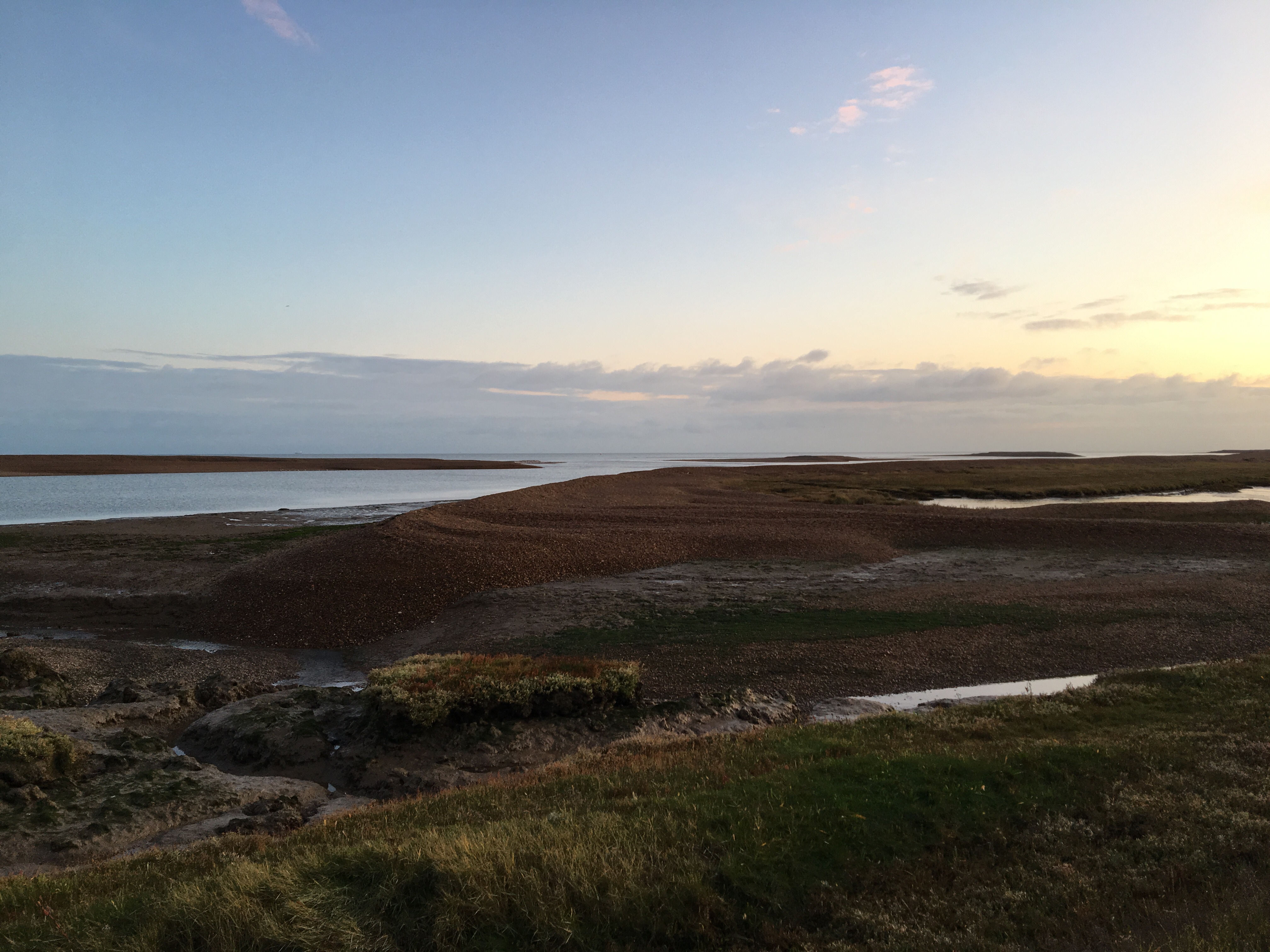
The River Alde just before it reaches the sea at Shingle Street

I thought I wasn’t doing to write about this but it’s unavoidable. My father is dying. We found out at the end of August and he has been given 3 months so we’ll be lucky if he is with us at Christmas. It’s glioblastoma, a stage 4 cancer, or in layman’s terms a brain tumour. Untreatable, unbeatable and life changing: for him – clearly – but for us too.

Every other weekend I come back to Suffolk, the county of my birth to be with him and care for him. There’s not much I can do but help him try to walk to the loo or to where we eat in the kitchen and just be there and talk. We’ve always been good at that and thank goodness we still can. He is affected physically – he gets weaker by the day – but mercifully his mind remains in tact (for the moment). Although what it must be like for him, what he must be thinking I can’t begin to imagine.

That path which he has always been master of now leads him to the cliff edge.

Each weekend I try to keep a couple of hours free to walk the coast. I love walking coast paths. The SWCP is my real goal but Mum and Dad are in Suffolk so I have substituted it with the Suffolk Coast Path.

I started at Bawdsey Quay at the start of September and I don’t know how far I’ll get. I don’t even know where it ends. That’s not the point. It’s the elemental escape that it affords me.

It’s cold as I dump the car on the winding dead end road to Shingle Street, the coastguard cottages starting to be silhouetted against the sky and the moon already above the sea and the Eastern horizon although it’s only 4 O’Clock. I’m still getting used to the day ending so quickly, darkness arriving too quick.

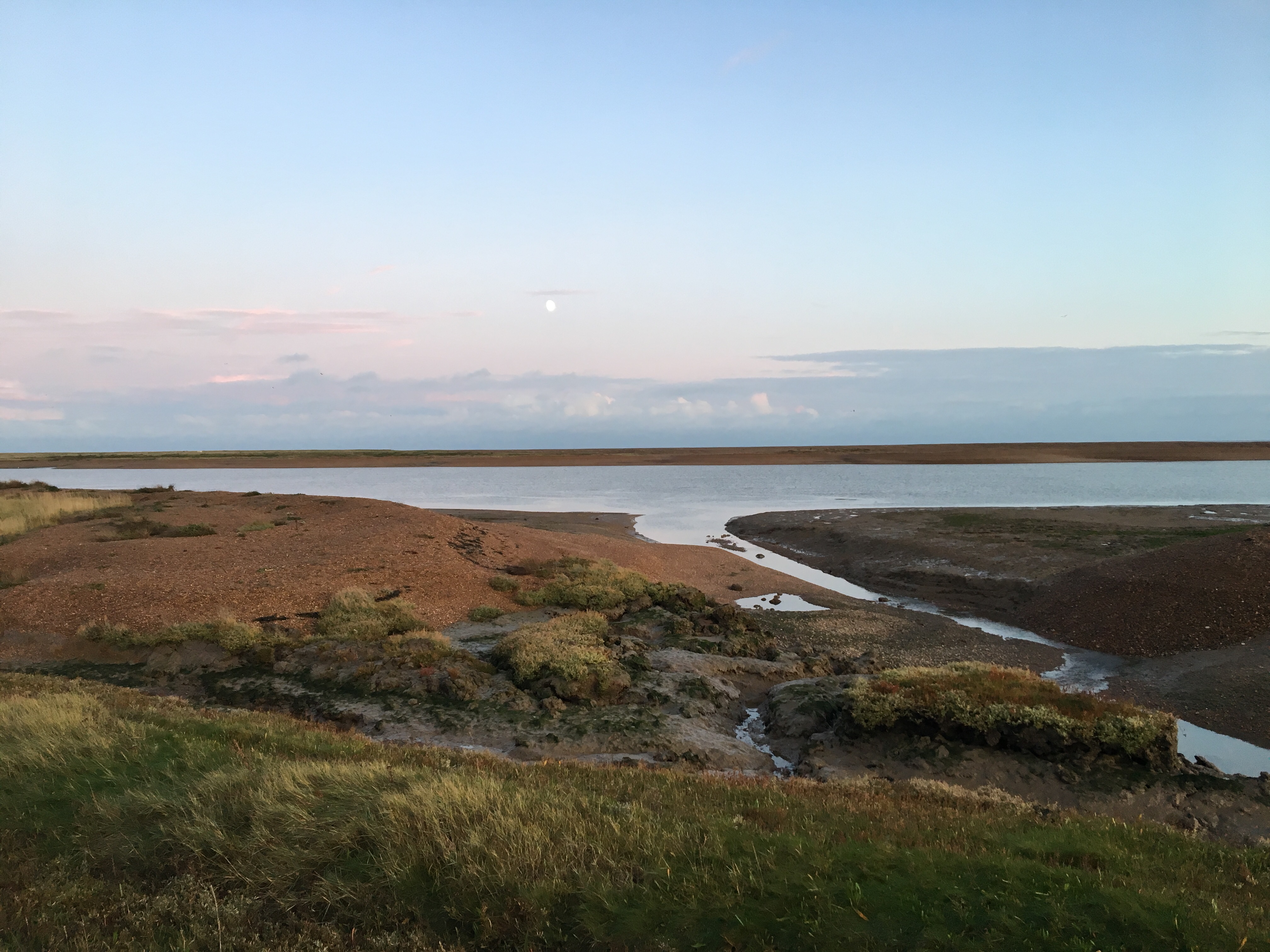
I walk from the road along a stream that joins the River Alde as it reaches the end of its winding journey and joins the sea. Sandbanks rise just a couple of feet above the water where the mouth is and crowds of birds – cormorants I think – stand like a remembrance parade facing the sea. 2 oystercatchers rise up out of the stream making their loud ‘peeping’ sound, no doubt disturbed by my rubber booted tread.

Lots of lines this evening. The many lines of small water courses meeting the river. The line of the bank this side of the tidal river. The low flat line of Orford Ness – now 10 miles long – and just a brown stripe between the river and the sea. The line of the sea as it reaches the sky. Horizon. And finally, beyond that a line of a low bank of clouds, its points highlighted by the pink of the disappearing sun. And above the lines the solitary pale orb, brighter in the cold and, as if by design, a thin line of cloud is settled above her with the symmetry of an eye and eyebrow.

‘Art thou pale for weariness, of climbing heaven and gazing on the earth wandering companionless.’

It’s heart breakingly, life affirmingly beautiful and I shudder at the thought of age and infinity and our lack of understanding.

The grass bank is a sea wall and follows the curves of the river. Holleseley marshes are on my left as I walk North, the sea on my right. I can see 2 orange beaked geese poking their heads up from behind some rushes. A pair, like the oystercatchers, and on alert at my presence. A bit further along is the thin bent shape of an egret, gleaming white in the twilight. I still always feel a little surprised at seeing one. Didn’t they only used to live in much hotter climes like Africa and India? Perhaps I’m wrong.

The light is leaving the Western Sky and I tighten my scarf and pull down my wool hat to keep out the cold.

I pass a birdwatcher and we say quiet hellos to each other.

The River Alde as it meets the sea

To the North, miles up the Ness I can see the jaunty red and white of the lighthouse on the Ness, like a bath toy and the strange Eastern temple-like structures of the ‘pagodas’, a strange word for these buildings which tested triggers for weapons with the ability for unimaginable destruction during the Cold War.

Less incongruous but still in stark contrast to the simple beauty of the flat lines of the landscape around me lies the Hollesley Bay Prison just on the edge of the marshes. It started its life as a borstal in 1938 and for years was a young offenders institution. It still is that but also confines adults too. As I turn my back on the sea across the marshes I can see that it’s made up of several buildings like an army camp or university campus, a dull orange light emanating from it.

Another dramatic transition. From the wildness of the flat Eastern sea and sky to this strangely positioned ‘other’ community. I suddenly arrive from the track into the heart of it. High fences. A meeting of roads. And no one about. They’re all inside (of course). It has a strange feel. A guarded community. But, hold on, here’s 2 young men on the side of the road smoking and chatting carefully in the half light. They watch me approach with the half expectant, half cautious attitude of those used to being avoided or ignored.

I look up as I pass and look at them.’Hiya’, I say.

The white boy takes a drag and say ‘You all right mate?’ He gives me a smile and after I’ve gone I can hear him and his mate laugh. I find out later from mum that it’s an open prison.

The lights are behind me and the natural light is returning and the dark shapes of trees on the roadside. The last light of the sun is off to my right as I head South back towards the car. I think about going back to see Dad and one of his old army buddies who has driven from London with a bottle of Champagne to have one last blast together.

A squat silent black silhouette flies over my head. It’s a tawny owl. Like a fat stealth bomber.

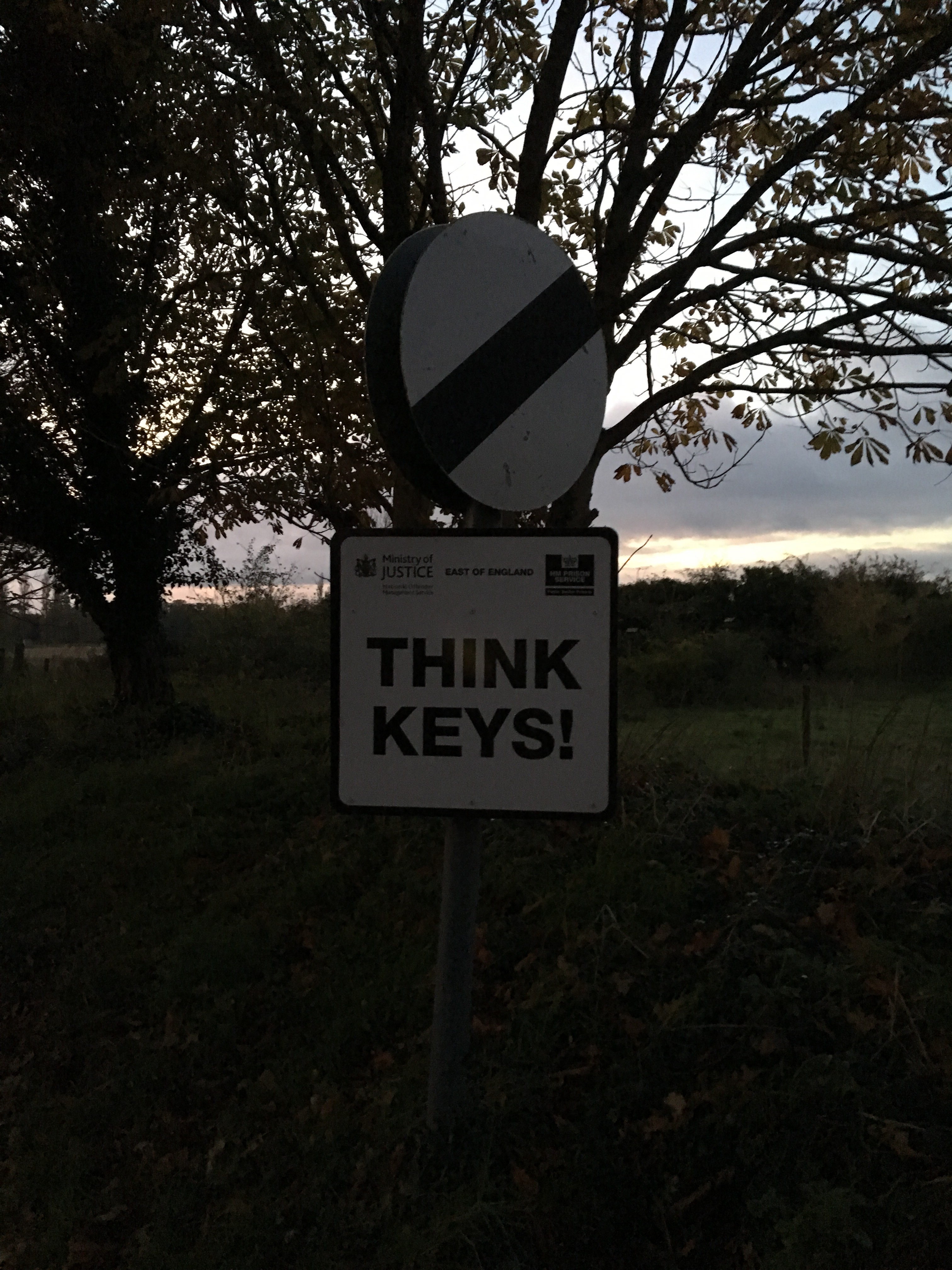
As I reach the end of the Hollesley Bay colony a sign that I’ve never seen before. It’s so without embarassment and must be meant for the prison guards. Isn’t it? I laugh out loud as I imagine someone having forgotten, cursing, and then streams of teenagers running across the marshes, running towards the moon and the sea and the cloudbanks.

SWCP – Whitsand Bay October 19th

I am walking the South West Coast Path very slowly. I started a clockwise route from Studland 3 Summers ago. I met someone last Summer who was doing it in 3 weeks. 630 miles. That’s pretty quick. I tell myself, however, that for me it’s all about the revelling in the time spent amongst people and places that I encounter en route not the feat of having done it. Where will the joy be then when I’ve stopped doing it? No, it’s the little surprises that each twist and turn throw up.

It’s the transitions, the changes that I often enjoy the most: walking up and down steep, chalk cliffs on the Jurassic Coast before suddenly entering an army range and the ghost village of Tyneham (it was requistioned by the government in 1943 to be used as firing ranges. 225 people were forced to leave their homes), walking past deckchairs and amusements on a wet day in Weymouth before crossing the harbour by ferry (one man in a rowing boat) and then starting a quieter, greener part of the path, crossing over the thin neck of Portland Bill and exploring the mysterious cliffs before arriving at the bill in sea fog, the light house sending out a haunting ‘HOOOOOOO’ which echoes into the wall of fog above the sea, climbing a stile and going into the cool, green of a wood or climbing a stile at the other end and coming out into the openness of fields, sky and sea.

It’s easy to make the obvious comparisons with life and the changes, successes, failures and micro dramas that mould us into the people that we are. For me, it’s even easier to feel how landscape is also instrumental in that moulding process.

So, I am picking the path up at Whitsand Bay just after Rame Head.

The night before I stayed at The Devon and Cornwall Inn in Millbrook. I eventually start just before 10 (England were playing a Quarter Final of the Rugby World Cup). The air is cool in these sunken lanes where the banks rise steeply up from the roadside and the meadows continue in strange angles up towards the sky. It’s cosy.

Just out of Millbrook I take a road map marked just as a white way ===. It’s a road because it was tarmaced once but when? There’s no way a modern day vehicle would be wide enough to make it along here. The tarmac is covered with moss and leaves and it winds its way up a hill past Wiggle Farm and eventually to a crossroads where it meets another, more accessible lane. The Autumn sun is stronger and warmer now and to the East lies Plymouth and the humped Loch Ness monster arches of the Tamar Bridge.

I have one of those rare moments where I return to the debate I have had with myself for so much of my adult life – solitude v loneliness. My solitude is not complete – I spend a lot of time with family and friends – but I do spend a fair amount of time alone. Often it’s thrilling and liberating and at others depressing and frustrating. This morning – after a week of not seeing many people and feeling quite alone – this moment makes it seem worth it.

I am on the top now walking towards Whitsand Bay. Rame Head is to my left, the squat chapel on its perfect little hill, even from a distance away showing the light that comes from the windows that are open on both its North and South sides. If I twist my neck further to the left I can see headlands that I’ve passed earlier in the year: Start Point sticking right out into the Atlantic and closer Stoke Point and the rugged little peak of The Mewstone, one rock half a mile off the Devon coast.

I meet a Devonian dog walker with his black and white lurcher. He must be in his seventies. He tells me he grew up in Newton Ferrers on one of those headlands that I was just looking at. His grandfather ran the lifeboat there on the Yealm estuary just with a small boat ‘with one sail’ so he tells me. I wonder how many times he risked his life to save others’.

How thought gets louder and more immersive when walking. I’m aware of the lane ahead and the rise of the land on the right and the drop to the left and then I’m aware of a new line appearing at the end of the road. My mind has misinterpreted it. After a split second what I expect to be another hill is the blue grey of the sea stretching to the horizon. I have a brief sense of vertigo and the excitement I would get as a child seeing the sea for the first time.

And here is the path. I normally slap the wooden sign that signals the next bit of the path as I did when I last left it (I am meticulous about starting the path where I left it – always pausing to take in the exact location of where I am before I leave that section). However there isn’t one this time. So I just give myself a little whoop and carry on.

The lone walker. A group of 8 or 10 walkers with dogs loudly chatter about a mutual friend. I am happy for them but I want to live the walk, the view, the air, the colours without interruption – absorb myself into that picture – and so I pretend to look at the map and let them pass. A chance meeting never to be repeated.

The path is narrow and snakes through the gorse and past the small chalets that nestle in the cliffs over Whitsand Bay with names like ‘Happy Days’ and ‘Blue Haze’. They look like they could be blown off but I’m probably wrong.

The path joins the road that links Kingsand / Cawsand to Freathy. The sun is warm now. Freathy passes. And now I am getting near the shooting ranges of Tregantle Fort.

The slick black outlines of surfers waiting on boards in the sun glitter.

Tregantle Fort is fearsome in its size and design. I wonder what it must look like inside. Huge MOD signs warn walkers not to leave the path. Gravel beds with numbers 1 – 6 look like golf driving ranges but are actually for firing.

I leave the range behind the path and I now bend myself along green banks towards Portwrinkle, clouds clustering into banks or masses – lines of the land, lines of the sea, lines of the cloud banks.

Wind, sun, sea. And nothing else. I am tired by the time I reach Portwrinkle and I don’t know why: probably the beer and a fitful night’s sleep the night before.

Suffolk Coast Path – Bawdsey September 28th

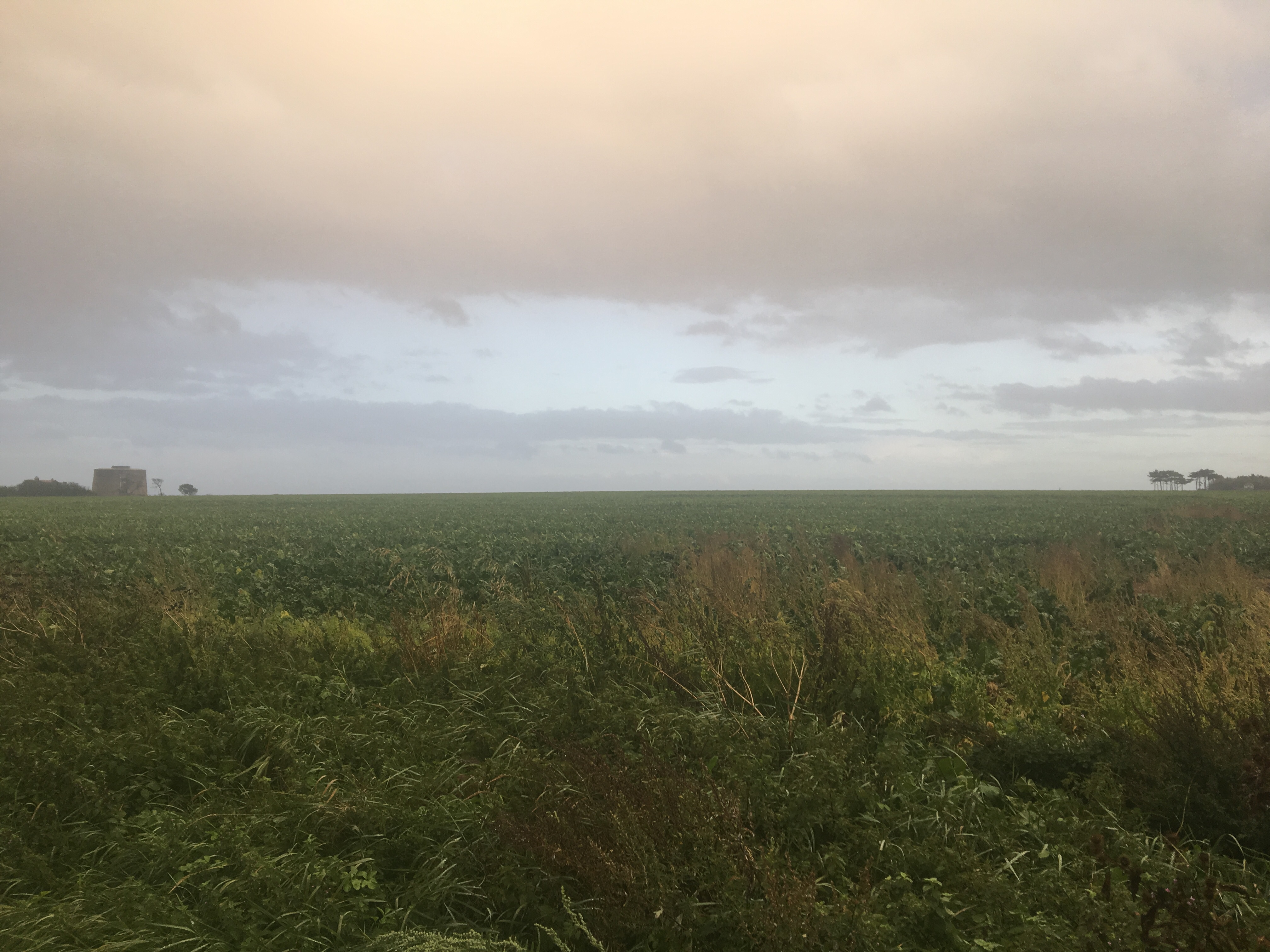
Martello Tower and retreating storm, Bawdsey

Walked on Friday evening from close to Bawdsey Manor up to the first of a chain of 4 Martello Towers that sit squat like giant bollards along this section of Suffolk Coast. I could tell it was going to happen before I even started. Parking up in a field, there was a ribbon of greyish blue above the sea but I noticed a dark mass above the late Summer bareness of the fields.

It’s a strange relief when you have to give in to the inevitable. When something is too big to challenge. I had just got to the beach when the first drops fell tocking my anorak and turning the pebbles dark and shiny. Give in to it. What’s the worst that can happen? Get wet and cold. Clouds merged or interlaced with other clouds to create a slowly moving blanket and lazy rumbles came from somewhere up there, mysterious and threatening. But weirdly, I also felt comforted. I am insignificant. Nothing matters. The greatness of everything overwhelms me and my mind goes blank. A beautiful blankness.

I can’t see much now as the rain comes in great waves and the sky is lit intermittently. Out to sea curtains of rain move in indistinct lines isolated to a certain part of the water. I imagine myself being in it there. I am beside the Martello Tower and the rain is at its heaviest. By standing between the sea and the great round block of brick I am sheltered to a degree from the wind and rain. For a minute the rain turns partially to hail and the sound changes as the ice falls into long grass. Time stretches and I’m soaked but unphased. Making myself disappear into the environment, imagining myself made from clay and then dissolving back into the ground.

The clouds are more eerie now, small organic tendrils stretch out and then break to form smaller patches of grey and disappear and the moment has moved on. And so do I. Back across the fields. Back towards a thin light in the West. A sign that the storm has passed.

Why wander?

I have always walked, not only to explore but to think, see without and within, sometimes to escape. Sometimes I find unexpected things wherever I go. Often I discover things about myself. Sometimes it’s extraordinary and at other times disastrous but there’s always something interesting to find and that’s why I keep doing it.

This blog is about my walks – the places I visit and the people I meet – but will be about my own journey too which may explain why I feel the need to do these walks. I hope you enjoy the journey.

My First Blog Post

Why wander?

Hello and thank you for following me as I wander. This blog is about walking but also what happens to me when I walk. That is – like with many of us – I drift, not off the path, although that often happens too (and that can be sometimes rewarding or challenging). No, the ‘drift’ that I’m referring to is the thoughts that occur as I walk. I like to refer it as slow walking. The priority is not so much the exercise or reaching the end but the experience: what I sense, think and feel.

First and foremost I love the experience of walking. The landscapes, topography, plants, wind, light, wildlife and people I meet are a never ending fascination to me but also the experience often (not always) can inspire memories, thoughts, stories and physical happiness. And sometimes I get wet, cold and miserable too. Yet that is all part of it. I’m never sure what there’ll be. It’s all about the novelty of the adventure. I hope you enjoy it too.

James Rogerson November 2019

Introduce Yourself (Example Post)

This is an example post, originally published as part of Blogging University. Enroll in one of our ten programs, and start your blog right.

You’re going to publish a post today. Don’t worry about how your blog looks. Don’t worry if you haven’t given it a name yet, or you’re feeling overwhelmed. Just click the “New Post” button, and tell us why you’re here.

Why do this?

  • Because it gives new readers context. What are you about? Why should they read your blog?
  • Because it will help you focus you own ideas about your blog and what you’d like to do with it.

The post can be short or long, a personal intro to your life or a bloggy mission statement, a manifesto for the future or a simple outline of your the types of things you hope to publish.

To help you get started, here are a few questions:

  • Why are you blogging publicly, rather than keeping a personal journal?
  • What topics do you think you’ll write about?
  • Who would you love to connect with via your blog?
  • If you blog successfully throughout the next year, what would you hope to have accomplished?

You’re not locked into any of this; one of the wonderful things about blogs is how they constantly evolve as we learn, grow, and interact with one another — but it’s good to know where and why you started, and articulating your goals may just give you a few other post ideas.

Can’t think how to get started? Just write the first thing that pops into your head. Anne Lamott, author of a book on writing we love, says that you need to give yourself permission to write a “crappy first draft”. Anne makes a great point — just start writing, and worry about editing it later.

When you’re ready to publish, give your post three to five tags that describe your blog’s focus — writing, photography, fiction, parenting, food, cars, movies, sports, whatever. These tags will help others who care about your topics find you in the Reader. Make sure one of the tags is “zerotohero,” so other new bloggers can find you, too.