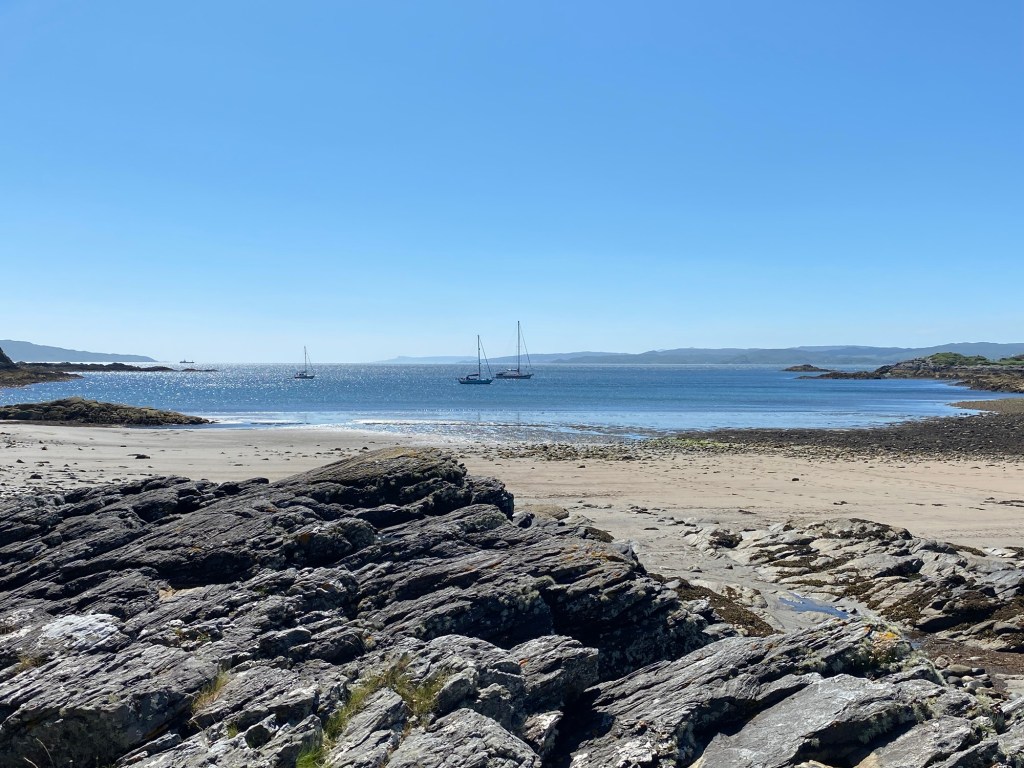
From the beach at Sandaig I am looking out over a mass of sea glitter down the Sound of Sleat, with Eigg a pale, flat form on the horizon. Its Sgurr, meaning ‘high pointed peak’, rises vertically at its southern end from a low rise of land and then tapers down to the north along the back of the island. Emily, our first mate on board Zuza, who is from the Sound of Mull, said it looks like a shark’s fin and so it does, like a leviathan risen from the depths swimming across to Skye.
In the foreground Zuza lies at anchor, a low white glistening line in the glitter, her red ensign, flapping and stretched to its full extent by a stiff northerly wind reaching down to us from the North Atlantic. Zuza is a 72 foot exploration and expedition vessel built in Cape Town in 1998. In her time,she has done voyages in the Arctic and Antarctic but is now used for live-on-board group sailing and sightseeing trips like this, the 3 day trip I have booked from Ullapool to Mallaig.
She has sleek lines, is painted white with a blue stripe down her sides and halfway down her length the deck becomes slightly raised with windows (the galley) and then at the back the cockpit rises up more so that it appears there are two raised blocks at the back of the boat which it gives it the air of a Turkish schooner, albeit with a fresh, modern design.
I joined Zuza at Ullapool the day before yesterday with five other guests and three crew. |It’s an eclectic mix – as always – and there is the usual slow burn of getting to know and used to one another. From Ullapool we motored north west under a deep blue sky through the Summer Isles, past cormorants and skuas and then down into the sea loch of Loch Ewe on the mainland for our first night. Yesterday we headed south to the west coast of the Isle of Raasay, only a few miles east of Skye and dropped anchor in Churchton Bay for our second night.
Only a couple of hours ago we had sailed through Kyle Rhea, the narrow channel that lies between the most easterly part of Skye and the remote chunk of land that is almost surrounded by water between Loch Alsh and Loch Duich to the north and east and Loch Hourn to the south. It was the most exciting part of the journey so far: setting off from Churchton Bay, passing round the southern tip of Raasay and then passing under the Skye Bridge and Kyle of Lochalsh. It was here that we turned south from Loch Alsh into Kyle Rhea. Zuza,with only her yellow foresail bulging with wind on the bow, was rushed along by a rising tide that funnels into the channel and creates strange movements on the surface of the water, like spools of thread looping and unfurling in circles and lines all around us, as the currents merge and twist over and around each other.
One of the crew said ‘It’s like lots of mini Corryvreckans’, a reference to the notorious stretch of water not far from here, near the Isle of Jura where in certain conditions an underwater point of rock creates the world’s third largest whirlpool and renders it unnavigable.
From the rocks I’m sitting on I look across the sandy and pebble strewn beach across the sound to Sleat, the southern peninsula of Skye.
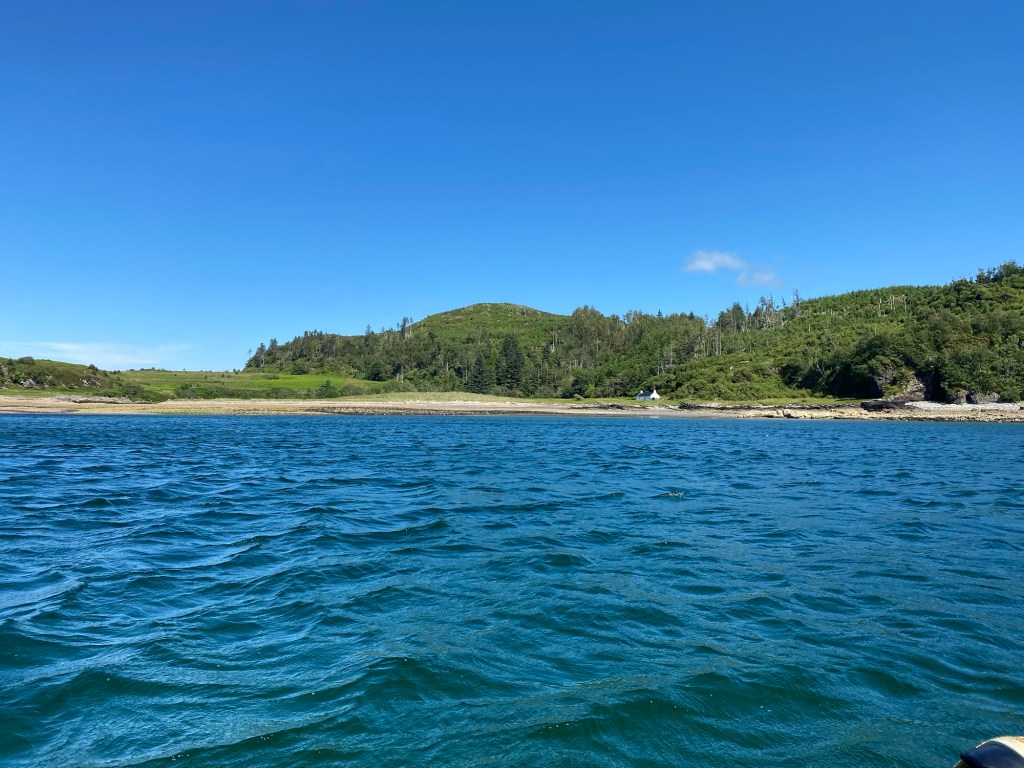
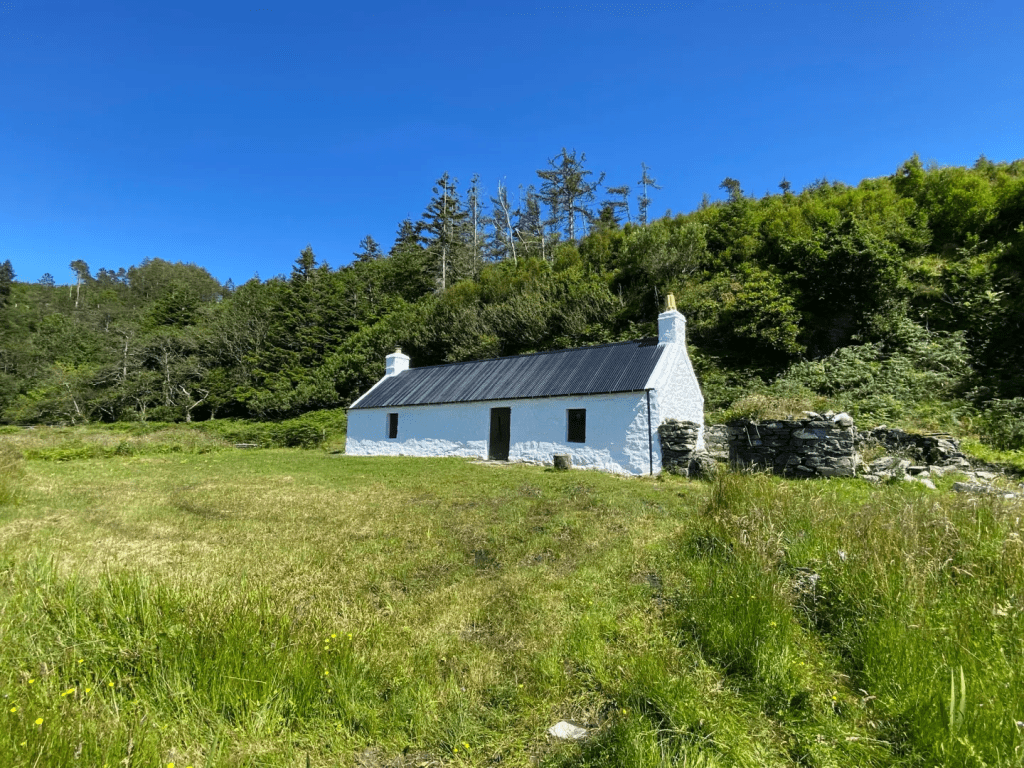
It feels utterly cut off here. There is only the sound of wind in the trees mingling with the rush of running water, which are so alike they seem to blur into one. There is a river that runs shallow through the wood and then flows out onto the beach. There is one Crofter’s cottage, end on to the beach, newly white washed but with the windows and door frame filled with rusted iron plates. It looks entirely shut up and disused and makes me wonder why it has been freshly painted.
Behind the cottage is a wood of fir and ash and just inside its perimeter the remains of another building with just the stones of the walls remaining.
The land in front of the house is covered with grasses and bracken that is being buffeted by the wind. There are also long stemmed buttercups and pink clover. Amongst the bracken are tall foxgloves nodding in unison in the wind.
It was in this wild and remote place that the writer Gavin Maxwell lived in a lighthouse keeper’s cottage and wrote Ring of Bright Water about his experience of life with his adopted otters . He named this place Camusfearna, meaning ‘bay of the alders’, and first started using it as a writer’s retreat in 1948.
The book at one time was the best selling non fiction book in the UK and US and has now sold over two million copies. It was also turned into a film. It is a story about a man escaping the city and starting a new life to be closer to nature. Much of the story is enlivened by the otters’ fun and mischievous behaviour and his relationship with them.
Maxwell’s first otter, Mijbil, known as Mij, had been given to him by the great explorer, Wilfred Thesiger when they were together in Iraq, travelling and living amongst the reed marshes which formed the basis for probably Thesiger’s most famous book, The Marsh Arabs.
It was Mij that Maxwell brought back to Britain, initially to live in his flat in London but then who he brought to Sandaig as the first of his otter companions.
Being here it is tempting to imagine how Gavin Maxwell lived a life of simplicity and harmony – or perhaps this is what he craved – as the reality of his later life was far more complicated.
For many years he had a close friendship with the poet, Kathleen Raine. It was from one of her poems that the line ‘ring of bright water’ was taken, although he didn’t acknowledge this in the book. She was passionately – and perhaps obsessively – in love with him, but, being gay, he refused to have a relationship with her (he did eventually marry Lavinia Renton, a relative of Thesiger’s which added to Raine’s hurt and frustration, but it ended after a year).
Maxwell and Raine’s relationship was tempestuous and marked by frequent arguments. It was after one of these rows here at his house on a stormy night in July 1956 – exactly 70 years ago – that Maxwell threw her out of his house. Raine returned later that night and, holding onto a Rowan tree near the house, spoke a curse: “Let Gavin suffer, in this place, as I am suffering now.”
Raine later blamed herself for the misfortune that befell Maxwell at his remote Scottish outpost.
It was her who let Mijbil run wild one night and as a result he was killed by a local road worker with a pick axe handle (as described in Ring of Bright Water). That wasn’t all. In 1968 Camusfeàrna burnt down, killing another of the otters, Edal, who was shut in an enclosure, and destroying most of the writer’s belongings. It was only a year later that Maxwell himself died, by then having moved to the small island of Eilean Ban which I had passed earlier and now carries one part of the bridge from the mainland across to Skye.
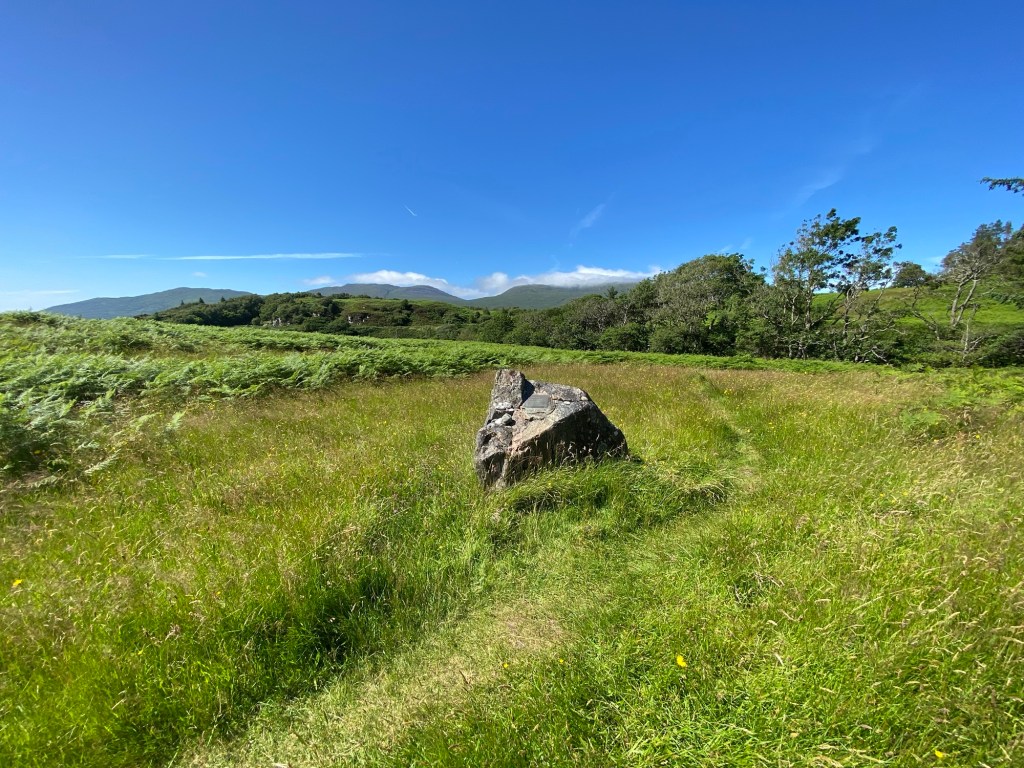
Standing here, there is nothing left to suggest there was once a house here. Now where it once stood is a boulder and a plaque under which Maxwell’s ashes have been buried. The boulder has been put in the place where his writing desk once sat; the ashes were placed here by Jimmy Watt, who Maxwell employed as an otter keeper, while the grieving Kathleen Raine looked on.
The plaque reads:
‘Beneath this stone, the site of Camusfearna, are buried the ashes of Gavin Maxwell b. 15th July 1914 d. 7th September 1969.’ Shells and pebbles from the beach have been placed around it.
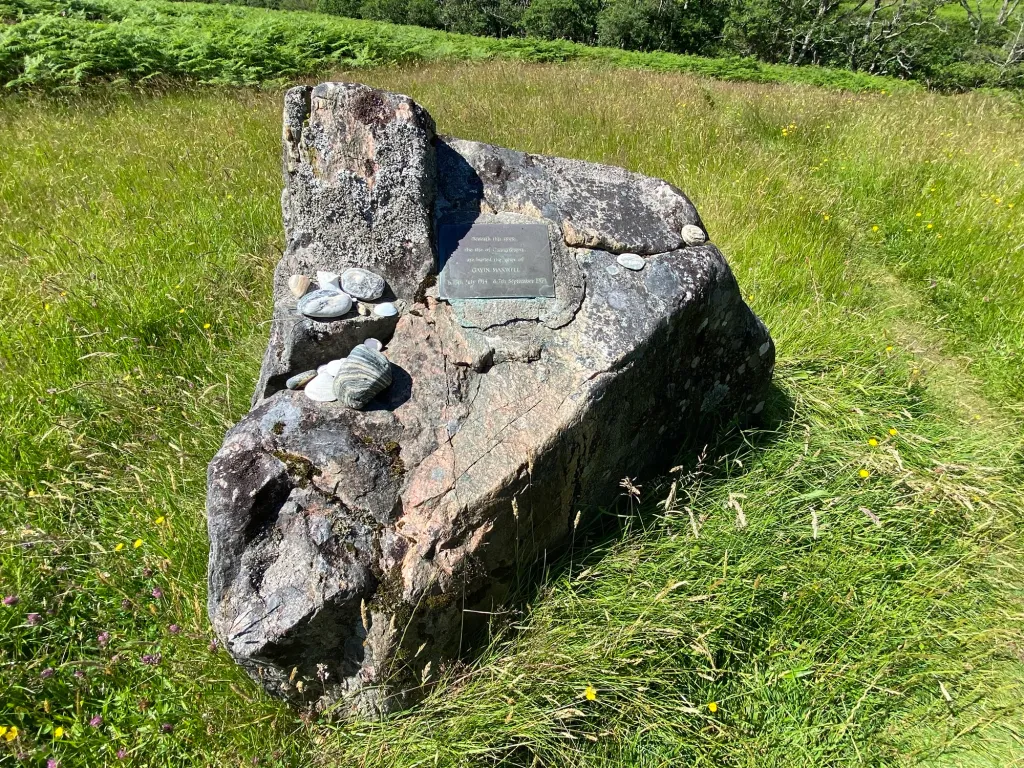
Although I don’t remember reading the book, I was aware of it when I was at school and people often talked about it. Standing by his memorial where his house once stood I felt a sudden heaviness in my chest – a great sadness about this man and his otters and their bad luck. I was struck by the contrast between the simple beauty of the place and the strange and dark story associated with it. This is where the nature writer appeared to find happiness but this was then undone by the success of the book and film as people started to visit his personal paradise. According to Terry Nutkins, the naturalist and TV presenter, who knew and worked with Maxwell, he couldn’t cope with his success: “But he didn’t want anyone to know that so he started drinking more, started smoking more”. A heavy smoker already, it was probably this that contributed to his death from lung cancer at the age of 55.
Behind the memorial to him is a large fir tree under which lies another memorial made of a stone block and topped by more pebbles and rocks. This is here to remember Edal, Maxwell’s otter, that died in the fire that destroyed his house in 1968. A quote from Maxwell on a plaque on the memorial seems to be fitting for this place and might be said to represent his own feelings about life: ‘Whatever joy she gave you give back to nature’.
With these words still in my head I feel my way through long strands of boot lace weed into clear, still and bone-numbingly cold water. Here with me once again is the familiar sharp intake of breath and the tingling sensation throughout my limbs as I lie on my back with sun sparkles in my eyes and a feeling of utter thoughtlessness.
When I surface I sit crouched in the water looking across the bay and imagine the dipping, twisting sleek shape of an otter, its coat glinting in the sun, as it dives, leaving small disturbances on the surface of the bay like the circling currents I witnessed earlier in Kyle Rhea, before the surface of the water finally flattens and lies still.