Felt a bit strange today. Woke up early in a lovely dream state and lay in bed listening to nothing but the low hum of the wind and the infrequent clicking of rain drops blown against the window panes.
So excited to escape the city even if it’s just to the perimeter. There’s something dystopian about it all. And these are dream days. Days to dream when there’s nothing else to do.
I park at the Shell garage on the A38 and as always smile at the return to the point that I left at last weekend.
Back into muddy boots
The path leaves the road and starts heading straight up the slopes towards Dundry, every step the man made noise and images retreating. It’s really muddy. Slop. Slop. Gurgling, rushing sounds each time I put my foot down.
Immediately I’m lost in the moment. Thoughts expanding, the surroundings a backdrop to my inner voice much louder going over events, messages, decisions, some things weighing heavy on me but I knowing it’s my own voice, own mind that assumes stuff that is probably wrong. Think of nothing. It works.
Walking uphill is a great way to focus the mind. Get into the groove and focus on steps and breaths. Water is everywhere. Trickling, bubbling, overflowing – little streams running everywhere following the rules of gravity.
Path channelPath stream
What is it that’s so soothing about running water? There’s so something so playful about it it’s almost by design.
I reach Dundry quickly. It easily has the best views of Bristol and I sit on top of the cairn and eat sandwiches feeling smug as I look at Clifton, my home, the bridge, observatory, then move slowly left to the Severn Bridge, from here just next to its smaller more beautiful counterpart, then the steam coming from Avonmouth and dramatically the channel and the hills of Wales in the background.
Cairn, Dundry
The ridge seems simple. I climbed up. I’m on it looking along it for a few minutes. Then I’m coming down the other side, a whole new landscape appearing. The city had disappeared and the Mendips are laid out before me with the 2 big lakes of Chew Valley Lake and Blagdon Lake, sitting mid distance my view looking left to right as I head South.
A young farmer belts past me in an Isuzu 4×4 opening the gate and then shouting at me
‘you all right to shut that?!’
I raise a gloved thumb and thank him. Good to have some communication. As quickly as I came up I come down to Winford. More stiles, rain-soaked ground and slish sloshing and slipping along until I reach a strange structure. Is it a water pipe? It’s clearly old, judging by the brickwork holding it up.
Pipeline? Winford
Across one meadow and I reach Winford church, like many churches enlivened by an ever rotating crowd of jackdaws noisily fuss around the time, flying, circling, landing and constantly chattering.
I always intended to finish the coast path and reach Lowestoft before the end of the Summer holidays. It would mean I would end it pretty much exactly a year after Pa was first diagnosed with Glioblastoma. I hoped there would be a neatness to it. I didn’t expect anything else – just the satisfaction of a route completed.
Today I only expected to get as far as Kessingland, a place one vowel short of having one of the sweetest place names ever. But what I’ve realised with these walks is how, like in life, there is often little point in making predictions.
I’m excited about my return to Covehithe. Guess what? It’s another magnificent day. Warm and cloudless, the sky a deep Mediterranean blue. There aren’t so many cars today.
Here I am back at the church within the abbey walls. The road rolls past. There’s a barrier across the road and then it starts to narrow as the hedgerows encroach on both sides. It looks like a path but I know it’s a road.If you look closely you can see the tarmac and you used to be able to see the road markings down the middle. It goes in a straight line until it stops at the cliff edge. And there is nothing but the tea-coloured North Sea. Where did this road go? However much I try, I can’t imagine where it went, what shape it took, how long ago or what else was here.
I can only see the road ending and the sea.
The road to nowhere, Covehithe
From the end of the road I turn left North along the cliff top. The sand cliffs are honey coloured and crumbling. There isn’t a designated path here, I don’t think. There’s no sign for one and nothing marked on the map but people are still walking along here.
A couple look at me expectantly as if they are probably having that same thought: are we doing something we shouldn’t? Is this person going to tell me off? In the ‘new normal’ of our Covid world I sometimes notice a heightened wariness or anxiety of those around us. We have become used to seeing people as either a potential threat, either a carrier or a critic, someone who might report you for not abiding by the latest restrictions.
I only walk a couple of hundred metres before I notice a small landslide in the cliffs to my right. It offers a perfect way down to the beach and I rush down it, making a final leap onto the sand and pebbles of Covehithe beach.
Covehithe beach and cliffs
Sand martins nest here and create many holes in the soft cliff face so that it appears like honeycomb. They are one of the earliest to arrive (March) but also the first to leave (August) so they are reaching the end of their long Summer sojourn.
Sand martins’ nests, Covehithe
I am progressing North as always, getting close to Benacre Broad and here are more of the strange beach trees that inhabit Covehithe beach. There are a family up here using the old skeletal branches as a washing line for drying all their swimming gear and towels.
Beach trees, Benacre
And now it is a wilderness. As foreign and timeless as life itself. Those trees will slowly get paler and smoother and then get washed away. As little and subtle as a breath. And I keep walking.
There are more reminders of defences here and the unstoppable force of the North Sea. Just as the trees are half buried in the sand so an old World War 2 pill box lies at an angle almost wholly swallowed up by the ever shifting sand.
Passing Benacre Broad to my left the beach opens up and flattens out as it stretches North. Soon I am at Kessingland Level, another area of marshland where the Hundred River spills out into the sea. Here are more reminders of the constant battle to protect this part of the coast.
Huge bags of sand are being used to create sea walls. You see them everywhere here. Then they are covered with long lengths of carpet-like material. Unfortunately, this eventually gets ripped up by storms and left in great swathes along the East Anglian Coast.
Sea defences being built, Kessingland Level
Kessingland arrives soon after. Here the beach is sand bordered by a broad strip of scrubby, bumpy land that reaches the town. There is something faintly surreal about this place. It has all the air of a purpose built resort. It feels unlike anywhere I have been through yet on the coast path. Transient, a bit tacky, a bit soulless.
My assumption is that it’s mainly a holiday destination but in fact an information board tells me there’s a permanent population here of 4200 which then doubles during the Summer months. Apparently it used to have a huge herring fishing industry here, even greater than Lowestoft, and Sir Rider Haggard used to holiday here.
The path here briefly becomes a concrete track reminscent a storm drain in LA. The sun is still high. It is only mid afternoon and Lowestoft shimmers on the horizon. There lies the end of the path. It’s one of those many those ‘toss a coin’ moments that I have when I’m walking alone. How I love it – the devil may care attitude of a person endowed with time and freedom to use that time as he wants.
Beach Path, Kessingland
Yet another transition as I leave the holiday homes, caravans and dog walkers behind. Always happier away from the crowds. It seems like I’ve been running away from people most of my life. Being sent away to school at 8 made me independent and solitary in a way that has stayed with me for good.
A sudden turn of the corner or crossing a stile and a totally new scene can unfold. Here is a quintessential late Summer Suffolk scene. The pale yellow stubble, pale blue sky and slightly weaker light a reminder of so many previous Summer ends. Yet this one so much weirder. Another gone and that slightly sickening thought of the return to school. Yet I must move on. Every episode must come to an end and this one is almost done.
Suffolk stubble and sky, Kessingland
This is a fleeting moment. Minutes later I am wandering up the drive of a huge holiday park towards the road into Lowestoft. I am entering a different phase – I can feel the effects of getting closer to Lowestoft: busier roads, more people, adverts, litter.
I pass another caravan park and stop to take a photo of washing on a line animated by the East wind, only half aware of a white Range Rover with tinted windows somewhere in the background. As I walk away from the washing line the Range Rover pulls up ahead of me, the tinted passenger window slowly whirrs down while at the same time a huge, tattooed man beckons me silently and threateningly towards him with his index finger.
What is this? We’re easily within earshot of each other but I respond with my own signing, looking behind me before pointing a finger at myself. ‘Me?’ I hope it communicates before I shout out ‘What’s up?’
‘You taking photos of kids?’
‘No, I was taking a photo of this washing line.’
I don’t know which of us sounds more crazy.
He points behind him and I think he’s imagining kids playing on the grass near the washing line but there aren’t any. It’s only then I realise that he’s talking about the kids in the back of his car.
Even if I was a predatory paedophile, would I really be taking photos of children in public? Where do these people get their ideas from? I curse and walk on.
A seemingly harmless washing line, Pakefield
I am now on the A12 entering Lowestoft somewhere that – although I’ve been in Suffolk on and off most of my life – I’ve never been to before. Dad knew it. I can remember him in a dark suit heading off to work. He was a sales rep in those days and Lowestoft would be one of the many places he used to do business.
I pass the sign that welcomes me to Lowestoft ‘Britain’s most Easterly town’ and at the first roundabout turn right, back towards the sea. Forever by the sea.
This is actually Pakefield Cliffs and beach. I’m not in Lowestoft proper yet. This is quieter and more gentile.
Pakefield Beach
There is something bygone and unspoilt about this place. There are a few families and couples sitting in deck chairs and a woman on a horse.
Pakefield Beach
Further on little fishing huts, faded dinghies and rusty winches are strewn here and there. Just here this is a working – not a pleasure – beach. It reminds me of Sizewell. The look of it might have been the same 40 or 50 years ago.
Pakefield Beach
There’s a curve to the coast here. Everything follows the same stretched out inverted S – a beautiful, curvaceous sibilance drawing me North like a slowly let out breath. The path follows the curve and so do the multi-coloured beach huts swinging slowly round until they disappear at a point where the beach seems to meet the sea like topographical art.
Curves, Pakefield Beach
There’s something rather refined and old school about Pakefield. There’s another imperceptible change and suddenly I’m in the wide streets of Lowestoft. This is the first time that I really feel like I’ve walked through a town. The path passes through Aldeburgh but it just brushes the outskirts, passing The Red House, Benjamin Britten’s old place before reaching South Warren and then the sea.
After 10 minutes on the streets yet again I’m heading back towards the sea past a bowls green and tennis courts and onto a wide pedestrianised promenade. I am pulled up short.
On the right is a wide band of perfect sand, a long continuous soft beige scarf that drapes itself along the coast. It is possibly one of the most beautiful beaches in the UK.
Lowestoft Beach
All the world and their mums are out in force today. It’s a surreal end to my journey after so much flatness, bareness, greyness.
The promenade, rust red like a cycle lane carries on towards the first of the piers, Claremont Pier, where people are gathered in groups doing all those things that we associate with a British seaside resort: eating ice creams, drinking beer, playing on the amusements. There is a police presence here. Is that due to Covid?
It seems fitting somehow that everything feels so very different from last year. It’s taken me a year to come to terms with Dad’s diagnosis, decline, death and aftermath. Yet now I feel like I’m moving on.
A little bit further on I start to feel the end drawing nearer. South Pier is a white line half a mile ahead. The end of the path.
I pass a rather weather-beaten but impressive statue of Triton on the esplanade. The statue was commissioned in 1849 and designed by John Thomas. He is holding a cornucopia and surrounded by dolphin heads.
As the son of the Greek god of the sea, Poseidon, he seems a fitting emblem to finish my walk where the sea has almost always been my constant companion. I stand and stare at him for a whole ten minutes.
Triton, Lowestoft
The South Pier is suddenly just ahead of me and I slow down and stop. Suddenly hesitant. Like the change in the path – the transition – I have that sad feeling of never being able to go back. We are always creating the past, it unfurls behind us like vague tracks in the sand, disappearing into our memories which in turn, will fade.
It’s that mixed feeling of exhilaration and sadness when a brief phase of my life has come to an end, like the end of the school year or the end of a trip abroad.
Without even realising it I am at the end. At South Pier. I mill about and for a while I appear at a loss as to where to go. I look at the amusements. I stare into the worn old eyes of the second triton, he so mighty but somehow reduced, holding forth in front of the amusements and the fish and chip shops.
I look back the way I’ve come but I can only see streets and people swarming along the promenade. I flick back through my mental photo album of the last 11 months. The strange twists and turns. Have I learnt more? I guess only what comes with experience and growing older…..
Grief. What was once like a stabbing pain in the heart and intense shock like a moment of violence or a car crash has become diminished by time. What was once an open wound is now a dull ache underneath the skin. I wait for time to dull the bad memories and leave me with the good. And as it always has, the path has helped – has taken me away from that which disturbs me, away from myself. Footsteps placed one before the next. Thoughts growing. Mind lost. It’s a glorious healing and if I’ve learnt anything it has been to rinse every last little drop of the time that has been allowed me. Who knows where to next?
I draw my gaze from the statue, say a word for Dad and head towards the bus stop that’ll take me south back to his home.
How many beautiful days this Summer? And what an elongated Summer because of lockdown. Even at the start in early April the weather was warm and barmy. It’s added to the surreal nature of the whole situation.
Today is no exception. It’s warm and cloudless but there is a constant breeze that refuses to allow the day to become too hot, a relief for those walking abroad as I am.
One morning a few years ago I woke early, between 5 and 6, and drove through quiet, deserted lanes to Covehithe and from there walked to Southwold for breakfast and then back again. A blissful, carefree Summer morning near the start of the school holidays. Unplanned. No expectations. These are often the occasions which seem to create some of the most intense memories.
This is a favourite stretch of coastline for me, like Thorpeness and Aldeburgh, redolent of happy memories of Summer. I think 3 Summers ago I was suddenly into being up early and seeing the day start (just as this Summer I have been into sleeping out under the stars).
You’d have to be a very early riser to avoid the sort of crowds that have been descending on the East Coast this Summer holidays. I don’t blame them. One blessing that could be taken from Dad declining and then dying during lockdown was that we felt we were able to bend the rules a little.
Today I park in the car park next to the pier. It’s only 10 am and the breeze makes me tingle like a seaside kiss. Why hasn’t someone written a book about winds? The different winds on earth and their impact. From the roaring forties to desert sand storms to tropical hurricanes. That would be a good read.
The path immediately heads away from the sea across Reydon Marshes. Southwold soon becomes a small cluster of shapes on the Southern horizon, its white lighthouse protruding above its houses. I normally think of lighthouses on remote promontories but love the fact that in Southwold it’s right in the middle of the town cosied up to the houses, pubs and Adnams brewery.
Southwold and its lighthouse recede to the South
Another transition. Places appear, enfold me then retreat into the distance. The process of moving through time.
I remember the lovely red and white bath toy lighthouse on Orford Ness. During those grey Suffolk days over the Winter when I walked to take a break from looking after Pa it was a marker. Something to head towards as I headed North. It had stood there for 228 years. Yet last month it got dismantled. Block by block. And the last time I saw it only the base was standing.
‘Nothing beside remains’.
I’ve stopped seeing Dad in the world around me now. I often talk to him as I walk and I revisit memories of him. It’s amazing how we just move on. I thought I would be changed forever. I was wrong.
After passing the red brick houses of Reydon I have that wonderful realisation of leaving a town and gradually being absorbed back into the countryside. I arrive at the fabulously named Smear which as far as I can tell is no more than a few houses built on a bend in the road. A smear of houses?
Later with Mum we get out the Oxford Dictionary of Place Names. We can find nothing under Smear although there is a record of Easton Bavents, the crumbling low sand cliffs, much loved by sand martins that line the beach just North of Southwold. Bavent was the name of the local – probably Norman – landowner I think in the 13th Century.
From Smear I start zigzagging cross country North a bit, then East a bit, as always delighted by a sudden turn in the land or view that I’ve never seen before. A rare gift when most other people are screaming past in their packed 4 X 4s oblivious to these hidden gems always waiting to be discovered.
The path meets the Southwold to Wrentham road and I head North – always North – feeling the heat off the tarmac and the breeze in my face.
From the road I am relieved to get onto a track, marked as a bridleway and not the designated path (the rough walks path across the marshes is closed). I am behind Easton Wood that borders the sea. I think of the book I’m reading on Coleridge and his extraordinary relationship with nature. He believed in a harmonious relationship between God, nature and human beings. Perhaps it seems far-fetched or fanciful yet there is something transcendent about the impact of nature.
I often wonder if I feel this more intensely than most. I’m not sure if others are so moved by the sun filtering through the leaves of a beech or the feel of wind and sun on skin or the smell of sea after time away from her or the sound of waves. These moments – never predicted or expected – seem sometimes to be more joyous than anything else I’ve known.
I stop for one of these moments and float amongst some old oak trees along the way. One is just a hollow shell, its wizened fork and the main trunk the only remnants of this once vast and great thing. Small cobwebs flap and shine in the wind at its extremes like a pennant on an old ship.
This moment is beyond words in its experience. Something like the experience of ‘feeling’ the natural world when in the group of a strong hallucinogenic. I start to imagine that there is an unspoken communication, something ancient, that is beyond language in the way we connect with the world around us. Is this what shamanism does?
Tree Remains near Easton Wood
Nearby a whole avenue of trees flank a track to the sea like a grand avenue leading up to a stately home. I think they are beeches. Their leaves are fluttering, quietly whispering, undulating like the distant sound of waves. Like the earth’s breath. I stop and listen and breathe and listen again. Absorbed. Absent from normality.
Avenue of trees leading to Benacre Broad and the coast
A track reaches a road and the road leads straight to the coast. I am getting close to Covehithe. This has always been the place to come for remote Suffolk seaside. There are barely any houses here, only the dilapidated walls of the old abbey within which the new, smaller church nestles. It won’t be too long before the sea will reach those walls and it’ll cave into the sea like at Dunwich. According to Wikipedia ‘Covehithe has the highest rate of erosion in the UK’.
There are two things I always remember about Covehithe: there are always tree trunks washed up on the beach, some half buried in the sand and many smoothed and sculpted by the tides. I know of no other beach which has this.
Beach trees, Covehithe Beach tree, Covehithe
The second is the road that runs straight to Covehithe. In fact there are two – both straight lines – that meet in a fork just before the church. The road then continues straight towards the cliff and the road literally disappears off the cliff. I’m sure I remember at some point you could still see the lines that run down the middle reach the cliff. Where did that road go? To see it now it’s nothing more than an overgrown path but the tarmac is still there.
This is where I leave the path for today but I have the long walk back along the beach to Southwold to get back to my car. It is my birthday celebration tonight at The Ramsholt Arms. It’s the first time Mum will have been out for a meal unaccompanied by Dad. It’ll be emotional but also a step in the right direction.
The heat and haze remind me of another continent. It doesn’t look or feel English. The beach here is so wild it seems in my mind’s eye like a fantastical desert.
Covehithe Beach and Cliffs looking SouthSun clouds
Again I feel myself getting truly lost here. Sky. Sand. Wind. Sun. All thoughts disappear. And only feelings exist in a timeless place. And then the thought of a swim brings me back to a sort of reality. The thought takes me from one dream and makes me deliberately dive into another.
Halfway between Covehithe and Southwold I spot a young seal pup still covered in white fur. Flopping towards the water. I remember 2 years ago finding one similar to this at Covehithe and trying to force it into the water but it wouldn’t have any of it.
This one makes it into the breaking waves and plunged under and I see its domed head pop up about 100 yards out looking back to shore and towards me.
‘Yes’, I say to myself ignorantly. A few minutes later it has swum back onto the beach a bit further back from where it had taken off. And it flops back onto the sand looking bewildered. Deserted.
Do their mothers abandon them? It seems seal pups like this are unable to fend for themselves. Who knows what will happen to it? I leave nature to take its course and head to Southwold to a packed car park and the hordes of holidaymakers.
Today is my birthday. 46 sounds very different to 45. How did it happen? I still sometimes get confused about my age. Am I 45? Or am I still 38? When we’re young we never heed the warnings which I hear myself saying to young people now: ‘make the most of your youth because one day..’
How different this feels to the last time I was here. The school holidays are underway. Lockdown has been eased up. More people are holidaying in the UK. And the hordes are out in force. And fair enough.
Had a slight wobble about Dad. The first time he won’t be celebrating it with me. The first time I shan’t hear his cheerful ‘Happy Birthday Jamo!’. The first time I don’t have his scrawled ‘love from Dad’ in his terrible handwriting in the card Mum would have bought.
I get little bursts of sadness like this sometimes but surprisingly I seem to be fine. I keep waiting for the grieving to get worse but it hasn’t. Will I suddenly get bowled over by it? A delayed reaction like PTSD? I doubt it. And the walking has helped.
The car park is full at Walberswick. The jaunty ice cream van is in its place with a bucket full of crabbing nets to sell. Families and couples wander here and there, I suppose happy to have the freedom to be out and about again. There’s no doubt the persistently good weather we’ve had has made life easier especially for those living outside the city.
Crossing over the River Blyth, which empties itself here into the North Sea, I’m reminded of a boys’ bike ride we did a few Summers ago. Dad, me, bro and bro-in- law. We had lunch at The Harbour Inn. I remember thinking how fit and fearless he was caning it on his bike through gorse bushes. ‘You’ll go on forever’, I once said to him. How wrong I was.
The Harbour Inn, Walberswick
The pub is one of several places here which indicate the high water mark of the notorious flood of 1953. Earlier I had noticed huts along the side of the river similarly marked. The combination of a high Spring tide and a storm on January 31st 1953 caused extensive flooding all along the East coast of the UK and also a huge part of Holland and Belgium. In England alone there were 307 deaths.
I like the sort of English shantytown feel of this drag beside the river I now know is called Southwold Harbour. There is the odd brick building like the pub but most of the structures are small wooden fishermen’s huts, their wooden boards creosoted black with names like Bounty. Small boats are pulled up beside some of these huts.
One place sticks out amongst the rest. Looking from outside in it is like a beautifully constructed picture displaying wooden furniture, boats and even SUP boards all made using traditional methods and materials by the Dutch boatbuilder, Jochem Voogt. Novoboats. I check myself. Amidst the crowds and queues for the fish and chip hut this comes as a breath of fresh North Sea air.
Novoboats, Southwold HarbourNovoboats Seat
Despite all the holidaymakers this is clearly still a working harbour, altogether different from the genteel feel of the main town of Southwold less than a mile away. Newly made lobster pots, and bundles of rope sit alongside the staples of seaside life: seagulls, fish and chips and tourists.
Halfway along the river to the sea, the path takes a sharp left turn and I’m en route to Southwold. There’s something so very English about Southwold. Arriving from the South, as I am, I’m struck by how much grass there is in the centre of the town. I wrongly assumed that this was something akin to a village green or more like several greens but actually they came about as a result of a fire in 1659 which destroyed most of the town and created the spaces which have not been built on since.
The most notable of these greens is the one which looks out to sea and is called Gun Hill where 6 cannon still point out to sea commemorating the Battle of Sole Bay in 1672 between on one side the English and French navys and the Dutch on the other.
The centre of Southwold from Gun Hill
I hasten to get through the crowds in the middle of town, always keen to be nearer the coast, closer to nature and away from people. I wander close to the lighthouse but don’t have the time this time to have a proper look. Soon I am back on the seafront looking over the neat little valley roofs of Southwold’s beach huts. Although tiny inside (you might possible get a family of 4 or 5 to be able to sit together under the roof while they have their tea) these mini spaces for a mini break have become highly desirable and valuable relative to their size. They originate from the Victorians’ changing huts where people could step into the sea from their hut and thereby maintaining absolute privacy from prying eyes.
What is it about the seaside that has meant that it was historically associated with less virtuous activities? This was where extramarital affairs were conducted and where smutty postcards and literature did a thriving trade. I guess it’s because this was a place for holidays which in turn meant a place designed for pleasure (of all sorts). The commentator Andy Medhurst, himself a resident of one of the most famous seaside towns in England – Brighton – has written how “Seaside culture is somewhere [where] the everyday rules of behaviour are put on hold.” I’m not sure if you could say this about Southwold.
Southwold Beach
I’m walking along the strip of grass that follows the path beside the sea and looking towards the pier. Originally built in1900, it was designed so that steamships could pull up alongside it. Over the years it was damaged on various occasions by storms with the whole T shaped end being destroyed in the 1930s
It was completely restored in 2001 including a new T shaped end and now has a hilarious array of coin operated machines designed by the inventor Tim Hunkin in what is called the ‘Under the Pier Show’. It’s the perfect place for a rainy Sunday afternoon for fun and funniness. One of his machines is the Autofrisk which according to Wikipedia is ‘a device that simulates the experience of being frisked by multiple, inflated rubber gloves’! They also have other classics such as ‘Whack a banker’ and one where you’re a fly trying to avoid being swatted.
Ad for ‘whack a banker’, Southwold PierThe ‘bathyscape’, Southwold Pier
I stayed with a friend last night in Snape and had one of those strange nights that I’ve been having off and on for years. To be awake at night is to inhabit a different world. One where normally you’re alone. Yet magic happens at night.
At this time of year I want to be out under a canopy of stars. No tent. Just a sleeping bag and the cosmos swirling above me. Thinking back on it, I can only remember doing this once before – with a family I’d never met before – the son was at school with my brother. They gave me a lift up to Scotland one August. We all lay in a row in our sleeping bags on the Yorkshire Moors and I lost count of the shooting stars we saw before I fell asleep.
I was going to do it yesterday but something interfered with my mood and I decided company would be a better option. I was asleep before 12 – great – but then woke at 2.30. By 3 O’Clock I started to realise I might not get back to sleep. At 3.45 it was getting light. The stars were disappearing quickly unable to keep their fires alight in the greying sky.
Outside my window a muntjac passed slowly, deliberately across the gravel of the drive stopping after each little step, aware of me somehow, but not. It looked like a woodcut figure. Its face turned towards me searching for me in the gloom. As it passed under the trees 2 white flashes, one from its leg and the next from its breast hit my retina like the quick 1,2 of a lighthouse light. Then it disappeared into the gloom. 5 minutes later the light was as as clear as daylight. I had seen night turn to day in minutes. It was like a slow dimmer switch being turned on.
After that I got up, got dressed, made the bed but then couldn’t get out. The whole house was locked without a key in sight. Reluctantly I returned to bed and eventually went back to sleep.
I was grateful when I woke up. The extra sleep had given me more strength.
Thursday had been stiflingly hot, oven door open hot. It was there smothering everyone and everything and all the time a tension, an expectation palpable in the air.
The next morning it was closer and then it broke. Warm water falling suddenly, hissing as it hit the earth, suddenly faster, heavier, louder. As quickly as it had started it stopped.
My 13 year old Godson, George, made me one of the best bacon and poached egg sandwiches I’ve ever had. I can see him now in his spotty dressing gown carefully swirling the water before dropping the egg in.
I drove off as the storm was passing. This far East will often miss the weather front that will affect the rest of the Suffolk area. The A12 was slick black from the rain.
Parking near the church at Walberswick, there was a real hush. The calm after the storm. The tension gone. No one out and just the heavy, lazy dripping of water from trees and bushes. These moments are like gifts.
My sleep deprived mind seems to absorb the landscape in a new way. I cock my head like a dog looking at clouds and light and curves in the landscape. It’s almost hallucinatory. I might look like a lunatic but I don’t care.
I am reminded of the excellent book that I’m reading at the moment. It’s Adam Nicolson’s bold account of the year (1797) when Coleridge and Wordsworth lived in the Quantocks and wrote some of their finest poetry. I love this description of the poet’s’ relationship with their landscape:
‘The full life was not the enjoyment of a view, nor any kind of elegant gazing at a landscape, let alone sitting reading, but a kind of embodiment, plunging in, a full absorption in the encompassing world’
Last year I tried an experiment when I forced myself to swim over a kilometre in Kalymnos. Deep strokes out to sea with little thought. Trying to think in a different way. Slowing down.
I did it again at Thorpeness a few weeks later. I was aiming for a buoy a long way out at sea. I can’t remember how far I got or how long it took. I was absent. It might have been a couple of hours. But I was also absorbed in that environment and afterwards I felt somehow blessed. A family on the beach were alarmed when I finally got back and I didn’t know what to say in response to them saying they were worried. I think I said something like ‘it’s like Ben Stokes in his last wicket stand against Australia at Headingley’ (in 2019), trying in vain to express something about the ability to get into ‘the zone’.
I am heading south to the point where I left off. The cut through to the beach. Half the sky is stained still with the remainder of the storm while a hazy blue slowly fills the rest of the sky in the West. The sun is not out but is a pale yellow presence behind the bank of cloud.
Heading South to the path
The haze is heavy, getting warmer. I follow the path along the river, wet grass slides against my legs. A man with a pink baseball cap and a very friendly Staffie bull terrier is catching up on me. Whenever this happens I pause and wait for them to pass. As soon as he gets close I recognise him. I have a strangely acute memory for faces and he asks me exactly the same question he did last year ‘Do you know where you are?’ I am looking at my phone and say I’m fine and that I’m just taking a photo.
I like that he is offering help but a prouder person might feel like ‘Hey, I don’t need your help’. This thought rises very briefly and I dismiss it immediately and appreciate his offer.
The path is now on the marshes with the solitary windmill a red beacon against the flatness.
Heading south on the path towards Westwood MarshesWindmill, Westwood Marshes
Suddenly, there are lots of people. A good looking family, all blonde and happy on bikes with cheery faces and hellos. A red faced man with binoculars who offers a cursory ‘morning’ while looking across the marshes. Another family, quiet, 2 very tall sons with long hair and the baggiest trousers I’ve ever seen. They look like their legs might suddenly blow up and they’ll drift upside down across the marshes.
And here is the cut through. Yes. Back to where I started, however prosaic it might seem it always gives me a glow. The brutal consistency of a Suffolk beach backed by the North Sea
Beach south of Walberswick
I’m feeling the heavy head and sore eyes that come with lack of sleep as I crunch up the beach. The haze is still above me, the sun seeming to strain itself to burn off the cloud but still a white smudge behind the veil. Yet, turning my gaze to the sea, little silvery flickers are appearing on the surface exaggerated by the darkness of the surface and the sky behind.
Sea glitter, Walberswick Beach
I’ve read too many stories by twelve year olds that say something like the sun reflected off the sea like a million sparkling diamonds but as the sun starts to get stronger and I look for miles across the glitter towards the horizon I can think of no better way to describe what I’m seeing. The sparkle is like that of gems constantly blinking sending lines of light into my tired eyes in the way it seems only diamonds can.
I have that urge as I have so many hundreds of times before to be out there amongst it in the pull and the rise and the drift. There’s never any hesitation. Once I’m committed there is no going back. Again the fatigue distorts my sense of time and space and I’m suddenly out 100-150 metres, then flat on my back my eyes closed listening to the lapping in my ears.
I am imagining a castaway film. Robinson Crusoe. Or something similar. The man shipwrecked and unconscious at sea bobbing about after the storm just off the coast of a desert island about to wake up and discover his new terrain, the new life of survival and hardship that awaits him.
Alas – or not – when I open my eyes it’s still only the shingle, sand and marshland of Walberswick.
Northwards I continue (as always). North to the end of this particular journey. When will I get to Lowestoft? Will it be this Summer? I expect so.
Walberswick itself starts to present itself as a thin black line sticking out to sea. This is a line of steps that mark all that’s left of the once grand Walberswick Pier. Colourful objects and people start to come into focus. The archetypal British seaside scene: toddlers in orange armbands, sandcastles and dams, a multi-coloured lined windbreak up in the dunes. It’s good to see. People have been locked down for so long. What better escape than the beach and the sea?
Walberswick Beach
I follow the beach to the pier heads which seem to follow the river like a riverbank as it empties into the sea.
Pier heads, Walberswick
I now have only one choice and that is to follow the river inland towards the village. I cross Wally’s Bridge lined with families crabbing. I don’t realise how fitting this is til later when I discover that the bridge is named after Keith ‘Wally’ Webb, co-founder of the British Open Crabbing Championship, held in Walberswick every year between 1981 and 2010. Everyone is out at play. It couldn’t be more different than the seemingly empty world I arrived at after the storm this morning.
Walberswick Ice CreamWalberswick Village GreenWalberswick Village Sign
After a crazy few days in Somerset, Bristol and London, once again trying to sort out my flat (in London) I return to Suffolk. All of this movement is highly irregular and irresponsible in the present climate.
Everything about today is grey. The sky. The sea. My mood. The start point is St James Church. How I’ve always loved places by the sea with their reliance on the great unknown on their doorstep, for small communities often the giver but also the taker of life.
A simple symbol of a ship adorns the village sign here like at nearby Walberswick although – not unlike the place – Walberswick is a bit grander.
As always I am alone. I prefer walking alone. With someone else you miss out on half the experience while you chat. Of course it’s fun but not if you’re trying to get under the skin.
As often happens I soon realise that I’ve been here before but I can’t remember when. The same thing happened when I was going round Minsmere the other day. The other thing about this solo walking is that the walking is never linear, always circuitous so if I ever make it to Lowestoft (where the path ends) I will have walked probably more than twice the length. It’s all part of the fun though isn’t it? And it’s not like I’m short of time right now.
Like much of the SCP, a lot of the path actually isn’t on the coast so sometimes I have to cut a few corners and just head up the beach. I can see myself doing this at Walberswick and certainly above Southwold where I want to be by the sea and often in it too.
The path is a track for much of this section passing along the Eastern edge of Dunwich Forest, the sea marshes off to the left. Everything feels brittle today. Is that just me? Of course.
Coast Path between Dunwich and Walberswick
Amazing how weather can change a place. Suffolk seems prone to this. Sometimes, even in Summer, it can appear featureless.
There aren’t many people out today. Or not here. Everything feels sluggish, mired by the greyness. The track winds through more patchy woodland and then becomes a vague pathway through the marshes, the ghost of the track that I was on just now, distinguishable only by being paler than the grass that surrounds it.
The woods are behind me and the sky is suddenly, terrifically fathomless like an ocean. I feel like an irrelevance. It’s strangely comforting, similar to how I feel when I am out there in the metallic North Sea. Always reminiscent of the infinite, a reminder of the unknown, like a planet moving through space only aware of its own movement.
This is true Suffolk flatness. Bleak beauty. Worlds away from the cosy voluptuousness of a Dorset or Devon. There is space to unravel my thoughts. Small details take on new significance.
The path opening out into Walberswick Reserve
It dawns on me how much water there is everywhere here and I kick myself for not appreciating these wildernesses on my footstep before now.
Path ghosting the river en route to Walberswick
North and West of me is Westwood Marshes, which according to the Natural England information board has ‘one of the largest reedbeds in the UK’. Twitchers’ delight! And although they’re not out today I have seen many of them before – distracted looking men (normally) who give you a vague ‘hello’ before quickly clamping binoculars to face.
I reach the one cut-through here between waterways over boarded walkways and back onto the grey, brown beach and the grey-brown sea which washes itself around a stump in the water that I’ve seen and wondered at before. What is it? Why is it there? Once again I turn South into the wind and ponder my journey home.
3 weeks since Dad left us and strangely I don’t feel much. It was so intense at the start, as it progressed and at the end that the actual aftermath has been relatively calm. The rollercoaster has slowly ground to a halt.
Lockdown continues to offer a new strangeness but one that is definitely easing. The early weeks of uncertainty and anxiety have given way to acceptance and an enjoyment of the near world and at least we can travel for the day. Where am I now? In the small patches of forest North of Dunwich Heath and about to do a circuit of Dunwich.
Yet another sun-soaked day, something which should never be taken for granted in a country with a hundred types of weather.
I pull over on the road between Westleton and Dunwich used now to the abundance of cyclists, joggers and walkers that proliferate wherever we are. What else to do? A straight track goes South via Mount Pleasant to rejoin the coast path where I said farewell last time. Anticipation. Like with the SWCP when I rejoin the path I say out aloud ‘Back again’ and if there’s a wooden footpath I’ll slap it to signify I’m back en route.
The path winds through a mix of trees, many of them pine, the smell exotic and reminiscent of the Mediterranean and more specifically Greece. There’s also a profusion of rhododendrons in the undergrowth: wiry branches and purple flowers under the dappled light. What Ted Hughes referred to as ‘like a brass band in India.’
SCP South of Dunwich
Houses start to appear amidst the trees and before I know it I’m on the road into Dunwich. I see a few couples in their seventies classed as Covid ‘vulnerable’. Some of them look self aware as though they’re worried that people will object to them being outside. 2 couples talk to each other from either side of the path 2 metres apart.
‘Sorry’, says the woman sheepishly as I walk between them.
‘Don’t worry’, I reply. I don’t care. People should trust each other to be sensible.
The road bends left into the village and I carry on a dead end road into Greyfriars wood which borders the cliff edge. It is unusual to have woodland this close to the sea as trees have only a limited tolerance to salt in the atmosphere.
How I love the surprise of a transition in landscape and from the dark, scrubbiness of the wood I am suddenly in a large meadow with a long flint wall bordering the path to the cliff edge.
This is what’s left of Greyfriars Friary, really the only surviving building from the original town of Dunwich. Built in the 13th and 14th centuries it was then dissolved in 1538. Much of the surrounding wall, including the gate survives but little else. In 1289, in a way portending the fate of the rest of the town, the friary was moved inland as a result of coastal erosion.
Greyfriars, Dunwich
There are a couple meticulously trying to reimagine how the friary would have looked but l walk on preferring to be alone.
I can hear the gentle whooshing of the waves to my right as the path turns North once again along the cliff edge.
As I’m about to enter another walking thought dream, I’m stopped in my tracks. Barely visible amidst the undergrowth – overgrown and only 2 or 3 metres from the cliff edge – lies a gravestone. It is the last grave from the graveyard of the last of Dunwich’s original churches, All Saints.
The ever moving cliff edge here reached the walls of the church in 1904 and one part of the town gave in to the sea in 1922. One of the buttresses of the tower was saved and can now be seen in the graveyard of St James’s at the Western end of the village along with a photo of All Saints teetering on the brink.
Apparently it was a common site over the years for the erosion to reveal the bones of those long since laid to rest and for them to tumble out onto the beach. The gravestone itself is that of Jacob Forster and its inscription reads ‘In memory of Jacob Forster who departed this life March 12th 1796 Aged 38 years’ After all these years at rest I wonder how many more Jacob has before he too ends up in the sea.
The last grave, Dunwich
In the 2011 census Dunwich’s population was said to be 183 but at its height in the 13th century Dunwich was an international port with a fleet of ships that was similar size to London’s port in the 14th century. During the Anglo-Saxon period it is generally recognised that Dunwich was the capital of the Kingdom of the East Angles.
Towards the end of the 13th century, though, its vulnerability became apparent. Storm surges twice destroyed whole buildings and swept them out to sea. A large storm in 1347 swept 400 houses out to sea. Almost all of the quite substantial town that existed in the 13th century is now under silt in the North Sea including all 8 churches that once stood here.
The famous legend still exists to this day that at certain tides you can still here a church bell ringing out at sea.
I have often felt myself floating in the light brown waters off Dunwich beach listening to the ebb and flow of pebbles on the sea floor like sand falling through an egg timer and thought about all that is out there somewhere buried beneath the waves.
When I arrive at the beach and car park people are everywhere. Families and couples on the beach and in the car park. Spread out as per normal, queueing for fish and chips or eating ice creams.
The holiday feel of lockdown continues as the sun consistently shines and we all wonder ‘When will this end?’
I remembered to take my Dad’s ‘bins’ with me this time as I was going to be crossing Minsmere again. Another beautiful day. How long will this go on? We’ll remember it as the lockdown heatwave. But what a blessing it’s been.
Remember how I decided to walk from home in the early days of the restrictions, from Otley up to Framsden and then down the Deben valley? I’m still doing that walk. Remember how much quieter the roads were then? Few people were travelling very far. I remember feeling guilty for going on my own to Thorpeness. Would I be stopped? What would I say?
We were only supposed to walk from home. Essential travel only. Only one bit of exercise allowed per day. ‘Stay at home. Protect the NHS. Save lives.’ Now people’s movement feels like we’re almost back to normal although most people still aren’t back to work (me included) and most businesses are still closed.
It’s a long extended and enforced holiday. Am I the only one to feel that there’s been something subversively pleasurable about this whole time? Yes, I know the economy is going to pot and no, I don’t have my own business or children going bonkers at home so I know I should feel a bit more sympathy with the rest of us but hey.
Yet another day of blue sky and balmy breezes. There’s something rewarding in the retracing of steps. The continuity. Where was I the last time I was here? Sometimes it’s a bit of a plod to start with, not yet finding my rhythm. Here is the same sprinkler, laid out as before (so little water so far this Summer). Here are the same willows and small waterways that indicate the start of the reserve. It feels watery down here and reminds me of the Somerset Levels.
Along the rugged track directly East pointing to the sea. Here comes the old chapel up on my right and then the sluice on my left and at last the sea, the sea.
A line of weathered cubes lines the next part of the path, one out of step with the rest so that it’s corner faces down rather than its base. The path – a rough track – continues ever Northward, the North Sea once again an invisible but voluble presence just beyond the dunes.
Sea Defences, Minsmere
Before long, a hide appears on the left that looks over the watery flats of the reserve. I notice some Canada geese with fluffy chicks and a lot of gulls and terns but to be honest I wouldn’t know something rare if it was perched 10 metres ahead of me.
I feel less sombre today. 10 days since Dad’s passing and we had so long to get used to the idea. It still makes me feel sad seeing his waxen face turned on its side, the life suddenly departed from it.
At the back of my mind throughout this time is the funeral hanging over us. The final act. I’m quietly relieved it’s not a big affair. Covid has forced us to have 6 of us at the graveside, 2 priests and the undertakers. Yet not having to face the friends and relatives is something of a relief. There’s less pressure although I know M feels sad about it. ‘We’ll do a service of thanksgiving but when?’ she says. We are all aware of how long it could take for it to happen and how many other people from their generation might have passed by then? Somehow a service outside in the sunshine seems so fitting for Dad, though, ever the nature lover.
The East Anglian coast is so stunningly bleak. I love it. Flat lines. Mute colours. Brown beaches and grey, brown sea. Ahead is Southwold and its lighthouse on a thin point sticking out into Sole Bay.
A National Trust sign indicates this is the start of Dunwich Heath which must stretch for some way North of here. The land rises inland, not by much (this is Suffolk after all) but the path curves up the small cliff (Minsmere Cliffs). Looking back I look at Sizewell and think back before that to Thorpeness, Aldeburgh, the Alde estuary, Burrow Hill and all the way back to Bawdsey when I started this odd odyssey, before Dad died, before Covid and lockdown, before so much change.
At the top of the cliff the path is recently paved and a long white row of cottages running West to East signal an old coast guard’s abode. They always make me tingle these places, old, out of the way and made to endure the hardest storms and help those who might be struggling at such a time.
I look back again. South. Back over time. We often forget to look back at the views we’ve left behind.
Dunwich Heath with coastguard cottages and the power station
Up here on the Heath it’s suddenly strangely colourless. Almost sepia. Like a photo deliberately deprived of its colour dyes. It appears a wasteland. The land of the dead. Like that fantastic change of light in the film ‘Mad Max: Fury Road’ when the bright orange of the desert transforms to a cold black and white.
A ghostly grey path threads its way sadly through the browns and whites of heather yet to spring into life. There are greens here too but much of this space on the top appears a dead zone.
Dunwich Heath
It reminds me of the mental and emotional impact our environment can have on us. I suddenly feel transported to some far off desert, not the safe and fertile land that I normally associate with the county of my birth.
I have had similar experiences while out walking. A sudden and inexplicable coldness or fear from a moor or hillside or forest. I’m not a huge fan of forests. I lean more towards claustrophobia than agoraphobia.
Then, soon after the colours start to soften again and life becomes more apparent. More greens. Trees and bushes intermingle with the harshness of the dust and twigs. Woodland starts to take over on the Heath. Verdant lushness. A welcome relief. The sight of sunlight through leaves.
I know away through to the North through the trees lies the village of Dunwich now with a population of 183 but once a huge port town that was the same size as 14th Century London. What was once there lies out in the North Sea buried under silt.
Here I leave the path once again and head diagonally South West through a wondrously beautiful part of the Heath with a great variety of trees: birches, pines, beeches, the pines’ fragrance redolent of a thousand Mediterranean Summers.
Dunwich HeathDunwich Heath
As I return further South towards Minsmere the trees become thicker and greener and lusher and the light plays like sprites amongst the leaves. It’s a surprising and stunning way to end this part of the walk before I suddenly spill out of the wood back onto the marshes of Minsmere and past the legendary Eel’s Foot Inn, sadly closed for the moment but at least still selling take away beer.
Woods north of EastbridgeMeadows EastbridgeEel’s Foot Eastbridge
Today is VE Day. 75 years since the end of war in Europe. It’s 3 days since we lost Dad.
Tuesday was queasily unpleasant. The carer had left the day before. Her time was well over due and there was nothing more for her to do. He wasn’t eating. Drugs were being administered by a syringe driver. Mum was hoovering. Ivy barked at the Hoover. I was getting angry with my computer, unable to complete the assignment that I was working on. Instead I’d gone outside to try to pump up the tyres on his bike. Puncture.
As I walked into the kitchen, Mum simply said ‘I think he’s gone.’ And so he had. Where his chest had been rising and falling intermittently, now there was no movement. His face was turned towards the window, his skin pale and soft like candle wax. The pallor of the dead. I couldn’t get it. Dad. Dead. Dad still there in front of me, but not.
We were grateful in the end that there was no one else here. Grace the carer had left the day before. The sibs arrived and we had a day of waiting: for the doctor to register his death, and the undertakers who came after tea. The sun continued to shine and Dad stayed where he was. ‘Why shouldn’t he?’ I thought.
None of us wanted to see him leave and the undertaker told us to wait elsewhere while they got him ready. We waited outside at the other end of the house on the little lawn beside the conservatory. The same lawn where we had had so many cups of tea and chats on the old deck chairs with stripey seats that he had got remade. Where he had many afternoon snoozes or a glass of wine. Where he sat calmly with his walking stick when he first got ill watching me carefully mow his lawn.
Eventually the man from the undertakers came round to see us and a couple of minutes later we heard him leave for the last time. My brother had already gone and my sister left soon after. When I walked back in to the room there was a perfect hollow in the middle of the pillow. The last reminder of him. I stared at it blankly and then smoothed it out.
And so I return to the path. This started out as a way for me to let off steam when visiting dad through the progression of his illness. It also replaced my infrequent walks along the SWCP which I knew I would have even less time to do.
Now he’s gone, there’s probably even more reason to carry on – to Lowestoft if I can – and since Sunday the government has allowed travel to take exercise. What else am I going to do? No one is going anywhere. We are in a state of lockdown for the foreseeable future. Besides, even if everything was as normal, I would be here looking after Mum and helping make preparations for the funeral.
So to Sizewell I return, to that huge grey block surrounded by the incongruously beautiful white dome behind it (Sizewell A and B respectively). B can be seen from miles around on sunny days, the light glinting off its dome looking like some futuristic mosque.
Sizewell A and B
There’s a bit of activity here today. I give a local a shock when I sneeze. He has one of the cottages on the front. A few dog walkers on the beach. A man pushes a younger woman in a wheelchair along the path. I say hello to 2 people and get no reply.
There’s a big bank of clouds to the North over Southwold. Here and there vapour contorts itself into shapes. One moment a cloud has curved itself off the top of the main block like a cornice off a mountain. Moments later there is a perfect round hole of blue in a little bump of white. Like an eye. And then it’s gone.
‘I see Dad everywhere’, my sister said yesterday when she had come over yesterday. Perhaps it helps some people seeing reminders in nature. I don’t want to be reminded.
The path here is a track with dunes on either side. I can’t see the sea. I start to feel itchy and there is a greyness to the near world. I start longing for a change.
Coast Path between Sizewell and Minsmere
Before long the dunes peter out on my left and the lush greenness of Minsmere starts to unfold itself. Water. Meadows. I still can’t see the sea but am accompanied by its continuous, soft roar somewhere in the background like awakening and remembering a dream just departed.
Minsmere sluice is the next landmark and where I leave the path so that I can walk in a big square via Eastbridge. Although not much to look at there’s something a bit magical about this place. Swallows like to nest under the arches. And this is where the water from the reserve spills into the North Sea. Eels wait in the drains that meet at the lock here and wait til a high tide before they make their way out to sea and then travel 3000 miles to breed in the Sargasso Sea.
I think of them on a moonlit night queueing up readying themselves for such an epic journey knowing they won’t come back. Once they’ve bred they’ll die. Everything about them is mysterious.
I realise for the first time why the local pub at Eastbridge is called The Eel’s Foot Inn.
Once again I turn away from the sea and head inland across Minsmere Reserve. I kick myself for not bringing Dad’s ‘bins’ with me. He would love it here. I don’t try and comfort myself with idle thoughts about carrying him with me or feeling him beside me. Besides, he would hate such sentiment. I probably wouldn’t know what half the birds are called even if I did have the glasses. It’s a glorious day and the green cheers me. It’s what I love most about England.
The remnants of the old chapel passes me to the left, an original site for Leiston Abbey I read later but too prone to flooding. Thus the move inland at a later date.
There is a lot of water here and reeds too. I hear the intimate chirping of something in the reeds and guess it’s a warbler or bunting.
I enter one of my walking trances and soon realise I don’t remember much of what had surrounded me for the past 20 minutes. I cross from meadowland to arable and soon the path reaches Eastbridge. I can picture the pub but it’s not en route this time, not that I could visit anyway.
Time to turn South. The road is newly surfaced and the grey dustiness reminds me of August. Old red brick cottages and farmyards doze in the mid afternoon sun. Nothing moves.
Soon I’m turning onto a bridle way lined with horse chestnuts. There is no tree quite as spectacular as this at this time of year. With its thick, bright green leaves and little towers of white flowers they always seem so full of life magically transforming roadsides and fields at a time when countryfolk are crying out for the cold days to end and for the long days of Summer to begin. These trees are harbingers, hope bringers, crying out ‘Look at me – all is not lost!’
How much can the world change in so short a time? A new vocabulary has suddenly emerged: pandemic, lockdown, restrictions, Coronavirus, Covid-19. This is something which is affecting all of us and will do for many years to come. It is historic. A once in a hundred year event.
Having become used to the idea that coastal walking would be consigned to that box of banned activities due to the Coronavirus pandemic – like going for a pint or having a picnic – it was with wondrous surprise that I discovered last week I could drive to go for a walk.
It is fortunate that I was in Suffolk. Fortunate in so far as I can get to the coast in half an hour. Fortunate in that we seem to have experienced uninterrupted sunshine for the last month, since the early days of lockdown.
When I pulled into my well-used parking space on the dead end road in Thorpeness, I experienced the faint exhilaration of doing something that might be subversive, a bit like going for a midnight swim in a public swimming pool. Should I be here? What would I say if I were stopped? Would the residents look askance at someone who clearly didn’t live here?
Saying and receiving cheerful hellos to two old ladies, I followed the road which became a track which became a path.
And here I was again.
The change from walking close to home was intense. I’d forgotten how much I feed off the hugeness, the epic drama of the sea. Even if I was Prometheus on his rock, despite the eternity of pain, at least my mind would always be intrigued by the mysterious beauty of that other world.
And amidst these Covid days, a strange wave of ecstasy rolled over me until I spun around on my toes and shouted and pumped the air with my fist over and over like a tennis champ winning a tournament.
Back on the path! (Thorpeness)
And as I walk and I taste the salt air and feel the wind and stare into the myriad ripples and creases and overlapping wavelets, something else quickly becomes apparent. Nothingness.
No planes. No boats. No ships. No one.
I’m aware of the constant sound of dry leaves in the windswept bushes along the coast path and the hypnotic swooshing of waves. Is this what’ll be left after we’ve gone? I try to recall Betjeman:
‘And all the time the waves, the waves, the waves Chase, intersect and flatten on the sand As they have done for centuries, as they will For centuries to come, when not a soul Is left to picnic on the blazing rocks, When England is not England, when mankind Has blown himself to pieces. Still the sea, Consolingly disastrous, will return While the strange starfish, hugely magnified, Waits in the jewelled basin of a pool.’
A pandemic makes us all philosophical, sure, but you know it’ll be business as usual when this is all over.
The flat heath or common stretches briefly out of the top of Thorpeness towards the pill box where the path turns sneakily onto the beach. I am a little boy again running through this passage between two worlds desperate to see the sea.
The path to the sea @ Thorpeness
Now I’m walking North across the beach, the path a sandy line that weaves between grey green sea kale that grows here. Before long the path starts to follow the sandy cliff line that runs parallel to the beach.
Some steps lead up to the left of the path towards a tiny and battered old wooden gate. I walk up the steps. A long flint covered house faces across a lawn towards me and the sea. Ness House.
Dating from the 19th century, at one stage this would have been the only building between what was then the small hamlet of Thorpeness and Sizewell Gap, long before the power station was even an idea.
The building is long and might have been grand once. It has shingle facing. With its large windows and lawn facing onto the North Sea, it reminds me of nostalgic love stories set over a seemingly endless Summer at the seaside during some indistinct golden age. I’m thinking of ‘The Camomile Lawn’ and probably something else whose name eludes me right now.
Ness House
I can’t tell if anyone still lives here but there’s a faded, dilapidated look that suggests not. The paintwork is ancient and weeds grow extensively out of the window sills. I creep towards the house and notice a tall lamp in one room, piled up board games in another. I return quickly to the path, aware of invading someone’s privacy. Trespassing.
Later I find out that it’s no longer in private hands but is a centre for the physically and mentally handicapped. It might account for the air of faded grandeur.
The path continues following the beach northwards. The sea and sky are so expansive to the right of me that it feels like the end of the world and if I carry on I might just fall off the edge of it. However I know there’s a big surprise up ahead.
Great hedgerows of gorse start to border the path, bright yellow and smelling of coconut oil or the sex wax that surfers rub onto their boards for grip.
En route to Sizewell
How relieving it is to be out here in all this space away from the smells of toilet, detergent and the congested breathing of my poor dying pa. How long now? No point guessing. He’s beyond talk, beyond comprehension, not even looking anymore. Just sleeping. And that is a blessing: no pain and at home. It’s what he and mum had decided from the beginning.
The gorse becomes thicker now, startlingly bright and there beyond is the behemoth so incongruous in this wild and windswept place.
Sizewell ASizewell Tea
Apart from the vast power station, Sizewell or so I imagine, appears to be little unchanged as to how it was a century ago. Tiny fisherman’s cottages with painted brickwork face east. A coast guard’s cottage with look out tower and a right angled window for a 180 degree view of the sea sits squat and blocky painted defiantly black. Several small fishing boats are pulled up on the beach now redundant as a result of Covid. I notice a fisherman pottering about. I expect there’s still mending and making that can still be done while ashore.
Two couples have met up in 4x4s in the car park and I say hello while at the same time half aware that they might be breaking restrictions. Who cares? Trust people to be sensible. I’m reminded of an old friend of mine who’s uncle – a huge discus thrower-like man – had a cottage in Sizewell. It was tiny and one of the closest to the power station. It was called ‘Why Worry’.
‘THANK YOU NHS’ on the M25 (it used to be ‘GIVE PEAS A CHANCE’) en route home, Easter Day
The days seem to melt into each other. I can’t remember the date. And 2020 isn’t done yet with having more surprises up its sleeve.
We are in the 4th week of lockdown against a previously unkown disease: Coronavirus or Covid-19 a new and deadlier form of SARS. Yesterday Foreign Secretary Dominic Raab (Boris Johnson is recovering from the virus) announced it will last another three weeks with the same rules: we can only leave our houses for one essential piece of shopping, once a day to exercise. We haven’t reached the peak yet – the time when the most amount of recorded deaths has been reached.
It’s a strange time. The situation makes many of us anxious. We all have become spacially aware. We have to stay 2 metres apart. Another person is a potential threat.
It is also liberating, this period of stasis. Travel has become impossible so our worlds have become smaller – we have become used to our ‘near worlds’. It is like a return to the past, when life was slower, simpler and more silent: very little traffic. Fewer cars, fewer planes overhead. These sounds have receded and birdsong is the primary sound, amplified by the start of Spring.
And here I am. Back with my devoted mother and dying father. Waiting. Waiting.
On Easter Day he started to vomit and was coughing uncontrollably. His feet and hands were cold. His breathing became intermittent. One breath, 2nd breath. Then nothing. Beat. Then the breathing starts again.
Grace – our live in carer – said he seems much weaker now. The signs seemed to show that he was about to ‘reach his terminus’ as Clive James once said. He died earlier this year.
Mum called me home. A strange day. Driving fast along the A303, M3, M25, A12. No one about. Something dystopian about it. Like a film where there has been some sort of disaster. Always the feeling that humans and the world they have created are somehow in retreat and the force of nature is returning.
An empty A12 in Essex en route home
It was like a Summer’s day. Hot. As I got closer to home huge black clouds appeared. Storm clouds which would give their rain in a sudden burst. Windscreen wipers frantically flipping from one side to the other.
When I got here it was raining slowly and warmly. Moody weather. As my sister said – ‘you couldn’t make it up.’
Dad looked so pallid. His skin grey like putty. He was wearing a T shirt of my brother’s noise rock band. He used to wear it when he was gardening. And propped up and surrounded by pillows – the same pillows we had when we were children, each one with our name on.
The one nearest to me was faded green. It has greenery, a woodland scene and an owl and the name James in the middle of it. I remember it. I breathe hard and walk out of the room into his study across the hall.
Then a feeling of relief, elation almost. Then my brother and sister sit or stand in the room keeping 2 metres apart from each other yet wanting to be close to him. All of us in silence, our eyes shining, watching him with our own thoughts, memories and prayers.
That was Sunday. Today is Friday. And again he’s pulled himself back from the cliff edge. Does he feel he’s getting closer and decides to resist it, to fight it. Who knows? There is no communication anymore. It’s amazing but it’s tiring, especially for mum. She’s admitted she wants to move on. For his sake and for our’s.
Every day feels like a weekend. Wake up and think what will I do today? The slowing of time. The sound of the bees. The sound of the wind in the lime trees. The slants of sunlight coming through the window creating big blocks of pale gold on the floor.
It’s only been 2 weeks since I was last in Suffolk but it feels like ages. The change in Dad is clear. He sleeps a lot and half coughs, half chokes now with the secretions in his mouth. Last time I was home when I said hello there was a delay of a few seconds before his face lit up with recognition and pleasure at seeing me.
There has been none of that this time. He looked at me blankly for a brief moment then turned away. It’s been 6 months since the diagnosis. 6 months when it was supposed to be 3. We are nearing the end.
I can hear mum reporting to him about his old pal’s 80th birthday party, which they’ve been invited to. There are pauses after each comment she makes. She is greeted by silence. She is now telling him about who all the cards are from next to the bed. I walk in. He is sitting up in bed staring at her and looks up at me but there is no spark, none of the glitter that used to live there.
It’s heartbreaking seeing mum be the ever dutiful wife.
Now she is showing him a replica Victoria Cross that someone has sent them for both of ‘their dedication and bravery’. She is explaining why it’s been sent.
‘For valour’
Moon and scallop at Aldeburgh
On a crisp, bright Friday I arrive at Aldeburgh beach. The sky is a dark metallic blue. There’s barely anyone about. One man fusses over his little dogs. A girl sits in her car looking into her lap.
The scene is completely serene. The light is stronger now, closer to a Summer’s evening but the light is turning a mellow gold. Imagine arriving from another planet and seeing the world on a night like this. Your little martian heart would break in two and you would never go back.
The sunlight seems made for the copper pebbles of the beach and the bronze of Maggie Hambling’s Scallop which hold its warmth, glowing with the softest fire.
I love the flat lines of this coast. I’ve looked at them and photographed them hundreds of times.
Beach. Sea. Sky. Simplicity and symmetry.
Upsetting this linear view, the roundness and fullness of the shell are reflected in the small pale sphere hundreds and thousands of miles above the earth, his face looking down mournfully, his mouth open as if sick of seeing the life and vibrance of his cousin around whom he must spin for all eternity.
Through the words carved out of the top of the shell I look at the sea.
‘I hear those voices that will not be drowned’.
I think of dad’s voice. Please, don’t let his voice ever be drowned.
I start to walk, as if in a trance, ignoring the path and pulled as if by the moon away from the shore towards the sea.
This particular part of coast has witnessed every twist and turn in my own journey. Winter walks. Summer swims. Mostly alone. Sometimes with friends. Sometimes with girlfriends – cavorting and laughing hysterically out there. A child, a teen, a man.
It is the hand mirror that I hold up to myself. The one and true constant. Fittingly it’s the place where my brother told me at the end of the Summer that there was nothing we could do for dad.
What had the doctor said? ‘We think 3 to 6 months. All we can recommend is good care in the community.’
The moon becomes gradually brighter as the blue of the sky grows darker. Aldeburgh is so low above the beach and below the sky it quickly recedes into the darkness. A vast luminous cloud rests above the stillness of the sea like a continent on a map. It catches a pale yellow of the dying sun and once again my heart seems to momentarily stop like a breath held in.
Lit lines, Aldeburgh
The crunching of the pebbles creates a slight echo like a tunnel from the depth of my boots. It’s a sound I know well.
I decide to veer towards the road, aware that I want to pick up the path from where I last left it near an abandoned red brick house next to the road.
The sun is setting, an orange splash above the marshes as the first houses start to appear in Thorpeness. One beach. 2 towns. And not much in between.
Like Aldeburgh no one is here. An odd dog walker. One man on his own in a house looking out to sea. Most of the houses are shut up for Winter.
Thorpeness was designed as a purpose built Summer resort at the start of the 1900s. Glencairn Stuart Ogilvie decided it should be his own idea of a fantasy holiday village for recreation and play. And a hundred years later it is much the same: a Summer holiday village. In Winter, a refuge for escapists.
Thorpeness sunset
The path follows not at all clearly the beach. Heading directly North with the silent houses watching on from the left out to sea.
Thorpeness Beach
The clouds have silently formed a broken ceiling so the Suffolk sky – normally so vast – has been blanketed. The space feels more contained. Almost cosy. Again I’m struck by how indistinct the towns seem on the shoreline, small shape silhouettes and the beach and sea and sky.
I was devout once. As a child. It was the way we were brought up. In recent years I’ve often wondered about if Mum and Dad really believe in God, heaven and all that stuff that the bible teaches you. As intelligent and progressive people I guessed not, that it was more tradition than true belief but I cannot tell and wouldn’t dare ask.
I always assumed Dad’s faith had less conviction but several times he has asked for the vicar to visit to pray with him and to give him communion. Isn’t this why we have religion? To make some understanding of the void that suddenly, inexplicably opens up in front of us.
I see a God in the scenery on an evening like this. Or is the God inside me and brought to life by the inspiration of nature? Whatever the case, I feel fortunate to have the ability for such an intense, visceral reaction to the near world. And what a blessing and a relief it has been through this period of trauma.
It’s now been 3 weeks since Dad got a UTI, 3 weeks since I was called home expecting the end. Now we don’t know what to think. My sister and brother and I had braced ourselves, made some sort of mental preparation (as much as you can) but we’re still waiting. Obviously nobody wishes it but it’s a strange sense of flux. We can’t plan ahead and we can’t start grieving but nor can we communicate much with Dad.
That’s not quite right. We do. I sat with him yesterday and cut and filed his nails, something which he was always so particular about doing when he was able. I sit facing him with his arms out in front, him watching me intently while I work away as I’ve seen women do at nail bars in London.
While I snip and file I talk about the forthcoming England v Scotland rugby match. I talk about the players – Kyle Sinckler, Jonny May. ‘Jonny May’ he repeats but it’s all he’s able to do. What is he thinking? The eyes don’t seem to communicate much either.
He has always been a mad keen rugby fan. I remember him bringing back 5 Nations (as they were then) rosettes from Twickenham – one for England and one for France each with their own motifs: the rose and the cockerel. They’re still up in my bedroom, the bedroom I sleep in while he lies still and silent down below.
He used to get so involved: when the England backs had the ball he would be shouting ‘Go! Go! Go!’ while he bounced up on down on the sofa which was normally followed by ‘Oh, for FUCK’s sake!’ as one of the players had dropped the ball. It was such an enduring memory of him. Never scary, just funny.
In those first months of the last months we had the good fortune of having The World Cup to keep him and us going. It was like a small gift from God. He was still all there back then in October/November but movement was difficult.
As Mum, me and Bro had Sunday lunch one day we had a sudden shout of distress. I rushed down the corridor to see what had happened. Again it was nothing to do with his own discomfort – it was his shock at England’s poor tackling.Afterwards I knew he would probably never have shouted like that about his own failing body.
We even had our own little piece of hallowed turf stuck between the cracks on the uneven patio at the back of the house. ‘Twickers’. He and a friend had got onto the pitch at the end of the match and either picked up a divot or deliberately dug out a square from the pitch and one of them stuffed into his pocket. I remember him telling us the story with pride and a good deal of self mockery.
He has started to cough more now, a result of the secretions that happen as a result of his condition. We were told that a rattly cough would be the sign of the end. Yet he had signs of that 3 weeks ago.
‘You sound like a rattlesnake’, mum said.
And now he seems to have made something of a recovery. It’s amazing. All of us are living in the moment.
I’m now working my way down the other side of the river estuary back out to sea. I follow the river, the Maltings receding into the background. After following the path once more as a bank that curves beside the river it’s not long before the path careers off to roam through Snape Warren.
From the small car park on the edge of the warren, I follow the path straight as it heads into Black Heath Woods. The light is beautiful today, a golden glow filtering through the pines bouncing off the black gloss paint of a fence surrounding a paddock, and lighting up the dark auburn coats of the red pole cattle who silently float between the pines. How in a moment we can have a glimpse of heaven.
Black Heath Wood and silent cows
The woods here don’t spook me like Tunstall. Like everything right now I keep telling myself it’s a state of mind. When I feel scared, or sad about Dad, or lonely I tell myself it’s just a thought. A thought that I don’t need. It’s not the woods, not the days spent on my own, not even the minutes I spend staring at dad when he’s asleep. It’s just a thought. And sometimes the thought just flits away, a tiny black moth floating up to the sky and the gathering clouds and beyond that into space.
The next part of the wood looks like it’s been designed by ‘some blind hand’. The silver birches curve oh so gently over the path, elegant waif-like models. A perfect almost arch that continues for as far as I can see until I see a dot of light at the end. Like crossing over to the other side. And all around the golden light on pastures and alighting on the odd sheep like the Golden Fleece.
Arriving at the other side is a change. Marshland. Dark, peaty channels and a raised path on boards that creates angled lines like wooden rulers placed end to end at skewed angles.
From here, I plonk along the boards surrounded by wetlands and bare, thin trees. Visible now and then between the trees is a bank which indicates the river is beyond.
There are a group of children playing a game. My bucolic imagining of a Swallows and Amazons scene is shattered by a gunshot from a shotgun very close to my left. I hope they’re aiming up.
Suddenly the woods end and the wide estuary spreads like a ruffled sheet to my right, curling and then twisting its way down to Aldeburgh. My next port of call.
Back in Suffolk for the whole week. It still feels touch and go with him. The doctor came to visit and told us it could be another week or could be more. He can’t be sure. I try to sit with him and tell him things and he looks at me but there doesn’t seem to be much recognition in his eyes.
Today I wander North on the Suffolk Coast Path through Tunstall Forest. There is nothing ‘coastal’ about the path now but soon enough it’ll return to the sea near Aldeburgh.
Chillesford is quiet again like when I was last here but sunnier today. I cross a couple of fields before I start to see the ubiquitous Scots pines of Tunstall Forest. The Forest stretches from Chillesford and Sudbourne in the South almost as far as Snape in the North.
During the great storm of 1987 Tunstall suffered huge damage losing thousands of trees. I remember driving through it not long after and pine trees had been snapped in half like match sticks. Whole swathes were laid flat. A replanting programme that was started soon after ensured that Tunstall would recover and was given a greater variety of trees.
I remember clearly that night in October 1987. I was in my first term at public school in Berkshire, a place I never took to and eventually which my parents took me away from as I was so unhappy.
In one of the many games of compulsory rugby we had to play a boy had tackled me and then fallen forward with his knee onto my shoulder breaking my collarbone. It was for this reason that I ended up in the Victorian ‘San’ at school with just one other boy from the lower sixth.
The matrons were as austere as the asylum-like building, the latter made up of bare walls and long corridors with rooms off each side. I remember the most fiercesome of the matrons was thin, frosty and unsmiling with an awful short fringe which looked like she’d been in a prison camp. We called her Hiroshima. I don’t think sympathy came into her vocabulary.
The night of the Hurricane I remember I’d been reading ‘Rats’ by James Herbert. Not the finest choice, I admit, but a book that was incredibly popular with us teenage boys back then. That had already made me slightly unnerved but when one of the doors started opening and slamming in the corridor and the trees started creaking and eventually branches started to crack and break sleep became an impossibility. For some reason I think I had a radio next to my bed and I remember being comforted by the strange poetry of the shipping forecast as the gale swept over the san and the school grounds. Ever since the shipping forecast has always brought me a sense of calm.
I remember the end of that first strange year at public school Dad took me to North East Scotland at the start of the Summer holidays. We stayed in Helmsdale with a widow who had lived in the village that I grew up in.
It was a fun week. I’ll never forget the excitement of getting the sleeper train from London to Inverness. I was listening to U2’s ‘The Unforgettable Fire’ and ‘Burning from the Inside’ by Bauhaus. For years afterwards listening to ‘The Unforgettable Fire’ would remind me of the pale blue interior and the little bunks where we slept.
The excitement of sleeping on a train is incomparable: the hypnotic sound of the carriage on the tracks, imagining the fields outside and the landscape changing as we headed further and further North into the wildness of the Scottish highlands.
I remember waking up early and we had stopped. When D pulled up the blind we were at Perth and we were changing engines. Was it because we had crossed the border and we now had a Scottish train to take us onwards? It’s what I imagined at the time.
We stayed with Liz on the side of the Helmsdale valley overlooking the town. We tried fishing on lochs and in the river. We watched the locals perched on rocks dangling a fly in the pools when they thought the fish would be running.
I remember D’s old camping stove (again) and him making tea with Carnation condensed milk. He wore a green and red squared Norwegian fisherman’s jumper. He looked rugged and handsome although everything was always a bit shambolic with D and holidays. We got rained on and drenched and got our fishing lines in an almighty tangle and I don’t think we caught much but it was fun. We always remembered it afterwards. I was 13.
There’s always been something I find a bit spooky about forests. Doesn’t everyone? From Hansel and Gretel to The Cure’s ‘A Forest’ to The Blair Witch Project there seems to be a universal fear of forests. There’s something ‘other’ and claustrophobic about being surrounded by trees. It can often trick the mind into seeing things that aren’t there.
As the path narrows and becomes lined with silver birches I remember being on the Isle of Mull when I was about 12 probably only a year before the unforgiving night of the hurricane in 1987. I was with friends walking along a path at dusk. A pale shape hung ahead the only light looking thing in the gloom. For all the world it looked like a body in a bag or perhaps we just convinced ourselves of this. It was only when we got closer that we saw it was the pale trunk of a silver birch that had somehow lost the top half of its trunk.
Silver birches in Tunstall Forest
As always with my walks the transitions are often the best moments, those sudden changes which often take me by surprise. The narrowness of the path leads onto a stone track with Scots pines all around but not as closely packed as they are at the start. The sun suddenly comes out, somehow brighter than it has seemed for weeks. Looking upwards through the treetops I imagine myself in Greece or another faraway part of Southern Europe. When all this is done, when this strange phase of our lives is over then I can start to make plans again.
Turf Field, Iken, with St Botolph’s Church in the distance
After the closeness of the trees in Tunstall Forest, I feel a sense of relief – a sigh inside – as I see the openness of sky and space and in the distance, water.
I’ve been here before. An old friend of mine lives across the water from here in the house that he grew up in. I used to go there as a child, then for crazy all nighters when we were at university, the excitement of having a house to ourselves when the parents are away.
On this side of the river is another riverside house, one of only a few, which has always been a holiday home that can be let. There are more memories here of my sister and brother in law coming to stay early in their relationship. Staying up late drinking and dancing and me the last one up trying to sleep in a hammock slung between 2 trees looking down the river towards Iken church.
Today is a Sunday. It’s sunny and crisp and there’s more brightness in the sky. Every day is a bonus – another day with dad in our world, still on this side.
I start on the corner of a road with a heap of muck and mud and sludge. Little oily puddles reveal purples and blues still and incongruous amongst the brown mass.
Heading towards the pines that signal the edge of Tunstall, the path follows a farmer’s track along the edge of a scrubby field. Funny how certain landscape can suddenly throw me into a dark mood, more prone to dwell on darker thoughts. Sometimes scared or lonely like I used to be as a child calling for my mum at the top of the staircase at the top of the house.
I’m sometimes reminded of the recent Storyville documentary about the absolutely bonkers story of Jim Jones and his group of followers who set up Jonestown deep in the Guyana jungle before all killing themselves in a forced mass suicide.
The story is so shocking and there was so much real life footage and audio tapes (many of them of Jones ranting and becoming more deranged and incoherent as his project started to implode) that it made an impact and stayed in my consciousness for more than a week after I watched it.
Walking through bare fields with makeshift pig shelters surrounded by forest would bring up images of that silent space in the jungle where Jones and his 918 followers all lay many of them face down on the ground.
Oh, the relief of seeing water. It’s always been my favourite thing. Water has a magical ability to console me. The colours are in sharper contrast today. The green of another turf field so dark and perfect it could be a picture. The wind bracing and refreshing forcing me to dream of being in colder climes. I want to be in Bulgaria skiing, was hoping to go in February half term but we can’t plan – Dad, though we didn’t think it 2 weeks ago, may still be here.
I walk down to the water’s edge at Iken Cliff. The River Alde rises I think in Brundish in North Suffolk. There are several houses with moats in that village. It wiggles its way through pretty villages like Badingham and Sweffling and is nothing more than a stream before becoming tidal at Saxmundham. It then continues a course down to Aldeburgh before turning a hard right and heading South as the River Ore along the extraordinary Orford Ness until it meets the sea at Shingle Street. That meeting I bore witness to back in November what seems like years ago.
The walk along the river between Iken and Snape I’ve done before. I came here with friends in August to swim, all of us up to our knees in soft mud before we were in enough water to swim in the running tide.
Suffolk sky near Snape
Often seals rest on one of the shallow islands between the Southern bank and the picturesque St Botolph’s Church which is neatly built on a tight bend in the river so that it looks like it is on its own little island.
The path follows the river towards Snape between the now ubiquitous reed beds. Bare trees look starkly beautiful against the East Anglian sky.
Trees between Iken and Snape
It is essential, this escape into space; it always has been but now more so than ever. Dad was the same: he loved walking, mountaineering, skiing – most things which involved being outdoors. It’s hard to equate the image of the old, active dad with the one I see at home now.
While I’m here he’ll probably be sleeping, face turned towards his beloved garden, mouth turned down. Reduced over the last 5 months to a frail and incapacitated old man.
When I get home he will be sitting upright in his hospital bed surrounded by the dark wood and oil paintings of the transformed dining room. Mum sits dutifully next to him while they watch their favourite programmes. Today being a Sunday it’ll be Countryfile. Sometimes I join them. She’ll chat along and make links to things from their past.
‘Oh, look they’re in..Do you remember..?’
Dad stares at the screen but there’s no response, no reaction, not even any recognition. When I walk in I say keenly ‘Hi Dad.’
He turns to look and responds ‘Hi Darling’. Then as soon as I start to talk to him he slowly looks away as if he’s thinking ‘I can’t stand this. Take me away from it.‘ It’s what he would be thinking, knowing him as he was. Is it what he’s thinking? Is he thinking anything? Mum seems to think or hope so. It’s what keeps her going. I’m not so sure.
There’s something dreamlike about the sea of reeds, their pale gold lines a sweet contrast to the blue of the sky above. Earth and sky. Many others are walking. Some say hello. Some don’t. Is it the locals who do?
Reed beds near Snape Maltings
East Anglia is famed for its vast skies. There’s something sublime about the sky here especially in a distant, flat corner of Suffolk on a bleak day. It reminds me of the power and fearsome nature of the world that we have tried to make cosy.
The dramatic skies and seas of this part of the world were a source of inspiration for Benjamin Britten. Thanks to him Snape Maltings is now a world class concert hall and arts venue hosting an incredible diversity of musicians every Summer at the Snape Proms. Mum and Dad would always go.
They went to the last concert of the Summer – Nicola Benedetti – as Dad was starting to show signs of the effects of the tumour. He couldn’t quite get his balance. Mum had to help push him up the steps. Friends they saw there – as they always did – said later how he didn’t quite seem himself.
Snape Bridge is where I end today. The old barge resting up snuggly against the river wall and the low arch of the bridge behind where boys jump into the water at high tide on hot Summer days. It’s like a postcard. In fact I think it is a postcard that I’ve seen somewhere. This is a neat place to end. Next time I will start along the North bank on what’s called the sailors’ path, the path that connects Snape with Aldeburgh.
Snape Bridge from The Maltings
I return to the car along the road. As I’m always alone, the distance waking the path is only ever half the walk but that’s fine – it’s part of the fun working out a circuitous route although it has often lead to me misjudging distances and trudging the last few miles along a road or track in the dark. Who cares?
When I get back to the car at Iken Beach the sun is still high enough in the sky. I don’t want to go back yet. I drive East in the lane which eventually goes down to the marshes towards Ferry Farm and the North Sea beyond. This is where I intend to go but seeing Iken Church lit up in the pale Winter sun, I decide to pop in.
There’s a narrow strip of road which leads down to the church. At the end there is only parking for a few cars next to a large hedge. There are 2 other sizeable houses here and they and the church seem to jostle for space on the limited strip of land. Water is close by on all sides.
There is no one else here. It is utterly silent apart from cries of sea birds – oystercatchers, I think. I’m never sure about the word ‘aura’, it’s a word which I’m never even sure of the meaning of and I’ve heard it used in some quite cringeworthy contexts but I guess Iken today at this time has something that could be called an aura about it.
St Botolph’s Church, Iken
There is something distinctly moving about being here in this moment. There seems to be a meaning to this place beyond my understanding or abilities of description. Is it just in my consciousness or is it actually the place itself or both? Why do I need even to ask the question? It’s enough to feel moved to wondrous thoughts by a place.
I wonder if St Botolph felt something similar when he first decided to set up his place of worship here. Perhaps he felt the ability to feel powerful, spiritual moments of glory in nature all the time. I expect they had to be that committed to their cause. Probably got sick of feeling it in fact. He was recorded as being ‘a man of unparalleled life and learning, full of the grace of the Holy Spirit.’ I’m sure he had his off days too – when he couldn’t be bothered to do the washing up or he couldn’t quite focus on his prayers.
According to the Anglo Saxon Chronicle ‘Botwulf began to build the minster at Icanho’ in AD 654. Apparently his monastery was one of the earliest to be founded in East Anglia. The local kings gave him land in ‘a waste and ownerless place’ for him to set up his community. It doesn’t feel dissimilar today.
In the winter of 869-870 the Vikings raided East Anglia and laid to waste many monasteries including Icanho. St Botolph’s remains were removed from the ruins in the 10th Century for safekeeping (he had died in 860). Part of a Saxon Cross dating from a similar time – late 800s to early 900s – was found built into the base of the church tower in 1977. Unfortunately little survives of it today.
Reading this information in the church porch again I’m struck by an old feeling. A feeling without words – of simplicity and goodness. It’s a feeling which many would call faith. All of it amplified by a golden glow that throws the shadow of the door frame on to the porch wall, the shadow of a cross. I can hear the loud flapping of pigeons’ wings as they court each other and the bickering of jackdaws and the spring song of blue tits. All else is quiet and I want to hold the moment and remember it.
A cold and colourless day in East Suffolk, the wind rushing across the fields whipping the grass and the bare branches of the trees.
The lane lined with cottages that I walked down a couple of weeks ago is silent. There is no sign of life apart from a digger carving up a garden.
Now the path has left the coast, there is less beauty in the views. The sandy track winds its way through farmyards and cottages and my mind starts to wander. I bring up the small clusters of verse that I know. They all seem to be about life and death.
‘And death shall have no dominion, dead men naked they shall be one with the man in the wind and the West moon..’
‘What dreams may come when we shuffle off this mortal coil..’
‘Tomorrow and tomorrow and tomorrow creeps this petty pace from day to day to the last syllable of recorded time..’
It’s a Monday but I’m back here. Dad got a urinary infection yesterday and we thought it might be his final call. He couldn’t swallow and he was completely blank. Mum sent a group message to the family and, being in London, I decided to come back.
He looks pale and he stares at me but his mouth is turned down. No words. No smiles. None of the warmth that was always there. He stays in bed and we all hold our breath. Everything is on hold. Nothing can be planned. We can only live in the moment.
The last of the cottages – Suffolk pink like the one where I grew up – passes to my left with a miniature Christmas tree left by its bins turning yellow. Coal and blue tits come looping out of the hedgerow alongside the track one after the other as I get closer. Each one flies so quickly like a dead leaf in the wind only to land a few yards further on while another closer to my step comes rushing out and loops around the one before before the first has landed. And so it goes on, this whirling and looping like some game. It reminds me of a highland dance.
The track turns a bend and I can see Butley Church through some trees to the left. Stark and remote. The sand track now proceeds due North in a straight line. There are pigs in huts and bands of fir trees on either side. At one point a perfect lawn is suddenly stretched for hundreds of metres alongside the path and a silver strip beyond it is the Butley River. This is turf commercially grown to be sold for people’s lawns. It’s obviously suited to the sandy soil because there are swathes of lawn similar to it close to here. It’s so flat and so big 2 teams could play a proper game of cricket on it.
Turf field with the Butley River beyond
I keep on trying to hold on to the memories of how he was, not how he is now. He had a wonderful sense of ease with himself and with others. Wherever he was he was able to get chatting to people: when we were on holiday, or at occasions where he didn’t know many people or in church. He had this boyish enthusiam about life and a genuine interest in all people. I remember schoolfriends saying ‘Hey, your dad’s cool.’ And I guess he was.
I think about the times he used to take me fishing or camping when I was a boy. He and I camping in his orange tent on the moors at Midelney in Somerset. I guess it was 1982, only because I have photos of me in the England World Cup strip from that year beaming at the camera holding up a mud brown squiggle at arm’s length. It was an eel that I caught in one of the rhynes that managed to curl itself around the line and left slime all over my hands as I desperately tried to unhook it from that perilous, neat little mouth. Dad had warned me about the teeth. I was thrilled.
The track continues its pencil straight course past Low Farm. The view turns ugly and so does my mood. The land is being churned up by diggers while whole rows of pig houses with white flapping tarpaulin roofs have the air of a concentration camp. The wind also brings the smell of pig shit. I quicken my step missing the freshness and clean lines of the path when it does follow the coast.
Pig sheds between Butley and Chillesford
I am relieved when the track meets a road and the landscape changes to marshland. The Butley River is coming to meet me meandering its way through reed beds to Butley Mill. The mill house is a beautiful red brick building all refitted to create a new home for someone. Butley Mills studios across the road is a nice contrast. Dilapidated red brick barns that seem all to be used as artist studios. Random sculptures are plonked around the plot. There’s a nice DIY feel to the place. The sort of place you feel like you could let yourself into one of the studios without it being an intrusion.
Butley Mill StudiosButley Mill Studios
The path now joins the road and heads towards Chillesford. Looking back, I see the mills and Butley River surrounded by reed beds.
The Butley River meets Butley Mill
Shortly afterwards, the road reaches Chillesford and I peal off the path to take the road back to Butley.
Chillesford is a bit spooky today. It’s silent. No pedestrians, no cars on the road. The old school, now a house, is on the left and the last building on the way out of the village is the church set back about 200 metres from the road on a raised bit of land surrounded by gravestones.
This church is unusual for Suffolk because of its colour. It has a golden coloured stone which reminds me of the Ham stone churches of Central Somerset that get their stone from Ham Hill. Chillesford Church is made from Coralline Crag, one of only two churches in England to be built from this material. The other is Wantisden, less than a mile away. The quarry for the stone at Chillesford sits directly behind the church.
There’s something about the way it’s so exposed on its hill that makes it seem a bit bleaker, a bit rougher like we’re in a frontier town in the Wild West. Perhaps my imagination is getting too carried away but most churches in England here are enclosed either by hedge or by wall.
It’s not unlike when I went to Navan in Ireland and its surrounding area and was surprised by how several houses didn’t have a recognisable garden – the land stretched unhindered to the walls of the house.
On leaving Chillesford I walk the road for about a mile then turn off and walk across 2 fields to get to the road which heads straight and South East back from Butley village towards the smattering of houses near Carmen’s Wood where I started.
The sky is almost dark now and great dark clumps are moving from the South. I know that rain is due about 5 but there’s still a place that I want to see before I reach the car. After 20 minutes on the straight road I make out a dull orange glow through the woods to my right and the sound of a chainsaw.
Finally a small road turns off to the right signposted to Woodbridge and in a dip on the left of this road is the priory. Founded in 1171 by a justiciar to Henry II for the Canons Regular (or Augustinians) there is little of the old priory left apart from the incredibly well preserved 14th Century gatehouse which retains all of its features from when it was first built.
According to Wikipedia the gatehouse was built ‘to provide a grand entrance and accommodate important visitors.’ The entry also states how it is ‘one of the finest examples of Decorated Gothic architecture in Suffolk’.
Most impressive is the large heraldic display on the main facade with ‘5 rows of 14 chequered squares 35 shields of arms carved in high relief, with whimsical figures and grotesques crowding into their surrounds, alternate with carved fleur-de-lys set into flushwork panel. Sir James Mann identified the upper row as showing The Holy Roman Empire, France, St Edmund’s Bury, Christ’s Passion, England (before it became quartered with France in 1340), Leon and Castile, and Hurtshelve. In the second and third rows are English baronial families and in the fourth and fifth are East Anglian gentry’ (Wikipedia)
The Gatehouse at Butley PrioryHeraldic Display on the Gatehouse
The Priory is now a wedding venue. There’s a long table with a white cloth laid out in the main hall. I’m rather pleased with this – that an old priory is still partly in use and not left in ruins.
It’s only a short walk from here across the field to my car. It’s almost dark and the wind is really up. This is Storm Brendan which hit the West Coast last night.
I want to ask Dad about Butley Priory. I know he would have an interesting anecdote about it but I can’t. I have to get used to this. Wanting to share, ask, listen but then remember I can’t. It’s time to see how he is. I reach the car just as the first spots of rain hit my jacket.
Another sunny day as I head East from home after lunch past Woodbridge and through Tunstall Forest to the coast. I’m listening to an Audible version of The Ruby in the Smoke by Philip Pullman but I can’t seem to get into it. After 5 minutes I can feel my mind wander.
The roads turn to lanes and the edges have pale, sandy beaches where the wheels of the car slide and send up an occasional plume behind the car.
I park near Dock Farm and make my way back down to sea level, to the marshes. What’s changed this time? Dad is in bed but only because he has a sore bottom from sitting so much in the same position. I start to wonder if he had made a special effort for Christmas and now, with no goal to aim towards, he might just wither away.
I know he hates being in bed all day but I bought him a TV and I’m now starting to wonder how much his brain is affected. This morning mum brought in the milk jug before she brought his tea and he started trying to drink from the jug.
It’s just the way it looks that hurts. Is this how it’ll end?
Christmas was odd. Having always been someone who had liked the feelings of goodwill associated with this time of year, the forced fun and happiness portrayed in countless posters and TV adverts smacked of falsehood. How can we be having fun when we know one of us is about to die?
We managed to congregate in the sitting room with Dad in the centre of us all but he didn’t seem to comprehend it. He sat quietly in his riser/recliner, looking like he always did but without any of the verve, vigour, laughter, life that had always been there.
He would always open a bottle of Champagne – quick to celebrate any occasion – but this time I did it. He knows to raise his glass with the rest of us and when we say ‘Happy Christmas’ we try to smile our way through the irony, our eyes glistening behind the smiles
The carers have been excellent. Every morning and night Alec from Zimbabwe comes to change his incontinence pads, wash and dress him. He always has a cheery ‘Hello, my friend’ for Dad.
Grace from Namibia has lived with Mum since we had the panic when Mum knew she couldn’t cope anymore. Grace administers all his drugs and feeds Dad and is there to help with any other chores that Mum might need help with.
She is calm and deliberate and good to have around for peace of mind.
There are more people on the marshes today. It’s Sunday. Some of them birdwatchers. As I walk between the ponds a flock of some type of duck take off and circle overhead three times, making high-pitched clucking sounds before settling on the water.
Flock over Boyton Marshes
I run up the grass bank that allows me back onto the path. Although it’s called the Suffolk Coast Path it has started to move away from the coast following the Butley River then making a detour around Snape before eventually being reunited with the sea near Aldeburgh.
The river, stretching inland, is bathed in a soft yellow light picking out a solitary fishing vessel resting up in the middle of the stream. Jolene. I wonder at what sort of voyages Jolene has taken over the years and how many fish she has dragged up from the depths.
‘And I can easily understand How you could easily take my man But you don’t know what he means to me Jolene’!
I have a fretful thought about memories and how poor mine are. I often think of times I can’t recall properly or I get muddled. Did I used to play with a toy boat in the bath when I was a child? At my grandparents’ house yes but never at my parents’. I don’t think.
Similarly, I’m sure there was a time when I used the Butley ferry but when and who with? Am I just imagining it?
It’s only discernible as a place by its low jetty and a small hut on the marsh side of the sea wall although there has been a ferry here for hundreds of years. At the end of the 16th century the local landowner employed a ferryman who lived next to the river. Passage was free. At least 2 women were in charge of the ferry at various points. In 1897 George Smith was run over by a wagon so his widow, who had 10 children to look after, took over the ferry.
A friend of mum and dad’s did it for a while. In fact I saw him at a friend’s friendly football match on the 27th but forgot to say hello. Even now I think it’s not much more than a rowing boat.
Butley FerryView from Butley Ferry down the Butley River
The path now turns inland and for the first time since I started walking this path I am walking up an incline. This is Burrow Hill a name I’m more used to seeing in Somerset. Like the hills in the west I expect this site is home to a barrow or burial ground.
There was actually a Saxon Settlement here in the 8th century. Excavations have discovered wooden graves and the skeletons of over 200 people giving rise to theories about a battle. Apparently these settlers also had the ability to make fine materials. They must have chosen the site for its defensive ability. Although only 15 metres above sea level this would have been the highest point for miles and would have been an island in those days.
I turn South and West, refreshed by the change of view offered by the rise in the land. The sky is incredible. Clouds are stretched across it in all sorts of intricate patterns while the light in the West already promises a sunset. How I love those curved shapes in the land – the contours, paths or lines of the land always moves something inside me.
The view South from Burrow Hill
No sooner have I turned back to the path and there’s a very sudden change. No water. For the first time I’m not accompanied by that ever changing presence of the sea. It might seem more prosaic, certainly less dramatic but I enjoy the change. A desire for newness.
The path now heads North West towards Butley, a green band lining the fields and woods ahead. Turning my head back from the sun to the path ahead I see a figure several hundred metres ahead and I can see him clocking me. Strange how aware people become of each other when in the middle of nowhere.
This man is walking very purposefully. I can tell by his gait what sort of person he might be. Less than 100 metres apart and we look at each other again. As we get to within talking distance we look up to greet each other.
‘Afternoon and seasonal greetings!’
It’s such an old-fashioned and rhythmic phrase.
‘Oh, yes, and to you’, I manage to conjure up in the few seconds that I have to respond. And the moment is past.
The coastal path no longer on the coast looking towards Butley
I seem to arrive at Butley in a matter of minutes although of course it’s not: it’s just that I’ve drifted into one of those deep daydreams that absorb me when I walk. The type that consume your consciousness so entirely that you’re not really aware of anything that’s around you. It’s a little bit of magic.
When I was at school I was always made to feel daydreaming was a weakness. Something that needed to be corrected. I was always getting in trouble and not understanding why because I was absent from what was happening in the classroom or rugby pitch or even when we went on an outward bound trip. I remember various men red in the face with fury yelling at me and me looking perplexed wondering what all the fuss was about. Now I consider it a great blessing.
Butley is the sweetest little village. I pass old low cottages near Carmen’s Wood looking cosy in the dying light. It is also home to the wonderful Butley Priory. I didn’t visit this time but it will get a mention in the next post. Where will we be then?
The road twists and turns as I loop back towards the South and head towards Capel St Andrew and to the car. Lines of clouds are banked in the West and I witness one of the most intense sunsets I have ever seen. The lines of cloud in various hues of pink and peach look like hills of foreign lands. As a child I imagined it was heaven. My heart becomes heavy. Everything that a sunset symbolises – the ending of something, the death of a day, the inexorable passing of time. I feel the same as I always have but suddenly I’m older and when dad passes I really will feel older. A part orphan, no longer protected, looked after. Vulnerable.
It stops me in my tracks.
The fiery beauty is suddenly terrifying and I get another glimpse like at Avon Gorge of the brutal, ancient mystery of everything. Where are we? Who are we? What are we doing? Nobody knows and we can’t understand. Just putting one step in front of the other.
Dad will never see another sunset.
It’s time to join him and seize the moments that are left.
A cold day as I park the car on a sandy track leading to Boyton. The sun is low in the West and too weak to warm me. I think of Dad rubbing his hands to try and get them warm back at home. The tumour is slowly shutting his body down.
I pass one car in the small car park and go through the gate and past the wood that was full of cormorants last time. Today nothing.
That familiar feeling of comfort from being alone in the wild. I think about how strange that sounds – to be comforted by the company of nothingness – sea, sky, fields. It’s the same feeling I get when I’m swimming in the sea. Embracing the infinite. A reminder of how insignificant I am in the bigger scheme of things.
This morning I had done my final bits of Christmas shopping, visiting John Lewis in Martlesham and going from queues of traffic to queues of people at the cash tills. Now hear I am with no one, not a soul, and that familiar big sky.
Looking South across Boyton Marshes to Hollesley
The coastal path is on the same grass bank that I’ve been following since Shingle Street while the Ness is a constant pale brown strip across the river.
Boyton Marshes is on a corner of land which looks like 3 sides of a 50p piece with the Butley River coming from the North which then meets the River Ore arriving from the North East at one sharp corner.
Further up the River Ore is Havergate Island and beyond, Orford, and the start of the Ness with its lighthouse, pagodas and thin radio aerial towers.
The path now turns away from the sea to follow the West bank of the Butley River North West towards Butley. Everywhere is water. Little channels trickle into the river or the drains that crisscross the marshes. This is an RSPB reserve and is a home for lapwings, avocets and redshank, as I discover from their website.
The sun is now nothing more than a pale yellow smudge and my brother messages me to ask about presents for Dad. The last time we’ll do this. I suggest gloves that will go well with my socks to keep his extremities warm at night. That phrase ‘his body is shutting down’ rises up in my consciousness to haunt me once more.
For the umpteenth time I imagine his funeral and what I’ll say if I have to. It’s a relief to let the tears flow, streaked and dried by the East wind.
He is at home holding forth in his chair watching TV. I was shocked how much less he said when I got home on the 21st. So much can change in 2 weeks. It’s so quiet where it was once so noisy. I don’t think he even has the strength to laugh at stuff anymore. He stares at the TV and at me. Then back at the TV.
He wears slippers that have Velcro flaps to allow for his swollen feet. He has a rug over him. His glasses are on and his head is bent forward.
He seems more absent. The tumour is affecting his ability to make connections. His eyes seem to stare at the images but without seeing.
That bright spark that used to be there has all but gone.
Mum has fallen now into the role of full time carer. How strange it must be to be living with the love of your life (50 years they’ve been married – we celebrated their Golden Wedding in April) and then suddenly to be nursing him, helping him up out of his chair – him once so strong, now so weak, getting up with him 5 times a night to help him pee into a bottle. Last night she was up most of the night. She had to change his pyjamas and his sheets.
I wonder if she ever thought something like this might happen when she stood in that church half a century ago in her polka dot dress and veil, still so young, and repeated the vows ‘In sickness and in health’…’Til death us to part.’ And her still so loving, speaking softly to him ‘Peeka, my darling boy’ as she smooths his forelock of hair back over his head, just the way he used to before he started to forget.
She puts on a brave face but I can tell it’s tiring. Sometimes she sighs, emotionally and physically worn. Earlier she admitted ‘I’m not coping’. His deteriorating condition is too much for her to manage on her own.
One of the local clergymen had been here earlier and while he talked about the Suffolk Wildlife Trust, Dad slid further and further down in his chair so that he was almost lying down by the time they went. D instinctively being polite and and seemingly unphased while for them it should have been obvious that they had outstayed their welcome.
It took all of our strength to get him back into his chair and he’s barely able to move his feet now to get his legs close enough to the chair to be able to sit down in it properly.
I think of the way she has always made everything all right, the way mothers do. When I couldn’t sleep as a child, she would calm me, reassure me until the panic was gone and I’d be calm enough for sleep. For a long time in my life I was lulled into thinking everything will be all right and that I suppose that is a mother’s instinct. Everything is always ok.
But now it’s not.
Just now after the carer had come to help him up, help him wash and put him to bed mum just said out of the blue:
‘He’s still my Peeka but he looks so old.’ It’s true.
I reach the corner of this mini peninsula and, looking at the jetty and half dismantled red brick building, try to remember if this is Butley Ferry and when I used it. Was it with Dad? Probably.
We had walked together, fished together, skied together, gone on great holidays together. I assumed there’d always be more. We’d talked about it. In fact he was already planning his skiing trip to Austria in February as he’d done for years.
I remembered the last time we went skiing in Kitzbuhel. It was February 2013. Typically, he would always be up for the Apres Ski, him and the other old boys that he would meet up with every year. I think I was going through a weird time: I was having problems sleeping. I was stressed in my teaching job that I was doing at the time. So I didn’t want to drink and I sensed his disappointment. We had some drinks together at the little restaurant he liked to go to every night and it was fun – of course it was, but I was a bit absent. As always I wanted to do my own thing not just be with him all the time. How could I have known it’d be the last time?
Each little reminder of his imminent demise is a little stab in the heart. Every day I get a little reminder, normally when I first wake up and it takes me a few seconds to remember. Each time I recoil at the idea but I tell myself every time is one more thought that won’t take me by surprise the next time. I’m building my own defences like the thick brick and concrete walls that I walk past to protect myself from the final assault, whenever that will be.
Time to leave the river and turn inland wondering where we’ll be next time I pick up the path.
This morning I discovered that Dad might be admitted to a hospice. We thought he would be at home for Christmas. I’ve felt shaken for the rest of the day. A part of me throughout has been unable to grasp the reality of what is happening. I’ve been holding onto the fact he’s still with us but I can’t feel myself losing my grip. He’s starting to slip away.
A friend of the family’s – a nurse – revealed something that was also hard to accept. Over the weekend he was unusually cold. He had to have a mohair rug over him and his hands were so cold mum had to hunt round the house and find my brother’s fingerless mits (a Father Christmas present from a few years ago). Mary, the nurse, said it seemed like his body was ‘shutting down’. I wince at that phrase.
She must be right. He’s gone beyond the predicted three months and his movement and thoughts are more and more impaired. And mum is struggling.
I don’t know what to do. After finishing my first feature about education and having sent it off I need to get out: get some air, get some space.
I wasn’t able to walk the Suffolk Coast Path this last weekend. It was too important to be at home. Carpe Diem.
And so to Clifton. My adopted home.
It’s cold but the sun is shining weakly from somewhere in the West beyond the gorge and the bridge. I am wrapped up and head North up Pembroke Road towards The Downs.
All Saints church points to the sky like a vast syringe and needle. These are only a small part of what is left of the original building, the rest having been destroyed by an incendiary bomb in December 1940.
I love the openness of Pembroke Road – its width – and the grandness of the buildings standing either side. In Summer I like to sit outside my window and watch the people and traffic flowing up and down this straight bit of road. Late at night I sometimes hear motorcyclists ragging along this straight bit of road, probably doing at least 60 or 70 mph because it’s so straight.
At the top of Pembroke Road the Downs unfurl themselves. It is as though you have suddenly, inexplicably left the city. Open downland extends for 412 acres and was promised to the people of Bristol by The Clifton and Durdham Downs Act in 1861 as a place of recreation “for ever hereafter open and unenclosed.”
Clifton Down looking West towards the gorge
Clifton Down looking East from the gorge towards Clifton
Arriving at the gorge, I’m impressed as always by how quick the transition has been. How I love change in landscape and this one is as dramatic as any. From my house I am 15 minutes walk South to the centre of Bristol and here 15 minutes walk North I am looking at Avonmouth and beyond that, across the Bristol Channel to South Wales. Not bad for a city view.
There is something ancient and sublime – in the old sense of the word – about Avon Gorge. Today it terrifies me but fascinates me at the same time. Its steep drops. Its strange contours and sharp edges where some huge force in the long distant past gouged out this channel through the limestone.
The world seems colder, harsher somehow. I have a feeling of a world that I hadn’t known existed before. A hard and ancient world, with no understanding of such petty fancies as human love.
The River Avon has one of the greatest tidal reaches in the world. It can rise up to 15 metres at its highest, transforming the view that I’m looking down on from the edge of the Down.
The Avon Gorge with Avonmouth and Wales just visible beyond
I turn upstream along a meandering path, which seems to mirror the shape of the river a hundred metres below me. The walls of the gorge are popular with climbers but I know below me and further North at Sea Mills there are large caves within the limestone.
Listening to Derren Brown on Desert Island Discs a few months ago he talked about how as a rather eccentric student at Bristol University he would come and read poetry on his own in a cave overlooking Bristol Gorge and I wonder where it is.
In the Summer, there are always groups of young people who climb over the fence at various points along here and find a spot to drink and play music a bit closer to the drop. Here is also a regular haunt of Peregrine Falcons who can be seen plummeting at incredible speeds down vertically towards the water.
The Western half of the suspension bridge with 2 people visible near the viewing spot on the left
The path continues from Clifton Down for a short way before turning abruptly left as the gorge opens out and there is just half the iconic bridge disappearing into the land on the left.
I think of the many stories of people who have leapt from this bridge. The most famous probably being of Sarah Ann Henley, a barmaid from Easton, who jumped from the bridge on Friday May 8th 1885. Apparently the updraft under her large skirt slowed her fall and directed her away from the water and she landed in the tidal mud.
According to Wikipedia:
“An article dated 16 May 1885 in the City Notes of a local newspaper, the Bristol Magpie, reports as follows:
The rash act was the result of a lovers quarrel. A young man, a porter on the Great Western Railway, determined to break off the engagement, wrote a letter to the young woman announcing his intention. This preyed on the girl’s mind, and she, in a state of despair, rushed to end her life by the fearful leap from the Suspension Bridge.
After her landing in the thick mud of low-tide, two passers-by, John Williams and George Drew, rushed to her assistance.[3] They found her in a state of severe shock, but alive..”
Between 1974 and 1993 a total of 127 people fell to their deaths from the bridge. In 1998 barriers were erected along the sides to try to prevent people from jumping but it still happens.
I remember driving back from a day at school in Taunton one beautiful Summer’s day and as I drove over the bridge a girl of probably 19 or 20 was being cradled by one of the security guards who man the road barriers at each end of the bridge. She had climbed over the railings but was being cradled by the guard hanging over the 245 feet drop.
Yet I don’t want to make grim associations with one of my favourite constructions anywhere in the world. I love that bridge. The journey home from the West is one of the finest entries to a city anywhere in the world. That and crossing the Williamsburg Bridge to Manhattan Island.
I leave the gorge behind me and head back through the back streets of Clifton. Some students from Clifton College, dressed in navy blue blazers, are coming out of the old buildings of their school. I remember the feeling of the end of the Christmas term and the excitement it brings.
My loop is almost completed as I arrive back on Pembroke Road, the strangeness of those hybrid churches, my vast neighbours looming over me as I hasten back to the flat.
Pembroke Road
When I arrive home there are 2 boxes waiting for me. They are boxes of beer, an early Christmas present from Dad with a short note saying ‘Happy Christmas. Love from Mum and Dad.’
I sit at the small table in the kitchen with the card open in my hand. And I cry.
There’s a stark beauty to the Suffolk coastline. In fact many might question that it’s even beauty. In certain places on certain days it is the lack of definition – the emptiness – that is profoundly moving. Maybe it’s just my state of mind.
Dad would have walked along here, I’m sure. He loved walking and conservation. He spent many years working for The Suffolk Wildlife Trust. He’s Suffolk born and bred and there’s still so much I want to ask him. I’ve made several recordings of us chatting but there’s never enough time and often now he’s too tired.
I cast my mind back to August and the beginning of September.
At the start of the Summer holidays Dad seemed a bit distant, forgetful and prone to mental blanks. I wondered if he was just getting older. He’s 79 after all. After I went to Greece I’d hoped he’d be better and sometimes he was but then at others he would sit in silence with a faraway look in his eye which I hadn’t seen before.
In the last week of the holidays – the last week of August – we started to notice other little quirks of behaviour which were outside the norm: while Mum and I talked about my brother, he confused him for my brother-in-law. Was it his hearing? Was it dementia? And in the afternoon he would sit in his deckchair in the sun outside the conservatory looking at the ground and then look up at me – that intense gaze he’s always had, unflinching but also somehow now unknowing. There was something about those moments that I couldn’t bear and I’d leave the house and run away to the sea.
Incredibly we had arranged a family photo shoot for Wednesday August 28th, the first time we’d ever done something like this. It was a present from us children to him and mum for their Golden Wedding back in April. There we all were – Mum and Dad, the children, husbands and wives and grandchildren – now sitting in a row with champagne in the conservatory saying cheers to the camera. Then wandering round the garden swinging my little niece, her face alive or bouncing my nephew, still too young to comprehend the pathos of the situation. All of us in scenes of family joy, with genuine attachment, but with our minds somewhere else wondering what was going on.
And now here were Mum and Dad standing close together, holding each other in the vegetable garden , his vegetable garden with the runner beans that were too late because he’d forgotten to plant them until later in the season, and him suddenly looking old and frail and me having to look away with that feeling like something is caught in my throat and the now familiar heat in the eyes.
It was so lucky that we timed it then to have those photos but I suppose there’s no getting away from that will always be a reminder of the start of the end.
That same day – weird to think of it now – we had a meeting with mum about their lasting power of attorney but it was also a moment where the 4 of us agreed that it was clear something was wrong and that he needed to be checked out.
The following day – Thursday – mum got active and they started a whole round of tests at the GP. One day that week – I can’t remember which – he had been mowing and had fallen over. Was it the Thursday? I think it might have been. Then it happened again the following day when he was unlocking the church.
Friday was the last day of the Summer holidays (or the last day at home before going back to Bristol). It was always a sad day anyway – a reminder of the days of being a schoolboy and having to go away to a boarding school I hated. I was woken up by mum, her climbing the little staircase to the room next to the attic where I’ve slept since I was 7 years old.
She told me calmly that Dad had fallen over while trying to get out of bed and he couldn’t get himself up off the floor and she didn’t have the strength to help him up. My father, always strong and unphazed, was lying prostrate next to the bed. ‘Oh J, this is ridiculous’, he said to me with his face turned sideways on their cream carpet.
The GP decided that he had to be admitted to hospital and they called an ambulance to take him. My last day of the Summer I watched him walk himself into the back of the ambulance, well dressed and handsome as he always has been, and sit down on the little seat they have behind the driver. I said goodbye and drove back to Bristol in silence.
Not knowing a diagnosis when you know something is wrong is dreadful. Your brain tells you not to think the worst when all along your brain is thinking the worst. And it really couldn’t have been much worse. Glioblastoma is a particularly aggressive form of brain cancer that affects or infects only 1 or 2 in every 100,000 people. But what a thing: by the end of my first week back at school they had spotted it, diagnosed it and it had grown to 6cm long in 2 months. ‘It is the size of an egg’ Mum told me over the phone. The image makes me feel sick.To think that throughout this lovely Summer, where I’ve felt so good about life and had such fun, that thing was quietly but rapidly growing, waiting to be discovered and then turn our world upside down. It would have started at the beginning of July when we first noticed he wasn’t his usual self.
I drove straight from school on Thursday evening 5 days after he’d first been admitted and still without a prognosis although we knew it was a brain tumour. Walking through the door I tried to sound chirpy: ‘Hi!’ expecting it to be mum on her own. This would be how it would be some day soon.
‘Hallo!’
Dad was home. That was a surprise. Mum caught me before I walked down the corridor to hug him. She looked frightened.
‘They’ve said he can come home but it doesn’t look good. He’ll explain.’
I sat on the sofa in the same place and the same room where we have gathered for almost 40 years: birthdays, Christmas, parties for their friends or ours or just a place to be together to chat or watch TV.
They sat in armchairs one on each side of me and spelled it out between them, clearly worried how I would react.
‘It’s very aggressive.’
‘Treatment is difficult and could be risky.’
Pause
‘They say 3-6 months, possibly a year if they can operate.’
There is no noticeable effect on me. The room doesn’t start spinning. The clocks keep ticking. We keep talking as we normally would.
But everything has changed.
This is what countless generations of people who have come before have had to endure. The loss of someone close. It’s so simple, so obvious. It’s everything that I’ve read about or seen on stage or screen but nothing can prepare you for it. Already I see my life up to this point as an innocent, unknowing time. Who was the poet who talked about how we throw away our youth like toffee wrappers? What do we know about life? Nothing. How woefully unprepared we are for this entire misadventure. They don’t tell you these things in school but one day life will let you down and you won’t know how good something is until it’s gone.
****
I set off from where I ended up 2 weeks ago at the end of a dirt track next to the prison car park. There’s a strange satisfaction I get from arriving back at exactly the same place wondering how I was then and what has happened since. The continuity of the path and the passing of time. Arriving here once again I had driven through the prison buildings and fences of Hollesley Bay Colony with big signs ‘No access to inmates’ and not a soul about. No people on the paths. No cars in the car parks.
How I like this. The cosiness of being alone with my thoughts on a Winter’s day.
The greyness is strange, distorting the edges of reality. Sheep grazing in a field merge with their background. A ship out at sea, not far from the coast appears as a ghostly vast lego block, more like an upturned table than a ship. Sky, river and sea are all grey. The sky has such subtle changes of the same colour it is almost impossible to tell, let alone describe.
Trudging across Hollesley Marshes wrapped up in my thoughts I am immediately aware of the sea’s crashing out of sight to the East. It sounds like white noise in a wind tunnel. Something is making the sound bend. The bank in front of me hides the end of the land.
The greyness is manmade too. Sea defences appear at random, lurking on the edge of the path. Further back on the path near Bawdsey a whole pill box had ended up on the beach half sunk in the sand, its corners sticking up awkwardly and out at a strange angle. It’s now the sea that poses the biggest threat here.
Coast Path leading North towards Boyton
I quicken my pace. It’s mild today but I want to get into the groove of walking and then the thoughts will start to become louder and clearer. It will clear the thoughts of home where Dad lies silent in his armchair.
I stick to the narrow spine of the grass bank that follows the river as it rushes down from Aldeburgh.
The only colour apart from the grass is a fisherman, bright orange in a wooden dinghy with an outboard turning around in the river far ahead in the distance.
The wind is to my back from the South and a slight change in the sky suddenly reveals some light above me. My mood changes. I have one of those moments. Time is frozen and I’m entranced by the wind and light. Not thinking, just feeling. It reminds me of hiding from the winter wind in a bush when I was little like a young leveret or bird. I feel the same now as I did then.
A transition. Something new. Simpson’s Saltings is a 25 hectare nature reserve consisting of marshland and beaches but is home to many important and rare species of plants.
I run down through the sea campion to the beach and jump into the pebbles turning south into the wind. There is something here that breaks the smooth lines of beach, water and plants. Upturned boats and a winch left for the Winter.
Simpson’s Saltings
Onwards, Northwards. A boy runs past me and then stops behind another pill box on the path to get his breath back. Then shouting suddenly ‘Ella, Come on!’ before suddenly turning inland towards a line of trees although there is no path. I have a thought about the fearlessness of youth.
After the trees, I turn my back on the sea and cross a narrow channel parallel to the river. A transition and another Suffolk scene: a flat field stretching to a thin line of trees, skeletal dark forms filled with a mass of black birds silhouetted against the sky. My immediate assumption was that they were crows or rooks but, as I saw a flock coming into land, I realised they were cormorants with their white underbellies and yellow throats.
The great bird lover and writer Adam Nicolson has referred to the cormorant as ‘the most sinister bird in English literature’, a reference to the cormorant being mentioned in ‘Paradise Lost’ but also, according to Nicolson, ‘Aristophanes, Plutarch, Chaucer, Erasmus, Shakespeare: everyone has given this bird his evil part’. Being faced by this wall of black shapes sitting amidst the bareness of the trees in the fast fading light did produce a little rush in my chest. I carry on.
Like the last time I had the same incongruous experience of going from the wildness and openness of sea, beach, marsh, meadow to the starkness of fence, barbed wire, CCTV, prison block as the path passes the main detention centre at Hollesley.
Yet somehow there is a conjoining. It seems absolutely obvious that the prison – grey, austere, remote – should be here on this featureless East Anglian shore. There is a certain symbiosis to these 2 seemingly alien environments. They’re made for each other.
The light has all but gone apart from a pale patch over the Western horizon. Head bowed I arrive back at the car. Refreshed somehow I’m ready to return home to have a drink with Dad and tell him what I’ve seen and done. I know he’ll be polite and genuinely interested but it must tear him up – he, the wildlife lover, the explorer – knowing that he’ll never do anything like that again. How would you stop yourself thinking that it’s all downhill from here?
I always kick myself when I first arrive home and automatically ask ‘Are you OK?’ To which he always responds in the same frank, honest way with no pity for himself:


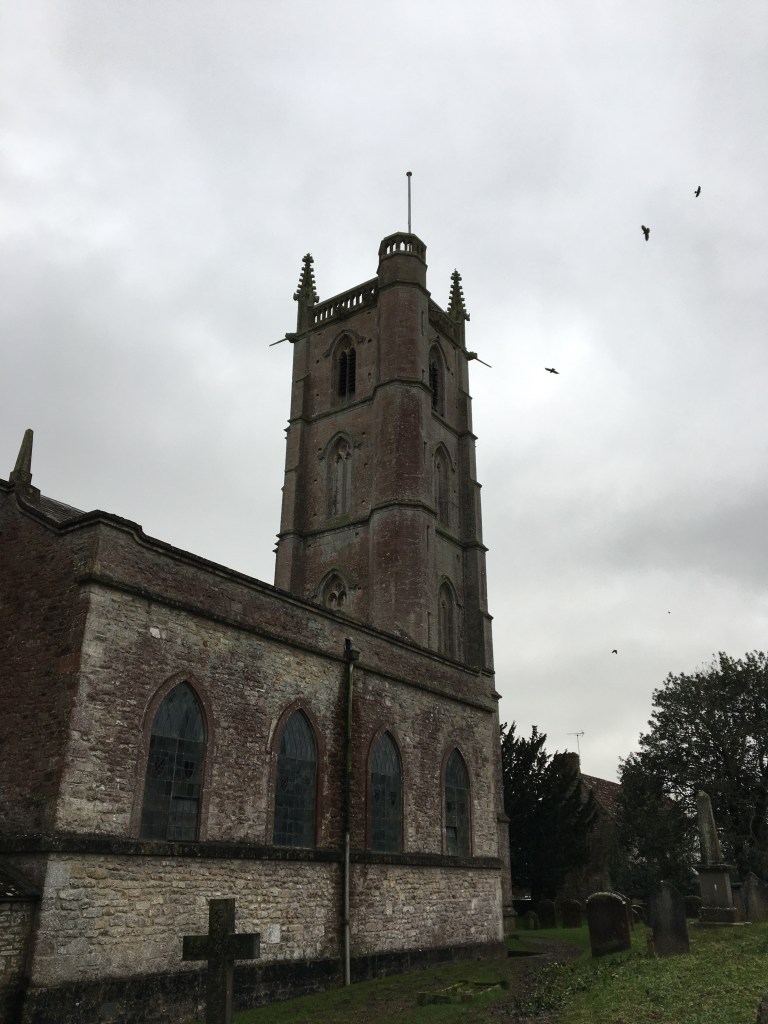

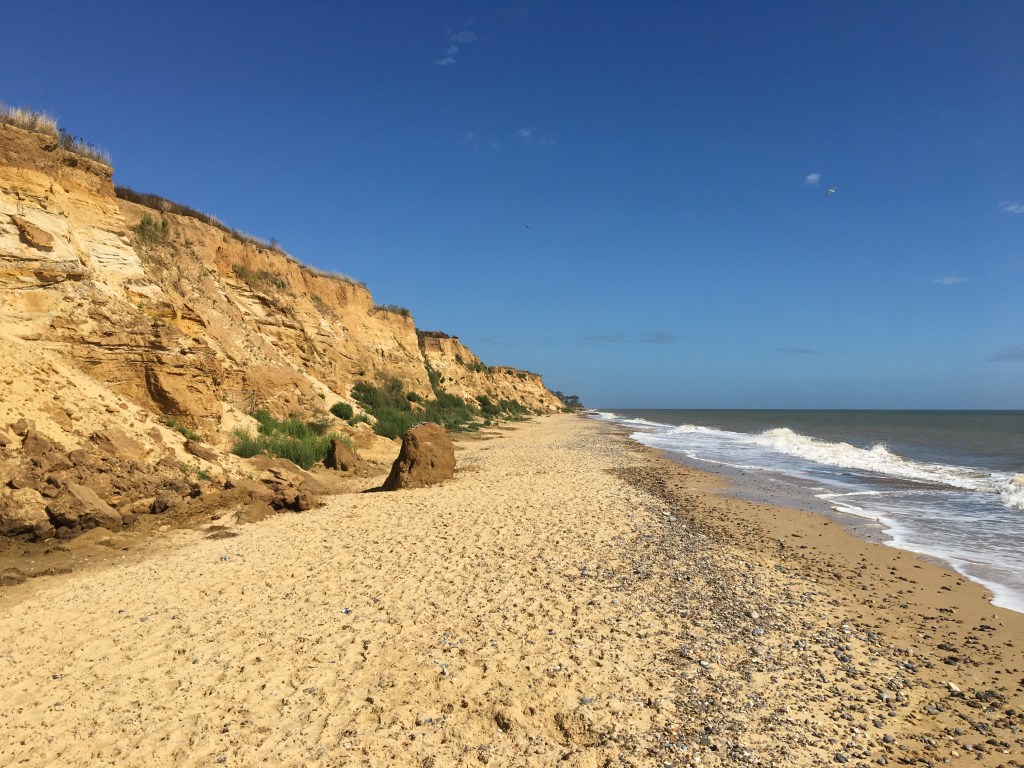


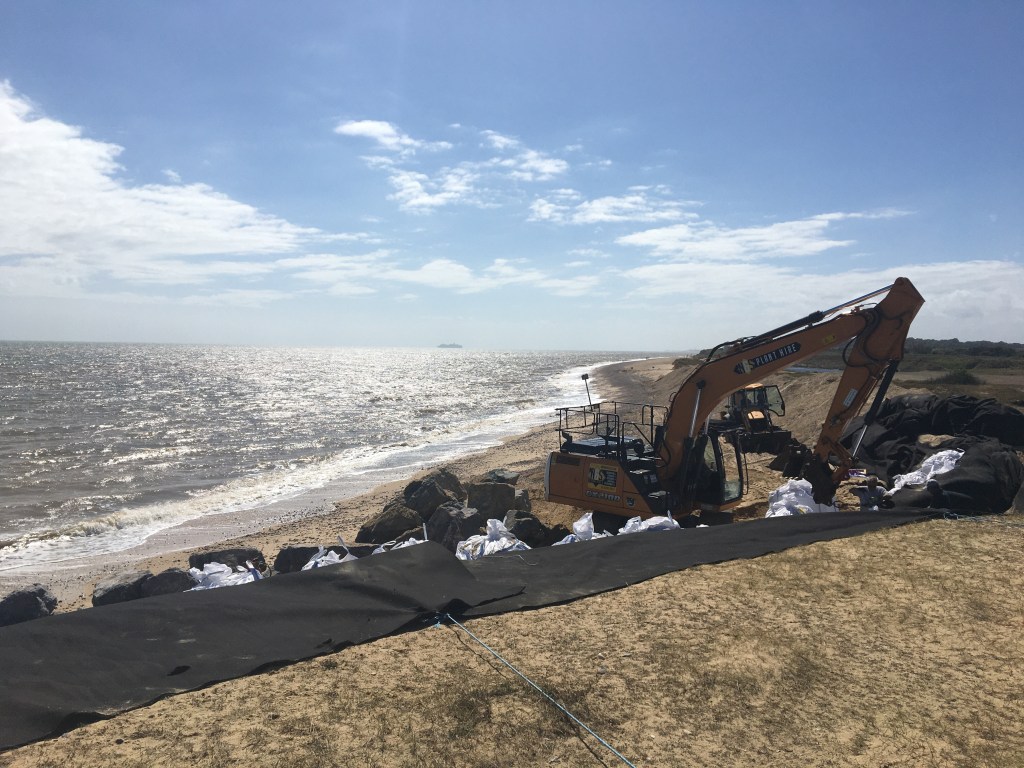
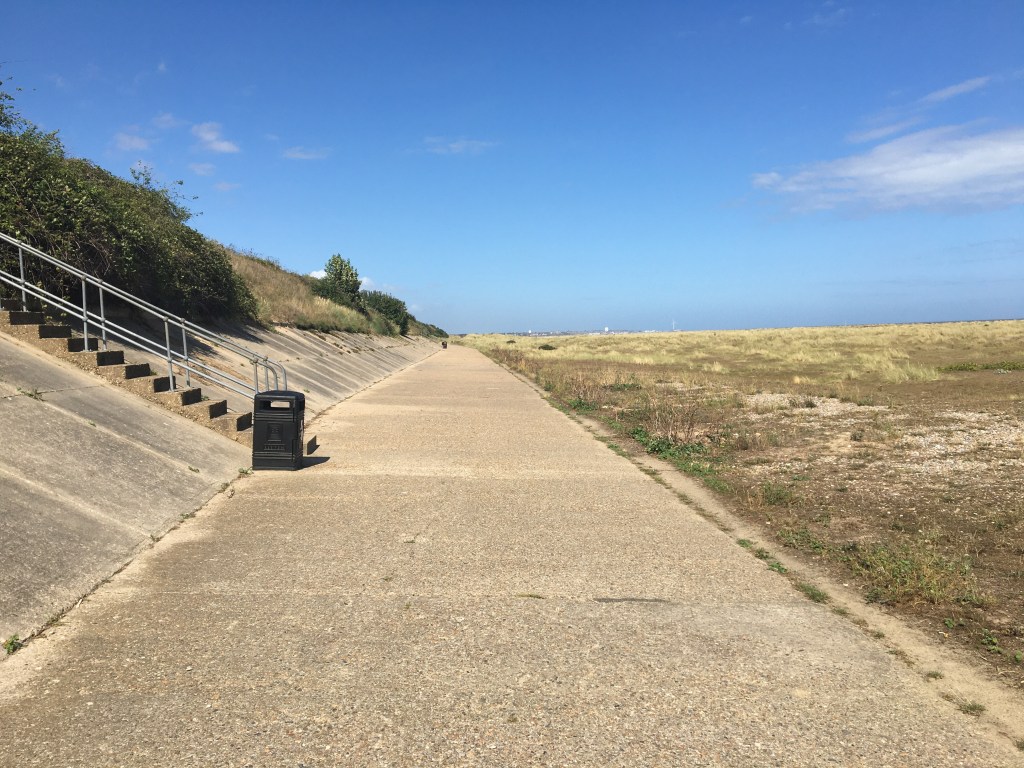


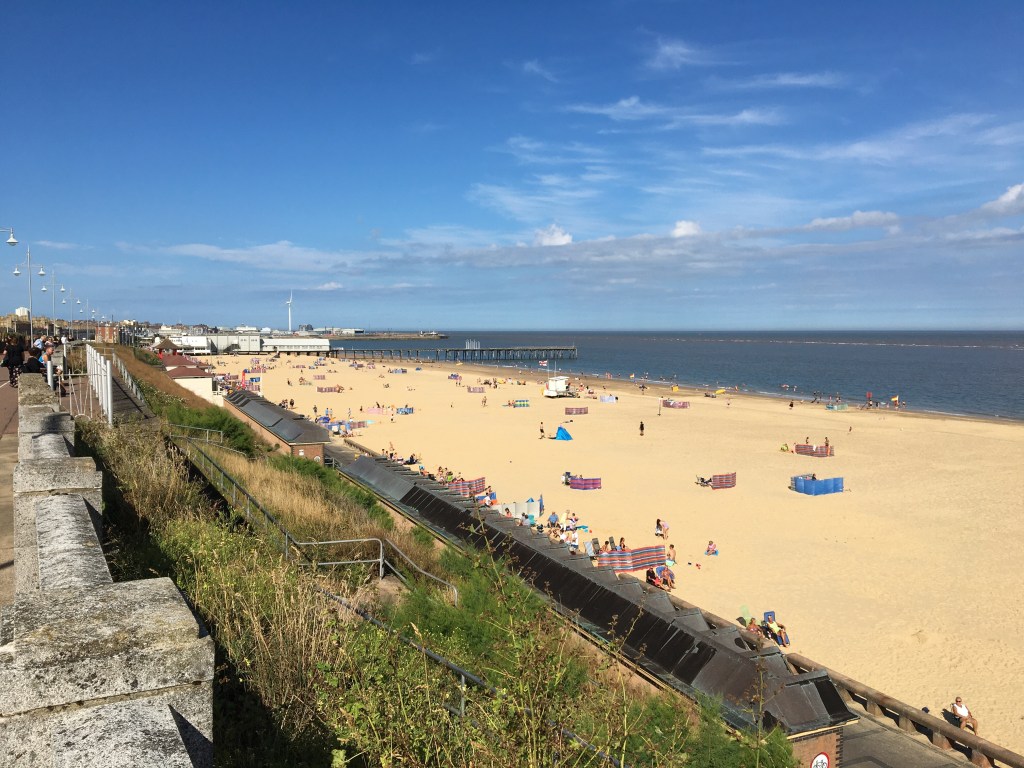

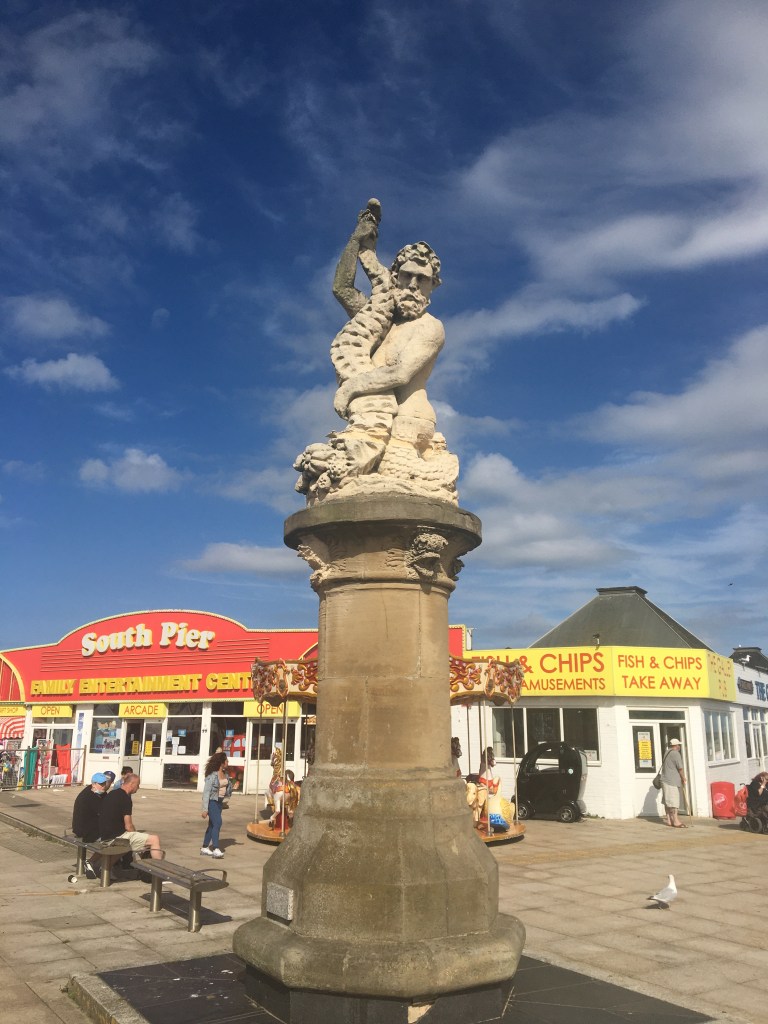

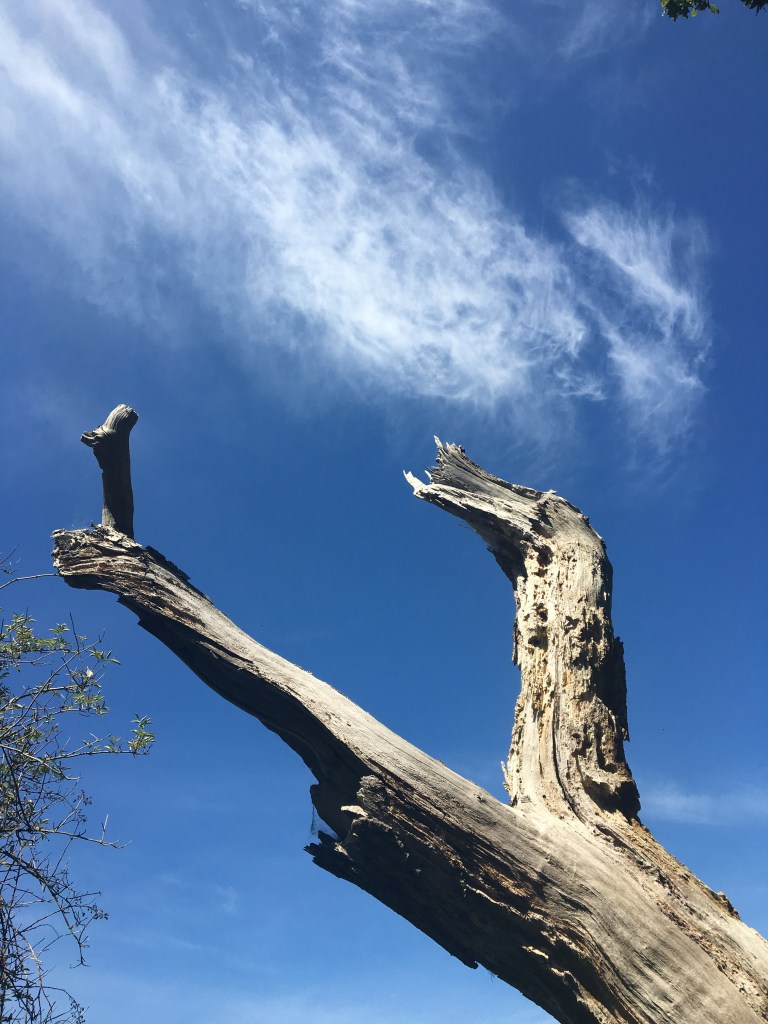

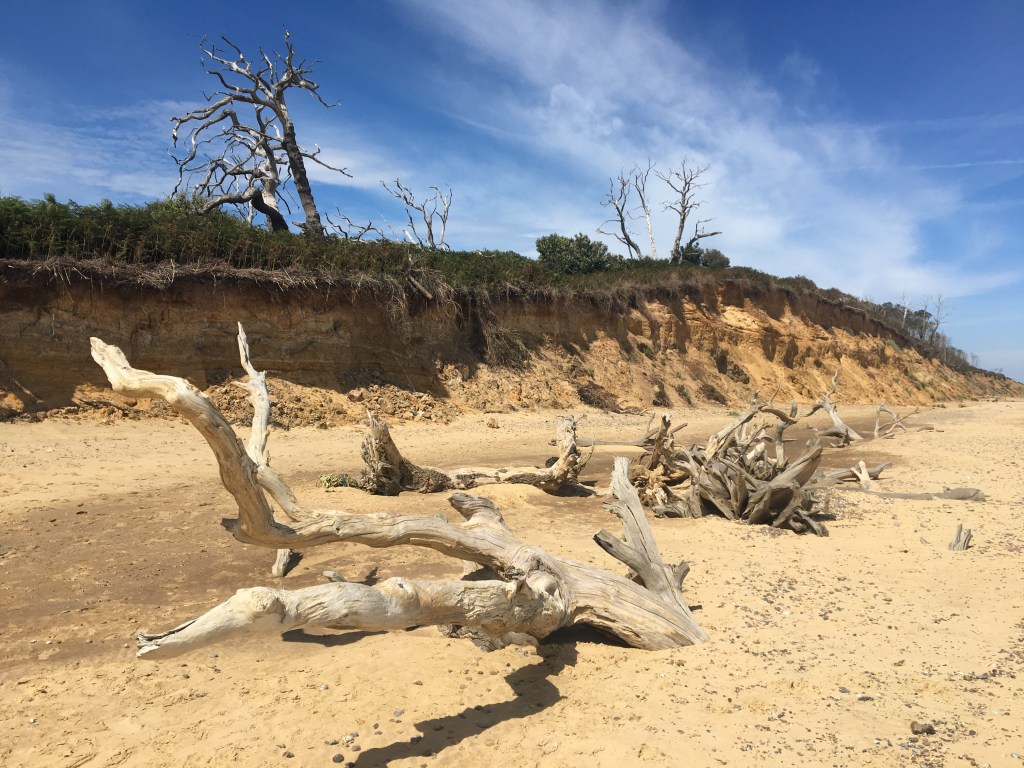
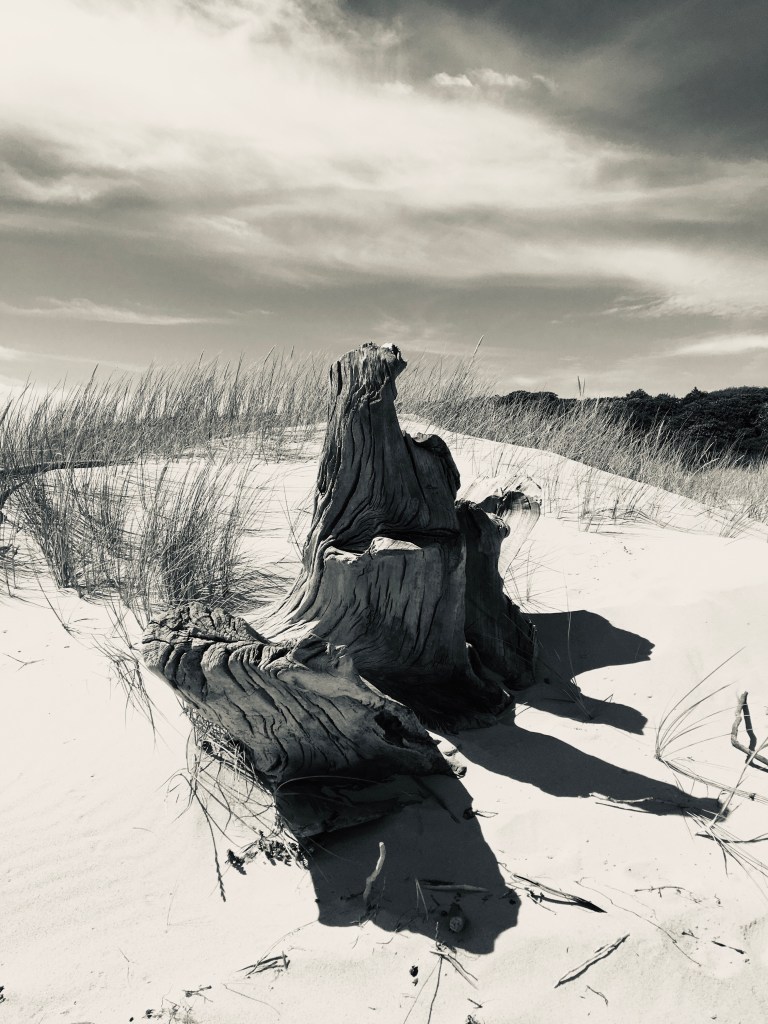



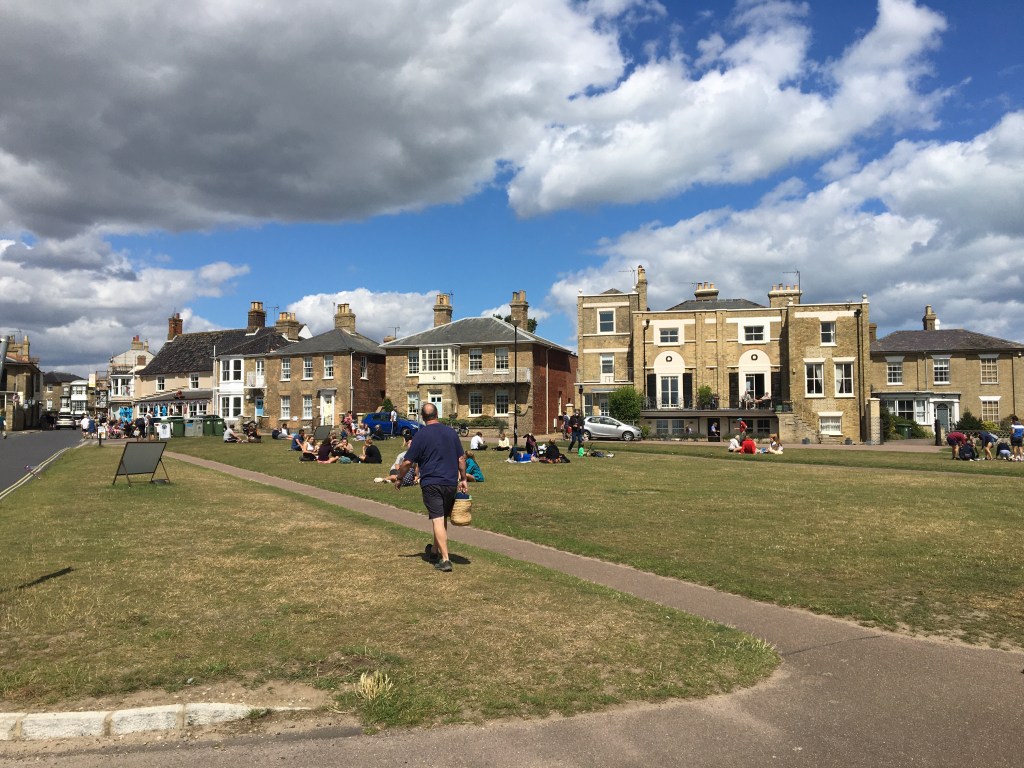


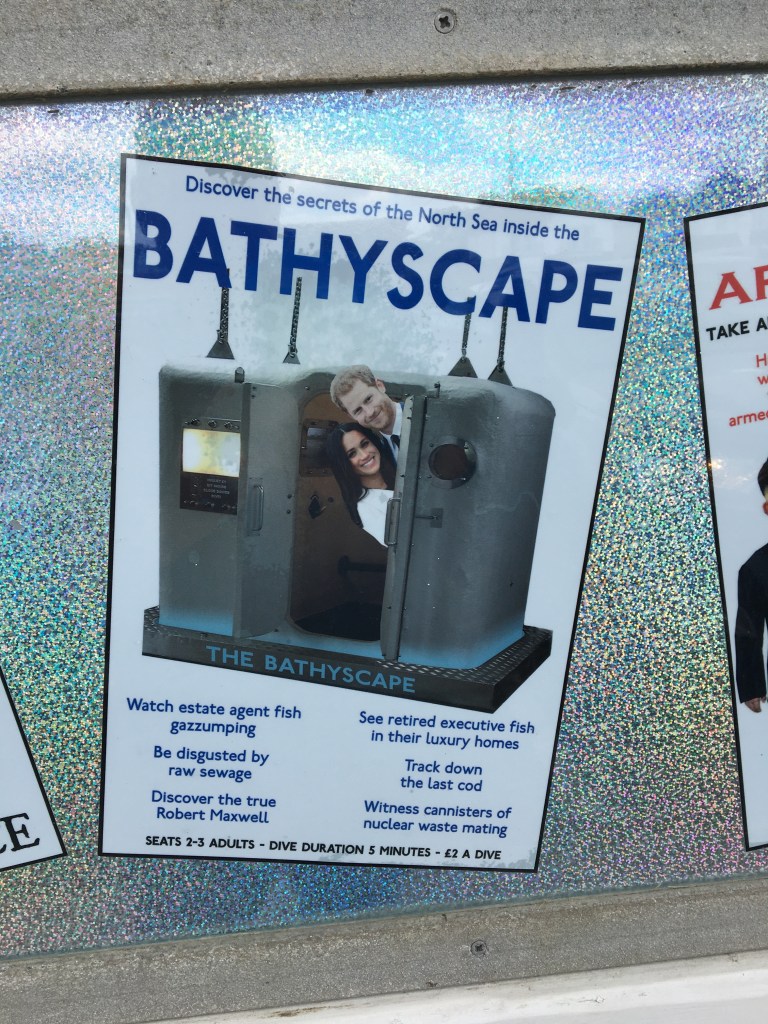
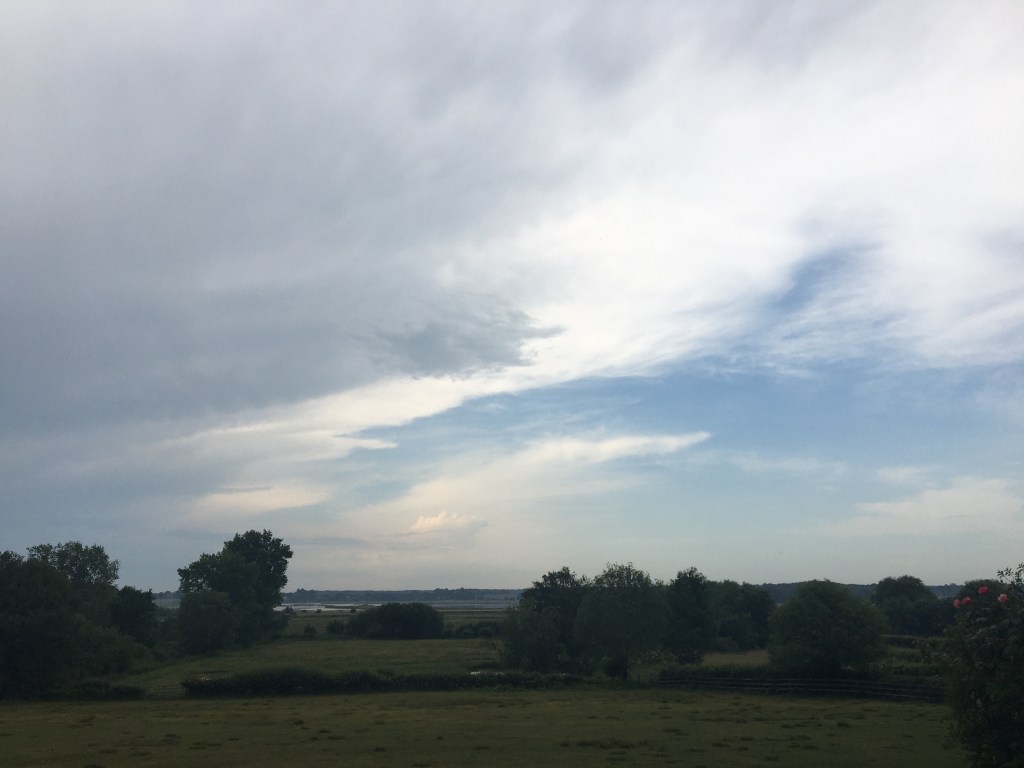


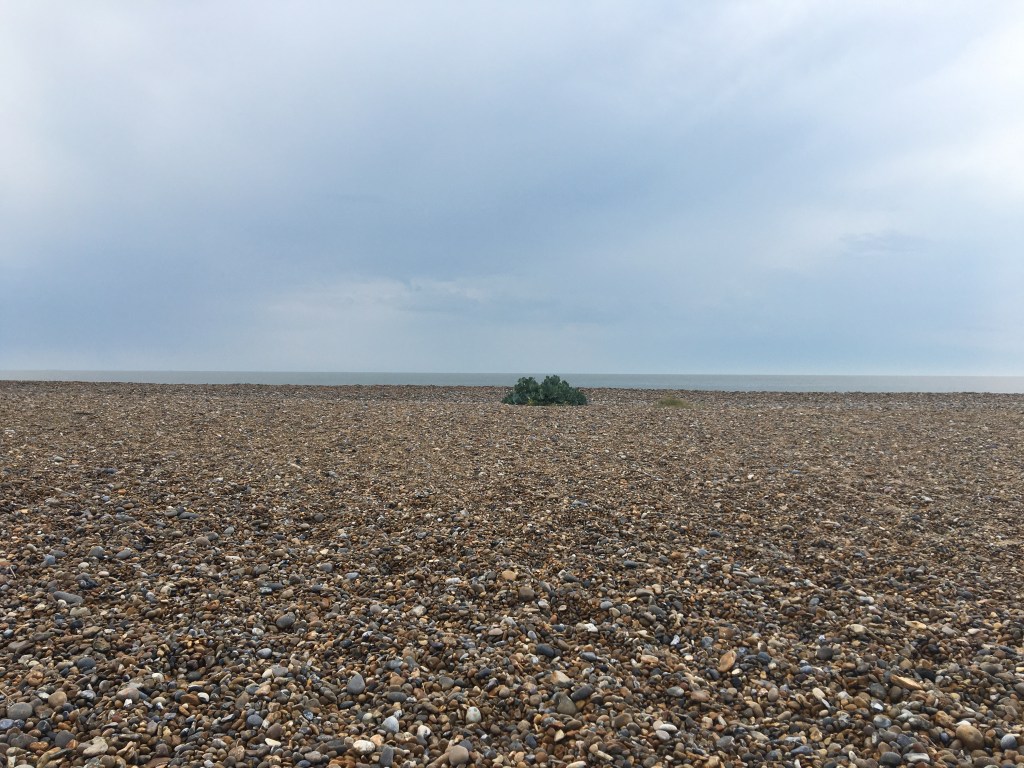


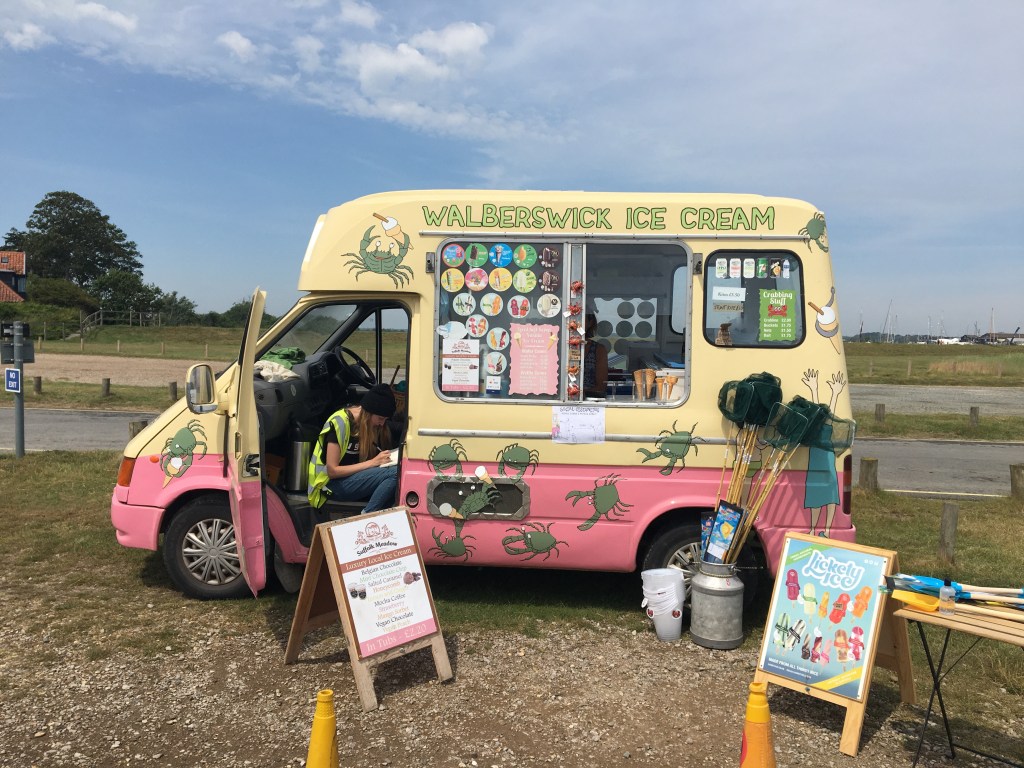
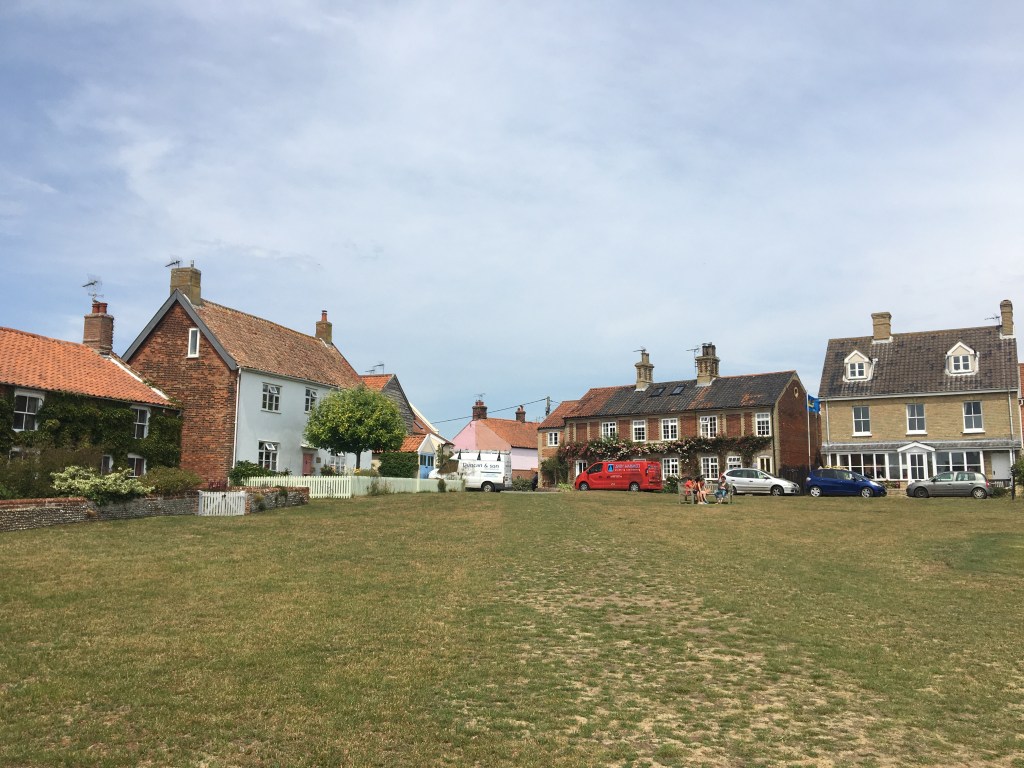
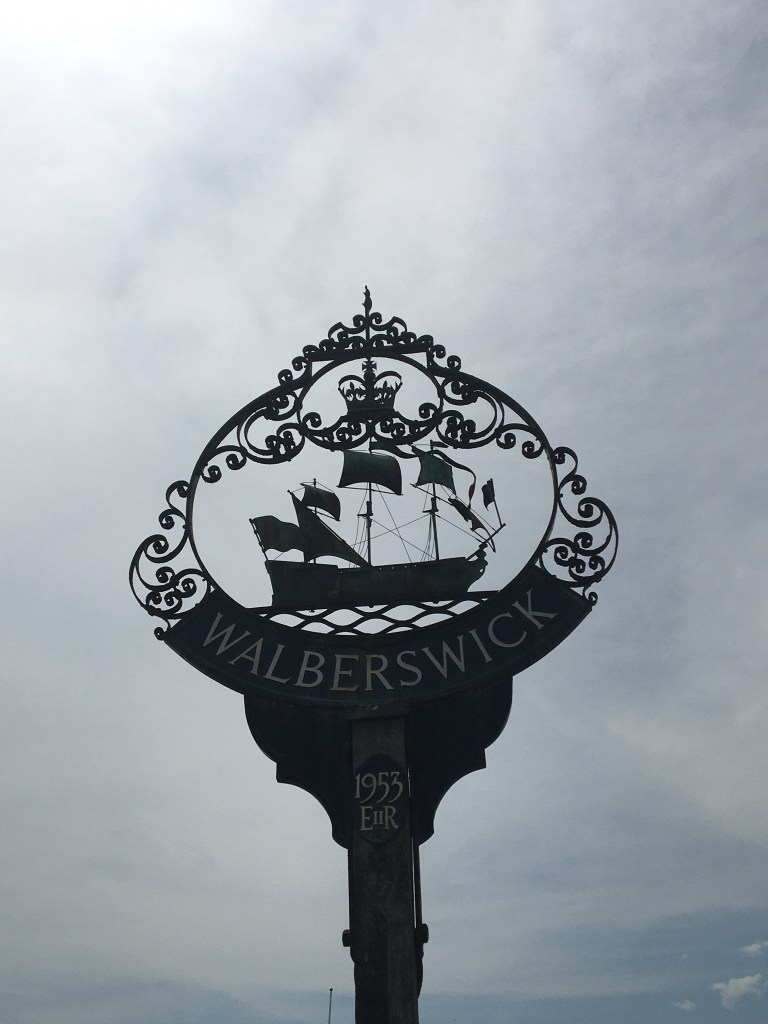

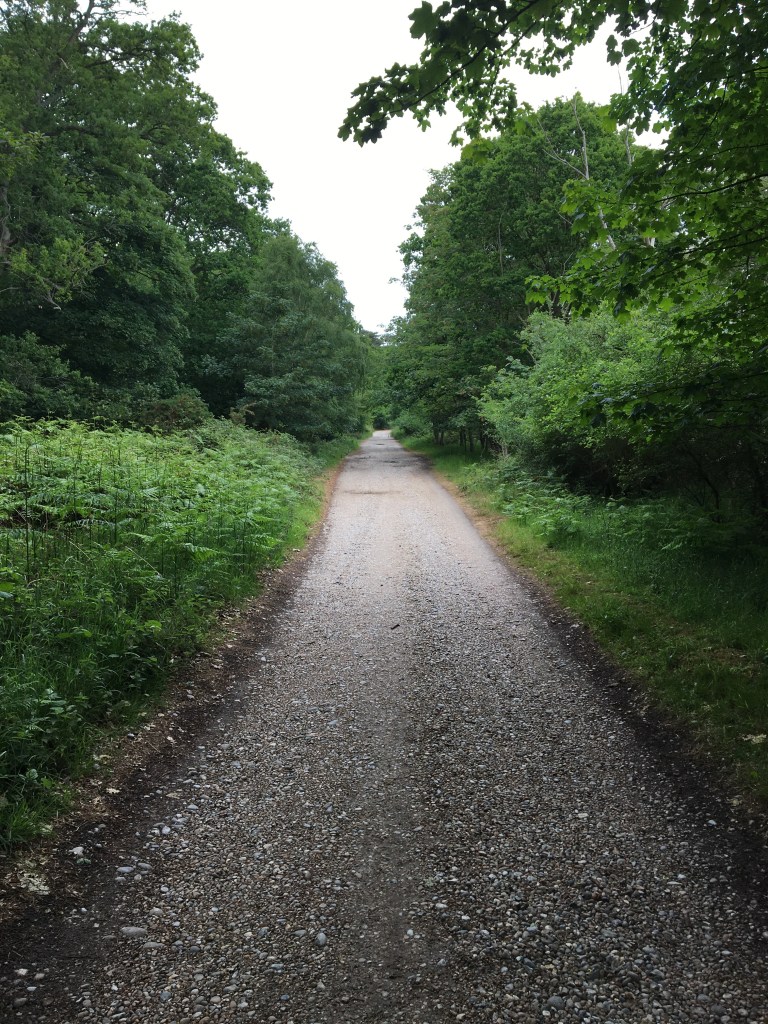


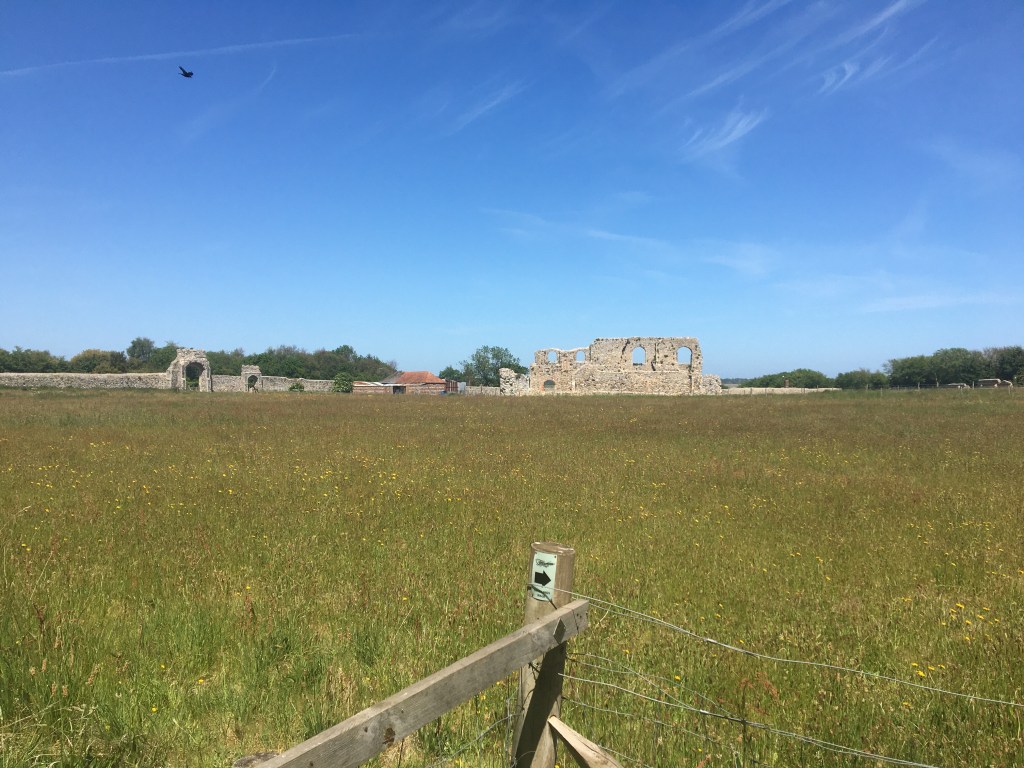

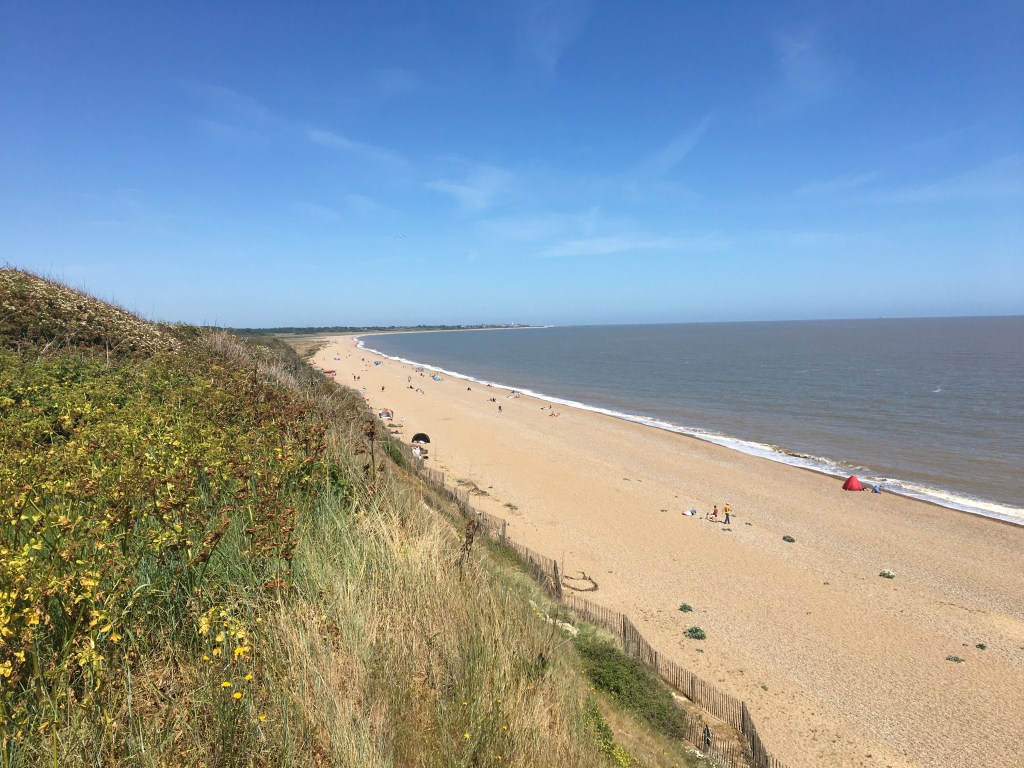
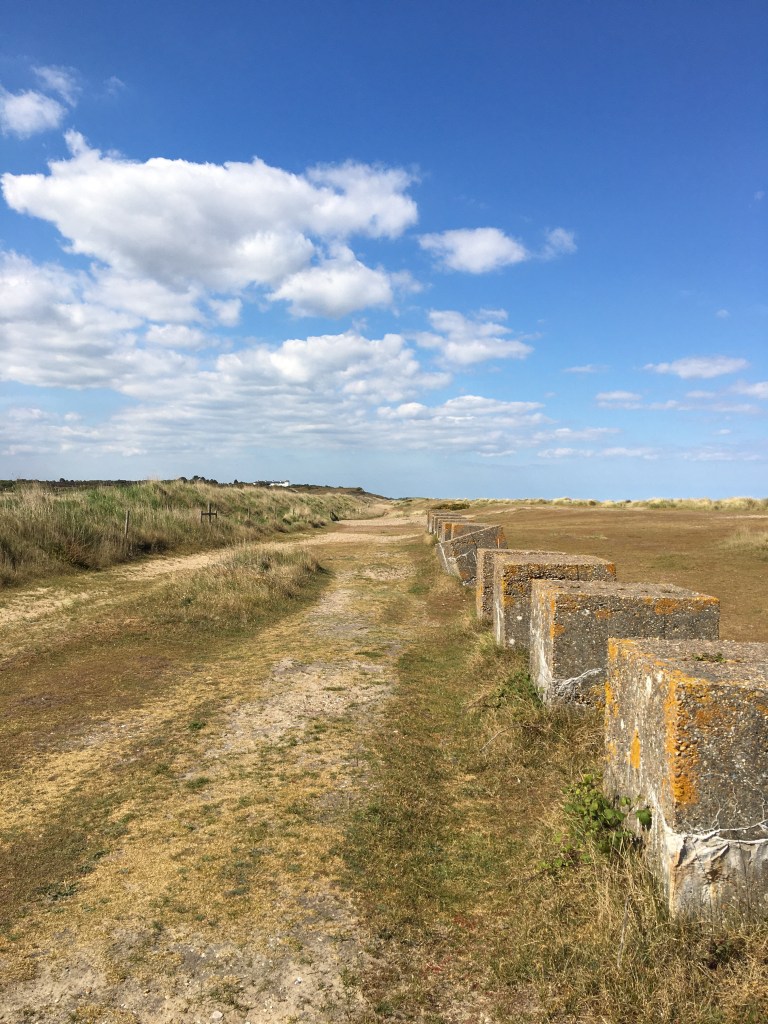
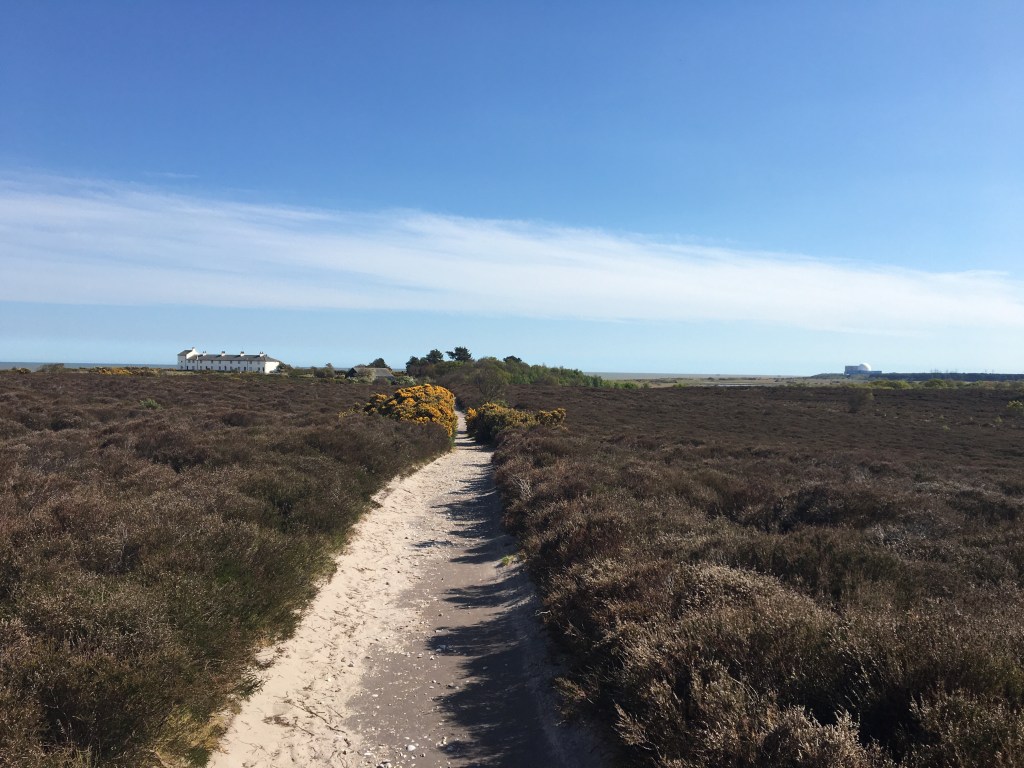
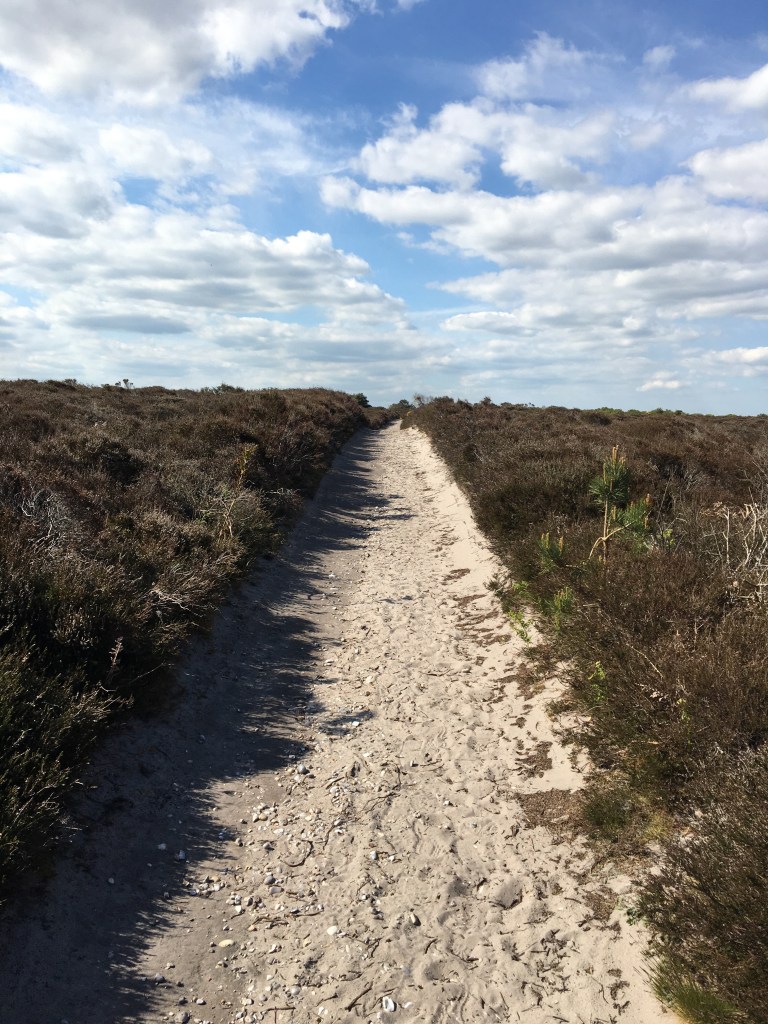

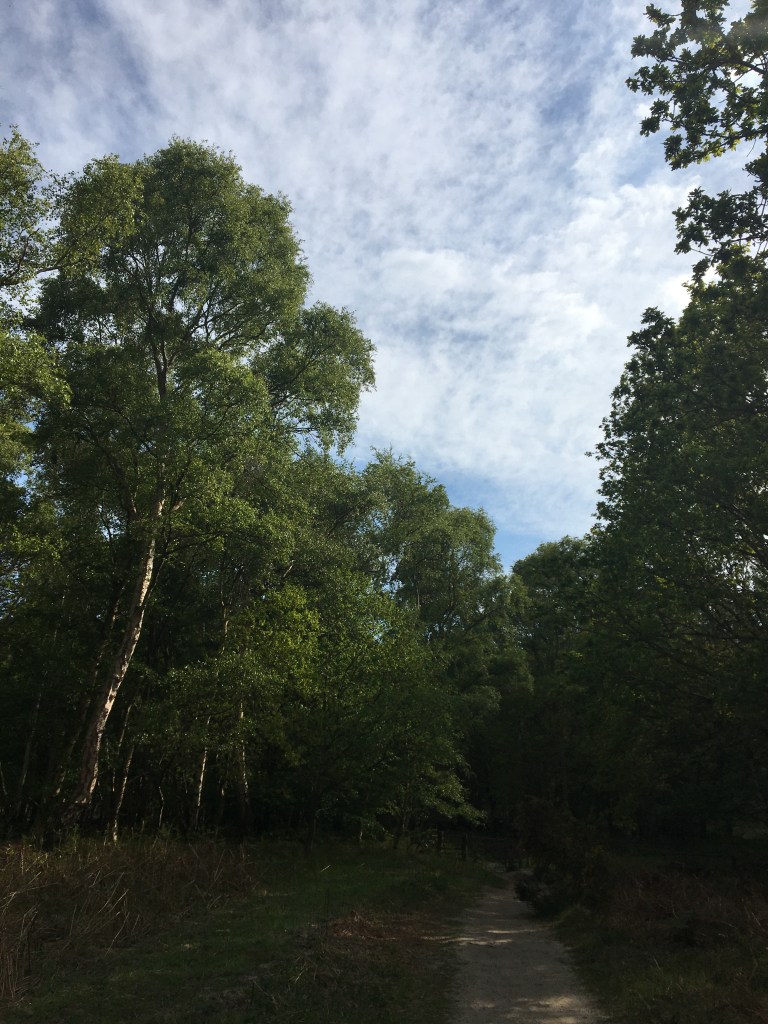


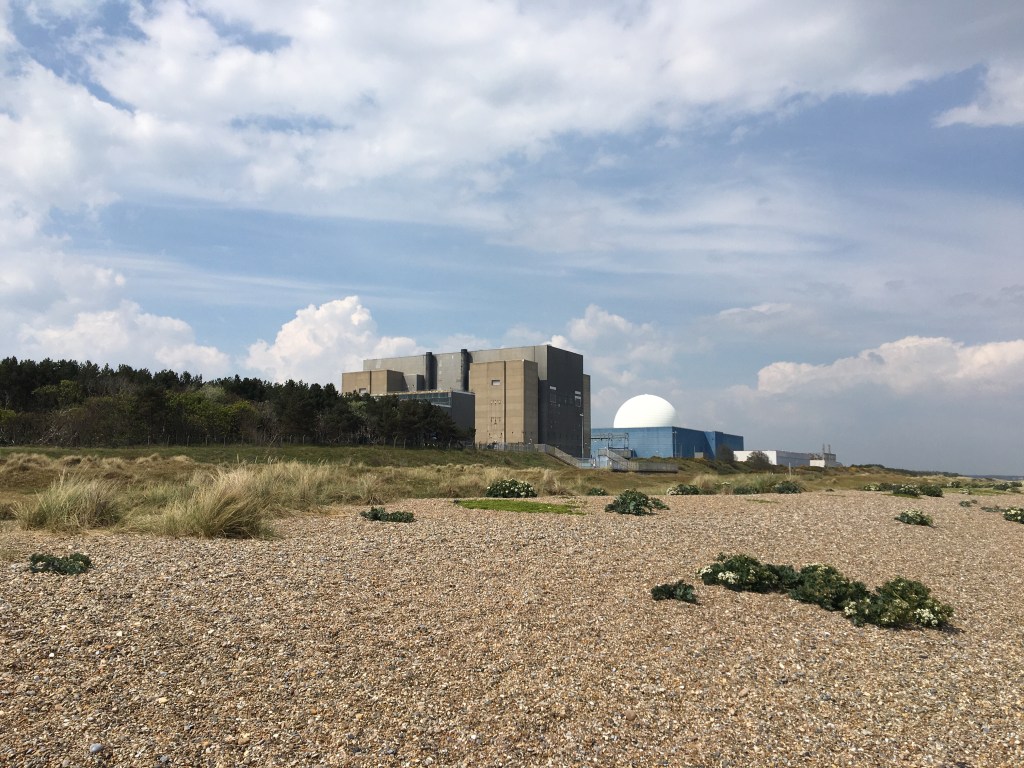

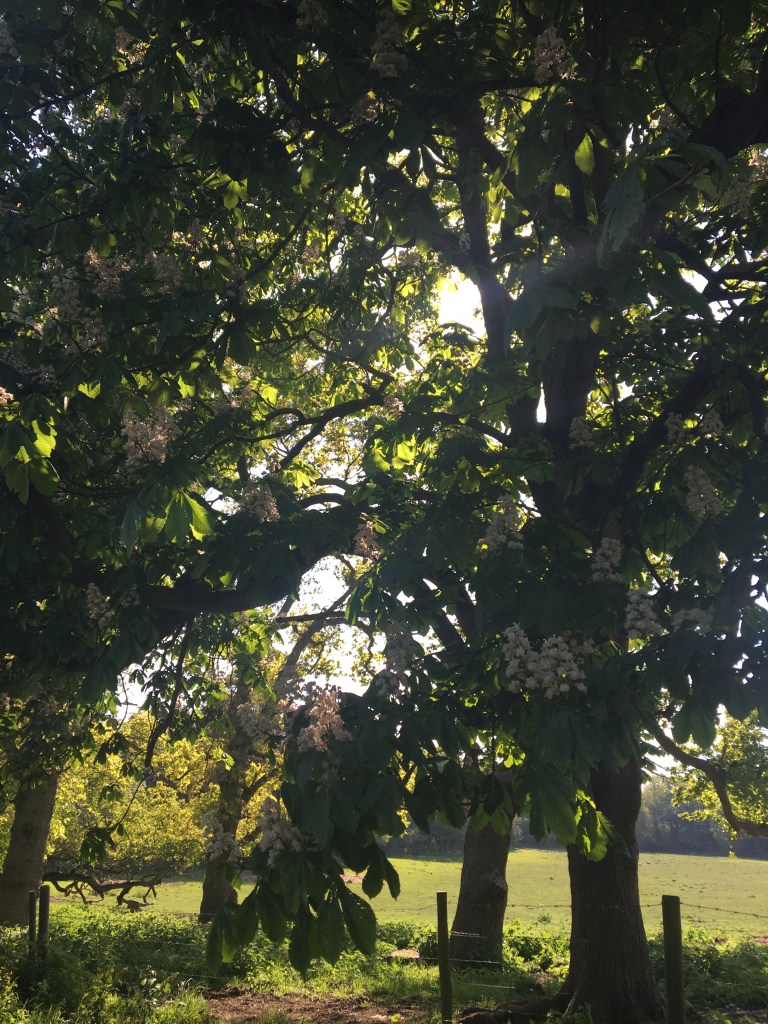

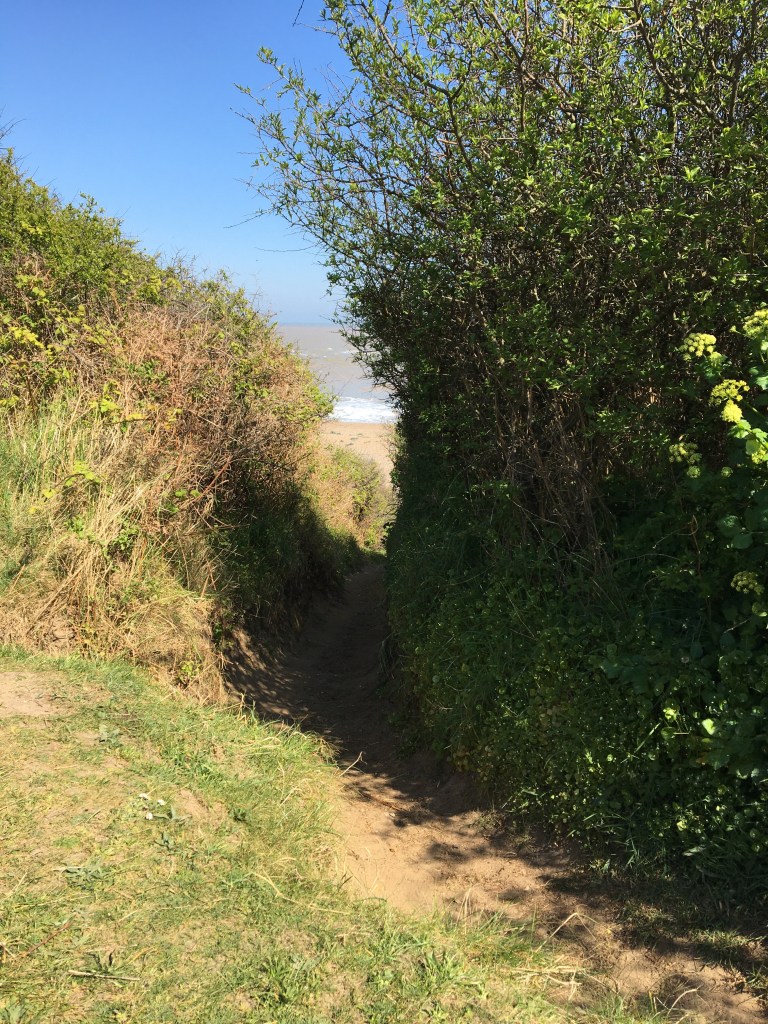
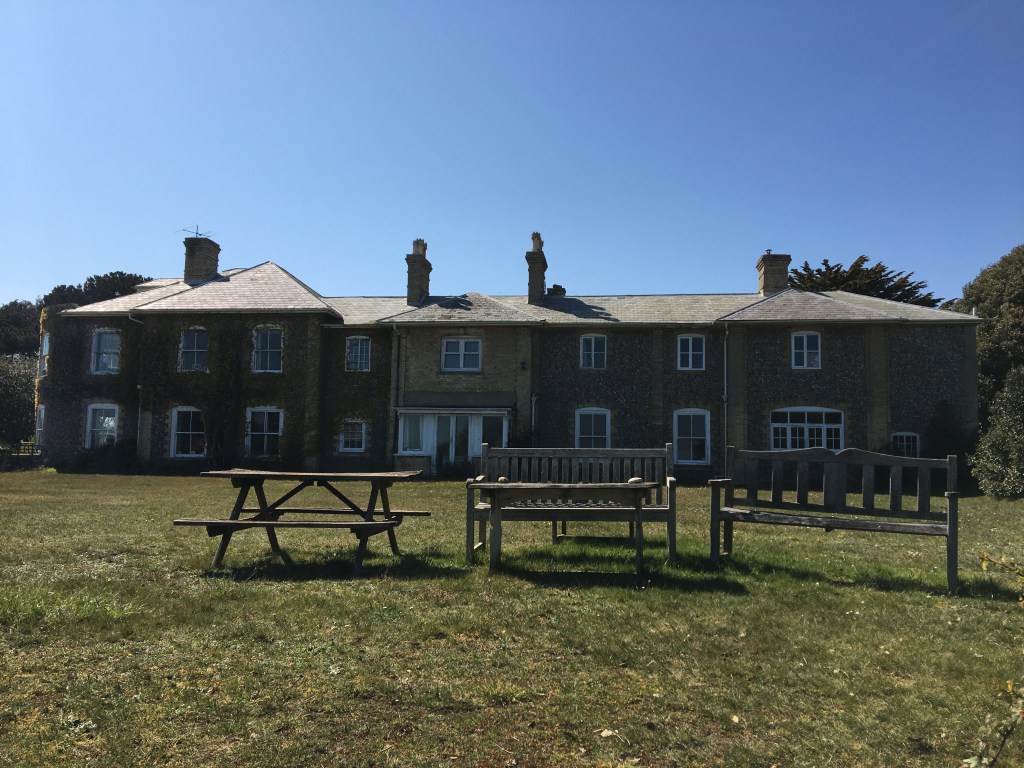


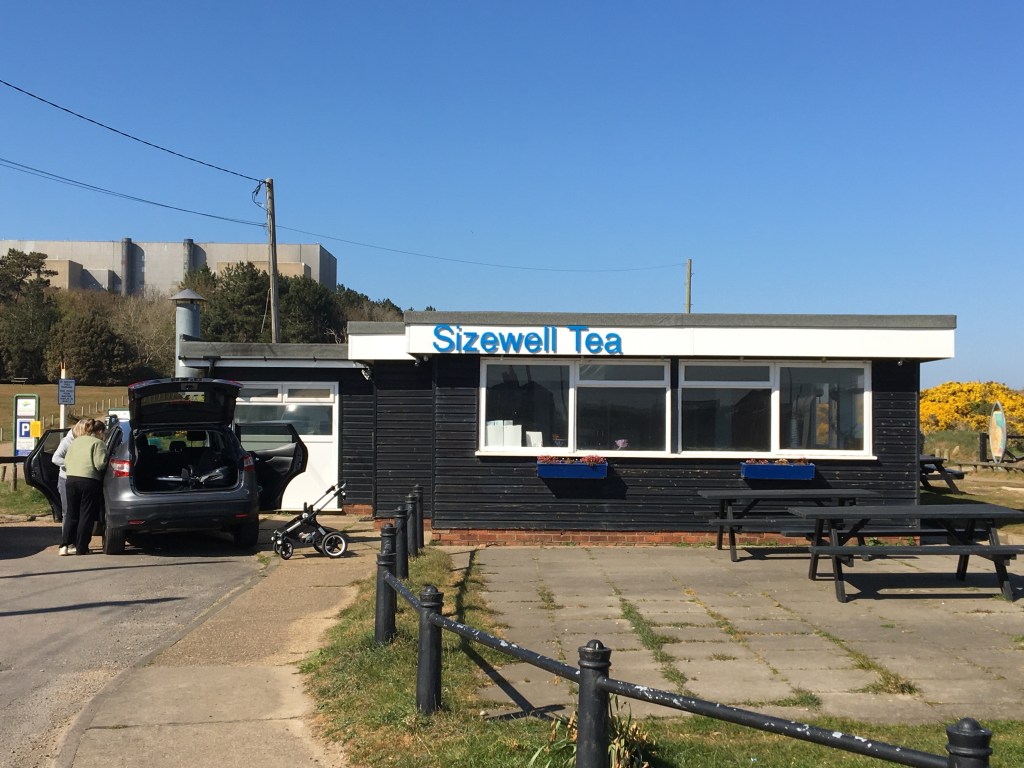


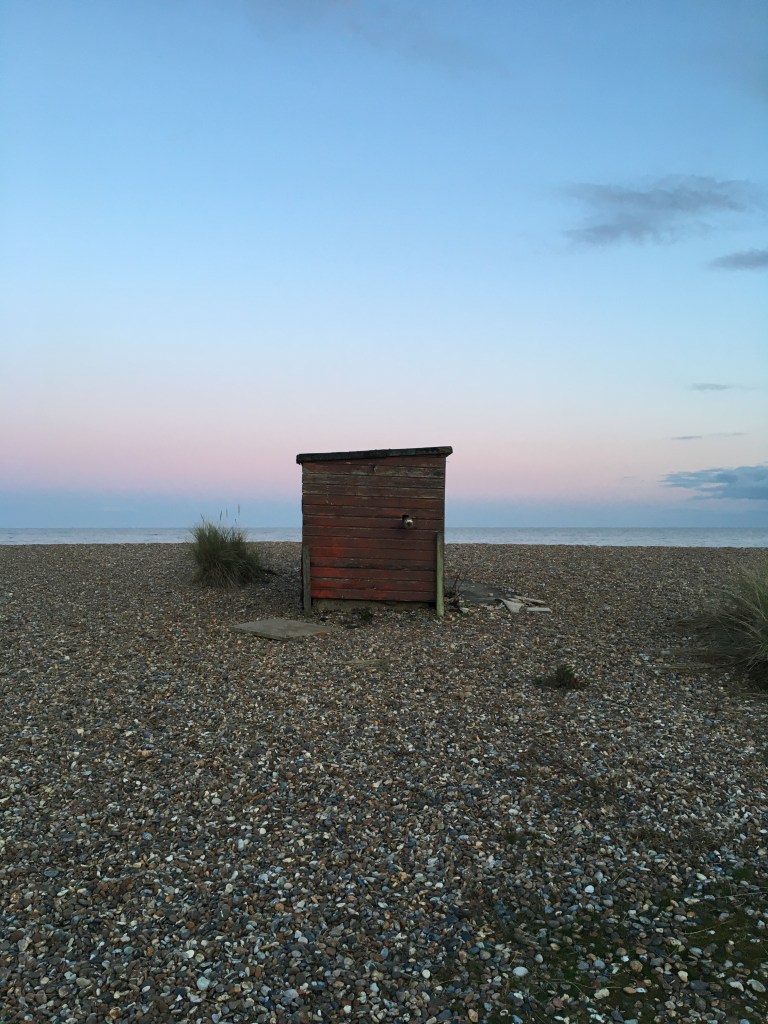


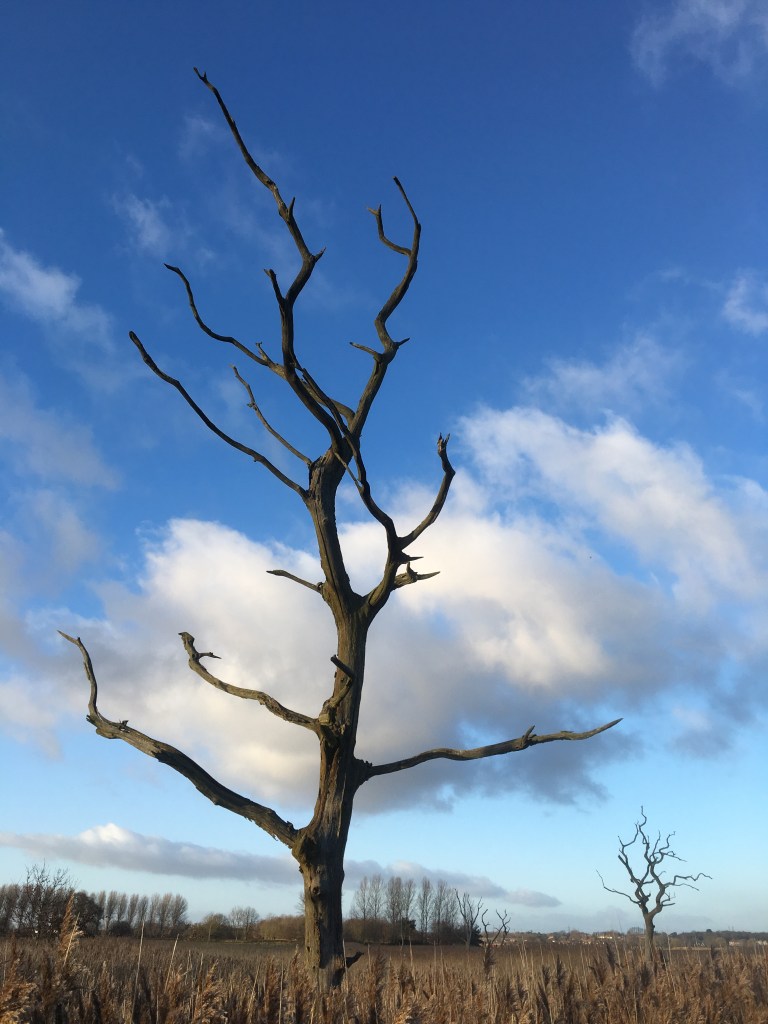
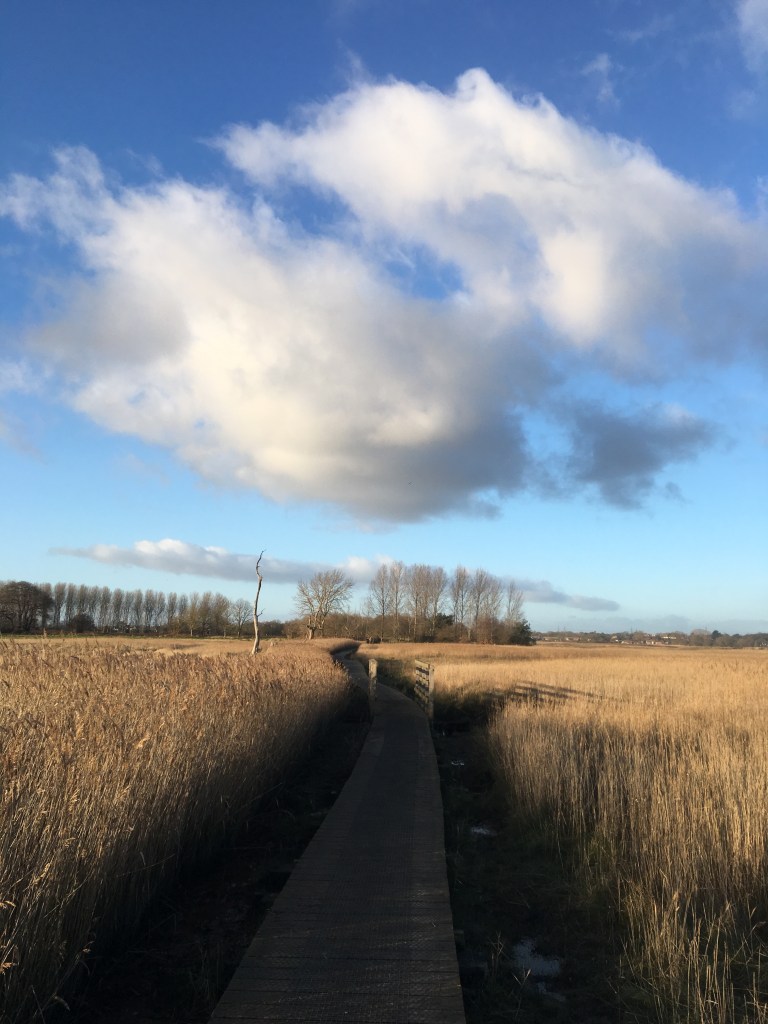
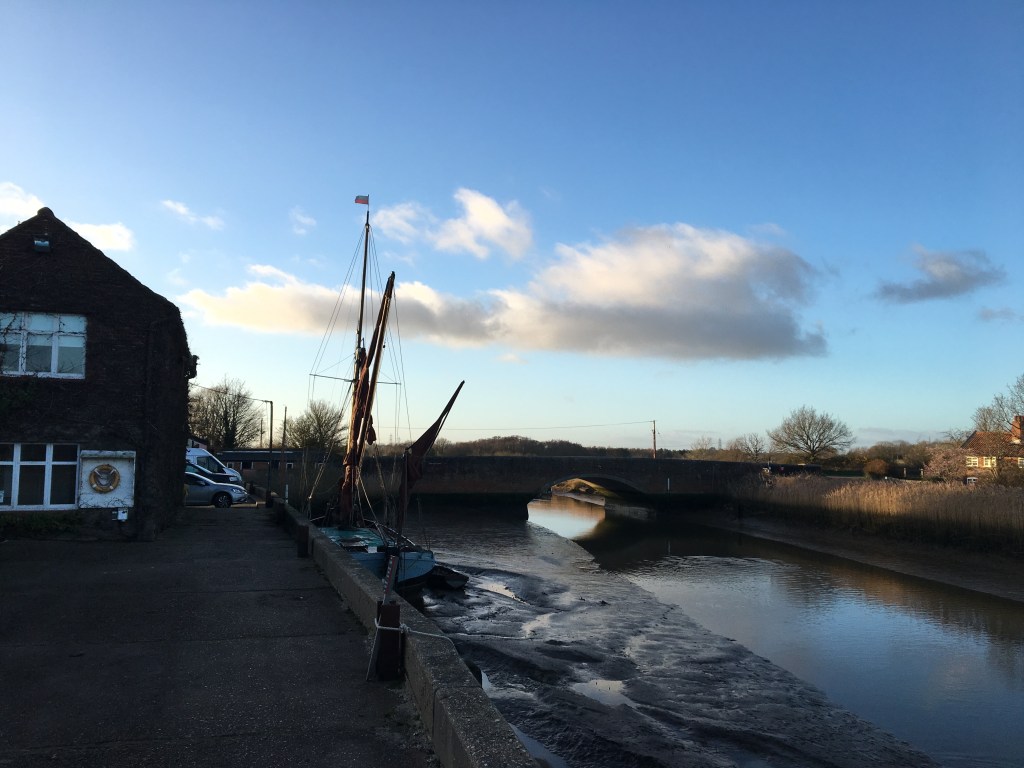




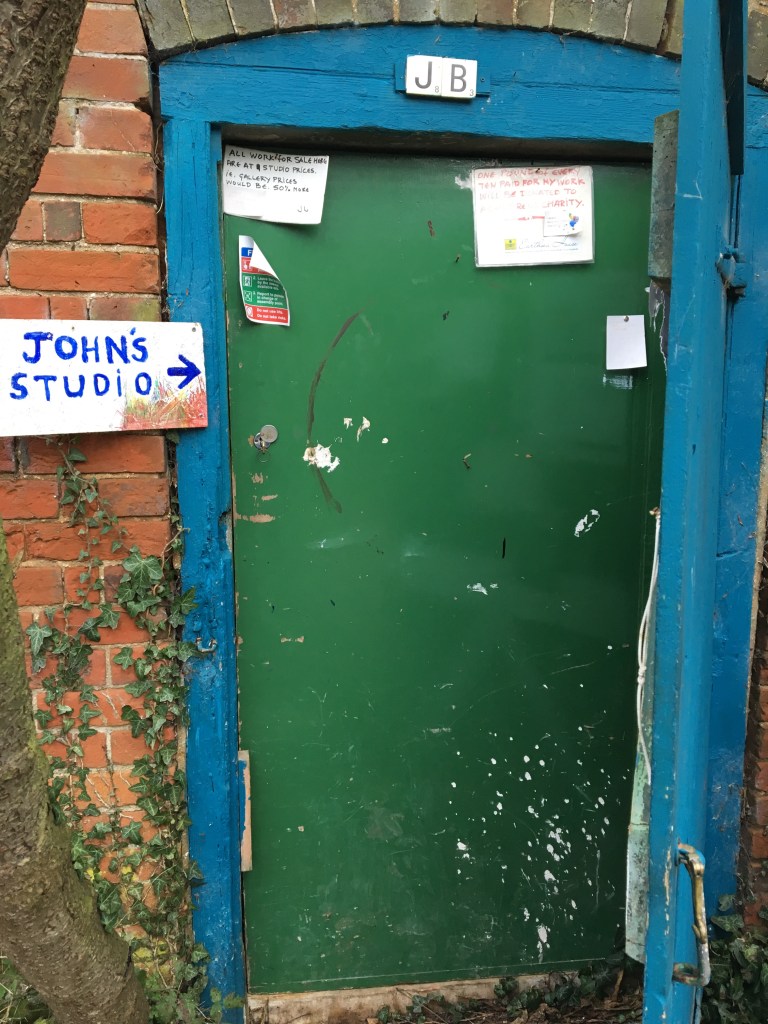
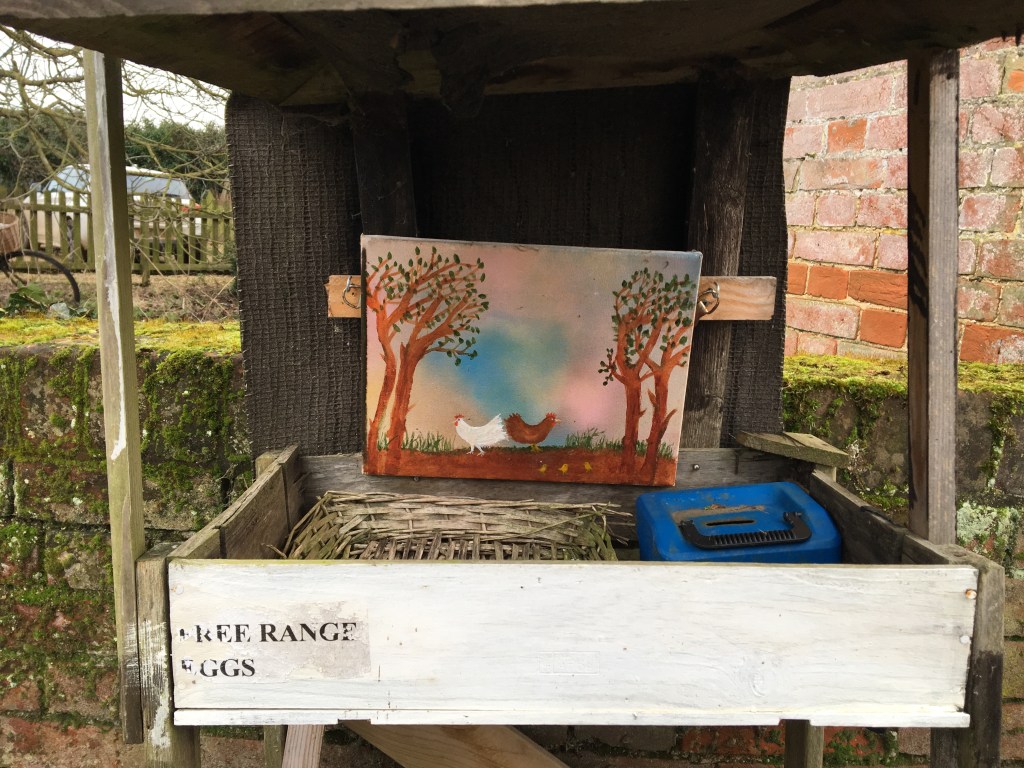


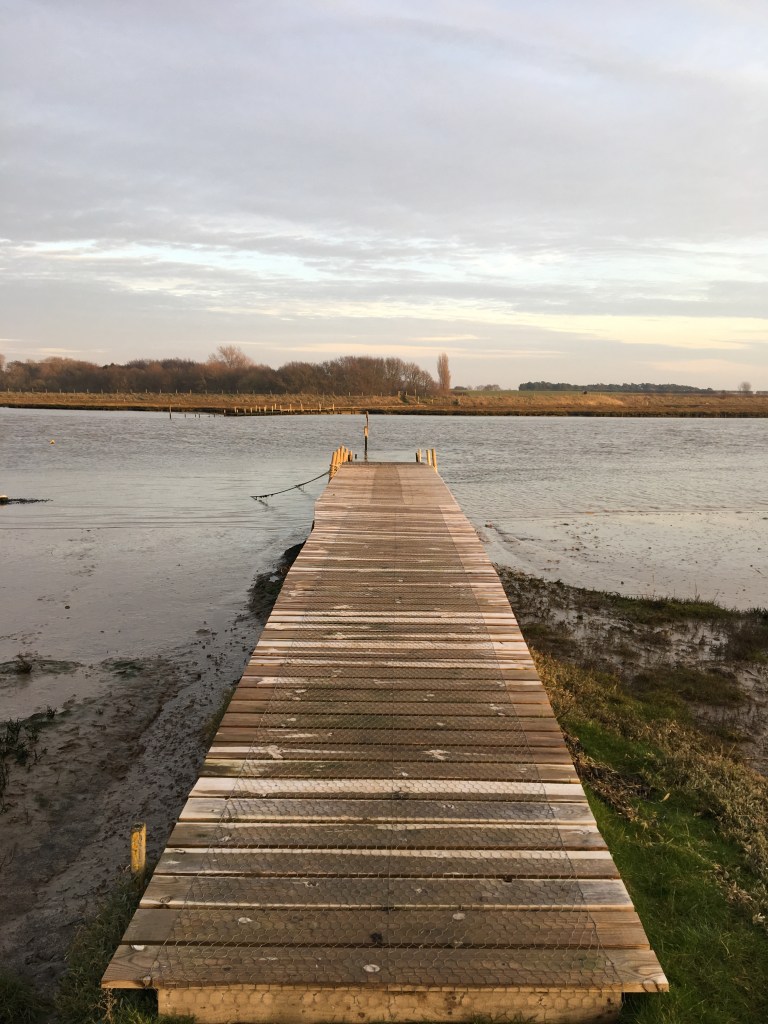

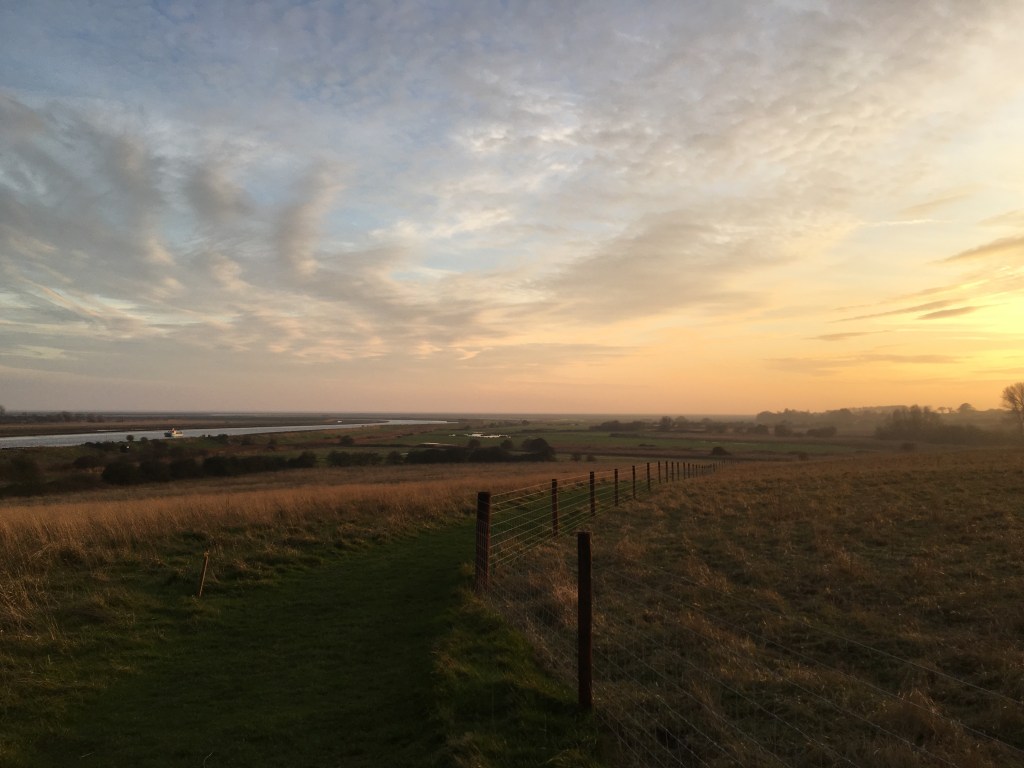
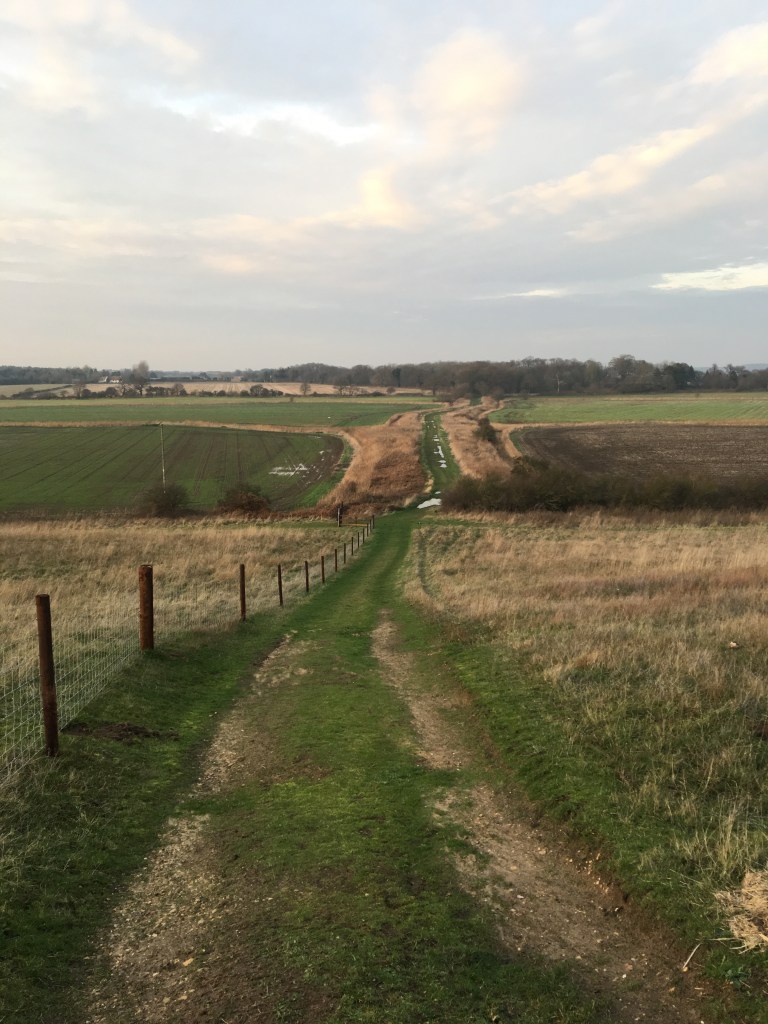

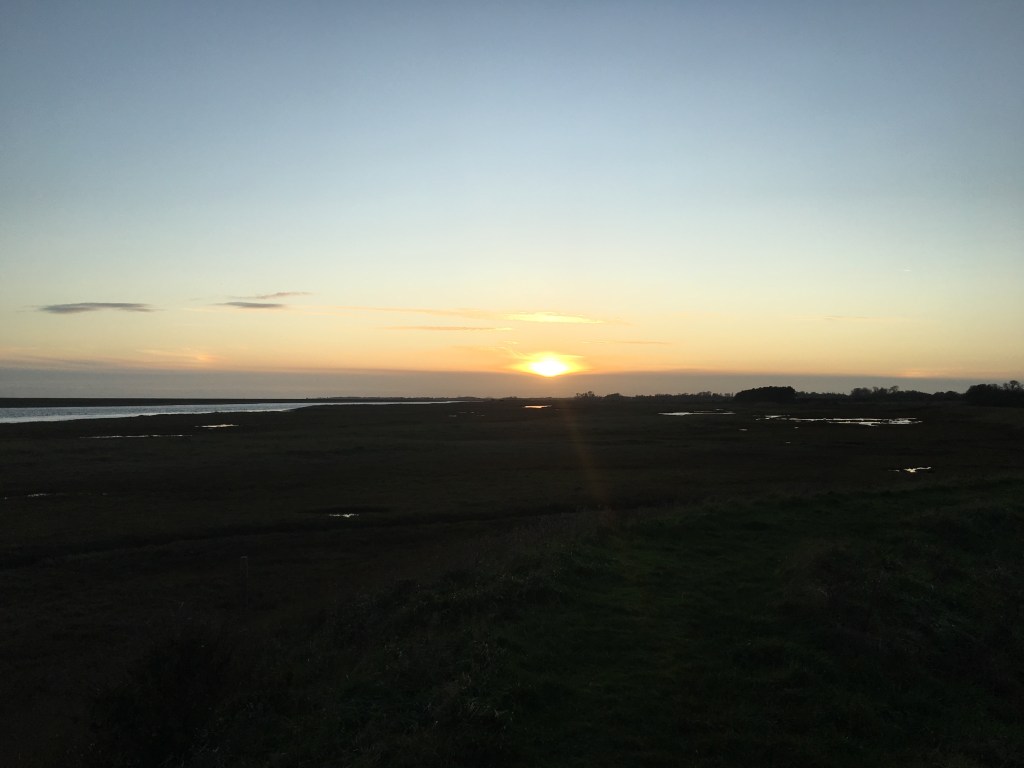


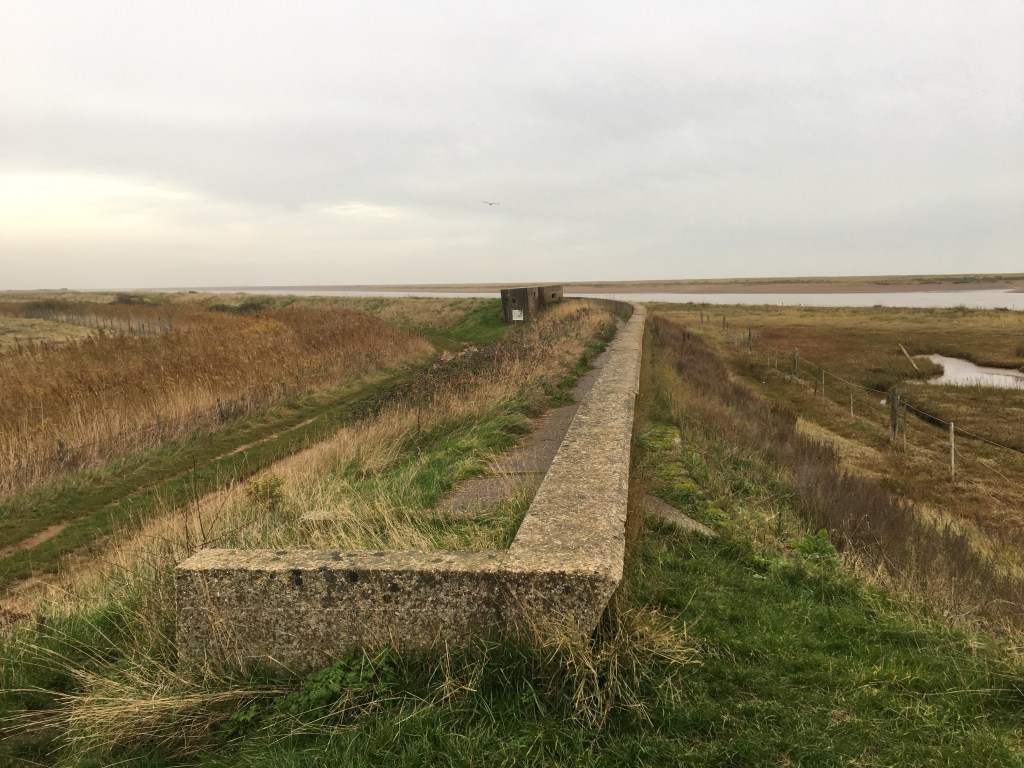

 The Slow Walker