Bessie Ellen to the Hebrides Day 9. Loch Drumbuie to Kerrera Aug 29th

Up at 7.30. It has been the same everyday. People stir and poke their heads out of their curtained bunks or sit on the edge looking a bit dazed. These people who were strangers 10 days ago now familiar. A team. A crew.

It’s overcast and still. A sea otter is in a bay a few hundred metres away. You can see his head pop out of the water, bob around a bit and then his sleak back arches as he dives. The last thing to disappear are his pad shaped feet. We see him come up several times and calmly paddle, just his head visible. Suddenly the glass of the surface is shattered by tiny fish scattering. Calm on the surface but clearly active beneath.

Trying to sail but it doesn’t seem to work. Skipper is yelling and rushing to get the sails up. Several of us wonder what the rush is.

1st mate ‘Calm down’

‘I can’t!’

It reminds me of a comedy sketch but can’t remember which one.

Once again we get all the sails up for less than 30 minutes. I seem to be the bow sprit boy now. Three times now I have had to climb up the bow sprit to fold or unfold the the jibs.
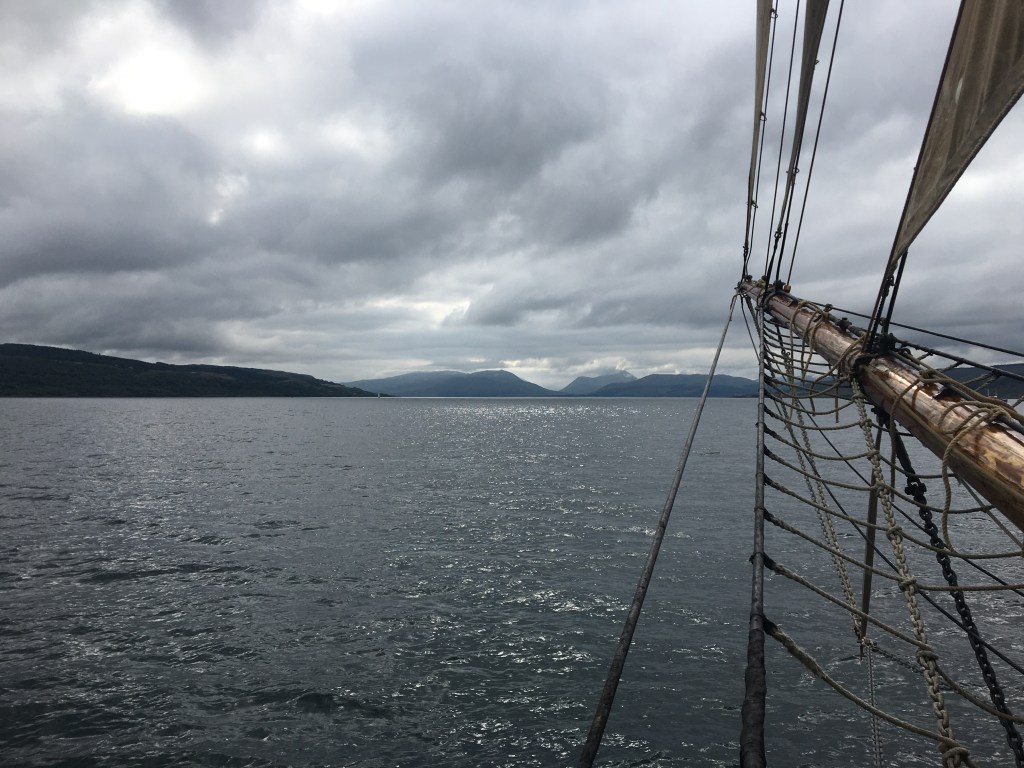
Bow sprit pointing us down the Sound of Mull

It’s precarious. There’s a clutter of ropes, sails and wires. I climb over the bow onto the ratlins, the ropes that connect to the bow sprit meant for walking on not looking at the water beneath my feet or even worse imagining what would happen if I fall in and get mown down by a 100 foot ketch.

I have to straddle the bow sprit along with Taylor and Richard and reach over and start folding the sails into their creases before wrapping them up into a sausage and then tie them to the sprit with the Gaskells (ropes).

Once we’ve done one it’s onto the next two. The final one at the end the ratlins runout and Taylor and I are sitting only on the whiskers, the bendy bouncy wires that run along the outside of the sprit. My legs are more hesitant each time I take a step. There’s a whisker to sit on and a whisker to stand on while you pull and fold and push and wrap.

Bessie Ellen’s bowsprit

Yet it’s incredibly exhilarating. A mixture of adrenaline, workmanship, teamwork and the realisation that we’re in the middle of nowhere holding onto the very tip of an old boat makes me smile and then laugh.

‘Come on James we haven’t got time to look at the view. Get back on board!’ It’s like being back at school.

We get back into the Sound of Mull. Looking out for buoys. The sun comes out after lunch and we motor. We have sails up but it makes little difference. Under sail we make about a knot.

We are heading for the Isle of Kerrera for our last night. It is just off Oban so that we can get back to port in time for our disembark time of 10 am on Monday.

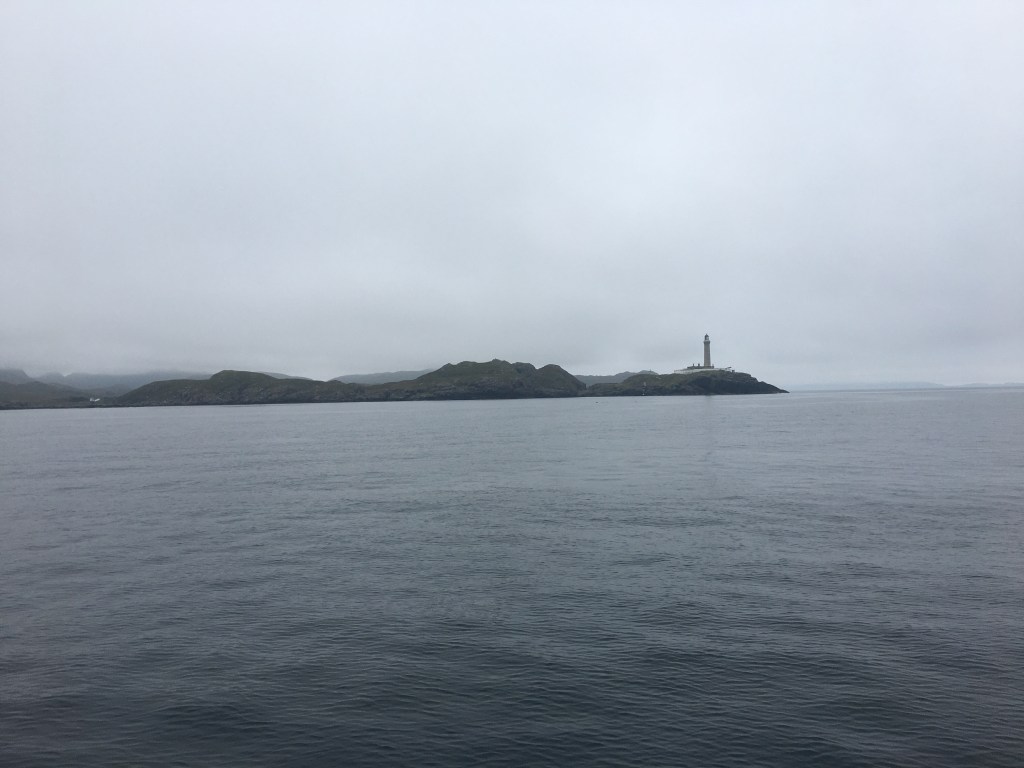
We have to tack a few times to get round the corner of Kerrera. As we come into the bay on the western edge is a lighthouse repair vessel, the Pharos.

Once again we’re in the rib to go to Gylen Castle, a narrow ruined Castle which stands on a promontory looking to the eastern coast of Mull. It is like something out of a picture book or film.

After it was built it was owned by the MacDougalls but was only lived in for 65 years (by a garrison) before it was put under siege, the men were forced to surrender with the promise of imprisonment before they were all slaughtered.

Everywhere here there are remnants of a brutal and savage past where massacre and slaughter seemed to be regular occurrences.

Swam off the rocks in the clearest blue sea. Used to the cold now. Always the fear going in. It disappears as soon as I’m in.

It’s an hour’s walk to the eastern side of Kerrera to meet the Bessie Ellen. As always she stands out as she has in every destination I’ve seen her.

I am on the jetty waving to get the rib to pick me up for the last time.

Back on deck we have drinks and look at the promenade of Oban. Tomorrow it takes only 30 minutes to get there. We’ll say goodbye and part, most of us never to see each other again but just for a few days we shared adventures, experiences, stories, skills and knowledge. It’s been intense and full of wonder. I’m already planning a greater adventure for next year.
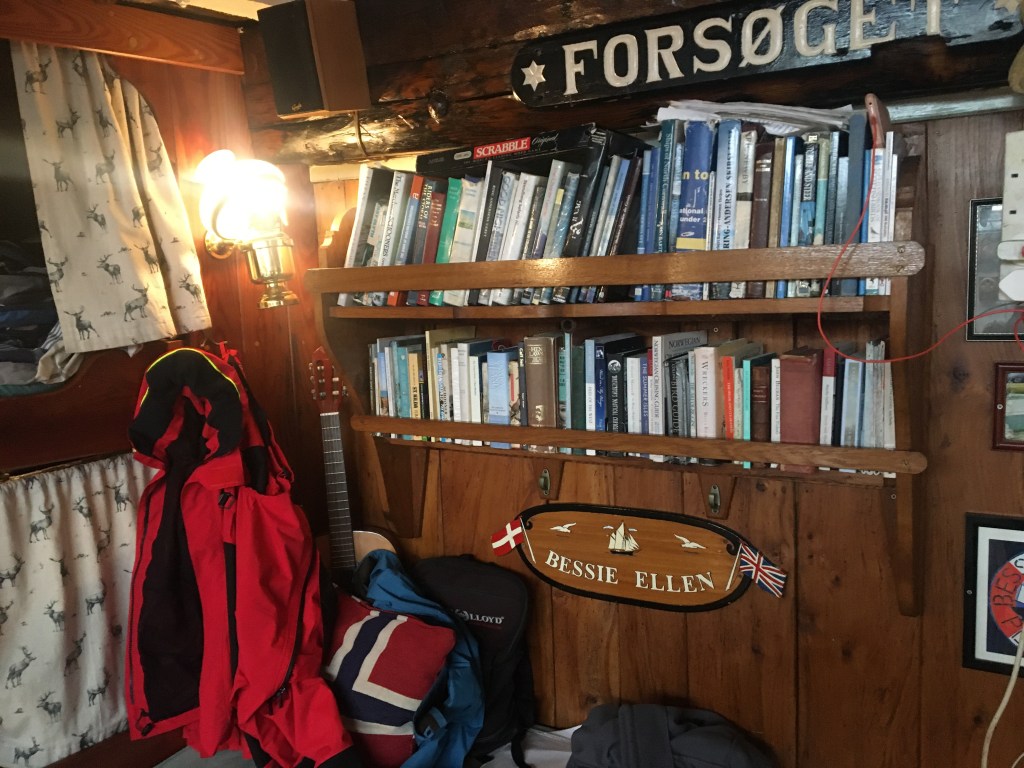
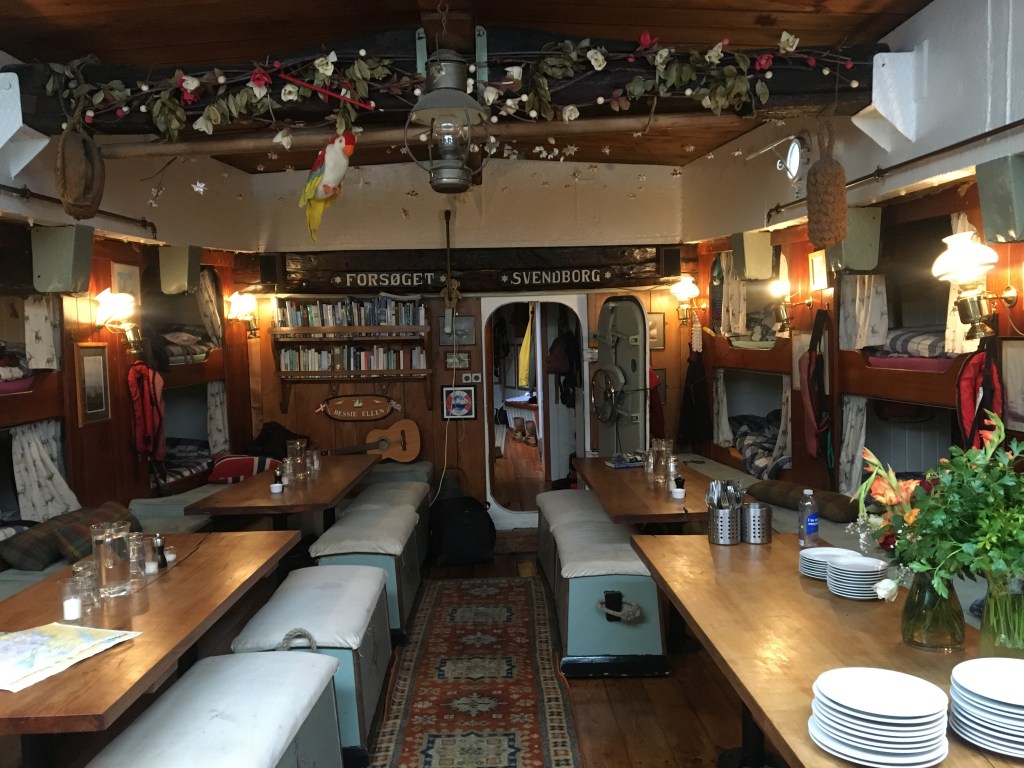
Bessie Ellen’s saloon. Note the bunks and Danish given name above the bookshelf

Bessie Ellen to the Hebrides day 8. Muck to Loch Drumbuie Aug 28th

No wind. Again. We get all 8 sails up but we’re still only doing 1 knot or less. Heading for Ardnamurchan Point. When we get within half a mile engine goes on. At helm hard over to starboard but makes little difference.

1100 I fill in the logbook. Course 150 degrees. Sea 0 or still. Conditions overcast. Interrupted by Nikki who sets course. Can’t make her out.

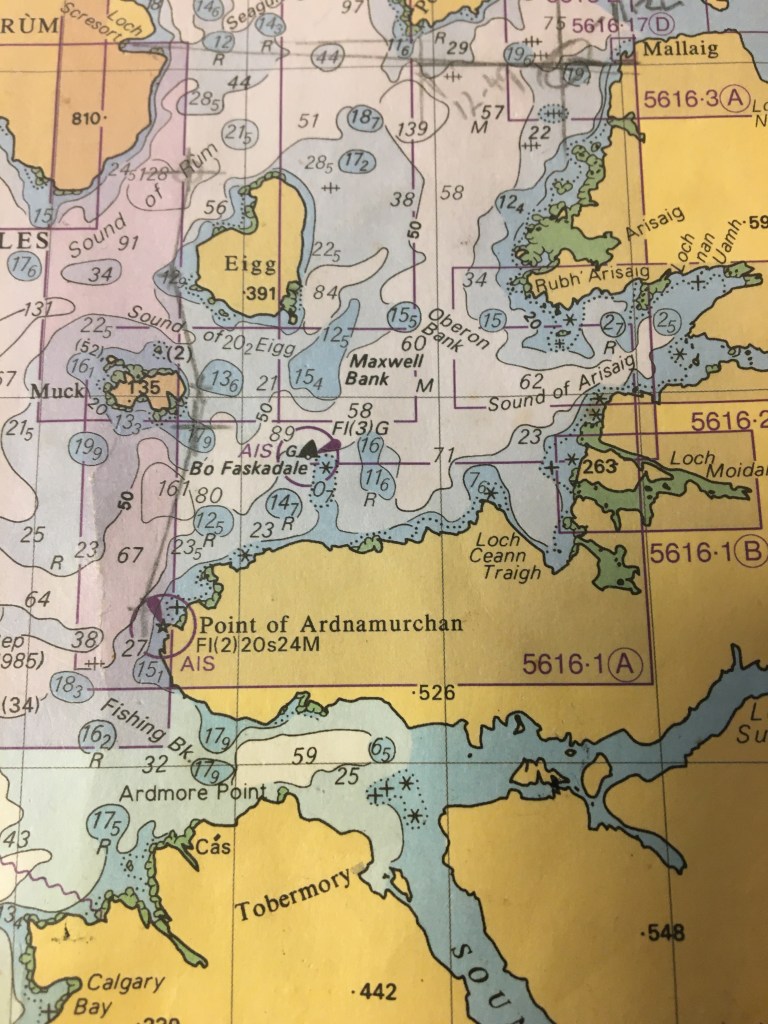
We get the tender over to Ardnamurchan Ppint. Built by Alan Stevenson in 1849. Most Westerly point of mainland Britain. This feels so remote.

Ardnamurchan Point

Simon ‘I’ve driven here and it takes hours and there’s nothing else here’

Ardnamurchan Lighthouse

As we wait to get on our tender from the rocks being watched on by an old border collie a young Scottish woman makes her way down the rock staircase to join us

‘Is that Bessie Ellen (she’s half a mile out at sea)

I’ve worked on Irene and seen her before in Oban’

Shows how recognisable she is but also the small world of classic boats.

Bessie Ellen

I follow Taylor to take down the jib sheets on the bow sprit.

Above Drumbuie the sea Loch winds it’s between tree and heather lined slopes. In midstream an almost island (Oronsay) splatters across the middle of the loch. Around the edge the grey rock has a black line – the high tide mark – then it’s beige. Below this the honey coloured seaweed ribbons it’s way round the bays and inlets. Drumbuie means Loch of the yellow hill.

The loch gets narrower like the upper Thames or Tay and disappears behind a craggy headland. Behind that a ridge rises up into the sky, the top lost in cloud. On the side of the ridge below the cloud, pale sunlight briefly lights the wall. It’s the only sunlight for all the miles and miles I can see.

Below it in the inlet the Bessie Ellen sits at Anchor. It’s like the scene in the film Master and Commander when Paul Bettany’s doctor spots the French naval ship moored off the island he is exploring in the Galapagos.

I am 14 again. I really feel like it. I am on the sleeper train with Dad listening to The Unforgettable Fire and dreaming of the mountains and the rivers where the Salmon lie.

I believe in God again and I see him in that sunlight. I want to be there.

I am sitting my GCSEs in the gym at school and dreaming of getting on a boat across to the Hebrides to Mull. To be free. To feel that feeling of communion that has always been there. And here I am 30 years later doing jus that.

A view that sends me, Loch Drumbuie

Later I swim off the rocks with the sunlight still lighting the distant peaks. The water is still and cold. Again I can see clearly beneath the water. There are hundreds of mussel shells strewn across the bottom, no doubt picked apart and dropped by oystercatchers.

When I get back I am shaking and eat industrial quantities of chilli with salsa and sour cream with dill and cheese.

Bessie Ellen to the Hebrides Day 7. Canna to Muck Aug 27th

While swimming on the deserted beach on Sanday in the morning a woman with thick grey hair and a big white hat floats along in a canoe.

‘Morning.’

‘Morning.’

‘Is it warm or cold?’

‘What do you think?’

‘Ha! Well you’re very brave.’

On parting ‘I wonder what you’ll make of Muck. It has a strange atmosphere…’ she says this as she’s already rowing away from me.

Set off at 12 for Muck. Some sailing but going at only 1.5 knots with the engine off so once we have lunch we take down main and jibs and head on into the fog with the engine the only sound. No one talks. We have the 7 mile state of people used to being at sea staring into the open. It always makes me think about time and life.

Arrived at Muck 1615. All islands have campers often just pitched on outcrops, etc. The right to roam as made law by the the Land Reform Act of 2003. England could learn something from this.

Muck is mucky. There’s lots of metal on beach fencing, lobster pots, rusted wheelbarrow. A whole tip w metal. Is this how they get rid of it? Even outside the working farms there are rolls of fencing or piping just left lying about. The graveyard near where we land is uncared for.

I think this is what my friend from this morning was talking about. After a walk to Horse Island we retire to the boat for a beer and dinner.

Dumped metal, Isle of Muck

Bessie Ellen to the Hebrides Day 6. Harris to Canna Aug 26th

Every night I wake up to go for a pee. It’s always a bit of an effort to drop myself out of the top bunk and onto the bench alongside. After that I always go up on deck.

Two nights ago the moon was up and creating a soft reflection in the ripples of St Kilda. I was interrupted by Bracken starting to bark. Last night about 3.30 it was really windy and the moon was lower with a bigger chunk off one of its sides like a corner bitten out of a biscuit.

I shivered and dreamed of sailing to a thousand different lands at night, each time seeing the stars in a different way.

We are away by 8.

There is a flurry of activity. I have to hoist the mainsail. It takes four of us pulling with every sinew.

‘Pull it into your chestbone and keep your back straight!’ yells the skipper. ‘Pull! Keep going. Another 3 metres.’

Next I am on the halyard, the rope which will take the top sail up to the highest point on the boat. Dave is a giant from Yorkshire and we puff and groan while we hoist.

Owain the first mate is suddenly with us pulling the rope out and in while someone else takes up the slack (tailing).

She is now pulling on all sails. I can feel the force of the wind pushing us forward.

We also have stay sail and 3 jibs up at the front.

1200 Sun is out and a fresh breeze is blowing from the South. Bliss. Skye passes on Port bow: brown cliffs, green slopes and peaks. The cliffs are in blue haze.

Skye off port bow with Cuillins visible on right

Peaks of Rum dead ahead with the low line of Canna to its right.

1400 wind drops. Beautiful strong sunshine. No cloud. Sea glitter. It could be the Med.

We motor around East side of Canna arriving about 6pm.

Isle of Canna

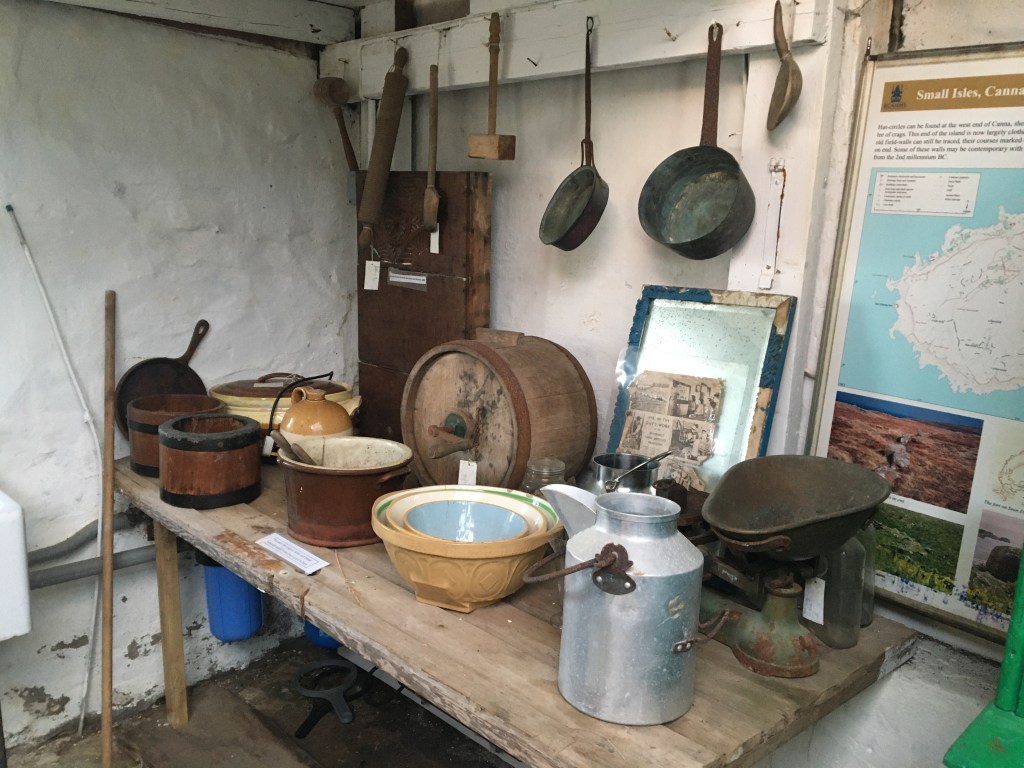
I am in one of the most evocative museums I have ever been in. This has none of the grandeur as the V and A or Natural History but as much impact.

The museum on Canna is in a white-washed block which was the old dairy on the farm that straddles the path to Sanday. There is a disused ceramic sink on legs with some flowers growing. Inside there is a smell of musty old objects. It reminds me of the smell in my grandparents’ larder. It is silent here apart from the tweeting of the sparrows in the sunshine outside.

Canna old dairy/museum

Old vessels and pots, urns and sets of scales are lined up on shelves and tables. There is a green painted cupboard, a chest of drawers and a life saving ring which has the name Zephyr on it.

Canna old dairy/museum

These objects all speak of an old way of life. In between these worn objects are information boards that tell some of the history of Canna.

One board is entitled ‘The Story of the Birlinn’. The Birlinn or highland valley was a type of small cargo vessel whose design was based on Viking boats. The board tells how ‘Using highland galleys helped Lord Somerled, the first Lord of the Isles and founder of Clan Donald, to break the power of the Norsemen in the twelfth century. Somerled’s domain spread 25,000 square miles and 500 islands.’ This is the same Birlinn beautifully engraved over Alexander MacLeod’s tomb at Rodel to show his status as a clan chief. Adam Nicolson writes about the importance of the Birlinn and the engraving at Rodel at the start of his book about his time on The Shiants, ‘Sea Room’.

Coming out of the museum other whitewashed buildings surround the track. It is a farmyard. There is a lock with a toilet and shower for the campsite in the field behind. In the garden of the farmhouse next door two border collies survey the track, one his front paws on top of the wooden gate his ears pricked.

In the corner the ‘yard’ in what looks like the back entry to a utility room the sign on the door says ‘HM Coadtguard Canna. Coastguard Rescue Station.’ All in the same farm.

A few hundred metres down the track (there are no roads on Canna) a green shed has a small postbox and original phone box oitisidr. A sign on the shed reads ‘Canna Post Office’. Sure enough through the dusty window I can make out a card payment machine and a Post Office parcel scales.

Canna Post Office

Canna has something about it. It’s hard to put into words. There is a sense of absolute calm. It’s so peaceful. There are no roads. The contours of the land are gentle. The colours are lush. It isn’t as harsh as St Kikda or Harris. The rock even looks different. It’s basalt which rises up at the top of the island in rod like lines. Someone on board says ‘The Giant’s Causeway is basalt. You can see the similarity.’

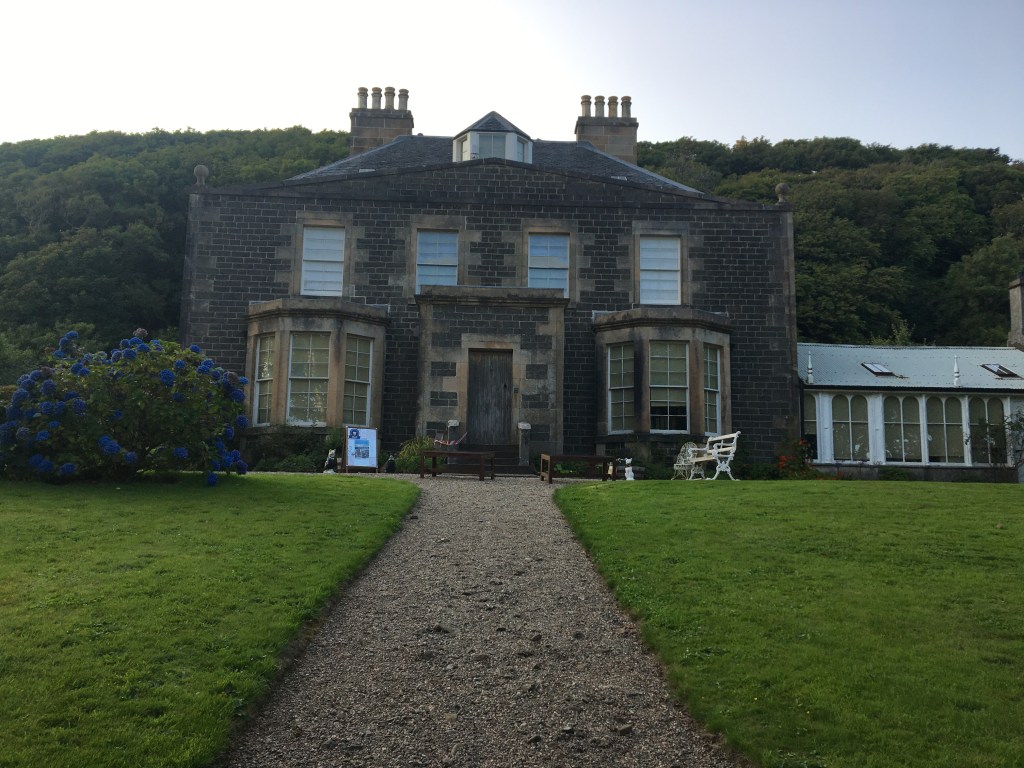
Before this, i had followed a dusty track past the whitewashed cafe selling local beer, lobster and crab. After that the lovely Canna House overlooks the bay. The house is closed til next year but the gardens in their bright neatness seem to sparkle in the sun.

Canna House
Canna House garden

I had walked through the farm/campsite/dairy/museum/coastguard. The track follows the edge of the land along a crystal clear river before reaching a footbridge that connects Canna with Sanday. To the right is a perfect crescent of white sand and blue sea. It is a desert island beach like something from a book.

To the West there are low lines of rocks and the crash and rush of the Atlantic coming over the rocks. That and the birds are all I can hear. There are great streams of kelp like thick hair waving. The visibility is good here. A friend of mine said it ‘has some of the best marine life in the UK’ but I’m yet to see much: a few crabs at most.

Beach, Sanday

Canna at dusk
Canna at dusk

Bessie Ellen to the Hebrides Day 5. St Kilda to Harris Aug 25th

Depart about 8 past the cliffs of Conachair where I looked over the edge yesterday. The cliffs where the fulmar slaughter would take place.

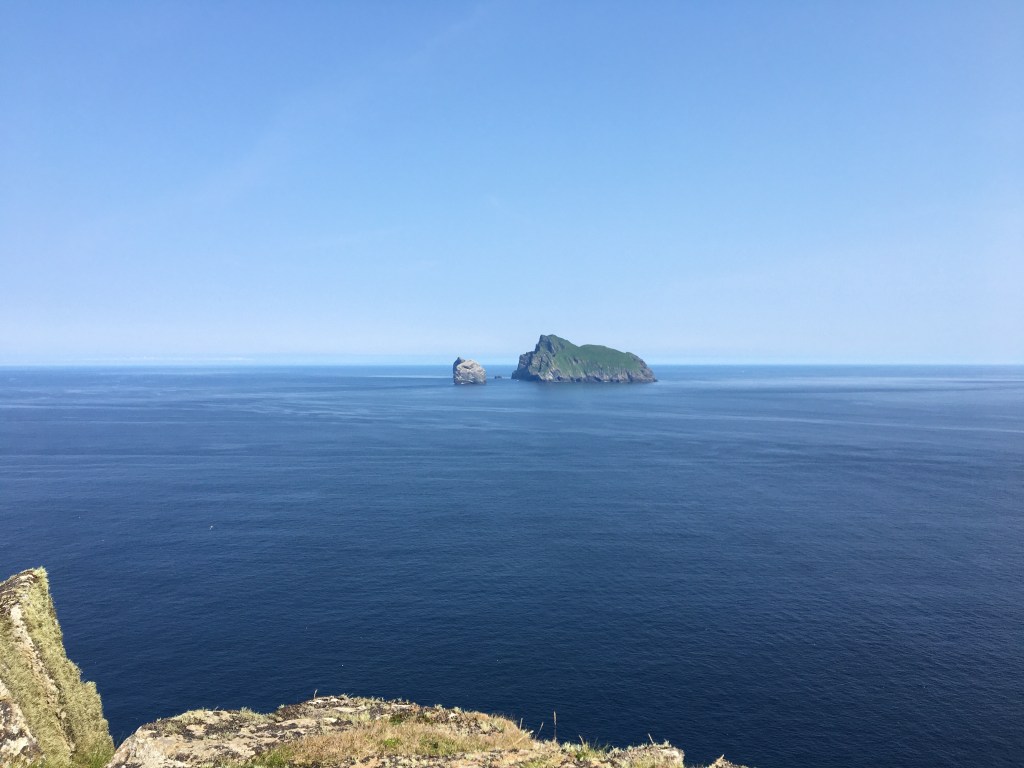
8.50 Across to Boreray, Stac Lee a giant lump of granite crisscrossed with fissures where the gannets sit in rows or else wheel in great circles over the top. This is the largest gannet colony in the world.

Boreray

There is a loud cawing but none of them are feeding. They must do that further out at sea where they dive missile like into the ocean with such velocity it makes a huge fump sound and sends up plumes of spray. Likewise with Stac an Armin.

The men of St K would take their one boat over here and try and try to jump onto a shelf and find something to moor onto, the swell often making the boat rise 14/15 feet at a time.

Stac Lee, the largest gannetry in the world

Hirta recedes into the distance a brown and green mass half lit by sun half covered in cloud.

Nikki ‘there’s not enough wind. It’ll just make us roll so we’re going to carry on motoring. It’s 60 miles to the Sound of Harris. Back onto our watches. We are in the same groups of 4 as on the crossing over.’

Grey skies and a keener breeze than we’ve felt so far. Good visibility. Temperature can drop v quickly at sea and standing about it’s easy to get cold even with jumper, fleece you need proper sailing wear. Big canvas red jacket Dremtech Plus Guy Cotten. It must be XXL but I’m grateful for the loan from the crew.

10.45 6 sails up including main, jibs and mizzen. Ketch means mainsail is at front.

Jibs up

Crew constantly kept busy, sanding, varnishing, painting. The skipper is keen to put them to task. She says ‘they should be always thinking about what job needs doing next. I shouldn’t have to tell them.’

If they are not preparing food, they are sanding, painting, polishing brass, retarring the rigging.

Nikki: ‘Bessie Ellen was the last of the West Country cargo ships. There are only 3 left in existence. Where you’re sleeping there would be room for 150 tonnes of cargo. During the war she went to Denmark and carried on being a cargo boat (under a different name) until I brought her back in 2000.’

Owain: ‘most of produce is from local stockists around Oban. The local wholesaler delivers it to the boat.’

Nikki is a skilled cook as well as skipper. Big meals – cod loin in tomato and parsley, duck casserole with lentils, scallops and good local smoked salmon for lunch, excellent cheese board. Then cakes: sticky toffee with pecans, apple tart, etc. Despite working on pulling up sails, pulling down sails, folding sails, tiring sails, swimming, walking I am putting on weight! Who cares?

On a course 100 degrees just off East.

12.30 we sight land: Pabbay (the Northern one) and Shellay. Little else to see apart from the sea. A white bottle that looks like it might be for detergent floats by. I saw another plastic bottle earlier but that’s the only flotsam I’ve seen so far.

Engine goes off for the first time about 2pm. We are sailing properly with all sails full and heaving at the creaking ropes.

Turning starboard into Sound of Harris

Jibs start to flap.

Alice ‘Bring in the jib. Leave one turn on.’ One of us sweating the other tailing.

‘Make fast.’

The same with flying jib.

1700 passing through sound of Harris with South Harris off port bow. Smattering of houses close to coast. Again no trees. Many other small and low islands off to starboard. Many marker buoys. Narrow passage.

Bring down all sails. Learn how to fold sails by grabbing folds and then wrapping it up like Big sausage and hung up. Same with mainsail.

We arrive at Rodel on southernmost point of Harris about 6. Hidden natural Harbour. No other boats and just a few houses here or there. We take the tender over to the sweetest little harbour with a stone jetty, a house and an old hand powered crane. It seems like no one uses this little mini Harbour but who knows?

Rodel Harbour

A little way up the hill is St Clement’s church. It’s dark stone and empty inside without pews or altar but this is the resting place of many of the Mcleods the same clan who for years owned St Kilda. They were also known to be brutal warriors. The man laid to rest in the main tomb here was known for killing 398 men, women and children by lighting a fire at the mouth of a cave they were hiding in and suffocating them to death.

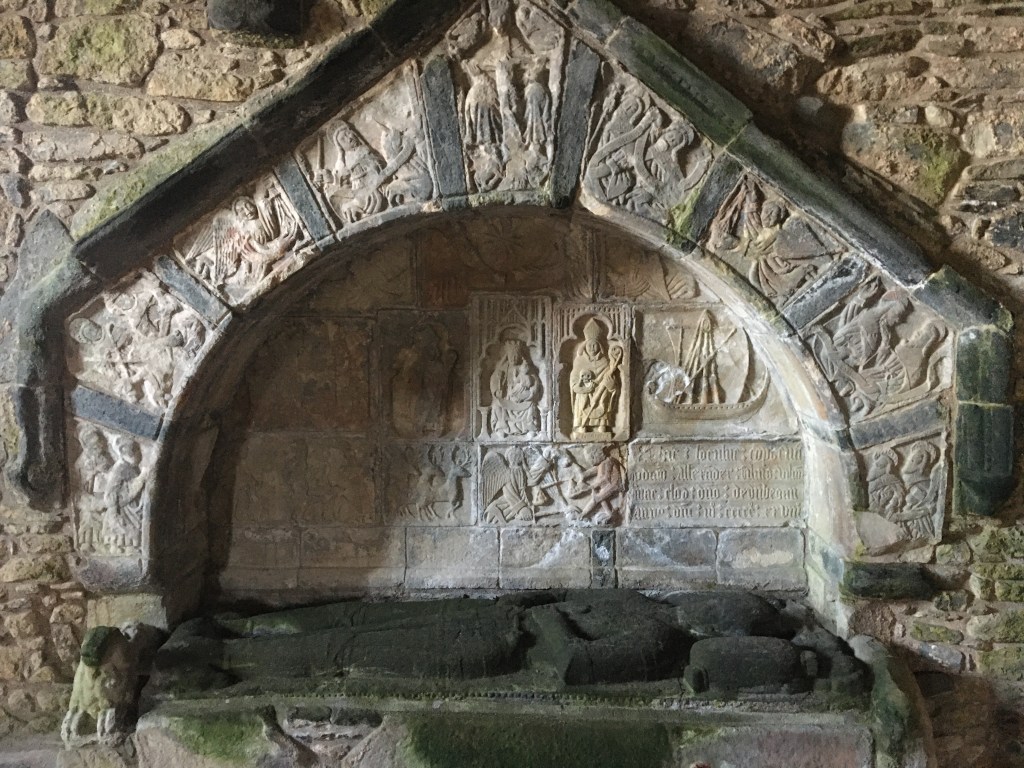
Two tombs show figures like prostate like warriors. One is surrounded by engraved panels of important scenes: the holy trinity at the top, an angel blowing an instrument and a sail boat – a Birlinn – which would have been a sign of wealth and status.

Tomb of Alexander MacLeod. Note the Birlinn boat on the right
Loch Rodel with Bessie Ellen left of picture

Bessie Ellen to the Hebrides Day 4. St Kilda Aug 24th

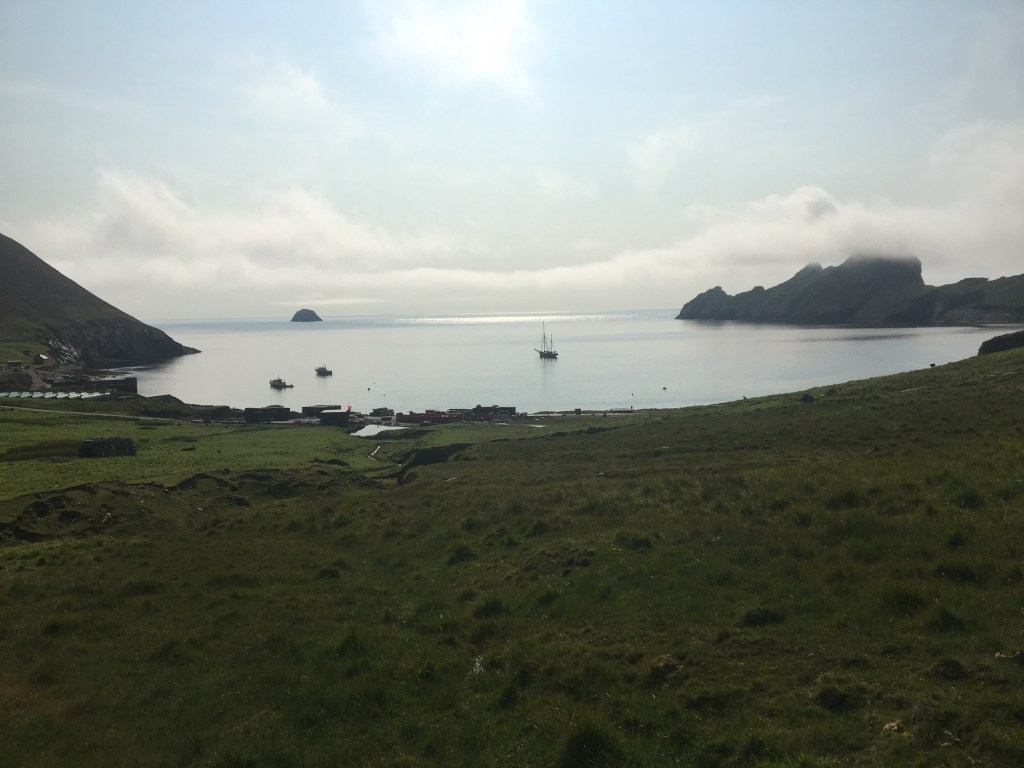
Village Bay, St Kilda

‘When a skua flies towards your face put your hand up and it’ll come close but then fly over the top of your head.’

So advises Sue the Ranger from the National Trust for Scotland about walking around Hirta, the main island of the St Kilda archipelago. It’s an indicator of how much this is an island habitat where birds rule the roost (excuse the pun).

Sue had lost her job on St Kilda during lockdown when no one was visiting. She went back to her old job of being an occupational therapist but now she’s back doing what she loves.

‘We are just coming up to the 91st anniversary of the evacuation so the descendants of St Kildans come back to see where their forefathers lived.’

It feels like I’m on edge of the world here. From here the Atlantic Ocean seems to stretch forever. I imagine myself as one of the thousands of fulmars who call this home or one of the puffins who have already left (July).

To fly due West from here I would get close to the toe of Greenland but finally find landfall in Newfoundland. Somewhere to the North of here are the Faroe Islands, another isolated group of islands. Beyond that is the Arctic Ocean.

There are three main peaks with a bowl hanging in between. Within this are enclosures and cleits and the one street.

These are the highest cliffs in the UK. The cliffs of Conachair. I love that ‘air’ is in that word because that is what I am most aware of here: elevation, space, air. As I edge to the side my legs and feet quiver. Can’t help imagine what it would be like to fall.

Chattering of fulmars are a bit like geese and a wailing echoes up one of the gullies. Hirta is a horseshoe with two peaks at the end of each prong or peninsula. There’s a short gap at the end of the Southern point and then another island (Dun) which is a sharp ridge of rocks and green rising out of the sea.

A steep ridge rises around the back of the shoe with a mast that listens out for anything that might interest the MOD in the North Atlantic.

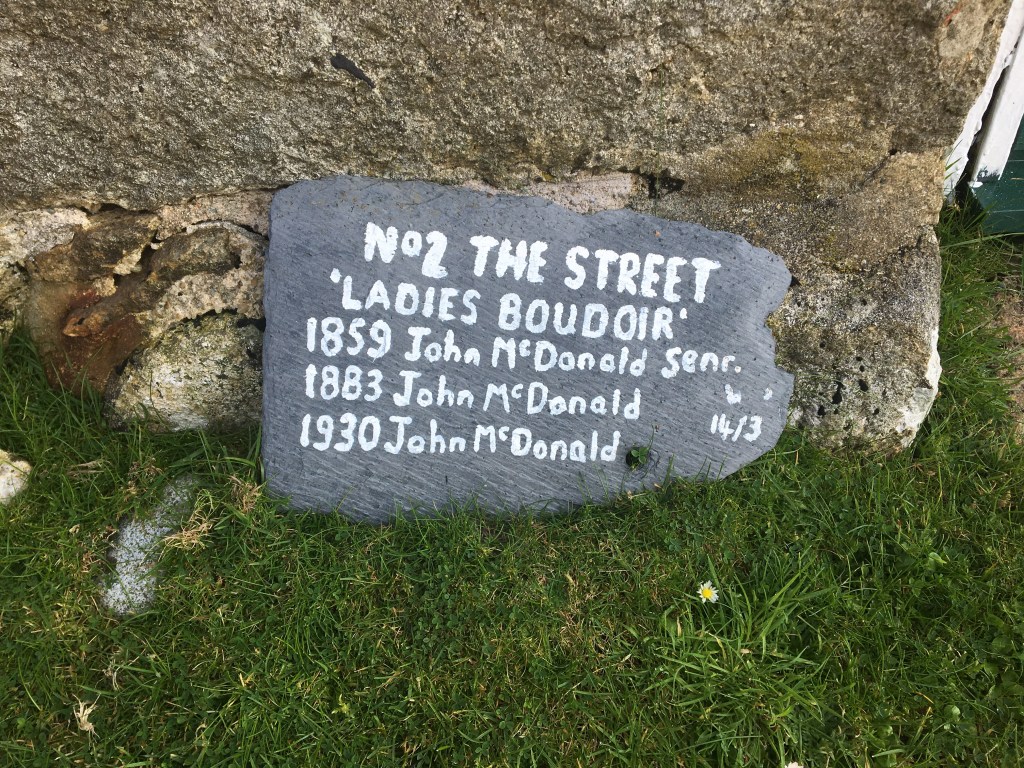
The slopes of the ridge slope down to the U of the bay and as the land flattens is the street – a line of 16 simple one room cottages built of stone in the 1830s where the last inhabitants of St Kilda resided until their evacuation on August 29th 1930. The street is parallel with the beach.

The Street, St Kilda

Behind the street is a long dry stone wall that enclosed their livestock.

Dotted all over this land and the hills behind are the dry stone cleits, neat piles of stones that look like ancient burial chambers that were actually where the St Kildans stored the dead fulmars that ensured their survival for so long.

Cleits, Hirta

For the UK’s most remote island there is a lot of activity and noise. 2 diggers are hard at work behind the only jetty and next to the Manse.

Sue tells me they are landscaping after having got rid of the original MOD buildings. Instead there are wood clad one storey buildings with of Scandinavian design with turf roofs. These are for employees of Qinetic who Sue tells me now ‘man the mast on behalf of the MoD.’

‘Your walk shouldn’t be compromised by the sheep count that’s going on. Researchers are here to carry out scientific research on the Soay sheep’.

These sheep are native to St Kilda and are named after the small island of Soay (part of the archipelago) and are descended from the breed that would have lived here over a thousand years ago.

I saw the Kirk with its prayer books and austere interior. A plaque on the wall commemorates a captain whose ship registered at Greenock ran aground here. He managed to borrow the St Kilda boat and make his way back to the mainland. He contributed a bell.

Walked along the street. Each house has the name of the residents including the last person to live there before it was evacuated. Visited the good museum in one of the houses.

One of St Kilda’s houses with its last residents

After this I went via the beach back to the jetty so that I could find Sue to interview her about tourism and the island.

After lunch I headed up the back of the village to the cliffs. So steep and high like one of my dreams where I am falling from a very great height.

Fulmars swooping wheeling or just sitting on a shelf in the cliff. This is where the men would lower themselves on ropes to slaughter the birds.

Conachair cliffs, the highest in the UK

Flat blue sea in all directions. Vague outlines of the outer Hebrides are just smoky blue apparitions on the horizon to the south east.

The path follows the top of the cliffs then climbs steeply to the highest peak. There are two rough sheep at the top and a cairn. The sea stretches for miles in every direction. From here across a saddle to the next peak where the mast is. En route a skua flies a few metres over my head.

At the mast I join the road that zig zags back down the hill to the beach. I swim in turquoise sea which Sue tells me is 13 degreees. So hot the cold is like balm then fall asleep on beach.

Looking East from Conachair to Boreray

Bessie Ellen to the Hebrides Day 3. Vatersay to St Kilda Aug 23rd

I wake to the sound of a foghorn low and mournful. Sure enough there is a sea mist and the sun a smudge behind it. We leave before 9 heading south to cut through the bottom of the Outer Hebrides passing close to Pabaigh then heading roughly North West to St Kilda. There is no wind again so we motor. It is 70 miles approximately and should take 12 hours.

I take the helm on a course of 290 degrees avoiding lobster pots indicated by two buoys. By 10.30 we’re into the Atlantic proper surrounded by grey sea and mist indistinguishable from each other.

The sea is so smooth it could be a grey vapour stretching into the mist. Many jellyfish with long tentacles and pulsating pale heads float past. Lions mane jellyfish – owing to the orange ‘feathers’ that come out of their heads with tentacles that can be 6/7 feet long. Penny tells how her son got stung by one recently ‘it looked like a burn from a poker and blistered and became raw like a burn does.’

The only sounds are the thrumming of the engine at the back, the slosh of the water coming off the bow, the creak of cleats and muttered conversations from people in small groups around the deck.

There is a sense of calm.

I am in watch in the bow when suddenly a shout from the stern: ‘Whale!’

The engine is cut and we stop in the flat calm. Everything is silent and still. There is a holding in of breath. About 100 metres off our starboard bow a glossy grey back slowly breaks the surface with its dorsal fin. Its back appears. As it arches out of the water I guess its length 20, 30, 40 feet long. It slips away as smoothly as it appeared. We can see its white patch slowly coming back across our bow, turquoise blue in the water and then swim astern. It breaks the surface once more and is gone. Minke.

Nikki: ‘That’s as good a sighting as you’ll get. The best thing to do when seeing a whale is to switch the engine off and wait. Often they want to come and see who you are.’

Just before 2.30 we have another pod of dolphins at the bow. We cross into the shipping lane and the skipper tells us to keep eyes peeled for big container ships.

We plough on motor running and the fog descends again. Sometimes we can see a mile or more. At others it’s only a few hundred metres.

There is a sense of expectancy. It’s cold and we’ve been at sea the whole day. Evening is upon us.

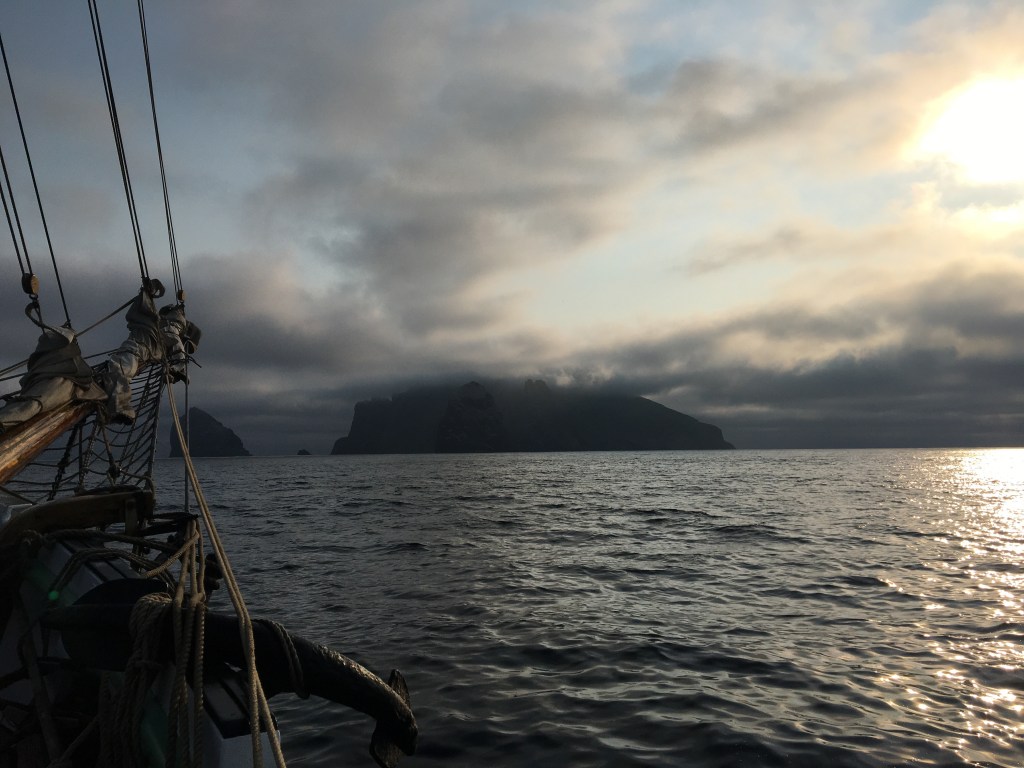
At first St Kilda I mistake for another layer of mist. It’s a slightly darker shade of grey. We’ve been looking at grey all day. It’s the first time I’ve seen the horizon for hours and suddenly I can see a raggedy line meet the line of the sea.

Then off the starboard two vertical sides of rock rise up and then are quickly enveloped in cloud. It’s sublime in the traditional sense: terrifying and beautiful. I’m all of a sudden wondering why I’m here in this desolate, lonely place. I can’t keep my eyes off it what I can see of it. Steep slopes, moraine, rocks. The only sign of human presence is some small enclosed spaces surrounded by dry stone walls and the little low buildings that they lived in and one cleit.

I feel like Chris Klein in Solaris. This place seems to exert a huge unknown force on me. I feel scared and powerless like I’m being drawn into a whirlpool and am unable to stop myself.

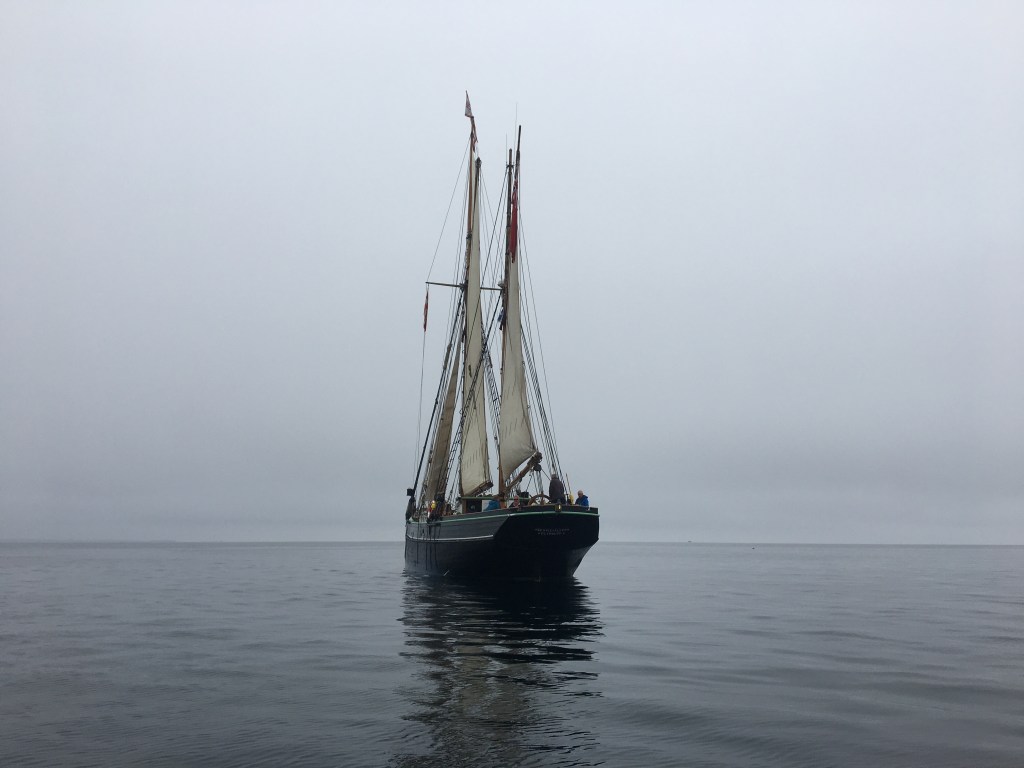
Bessie Ellen

Bessie Ellen off Rodel

Named after the original owner’s daughters, Bessie and Ellen. She is 120 feet long. According to her dedicated website ‘Bessie Ellen is one of the last surviving West Country trading ketches from a fleet that once stood at nearly 700.’

She was capable of holding 150 tons of cargo. The website says how she ‘transported clay, peat, aggregates, salt and many other bulk cargos around the UK and Ireland.’

She carried on shipping cargo until 1947 before being bought by a Captain Moller from Frederiksvaerk in Denmark. She was renamed ‘Forsøget’ (The Attempt) and was transformed to have less rigging and rely more on a big engine. She carried on carrying cargo until the 1970s.

Nikki bought her in 2000 and restored her to her original self.

The main space sits in the middle of the boat where once the cargo would be stored.

It’s spacious and nice and wide. There are 6 bunks along each side. Each has its own curtain and LED reading light. I sleep next to the rough, dark varnished timbers of the sides. 4 fixed dark wood tables are on the floor.

The saloon

There are banquette seats along the sides next to the bunks under which are our lockers under cushions. The seats on the inside of the tables are old sea chests with cushions on top, rope handles at each end and each painted pale blue and a traditional compass painted on the side. Inside they store provisions for the trip.

Sea chest seats

At one end the roof can be opened like a sun roof. Nikki has made it homely. Old boat name signs are at one end, her given name when she went to Denmark Forsoget and the place she was registered Svendborg. There are 2 chests of drawers and pictures of old clippers.

The saloon looking forward towards the galley and fo’c’sle

From the ceiling white origami stars of different shapes and sizes dangle and Bob with the motion of the boat.

Across the main cross beam branches of flowers made from material remind me of hops hung above a bar in a pub. Hurricane lamps provide light and a toy parrot hangs from the ceiling. There is a shelf of books at one end.

Above deck she has eight sails: a main sail, top sail, mizzen, mizzen top, stay sail and three jibs. We manage to put all of these out apart from the mizzen top.

She is painted black with bright green lines at the water line and along her gunwales. She flies a Danish and Norwegian flag and the royal ensign. Wherever we anchor people come to see her.

Bessie Ellen at St Kilda
Under sail off Ardnamurchan Point

Bessie Ellen to the Hebrides Day 2 – Tobermory to Vatersay Aug 22nd

Fairly good sleep. The faint restlessness of a new situation sleeping with strangers. No movement. No creaking like on Leader 2 years ago.

A fantastic breakfast: fruit, yoghurt, cereal, sausages, rolled cheese. People eat quietly. Many talk enthusiastically about the wildlife: seeing humpback whales and 2 minkes on previous trips aboard BE.

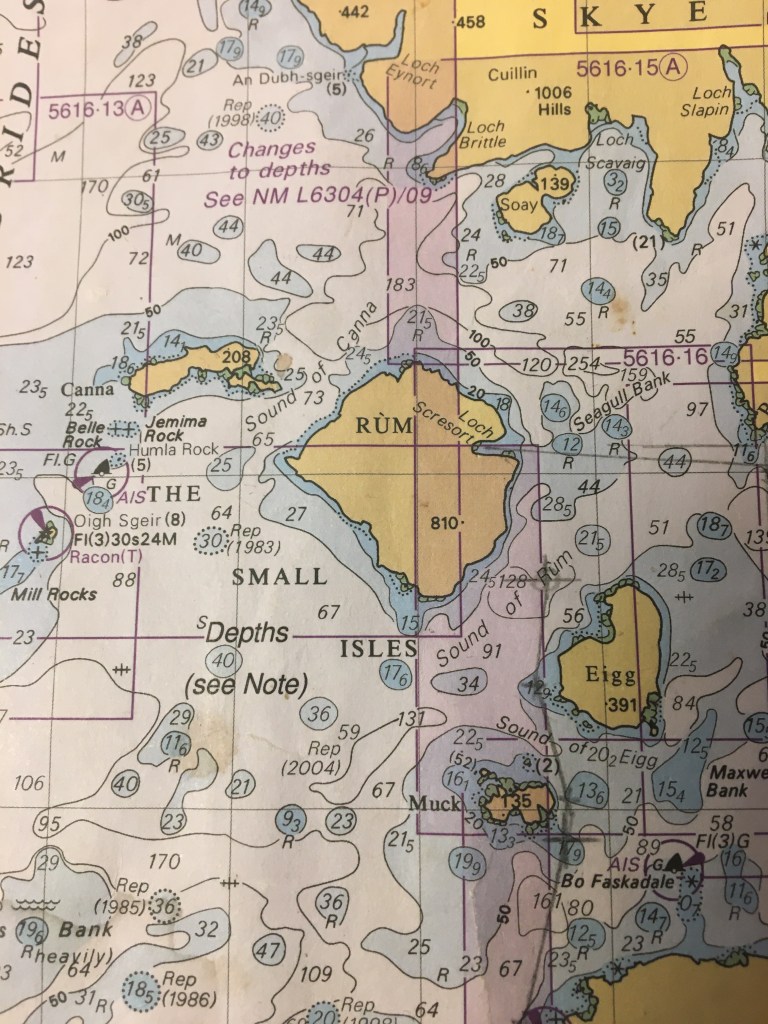
Underway before 9. Skies are clearing and sky is mostly blue. We make our way West across the North of Mull with Ardnamurchan Point on the mainland off our starboard bow. Passing that we can see Muck, Rum and Eigg a few miles to the North, the larger points of Rum flossed with cloud like ice cream on a cone. The sea is blue black and smooth but then ripples as we pass Mull and out into The Minch.

Rum off the starboard bow

First thing on deck is to hose and sweep down decks. One of the crew Ned ‘The saltwater pickles the deck and stops bacteria growing. We try and do it every 1 or 2 days.’

Scrubbing down the decks

Nikki, our skipper, tells us our watches.

‘It’s a long day to Vatersay so it’s something to keep us occupied.’

She tells us how after we pass Coll the sea gets deeper up to 23 metres and this is where it’s good to spot whales. I’m on 3 til 6.

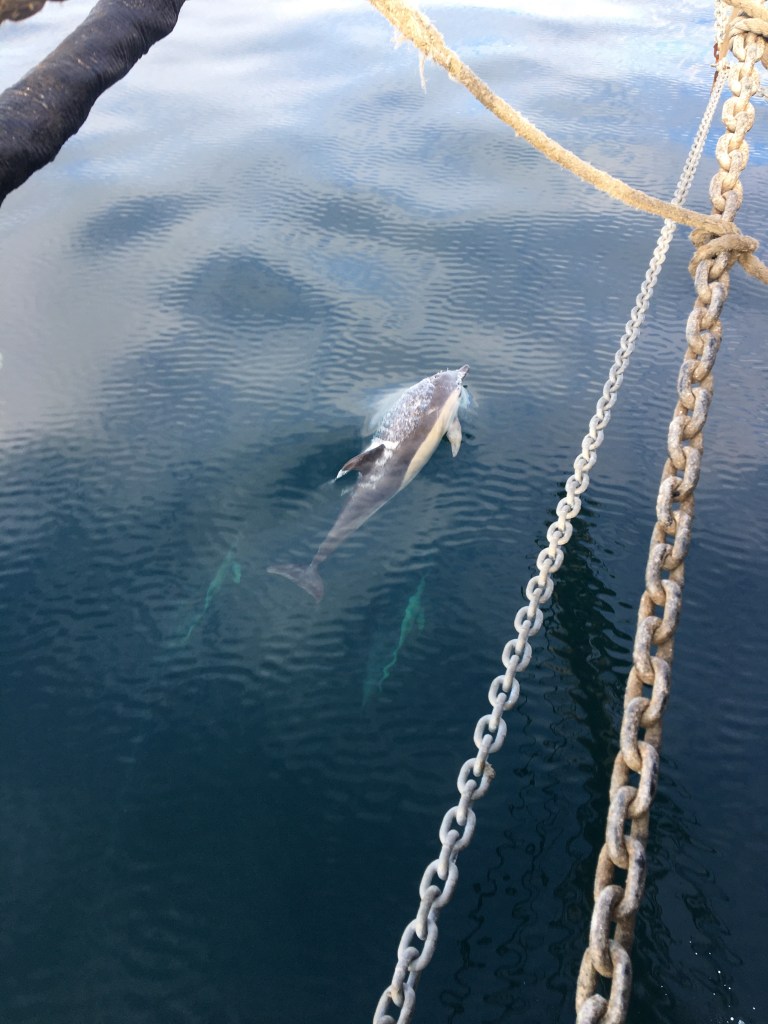
We see dolphins breaking the surface dead ahead but half a mile distant. Suddenly they are heading along the surface towards our bow like torpedoes. As they arrive they quickly flip over underwater like Olympic swimmers starting a new length and follow the bow close together rising and falling to the surface in that way they have.

They also like to turn their grey white bellys to the surface and fix you briefly with one of their eyes and smiling mouths as if to say hello to all of us peering down at them. When they do this their undersides appear a lovely bottle green. Like the sunlit water around them.

Dolphins off port bow

I notice many of them have abrasions on their backs and heads, long straight scars and one has squares of criss crossed abrasions like the hand grip you might get on a tool.

I read that these are ‘mostly caused by social interactions but also by tussles with prey.’

The skipper’s 2 year old border terrier, Bracken, is beside himself trying to poke his nose between the small gap below the side of the boat running back and forth barking.

We soon settle into the slowness of life on board. There is a calmness to being at sea (obviously not always). We sit and look at the sea and the views. Feel the sun and wind on my skin. We cannot go anywhere. Since yesterday when I was rushing about trying to get everything ready, get on time. My breathing has slowed. My thoughts are less frequent. Sometimes I don’t think at all. I just look and feel.

The sea is like a gently rolling blue and blue black flatness. Lit by reflections of white clouds above Rum.

Arrive at Vatersay about 5.45 into a bay with perfect sand and turqoise sea. Looks Caribbean but feels Arctic in the water. Stay in for 10 minutes but it’s too cold to try to enjoy looking for sea life. A few 100 metres across dunes is the Atlantic. The sun is above the Western horizon. I have the yearning for travel that is intense when you’re young and has diminished but is still there.

Sunset, Vatersay

The moon, bulbous and orange, rises from behind the hill on the promontory. Stars are coming out but I’m too tired to wait up for them. I climb into my bunk and fall fast asleep.

Bessie Ellen to the Hebrides August 21st-30th 2021 Day 1

Oban is rain soaked. It’s coming down in solid lines: the sort of rain that gets through to the skin in less than a minute.

North Pier is on the front near all the shops, eateries and throngs of visitors. There are boats of different shapes and sizes: a motor launch that advertises ‘Sea Exploration’ with a dirty grey hull that wouldn’t look out of place with pirates on board near the Horn of Africa, a smart looking medium sized cruiser with navy blue paint, polished brass portholes and staff in crisp white short sleeved shirts. There’s even a round the world yacht covered in advertising being chartered out for youngsters.

At the end of the L shaped pontoon beyond all the rest one stands out. She is the belle of the ball. Bessie Ellen. Over 100 foot long. Two masts. A tall ship. Built in 1904 in Plymouth. One of the last of the old cargo ketches from the West Country. There are only two left like her.

We leave at 1600 exactly. 27 miles to Tobermory.

We have to motor. Not enough wind to put sails up. Bracken the border terrier. Sits upright on the back looking out to sea.

Leaving Oban

Mull appears to our left. Low clouds snake themselves around hills or lie heavy in valleys like a sleeping creature.

Underway in the Sound of Mull

One of my crew mates asks ‘Why are those clouds so low?’ I don’t know.

A large castle is perched on a square cliff above the water’s edge. It has scaffolding spiking off it on 2 sides. It reminds me of Macbeth’s castle. It seems unreal in its combination of grandness and exposedness. They must feel the gales in Winter.

As soon as we’re underway one of the crew demonstrate how to use the ropes.

A shiny black ball breaks the surface. It’s a grey seal. It seems oblivious to our presence. Sometimes they swim on their backs before diving again.

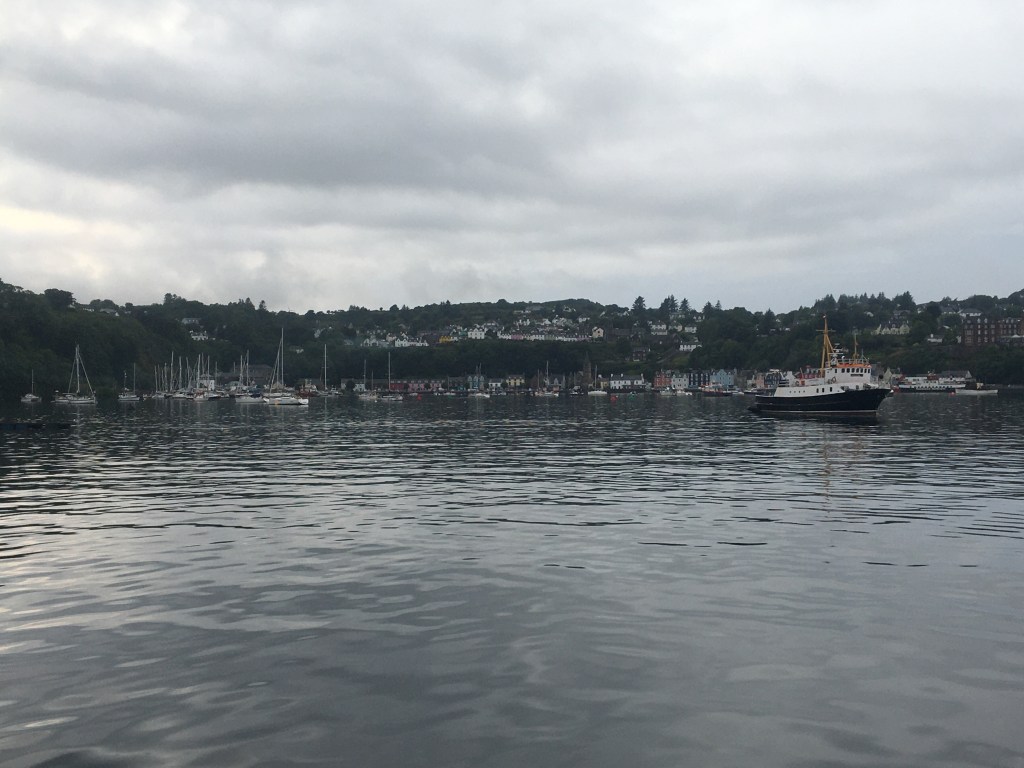
After about three hours we arrive into a glassy bay. Tobermory. The houses from the bay look like doll’s houses in their jaunty colours and perfect white windows. It’s silent apart from the rush of water. A river hidden in the woods and a waterfall that issues out of the trees into the sea. That sound I always associate with Scotland.

Tobermory
Glassy water, Tobermory

Why tramp?

It’s a cliche to say how the last year has made us re-evaluate how we live our lives. We’ve had to. I wonder and hope that walking might have taken root in many people’s lives and into their consciousness.

From inner cities to small towns to villages and remote areas it was our only release: one of the few things we were allowed to do, for a big part of this year and last. I wonder if it has become more popular as a national pastime as road cycling did after the 2012 Olympics.

I remember those grey Sundays throughout much of the first half of the year. Around the suspension bridge in Clifton you couldn’t move for walkers. Everyone desperate to escape from the captivity of their own homes. Then the first weekend the pubs were open the bridge was deserted. Maybe a stroll, a hike, a yomp, a tramp doesn’t hold quite the same appeal as a trip to the gym (or a trip to the local).
I’ve been walking with groups of students in the Quantocks and on Dartmoor. I’ve listened to them grumble and sit down and refuse to carry on. I’ve also seen them fight through and complete it and seen the smiles and listened to the comments that spell their sense of achievement.

I’ve lost count of the amount of teenagers I’ve passed in the most remote places with not an adult in sight completing their Duke of Edinburgh award. They have to be autonomous and self reliant. They learn independence in a remote setting. It gives them skills to carry through life but I hope opens their eyes to a sense of adventure, wonder and the benefits of being surrounded by the natural world.

And then there’s solo walking. The pace of walking and the lack of distractions frees the mind. Thoughts and feelings are exaggerated. Time stretches.

It isn’t always helpful: the level of introspection can sometimes be overwhelming and if something is bothering me it can get too loud. But it adds to learning about myself. How many of us take the time to really explore ourselves: our anxieties, passions, memories, hopes, regrets, fears and loves.

When I walk there is a clarity. And the thoughts unspool themselves.

Two years ago (before we’d heard of Covid-19) my father got diagnosed with a terminal illness. There was nothing we could do but care for him. He died in May last year at home. Friends and family were crucial in coping but it was also walking that saved me. And it still is.

Tramping Diaries SWCP Porthleven August 17th 2021

Could I be the slowest South West Coast Path Walker of all time? I set out to walk clockwise the 630 miles from Studland to Minehead on a sunny Sunday evening in July 2016.

Slow walking. This is my thing. Or just an excuse to daydream. It’s not just walking. It’s observing, listening, feeling, speaking to people, watching the sun appear from behind a cloud, seeing a dolphin jump in the Helford estuary or watching the first star to appear as I lay down next to the path.

When I crossed over the Exe estuary on a tiny ferry from Exmouth to Dawlish Warren two years ago I met a man completing it in six weeks.

He was a beast of a man, huge in every way and probably a rugby player. Bearded, gentle and quiet with a slight Somerset burr. He would walk all day until late in the evening. The night before he’d slept on a wooden seat near the path. How could he have fitted on it I wondered.

He showed me his provisions: big bags of nuts, seeds, dried fruit and blue m and ms. He had a huge back pack covered in a luminous waterproof cover. He had a water pack and even an app on his phone to signal where he could fill up water. (I fill up my battered bottle at pubs, public toilets, streams or just knock on people’s doors).

Six weeks! That’s pretty good going. Yet that’s not how I like to do it. For me it’s not about the end – the completion – it’s about the journey. It’s about everything that happens in between.

He strode off along the dunes. I jumped in the sea.

I am exact about following the path as closely as I can. Sometimes it’s impossible because of diversions, normally because of rock falls or parts of a cliff collapsing.

I mark each part of the route on an Ordnance Survey Landranger map in green pen with a date and the odd note: places I swim, where I met someone for a chat, visited a church and so on. The maps are starting to pile up in a box of memories at the cottage in Somerset.

Whenever I start a new leg I make sure I return to the place where I finished before. When I return I always think about what has happened in the missing weeks or months. On many occasions there is a wooden sign pointing west marked ‘coast path’. It’s often my marker. I smack it, pause and announce ‘back on the path’ to no one in particular.

Last Summer I went round the Lizard arriving on Porthleven Sands in September. And here I am 11 months later as near as possible to where I ended up. I cast my mind over the lost months. We won’t forget this year.

Porhleven Sands

Approaching the point which marks the start of Porthleven, a gentle 3 foot wave curls then disappears behind the point. Two miniature black figures dance amongst the foam like stickmen. Behind them a solitary crepuscular lights up a patch of sea like a spotlight. Something leaps inside of me. It’s a feeling unique to Cornwall. The slow released breath is loud in my ears.

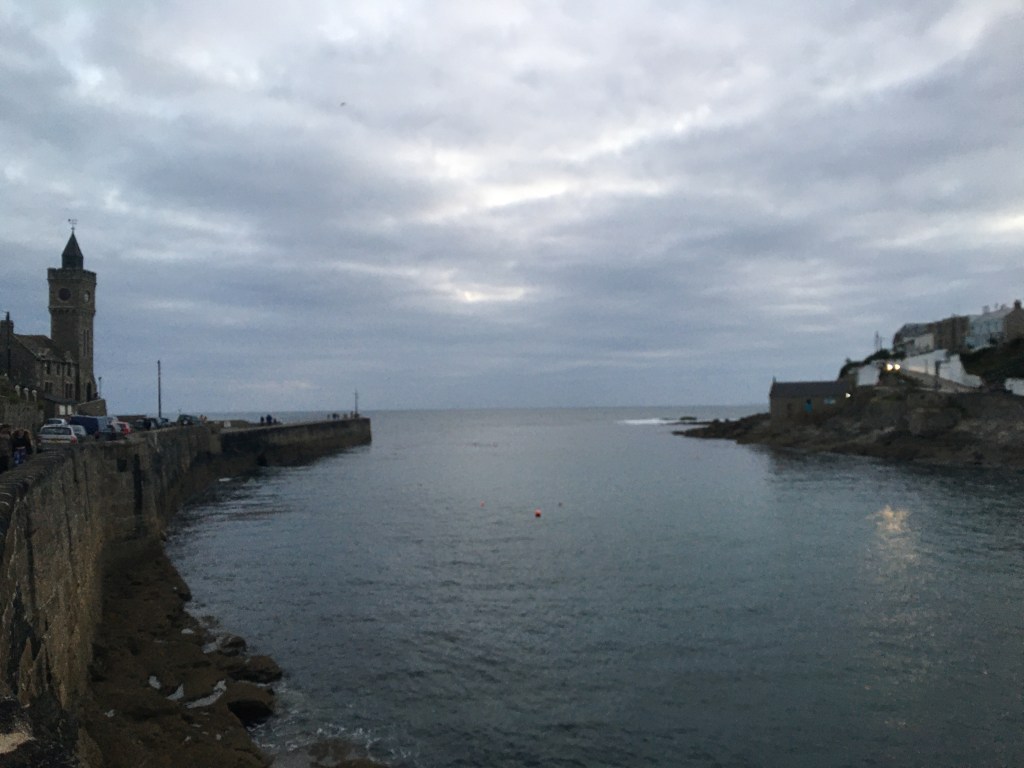
At the entrance to Porthleven harbour I pass holidaymakers: couples, young families, dogs. I stop to look at the entrance formed by the sea walls. How many boats have passed out through those walls? How many men set out in the early hours to drop their nets and lines who knows where out there?

Entrance to Porthleven Harbour

I wander round the edge of the harbour wall. Seagulls stand around like teenagers with attitude. They’re probably more permanent here than most of the people.

I walk almost a full circle, from one one end of a horseshoe to another. The Ship Inn is built high up so you have to climb stairs to get to it. It reminds me of so many others like this: traditional Cornish inns which smell of the sea and glow with opiate orange light. I wonder how far out to sea it can be seen.

Half an hour later I’m two fields out of town and the rest of Porthleven has been hidden by a shoulder of land.

Not long ago I had some trepidation about doing this. Now, like with a lot of things, I don’t care.

I look for flat ground first, preferably with thick grass. Then cover from the wind. I settle in the lee of a stone wall on the eastern side. It will shelter me from the westerly I’ve been walking into.

I learn from my mistakes: last year I lay down on a promontory near Broom Parc on the Veryan Peninsula. The wind got inside my sleeping bag and I started to shiver. In the middle of the night I found a dip next to a wall. It is one of the loveliest feelings, the feeling of being sheltered. Dry stone walls now feel homely.

I unpack quickly: all loose objects, keys, phone, wallet, toothbrush go in a separate mini rucksack. I blow up the West Peaks mat – a six foot padded mattress with blow up pillow. Once I’m in the sleeping bag and bivvy bag I am a large worm. A worm with an eye mask on my head.

I remember another evening on the path last year near St Anthony’s Head. I was in a field of long grass. It was a warm, sultry night full of life: fat, black insects the size of small birds buzzed back and forth. As I stared at the sky a ghostly shape appeared above. As white and silent as snow. A barn owl’s wings make no sound. He checked himself right above my head and started to swoop, then changed his mind. For a moment I was terrified.

I’m cosy and looking at the half moon dipping in and out of the clouds on its own voyage up there. With no distractions I could watch it for hours like Endymion waiting to be seduced. Slowness. Simplicity. And finally sleep.

Tramping Diaries The Monarch’s Way June 2021

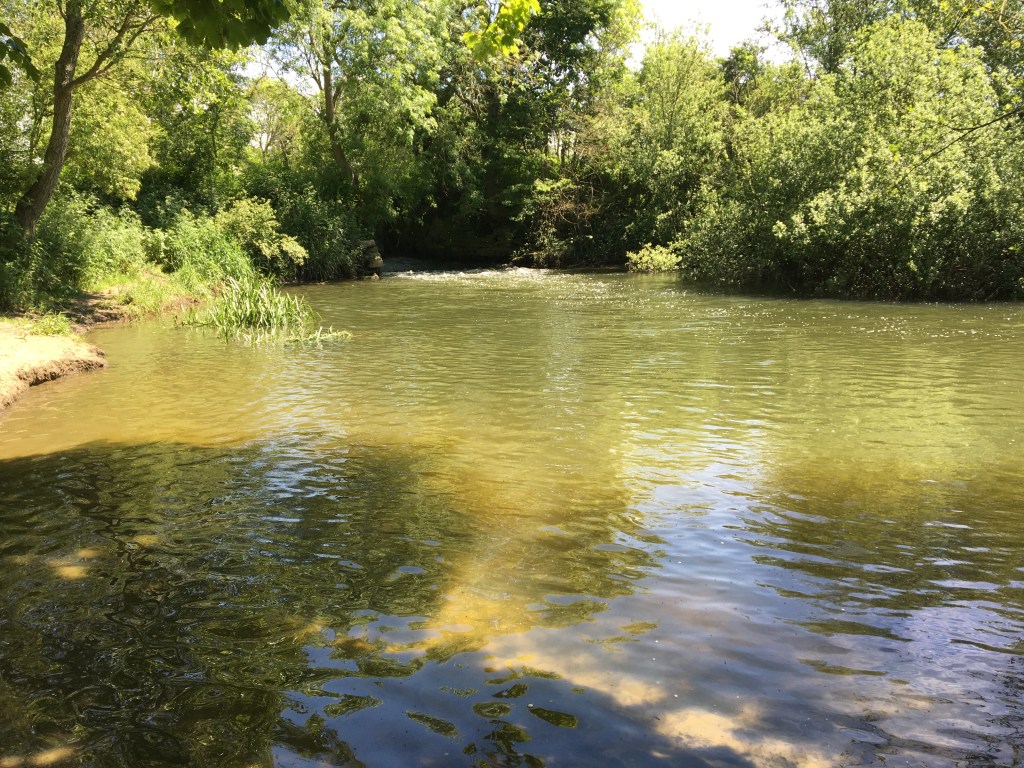
I am lying on my back in a green pool. I float through lily pads. The world is reduced to a frog’s view of blue sky and waving green leaves. Sunlight creates flashes of gold in front of my eyes. Is it just the light or is it the light catching the blonde of my eye lashes? I never know.

My hearing is muffled but I can still sense the rush of water. It reminds me of having my hair washed in the bath as a child. The otherworldliness of being submerged in water. It’s like being cradled while in the background the river sings her cooing, comforting melody. Around the pool there is flashing sunlight as it filters through the trees. At one end there is a run into the pool. The water splashes and gurgles. It makes silver wavelets that sparkle in the light before it rushes into the roundness of the pool. The water flows fast down the middle while it slows and eddies on the margins.

Blue damsel flies dart here and there. Streams of white gnats fly in opposing directions to each other just above the water. It’s an insect superhighway. Where the two streams cross each other it looks like crushed glass being blown through a wind tunnel.

I am near Mudford just North of Yeovil. It is only a day after stumbling across the church at Hornblotton and overhearing the teenagers outside Castle Cary.

I slept well in the orchard below Cadbury Castle. I woke at about 5 as usual. For most of the morning the sun was blocked by a thick bank of cloud that covered half the sky. I willed the pale smudge of sun to grow stronger. Dressed in several layers, I trudged on. Shivering. Meadows were heavy with moisture; my legs quickly dark and shiny from the wet.

The way takes a left to Stafford’s Green. It’s silent.

A mile later Sandford Orcas sleeps. All curtains closed. Is it because most people are still working from home? Or is it that it’s early?

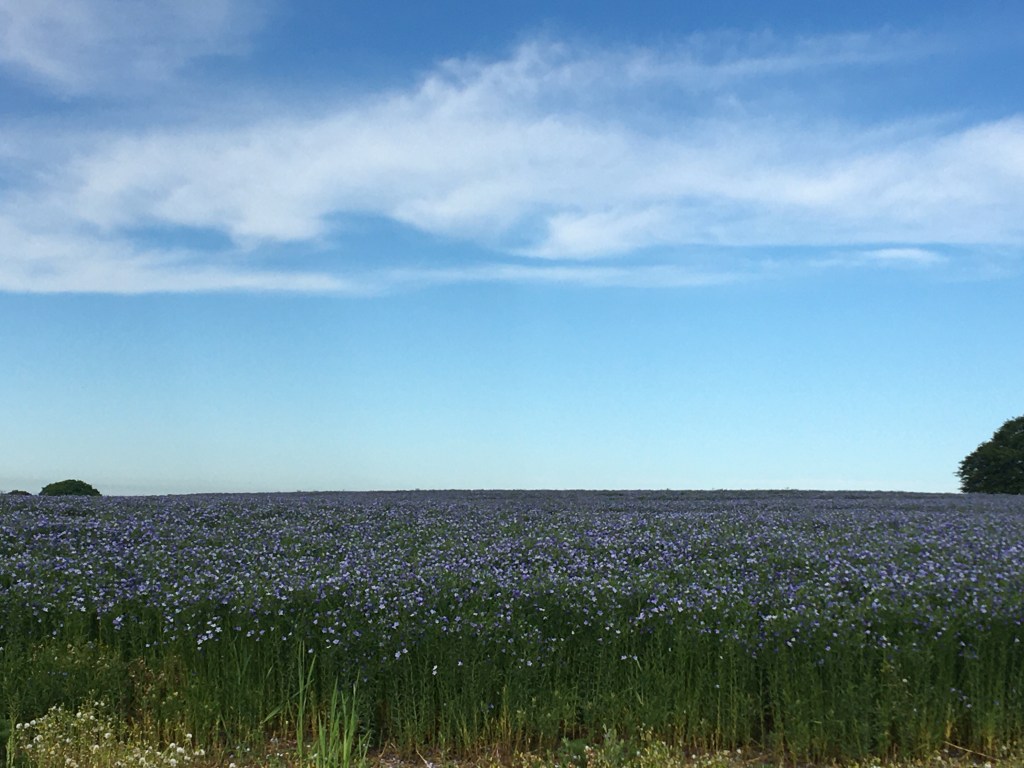
It’s only once I join the B3148 before it goes into Sherborne that the sun tentatively starts to show itself. I’m no sooner on it before I’m off on another drove. The purple of a linseed field accompanies me as the blue appears.

Linseed Field, Charlock Hill

Suddenly dog walkers are everywhere. One man is smiling at me from 100 metres away.

‘Morning! Lovely day.’

‘Yes, absolutely’ I reply, both of us matching each other’s enthusiasm at the miracle of sunshine.

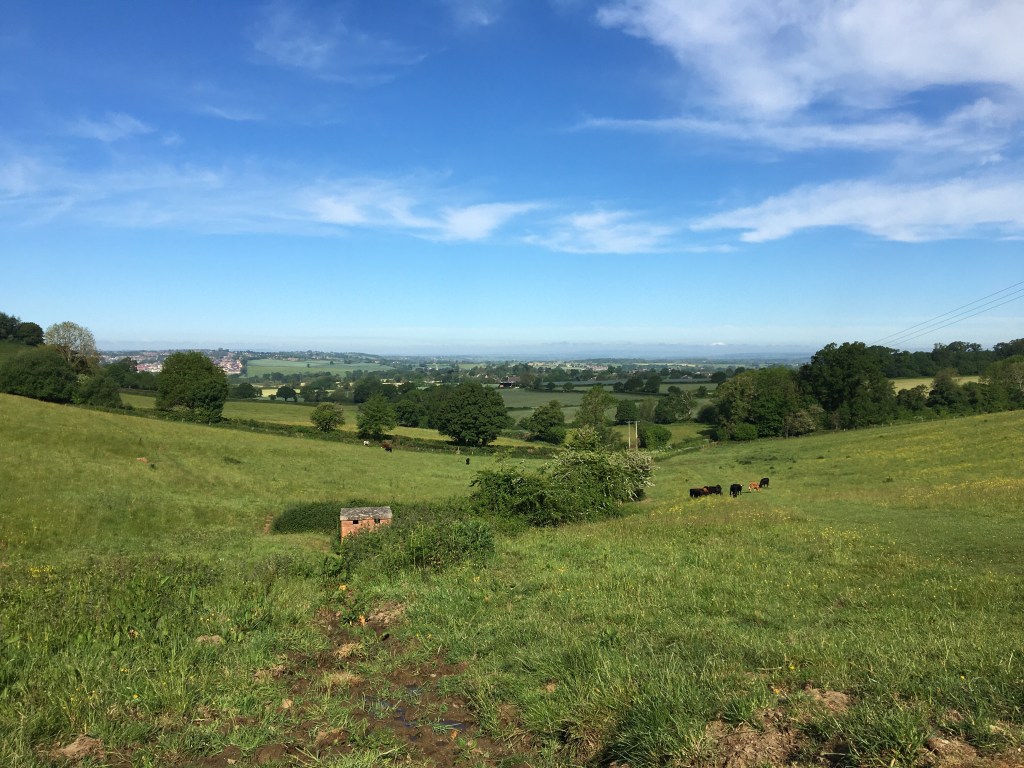
It’s slippery working my way down Charlock Hill. As I step into a meadow the west has opened out in front of me. Everything changes. I stop and breathe. The land here drops gently: one line will slope downwards and another will intersect it and go off at a similarly low angle. I used to draw lines like these to dream myself away from lessons at school.

The path becomes a track which becomes a narrow road. Openings into felds give way to openings into driveways and pretty stone houses. The relative vibrance of a village feels so different after the solitude of the way. A radio blasts out chart music. A man in dusty overalls walks around the front of his van.

‘Morning. Turned out nice.’

‘Lovely, isn’t it?’

Who says the English are obsessed with the weather?

View from Charlock Hill towards Trent and Somerset Levels

The Rose and Crown in Trent has one of the best beer gardens there is. Flowers in June create a flood of colour. You can see south over meadows towards Nether Compton while looking west the land dips down into the Yeo valley and the northernmost houses of Yeovil are visible amongst the trees. I eat a good caesar salad and a cold Coke. If I drink beer I’ll fall asleep.

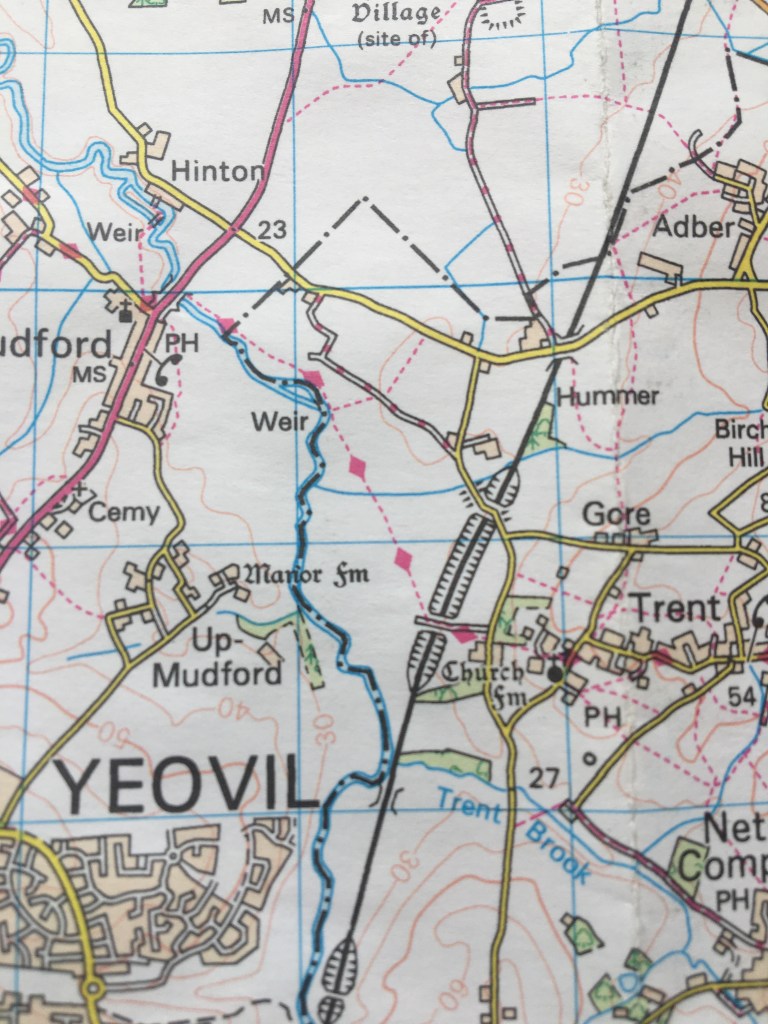
This was supposed to be the end for this time. Yeovil Pen Mill station is only a mile away. From there I can get a train to Castle Cary and then a taxi back to the car at Wookey Hole. But the sun is out. I can get a later train. It’s warm and there’s a weir on the map. I suddenly realise it’s on the Way. I imagine young people jumping off swings or a dead pool with scum and drinks bottles around the edges.

Trent to Mudford on the map

The walking is now a stroll through fields. Thoughts are absent; sunlight is in my eyes. Am I 50? Am I 5? In a moment sometimes I can’t tell.

I’m in the hottest part of the day. The sweat makes my hair stick to my scalp. I have to stop to wipe it out of my eyes. The river appears to my left but behind a thick swathe of nettles. Around a bend. Thick trees enrobe the river. There is a narrow footbridge. And suddenly an opening. I feel like a berber traveller stumbling on an oasis in the desert. I feel the little jolts in my chest – immutable, undimmed by the years or decades that I’ve felt the same rush of energy. Who would have thought a green pool could have the power to move me so?

Shorts, socks, trainers, boxers are discarded in seconds. The trunks are on and I slip over on the mud bank. I pause for a second then laugh to myself like a madman. I am in amongst the wavelets, the lilies, the glitter, the flowing insects. Somehow I feel this was predestined – not that I believe in such things – but there is a sense that I was waiting for this, working towards it. As long as I keep going.

The water holds me. I look like Millais’ s Ophelia but not. I don’t think she was grinning like this..

Weir pool, river Yeo near Mudford

Tramping Diaries The Monarch’s Way June 2021

Every day on the path is a series of mini dramas. They flow into one another as part of the same linear narrative.

South of Castle Cary the land is scrubby. It looks like land near a newly made road which is being rewilded. It’s bumpy and uncomfortable to walk on. The path approaches the A359. Like many times before I lose the line of the path and its markers. I’m confident I’ll pick it up again. I just need to find a way onto the road.

I reach a small electric sub station surrounded by a tall fence and Keep Out signs. There is a gap between the corner of the fence and the hedge. I’m through and on the main road with traffic flying along in both directions.

The normal roadside detritus lines the way: crisp packets, CDs, cider cans with their colours bleached by the sun and the now ubiquitous face masks. What was once an object most of us had never seen let alone worn has now become the object we all know like the back of a hand. Last Summer I stopped beside the M5 in Devon. Alongside the grubby PPE just off the carriageway was the plastic piping used for a blood transfusion.

I’m on the road less than 5 minutes before I cross a stile and the land slopes gently South towards Galhampton. It’s early afternoon and hot. My eyes ache as do my legs and toes. The day feels like it’s been long. I stop in the shade of a hedge and take my shoes and socks off. My feet look creased and sore. It’s a relief to feel the fresh air on them. I pull the big toes forward and wiggle them from side to side. It relieves some of the pain.

The near world seems to doze in the heat of a Midsummer day.

Between Galhampton and Tarkington the path runs straight. It’s hot and dry. Suddenly the path dips into a holloway. The air is cooler, the light darker. It’s almost like slipping into cool water after walking along the down. The roots of trees curl out of the banks like the limbs of Ripley’s nemesis when she finds it curled up waiting for her at the end of the film ‘Alien’. Huge fronds and brackens reach out of the banks as if fanning me like I’m Cleopatra. A gentle whoosh of wind breathes through me. Above all there is a low and constant whine of hoverflies like mini drones shifting in the cool air.

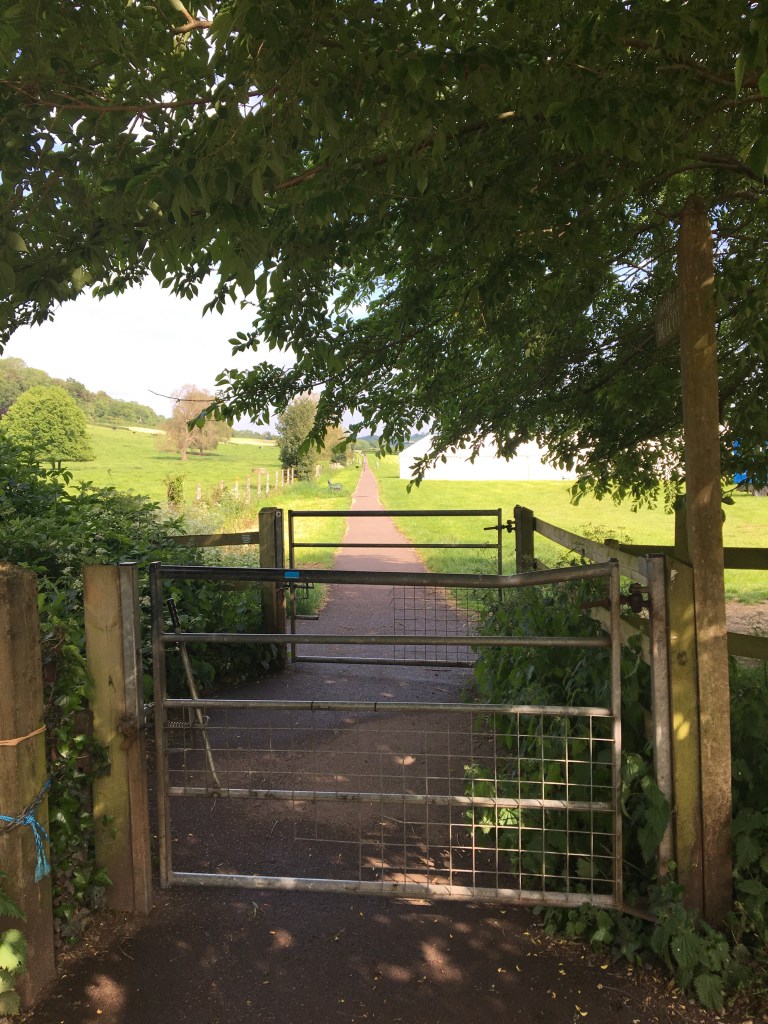
I think of the constant line that beckons me on. It has become imprinted on my mind. The path can be a thin or wide path, a road, a drove or sometimes just a different coloured line in the land.

Lines of the way:

The Monarch’s Way near Wookey Hole
The Monarch’s Way , Wells
The Monarch’s Way near North Wootton

I cross the A303 at South Cadbury. The road is climbing up a hill. From a distance I can see a high sided hill. It looks like it has been sliced in two halfway. It is a flat table top of green that overlooks the Somerset levels.

Cadbury Castle

A rough track leads up through old oaks to the grass rim. This is Cadbury Castle, the Iron Age fort. From here the vaulted sky is all I can see above me. Nothing else is higher. Everything worldly is below where I stand.

There are ramparts that drop down the side from the plateau. I try to lie down in one and imagine if I can sleep. It feels cold and damp. Something isn’t right. There is an instinctive sense of it being right or not.

The aura here is too dramatic, too stark. Part of me feels the fear of knowing I have to find somewhere. The gloaming is cloaking the world. Fields, road, path are now defined through pools of shadow.

It’s getting late.

Along the road a stile. A gap in the hedge. A meadow flat and lush. An apple tree my wardrobe. The yellow carpet my bed. I have found my next place of rest.

Tramping Diaries. The Monarch’s Way June 2021.

Time moves slowly. The journey is punctuated by moments: of transition, beauty, mystery and fascination. In between there are great lulls. These are the times where I just walk and think. I lose track of the surroundings. It is now the inner path that I wander along. I can be oblivious to the real world for whole sections of the path. When I look back at the map or photos I don’t remember.

Before Castle Cary the way had been hard. The grey of the day and way after Hornblotton was stifling. Sometimes I just have to dig in. Keep going. Over the next stile. Round the next bend. Always following my progress on the worn paper OS map.

There are advantages to walking. There are things you witness which few people see. One of these is Bolter’s Bridge, a medieval packhorse bridge that crosses the River Alham between Hornblotton and Sutton before Castle Cary. It is a beautiful bit of architecture with four segmental pointed archways.

I would expect there to be a road or track leading up to it but there is nothing. Just the mud path. Apparently it is thought to have been built by the Abbots at Glastonbury to ‘connect the two parts of the moor and to make a road between Castle Cary and Glastonbury.’ (Somersetrivers.co.uk)

Sometimes the way is lost altogether and all I have to work on is the direction as I plough forward through long grass or undergrowth. This is what I have to do as the path follows near the River Brue between Sutton and Ansford Bridge on the outskirts of Castle Cary. The swish of the grass as I walk through it reminds me of the sound of a scythe.

It had been a long morning before I arrived in Castle Cary. I had not seen anyone apart from the dairyman at Hembridge. He was short and stocky. He was dressed in an olive green plastic apron and he’d just finished milking the cows:

‘Lost? Follow that hedgerow and it’ll join the Glastonbury road.’

And that was that: the only interaction I’d had with another person that morning. I was looking forward to exchanging a few words with someone and eating something.

Castle Cary is the first place I’d seen as I travelled south that has that gold coloured stone. At first I thought it must be Ham stone, a sandstone quarried out of Ham Hill several miles south of here. It is only later I discovered it has its own quarry at Hadspen which produces a gold stone similar to Ham stone.

The market hall is the building that best shows it off. The stone itself is best seen on a Summer’s evening where the stone seems to absorb the warmth of the sunlight.

Market hall, Castle Cary

I ignored the lattes and almond milk of the cafe close to the market hall. I plumped instead for a full English at the George Hotel. I dozed off out the back while an elderly gentleman with his OS map eyed me and no doubt wondered what I was doing.

There’s a great atmosphere here. It feels like it must have done in years gone by. A group of four local women all in their seventies sit upright at the table at the front overlooking the market hall. They have glasses of pop and giggle excitedly to be with each other. A workman with his toolbox is checking in for the night. Other couples sit and watch the flurry of activity as bar staff take orders and deliverymen arrive. Oh, how we’ve missed this.

I leave my phone to charge in the hotel and look for supplies. I get a sausage roll and flapjack from the deli. On the way to Co-op I stumble on the Bailey Hill Bookshop and get my introduction to ‘Tramping’. How fantastic are these moments of inspiration. I would never have expected it.

I loiter for ages and also look at Horatio Clare’s ‘Orison for a Curlew’ which I buy partly for its artwork. I also want to wait and listen to the cricket score which I’ve been unable to do because my phone ran out of battery.

And now, packed up and refuelled, it’s time to head South…

Tramping The Monarch’s Way June 2021

I’m sitting in another field overlooking Castle Cary. I overhear the conversations of a group of local teenagers. They must be about 14. They sit on metal tubes. They look like large underground drain ducts that have been dumped in a meadow. The grass has grown over the top so they’re becoming part of the landscape.

‘F&*k, I hate it here. It’s so boring. Look how nothing is out there…Give me your phone.’ The speaker is skinny, pale, with bleached blonde hair and holds the attention of his female buddies.

‘Nothing is out there’.

What was he referring to? The universe? Life? An existential fear suddenly realised. Or was he looking at the view North beyond Castle Cary?

There is something filmic about that scene. It’s a scene that asks to be displayed. Green coloured hollows and dips curve down and around where I sit. In the middle distance a rough dark green line flecked with the brown of roofs runs across the page. Castle Cary. Within the roundness of the green trees, the odd spire reaches up heavenwards, catching the sun in the warm gold of its stone. The buildings seem to grow out of the greenery like the town is half submerged in the land.

Castle Cary

Beyond that the land stretches north east towards Glastonbury and Wells near where I started the day before. It’s flat and expansive. There’s a heavy, low ceiling of cloud. Grey and white contours fold into each other. And a stray crepuscular escapes every now and again. Its shaft lights up the rough squares behind the town. Light green patches are broken up by the dark green mounds that are clumps of trees. There are pale green strips also that are newly harvested hay fields. The grass left in little clumps at regular intervals waiting to be bailed. I’ve passed a few of them now. Beyond this on the horizon stands the Tor. It can be seen from everywhere around here. It’s like a beacon or marker. A point from which I can always mark my position.

For a moment I feel like I’m in a dream. I’m wandering back over the miles in that scene trying to remember where I’ve covered. The ever changing line of the path. The changes in landscape: a meadow, an orchard, a hay field, a steep hill, an ancient track, a road. And so on and on. The miles covered and the sense of time spent in thought and lost in the oldness and strangeness of the land. I tilt my face towards the sun and smile.

The Monarch’s Way, Pennard Hill

After my trudge up Pennard Hill and the meeting with the hares I found it hard to shake off the melancholia cloak that can enshroud me sometimes. Maybe it was something to do with remembering grey days after Glastonbury Festival. Coming down.

I alway wear trainers for walking. I hate the heaviness and heat of walking boots in Summer. Yet there was a heavy dew this morning and quickly my feet are soaked. It doesn’t bother me. Stings, aches and wet feet are par for the course.

But I was starting to drag my feet. I had crossed another busy road and got on a waterlogged track with long nettles and brambles. It was one of those where you just have to feel the hot sting most steps for 100 metres. At the end I met a lane. I spent 2 minutes breathing deeply trying to change my thoughts.

To the right was a dead end. A sign could tell me ‘church only’.

Churches have always been a place of refuge. For those broken who need solace. For some it has provided a physical refuge. I think of those who hid in churches during wartime hoping to provide a physical and spiritual defence against the threat of attack.

I think of the church next to my parents’ house where my father would go to unlock and lock the church door at the beginning and end of every day. Once he found someone who’d been on the road sleeping in one of the pews. He slowly closed the door as he left. I myself camped a few years ago in the small churchyard at Hope Cove in Devon while walking the South West Coast Path. Although only a few hundred metres from the beach and a strong westerly Atlantic wind, my little tent was protected by the solid stone walls and tower and the grass was perfectly flat. That night the Lord offered me protection. I’m sure he wouldn’t mind me sleeping next to his house.

I turned right. There is no village at Hornblotton. In the middle of nowhere and at the end of the track is the small church surrounded by fields and behind it a huge rectory. It looks more like a stately home. Like so many big houses I wander past it is empty. It must be only 7 in the morning. There is no sign of life.

The small side gate into the churchyard is freshly painted. Gleaming white against the grey of the wall and the backdrop of gravestones. The door is open. And inside everything is still. Everything slows down. This is one of those moments.

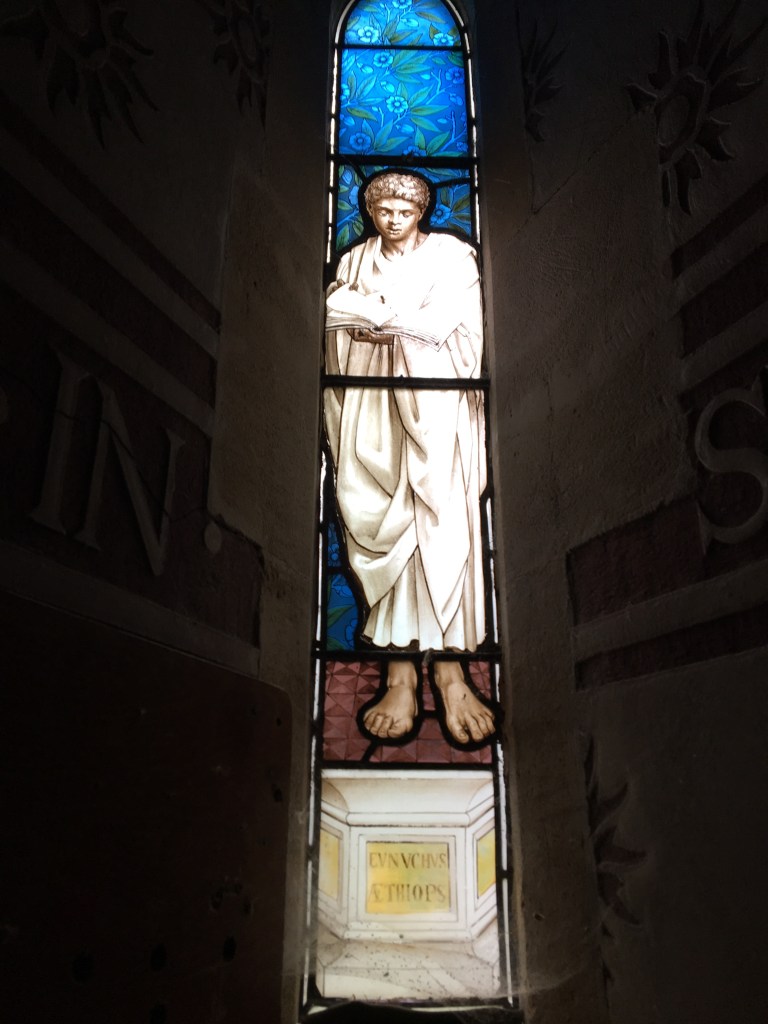
This little church – without a village – where the land stretches for miles around hides treasures. The church is 19th century. Inside the walls are decorated with sgraffito: rust and white coloured walls with figures and quotations from the bible. It is a style of wall decoration associated with the arts and crafts movement.

Hornblotton Church

It feels more like Tuscany than Somerset. A bee buzzes loudly around the otherwise empty building. The sound is amplified by the room and the emptiness. There is a strong smell of wood polish. It reminds me of old houses. Someone has recently been here to clean and take care of it.

A saintly figure reading a book – the bible? – with huge feet holds my attention for several minutes. After the long trudge, the walking through wet grass, mud and nettles, I feel rested and my faith in the walk is restored. Churches engender peace and calm whether you believe in a god or not. I say a few words for dad at the front of the church. I sit in silence and remember him.

Hornblotton church

The journey is often long and hard and frustrating. It can often feel like there is ‘nothing out there’. And maybe that’s the truth of it. Yet there are always moments of incomparable beauty or joy. And that’s what keeps me going.

Hornblotton church

Tramping Diaries The Monarch’s Way June 2021

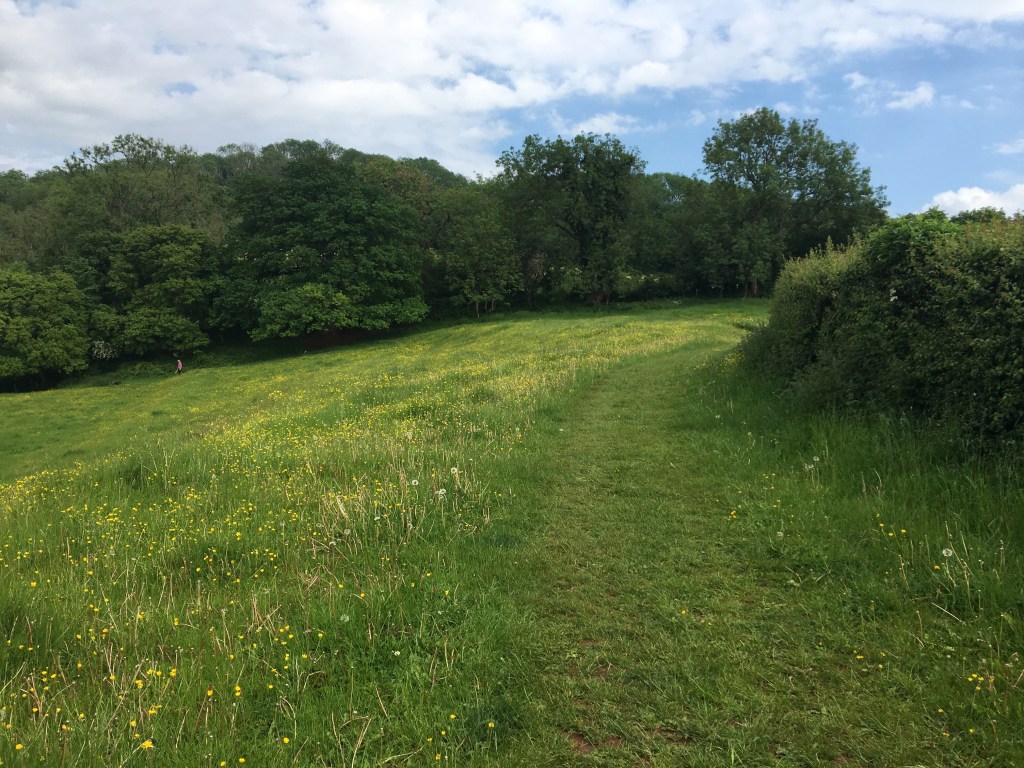
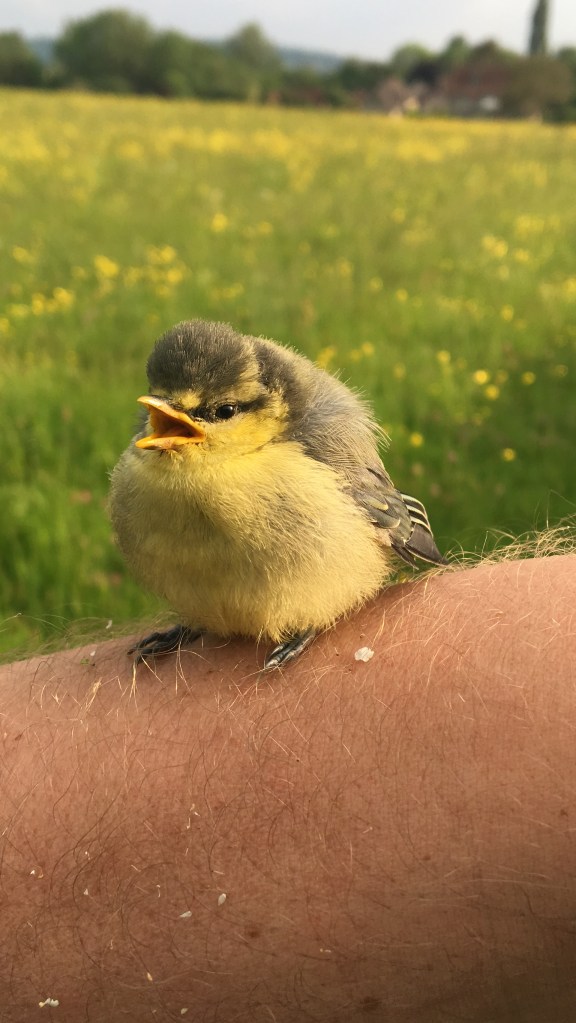
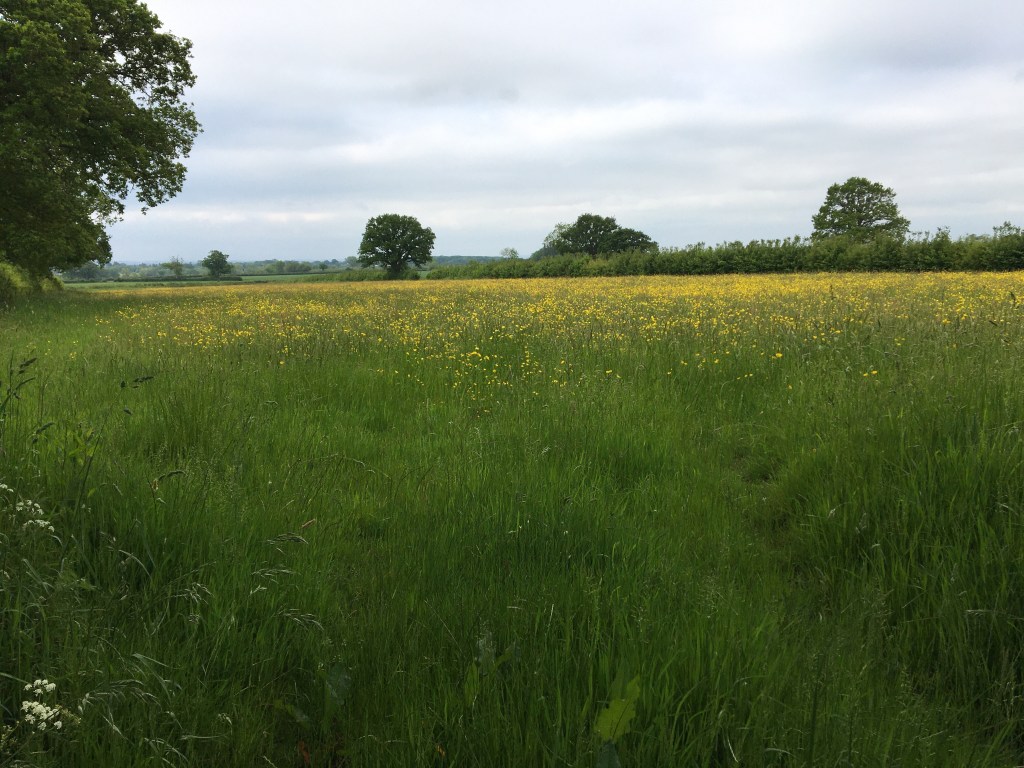
I am in another yellow meadow in North Wootton near Wells. I associate these golden pockets with Somerset at this time of year. Here more than anywhere they seem to be in abundance. The Monarch’s Way skirts two sides of it. Someone has mown these edges to make it easier for people to walk around it. The yellow appears a stronger gold in the evening sun. I stand shielding my eyes against the brightness. There is a sudden blur out of the corner of my right eye.

A little ball of fluff is perched on my forearm. It’s yellow like the field behind it. It’s a baby blue tit. It sits there for at least 2 minutes turning its head from side to side and cheaping the same shrill notes every 10 seconds or so. It has the recognisable urgency of a baby calling for its mother. When it opens its beak to sing I can see its throat is bright orange like an open flower. I throw it in the air and it flies confidently into the nearest tree.
Blue Tit chick North Wootton

That night I make my bed near Worthy Farm at Pilton, home to probably the most famous festival on the planet. No festival this year, though. There is a field the size of a football pitch recently mown. The ground is a bit bumpy but level. I stick to the edge and find a spot under a horse chestnut. I make a basic bottom mat of long grass ripped up and lain sideways. I imagine it like rushbearing where reeds would be lain on the floors of churches in the middle ages. There is the pungent smell of manure and the sound of techno being played somewhere close. I can also hear traffic roar on the A37 nearby. I have had better and worse places to sleep. It doesn’t matter. I watch the chestnut flowers in the tree above me and soon I’m asleep.

The following morning is cold and grey. I am up and on the path by 5. Yet I can’t get into my stride. Pylons and road noise seem to impede my progress. Climbing through Sticklinch and up Pennard Hill is a trudge. At this hour I see no one. I pass cottages with open windows and closed curtains. At the top of Pennard Hill the way turns East along a drove.

Buttercups Near East Pennard

Suddenly I see two hares in two minutes. One I meet face to face on the drove. The next I turn to look into a gateway and there he was shrinking into himself his head brought into his body his ears suddenly flat against his head. Those huge eyes watchful, wary. Then he is bouncing away silently.

I walk all morning. I always follow The Monarch’s Way markers: little stickers with the crown in an oak tree beneath a galleon. One to represent the tree in Boscobel Wood where Charles II hid shortly after the Battle of Worcester. The other to represent his flight to safety. They are everywhere these way markers: on stiles and gate posts, on road signs and lamp posts. Often the pennant on top of the galleon will be used as an arrow, directing me to which direction or angle the path will take. These are my only constant as I tramp on.

The Monarch’s Way way marker

Slow walking The Monarch’s Way 2021

tramp verb[ I usually + adv/prep, T ]

to walkespecially long distances or with heavy steps:

Cambridge Dictionary

I began walking The Monarch’s Way as a lockdown project in January 2021 when we were all told to stay at home. For someone who loves to explore this at first seemed like a challenge but it just meant a readjustment where I would have to explore my near world and look closer, walk slower while still appreciating what I came across. If you look hard enough there’s always something worth seeing. I joined the way near where it winds through North Bristol and crosses Brunel’s bridge not far from where I live in Clifton. I only knew it as a name and it was only when I looked it up I discovered it roughly follows the route that Charles II had to take to evade Oliver Cromwell’s parliamentarians after The Battle of Worcester. He was on the run between September 3rd and October 15th 1651. He went roughly south to Charmouth in Dorset and then to Shoreham from where he sailed to France. As well as my immersion in landscape I would now have a great story that could provide context to my walking: retracing the steps of a young King on the run with only the help of a few renegade – and often hopelessly disorganised – folowers and friends and revisiting one of the craziest stories in the history of the English monarchy.

For all my garndiose aspirations the plan was simple. In fact there was no plan. Follow a path to the sea and then…Who knows? None of us knew what would happen next so planning for the future had become a redundant concept. Walking like this fitted perfectly with the times and my carefree attitude to adventures. The key was simplicity. I had a small Overboard rucksack with a camping matt and a cold weather sleeping bag. I had a battered metal water bottle and a waterproof.

The idea was and still is to be wrapped up in nature. In the moment. I simply walk and follow the way. I eat dinner in a pub and then walk til dusk. I find somewhere flat and soft and out of the wind. I fall asleep as the first stars appear and it’s not quite dark. I wake up as it’s not quite light. And here I record what I find out there but also inside me.

In Stephen Graham’s 1926 book ‘The Gentle Art of Tramping’ the writer ‘gives guidance on walking, being open to discovery and being kind – advice as relevant now as it was then.’ (as written in the blurb on the new Bloomsbury edition). Graham himself describes the adventure of walking as: ‘The adventure is not the getting there, it is the on-the-way. It is not the expected; it is the surprise..’ And that is as good a mantra as I can find for this project.

Knowle St Giles and Cricket Malharbie April 25th 2021


Dressed in wellies with a hoe nestled in the crook of his arm, Audrey’s Moss Man had started to fade. Sitting in a deckchair he was made out of moss and grass divots taken from Cricket Malharbie churchyard. He was huddled forward amongst the gravestones. His beard was made of weeds and had turned to the colour of parcel paper. His chicken wire skeleton was starting to show through at the knees.

Audrey, the church warden here for 35 years, explained how he would normally get re-dressed every year as one of the centrepieces of this Somerset village’s flower festival to raise money for the church. Yet this year, due to the pandemic, he’d been neglected. ‘We’ve had so little rain, he’s not looking his best.’

The Moss Man was sitting among long grass and various flowers. They had been allowed to take root in the churchyard, in order to return it to a wildflower meadow. Bright grasses had been allowed to grow up around the base of the locally quarried Hamstone gravestones. The flowers nodded their heads in the breeze. She pointed each one out to me in turn. ‘Cuckoo Flowers or Lady’s Smock as some call them, Red Robins and Forget-Me-Nots.’

I had come to do a walk in some of Somerset’s most untouched landscape where I could still feel echoes from its feudal past.

Cricket Malharbie lies just South of the market town of Ilminster in South Somerset. It is in a small area of wilderness which seems a world away from the queues of caravans and holidaymakers that appear every Summer just a few miles away on the A303.

Cricket Malharbie itself has a population of approximately 80 and Knowle St Giles is only a few more. The lanes wiggle their way through the green of the countryside bordered by thick hedges. In Knowle on one stretch of the road there are as many farms as there are houses.

At the entrance to Knowle I park my car next to a wonderfully full chestnut tree with its upright blossoms already showing their whiteness. In May it must be my favourite tree in England. On a triangle at the Westerly approach to the village is a rough hewn lump of Hamstone with bright yellow lichens and dying daffodils at its base. The sides have been flattened at a right angle to each other. On the left reads Cricket Malharbie with an arrow to the left. The right has Knowle St Giles carved into it with an arrow to the right. On top is simply the date 2000.

Opposite this rough signage is the flint wall of another dairy farm. 3 grey milk urns are lined up next to each other next to the jaunty red of a post box attached to the wall.

I turn off a lane towards the diminutive Knowle church (towerless and now converted into a house). A large Mercedes is parked in its driveway. A small orchard lies opposite. I wonder how many years it has been there. Hundreds, I expect. Apple orchards would have been two a penny here in medieval times. Bordering it is a straight line of poplar trees only half dressed in their early Spring attire.

Opposite the church is Cricket Court where the Pitt family lived for more than 400 years. Many of them are buried in lead-lined coffins placed on shelves in the family crypt. The original Cricket Court is mentioned in The Domesday Book.

Audrey is typical of many people that I’ve met in Somerset: friendly and chatty. She offers me a little tour of the church (like all churches, Covid restrictions have demanded its doors be locked).

The air is cool and dark after the early Summer brightness of the meadow and graveyard. She shows me the crypt for the Pitts and the small pews which have sat unused.

She tells me about the dwindling congregations. ‘There’ll be no one to come here in 10 years’, she says with certainty.

As I leave, I have the strange feeling that I have just witnessed one of those moments in time; the feeling that I have seen something which will never quite be the same again.

Failand to Portbury Feb 3rd 2021

Woke up at 7 this morning and there was a weak, grey light coming through my curtains. The days are gradually getting longer.

I feel better today. I flew into the most violent of rages yesterday. I had to spend my car insurance excess on my car yesterday. I dumped the hire car at the place I was picking my car up from. A couple of hours later the car hire people emailed me saying that there was a huge scratch on the bumper. Not me. They took my excess too.+ £500. No questions.

Could be worse, I know, but at the time I am convinced that these things only happen to me. 40 years of being thoughtless and accident prone and it never getting better. I was shouting and screaming to the point that I felt a bit traumatised afterwards.

I keep telling myself it’ll pass but I have to walk and hyperventilate until the waves subside.

The cleaners came today and so I was forced outside, a lovely accidental surprise. In 10’minutes I’m across the bridge – the entrance and exit to the West of the city – and into rolling hills. The thrill of the escape and mini adventure giving me goosebumps.

And now I’m so calm and happy like a boy I can’t recognise the person that I was yesterday. It doesn’t matter. The moment has passed.

At Failand I always park in the same place next to the woods before you get to the church with the views across to Avonmouth, the mud coloured channel and Wales beyond. It’s my midweek treat.

It has rained for days on end. It could be weeks. I can’t remember the last time I saw the sun. Rainfalls on previously saturated ground. Every time I walk it’s slimy, slippy, mud splashing up over my boots up to my knees. I don’t care.

Something feels different today though. There’s a bit more light; a bit more strength to the light. I feel an expectation, something unspoken but pressing in the cold air.

Portishead, The Channel and Wales

There’s a metallic sheen on the grass.

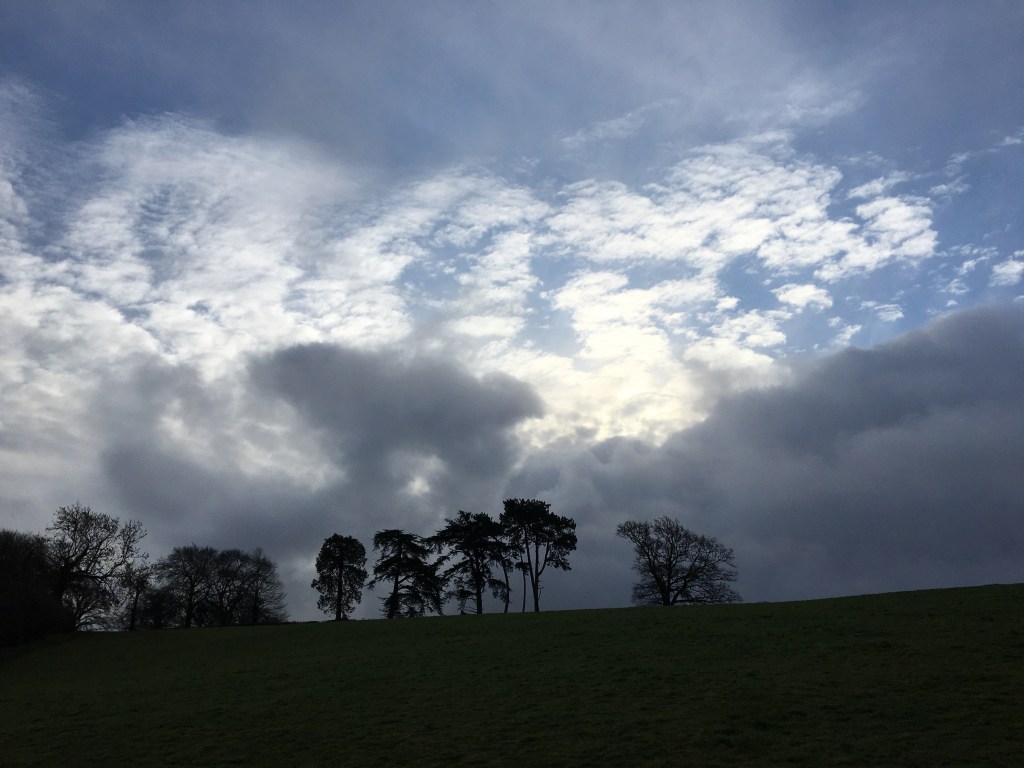
The sense of expectation grows inside me. It’s a faint hope that I’ll see sunlight. I turn around and above the ridge with the road the sky is starting to rearrange itself.

Sky shifting, Failand

I continue North. Grass rolls away from me up a gentle slope while the sky continues its unfurling drama. Will it happen? Will it break? It’s indescribably complicated what it is going on up there.

Above the Welsh horizon patches of blue have appeared where there was nothing but grey a moment ago. To my right Shirehampton and Lawrence Weston start to shine and the grass between here and there has turned a bright, luminous green.

Changing colours towards Shirehampton

I’m getting close to where the A369 meets the M5 and I can see lorries passing regularly over the flyover that passes over Avonmouth, their lives seemingly unaffected by Covid.

I’ve been heading more or less due North and now I turn West into a thin strip of woodland. The gradual buildup of the drama has now risen to a crescendo like a symphony and the change is so sudden, so serene it catches me completely off guard.

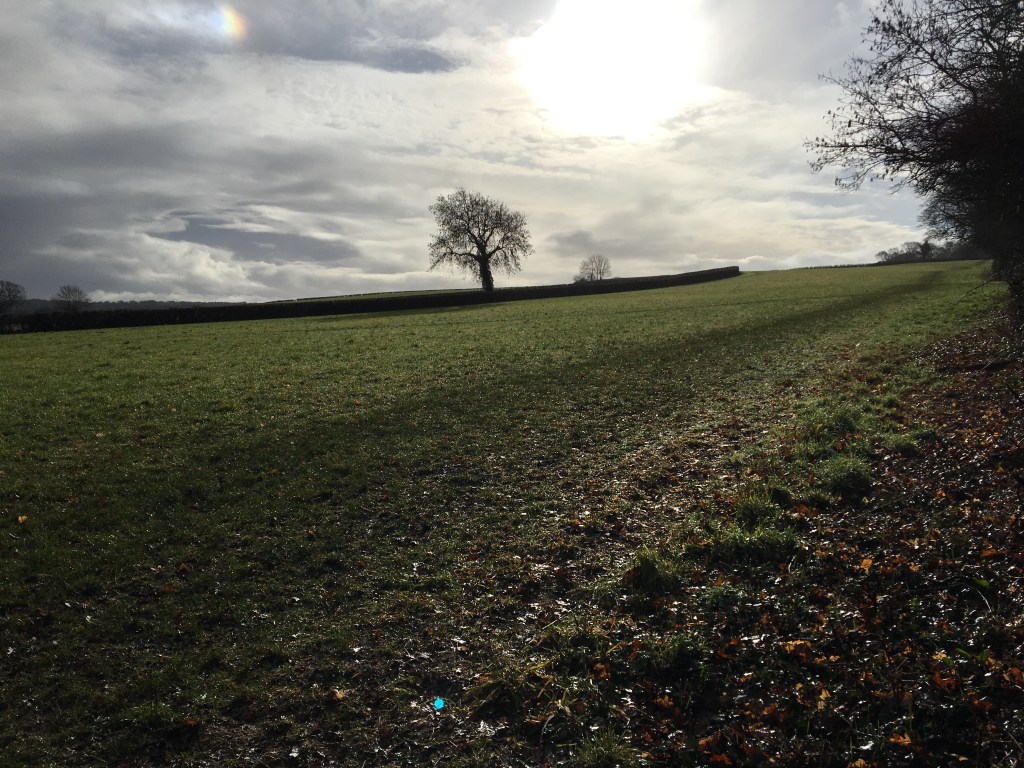
Sun shines on saturated field, Failand