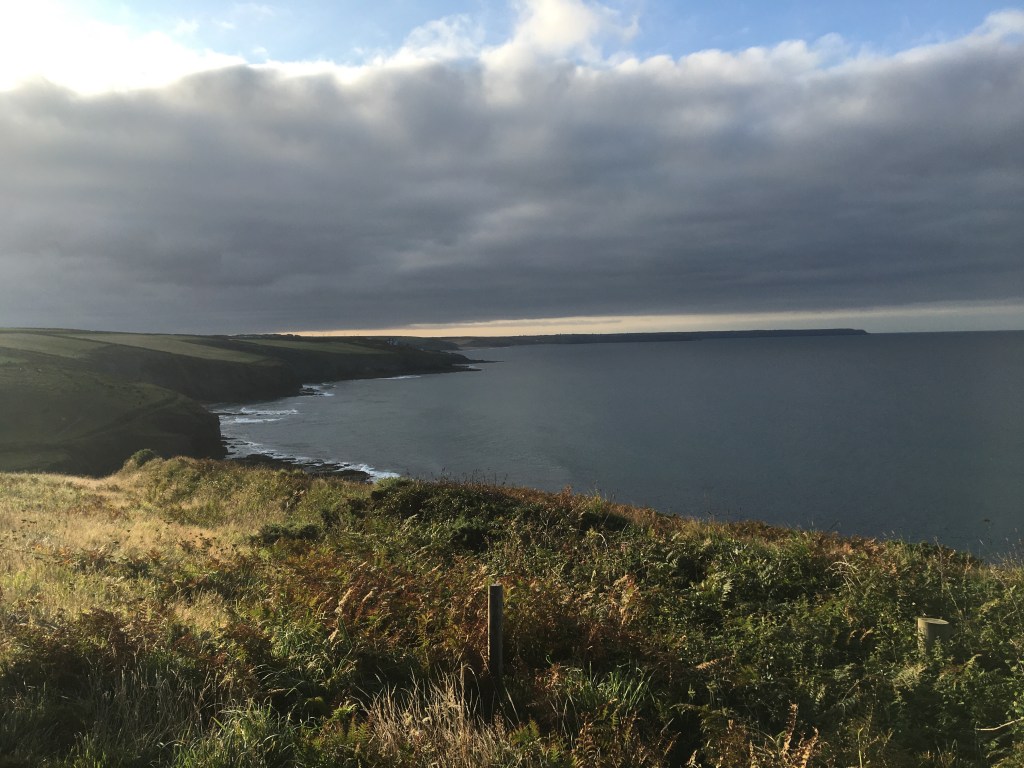
SWCP – Cape Cornwall to Porthmeor September 10th 2022

The Union Jack on the squat tower of St Just church is at half mast, the cloth caught around the wires that support the flagpole. The shape appears like a crooked 8. The bottom flaps joltingly like an animal trying to free itself from something.

We are in a period of national mourning for the Queen who died two days ago. The news outlets have gone into overdrive. News readers in black ties speak in lowered voices. Roadside houses have flags flying at half mast. Whatever your views, we are in a state of shock. For most of us she’s just always been there. 70 years as the mother of the nation. 70 years of opening the parliament, commonwealth visits, Christmas Day speeches, meetings with the Prime Minister. And with her passing there seems to be a void that can’t be filled. I suddenly feel old.
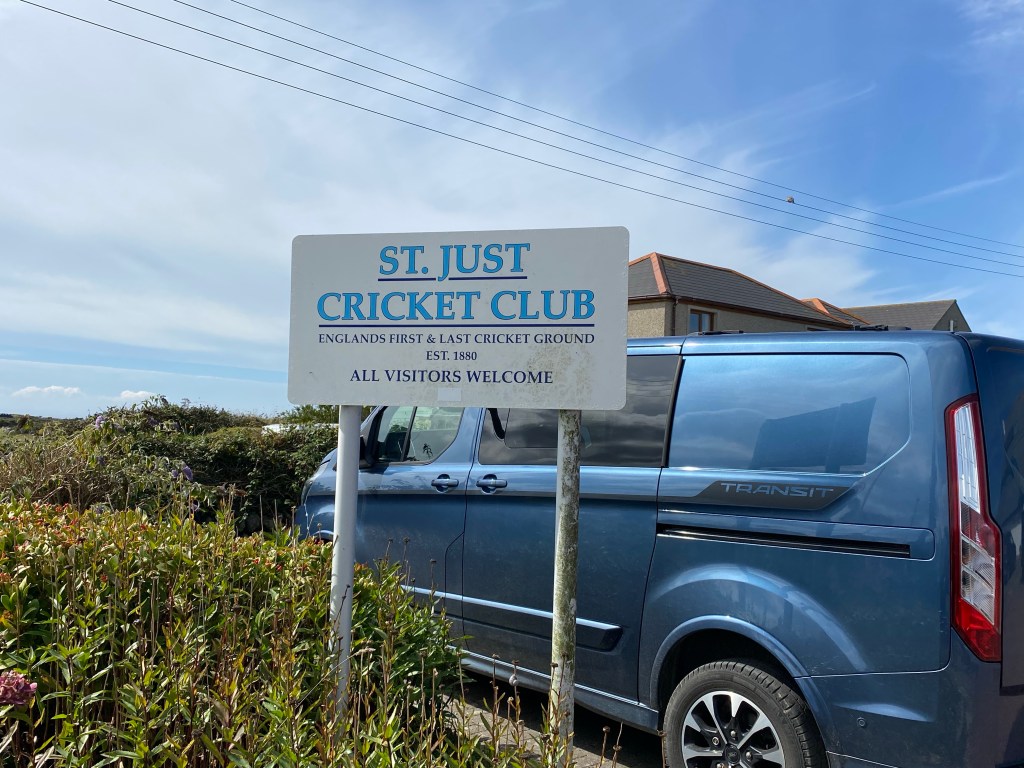
At St Just cricket ground ‘England’s first and last cricket ground’ a small group of men line up on the blue school seats on the boundary rope. In the pavilion two women are making egg mayonnaise sandwiches. A small single wing aircraft has just taken off from Land’s End. There is the occasional clap and shout of encouragement to the batsmen.

Two elderly men are next to a man in this fifties. In a pause the younger one says about the man two along from him:

‘Willy must remember last time there was a king.’

‘Yes, I do’ is Willy’s response. And they carry on watching the play.

At Cape Cornwall it’s busy again. A man enthusiastically points out six seals to strangers while old couples drink tea out of mugs with photos of the Queen and Princess Di.
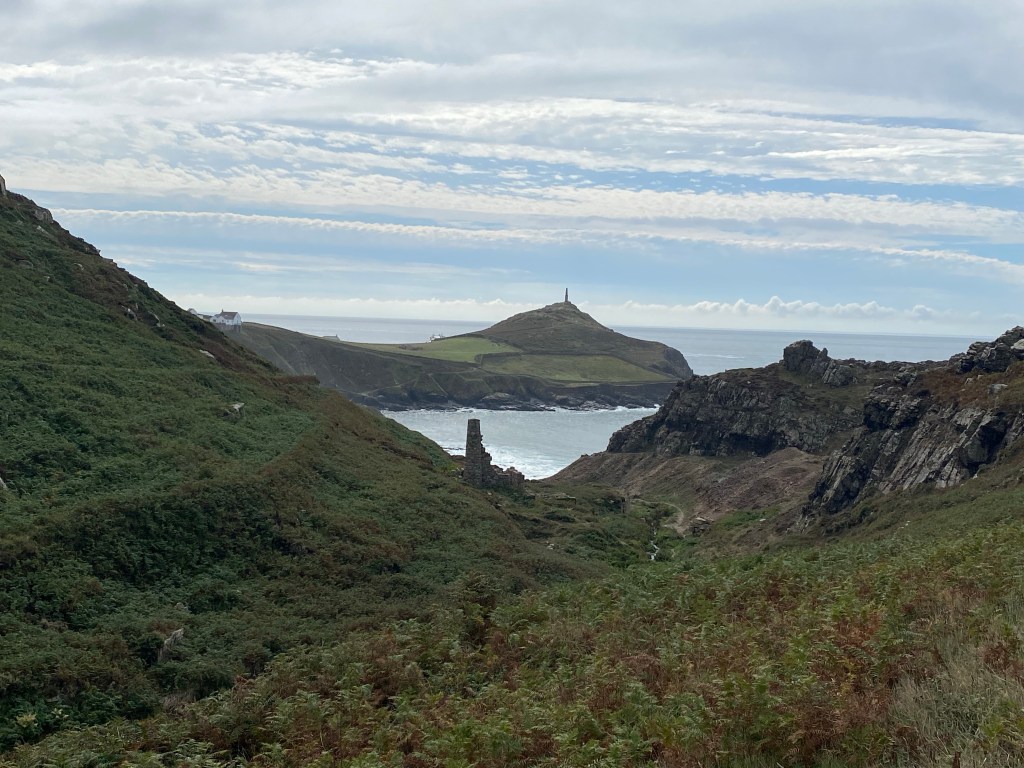
Cape Cornwall from Kenidjack

Soon after leaving Cape Cornwall there are reminders of this area’s mining past. Half demolished stone buildings with apertures might be mistaken for houses if it weren’t for the tell tale tall chimneys next door to them.

There were several mines at Kenidjack where the stream was used to power the works that dressed the ore. By the 1870s imported tin from abroad lead to these mines being given up.

At Levant there were even greater works and the whole landscape is littered with workings. Shaft openings, chimneys, the wheel towers. There is still a working mine here.

A man made stream is channeled to the cliff edge and the whole of one wall of the cliff is stained with the lurid green of oxidised copper. The mine here is copper as well as tin.
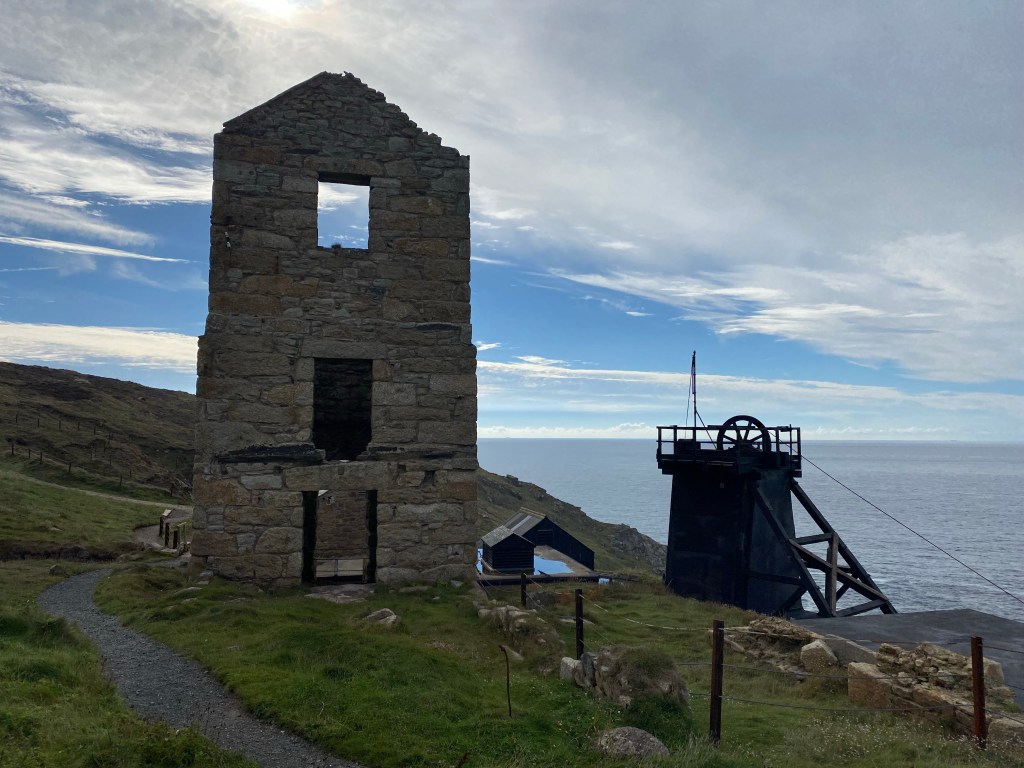
Remnants of the old mine at Levant

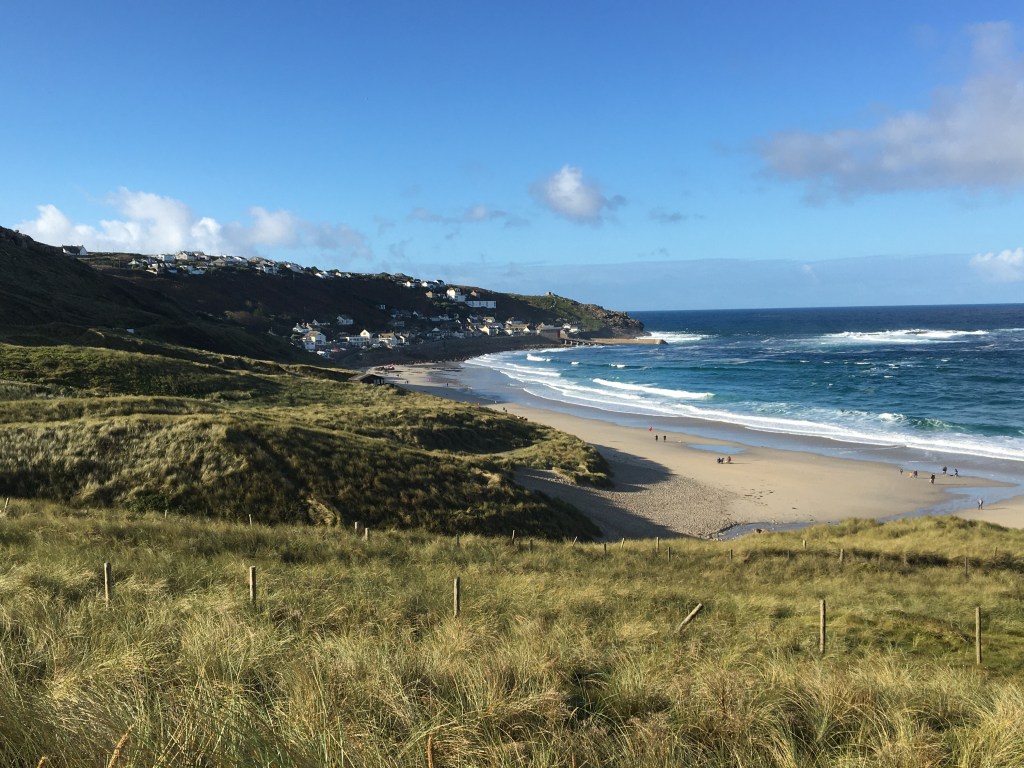
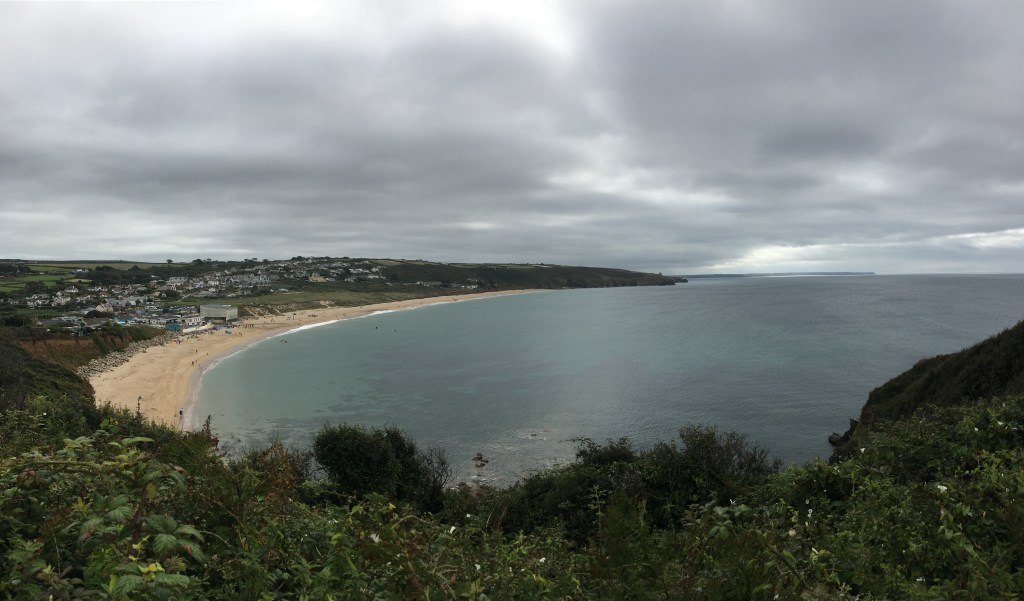
The beach at Porthmeor suddenly appears ahead of me and it stops me in my tracks. I stare and stare for minutes at it like a man possessed. It could be a beach on a desert island. Thinking back I realise it’s the first beach I’ve seen since Porthgwarra. After the grim post industrial landscape of Levant it is like a jewel amongst the dust.

The sea is a milky turquoise blue and the sand white gold. It feels wild in that way that anywhere that you can only approach by foot or boat does. I rush on.

Half an hour later the undertow strains at my legs as waves heave themselves onto the beach. Water spreads quickly, flatly across a large part of the sand before riffling and rushing back to the sea.

A teenage boy is about twenty metres out. He’s not swimming. He’s not doing anything but just bobbing, his head unusually still in the blue and turned towards the ocean. A middle aged woman, who I guess to be his mother, stands opposite him on the beach, her arms folded. They’re not communicating. She just watches him and steps back every now and again as another wave spreads water out and across the sand. He stays out there all the time I’m on the beach. And the mother continues her silent watching and waiting.

The water is cold enough to make my head ache, very different from the warm brown of the North Sea in Suffolk where I was swimming two weeks ago. Fronds of sea plants are tossed here and there and adorn me when I surface so I feel like the swamp thing.
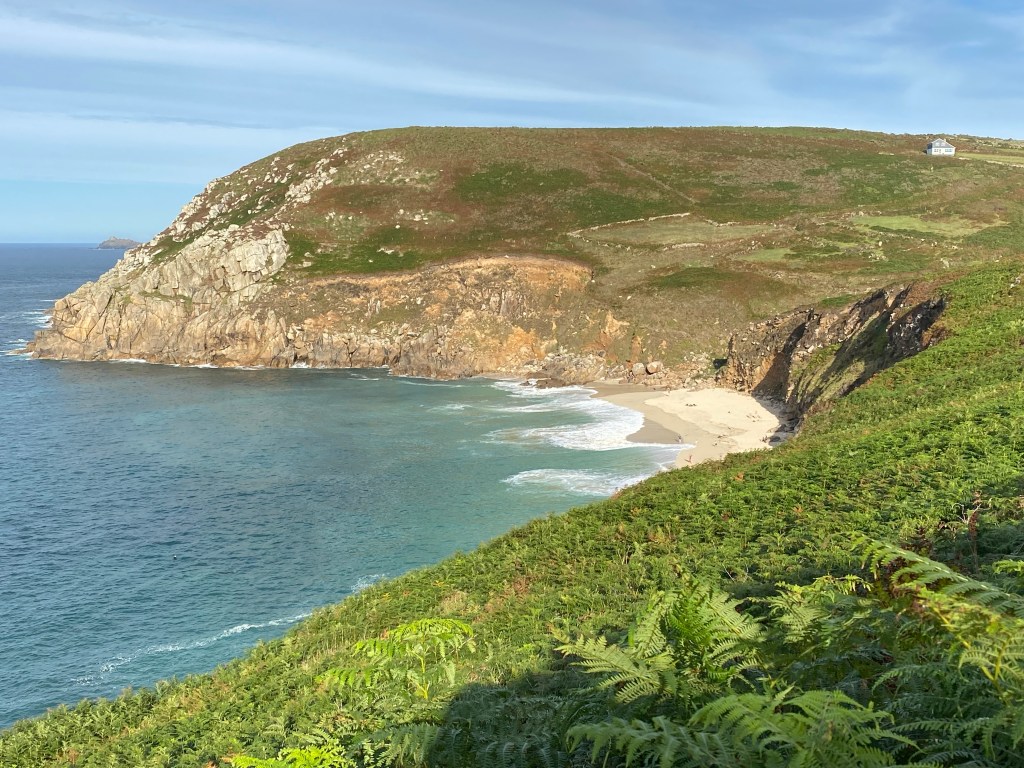
Porthmeor

Later I find somewhere to sleep near Pendeen House. I can hear the gentle roar of the sea below the cliffs. There’s a mackerel sky.

The grass is flat and the wind is quiet enough. I have a triangular stone which acts like a vertical bedside table. I lean my water bottle next to it, my toothbrush and sleeping pills. The full moon appears through clouds which make it distorted and elongated like a Kinder egg.

Bats fly from the cliff edge south above my head. One is so close overhead it sounds like a curtain flapping in a breeze. A satellite speeds over heading north. Is there a north in space? I gaze heavenwards thinking of the Queen and Dad before I give in to my tiredness and sleep.

Tramping Diaries. SWCP – Porth Nanven to Cape Cornwall October 25th 2021

I have been stopped by a stream. The sun is out and dances on the riffles of the water, sending flashes into my eyes like cartoon explosions. The light hovers in the branches above my head the way sunlight wobbles on a swimming pool floor. There’s something a bit UFOesque about it. Am I feeling the effects of too much fresh air and not enough sleep? It’s possible.

Several times over the last two days of walking I get stopped by a moment in which I sense a little bit of magic, a little bit of sparkle. I know it’s all in my mind but Cornwall does seem to lend itself to moments that appear supernatural: fairies, grottos, shrines, mythical creatures, legends. They all seem to exist here in greater prominence than other counties of England.

My mind has kept returning to the ancient Celtic story of Tristan and Iseult, the ill fated lovers who met while Tristan was accompanying Iseult from Ireland to marry his uncle, King Mark of Cornwall. All would have been well – but not much of a story – if they hadn’t ingested a love potion en route from Ireland to Cornwall.

Oh how a love potion can spice up a story! I wonder if medieval writers would fall back on this device when they were stuck for ideas. And how love IS like a potion with its ability to transform, persuade and beguile even the most stubborn of us. Every time I look out to see I imagine them on their barque, eyes like saucers with desire, staring into each other and to hell with the consequences.

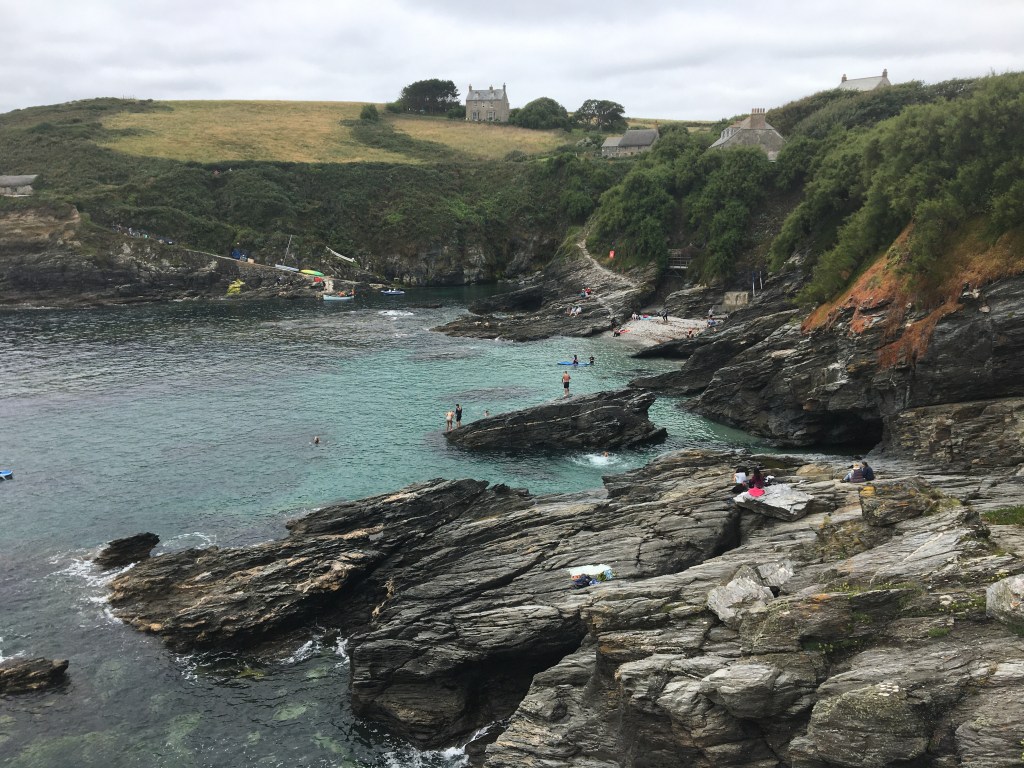
At Polbry Cove (I think) the path winds down into another hidden pocket of coastline. How many in Cornwall? And the only way to find these hideaways is to walk the coast path. Birdwatchers are here, one with an enormous lens like you might see at a centre court tennis match at Wimbledon. Something hovers. I think it’s a kestrel. They might be looking for Cornwall’s ‘patron bird’, the chough, with its flashy red legs, which is known to live in these parts.

The path follows a road and then up another hill and over the top to Cape Cornwall. It’s almost as far west as Land’s End but more pleasant. A craggy peninsula with a small peak. There is a red brick chimney on the point which was once the chimney for the Cape Cornwall tin mine. The chimney dates from 1864 and was kept here to be used as a navigation marker.

Cape Cornwall

Looking west I can see the Brisons also known as ‘General de Gaulle in his bath’ which once seen requires no further explanation. I seemed to have timed it perfectly. It was supposed to be showers today but it’s been beautiful. Sunshine. Freshness. Now a blanket of grey cloud is spreading from the West.

The Brisons

This is where I leave the path this time. I turn my back on the sea and head inland to St Just. From here I’ll get the coaster back to Porthcurno. The lane wiggles its way over the hill. Yesterday before I got to Land’s End I had seen jackdaws performing acrobatics on the cliffs. Now there are at least twenty fluttering and squawking and flapping and bothering a solitary seagull. Their black shapes are like ripped bin liners being blown across the sky.

For the second time in twenty four hours I’m stunned by their behaviour. They’re like the teenage hoodlums of the bird world. I’m still staring at them, lost in thought, when a black estate pulls up beside me.

A man in his sixties looks out of the driver’s side window. He has a soft north country accent. ‘They’ve obviously taken exception to you. I live down the road. Sometimes I see them – they like to float on the wind.’ As he says this he moves his hand up and down to illustrate the wondrous gliding of a bird.

Tramping Diaries. SWCP – Sennen to Cape Cornwall. October 25th 2021.

I wake up to the sound of the ocean crashing outside my window. The sea air coming through the open window makes the curtain flick every now and again like a teenage girl playing with her hair. The air is fresh on my face. I breathe and stretch luxuriously like a cat. Would I lie in like this if I was sleeping on the path? Possibly. Possibly not.

The Old Success Inn looks across Sennen Cove. This morning white lines are coming in at regular intervals. Out there in the turmoil of water and waves sleak black figures bob about on their boards waiting for the right moment. I know that feeling of apprehension and expectation where all the senses are on high alert waiting for that combination of paddling hard enough, the wave shaping right and the pop being enough to be up and in command of that curling beast. When it all comes together it might just be the best feeling in the entire world.

Sennen Cove

What a difference a night’s rest can make. As I turned north towards Land’s End, my feet started to drag. I would curse when my foot might catch a stick on the path or slip on a stone. This isn’t so much physical tiredness but a sense of disquiet that descends on me when on these solitary explorations. The inner voice is often loud but can also turn nasty. I have learnt to know there isn’t a reason for it. It just happens in the same way that the sky might cloud over and it starts to rain.

Yet today I’m a different person. Emboldened by the sun and the freshness of the air. I smile and start singing to myself aware that I might be mistaken for a complete loon.

Whitesand Bay extends a long way north east from Sennen Cove. A female couple are walking behind me. They are the first fellow walkers I have met today. I have learnt to wait and let them pass. As I’ve said before this isn’t a race. I want to be slower than the rest. The older woman smiles and says ‘Morning’ while the younger one keeps her head down.

Conversations are funny. These brief encounters never to be repeated. Some people might question the point of them but to me they can be just as valuable as catching up with an old friend.

Near Aire Point I meet a walker with poles. He must be a bit older than me. He’s from Devon. ‘I just come down and do bits here and there when I can. I love it.’

I tell him I’ve just done half of it.

‘It’s all uphill from here.’ We chuckle and say our farewells.

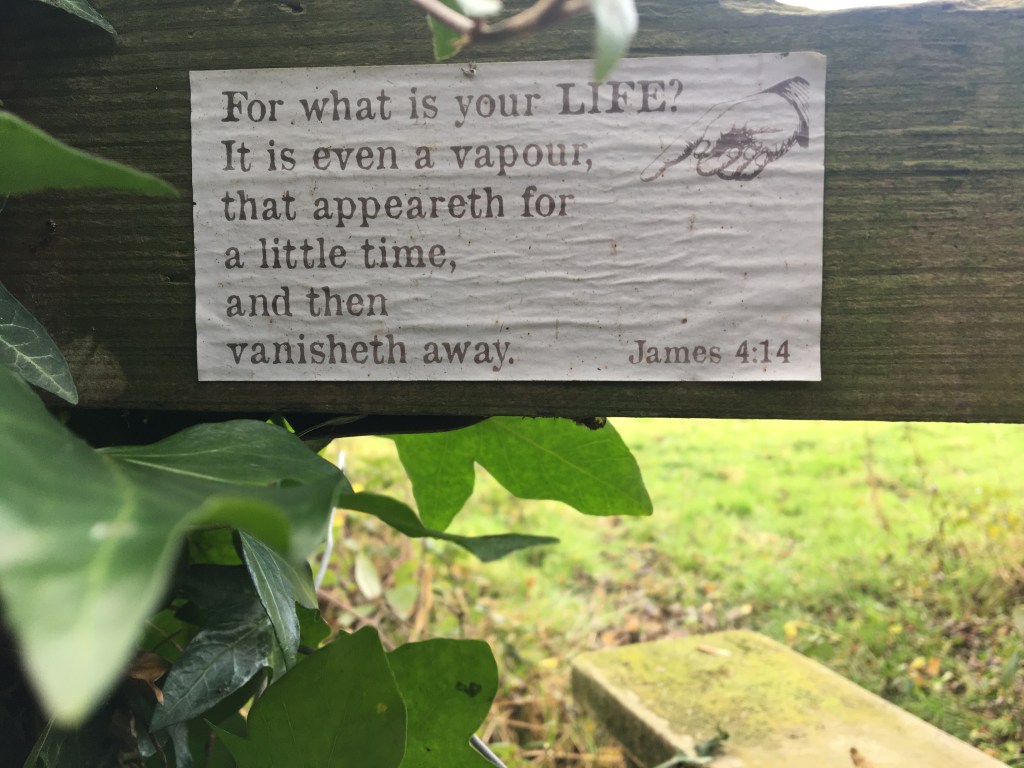
Sure enough soon after this the path turns up the cliff and the way is steep. I pause for a moment and lean on a bit of fence where someone has written anti-Covid restrictions graffiti.

Covid graffiti near Aire Point

I remember walking on cliffs near Dorset last year and passing people wearing masks. As the rule also included wearing one on public transport I remember having to wear one in a strong wind on a ferry – a small open motorboat – to get across to St Mawes. Soon, I hope, these things will become a distant memory.

There are breakers all the way along the bay and a stiff westerly. I am accompanied by the constant shhh, shhh, shhh of waves breaking on the beach and a lower roar further out where their bigger brothers break before they reach land.

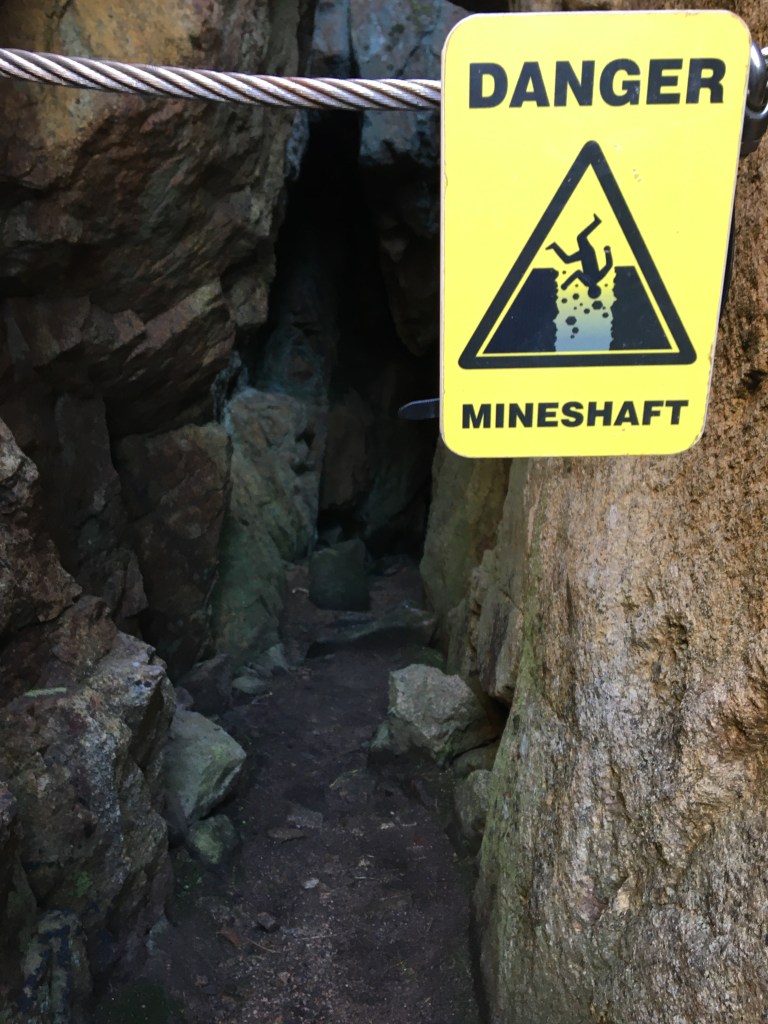
There are holes everywhere around here. In the land and cliffs. A perfect arch appears where sand has fallen away to reveal a seam of rock behind. There are signs warning of mine shafts. Sometimes they are even marked on my OS map. ‘Shafts’ as well as ‘mines’ and ‘cairns’ frequent this little corner of Kernow.

Cave or Mine near Aire Point
Mineshaft near Aire Point

Tramping Diaries. SWCP – Land’s End October 24th 2021

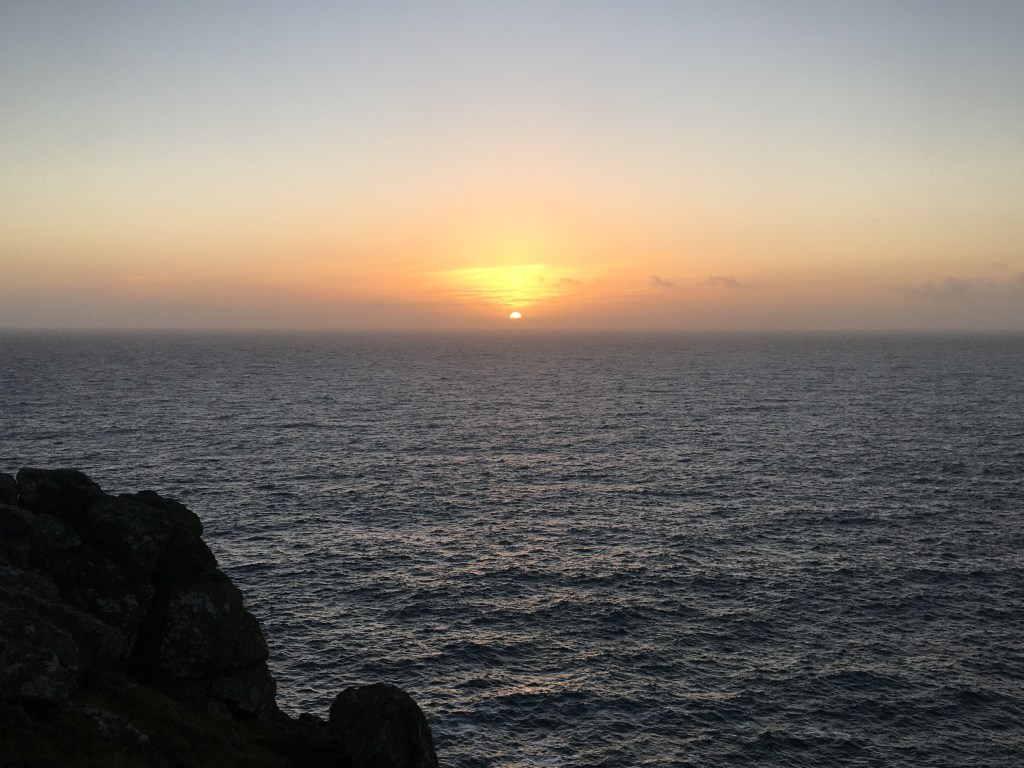
Sun setting near Land’s End

The sun is now a yellow smudge. It sinks into a bank of cloud that sits on the horizon. It creates a fan of light in the vapour. It’s getting cooler. I descend into coves, down steps and past rocks. Like many places before me. I try to recall the various points, hills and bays I’ve walked over. Portland Bill, Chesil Beach, Golden Cap, Lizard Point and so on and on. They are starting to fade in the memory.

This is the end of the land and it feels it. There are no people. I imagine myself as a dot on a map. To my right the crooked shape of the British Isles stretches north east. To my left is the Atlantic. I dream of being out there in the vastness.

The land is devoid of vegetation: bare and craggy. My only company is a group of jackdaws. There are six of them behaving in a crazed way. They hustle each other and perform acrobatics: rolling and diving like shiny black pieces of rock falling over the side of the cliff. One disappears for a second only suddenly to reappear again. It’s comical. Are they just having fun? What are their little brains thinking?

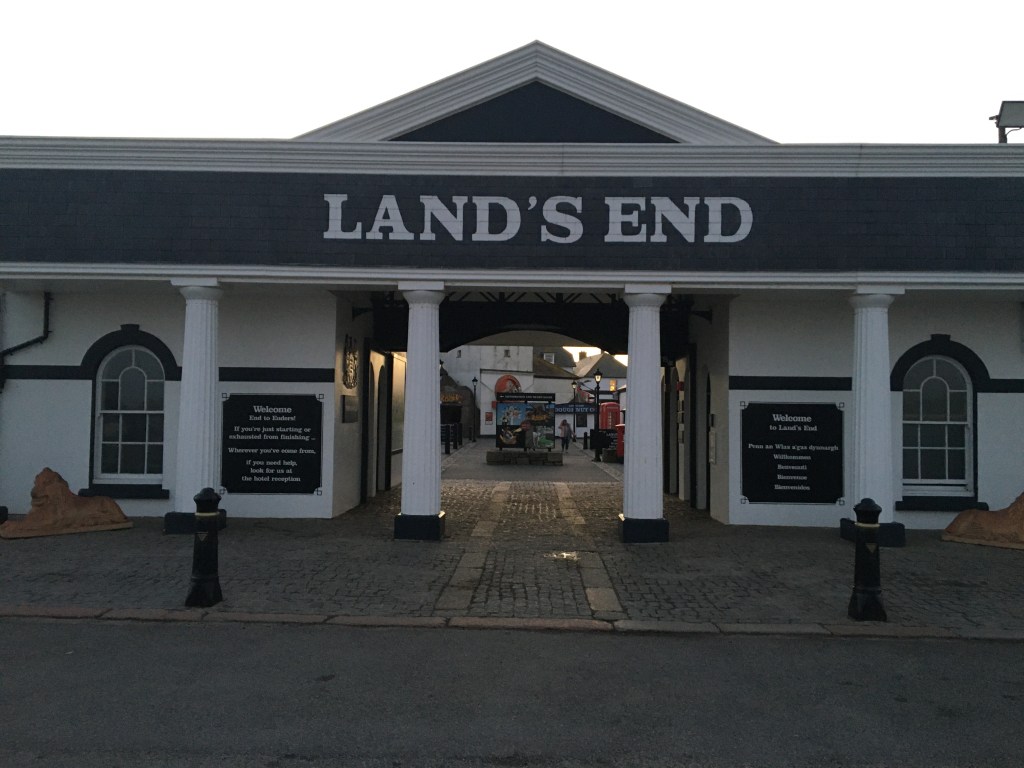
Despite Alastair’s warning Land’s End is still a surprise. There is an entrance. Why an entrance? An entrance into what? It feels like I’m arriving at a Colombian drug baron’s mansion. Not that I’ve ever been acquainted with a narco. It’s just that that’s what I imagine it would look like.

Neoclassical pillars hold up a pediment with ‘Land’s End’ in big letters. This is the entrance to a miniature amusement park. The Spanish style of architecture continues to where Wallace and Gromitt advertise a ‘Grand Adventure’ on the side of what looks like an Andalucian finca. Next door is Arthur’s Quest Adventure Maze where ‘Led by the voice of Brian Blessed…you will come face to face with Arthur, Merlin and the Mighty Dragon’. It sounds like someone having a bad trip.

Entrance to Land’s End

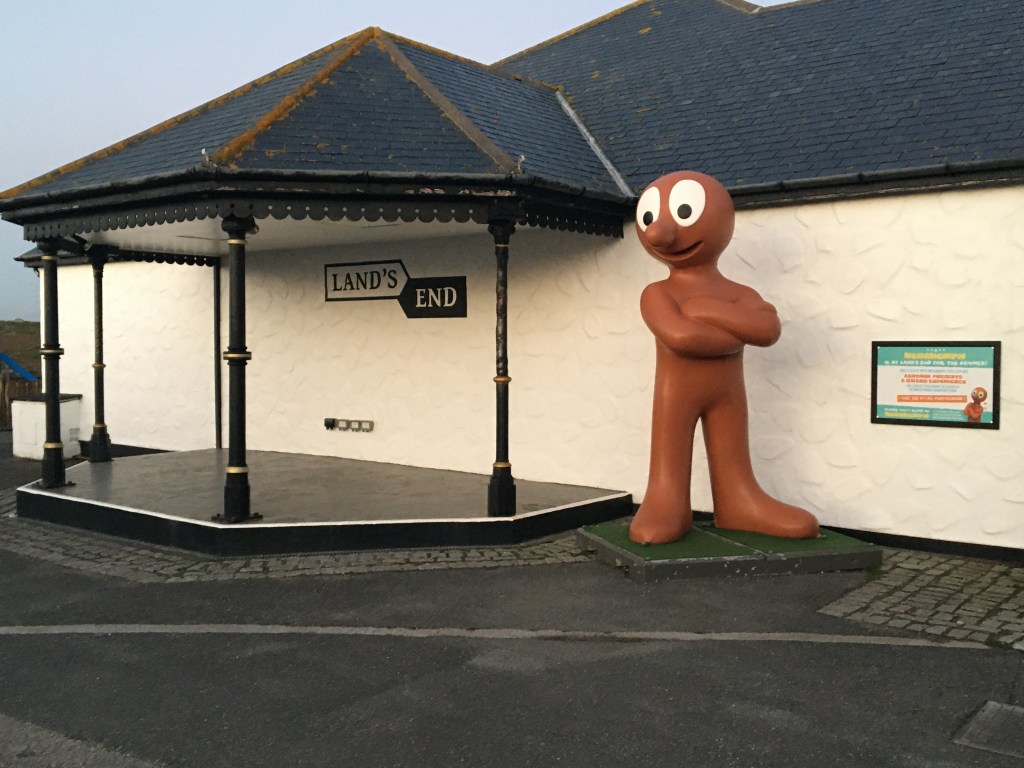
A huge Morph, the first of Nick Park and Aardman Animations’ plasticine heros, stands looking over the scene while over his shoulder is the drama and roar of the open Atlantic. Lots of foreign tourists have their phones at the ready like gunslingers quick to snap anything that suddenly appears. I kind of love this place and its strangeness.

Morph, Land’s End

I’m intrigued to know who decided to set up Land’s End as a small entertainment park. Later I discover it’s owned by a company called Heritage Great Britain registered in Liverpool whose motto is ‘Custodians of the spaces and places that people love’. They also ‘own’ John O’ Groats.

Time is ticking on. Sometimes I’m too slow. I lost track today. It’s getting dark and the path is unclear. It’s another mile to Sennen. I anticipate that feeling of comfort of coming into habitation after the wilderness. Tonight I will sleep in a bed again in the Old Success Inn. I can’t wait.

Land’s End cottage

Tramping Diaries SWCP – Porthgwarra to Land’s End October 24th 2021

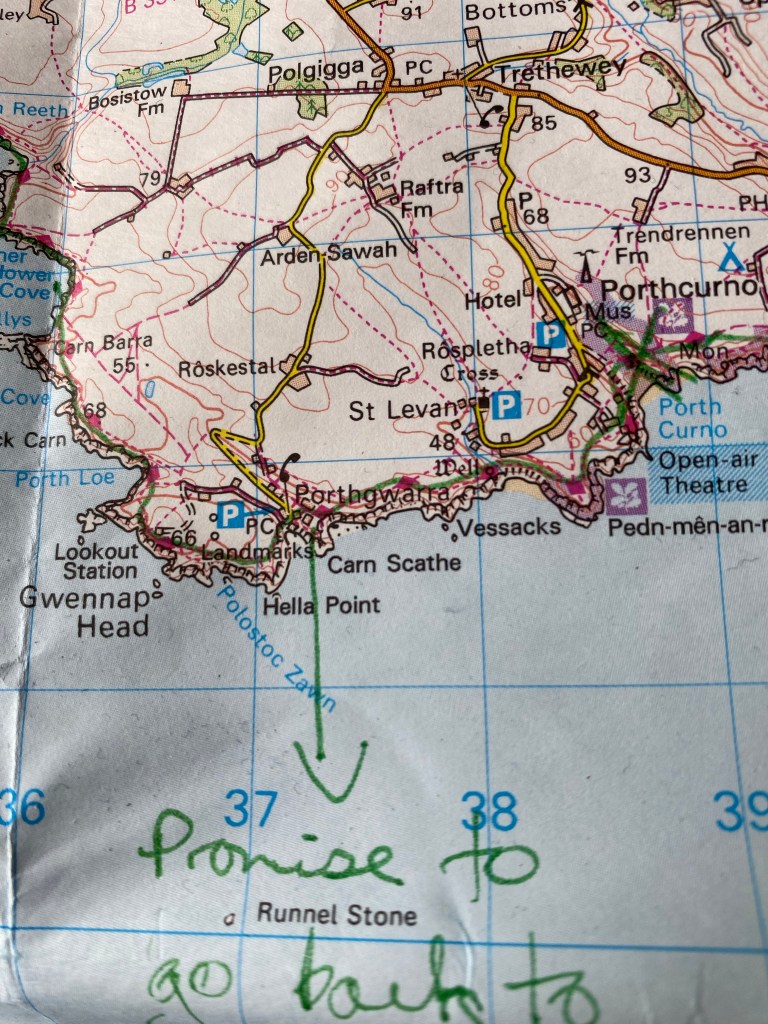
The black bell on the black buoy continues to toll. It is a small pyramid, a tiny detail in the enormity of the ocean. It rocks from side to side in the buffeting waves. The sound of it is a low moan, reaching me intermittently through the roar of the westerly I’m walking into. I could hear it long before I could see it. Like some mythical creature it calls its warning to the hapless sailor that might get too close. Later I find it is a marker for the infamous Runnel Stone where many vessels in the past have run aground and sunk.

I am at the end of the land. Gwennap Head. This is the true south west corner of the British Isles. Not Land’s End which is a few miles north west of here.

It was on a Sunday afternoon in June 2016 that I drove to Dorset with a rough idea of going for a beach walk and a swim. I strolled along Studland beach and fell into starting the South West Coast Path. Here I am five and a bit years and 368 miles later (according to the SWCP Distance calculator). I’m halfway.

A lot has happened in that time. I’ve lost a parent, changed my career and finally found my little love. Who knows what will happen in the next five to ten years that I’ll slow walk to Minehead? Everything is an adventure.

https://www.southwestcoastpath.org.uk/walk-coast-path/distance-calculator/

And now I won’t be walking west anymore. For now it’s time to head north.

Up a rise in the land are the cone like shapes of the Runnel Stone day markers. One looks like a gnome that has been buried up to his brow. People at sea need to always be able to see the black and white one to avoid coming to grief on the stone. According to the National Coastwatch Institution website:

‘When at sea the black and white one should always be in sight….. but if it is completely obliterated by the red cone, the vessel would be on top of the Runnel Stone!’

Runnel Stone day markers

I pass the square block of the lookout station on Gwenapp Head. The female coast guard gives me a big wave and a smile. I return it. I wonder how lonely it might be being a coast guard always looking out into the grey and the blue. Or maybe not.

I’m walking due north. There are rough bumps and varying degrees of greens and browns. Then a huge rent runs along it where it has been roughly hewn by the sea.

Heading north towards Land’s End

Rock formations create the borderland between land and sea. Block on block of two types of grey granite that form the wall of this end of England. The sound of waves crashing against it is constant. There are headlands that jut out with foreign sounding names Carn Les Boel, Carn Boel then Pordenack Point.

Linking these headlands are the coves: Porth Loe, Folly Cove, Pendower Cove. In these curves where the land rises less steeply there can be a sudden wave of spray that floats like smoke up the side of the land and over me.

A few miles ahead I can see a low cluster of white buildings. When I was living in Plymouth and training to be a teacher I lived with someone called Alastair from Blackpool. He was a retail manager who adored Top Gear.

‘Land’s End is proper shite – it’s like a second rate amusement park.’

I can’t wait.

Approaching Land’s End

Tramping Diaries. The Monarch’s Way, Ilchester December 4th 2021

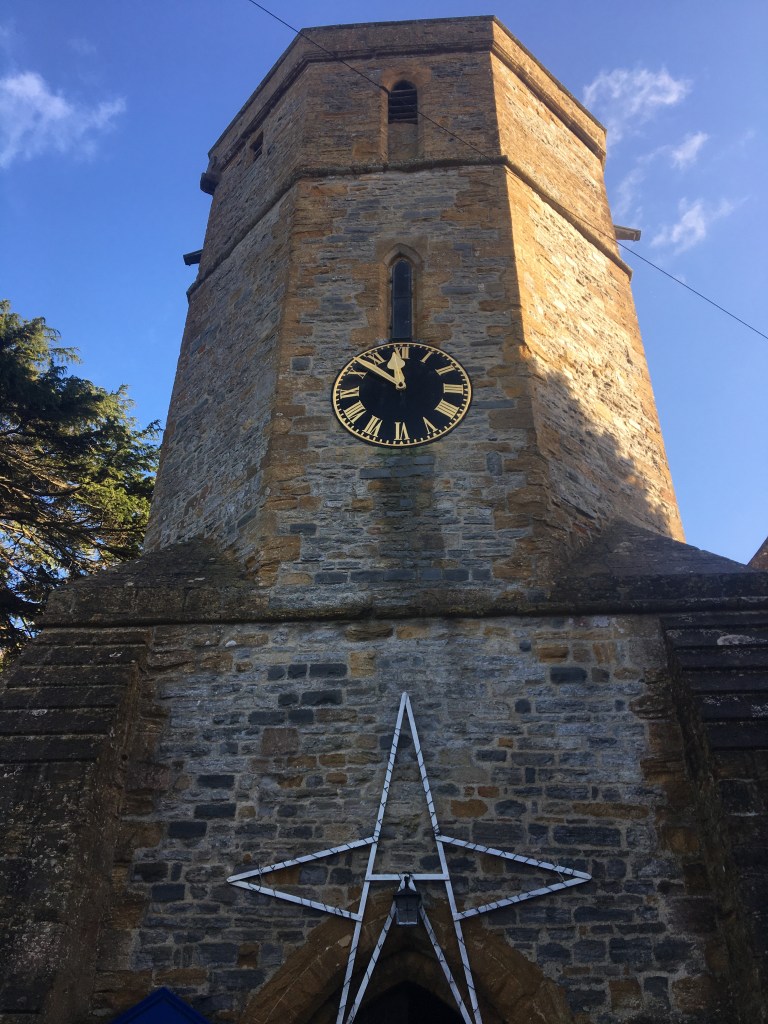
Ilchester Church

I’m standing outside the octagonal tower of Ilchester church. A huge star has been attached above the arch of the door.

The vicar looks up at it and then turns back to me. ‘It looks great when it’s lit up at night’.

Bruce is a robust looking man. He’s broad. He wears a Karrimor waterproof over his dog collar and walking boots. He has a direct look. He is the sort of muscular priest my dad would have liked. I wonder if he might have been a padre in the army.

‘The octagonal tower is only in this part of Somerset. ‘There were three others designed by the same person.’

‘Apparently they chose octagonal because it was halfway between the circle and the square. A circle symbolised perfection and the square symbolised reality (or something similar).’

The Fosse Way goes through Ilchester and turns into the A37 that goes down to Dorchester. It’s only a few hundred yards from where we are standing outside the church porch.

Bruce tells me how the gateway to the town would have been just beyond the last house before the roundabout and the the long, straight section of the Fosse Way that heads up the hill to Yeovil.

He also says there are stones in the church tower that came from the Roman road where ‘you can still see grooves from where cart tracks have been driven along them’.

There is another church in Ilchester which is Victorian. It’s the church for Northover. ‘The original church would have been a minster, a place where monks would go from to evangelise and convert the pagans in the dark ages.’

It’s the Christmas tree festival so Bruce apologies. ‘I’ve been trying to find a tree.’ When I look in the church there are four trees and I think there are more to come. It was his idea. He’s been vicar here now 10 years and lives in Ilchester.

I ask him about dwindling congregations. He quotes me figures recently published in The Church Times. Half of Somerset have less than 30 people coming to church.

‘But it’s a rural community and often the church might be in a village with a small population.’

‘Someone I know had done some research and found evidence of many people making excuses to get out of going to church in medieval times but we think of people then were all going to church.’

‘I’d love to have 300 people coming to my services but I know it’s not going to happen.

Most are over 55 but I have a woman in her thirties who comes regularly with her daughter.

Other churches have seen their congregations getting less because of online services. People got used to being at home and being able to choose when they can have their service.

Bruce takes me to see if the museum is open. On the way he points out a square stone placed in the pavement with a narrow trough running across its middle.

‘There’s an old piece of the road with a cart wheel track.’

Just behind the main square where traffic rushes by the museum looks like it could exist in a an old sweet shop. It’s closed but I can see a section of Roman mosaic.

When I tell him I’m doing the Monarch’s Way, he tells me to look in at Limington church.

‘A certain Thomas Wolsey was vicar there from 1500 to 1509 before Henry got him to start up the Church of England. It’s recorded that while he was here he was charged with drunken and lewd behaviour after the Merriott Fair.’

I could ask Bruce questions all day but it’s past midday (as indicated by the church bell striking 12 times when we first started talking). I wa

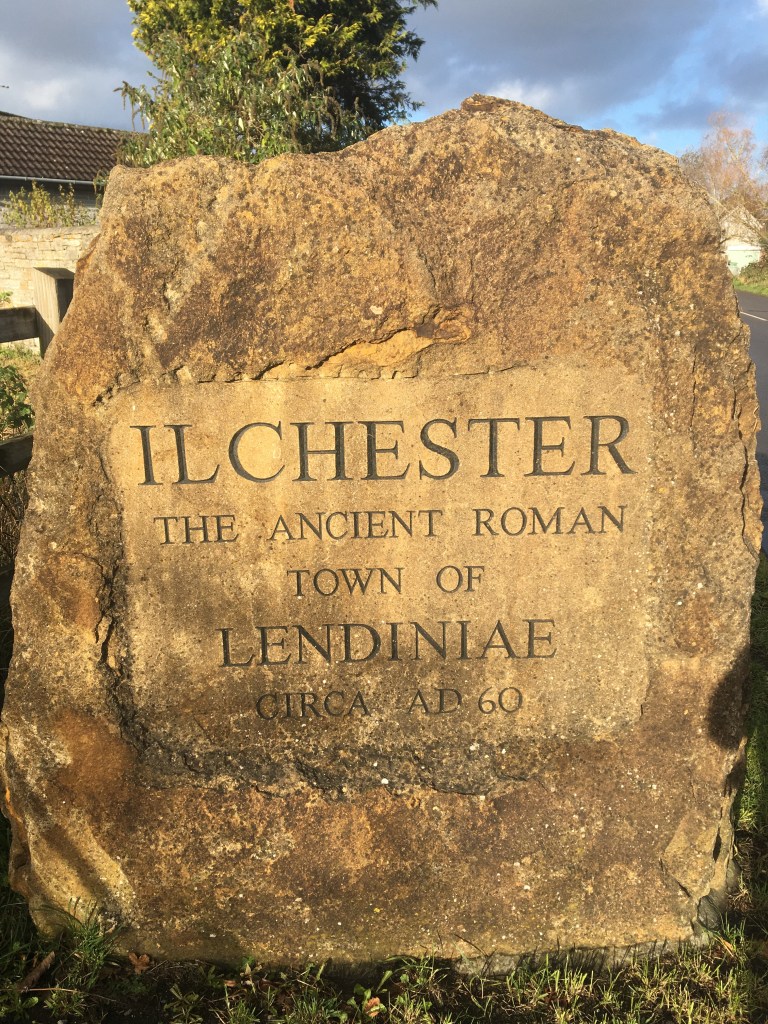
lk out of the town south towards Yeovil past a big chunk of hamstone on which the town name is carved above its Roman name Lendiniae AD60. I cross the A37 onto a footbridge, pass through a little foot gate and onto a meadow that looks up towards the ridge and St Michael’s Hill outside Montacute. The time is 12.26.

The path takes me in a straight line almost to Montacute. Does the Monarch’s Way follow a Roman road?

I have a moment when I’m stopped by the shape of the land: curves, lines and slopes often capture me.

A small ridge has a few trees on its horizon. The sun is south and shines from behind them the shadows are cast so delicately down the ridge. It is always the wind that stirs me.The shadows are like ballet dancers floating in the light.

I start to feel alone again. And the quote, the timing is near perfect.

Tramping Diaries – The Monarch’s Way June 1st 2022

Dawn light near Misterton

I wake up in a meadow just outside Misterton. Crows are fussing loudly above my head. Caw. Caw. There’s something urgent about them. Then the soft lilting of pigeons. There are minor changes every minute. There’s a Scots pine above me and the first light is amongst the branches like a fire that is just starting. A shower of elderflower catches the sunlight, turning the white splashes to peach. I’m outside Crewkerne and an early train is passing. It makes a gentle oooo like the hooting of the owl. It’s a small dawn chorus. It’s 5.30.

There is no sign of bunting in Seaborough. Just the drunk hum of bees in lime trees. It reminds me of growing up at Church House. In the church a crusader lies prostrate in the church, his helmet on and faded by years. Above his head a dedication tells how Ralph de Vallibus was given Seaborough Manor in the time of Henry III. He was a crusader at the siege of Damietta in Egypt.

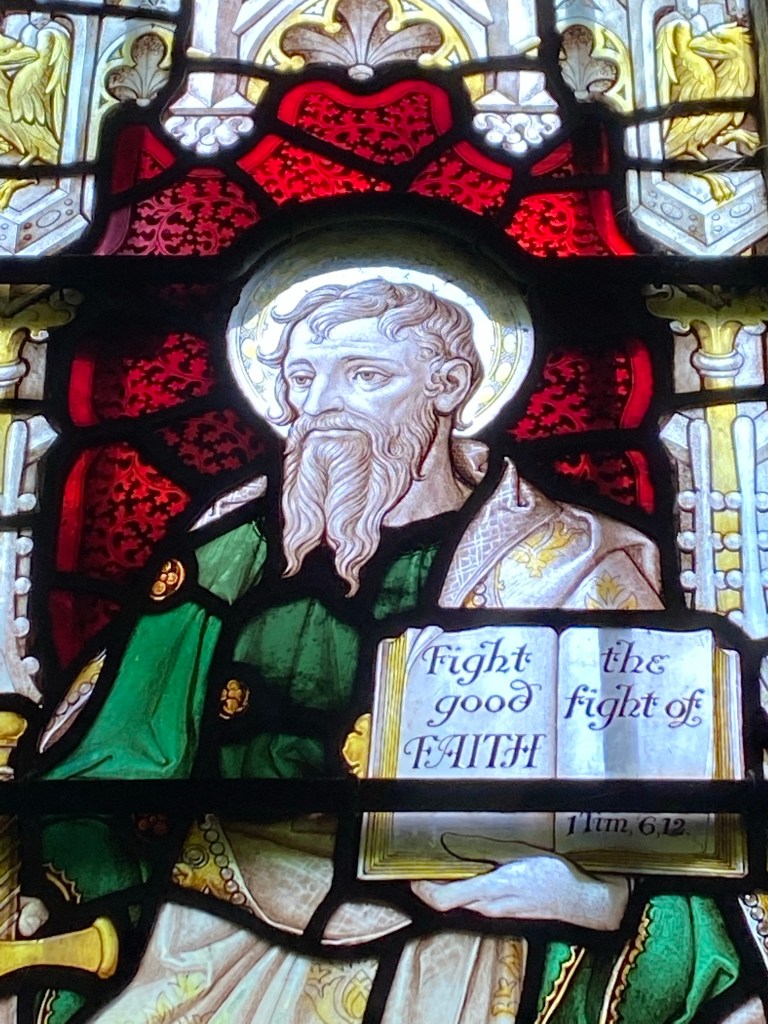
Above him a beautifully preserved stained glass window is an inspiration in the morning light.

Stained glass window, Seaborough church

After I leave the church I look across the gravestones down into the valley where the River Axe in its upper reaches winds its way like a young eel. I will follow it as it grows and maybe even feel its embrace it at Weyford weir.

Buttercup meadow, Seaborough

Approaching Drimpton I walk into a small arena for horses. Four dogs all run towards me barking.

A wiry man in a zip up wool top and jeans walks out of the barn

‘Be quiet!’

Mike Combs is 78 and been working with horses since he was 6 when his brothers forced him onto a pony that they wanted to break in.

‘I was dragged through hedges and brambles. I said I’d never ride again.’

‘Then when I was 14 I went to see a hunt. I said I’d like to have a crack at that.’

He became a whipper in, looking out for the fox and answerable to the master of the hounds.

‘I would go hunting seven days a week. I loved it.’

He has ridden with the Seavington, Taunton Vale and Exmoor and says it’s as strong as ever.

He breeds show ponies. He says he’ll have no rest this weekend as he’s showing at the Bath and West show.

‘Oh, I’m a royalist through and through. We’ve sold ponies to the royal estates.’

He has broken two vertebrae and also has a big scar across his stomach where a stallion suddenly attacked him for no apparent reason

‘I don’t know what happened with him.’

His wife left him for a master of hounds when their daughters were 7 and 10. He brought them up on his own. And he now looks after his 90 year old sister who has dementia. He points towards a static caravan next to the stables.

As I part I say ‘It sounds like when you go to bed at night you can pat yourself on the back.’

‘When I go to bed at night I’m too bloody tired to do anything but go to sleep’, is his reply.

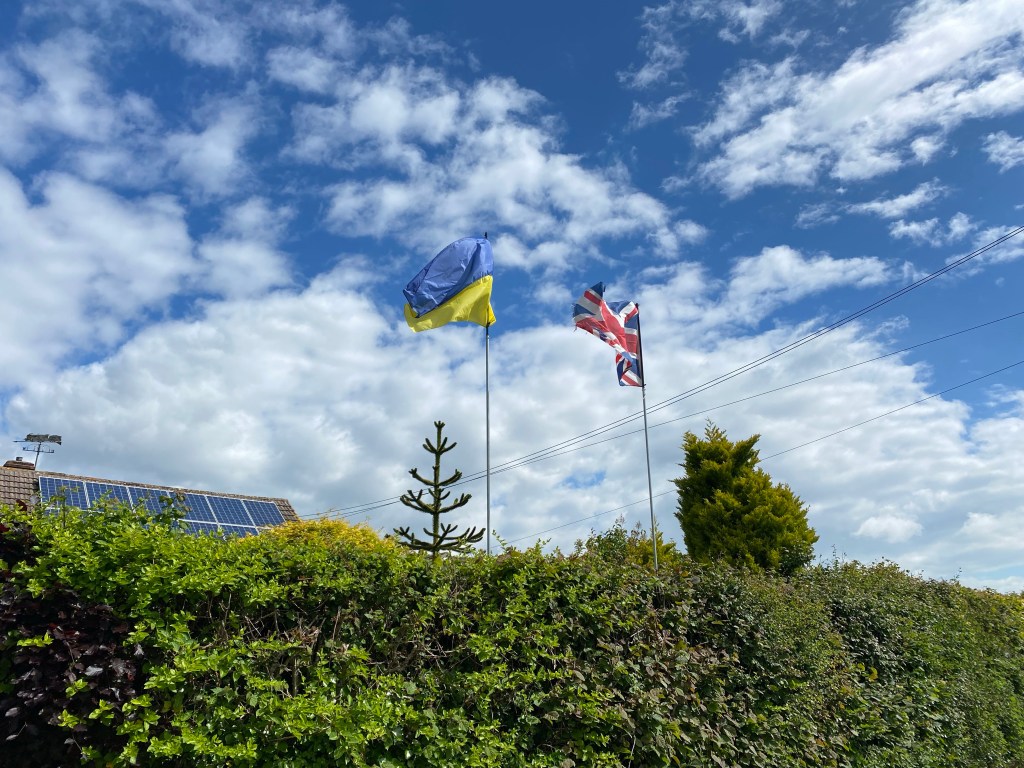
It’s been over a hundred days since the Russian invasion of Ukraine. We’ve got used to the ubiquitous blue and yellow flags of Ukraine but this week we’ve seen more Union Jacks flapping and flattering in suburbs, city streets and along country lanes.

It’s 70 years since the queen came to the throne this weekend. It’s never happened before and I doubt will ever happen again.

Is it fanciful to think how different would things be if Charles II had been captured and executed in that strange autumn of 1651?

I tramp through the village past cottages and bungalows. A man with white hair carries a large Union Jack on a stick and props it up at the end of his cottage under the wysteria.

‘Lovely day’ I say.

‘Not bad. Not bad.’

Ukraine and UK flags, Drimpton

Tramping Diaries. SWCP Porthcurno October 24th 2021

I have arrived at the triangle of white gold. The water surface is bumpy. One heavy wave after another rises, curls and falls with a heavy ‘crump’ onto the sand. After each a trail of white surf is dragged back to sea. Encampments of 2 or 3 people sit at polite distances from each other. Aside from the activities of children and dogs, many of those seem content to just sit and look at the sea.

I am standing on a dune back and a little above the beach. I am standing in front of a hut. It is just a small white block with a flat roof. Above me the cliffs rise both on my left and right where the path arrives one one side and disappears on the next. Ahead of me is the gold and the blue of beach, sea and sky.

Porthcurno was the point where many telegraph cables buried under the sea would enter the UK from far overseas. From all over the world cables would travel hundreds and thousands of miles and this is where they ended up.

Built in 1929, you can see the rows of glossy metal tubes where the cables are lined up vertically against the wall. Above each group of tubes is a white sign to tell you the origin of the cable. The one nearest to me says ‘Gibraltar’. There’s something English about this. The modesty of the scene and a reminder of past greatness.

A man peers through the metal gate that blocks our way in. He is so absorbed he mistakes me for his wife.

‘Look there’s one from India there.’ We do that thing of laughing briefly at his mistake. She’s down on the beach admiring the view. I promise myself I’ll visit the museum when I get the bus back here to pick up the car from Treen. Half of me wonders if I’ll make it.

I want to keep moving. ‘I must go down to the seas again. To the lonely sea and sky.’

It’s that feeling in the pit of my stomach like I used to get on the last day of the summer term. The dizzying expanse of the summer holidays stretching out before me. The expectation of all that could happen.

It’s a steep climb up the other side past the Mynack theatre with its terraces and balconies built into the great rocks around it like it’s a natural feature that’s been there for millennia.

The wind is coming from the west. Going right through me. I can feel I’m getting closer to the end of the land. I imagine the hundreds of miles of ocean ahead of me and the cables lying down there and all those messages tip tapping across the ocean floor.

Tramping Diaries. SWCP, Porthcurno October 24th 2021

Even by Cornish standards Porthcurno beach is magnificent. To the coastal tramper approaching from the east the land is flat. The sea is a steadfast companion on the left. Grassland undulates and curves inland. Like the beautiful curve at the bottom of the back of someone I know.

Grass is bright. Rocks protrude in clusters. Suddenly a path will lead off to a headland sticking out into the sea with blocks of stone teetering on top of each other.

Amidst the grey and the green there is a surprise in store. The beach appears in a moment. One moment the walker is only aware of grass, rocks, sea and sky. The next he is dazzled.

Two great arms of rock reach out to the sea on each side of the beach. Their grassy tops become patchy as they reach the granite cliffs at the end of each headland. The green becomes grey and ends in points like ships’ hulls where the waves fizz and froth.

In the cleft in between is a narrow strip of near spotless sand. A seam of white gold. The view is so sudden and so striking it makes me say something out loud. The beach is a rough triangular shape, the point towards the land, the base towards the sea like an immaculate breast pocket handkerchief in an old man’s suit.

Where the sand meets the sea the water is green-aquamarine-light blue-dark blue in that way that nature has of making things appear with changes so subtle they defy description.

Today the beach actually isn’t spotless. There are black specks dotted about on it. People are always drawn here. Beauty breeds popularity. And Porthcurno is just that: a rare beauty; a real cracker.

How lucky I am, I think to myself. How many times have I felt this? Me alone with this. Moved by the vastness of it all like seeing the world for the first time. That strange mix of sad happiness that I can’t put into words. I hold my hands out and look skyward. The wind blows through me. The sunlight fires off sparks in my eyes. The sea glitter flashes and sparkles and dances all the way to the horizon.

Tramping Diaries. SWCP Penberth to Porthcurno. October 24th 2021.

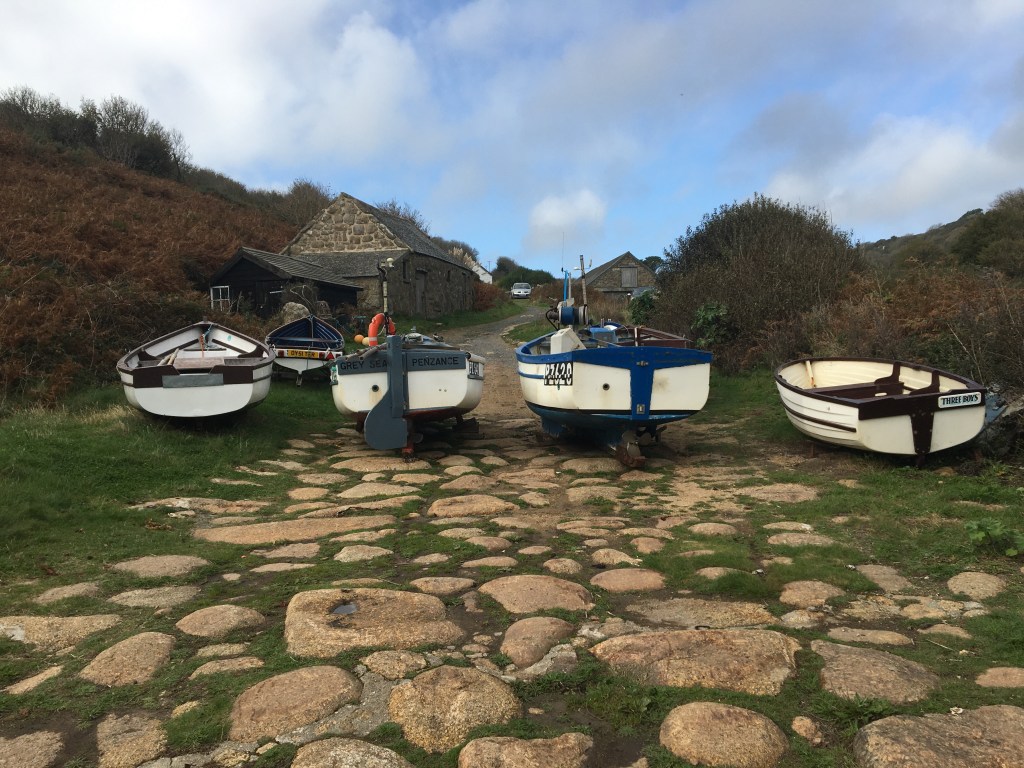
I am back at Penberth looking at the same lines of fishing boats that I saw in September. It’s a Saturday. En route from Somerset I stopped at Launceston where the rain fell in diagonal lines while people scuttled from their cars to shops and back again.

Here, in the same county, it could be another country, another season. I’ve brought a fleece, woolly hat and anorak but right now I could do with shorts and sun cream. The slipway is made out of and surrounded by oval boulders like dinosaur eggs.

Fishing boats, Penberth

As I write this I think of my travel writing mentor, Peter Carty, and his advice. ‘Keep working on your intros, make sure the reader is aware of the focus of your blog.’ Come to think of it, what is my focus? How slow, solo walking is one of the most powerful experiences any of us can have?

For anyone who thinks they want to pursue travel writing Peter is your man and I have no reservations about using this space to give him a plug.

http://www.travelwritingworkshop.co.uk

There’s no sign of Neil the fisherman today. The washing line is empty and the front door is closed. I say hello to an old boy in a worn smock and a brown bobble hat. He has gaps in his teeth, one eye red (from an injury). There are two younger men with beards and black t shirts wrapping up shopping bags on one of their boats.

They tell me they’ve finished for the season.

A UN report came out the week before this that revealed the extent of plastic pollution in the oceans. It made depressing reading. The report published by the United Nations Environment Programne (UNEP) stated that ‘by 2040, volumes of plastic pollution flowing into marine areas will nearly triple.’

The report continues ‘Consequently, all marine life – from plankton and shellfish to birds, turtles and mammals – faces the grave risk of toxification, behavioral disorder, starvation and suffocation’.

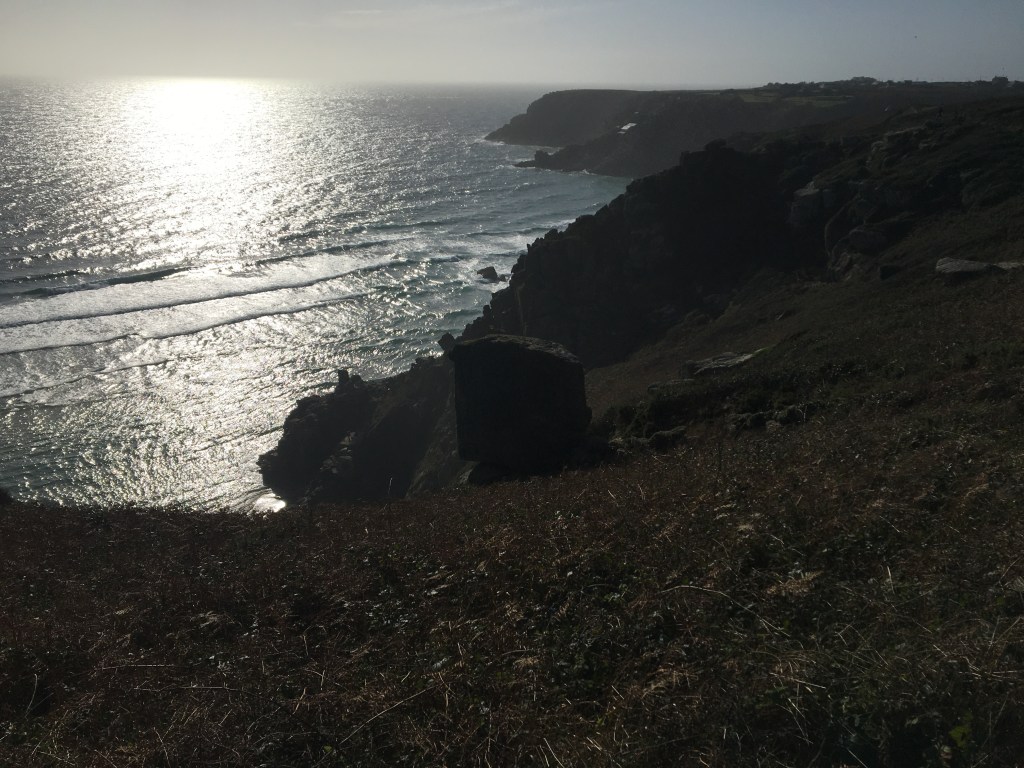
Heading west (as always) lines of waves peel through sea glitter. Hundreds of thousands of ripples sparkle all the way to the horizon. You’d never know to look at it that something is going severely wrong. So beautiful yet so damaged.

En route between Penberth and Porthcurno

When I arrive in Porthcurno I decide to use the toilets in the car park. Holidaymakers to and fro. For a long time the toilets are locked while the cleaner’s singing and whistling echoes amongst the white tiles.

People loiter about outside. Some appear fidgety.

When he’s done he stops to talk. Upfront. Chatty. Typically Cornish. Like so many others I met when I trained to be a teacher here in 2008. It’s always seemed different from where I grew up in the east where people have always seemed more suspicious.

‘It’s because they’ve been invaded so many times’, my Dad used to say.

My toilet cleaner friend is tall and well built. He is 62. He has several tattoos on his arm. He has one tiny blue dot beneath his right eye. It’s the smallest tattoo I’ve ever seen.

‘Where’ve you bin then?‘

‘I’ve walked from Penberth today. I started at Studland five years ago. I’m doing it slowly.’

He tells me he’s from Marazion and I say how lovely it is.

‘Oh yeah. I wake up and look at St Michael’s Mount everyday. I love it. Take it easy on the cliffs, mate. Get on.’

And he’s off with his bucket and mop, his whistling the last reminder of him as he disappears round the corner of the path.

I have a portfolio of so many coast path brief encounters like this. This cheerful toilet cleaner, Neil and Derek and countless other before them. Met once and never to be seen again.

Tramping Diaries. The Monarch’s Way: Ashington to Ilchester October 1st 2021

Two of the Teletubbies welcome me to Ashington. They are resting under a sign.

Arriving at Ashington

I’m back on The Monarch’s Way. My passion for ‘slow walking’ grows, meanders and thrives. There isn’t much of a plan apart from reaching the end of the path. It’s all about the moments that appear like magic en route (and sometimes not at all).

Ashington is sleepy. There is another flag with the Somerset dragon. There were several of these I passed around Pilton when I did that stretch last summer.

It’s tempting to think that this is a symbol associated with Somerset going back to antiquity but the flag – normally a red dragon on a yellow background – was only ‘adopted in 2013’ and was ‘mentioned in the book ‘The Once and Future King’, by T H White and is said to have been worn by Arthur during the first joust between Arthur and Lancelot.’ (Wikipedia)

Ah, the legend of King Arthur and his association with Somerset. Isn’t Glastonbury Tor supposed to be Avalon where Excalibur was jammed in the stone? I read recently that the legend was much hyped by the monks at Glastonbury to encourage tourism to the area in the Middle Ages.

Somerset Dragon, Ashington

A man is mowing the churchyard and a young lurcher with a scruffy and freckled coat flies towards me and runs circles round me.

There is a little church with two bells and no tower. There’s scaffolding on the Manor House next door and signs on the roadside that say ‘Slow! Moorhens.’

The wind is cooler and stronger today. Silvery willows sway in it, the trunks moving together like old couples dancing. Beyond is the champagne schooner-like watch tower, radar tower, hangers and bright lights of RAF Yeovilton.

Yet the only sound is the wind and the trees moving.

The blackberries are past their best. They are fat and black but now collapse at the slightest touch. They’re not as sweet as last week.

The first dead leaves fall and skid along the road. The make a scratchy sound as they get pushed down the lane. Autumn seems to have arrived late this year.

The way takes me to the edge of the airbase. There are a row of lights to signal the approach to the airstrip while horses in jackets graze beside them.

Airstrip Lights, RAF Yeovilton

What was the 21 year old fugitive King Charles thinking as he came through here? It must have been strange fearing for your life, any villager a potential death sentence, in your own land. I wish there were more signs of his journey but it was a brief – albeit dramatic – moment in history and one which I wish had more recorded about it.

Swallows still skim low over the meadow twisting left and right like a fighter jet on manoeuvres. They must be getting ready to leave. Is it Autumn or not?

An Alsatian runs up to me near the weir at Lymington. The owner looks sheepish and says

‘Sorry, she has no manners’.

I’m mostly welcoming to dogs. I think I’ve only got in trouble once walking in Mexico when two dogs I decided to pet weren’t the most well balanced or domesticated. I seem to remember having to extricate myself with one of them latched onto my water bottle.

Across fields. All is green and flat with the thin lines of rhines reflecting the white of the sky. This is a scene unique to Somerset; water courses everywhere. Little weirs and locks. Crumbling concrete dams. Old wheels and screws to work the locks.

Bridge and rhine en route to Ilchester

Ilchester is up ahead. I can see the buildings, the bridge, the church tower.

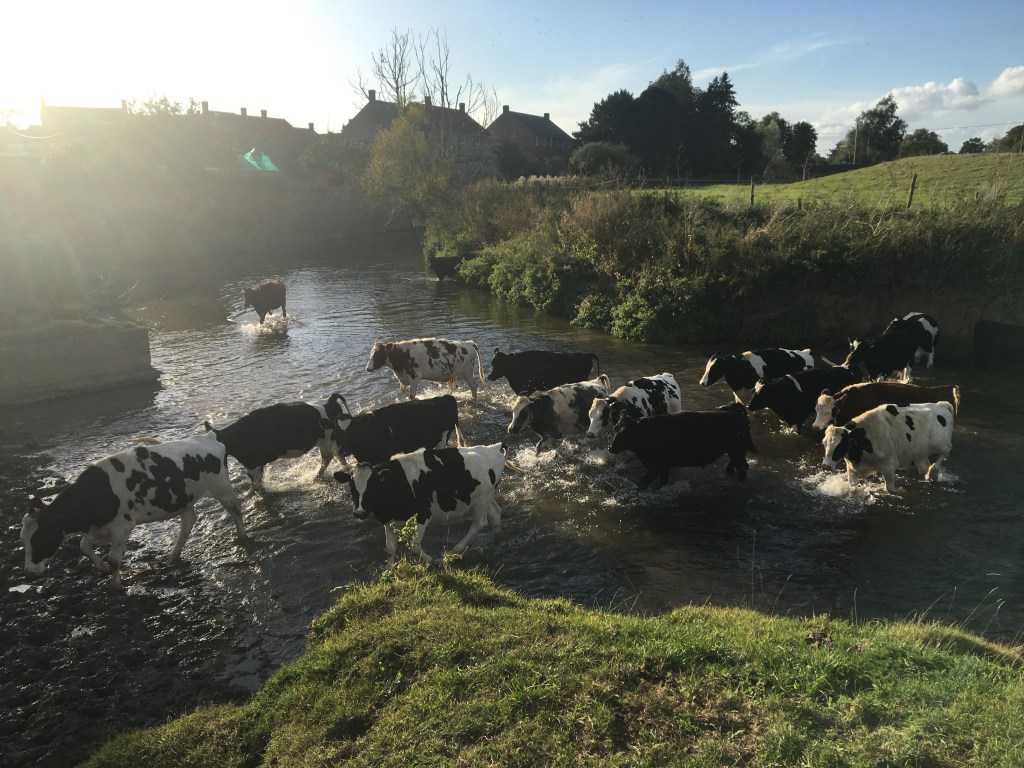
I stop at the end of the field. A gate leads from the field into the town. In a bend of the River Isle a herd of cows stand in the water at Ilchester.

In the evening sunlight this scene appears biblical.

Cows in the River Isle, Ilchester

Tramping Diaries SWCP – St Loy to Penberth September 13th 2021

Between St Loy and Penberth I was in a trance. When I arrive my eyes are brought into sharp focus.

Aside from those closest to me, the tramp has been my greatest constant. For 20 years I’ve struggled to sleep. And when the chips have been down I’ve forced myself out. Anywhere, but preferably away from noise, away from people.
Better a view. Even better a peak. Best of all the sea.

I’ve been hungover more times than I care to remember. I’ve been out without sleep (worse) or coming down and without sleep (worse still). But that was all a long time ago.

When I found out there was nothing that could be done for dad, I was – thankfully – on Thorpeness Beach in Suffolk, a beach I’ve been going to all my life, somewhere I must have walked more than anywhere.

I’ve proposed on walks. I’ve had relationships end on walks. I’ve been in love, broken-hearted, euphoric, sad, confused about life, confused about anything, over the moon, over the edge and under the cosh.

And every time a path in the wild has been there with me.

****

Penberth is a cove similar to Lamorna. Four or five buildings are nestled into the miniature valley that ends at the sea. All but one are made of the same granite that lies hidden beneath all of this. A lane comes from within the middle of the valley so that it seems that the grey of the road is appearing from inside the green, like it’s a road into the earth.

The road ends outside a small two up two down cottage. At the end of the house is a 3 arm washing line with t shirts fwupping in the breeze. Outside there is a pile of brightly coloured buoys next to the wall of the house. There are flowers too. The effect is, well, jaunty. I shield my tired outdoor eyes to try to take in the mass of colour. Outside the house there is a sign. On it are the words ‘THESE DAYS WILL PASS’.

The other side of the road from the cottage a slipway made of round stones, like the walls of Fred Flintstone’s house, drops into the sea. At the top of the slipway four fishing boats are lined up in parallel lines. It’s clear from the detritus lying in and around them that they’ve been used today. To the left of the cottage a long low building beside the road recedes up the valley. Boathouses. For winter.

I learn later that some of the recent BBC version of Poldark was shot here. Yes, I could be in the 18th century. Not much would have looked different then. There would have been more people tramping and sleeping out in the open. I smirk at an 18th century version of me with great coat, baggy trousers and hobnail boots. I stop myself before I imagine my swimming outfit.

A short, broad man with arms the colour of teak is walking out of the cottage with the buoys. He must be at the other end of his sixties but those arms look tight and taut, the tattoos just a blue black smudge.

There’s no mistaking this man’s job. A job that is as much a lifestyle, culture or birth right as a job. And one intimately tied to this land and sea. His name is Neil.

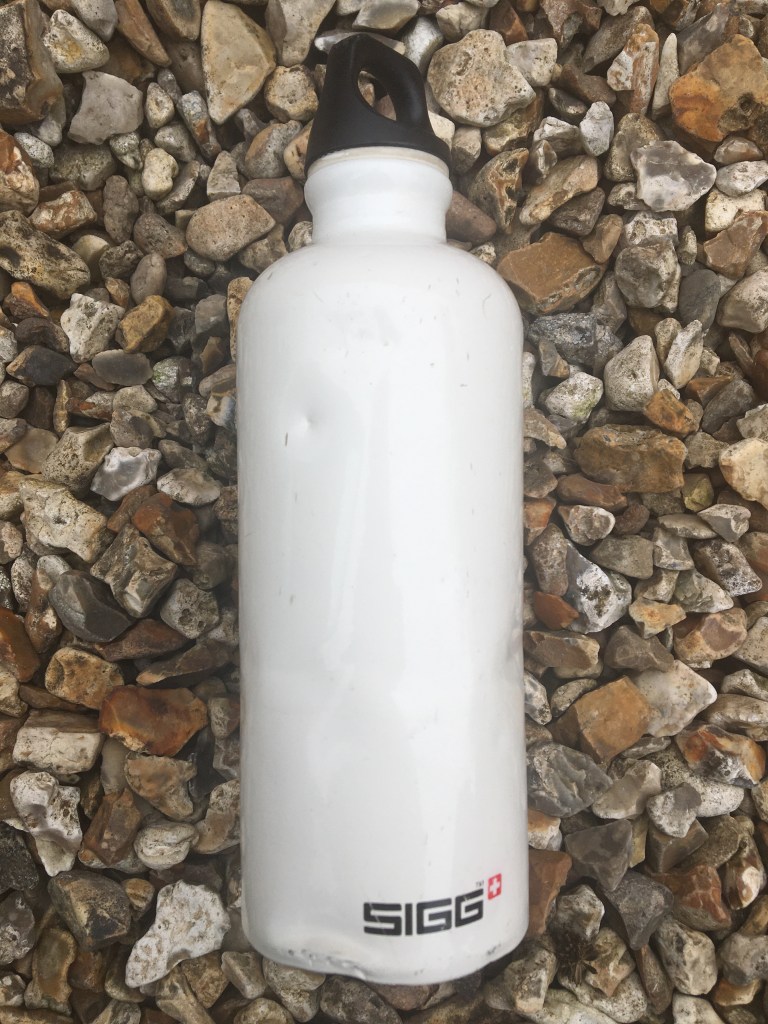
The Sigg is almost empty. Could he please fill it up for me? Neil goes into the house and returns a minute later out of the open front door.

‘I was born in this cove in the white house further up the hill.’

He tells me how they used to fish for days pointing nonchalantly to the greyness at our feet.

‘There’s still fishermen but most of them are old : only one young un doing it from here now.’

‘The mackerel have gone. There used to be a lot out there.’ He points just into the bay.

‘In the Spring there could be up to two to three hundred boats out there.’

It can’t happen anymore he tells me. A recognition of the huge reduction in fish stocks in recent times.

I thank him and say goodbye. I turn towards Porthcurno and as always my mind begins to wander.

Tramping Diaries SWCP St Loy September 13th 2021

I am picking my way amongst boulders like the backs of hippos. The sea is to my left. There is nothing between myself and the horizon that indicates any other life. The entrancing wash of the waves onto the beach allows the images to unravel as if from a film projector.

At the end of this rock-filled beach sub tropical plants crowd in around me. These giants have leaves so huge you could use it as an umbrella. They are Gunnera Manicata or Giant Rhubarb. On the land side heavy trees – a dark, impenetrable mass – appear as one mass. Jurassic Park: the UK version.

Cove Cottage – an upmarket holiday cottage – is tucked away a few hundred metres inland with its own well tended garden. The stream plays amongst mossy rocks. I hope there isn’t a dead sheep in it upstream. I splash my neck, and face and drink small mouthfuls from my cupped hands.

I think of how Cornwall seems like a different country to the rest of England. Roger Deakin said he felt this whenever he crossed the Tamar Bridge.

I wonder once again at the solitary existence I’ve carved out for myself.

I was sent away to school at 8. It felt like a mistake. Like one of those films where a spelling mistake means the wrong name gets chosen and the wrong person put forward. But it wasn’t that. My parents wanted it. It was what was expected. I never blamed them; I loved them too much but it wasn’t for me.

The teachers weren’t the sort that would or should be allowed anywhere near children nowadays.

I’m not affected by it. I think I was one of the lucky ones but boarding school makes you grow up quick. You build resilience but you also build walls to hide behind.

And strangely going away, going it alone has stayed with me all this time.

Even when I was in London I would always escape to Richmond Park. I went to Spain for a year to teach English. I moved back and trained to be a teacher in Cornwall. I lived in a fisherman’s cottage where I was so close to the sea that on a stormy night I would hear the slap of spray against my bedroom window from the waves hitting the sea wall. Most of my recent history I’ve been alone.

Dad also liked to tramp alone. He would disappear for a few days with a tent and a stove and walk down the Finn Valley or go up to The Saints (a collection of small villages all within a few miles of each other each named after a different saint), both in Suffolk .

The week after he died I was stopped short in the attic at Church House. In one of his rucksacks there was a freezer bag with half a bar of orange soap and a camera film case with waterproof matches inside. Part of his camping kit. I realised I do something very similar for my mini adventures tramping the path.

‘You’re so like him’, people always say.

I emerge from the jungle of St Loy into a familiar scene. Half the world is sea, half the world is cliffs and land and dissecting the two is the white squiggle between the grey and the green. The rhythm sends me into a trance and I remember nothing between here and Penberth, my next port of call.

Tramping Diaries SWCP Kemyel Point to St Loy September 13th 2021

The first thing I notice when I wake is the last thing I remember before falling asleep: the constant shh…shhh…shhhh of the waves. Like a mother calming her baby. Once again I feel accompanied. Less lonely than when I wake alone in Clifton.

This desire for lone walking seems to have always been there.

As early as I can remember I was mucking about outside. Yes I would go fishing and cycling with friends but often I would just wander around the garden and the back of the church with a stick. I remember hiding in bushes and feeling the wind breathing through me and in me. I believed it was the breath of God.

Forty years later I get the same fizz in unexpected places. Like on a January evening: when no one is out and I go for a late swim in the outdoor pool at Bristol Lido. I’m blessed to have it literally around the corner. A sense of being outside the norm, of living on the edge, even if ever so slightly, and the yearning for an adventure, however small.

Cosy and alone, my eyes slowly follow the line of my wormlike body to the cliff edge beyond my feet out across the grey mass and towards the low line of the Lizard. A line of orange appears over that line, brightens and then fades like a blush. Aside from this the world is grey.

The stings are still throbbing but getting back into the rhythm of the walk will distract me.

The light feels weak. A lone fishing boat bobs about half a mile out to sea, its port and starboard lights twinkling as it rocks from side to side.

After rounding the headland of Carn-du, I’m walking north west away from the sea and towards the land around Lamorna Cove. It’s just gone 7.30.

Lamorna Cove

Lamorna seems unassuming. A small cove where a band of boulders seem to tumble into the sea. At the western end of the beach the line of a road gently drops from the greenery of the valley and ends at a quay and sea wall that carry along the coastline and the path. Cottages – some white, some grey – are dotted about the hillside.

As I arrive I notice cosmos, hydrangeas and campions growing beside the path.

When I get to the quay a well built man in his sixties is ambling along with his dogs.

His name is Derek. He is from Bristol and has retired to Lamorna.

‘It’s all AONB (Area of Outstanding Natural Beauty) here so you can’t build on it. For years they washed the soil off for tin using the local stream. Placer mining they called it.’

‘Since the start of the Bronze Age people have been mining tin. There’s been three and a half thousand years of it.’

‘You can see evidence of it on Bodmin Moor too. They would move big piles of stones so that they could work the land.’

He asks me if I know Lamorna Birch.

‘Er, is it a type of local wood used in the building of the cottages?’

‘No’, Derek tells me slowly.

‘That came from a boat shipwrecked in the bay.’

Originally from Cheshire, Samuel John ‘Lamorna’ Birch was a painter and member of the Newlyn school of artists who ended up living in Lamorna. When I look up his name on Wikipedia I find the following explanation ‘At the suggestion of fellow artist Stanhope Forbes Birch adopted the soubriquet “Lamorna” to distinguish himself from Lionel Birch, an artist who was also working in the area at that time.’ Apparently Birch created over 20,000 paintings in his lifetime. His favourite subject was the cove that we’re looking over. He died aged 85 in 1955 in Penzance.

Derek and I chat for probably half an hour. Maybe longer. My sense of timing is pleasantly skewed when out like this. I hesitantly put my hand out to shake his. Covid conscious. He grips it and says ‘Bye then.’

I have a moment of poignancy. As Derek’s back disappears round the corner of the quay into the old quarry I’m suddenly struck by the knowledge I’ll never speak to him again. The urge to chat for longer is strong but not as much as the urge to be alone with the wind, the sea and the sky. As it ever was.

Lamorna Quay

Tramping Diaries. SWCP Mousehole to Kemyel Point September 12th

Surprises. There is no shortage of them on any adventure.

I always have a mental image of a place before I arrive. The Old Coastguard could only be one of those typical solid, whitewashed pubs dimly lit by lanterns which has withstood Atlantic wind and waves for centuries. Yet here I am looking across a large wood polished floor towards a row of french windows opening onto a large veranda. The veranda leads onto an expansive garden with a perfectly kept grass lawn that leads down a hill transected by a light gravel path. Bordering this path, tall palm trees drowsily rustle their leaves. The view looks south out to sea. There are beer garden tables dotted here and there with couples dressed for dinner enjoying the soft warmth of the evening. The effect is more Reid’s Hotel, Madeira, than smugglers pub. How lovely to be proved so wrong.

A young woman welcomes me warmly. ‘Oh, you must be the one I spoke to on the phone. I’m sure we can find you something. You might just have to be gone by eight o’clock.’

Not a problem.

I walk in: my hair salty, black shorts, black sweatshirt, worn Nike Runner trainers, black Over Board rucksack which is really a matt black tube with straps. I have walked into smart hotels or restaurants looking like this before. As long as you can pay it shouldn’t matter what you look like.

I decide to push the boat out. A Negroni with big cubes. It looks as good as it tastes. The dirty red catching the last of the sun’s light inside my drink.

I eat an excellent gurnard starter followed by duck with lentils. And a glass of fine Italian wine. I think briefly about the cost and then think what does it matter? I’m not paying for accommodation.

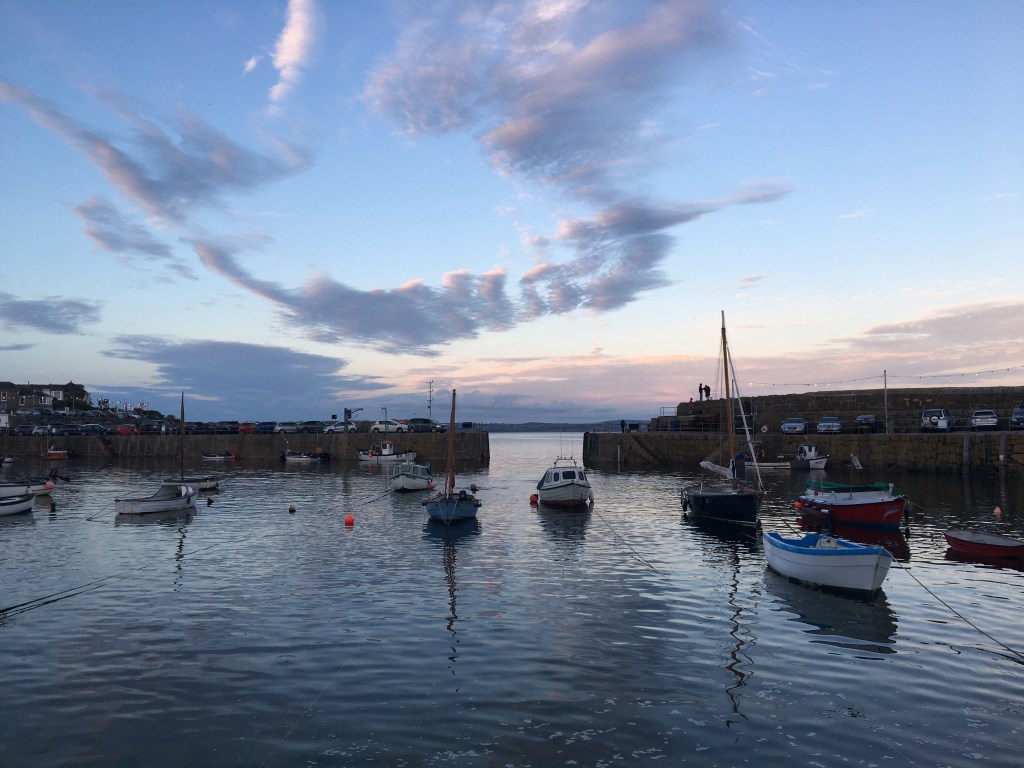
After dinner I go to the harbour. It’s one of those summer evenings that linger in the memory. The air is still warm. The wind has dropped. It is totally still. The sunlight is starting to transform into oranges and pinks in the clouds. It’s reflected in the glassiness of the water inside the harbour walls where small boats lie about like bath toys.

Mousehole Harbour

On December 19th 1981 the Penlee lifeboat launched from just outside Mousehole to attempt to help a ship, the Union Star, whose ‘engines had failed in heavy seas‘. Both boats disappeared. 16 men lost their lives including eight life boat volunteers.

Every year Mousehole has spectacular Christmas lights which are put on between 5 and 11pm each night for the whole of the festive period. On December 19th they turn them off as a mark of respect for the Penlee lifeboat men.

Mousehole Harbour

I’ve had a gentle time of it so far today but now I need to get moving and find somewhere to sleep.

Outside Mousehole the path becomes steep with thick foliage. The path is interrupted by rocks, some that come up to my knees. It’s getting darker and it becomes a challenge to clamber over them.

The negative thoughts start to rear up at me: what if I turn an ankle on one of these rocks? What if the path just continues like this for another hour or more? Is this the night I won’t discover a suitable place to sleep?

Yet in all my experiences it does turn out all right in the end.

After climbing some more I reach a long thin wood that leads towards Kemyel Point. The twilight is giving way to night proper. Inside the wood it is like a room at night with the light turned off. I fumble for my phone and turn the torch on. There are branches on the ground but otherwise the path is clear enough. I don’t feel spooked. I’m too focused on getting to a place where I can bed down for the night.

I’m only in the wood for a few minutes. I come out and the path now is flat and bordered by bracken. At one point there is a thin space of grass between the path and bracken, a sort of lay-by for pedestrians. I lie down it but it doesn’t feel right.

While I stand and ponder what to do I suddenly feel a searing, stinging pain in the back of my lower leg inside my sock and then 3 times more in quick succession. What the…?! I’m quickly at my shoes and shocks tearing them off and rubbing the stings. I still don’t know what it was. It was more painful than a wasp. I’ve tried researching it but without any answer. The stings blew up into big bumps and itched maddeningly for two weeks after.

Minutes later I stop with a sigh. The gentle breath of the sea comforts my panicked animal heart. I can see her white froth dimly in the half light. I have reached a place where the path opens out onto a cliff top and the surface is short stunted grass and plates of granite.

I wander back and forth for 5 minutes. I soon realise it’s perfect. The grass is flat and dry so that I can point my toes to the sea and have a relatively flat plate of rock as my bedside table. The wind is low here. I put the Sigg bottle, tooth brush, eye mask and sleeping pills on the rock and make my bed. I rub antiseptic cream on the stings and change my socks.

I’m tired and the stings, well, they sting but otherwise I’m comfortable and warm. The gentle murmur of wind and sea offer me company. Sleeping and waking with the waves is like sleeping next to a sleeping beast. It calms me. The cosiness of my sleeping bag is finer than a four poster bed. I can see across to St Michael’s Mount. Lights are twinkling along the route of my recent past. Praa Sands, Porthleven, Lizard Point – its lighthouse winking down there at the most southerly point. With a break to my usual devotion to simplicity I watch the first few games of Emma Raducanu in the Women’s US Open Final. She’ll go on to win it.

Within minutes my battery falters and sleep beckons, lush and heavy like an opiate. Tomorrow there’ll be more surprises.

Tramping Diaries. SWCP – Newlyn to Mousehole September 12th.

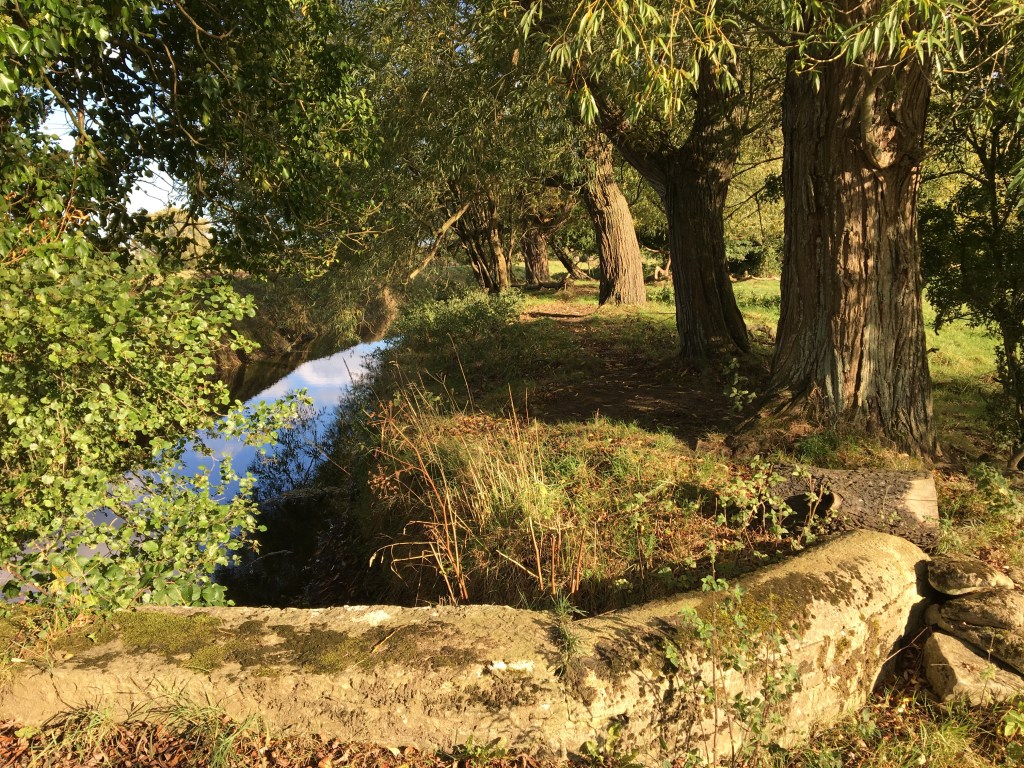
The Newlyn Stream

It’s a lovely late Summer’s day. It’s still shorts weather. It’s better for walking if I can wear them. I like to keep it as lightweight as possible. Almost taking it to the same extremes as pa.

At his memorial service there was a picture of him walking with the Austrian Alpine Club. He was high up on a snow covered ridge tied onto a rope that disappears to somewhere behind whoever is holding the camera. Probably a few thousand feet up and wearing khaki shorts!

The A30 stretches all the way through the tapering leg of Cornwall and then ends at Penzance where the road follows the coast and then heads up a hill towards Newlyn. I’m into the countryside along leafy lanes and then come into Newlyn from the north. I feel like I’m arriving through the back door.

I pull up next to a large factory like building which hums gently and smells of fish. ‘W Harvey and sons Shellfish’. This moment is great. I turn off the engine and just sit thinking of nothing, letting the journey fade from my mind.

Across the road the stream bubbles along parallel to the road. Lush ferns and other greenery sprout from its banks. There is the smell of figs from a tree hanging over the stream. It doesn’t look or feel like the UK.

The road passes the Newlyn Filmhouse on the right. How excellent: having an independent cinema with a bar and food too in a relatively small town. I’m glad to see they’ve managed to survive the pandemic (or so it seems). I stop and fill up the Sigg bottle.

The road flows down to the junction. The bus stop is on the left where I ended last time in the drizzle. The fishing harbour is there but quiet today. It’s Saturday. The path here is the road like many other coastal towns I’ve been through: Weymouth, Torquay, Plymouth and so on.

The Newlyn stream before it reaches the sea

The road/path curls the two miles to Mousehole. En route I phone the Old Coastguard to see if I can eat there. It’s one of two Mousehole pubs that I find on my phone. Only if I get there at 6.30. Like last year staycationers have flooded Britain’s tourist spots. I hope it’s good for the local economy.

The road climbs and turns to the left following the line of the coast. On the right are grey stone houses with large green doors. They look like stable doors.

To the left I look down on boats washed up at low tide. Three generations of a family potter about the seaweed around a clinker built two mast dinghy. It could be a scene from a painting by Stanhope Forbes, one of the preeminent artists of the Newlyn School.

Boats at low tide, Newlyn

Recently I took a walk around the Fitzwilliam Museum in Cambridge. in the same room as Picasso and other major modern pieces of art was an abstract work by Roger Hilton called ‘Large Orange (Newlyn)’. I was impressed but confused by it. How great that Newlyn has exerted a pull on artists for at least 150 years.

Another slip in time. These moments of absence are lost to the past and I have no memory of what happens. But at the time I’m in my own dreamer world.

Mousehole appears around the corner. Shiny black lines of rock appear parallel with the road before they fade into the wavelets of the sea. Beyond that a slim island of rock. Beyond that a thick band of clouds on the horizon.

Rising up and down in the channel between the shore and the islet is a wooden dinghy with two rust coloured sails. I have always loved the look of boats like this ever since I use to play with one as a young boy while the bath water got cold around me.

Boat and rocks, Mousehole

I am half aware this could be the last ocean swim of the year so I’m quick to get in. Sometimes the yearning aches like being in love. There is a square tidal pool blown or carved out of the rock. It reminds me of the bigger pool blasted out of the coastal shelf, Dancing Ledge, in Dorset by two brothers after the war. I walk past this and jump from one line of rock to the next until they get lower and closer.

There is no hesitation.

The water is cold and clear and constantly moving as the waves break over the rocks. I have goggles on and the white of the bubbles and rush of water hurl me through channels between the rocks. All around me is a mass of kelp. It is also being swayed and pulled by the waves. They remind me of the strips of hard cloth that whizz all over your car at the carwash. After 15 minutes I feel drunk. As I surface I tilt my head and whoop like I’ve heard surfers do when a set is appearing from the horizon.

‘What a weirdo’, a husband is probably saying to his wife outside the whitewashed cafe which overlooks me. It makes me happier than anything.

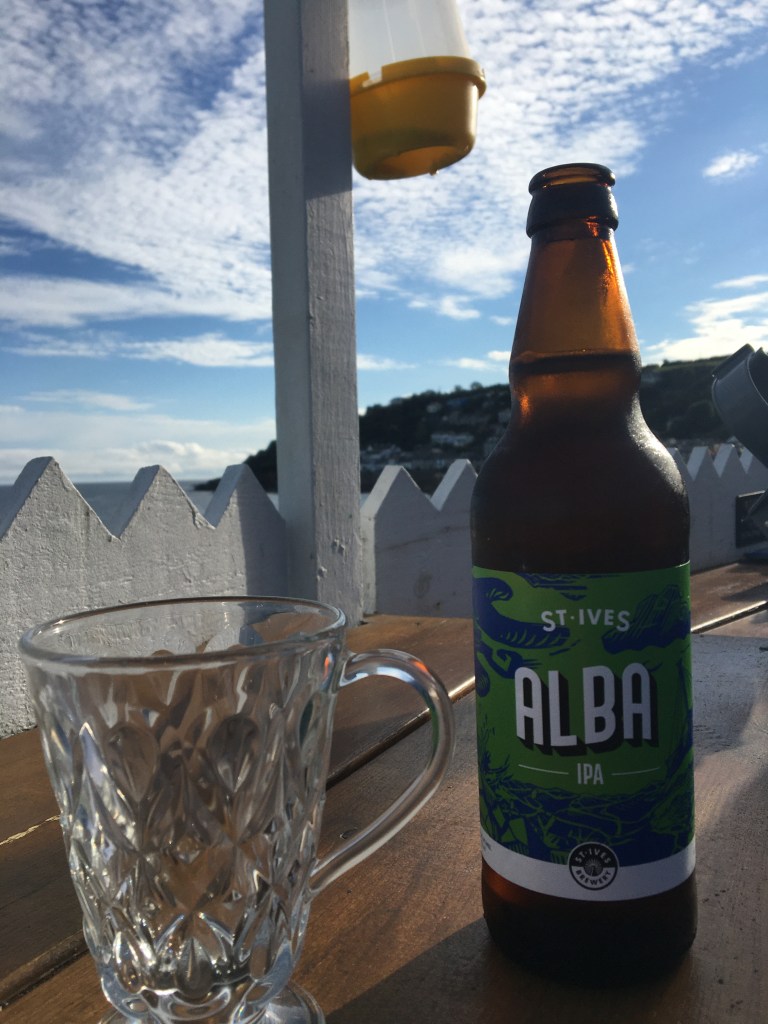
I come out and change in minutes. Up the cliff and drink a good local IPA while I look at the same island and horizon and the little boat disappears around a headland.

Sundowner at The Rock Pool Cafe, Mousehole

Tramping Diaries. SWCP – Penzance to Newlyn August 18th

Grey Penzance morning with St Michael’s Mount in the distance

Lovely to wake up in fresh sheets in a strange bed in a strange town. It’s like the first morning waking up on a holiday.

I lie staring at the ceiling thinking about the people of Penzance. A few weeks ago I heard an item on Radio 4 about how during lockdown house prices in this part of Cornwall had risen more than they had in London. A woman was speaking to the news presenter about the price of living in Penzance. ‘I grew up here, have always lived here but now myself and many like me just can’t afford to live here. I’m not sure I ever will…’

When I get up I sense something has changed overnight. The light coming through the blinds of my room is paler, weaker. I can hear the slish, slish of tyres moving slowly along wet streets.

I imagine myself waking on the path like I did yesterday morning. I would be a bedraggled caterpillar, my bright body darkened by patches of wet, my eye mask – cold and wet – stuck to my head. For all my dreamy days waking up next to the path I have to admit it’s nice to have a lie in and a hot shower.

Sky, sea, mist are a uniform grey white. St Michael’s Mount seems a ghostly outcrop like something in a dream. Boats move silently, sails furled. There is no wind. All is still. The sea is as smooth as polished stone. I feel like a figure could step out of the monastery and walk over it to meet me, me watching him all the way til we meet here on the sea wall. I slow my breathing like I have learnt to do at night when I can’t sleep. I stare out to the ocean to where it disappears at the edge.

The graceful white shape of the Scillonian glides out of Mount’s Bay ferrying passengers from Penzance to the Isles of Scilly. She is the third boat to carry the Scillonian name and made her first voyage in 1977. When I went to those islands in 2009 I went via helicopter. It went out of use a few years ago. In 2019 I crossed over in a force seven gale aboard the classic ketch, Leader. All the other passengers took to their beds while I just about stayed on my feet or my knees up on deck.

I return to the place where I left the path yesterday. It’s a bit of tarmac between the station and the sea wall. Every time this happens I have little bubbles of excitement inside me. What is it? The continuity of the path. It’s like it’s always going to be there. Like a partner for life.

It’s also the variety. Yesterday when I started it was a dusty brown line along the cliffs outside Porthleven. Today it’s a slick piece of tarmac surrounded by roads and passengers getting ready to board trains and buses.

Two ladies bob in the glassy water off the promenade. Everything is so so still. It’s like the world is holding its breath. I am walking in slow motion. Everything I look at is like a slowed down film. I take a double take. When I look at the water it could be vapour.

Still sea, Penzance to Newlyn

I amble on. There’s no rush. The road passes the protected boats harboured inside their wall. I pass big warehouses. The road turns a sharp right and the road angles along the line of the coast to Newlyn.

The triangular Jubilee Pool arrives abruptly on my left. Opened in 1935 it is now a grade 1 listed building. It’s not open yet. Young life guards arrive in their red hoodies. It’s just before 9. A young woman uses a high pressure hose to wash down the walkways.

Roger Deakin swam in it as recorded in his book about swimming around the UK, Waterlog: ‘With its dramatic ocean-liner decks, stainless steel fittings, steps and tubular railings, the Jubilee Pool is highly theatrical.’ The grey stillness heightens the sense of drama.

Stillness can sometimes be more powerful than a storm. I visited the writer Ronnie Blythe at his home, Bottengoms, this Summer. During a break in our conversation he turned to me and said simply ‘It’s so still.’ I looked out of the window and a petal fell silently off a rose. I felt like I had sunk into a trance. Roger Deakin had visited Ronnie just as I had many years before.

The Jubilee Pool, Penzance

The wide promenade that connects Penzance and Newlyn is quiet. Another sea wall marks the start of Newlyn harbour, a big fishing port.

Newlyn has traditionally been a poor town. This is what attracted members of the so called Newlyn School of artists to come here in the 1880s. This and the good light and an abundance of inexpensive models (many of them fishermen). I wonder what they thought of those ‘Down from Londons’ back then.

After another hairy journey around Lizard Point in 2014 we put in at Newlyn that evening and spent the night there. It is just as I remember it. The sound of clanking machinery as trawlers make their repairs. The strong smell of fish. Men in yellow boots hose down the floors of the long market building.

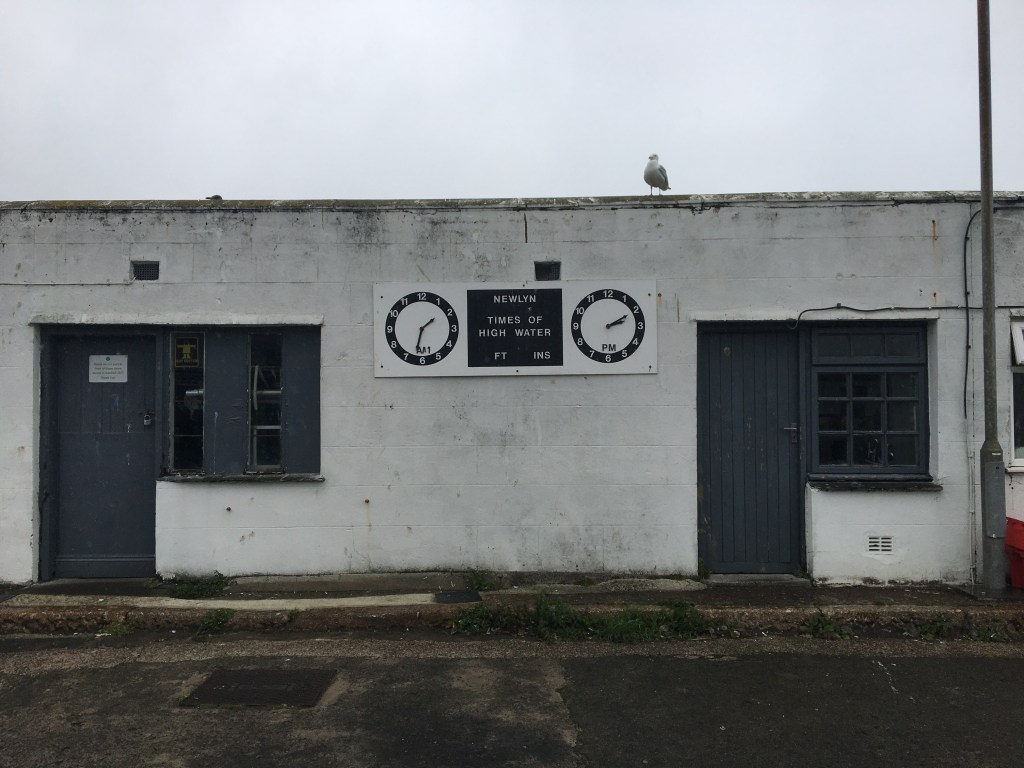
According to the Newlyn Harbour website ‘Newlyn is one of the largest fishing ports in the UK. With our strategic geographic location, we are proud to offer round-the-clock refuge to those vessels that fish the Southwest Approaches.’ The harbour master’s office displays the ‘times of high water’ on two clocks while a seagull stands guard.

The harbour master’s office, Newlyn

These things are just the same as they were on my last visit. Other parts of the town are different.

There is a quality coffee shop, a cheese and charcuterie shop and a smart looking ‘greengrocers’. Yet the chandlers and The fish shop opposite the harbour are still here too.

The Fish Shop, Newlyn

I stop here. Sometimes I just know the time is right. Waiting for the bus back to Penzance and then to get back to Porthleven I notice a sticker:

‘No more second homes!!!! Increase council tax on vacant holiday homes. Limits on Air B n Bs. Stop the destruction of Cornwall.’ Until the next time..

Bus stop, Newlyn

Tramping Diaries SWCP Porthleven to Penzance August 17th

I have that strange swirling confusion of waking up in the middle of the day. Storks of long grass nod their heads close to my face. I rub my eyes. I’ve probably been asleep 5 or 10 minutes. It’s never any longer when I sleep in the day. Strange images flutter around my consciousness like ghostly butterflies. Was dad there? I think so. He appears in my dreams more often these days. The path is between my feet again waiting patiently like a loyal dog. Oh if only I had a dog to tramp with!

The days are long when I sleep out. Is this why I keep on stopping for a snooze? Who knows and who cares? I can sleep when I want and where I want.

I have been drifting while I walk too. Long distance walking is a type of meditation. I lost a whole section before I dozed off. I do remember a father and his two teenage children stopping near where I slept. The teenagers had big rucksacks covered in orange waterproof covers. I’ve seen many coast path walkers with similar gear.

Dad did do a bit of the coast path with me: around the isle of Purbeck. We had a pint and Caribbean hot wings near Corfe Castle afterwards.

I am near Trenow Cove. I’m heading north west round Mount’s Bay. Coming up on my left is St Michael’s Mount, the tidal island and monastery. It’s the brother monastery to Mont Saint-Michel and is a similar shape but smaller.

According to Wikipedia ‘Edward the Confessor gifted the site to the Benedictine order of Mont Saint-Michel’. It would have been sometime before 1066 but many historians now dispute this.

I would love to go but I know it’ll be teeming today and I need to get beyond Penzance before nightfall.

Soon after I am walking up a hill to the road into Marazion. As I go through a gate I spot the father and kids again.

‘Good sleep?’ he says to me with a big smile.

‘Lovely thanks.’

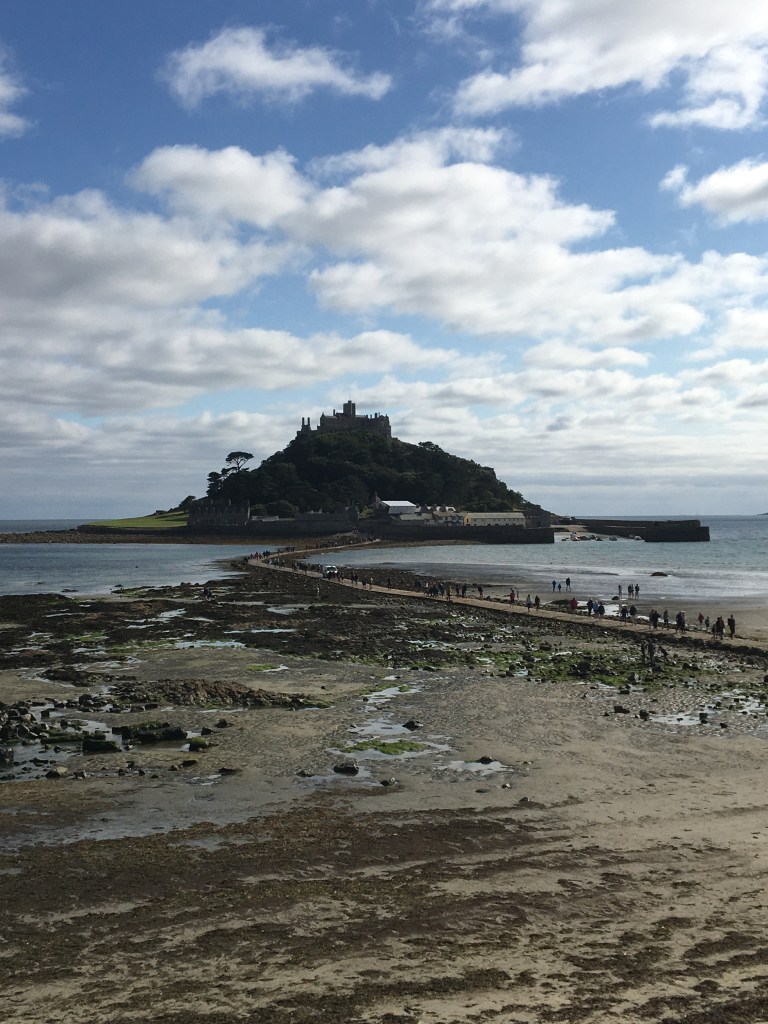
Marazion is heaving. I need energy so I stop at the pub and have a cream tea. The causeway across to St Michael’s Mount is visible. It’s low tide. People are streaming across. I can see the silhouette of the hill leading steeply to the entrance of the monastery. A line of matchstick people wait along the spine of the hill. Definitely move on.

St Michael’s Mount at low tide

From Marazion a huge expanse of beach curves at least 3 or 4 miles round to Penzance. The sun shines hard on the sea surface creating the dazzle of sea glitter. A road and rail track both follow the great crescent of sand around the bay. The dark green train that has arrived from London Paddington is just pulling in to its final stop. This is the end of the line and almost the end of the land.
I must have walked at least sixteen or seventeen miles today. I don’t feel sore but I have the stiffness and mental tiredness that comes from being out all day in the sea air and not having had much sleep the night before.

When I arrive in Penzance it is after 7. I had planned to walk out of town again tonight so I could sleep out but after dinner I realise it’s getting too late. Everywhere is fully booked but a few roads up from the station a white sign says ‘vacancies’. I manage to get a double for sixty pounds. For once I’m really grateful.

Tramping Diaries SWCP Praa Sands and Prussia Cove August 17th

I’m looking over the golden crescent that is Praa Sands. The backdrop of sky and sea is grey. The air feels cool for the time of year. People seem to have tried to stay loyal to their Summer wardrobe – shorts, blouses, flip flops – while at the same time having to add to it: fleeces, jeans, hoodies. It’s coming up to 11 and the beach has come to life in the last half hour. Colourful Windbreaks are being knocked into the sand, SUP boards are being inflated. There are ball games, buckets and spades and dogs barking.

Although we don’t want to admit it it does look and feel like October. Not at all like last Summer where the sun just seemed to shine everyday. Even back in the tumultuous early days of the first lockdown it was warm. It started in March and just seemed to keep going unabated into September. Not so this year.

I’m outside the Sandbar restaurant next to the beach. I just had breakfast next to a famous comedian and TV celebrity who was having breakfast with his girlfriend. A family are busy chatting and getting ready to hit the beach. The son turns to the father:

‘Did the beach look the same then?’

‘I don’t know. I was very young.’

The mother chats enthusiastically to a friend about what it’s like to have Long Covid.

It’s one of those regular occasions where I dip into the crowds. I enjoy the sense of people around me and listening to their holiday chatter. I like the way people chat so normally to young children and to their dogs too. Then I am ready to leave them all behind and be alone once more.

The beach is soon behind me and below me. The land is like a giant scythe with the beach the blade resting on a field of blue.

Praa Sands from the west

Often when I look back along the coast path, I try to remember where came before this. I think back to the cliffs on the west of the Lizard, Church Cove and Poldhu, Mullion and Lizard Point. I try and remember where I was before that and I struggle. I remember in Dorset for a long time I could look back and be reminded of the places I’d been: Golden Cap, Burton Bradstock and West Bay. Then round Portland Bill and up Chesil Beach. My memories often seem to be muddled or wiped out altogether.

I continue around Hoe Point to the small beach of Kenneggy Sands and onto the little inlets of Prussia Cove. I read an article recently in Discover Wildlife Magazine titled ‘Most Spectacular Snorkelling Sites in the UK.’

‘Prussia Cove is a beautiful,tranquil bay with a glorious backdrop and knockout snorkelling….swim straight out to sea until you hit sand. In front of you is a submerged, ridged island. On the Far East side, cork wing wrasse build nests in spring.’

If only I’d made a note before I got here! Still I join the kids jumping off the rocks into the blue. The water is clear and cold.

Prussia Cove

Once around Cudden Point (where I see an elderly couple swim several hundred metres out to sea) the path follows a big sweep around Mount’s Bay. West across the bay from here is Mousehole and north of that Newlyn and Penzance. I should get there tomorrow.

Coast path leading to Cudden Point

Tramping Diaries SWCP Porthleven Dawn August 16th

Dawn over The Lizard

The worm wakes.

These moments never fail to surprise me. The ocean is at my feet, whispering softly on the rocks. What Roger Deakin called ‘the whispering white line’ where the sea meets the land. It sounds like deep breathing, like someone sleeping.

Dawn creeps up over the line of the Lizard that recedes away to the left hand horizon. One grey line on top of a lighter grey line. A leaden sky appears to reflect the dark grey of the sea below it. The light is pale and still weak at this hour. Like everything else, it hasn’t quite got going yet. Yet it makes the grass that surrounds me glow like wheat.

My eyes are only half open. My face is the only thing recognisably human about my form. It peeks out from the hood of the sleeping bag. My body is a black and orange tube. My grey eye mask is stuck to my forehead. A seagull swerves sideways over the cliff and eyes me suspiciously.

I am as still as a corpse, staring, staring at the sea and the infinite ripples and lines and wavelets that meet and intersect on and on to the horizon. It’s early, probably around 6. Something about the light tells me so.

The path is between the sea and me, a brown line cutting left to right, east to west. The breeze is soft on my face. I feel like I could be the last person on earth.

What a way to wake. Give me this over any five star hotel. I certainly wouldn’t have a view that could compare to this. I’m living in it not just looking at it. All right, when it rains I have to take off my rose tinted spectacles but even those dawns have their own soggy charm.

I take a simple pleasure in getting up and being ready to go in 10 minutes. I brush my teeth with water from my battered Sigg water bottle. It’s been dropped so many times it’s covered in dents and dimples. I rather like its travel worn look. I should get another as I’ve realised one isn’t enough for these long, often remote walks.

It’s so easy. The pack is back on my back and the path is there at my feet. The only constant. The line which I follow west, that I’ve been following for over 5 years. ‘I Walk the line.’ I walk til it’s time to eat, then sleep, wake up and do it again. On and on into a trance where all is reduced to the path, the sea, my feet and my breath. Breathe with the sea. Walk with the light. And keep going.