SWCP. Zennor February 14th 2023

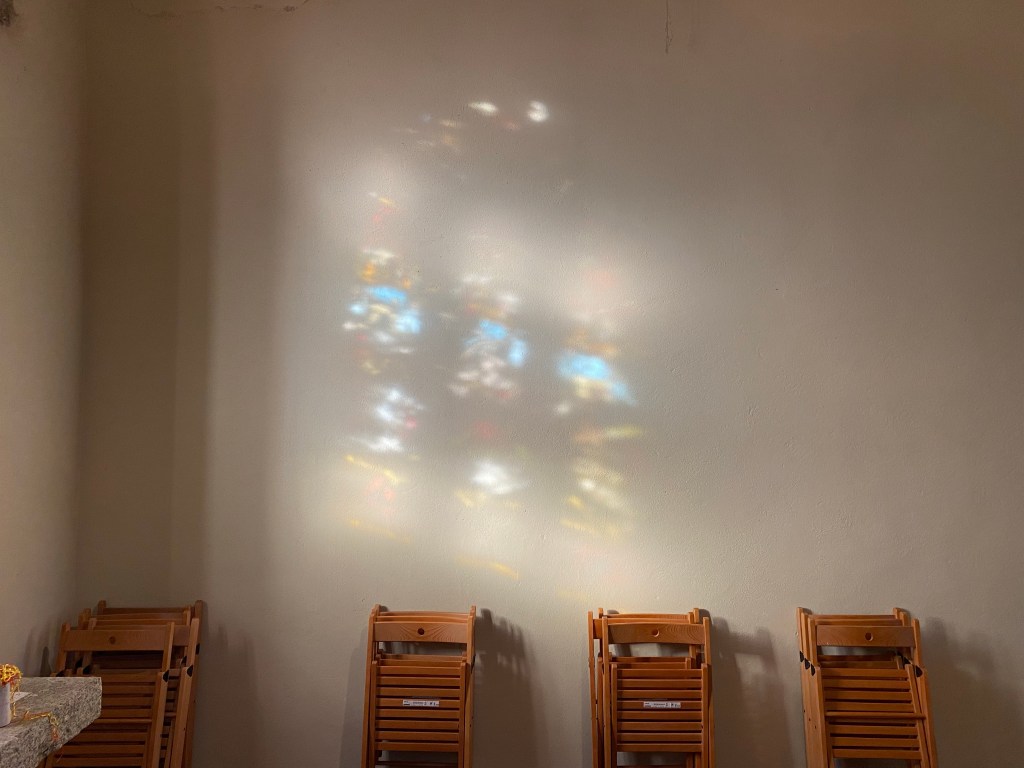
The south window and altar, Zennor Church

I leave Zennor on a road that turns into a track that turns into a path. The sun is out and revealing the brown and green coat of the land and the grey rocks that people every part of this landscape. My step and mood are lighter today. What a difference a day can make.

I think back to Zennor church which I left behind half an hour ago. This would have been the path where Matthew and Morveren the mermaid supposedly ran away to live together beneath the waves at Pendour Cave. But now I’m thinking of another story.

In the side of the nave of the church was an altar where the sun shone its light through stained glass saints forming patches of pale colour on the wall. On the altar were flowers and prayers from primary school children on little bits of paper. They prayed for what they felt was important to them. One prayed that he would get the back seat on the bus for a whole week.
On the right of these notes was what looked like a letter with smaller neater writing. It was a handwritten prayer which read:

‘O Lord, I pray for this baby that is in my belly now to be healthy, full of love and light in his heart, mind and soul. He’s not a mistake. I know he’s meant to be here as you my lord has predicted this and send him to me, so that my life can change a shift in the right direction. O Lord. I pray that his dad will be blessed for his life on this earth. Even though I only have met his dad twice, but knowing from distance for years (4 years). I listened and follow my heart, follow the sign, and I trust that I am here in the UK for a reason to meet this man Matthew and to conceive this baby.’

Something about this letter reminded me of a Thomas Hardy story. It has so much sadness and drama in so few lines and themes that permeate human existence: birth, life, death, guilt, renewal.

And there is that name again. Matthew. Matthew the disciple, Matthew the choir boy who fell in love with a beautiful mermaid and left his world behind to be with her and Matthew the dead father who only met his foreign lover twice and will never meet his son.

What did Ronnie Blythe say to me? ‘Churches are full of treasures.’ How right he was. Although I expect he meant something a bit different.

At Zennor Head I look for the mermaid in the emerald depths of Pendour Cove. No joy. Ahead of me the sea proper is hard blue, rippling and flecked all over with spots of white that appear and reappear every second all the way to the horizon.

I can see Gurnard’s Head which I went round in October half term after the voyage on Mascotte. Beyond that I can see Pendeen Watch with its white lighthouse and beyond that the foam forming around the rocks known as Three Stone Oar. It was the end of the summer, the time of mourning after the Queen’s death. How slow I am and how time flies. Before I know it a whole year will have gone and I’ll only be at the next headland! Time to move on..

Pendour Cove and Gurnard’s Head

Curry Rivel March 14th

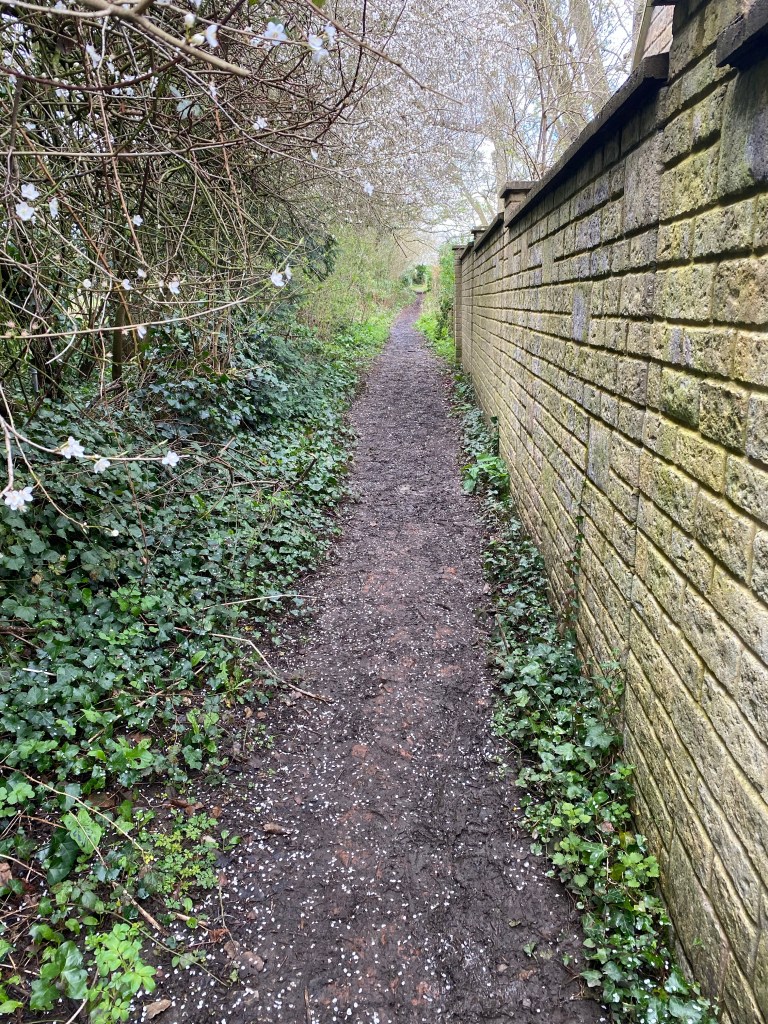
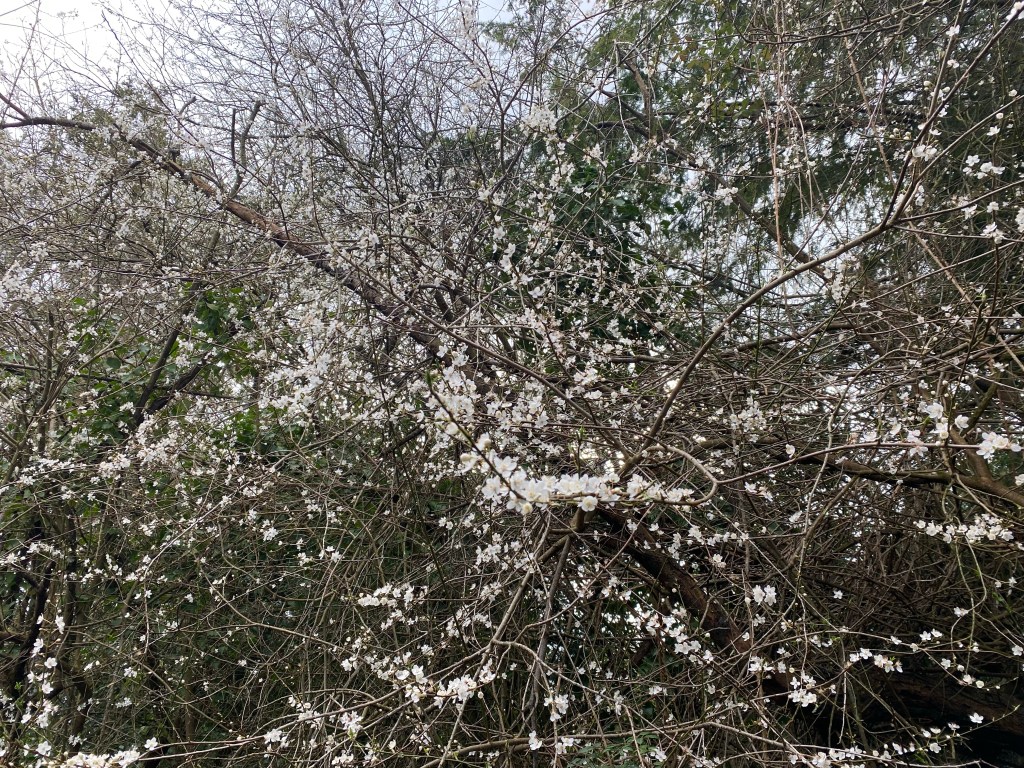
The rooks are raucous today in the trees opposite the farm. I can hear their constant squawking all the way up the path past the tennis court and to the top field. The hawthorn trees along Holden’s Way are suddenly snowy now with their little star shaped flowers. Their petals dot the path like confetti.

White dotted mud on Holden’s Way

The wind whispers through the bare branches of the oak trees at May Tree House. It still feels icy even though daffodils are now well and truly out. Great masses of cloud move to the south forming, overlapping and reforming with each other.

I’ve left Andy, a quiet man from Bridgwater, to fit the smart meter at the cottage. I last saw him in his van puffing on his umpteenth rollie of the morning.

The entry I’ve just read in ‘Next to Nature’ Ronnie describes a day in March when spring suddenly bursts forth at Bottengoms. It’s often the birds who herald it. ‘There was an exultant calling from bare trees’ is how Ronnie puts it. We’re not there yet. When, I wonder. I long for that day like waiting for a long lost lover to return from a place far from home.

The telegraph poles are in their perpetual march in single file west over the hill towards the sunlit Blackdowns. I always imagine them linking in a line all the way west down to Land’s End although I expect they peter out somewhere over the hill.

I pass a woman listening to a pop tune on her phone who has to keep on calling for Henry who is lagging behind sniffing about on the side of the field. He is a wiry terrier of some kind. He sniffs me briefly and then decides to catch her up.

Windmill Cottage

I can see Jane’s gardener hunched over in her front lawn at Windmill Cotrage. He’s significantly younger than her but still must be approaching eighty. What do I know about age? Or any of us for that matter. It’s just something that happens to us. When spring arrives or really feels like it it will be me that sings exultantly from the bare trees and I hope to record it here.

SWCP – Zennor. February 13th.

It’s February half term and I’m back in Cornwall, back on the coast path. I’m staying at The Tinners Arms pub in Zennor in a little room next to a dead end lane which looks directly onto the small, squat tower of the church and an ancient wall made of great blocks of granite so overgrown that it appears to be half wall, half hedge.

Zennor Church and The Tinners Arms

With boyish excitement I realise that this will be the first time I will be using the Ordnance Survey map app to guide me around the Cornish coast.

There was an item on the radio earlier about the OS map app as I drove along the M5 through Devon. They were talking about how or what to update. A woman from Bristol who leads hiking groups for women was saying how they should mark places that are at risk of flooding – very much something of our times. She also hoped that it would tell you what sort of fields you’re walking through. The man from Ordnance Survey was saying they make thousands of updates everyday.

Of course the best thing about it is that you can always see where you are and even what direction you’re facing with the help of the little red arrow. I’ve lost count of the amount of times I’ve had to try to work out my position on paper maps by looking at landmarks around me or roads or paths and then trying to relate this to the map. This is a great skill in itself – orientation – and I wonder if it’s something that I and we might lose the ability to do.

At the cottage in Somerset I have a box with a stack of the iconic pink Landranger maps that have covered all the parts of the coast path I’ve walked so far: ‘Taunton and Lyme Regis’ – falling apart from so much use; ‘Dorchester and Weymouth’ – some of the most beautiful countryside I can imagine and Thomas Hardy’s homeland; ‘Exeter and Sidmouth’ – the hill climbing up to Sidmouth was one of the steepest and most strenuous I can remember but with a heart stopping view of the coast stretching miles and miles to the east; ‘Plymouth and Launceston’ – full of reminders and memories of that crazy year I lived by the sea and slogged away at my teacher training; ‘Land’s End and The Isles of Scilly’ – the end of the land, bleak and dramatic.

On those worn pages in green ink I have charted my tramps each time noting the date and where I started and ended each section. It’s my own journey with my own points of reference put on top of the markers that are already there. Sometimes there is a brief note ‘swim’ or ‘slept here’ so that I can revisit it one day and remember. An app can’t record my journey like this – even if I do so here – so I make a mental note that I must still chart my journey with green ink on paper maps even if I’m now mapping my route electronically.

I am reading Ronnie Blythe’s last book ‘Next to Nature’ at the moment. I read like I walk: slowly. And I follow it as he records life at Bottengoms Farm, his home from 1977 until he died there in January and the inspiration for much of his writing. The book is set out chronologically month by month starting in January and ending in December. And I keep time reading January in January, February in February and so on. Yes, it takes me a month to read a chapter.

In ‘map-readings’ Ronnie says how reading a map when ‘one is still is sheer happiness.’ He empties his old OS maps onto his table – that ancient old table always piled with books – and welcomes them warmly as he did with anyone who cared to visit him.

‘The maps, young and ancient, slither on to the table. What dear, crumpled old friends..The magic when these are spread out, the endlessness of places!’

Oh yes, how right you are, Ronnie, and how your eye sees or saw so many things in that extraordinarily perceptive way of yours. I went to see him six times in the last two years before he died. I wish I’d known him earlier in his life but how invaluable those meetings were and when he finally departed in January I realised that there was something truly great about him that defies description. In another era he might have been a saint.

On the way from Zennor to Carnelloe it is blowy and cold. I can feel it in my fingers. I don’t think I’ve walked the coast path this early in the year before.

At Carnelloe a stream rushes past a tall bush of bamboo. One light intermittent rush of noise above a deeper, richer and more constant rush of noise. Shhhhhhhh. It could induce a trance. Gorse is flowering everywhere although most other plants seem cloaked in the brown of winter.

I can’t find the path at Carnelloe. The little red arrow goes back and forth turning back inland and then returning towards the sea again. The path forks further west than it says it does on the map. Bullocks chase each other through fields above Porthglaze cove. There is no one else here. There is an intense beauty at play over Gurnard’s Head but the enormous age of the land around me – its permanence and my impernanence – suddenly makes me shudder.

My father used to say there was something frightening about the Cornish landscape. This from a man who never said he was scared of anything. But today I feel that too. I walk another mile or two and then turn back inland for a hot shower and a pint of Tinners Arms ale.

Gurnard’s Head

SWCP Zennor February 14th

Zennor as seen by the Ordnance Survey app

I woke in the middle of the night, got dressed and let myself out of the old building attached to the pub. There was a wind whipping the ivy on the granite wall just outside my bedroom window. Behind it the squat block of Zennor church was silhouetted against the sky; stars burned above it all. The wind makes a consistent low moan as it passed from the west, from over the miles and miles of ocean out there, over Land’s End and over this low cluster of buildings amongst the rocks and heather. Once again I felt that vertiginous sense of deep time around me.

When I wake it’s cold but sunny and the wind has dropped. How the world is transformed between night and day.

It seems apt to be visiting Zennor church on Valentine’s Day to see the place where the story of the Zennor mermaid was born. This is the legend of the mermaid who seduced Matthew Trewelha, a local boy with a beautiful singing voice who sang in the choir at the church.

One version of the story tells how a beautiful woman would come to evensong to hear Matthew sing. It was the mermaid, Morveren, dressed as a woman. As she listened she let out a sigh and he saw her and instantly fell in love with her and she with him. It’s told that she was frightened being on land and made her way with him back to the sea at Pendour Cove (the nearest cove just north west of the village). On the way back her coat got tangled revealing the tip of her tail. It was then that he knew. She turned and told him:

“I cannot stay. I am a sea creature, and must go back where I belong.”
But it didn’t matter to him.
“Then I will go with ye. For with ye is where I belong.”

And they were never seen again. What a story! I’m with Matthew – I could easily be seduced by a pretty face and the immense romance of the sea.

Inside the church is a 400 year old chair with the Zennor mermaid carved into its side. She is holding up a comb and a mirror. Unfortunately her beauty is obscured as her face is no longer there. It reminds me of the many faceless angels I’ve seen in churches all over England defaced by Cromwell’s men.

Someone has created a well replicated wood carving of her with her beauty intact. It’s on the wall at the end of the one room in the Tinners Arms. Last night, as the wind groaned outside, I sat there transfixed watching her holding her comb and mirror, her tail curled, while the fire flickered in the grate.

The mermaid chair, Zennor church
The Zennor mermaid carved into the side of the chair

Curry Rivel February 7th

It’s below freezing once again outside the cottage. I had an extra blanket, a hot water bottle and socks on in bed last night. The heads of the hydrangea outside the front door are brown and sagging while underneath them the heads of snowdrops bow in unison offering some hope of new life amongst the decay.

Fog is thick in the meadows, the trees and hedgerows smothering everything and confusing the mind but exciting it too with the way it changes everything. We are hidden.

I’m walking to see Jane in the top field up Holden’s Way.

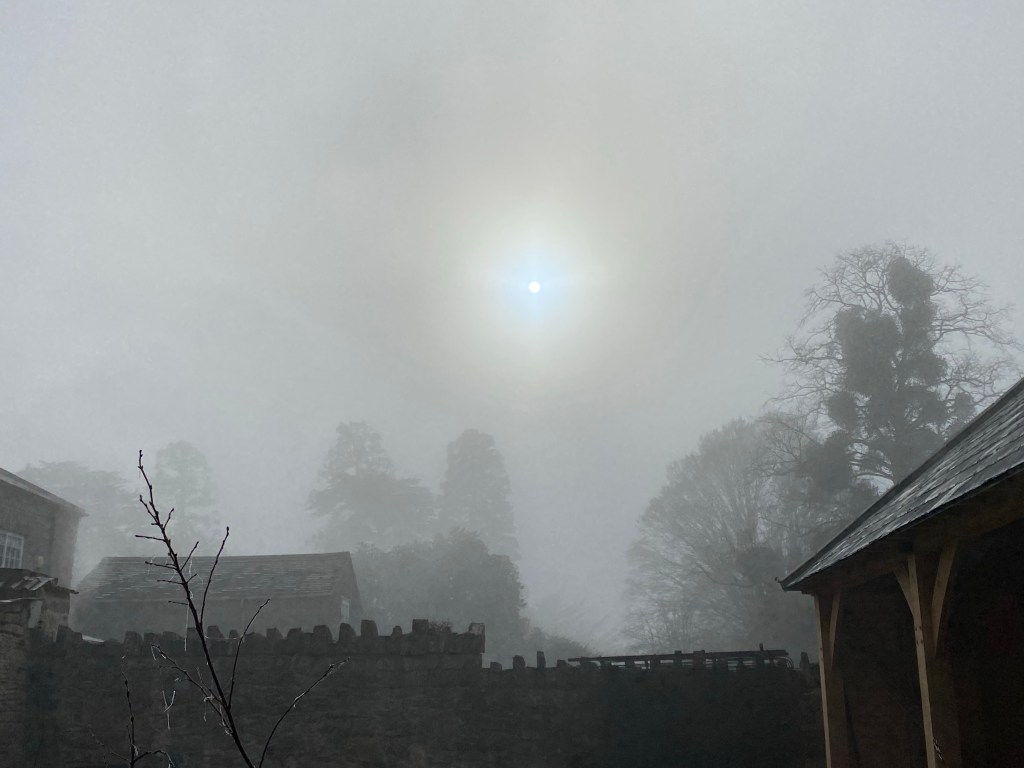
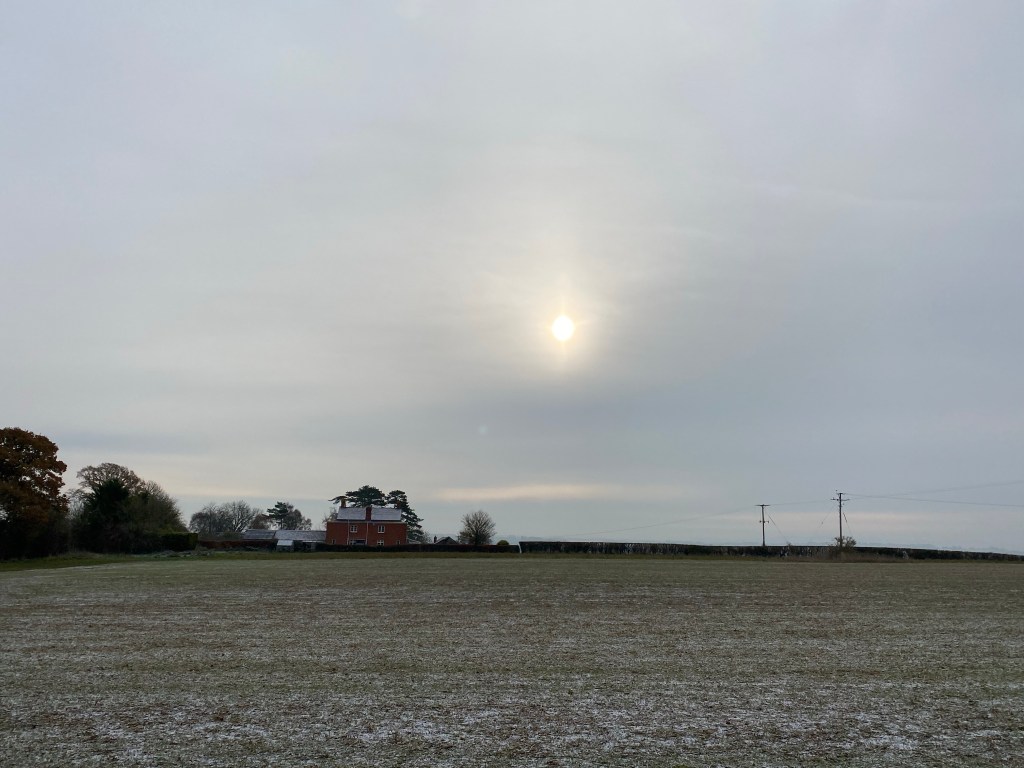
The sun endeavours to make an appearance but is a pale sphere behind the scenes seemingly drained of its strength. Everything is very still. There isn’t even birdsong. What do they do in this cold? Puff out their chests and hope for the best. I make a note to buy bird feeders. I know many of the smaller ones die if the cold lasts for days on end. Droplets of water tiptap onto leaves. The world seems frozen.

Sun over wellingtonias at Wiltown House

Outside Wiltown House is one of the biggest cobwebs I’ve ever seen dropping from a branch. For a second I wonder if it’s man made – a bit of nylon abandoned on a tree. It could be a scene from a hammer horror. Is there a figure in that window part of me wonders.

Cobweb and Fog over Wiltown House

With the world shrouded sounds become more acute. A woodpecker’s knocking echoes somewhere across a field, reverberating sharply through the fog. I hear the brief hoot and shhhh of the Penzance to London train as it rushes across Sedgemoor. It fades to nothingness after a few seconds.

At the back of Jane’s house everything is blanketed.

Jane looks great. She is 92 and has lived at Windmill Cottage for 33 years. We sit in her conservatory looking over the field I must have walked around hundreds of times.

The base of the windmill is just beside us, the stones still rising in a great ring overgrown with weeds some three or four feet above the ground. Much of the local grain would be brought here to be ground into flour back in the day.

Jane looks away from me and casts her mind back to the past. We talk about my grandfather’s famous birthday parties where there was a lot of drinking and the men would stand around the piano and sing. I remember it, trying to go to sleep in the little bed with a floral pattern eiderdown and the creaky headboard wide awake smelling the richness of cigarette smoke and hearing the deep voices of farmers and land agents bellowing out rugby songs.

Her and Anthony were much younger than most of the other couples in Wiltown, the little Hamlet on the outskirts of Curry Rivel. They would play tennis with the Furnesses at Wiltown House. ‘They were a strange couple.’ I never found out why. She says how all the men wore long trousers when playing tennis.

When Mrs Furness died she didn’t want a funeral. Instead they processed her coffin around the garden at Wiltown House while her husband gave a long eulogy pointing out her favourite tree and other things that she was fond of.

At Windmill Cottage daffodils are appearing along the drive. Two hours have past and the fog is still heavy on the land; the low roar of the train comes and goes again this time going west down to Penzance.

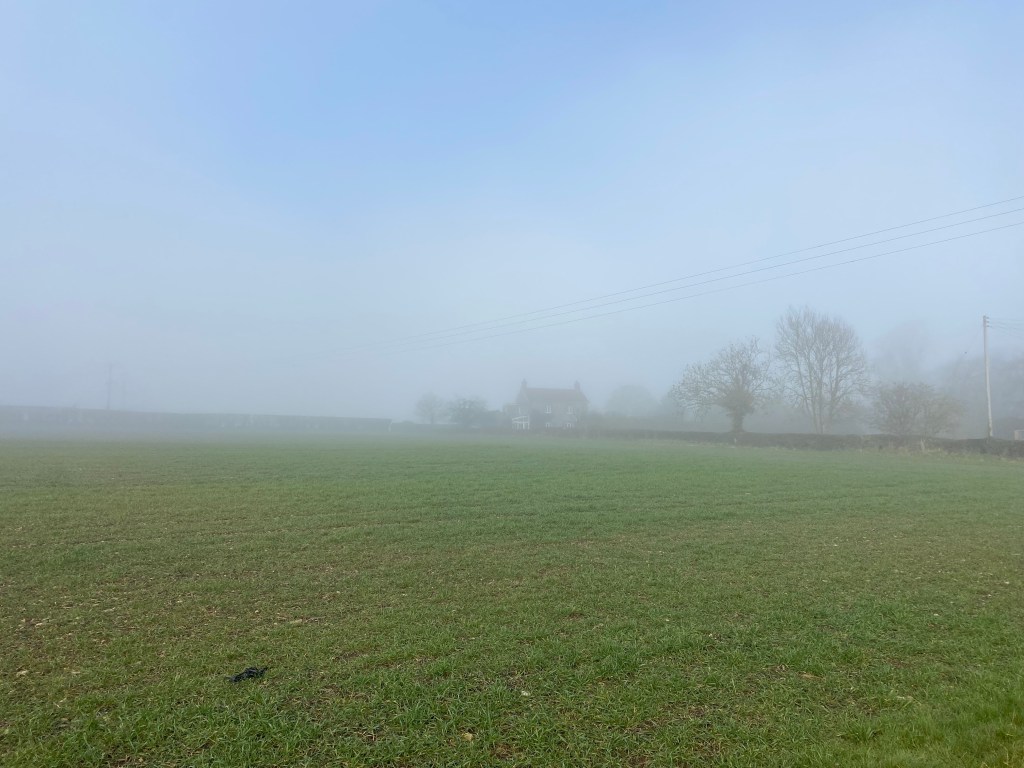
The sun is still white and pale but half of the sky is now a milky blue and forms start to become more distinct appearing like ghostly apparitions.

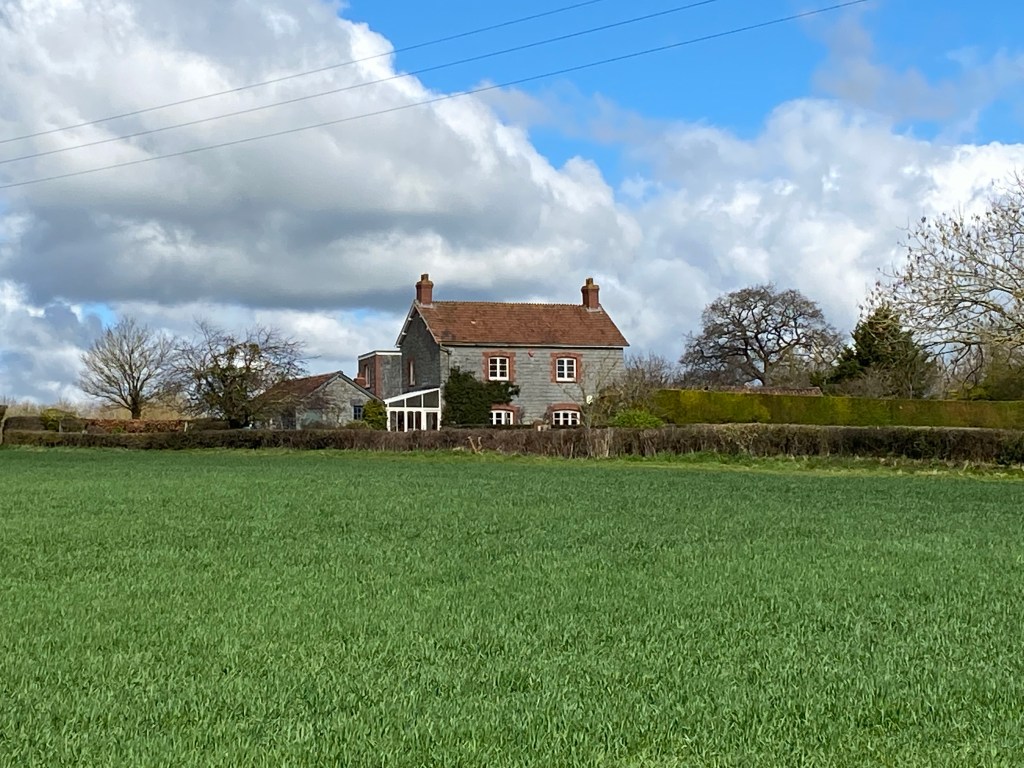
Windmill Cottage and one of the Langs’ fields.

Jane tells me how these two fields are two of the worst in terms of its soil. Her late husband’s fields, her son’s fields and now her grandson’s fields. They have poor soil and many stones. Jane’s son has always left wide margins on those fields which allows for the growing of wildflowers. She says how she used to use it to ride her Welsh cobbs that she once kept at Windmill Cottage.

As I turn northwards towards the monument at Burton Pynsent, my shadow appears miraculously below me and the field is unveiled and the sky too – great masses of cloud like continents on the ocean – moving slowly west.

The vapour starts to shift. Houses, trees, hedges that didn’t exist a minute ago are now back in their usual places.

Crows caw. The droplets on blades of grass shiver. And a great stillness presides over everything.

The Slow Walker – Muchelney January 7th

As I arrive at the bridge over the River Parrett at Muchelney the near world transforms. The sky and abundant water are granite grey while lines of greens and oranges of the grass and plants are thrown into vivid detail and shocking brightness by the sudden emergence of the sun. The colours are saturated; they are absurdly bright. Seagulls are white handkerchiefs fluttering over the abbey. I stand stock still trying to adjust to the change in my consciousness like being in the grip of a strong hallucinogenic. Moments later the light is turned off, the world is returned to neutral tones and I’m left staring at the watery fields in a bit of a daze.

River Parrett and moors west of Muchelney Abbey

At this time of year down here the water gets everywhere. In winter it’s as profuse as the land it smothers. Roger Deakin, who wrote beautifully about water, observed how on the Somerset Levels ‘Every village here has a Frog Lane, and a sign that says ‘Road liable to flooding’.

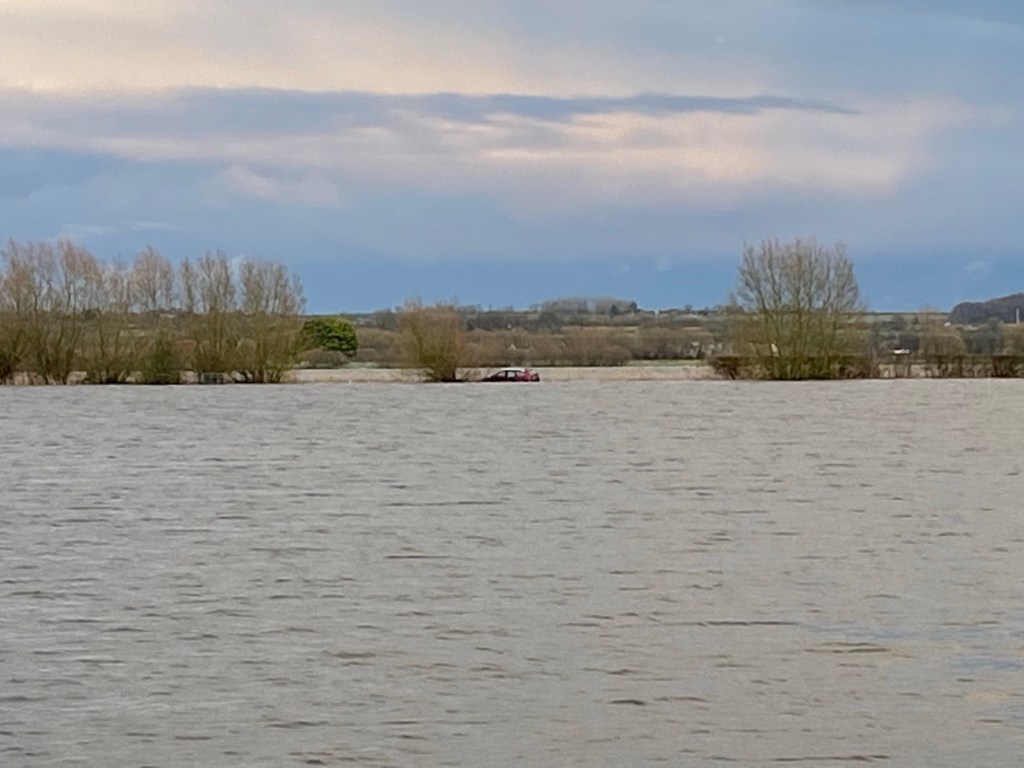
The water confuses the mind’s eye. Fields are now lakes. Raised land become islands or long spits. Roads are drains, the trees or hedgerows the only thing to mark them out as ways. It’s hard to distinguish waterway from meadow. In the middle distance a half submerged car is nestled in between a line of willows that marks the road between Muchelney and Langport.

Abandoned car on the Muchelney to Langport road

Sea birds come in their hundreds and bob about making their peeping and clicking and wheezing calls and I imagine I could be in a coastal town or village.

It’s beautiful yet chaotic. Roads are closed. Houses and communities become stranded. In January 2014 Muchelney made the national and international news when it became cut off for days on end after storms battered the UK over Christmas and new year.

Many houses were flooded and an RNLI boat was the only way in or out. I remember local residents on the news berating a representative from The Environment Agency because the dredging of the waterways had been neglected in the interests of conservation and this had exacerbated the extent of the flooding. Thousands of acres of the Somerset levels remained underwater for all of January. Several people lost their lives.

For hundreds of years people have been trying to drain these low lying lands. I walk south along the river across Thorney Moor to Midelney. ‘Ey’ is old English for island, thus Thorney, Midelney, Muchelney and, of course, Athelney where King Alfred hid from the Vikings a few miles north of here and, as legend has it, burnt the cakes of the woman whose house he was sheltering in because he was so preoccupied with planning on how to defeat the invaders. He eventually did.

A kingfisher flies low and straight over the river like a blue dart. Seagulls fuss up into the air and then settle again on the standing water briefly making dissatisfied squawking sounds before returning to a sense of calm.

Snowy blobs could be buoys or puffballs until one transforms itself, its wings splayed and a long neck uncurls itself and points up to the sky. Swans. Forty or fifty of them. Thorney Moor is one sheet of water, their trees and telegraph poles the only indication that this isn’t normal. Although of course it is. This land has carried water since before the memories of man. As Edward Thomas put it ‘when gods were young’.

The river suddenly bends – like a swan’s neck. Now I’m heading west towards Curry Rivel, the tower on the skyline beyond the river is the same one the boys forced a cow up back in the day, making it stagger up the circular staircase to the top where it stood surveying Sedgemoor from eighty feet above the ground. It’s the same tower where my grandfather, as a young man, was made to walk around the ledge at the top by his elder brothers.

River Parrett and moors

Egrets are also here, one walking in its lanky, cautious manner like a tall school master. Egrets are members of the heron family which were traditionally compared to priests.

It’s getting dark. A huge mass of grey is looming from the west. I imagine myself soon to be drenched by it in the dark. My heart beats faster. I can only give in to it.

Grey ground. Grey sky.

Twenty minutes later I’m in it. Pock, pock, pock on my waterproof. It feels almost like night but then the sky gets lighter again. Once I’ve given into it who cares? Darkness and wetness can’t hurt you. Walking after dark is the ultimate rebellion. I think of might walking at boarding school. Night walking – not intentionally- on Rasol Pass in the Himalayas. Waking the coast path at night. If walking alone in the wilds is a thrill then that thrill is doubled at night.

Weather front passing over Muchelney

The first star appears in the dirty blue orange of the western sky. Pulsing. Blinking. Is it Venus? I think so. For a brief time I think I might be lost until I see headlights lighting up the lane between Muchelney and Curry Rivel.

As I come back to the bridge at Muchelney the full moon rises out of the great blanket of cloud that has just passed over me. To its right is the silhouette of Muchelney church. There are myriad lines of moon glitter on the flooded field and in the narrow line of white light a submerged gateway. I stand at the bridge watching the swirls and sloshing and feel the great weight of the water beneath me before I turn and head for home.

Moonlight on the moors at Muchelney

Night Walks Clifton December 15th

It is minus 2 and going to drop to minus 6 later tonight. It’s clear and the stars flicker at me up above. Am I feeling Christmasy yet? Well I haven’t done any shopping yet but that’s normal.

The roofs of the cars glitter on Pembroke Road. Ice meanders across a bonnet like the metal has been melted.

Apart from the cars slicking up Pembroke Road to The Downs it’s very quiet. It must be the cold. Perhaps I should have gone into the village to find the Christmas feel.

Piper’s glasswork holds a low glow; it’s warm in the iciness.

All Saint’s Church windows

Past the Randall Room which is in the side of All Saints Church. The door is open and there’s a lit hallway within. I remember walking past a group of people here I started talking to once all having a fag outside, when I asked they told me they were an AA group. ‘If you’re a journalist you should join us’ one of them joked.

Further down Alma Vale Road the plane tree opposite The Alma has almost lost all of its leaves and stands silent and erect. When I open the grand double doors to the pub, I’m greeted by a blast of warm air and the excited murmur of people into their second, third or fourth drink of the night. It feels like Christmas.

Groups of students sit next to tables of old couples. A mountain of a man with a black shirt and long yellow tie that falls to below his belt downs a pint of something dark and points the glass at the bargirl to indicate his need for another.

The back room is full of tables with eight or ten people eating and wearing different coloured paper crowns. The uniform of the office Christmas party.

I enjoy watching the red faces who arrive with a cold gust, their faces showing the simple pleasure of finding warmth after cold.

The Alma Tavern

On the way home there are loads of young people pouring out of Alma Chutch. Very different from church congregations in Somerset. A star watches over them from the window as the last of them leave. It’s time for home and bed.

Curry Rivel December 13th

Minus temperatures outside and the finest dusting of snow in the garden, on the walls and my newly made log pile. When I look at the sky it reminds me of Ronnie Blythe’s line ‘the clouds are full of it.’ It’s got that dirty grey colour to it while the sun is a pale presence struggling to push through.

It’s very still.

Blackbirds fuss about on walls their heads and tails twitching. Great bursts of mistletoe are in the trees. I need to find a bundle to take back to mum for Christmas. I used to get it from the apple orchard where the parasitic plant seems to like apple trees. Perhaps that’s why it’s so much more prolific in Somerset than in Suffolk. Yet, there wasn’t enough last year and it needs to have enough berries and leaves that aren’t too yellow. In Scandinavia in ancient times even enemies had to greet each other underneath it. It was considered a symbol of fertility.

The Hawkins brothers are coming to empty the barn today of some of the stuff that’s been in there for years. A fridge, a bed, an armchair. Much of it is left over from when I moved out after breaking off my engagement eight years ago. Where does the time go?

I say hello to a woman with a black and white lurcher and a handful of evergreen that looks like it might be for a wreath. She was the same person who came to the door asking for someone called Robin two weeks ago. I remember then she also had her hands full of green leaves like a Mayday reveller of old and the same dog waiting patiently beside her.

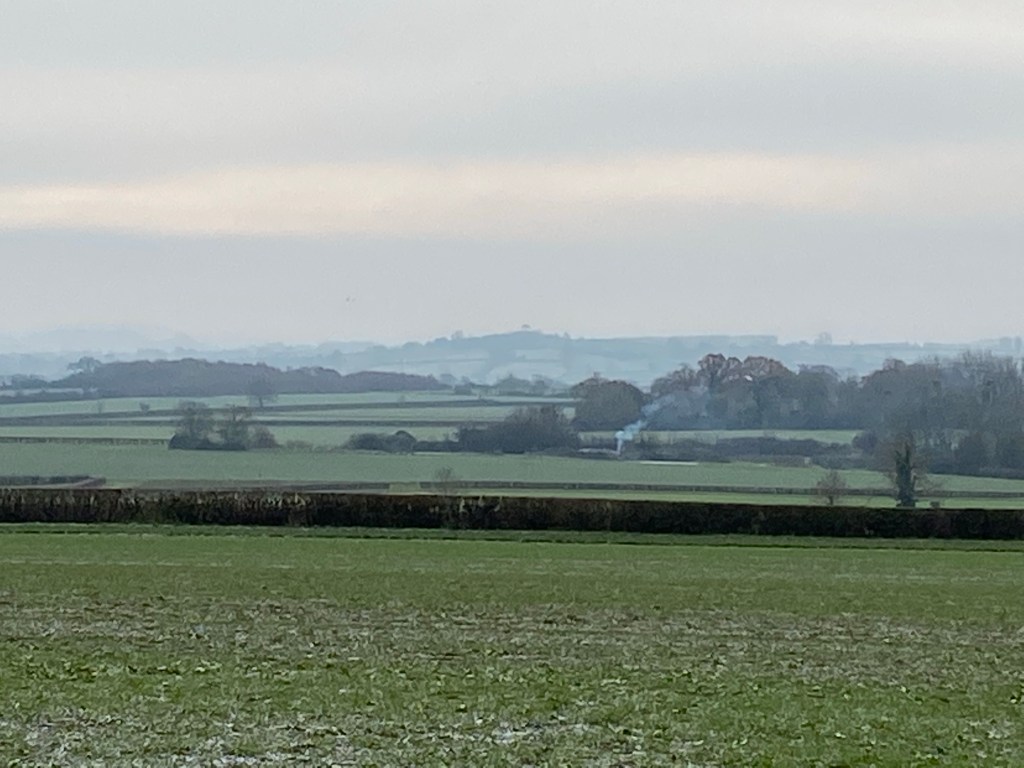
To the south the greens of the fields are muted and Burrow hill is grey and hazy. The darkness of the solitary sycamore that stands atop it only just visible.

A thin column of smoke is dribbling into the sky. Christmas is less than two weeks away. And I’m not quite feeling it yet.

Fields leading to Burrow Hill

Curry Rivel December 7th

The day is clear, cold and bright.

Marie drops off a truck load of wood from Wiltown Farm and we talk about the cold and the rising price of everything including the wood. She has three hundred sheep now. The price of a lamb has gone up from £70 to £150 but so has the feed so she informs me.

‘People just jump on the bandwagon.’

So after a morning writing about the cost of living for Bristol Somalis I’m out and down Furlong Lane where my father proposed to my mother on a walk in 1969. The sheep are in the field overlooking the cricket pitch just as they would have been then, their wool coats huge and round so they look like rolled up shagpiles with dainty legs and each one breathing a plume of vapour while they stand and chew.

Down to the T and down the wiggling lane where the water always seems to gurgle in the brook beside the lane. I walked down this lane to go back to the brother of one of my closest friends the day after his funeral in January. That was a cold bright day like this one. Tomorrow will be the anniversary of his death.

Striking out west across the fields, the Blackdowns are just a low grey line in the distance. I’m walking to Swell to a tiny church in a farmyard where they used to do Carols by Candlelight. Do they still? The last time I went was probably ten years ago. I’ve seen nothing online so I want to see if there is a notice in the church.

Threads of gossamer confuse the eye in the sun. The lines’ movement mean certain parts are reflected infrequently. It’s like broken lines appearing and reappearing every microsecond. Down another lane and then diagonally across a field to Moortown Farm which my mother always says looks like the farm in the Penguin children’s book ‘Down on the Farm’. It is a beautiful red brick farmhouse with a pond and barns. I remember coming to collect eggs from the chicken hutches as a young boy. I can still remember the smell of hay inside and the small clusters of pale ovals warm to the touch. It was like finding a bit of treasure.

Back then it was owned by another farmer friend of my grandfather’s and is now owned by a reality TV celebrity. I met her once in Langport and she seemed very nice.

Barn, Moortown

At Swell there is silence. No-one at the Court. No-one at the church. The interior of the church is simple and humble. The arch is out of line and there is little stained glass compared to the wealth and elegance of churches like Low Ham where I have spent a lot of time lately. I find the notice. The carol service is a week today.

Swell Court and Swell Church
Swell Church

I have one of those moments of stillness that is unique to churches.

When I come out the sun is going behind the ridge of the Blackdowns and two schoolchildren get dropped off at the end of the drive and both politely say ‘hello’. They’re the first people I’ve seen.

The sky is turning and it’s getting colder. I pull down my hat a bit further and quicken my step thinking about tea and stollen cake.

Sunset over the Blackdowns

Curry Rivel December 6th

It’s cold but clear. The pale face of the moon is up already in the blue sky in the east looking a bit aghast at how early it is for him. It’s quarter to four. The air is cold on my hands and legs.

The owl and the pussycat barn is only a hundred metres from the cottage and opposite the house where my grandparents lived for over fifty years. It is so named because it was built in 1888, the year of Edward Lear’s death. At one end are the owl and the pussycat carved into the wall and at the other the pig who sells them the ring, the ring that allows them to be married, and the date 1888. Above the owl and the pussycat is an iron weathercock with my great grandfather’s initials in wire just under the cockerel who, unless I’m mistaken, always seems to be pointing south into the farmyard of Wiltown Farm.

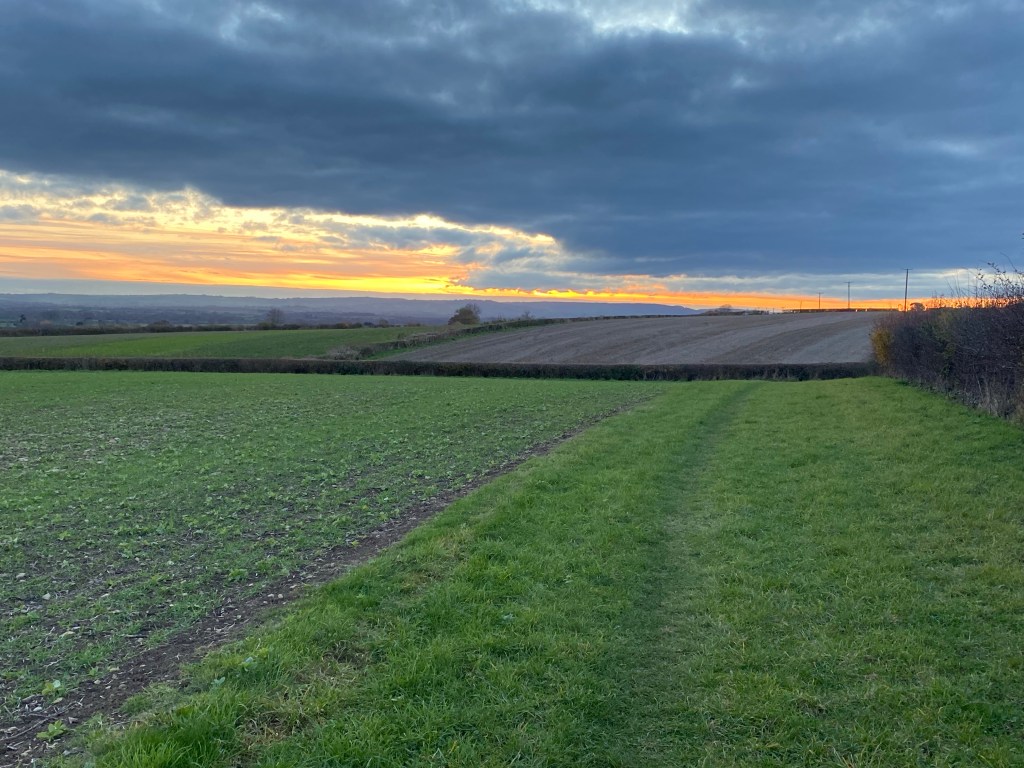
Up in the field the telegraph poles march haphazardly – some are straight, some are not – towards the Blackdown Hills across two fields and then disappear. Beyond that the horizon is ablaze as the day comes to its end.

A vast murmuration comes from the west – thousands of starlings stretching two hundred metres or more across the sky. They move as one mass like a long cloak making the faintest hushing sound as they fly overhead. It sounds like a short whisper.

Across to the south the stately home of Earnshill sits wedged in between two thick clumps of trees. There are rows of green fields broken by the lines of trees and these rise into the dark wooded tops of the Blackdowns and beyond that only the cloud and pale sky.

Everywhere are lines and curves; curves and lines.

Lines and curves and the Blackdowns

Across the northern side of the top field I can see the football pitch and pale walls of the council houses. One St George’s cross flaps in a garden. Gone are the boys who were passing the ball with a rhythmic thud prior to the England game on Sunday. I expect they’ll be out there again on Saturday before we play France.

It’s dusk at around 4.30 and the moon is now fiercely bright in the blue black of the sky and I think once again of the owl and the pussycat:

‘And hand in hand, on the edge of the sand, they danced by the light of the moon, the moon, the moon, they danced by the light of the moon.’

Curry Rivel November 29th

There is a freezing fog this morning that cloaks everything and doesn’t shift the entire day. It brings a dreamlike quality to the world – nothing is quite as it seems.

Straight lines of gossamer connect the saddle stone outside my front door to the bin – they look like silver tightropes. The air is still and droplets hang on branches waiting for their moment to fall. There seems to be a collective holding in of breath.

It is colder today. My breath is coming out in plumes as I pass Old Father Time standing with his scythe and egg timer on the side of the barn. The oak tree opposite in May Tree House has almost lost all its leaves and all its rooks too. There is one who sits at the top turning its head from side to side as if wondering where the rest are. A lone pigeon sits in one of the lower branches, its head sunk so far into its body all I can is its enlarged breast and the domed top of its head.

I cross the road and up the path to Holden’s Way where the path is strewn with the yellows and browns of fallen leaves. On the left is the old tennis court of Wiltown House where my grandfather used to play on a summer’s evening apparently wearing long trousers. As a little girl my mother used to be able to hear their voices ring out when she was trying to go to sleep.

In the top field I can’t see much. One of the telegraph poles is a dim outline. The far reaching views from here have been covered up today like a painting that has been covered with a cloth and stored away. All is quiet at Jane’s house. She is over ninety now. Her brain is perfectly in tact but her legs have gone and now uses a mobility scooter to get herself about. She must have been a widow for at least 25 years now. Anthony was the local farmer and, along with my grandfather, owned many of these fields.

Crows are my only other company up here, four of them with their funny head thrusting walk and then all of them taking off and melting into the grey like spectres.

Night Walks, Clifton Nov 17th

The air is cooler now and out with the scarf and hat for the first time in six months. Yes, the air has more of a bite as I step onto Pembroke Road. The leaves – crisp and beige like parcel paper – scuttle along the pavement. They mass into drifts that gather under the wall where the grey from Buckingham Vale spooked me last time.

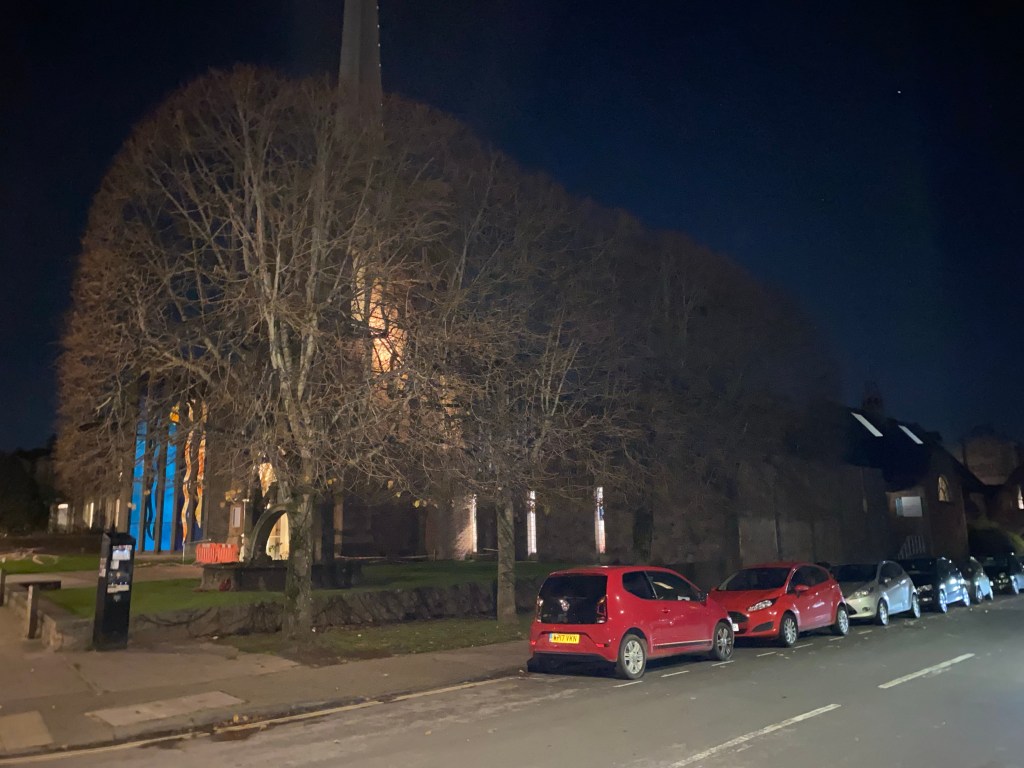
The tree hedge outside All Saints church is now bare. It still holds the shape of a London bus but now I can see the separate trees underneath, their wiry branches interlinked, and All Saints clearly visible through the branches. John Piper’s deep blue windows offers something comforting to the solitary pedestrian tramping past. People often mistake these enormous windows for stained glass but Piper made them from fibre glass and polyester which were then filled with resin. Most of the original church was destroyed by an incendiary bomb in 1940.

Tree Hedge outside All Saints

The Alma Tavern is busy tonight and not just with students. How much better a cosy pub can be when the temperature drops. On a table outside there is half a pint of Guinness, several dead matches and a dead leaf. The plane tree on the other side of Alma Vale Road is still covered in leaves, its African camo of browns and greens happily whooshing at me from above, that sound that always reminds me of the sea.

Do the stars seem brighter on a cool evening? Or is it because it reminds me of being a primary school boy in Charsfield walking home to the thatch and looking for that star, the one which guided the kings.

At the bottom of Alma Vale Road the leaves on the trees dance frenetically casting wobbly shadows along the road before the great red brick mass of Clifton Down Shopping Centre. There is the sound of humming electricity and creaking metal from within.

Shadows and trees outside Clifton Down Shopping Centre

Along the side alley and out onto Alma Road. A happy transition. And here is the king of the plane trees at the end of Alma Road. It is a beast of a tree with a huge canopy that when I look up into it I always get lost. It’s not quite as big as some of those that line some of the most famous streets of central London such as the plane that has sat outside the front of The Dorchester Hotel since the hotel was built in 1931.

That tree is so grand it has become almost as famous as the hotel itself, being chosen as one of the sixty one trees that made it on to the list of the ‘Great Trees of London’ created by Trees for Cities after the great storm of 1987. I remember seeing a documentary about ‘The Dorchester Plane’ which said how that plane trees’ distinctive peeling bark is good at absorbing – and thereby reducing – traffic pollution. I suppose the Alma Road plane does the same for the traffic here. People often sit on those worn out wooden benches at its base watching the busyness of Whiteladies Road.

Plane Tree Alma Road

The Monarch’s Way Charmouth September 18th

The Monarch’s Way leading to Golden Cap

It feels like late summer: the wind is cooler but the sun still has its strength. Swallows flit overhead flying in arcs showing the white of their breasts. They always seem like they’re having such fun. Suddenly the buzz of a bee is a loud shock in my ear before it drones clumsily away. Out there the sea is a dark blue, creating a straight line on the horizon all the way to where it meets the thin sliver of land that is Portland Bill.

I am on the Monarch’s Way. It seems appropriate that I am here now we have another Charles on the throne. I hope he has better luck than the other two: they both had to endure civil wars and the first one was executed while the second only just managed to get away to France. Despite Charles II’s dramatic escape along these ways after the battle of Worcester he was still only thirty years old when he was restored to the throne. Unfortunately Charles III doesn’t have so much time to play with.

I often think of Charles II walking or riding along these old ways, only twenty one, dressed as a peasant and realising that everyone he encountered was a potential enemy. At six foot he was unusually tall for that time and it made it all the more of a challenge to keep him disguised for those six weeks in 1651 trudging around the South West of England.

I’m on the top of the cliffs where the grass is short and spiky and the sand of the cliffs is visible beneath. The ground slopes away at gentle angles towards the coast. The signposts mark the South West Coast Path and just here the SWCP and Monarch’s Way follow the same route.

Signpost between Charmouth and Golden Cap

I say hello to a man and his wife. They are both in their seventies. He is in rust red trousers with a forked walking stick and a golden retriever. He has been in bed the last two weeks with ‘a rather personal illness’.

As a result he had been watching lots of television. ‘It really gets a bit boring watching all the people file past the coffin.’

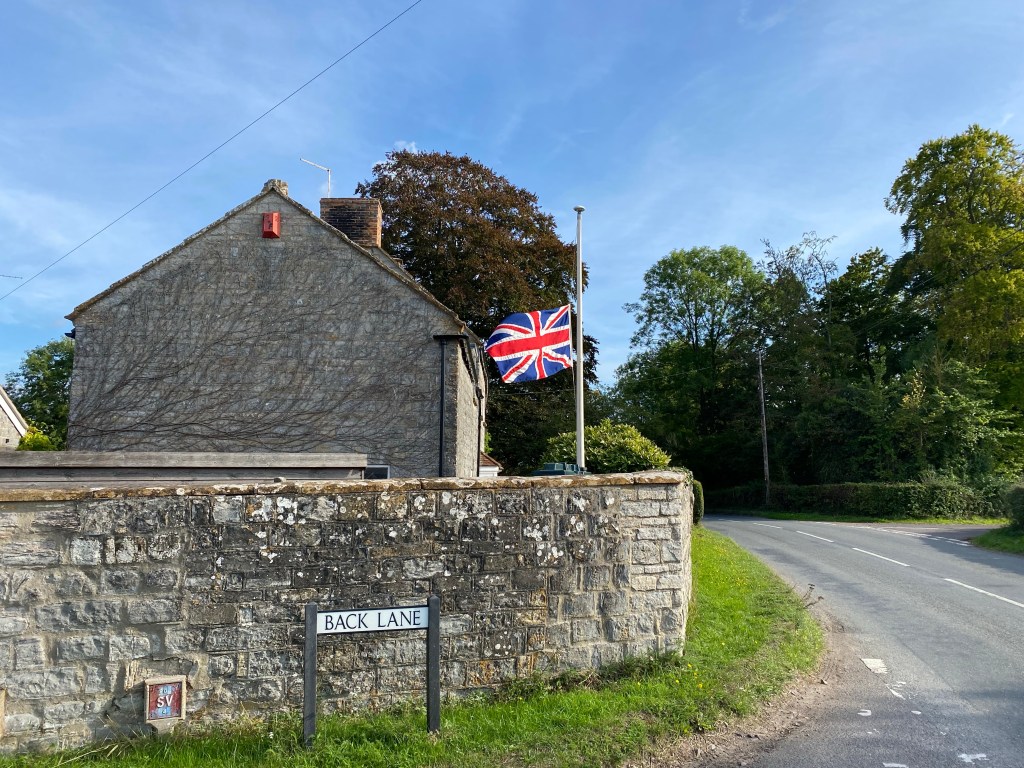
Yesterday the queue was four miles long. Today they told people not to leave home as they wouldn’t be able to get to see her in time. At one point people were having to queue for twenty five hours. Everywhere there are flags flying at half mast.

The outpouring has been extraordinary. I wonder if a big part of it is because they are a family with the same problems as any family and people relate to that (I’m thinking of William and Harry being reunited to stand guard over the coffin) or maybe it’s her amazing longevity and ability to keep going. As the shopkeeper in Charmouth said, she’s just always been there.

He continues ‘Prince Charles – sorry, the king – was moving about while he was standing by the coffin. Apparently it’s to keep the circulation going.’

Last night it was the Queen’s grandchildren’s turn to hold vigil around her coffin in Westminster Hall. There has been much in the press about William and Harry being reunited to pay tribute to her and the constant speculation about their relationship.

I heard Nicholas Soames, the conservative peer and grandson of Winston Churchill, on Channel 4 news when asked about her how he would remember her ‘unimpeachable, impeccable 70 years of service to the country. She never put a foot wrong.’

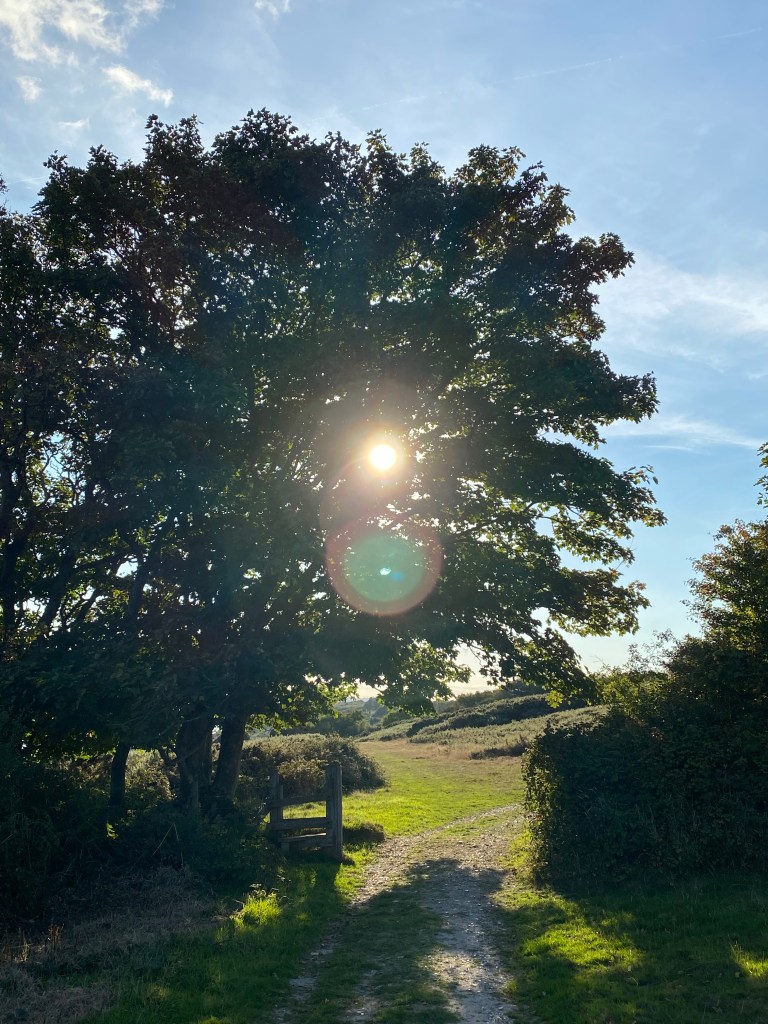
On the way back I stop by a stile below a sycamore tree. Light is flashing through the leaves. Charmouth and Lyme Regis are once again ahead of me. And the sea glitter is flickering on the sea in front of the town. I catch myself wanting to preserve the moment in my memory but then I realise we can’t. We just have to enjoy it while it lasts.

Tree light near Stonebarrow

Night Walks Clifton November 9th

In the village for the turning on of the Christmas lights. Someone says a melodramatic prayer and the lady Lord Mayor makes a speech. Isn’t it all a bit early? I like Christmas but not if I’m bashed over the head with it everyday for two months. Bah!

It’s buzzing tonight. Little pockets of mostly student-lead activity. The tables outside the Albion are all a murmur at the end of its own cobbled drive.

The Albion

Turning onto Boyces Avenue I stop. I always love this arch – I don’t know why – but I could walk beneath it a thousand times and never grow tired of it.

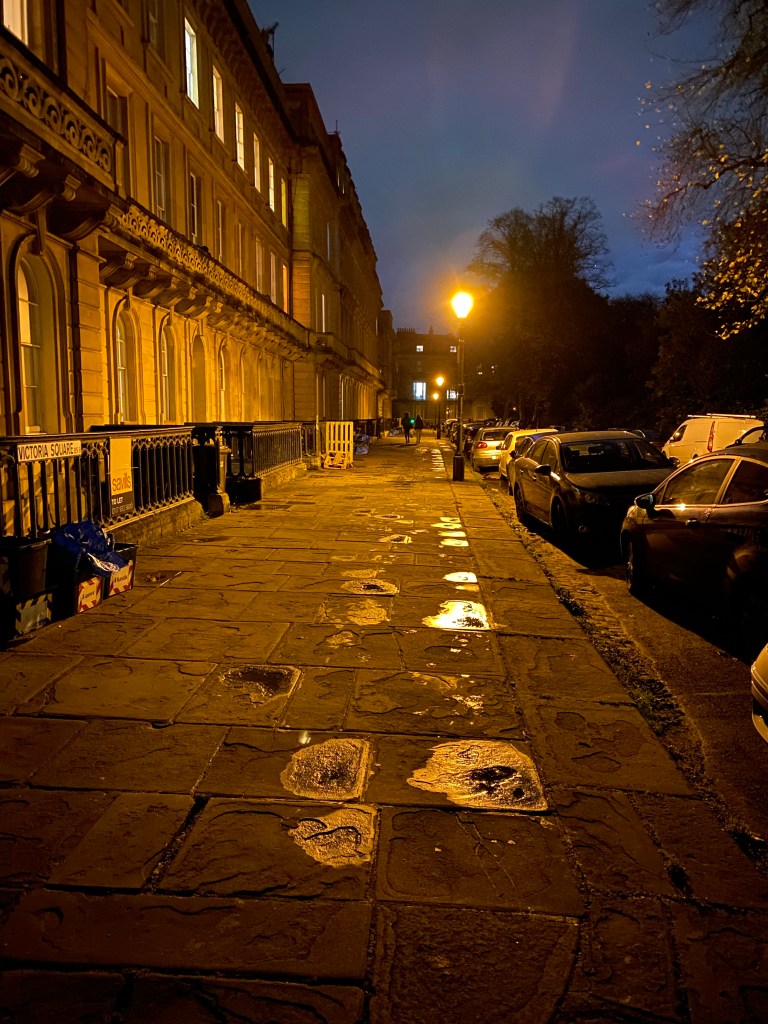
When it opens into the corner of Victoria Square the moon is hidden above the half naked trees in the square. The path goes diagonally across the middle of the green in the middle of the square lined by low walls.

The ubiquitous dull orange street lamps of Clifton emanate a dopey, dirty light like an opium dream and reflect the same orange glow in the puddles along the pavements.

North side of Victoria Square

The moon appears, shrouded by cloud, fading and then reappearing as if being smothered by smoke. That and the wind are a form of ecstasy.

It’s suddenly a pocket of relative quiet after the busyness of the village. Perhaps that’s what I love about this gate that opens onto this – it’s the transition in view and mood it creates.

On the corner of the square the silhouettes of the trees are momentarily projected onto the grand Georgian architecture growing and then disappearing as a car rolls past. This is the start of Lansdown Place. The balconies stretch the length of three town houses, some sixty metres in length with curved white painted ironwork.

3,4 and 5 Lansdown Place

I stroll past the end of Richmond Terrace where there used to be a crap nightclub called Luna which was only good for a late drink after the pubs were closed. I used to go there with Anna, my hard as nails first flatmate from Krakow. When she left she said in a most definite way ‘I won’t see you again.’ Ok then. Was it something I said? That was six years ago. Great to see the old offie, the Ten O’clock shop is still going though, like a little Aladdin’s cave retreating into the old basements of the townhouses behind.

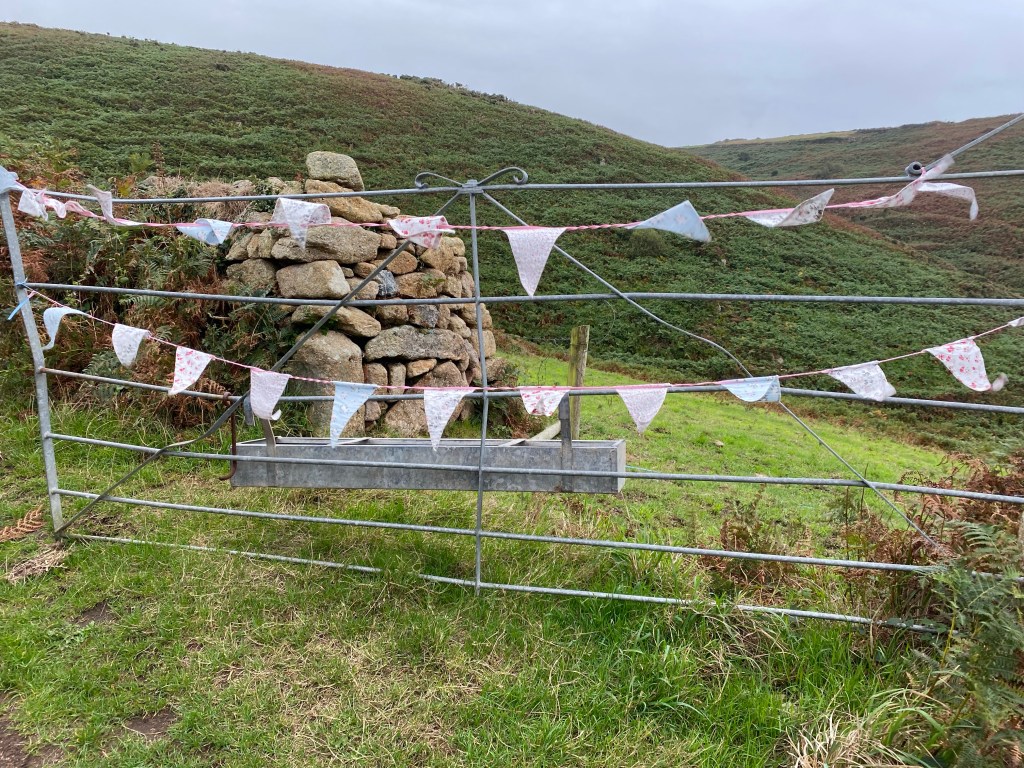
It’s getting cold and I start to pace my way home. Just before the flat someone has left some bunting forlornly, rakishly dropping beside the bubble writing of the Cathedral of St Peter and Paul. The little hankies seem to be dropping and drooping like the brown and yellow leaves that lie scattered around and above it while a hot hatchback revs its engine in the background. Late at night often the silence is shattered by people tearing up the straight half mile of Pembroke Road to the Downs.

SWCP. Portheris Beach to Porthmeor Sept 11th 2022

Sleeping bag, bivvy bag and triangular stone bedside table

I don’t sleep well above Pendeen Cliff. I keep waking up. I’m aware that other people are sleeping next to me and one person is clinging onto me. I wake up and have that horrible immobility which seems to last ages as I try to move in my twisted sleeping bag. The person huddled up to me is my rucksack. It’s fallen and resting against my back. Oh dear. The strange power of the imagination.

The weather has changed. While yesterday was summer, today is autumn. While yesterday was bright and blue, today is sullen and grey.

I pass the beach at Portheris which is abandoned today. Above the beach there’s some bunting left over from yesterday’s wedding flipping and flapping in the wind. I saw the bride, groom, bridesmaids in matching green and a few other guests walk down the cliffs to have their photos taken yesterday. It seemed like a scene from long ago.

Wedding bunting, Portheris

After Portheris I get up onto the heath on the cliff top. Here sprigs of heather shiver in the wind. I could be in the Scottish highlands. Three wild ponies look up at me, their manes blowing in the wind. I reach forward slowly to touch the one who stands at the front but he breathes out through his nose, nods his head once and walks past me – I sense – with disdain.

Near Morvah is a huge stone wall. Cows are lowing somewhere. Rain comes in great screens travelling in front of me across the land and over the cliff. I’m wet but I’m into my stride. I smile to myself at the adventure.

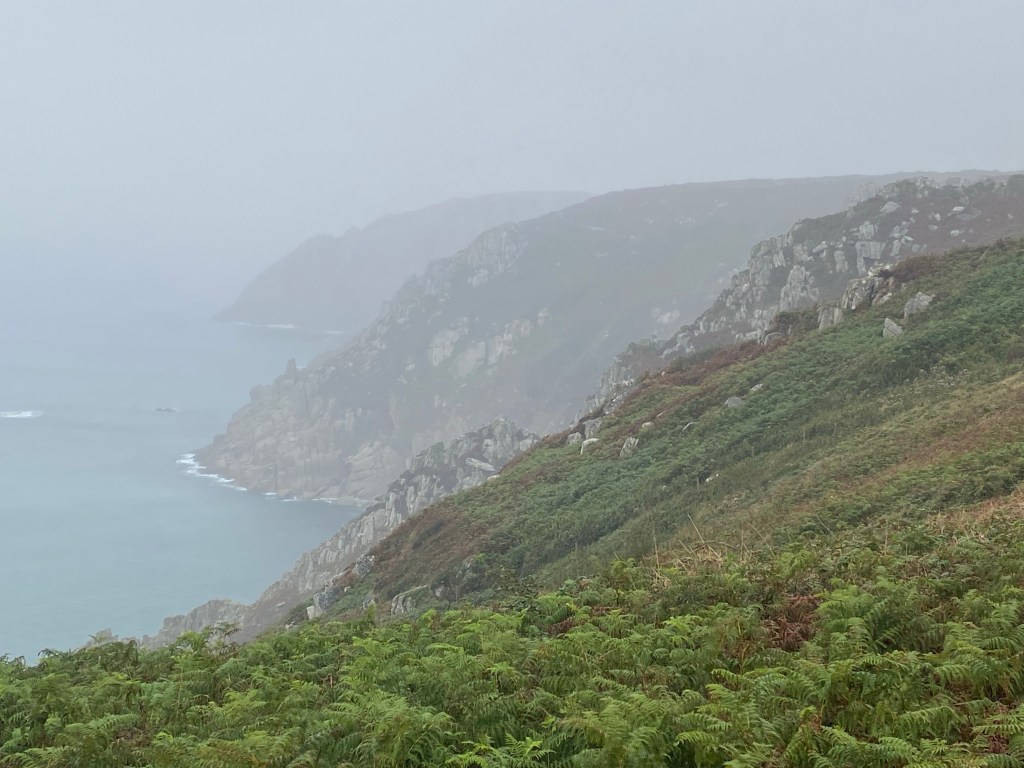
Great towers of rock rise like chimneys flanking the ocean. The rain is really coming down now. I’m soaked through. I get that awestruck confusion of fear and pleasure from the great jutting headlands at Bosigar. It is what Edmund Burke termed ‘the sublime’.

‘The passion caused by the great and sublime in nature . . . is Astonishment; and astonishment is that state of the soul, in which all its motions are suspended, with some degree of horror.’

Cliffs, Bosigar

Apart from the mooing of the cows I feel utterly alone. I actually appreciate their company when I finally bump into them. Their coats are the colour of ginger nuts, their coats slick and shining from the rain. A mother and a calf block the old stone opening and I have to clap my hands and force them back, the mother’s great udders swinging as she slides in the mud.

I’m worried about the Land’s End and Isles of Scilly map getting ruined. The green ink is starting to smudge. This is the disadvantage of using a paper Ordnance Survey map. I don’t want the memories to blur and fade from last year like my jottings. Kremyl Point, Porthcurno, Porthgwarra. They are still there like snapshots but there are so many names on the map that I try to recall and can’t. I tell myself that the reason I can’t remember great sections of the path is because much of the time I’m in that state of walking dreaming (which is partly true). Perhaps it is time to get the OS map app.

My mind starts to turn to dry clothes, a cup of tea and finding a way back to my car.

Night Walks Clifton to Portland Square November 1st 2022

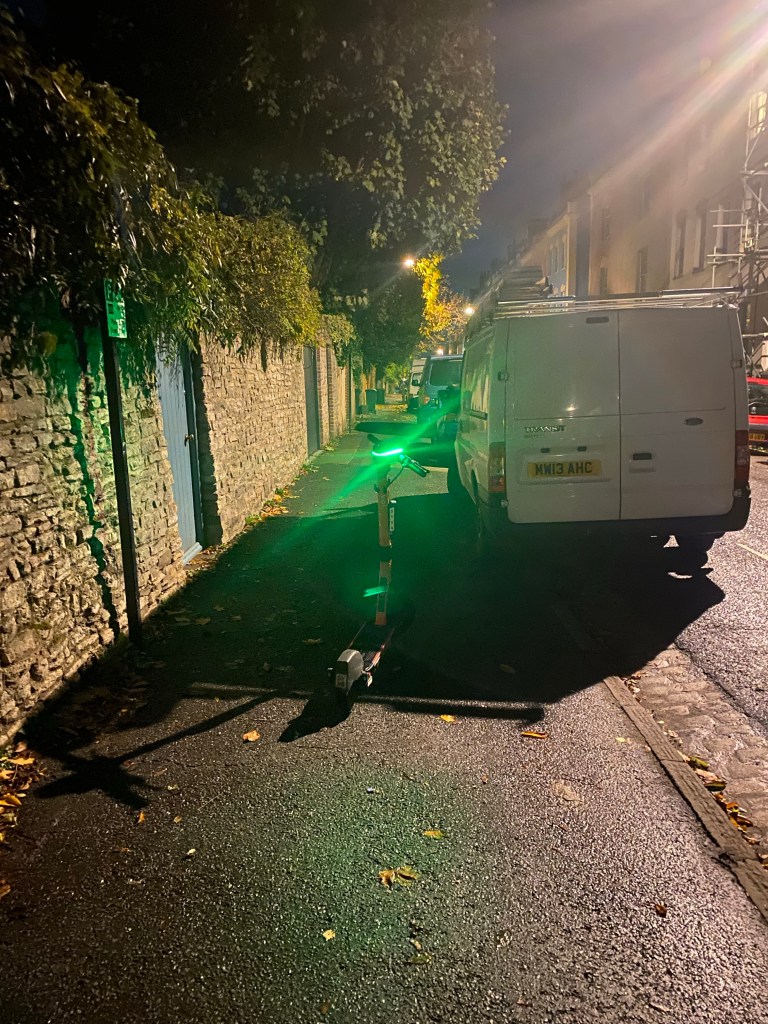
There’s a sheen on Pembroke Road. Cars splash past and the electric squeal of Voi scooters whistle along at their fixed limit of 10 mph.

On Oakfield Road a family of pumpkins, their crooked smiles forlorn after the revelry of last night, stare from their place on a low wall. The beeches are still in leaf but browner now. They still welcome me with their low whoosh like breathing, like the sea.

The night starts earlier now. It’s only 5.40 but dark already.

From the top of Southleigh road I can the steam pouring out of the top of the lido and a half moon like a slice of lemon floating in the blue black of the sky.

I trudge across Whiteladies and up the last part of Cotham hill. The leaves are gathered in the lee of low walls like dirty snow drifts.

Halfway along Cotham Road I turn down Oxford St where mattresses and pallets are lined up along a wall. I go through a quiet low rise estate where a couple silently smoke weed in the playground.

Down the other side into Kingsdown where the silence is broken again by the slickness of tyres and mumbling voices. It’s the sound of people going home.

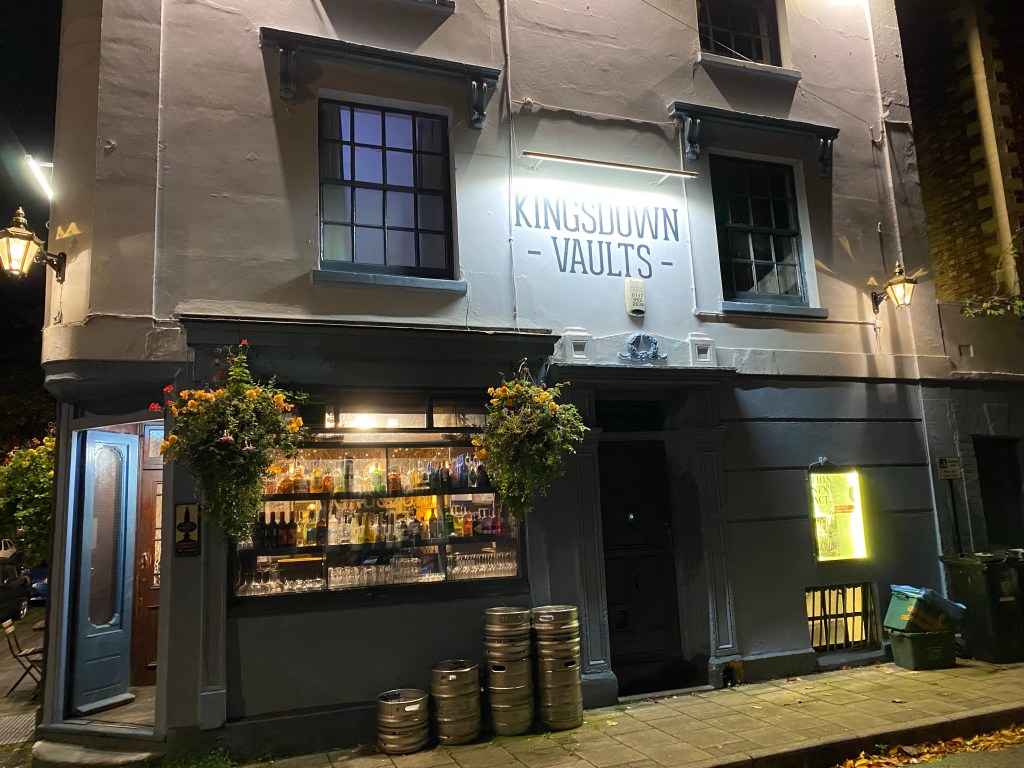
Past Kingsdown Vaults which is still going strong despite pandemics and energy crises. There is old furniture and orange lights and couple sit facing each other at a tables their talk silenced by the windows between us.

I pass one of the air vents that I see everywhere here and always wonder where they go. Someone has altered it to look like a lighthouse. It breathes loudly into the cool air.

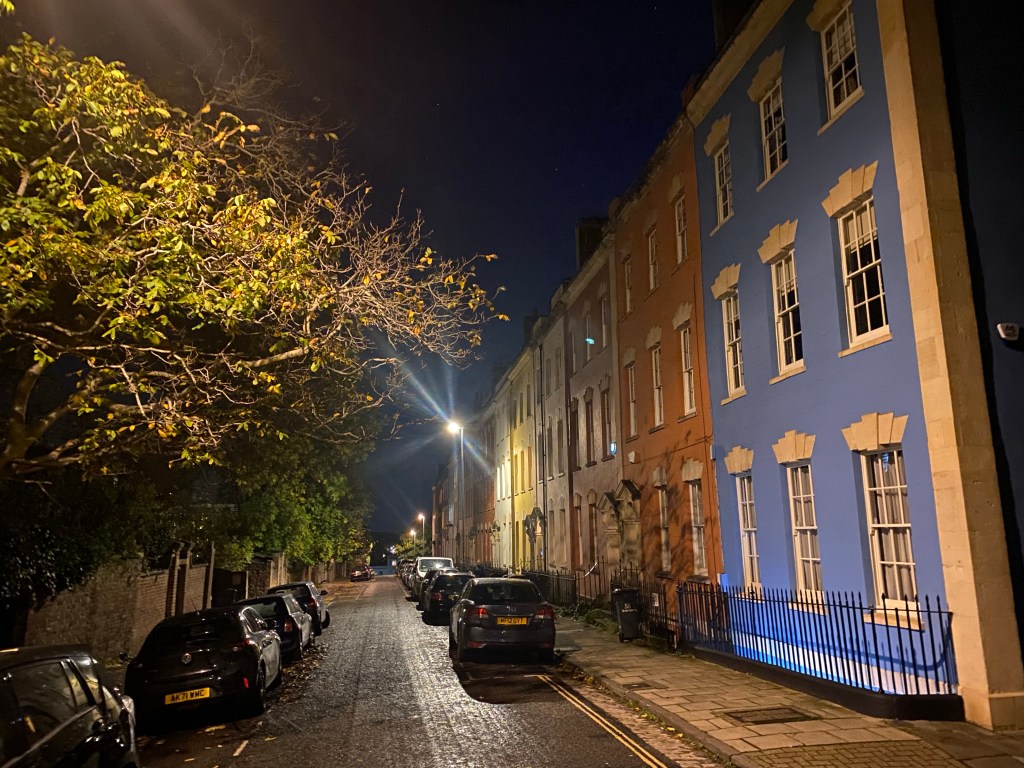
Dow Kingsdown Parade with its pastel coloured buildings like dolls’ houses and down the steep cobbled street and steps of Spring Hill which could quite easily be Victorian London with its box streetlights. It’s colder now and more wintry and Stokes Croft lies down there at the bottoms of the hill.

Kingsdown Parade

The moon is now distorted and blurred like a ghost moon in the cloud as I reach the bottom and spill into King Square. Two men shuffle home with bags. In an office man with a septum piercing looks fixedly at his computer screen while automatically eating a bag of crisps.

Stokes Croft could be another town. Neon lights reflected in puddles are like drunk visions. I’m across the road like crossing a river into a new territory. And onwards now onto a long straight street and eventually around a corner into Portland Square into an old beaten up door, a bar and finally the faces of friends.

Kingsdown Parade

The slow walker. SWCP Porthmeor October 24th

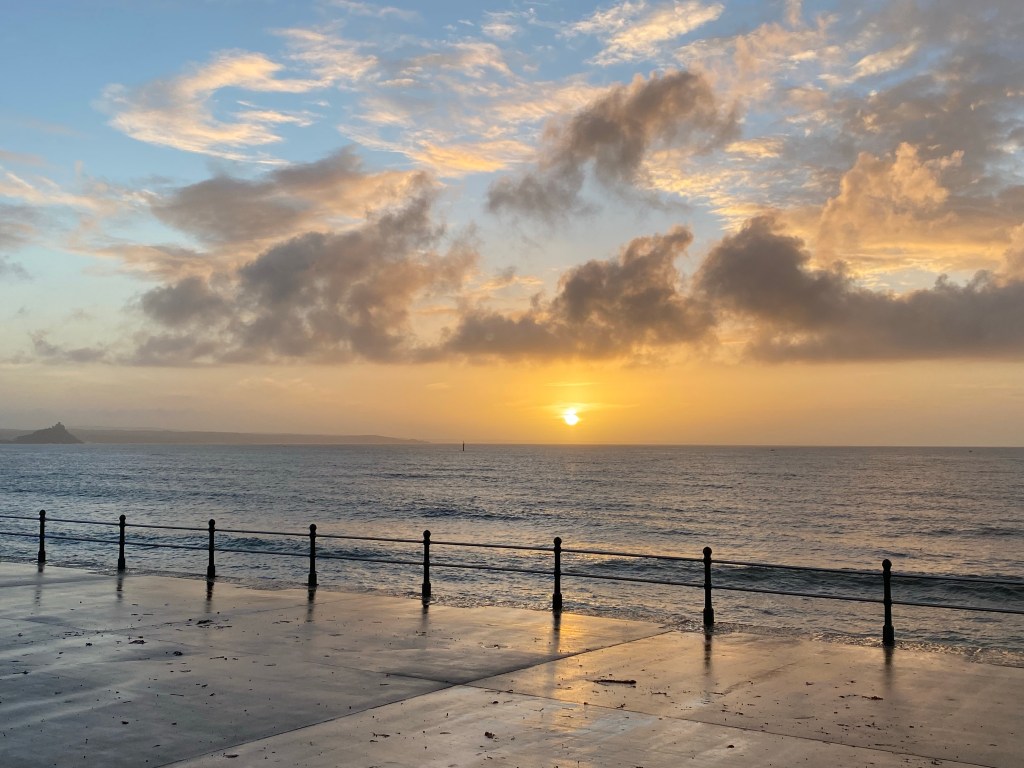
Penzance dawn

I disembarked from the pilot cutter, Mascotte, at Falmouth yesterday at 5 pm. I spent two nights in the sumptuous mahogany panelling of that old beauty and two long days sailing from Falmouth to Fowey and back again. When I got back to my car I booked a last minute room at The Beach Club in Penzance.

My room overlooked the new promenade beside the sign into Wherrytown at the west end of town. To my left I could see the jagged outline of St Michael’s Mount. Straight ahead powerful autumn swells crash into the sea wall. To my right Newlyn was neatly spread out across the first half of the peninsula.

The promenade has been rebuilt recently and stretches from the Jubilee Pool to the end of town. It was strewn with seaweed flung over the concrete, railings and seats that line the walkway by the sea.

Last night children were screaming and running towards the railings and then running away from the spray as it reared up the wall like lava being spat from a volcano.

It took me back to my days watching kids doing the same thing when I was living next to the sea in Kingsand on the Rame Peninsula while doing my teacher training. That was fifteen years ago.

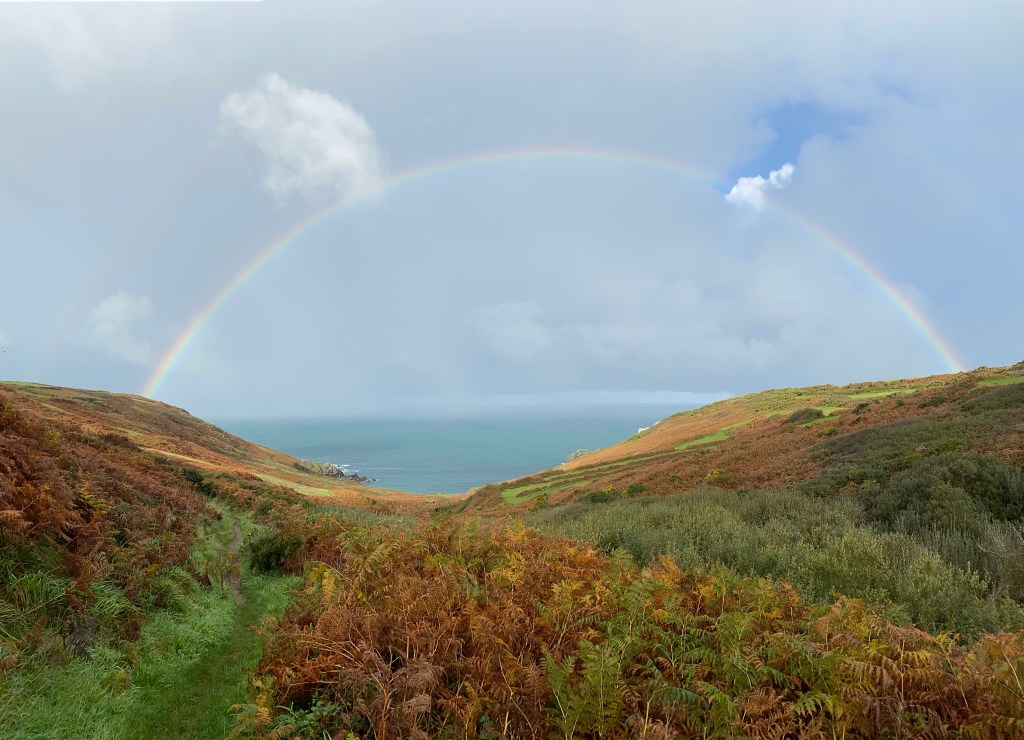
I am back at Porthmeor. Last time I was here was shortly after the Queen’s death. I walk down to Porthmeor, a perfect arc of a rainbow creates a dome over the bowl of the valley. There is only the sound of the rush of the stream and the rush of the waves. Small snowy flashes appear out in the sea and above them equally bright white dots. Seagulls. Sometimes I wonder wouldn’t it be obvious to believe in a god when you see things like this?

And then the rain kicks in and I’m not so sure.

Near Gurnard’s Head the sun comes out and everything is changed. The sea reveals its green blue in the cove. Birds cheep in the hedgerows. Bugs drift about in the deep clefts between the cliffs lit up like motes of dust. A seal bobs its head up in the water. And the water is so clear I can see the rest of its body beneath the surface. I’m green with envy and kick myself for leaving the trunks in the car. It looks inviting but how cold I wonder. There were a couple in the sea this morning in Penzance.

Chapel Jane is a medieval chapel which perches precipitously overlooking Treen Cove. It is possible to make out the four walls. The only obvious feature is the altar stone perched beside the cliff. Archaeologists have dated the chapel is being built sometime between 1100 and 1350. It’s recorded that the people of Zennor used to make an annual pilgrimage here. Am I a pilgrim? I suppose so but one unsure of who or what he worships.

Chapel Jane and Treen Cove

As the cove starts to curve there is a house and after that a rather sad and spooky half building. I can’t tell what it is. A mine building? But surely not with that aperture. There is a hole in front of it which might be a give away. I imagine there being a very long drop. One block is almost totally removed from the side of the building like a piece in a game of Jenga.

Soon after this I tire. The weekend’s sailing and a horrendous day at work on Friday involving an abusive year 10 who just went at me for twenty minutes and refused to leave the room has wrung me out. I wonder when I’ll next be back. Probably not until next year. What will have changed? I might at last be living in my own flat. I might have left my profession because of the stress at work. I hope I’ll still be in love. I might be a new man. Or not…

Night Walks Clifton October 21st

Going to The Christmas Steps to meet a friend of a friend.

The wind is fresh – truly autumnal – and there’s been a sprinkling of rain on the streets. The leaves are still mostly on their branches.

On Oakfiekd Road the copper beeches whisper to each other like waves as the clouds scud over towards the Avon Gorge. It’s the same direction the seagulls fly every evening in the summer.

The lido has its blue spot lights surrounding the door. On first sight it could be a nightclub but the warm chlorine accented air coming from a vent reveals what it is. It’s the best place in Bristol.

Down past the Triangle. The students are here. A group of girls in Lycra pour out of Anytime Fitness chatting busily and smile hasty goodbyes.

The straight steep hill of Park St slopes down towards the city centre. Cables criss cross from one side to another carrying spheres. They could be Christmas decorations or for Halloween?

As I turn into Park Row, the rain starts in earnest falling in straight lines and darkening the pavement in minutes. A group of three Asian girls squeal and huddle under an inadequate white brolly.

Christmas Steps

I reach the top of Christmas Steps and a wet, obscured Bristol unfolds itself in front of me. Some of it is like a Georgian print of the old town while graffiti on the right hand wall and a sixties tower block – Colston Tower – create a visual and historic mashup.

Night Walks. Clifton Oct 12th

It’s relatively mild outside the flat. There’s a moist stillness in the air. A three quarter moon bangs over Buckingham Vale blurred by a veil of cloud. the road is unusually quiet for a city. A car passes vaguely like an old memory. Someone laughs somewhere.

The first yellow leaves are under the apple tree. Students will be out in force tonight but they’re not making their loud, boisterous way home yet.

The long haired grey, the Lord of Buckingham Vale, is on Pembroke Road tonight. He normally sits in the middle of the road during the day looking displeased with passers by. I only know this because a sudden movement surprises me outside no 58 Pembroke Road as he jumps down from a high wall onto the low wall next to me. We both get a shock. He does that cat thing of freezing briefly, one front paw further forward than the other, leopardlike and then bolts off into some dark corner.

A Voi scooter swings drunkenly down the middle of Alma Vale Road, its red tail light getting blurry. And the moon now is just a vague smudge like the thumbprint of the artist.

All is still under the great tree on Thorndale Mews. A woman screams from a TV in one of the top floor flats and the little alleyway has a sheen lit up poorly by the orange lamp post at its end. As I step between the pools of light the sound of my footsteps echo off the walls on either side of me. It could be a scene from a Cold War spy film.

Thorndale Mews

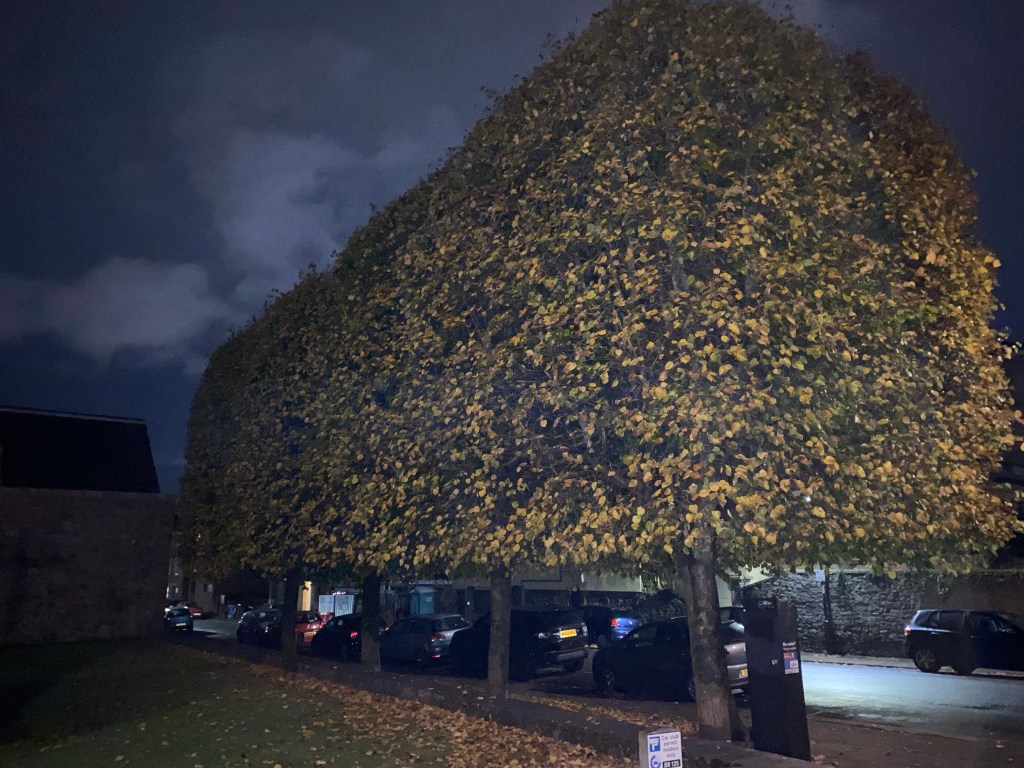
Why have I never noticed the four trees outside All Saints Church before? They have been trained so perfectly that they seem like a neat hedge but in shape and size like one of the old London Routemaster buses, its leaves half green, half brown, while a brown mass of leaves gradually gathers on the lawn beneath.

Tree Hedge, All Saints Church

The Monarch’s Way, Charmouth September 18th 2022

Charmouth

Driving along the lanes of South Somerset and Dorset, the road is lined with union jacks at half mast as well as the now ubiquitous blue and yellow colours of Ukraine. Beside the A35, before I descend the steep hill to Charmouth, a Jolly Roger hangs limply, the skull staring blankly above his bones. It’s also at half mast.

Charmouth beach has people strewn across it. Down to the left are where the fossil hunters go. The bins are overflowing and in the lagoon people on SUPs paddle under the footbridge. Out at sea there are the silhouetted triangles of yachts in a race. There is a feeling of an extension of the summer holidays because of the unexpected bank holiday. But does it feel subdued too? Maybe I’m just imagining it.

In The George Pub (named after another of England’s late monarchs) families are enjoying their Sunday lunches. There seem to be dogs everywhere. A well built man with a shaved head waits quietly by the bar. He has a Royal Marines T shirt on. He tells me he has fond memories of active service. He left in 2000.

‘I’m still in touch with a lot of the guys. Yeah, I’ll be watching tomorrow’.

After I’ve had a pint I stop in the shop just up the main road. The shopkeeper tells me. ‘We’re only open for a couple of hours tomorrow. We’ll, we’ve all grown up with her haven’t we?’

‘I’ll be doing some gardening and pop in and out to watch it. I don’t think I can sit through all 5 or 6 hours.’

I sit next to a smiley woman with a bright colourful hat on. We are sitting on a bench in front of the cafe looking over the beach and into the dazzle of sea glitter. She is from Germany and lives in Bedfordshire.

‘I think the Queen and the Pope are as bad as each other. She has too much money and power. They are all part of the same group – the Templars.’

Oh?

As in the Knights Templar. I think she means the Freemasons. I tell her these sound like Conspiracy theories.

‘Yes I am a conspiracy believer. Like Covid was a way that the government could create fear and control people.’

The country has been in a period of national mourning for 5 days now and it’ll come to an end tomorrow with the day long state funeral of Elizabeth II.

In the background the white houses of Lyme Regis twinkle on their peninsula. The thin bent line of the Cobb sticks out into the sea. On the top I look east towards Golden Cap. It has a flat top and each side a diagonal while the side facing the sea is a gold sandy cliff at the top covered with bushes. It reminds me of a tent.

Behind that the great crescent of Chesil Beach borders the sea, a narrow gold ribbon that ends at Portland Bill. It looks like sand but is actually stones. As the beach curls towards the east the stones get bigger so that they are the size of acorns at one end and bricks at the other. The land on Portland Bill is higher at the northern end and tapering gently as it reaches south out into the sea.

This was where I walked the SWCP in 2018 the summer I decided to leave my teaching job after 10 years. I felt a huge sense of relief then. Here I am 4 years down the line, back in teaching but wondering again if I should give it up for good. What did Dr Korfmeister, my GP in Langport, say?

‘You don’t go to work to get ill.’

What would her majesty say, I wonder? Time to move on.

Golden Cap, Chesil Beach and Portland Bill