The Monarch’s Way – Winyard’s Gap January 19th

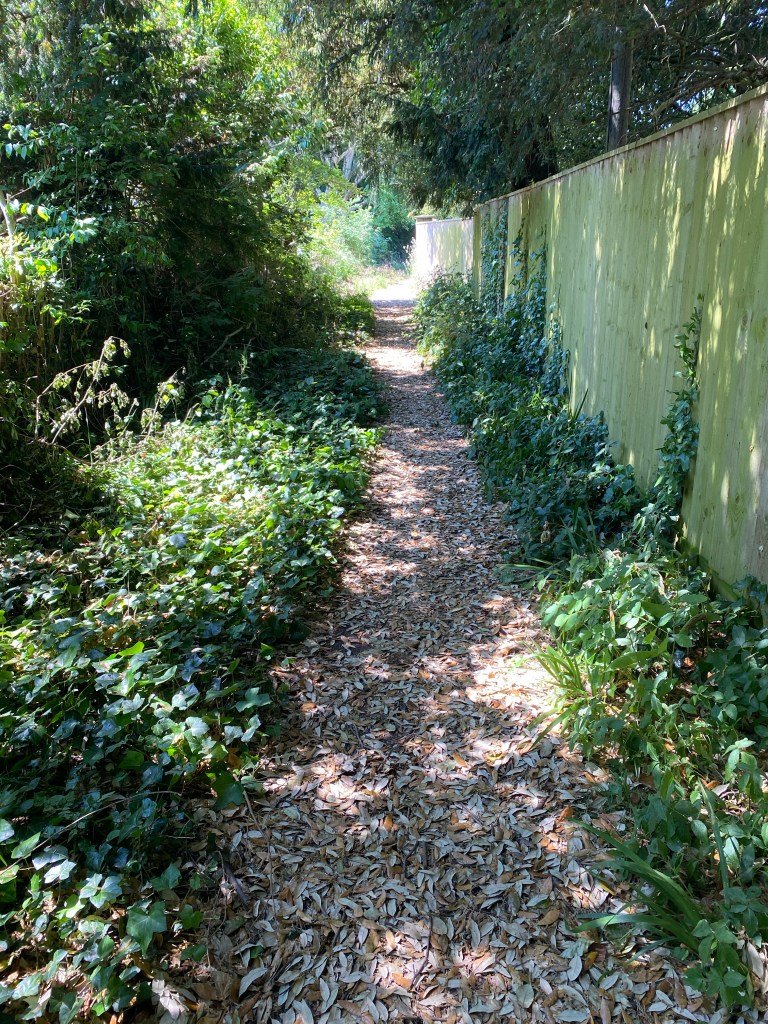
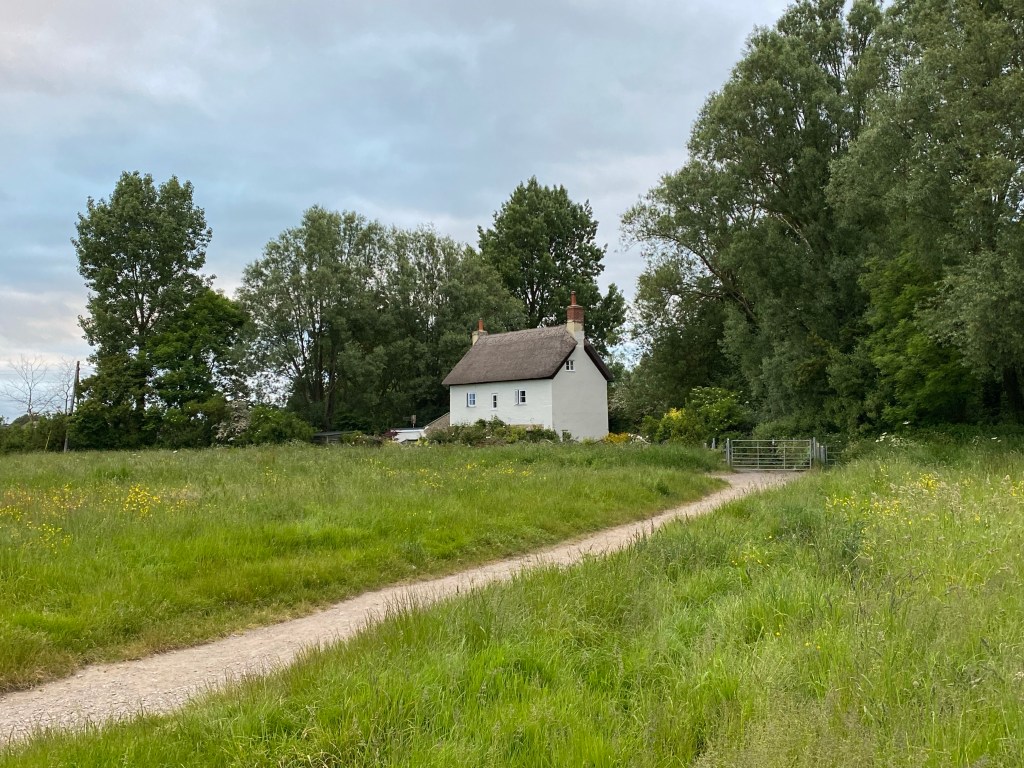
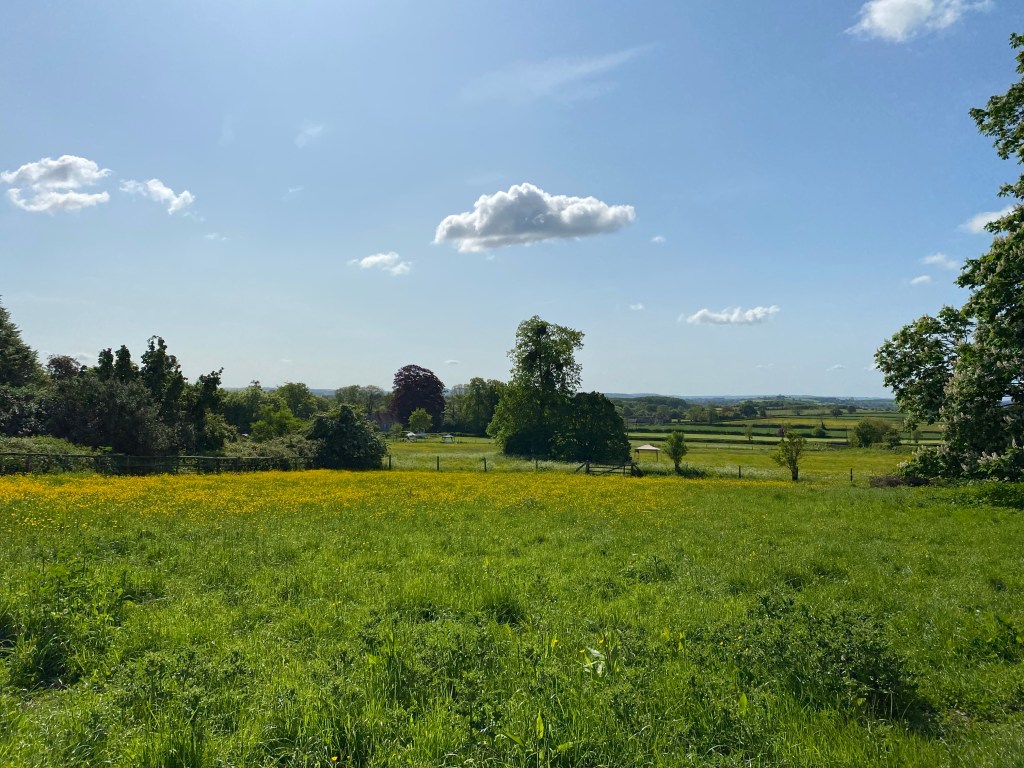
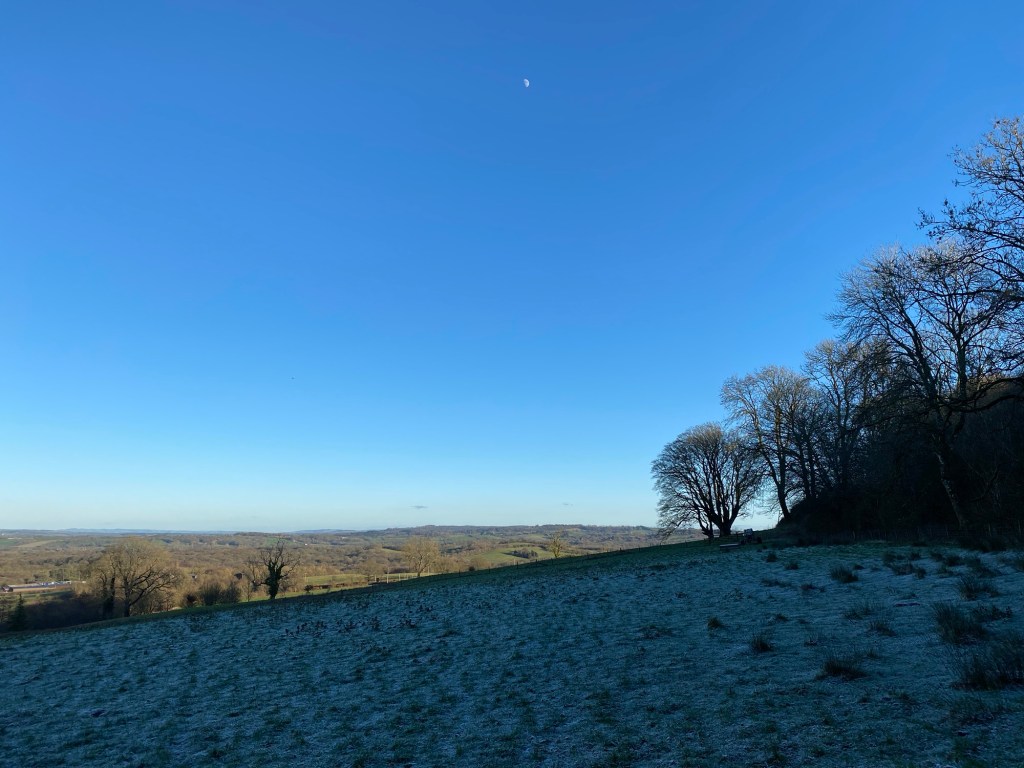
The Monarch’s Way looking east from Chedington Woods under a half moon

At the moment I’m reading Travels With Charley, John Steinbeck’s account of travelling ‘in search of America’ in 1960 when he was 58 (he won the Nobel Prize for Literature in 1962). Charley is the writer’s French poodle who is his travel companion and mentioned frequently.

Steinbeck has introduced me to a Spanish word that immediately struck a chord. ‘It is the verb vacilar, present participle vacilando’, he says. ‘If one is vacilando, he is going somewhere but doesn’t greatly care whether or not he gets there, although he has direction.’

Yes, I like this word. As I’ve said before it is the process of walking: the seeing, hearing and breathing in the moment that wins me over every time. It is the means and not the end. And it makes me – like the great Nobel laureate – a vacilador.

I’m outside the Winyard’s Gap Inn in the empty beer garden looking over the green and brown hills between Crewkerne and Beaminster while a buzzard makes passing loops in the sky and the sun lights its white undercarriage.

It’s been a week of freezing temperatures and sunny days with the near world covered in a layer of ice that sparkles richly in the sun. This morning it was -5 C in Dorset.

God, I love this weather: the air is so fresh it makes the skin tingle and a deep breath seems to clear the head and lungs and make my eyes water. It reminds me of exciting days and nights in the Alps or The Carpathians of Eastern Europe.

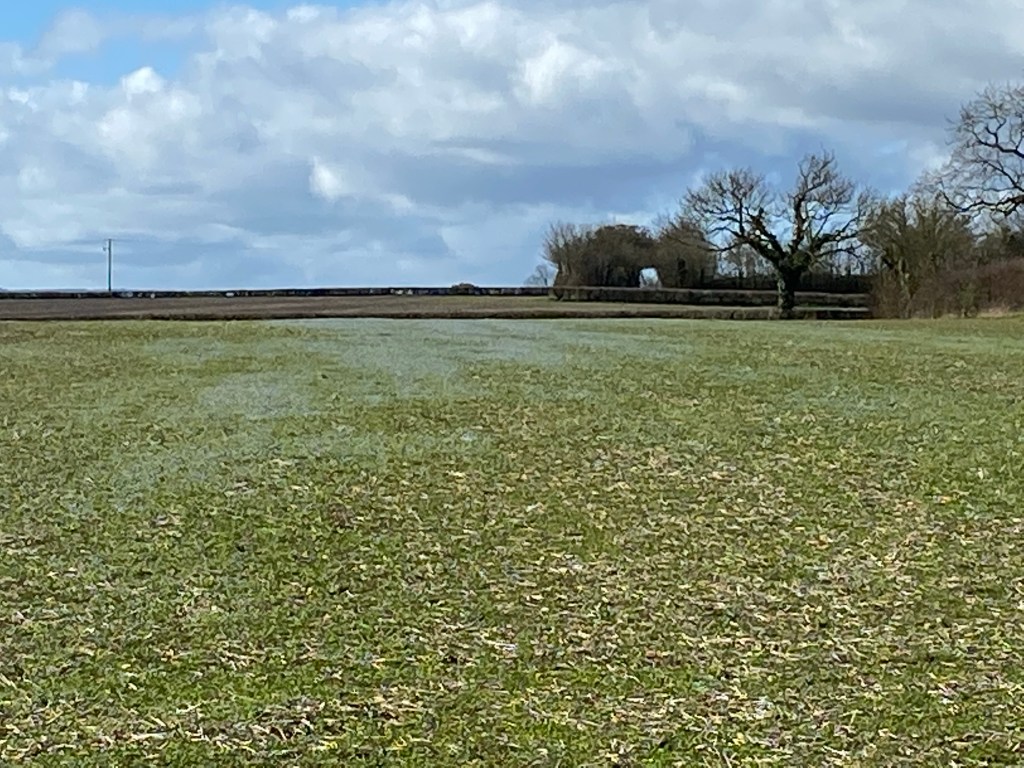
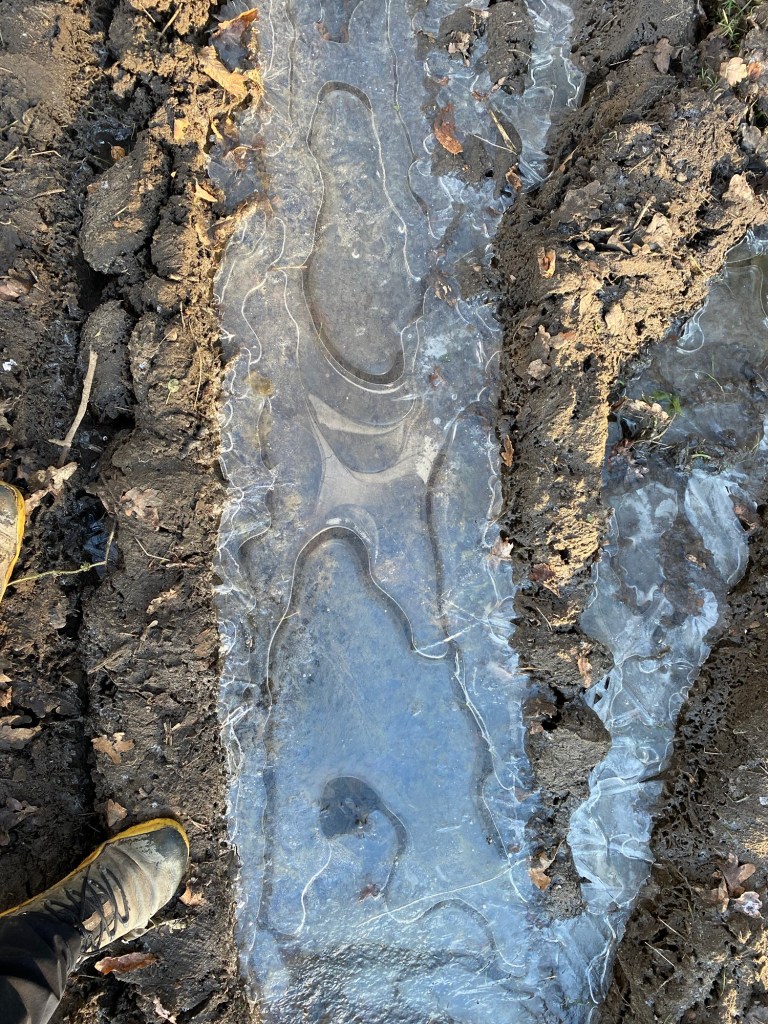
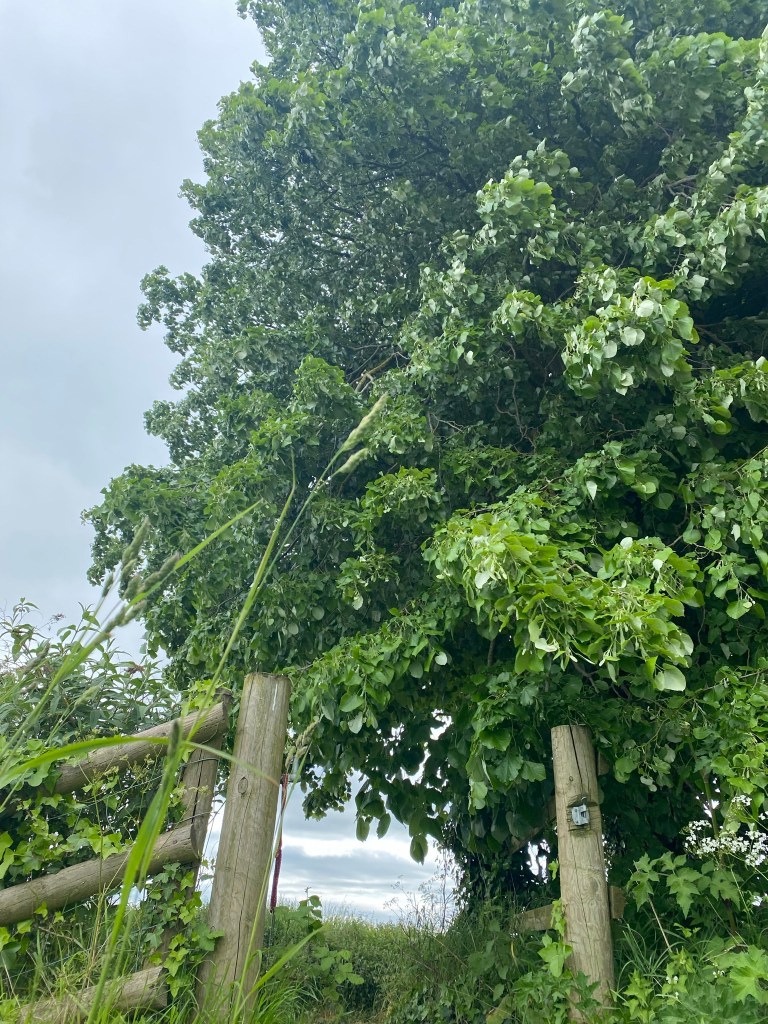
Water filled, ice covered tractor tyre tracks have strange swirls under them like contours on a map and crack and groan underfoot when I pass over them to get through the gate.
Through the gate I’m in Chedington Woods. It is a wood of old oaks, ivy clinging to the trunks and their bare branches twisting upwards. When I come out the other side there is the lonely, haunting mewing of the same buzzard echoing as it loops around again. It is only the two of us here. Why does it call out? Above all is a hard blue sky – clearer, brighter somehow in the cold air – and a half moon clear and strangely surreal in its incompleteness in the middle of the sky, its craters the same blue as the sky around it. What were those great lines by Shelley?

‘Art thou pale for weariness

Of climbing heaven and gazing on the earth

Wandering companionless’

In the foreground the grass is white, stems and leaves frosted with hundreds of little white shards. They crunch underfoot as I make my way down the hill, my fingers starting to sting.

The last time I was doing The Monarch’s Way was in July when I passed through Broadwindsor a few miles south west of here. It is where Charles II stopped the night at the George Inn in October 1651 after his failed attempt to escape by boat from Charmouth to France. While they were at the pub forty soldiers arrived en route to Jersey (where there had been a long and intense conflict as part of the English Civil War). That evening a woman that was travelling with the soldiers went into labour, another bit of luck that allowed the King and Lord Wilmot to avoid detection and escape back to Trent House near Yeovil.
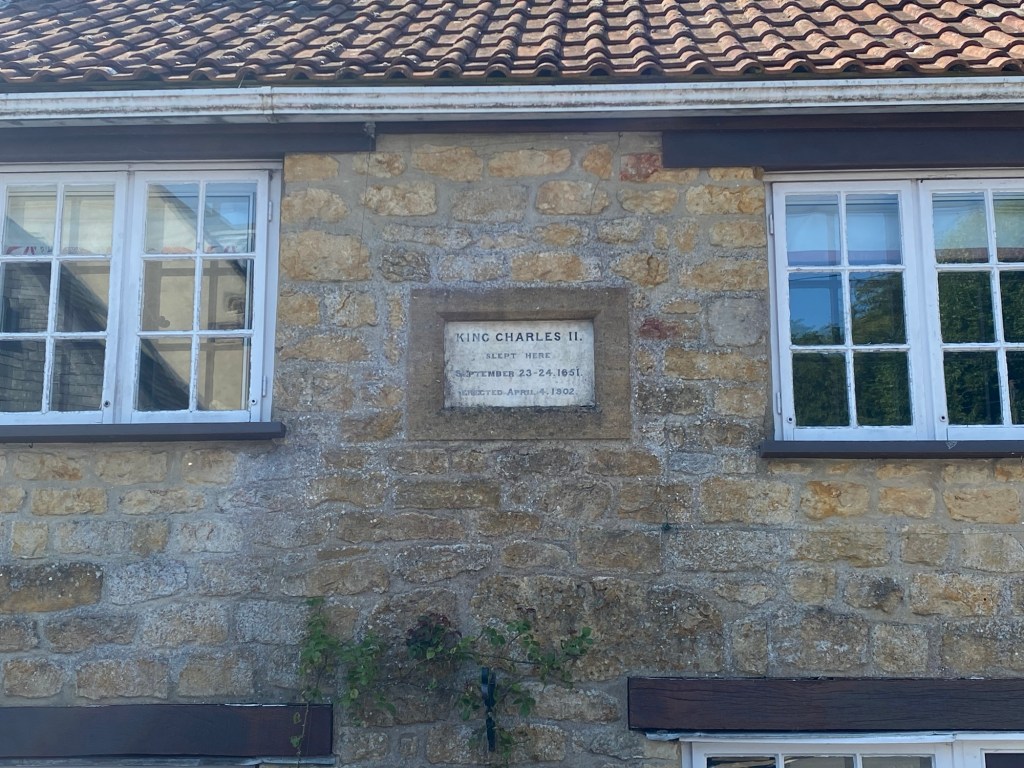
Plaque commemorating Charles II’s brief stay in Broadwindsor

By returning to Trent, the King had made a huge loop, as the path does and as have I.

I think of lovely Trent and it makes me travel back in time. It makes me think of those strange dream days during and between lockdowns. It’s where I swam amongst the lily pads in the River Yeo while doing the Monarch’s Way that hot day in June 2021 (recorded here). It’s where in the same month I met C for the first time in the beer garden at The Rose and Crown only a few hundred metres from Trent House.

She wore a silk skirt that caught the light of the sun as she walked over to me in the garden. She smiled. I smiled. And we paused.

These moments. Seemingly insignificant at the time and imbued with meaning in retrospect. Little did I know it in that moment but my life would never be the same again.

The icy air shocks me out of my reverie. I’m past Wyke Farm. I’m onto a track. Then past lots of felled trees and churned up ground. Then I notice that the light is fading and it’s only 4.30.

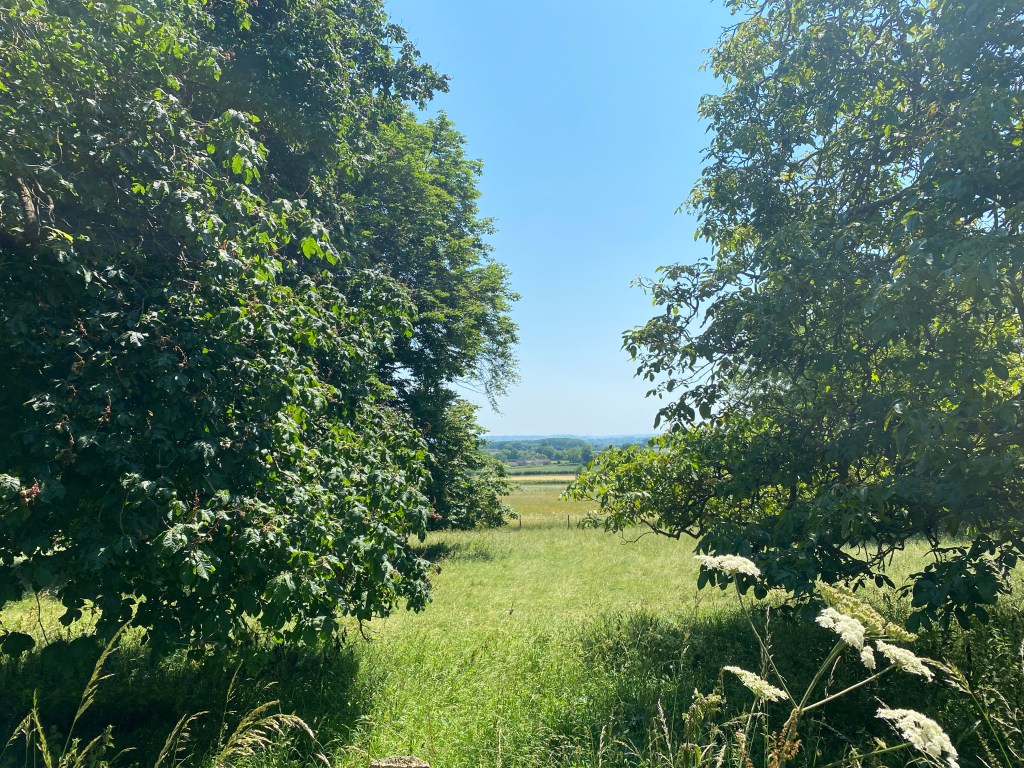
On my way back I’m stopped by something. The shape of the land, meadow, hedgerow and tree here have created a wonderful symmetry. The gap and horizon are a frame that pulls my eye towards the form of the tree. A perfect tree. I think it is a sycamore, not dissimilar to the Sycamore Gap tree that for many years stood next to Hadrian’s Wall in Northumberland and was inexplicably felled by someone on September 28th last year. That also had a perfect symmetry to it. As does the sycamore on Burrow Hill near the cottage in Somerset. This in many ways has a contrasting symmetry to the Sycamore Gap. Whereas this was most often viewed in the middle of a perfect U made by the land, Burrow Hill sits in top of and in the middle of a near perfect shaped mound to compliment the shape of the tree.

My breath is loud and great plumes come out of my mouth but I am as motionless as the tree. And the ice lingers in the hedgerows while the sun fades to a smudge. I shake myself, rub my hands together and head for home.
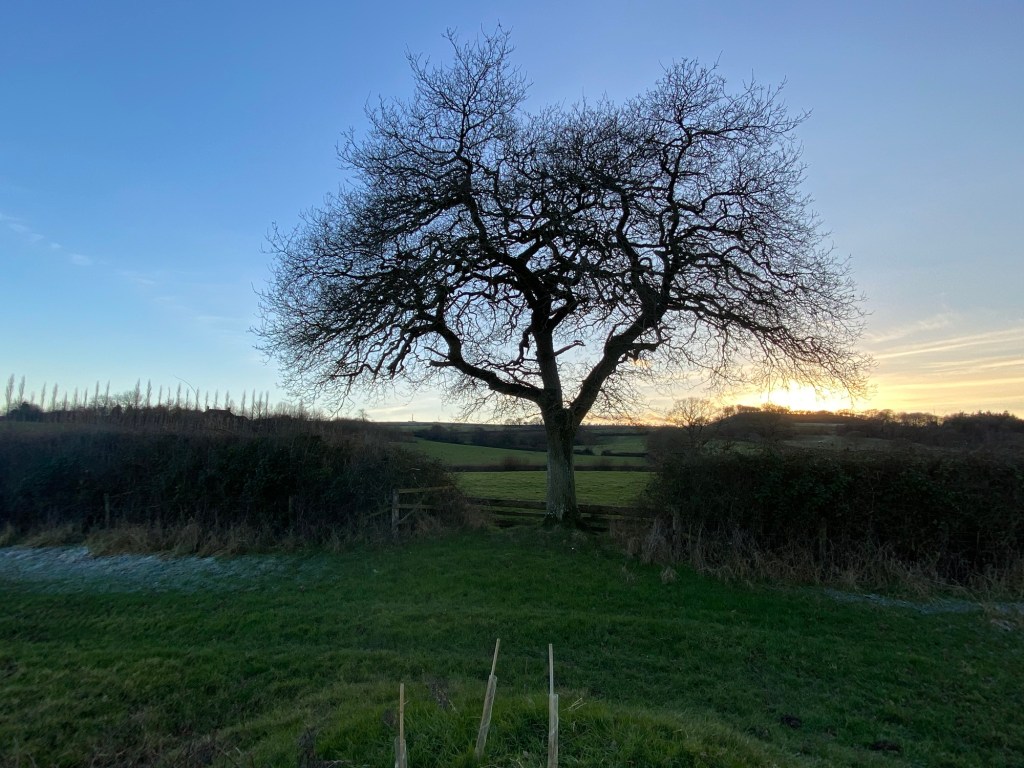
Tree near Wyke Farm

SWCP – Gwithian to Godrevy Point October 7th 2023

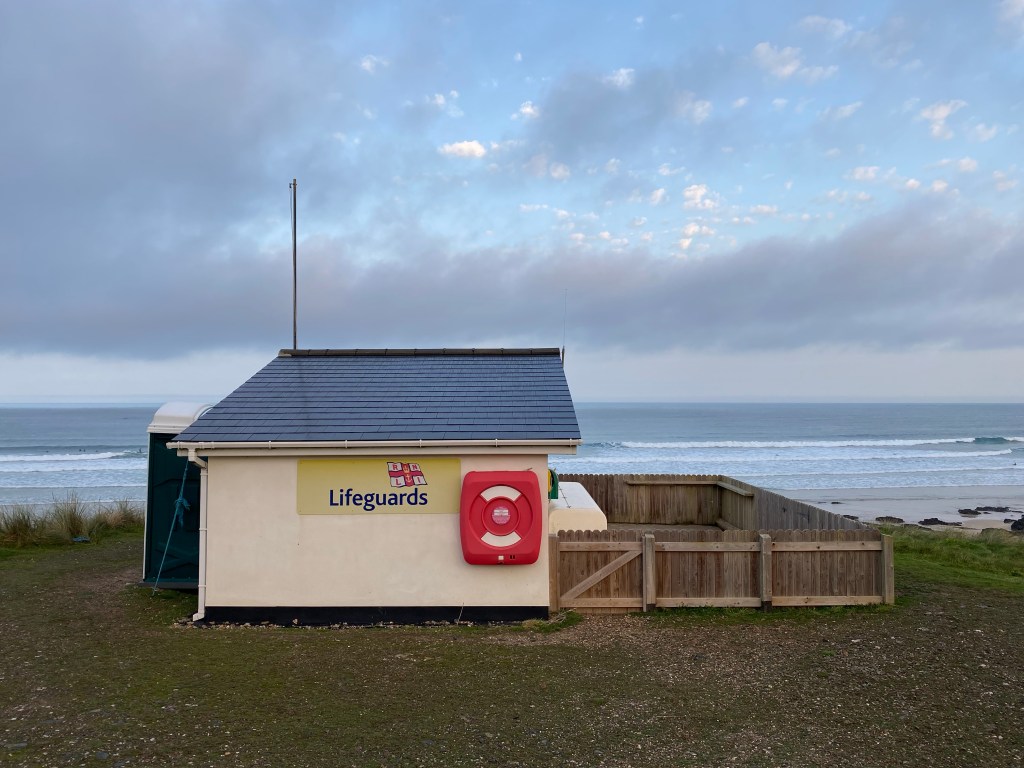
Lifeguards Lookout Gwithian

I get my early call from the sea, its cool air stroking my face and in the first seconds of waking I get the tingles from knowing I’m in the wild. It is a reminder of my earliest camping trips with dad down on the moors in Somerset with his orange tent and his lethal flamethrower of a stove ‘making a brew’ with Carnation milk.

I stare at the mackerel sky over St Ives bay trying to retrace the steps of my dreams – I think it was about school – the school that I left in July to make a change.

I’m lying on a concrete base beside a lifeguards hut and I was almost sheltered from the gusting autumn wind last night. I even had the use of a portaloo around the corner from the hut. It was positively luxurious compared to some of my previous sleeping spots.

Coat and bed outside Gwithian Lookout

Even in my sleep I was aware of the sea next to me. When I was in Carbis Bay it was like a breath. Last night it was a roar. And in the dark I could still see bands of white surf forming on the beach while the moon appeared and disappeared from behind fast moving clouds, its light alternating accordingly like a dimmer switch being turned on and off.

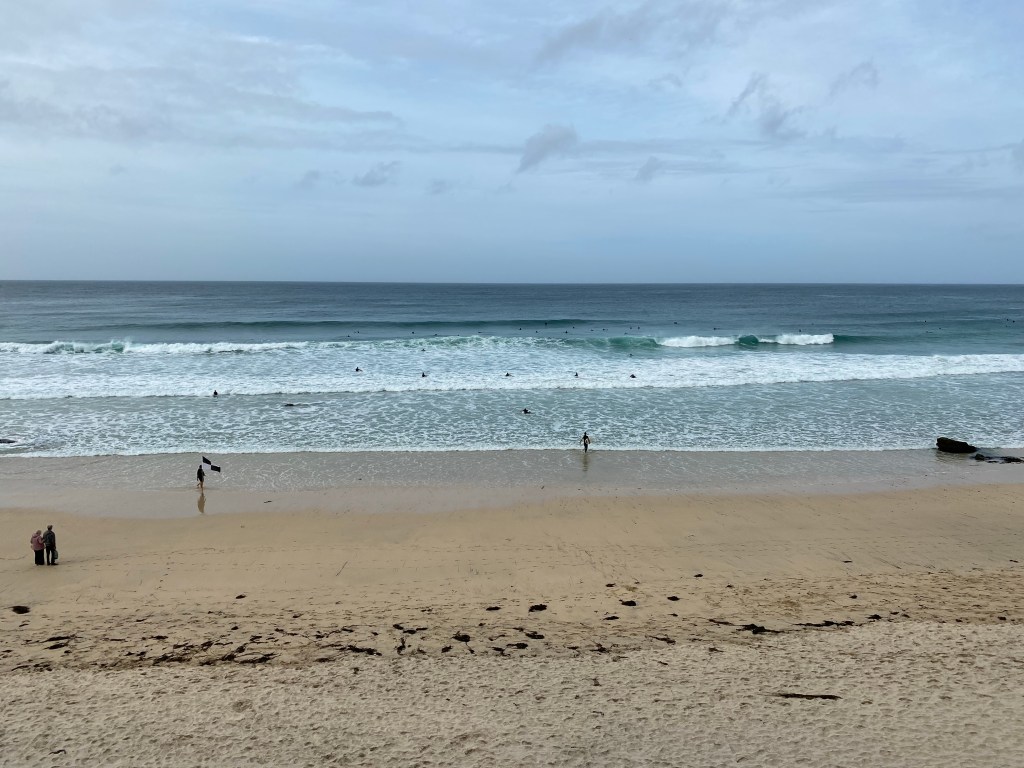
This morning the white lines and the roar are still there and the sleek shapes of surfers amongst the lines are like seals bobbing about in the water. Across the bay St Ives is under a cloud but lit up by pale sunlight.

View of St Ives from my sleeping bag

Yesterday I worked my way through the vast stretch of dunes known as The Towans that stretch for 3 or 4 miles from Hayle to Godrevy Point. It was like a mountain range in miniature. There were the same dips, peaks and valleys and as the sun started to go down I’d get to the top of one ridge and see the path sunk into the shadow of a valley before rising up to another ridge the top half of it lit by sun. The shapes and contours were all there; the only difference being that that valley is 30 feet across and that mountain 15 feet high.

The Towans are ‘Cornwall’s second biggest sand dune eco system’ according to a board I find en route. It informs me that during Summer ‘The Towans are a riot of colour as many plants flower now. Look out for swathes of yellow bird’s-foot-trefoil along with numerous pink flowers if Pyramidal Orchid.’ It sounds wonderful.

This weekend has been a final blast of summer as high pressure hit the UK and brought warm weather across the whole country. Once again I started late and after two miles I had to buy some shorts from Asda in Hayle as it was so warm.

The Towans took a few hours to traverse and after my obligatory dinner at a pub (The Red River Inn at Gwithian) I thought I could walk through twilight and the first part of the night as I did in Carbis Bay. As I turned off the road from the pub I passed a woman with a head torch who was surprised to see me and said ‘Gosh, it gets dark so quick now.’ And so it was.

As I tramped towards the cliffs at Gwithian Towans I could see strange low bobbing green circular lights on the cliffs. It took me a minute or more to realise it was two dogs with luminous collars running across the cliff tops, the same as those necklaces they sell at fireworks displays. Then other gently pulsing lights next to the path. Glow worms. And the first few stars are appearing in the sky. Stars in the sky. Stars in the earth.

Beyond this the dips and tufts of grass were becoming difficult to get across and the night was much darker than two weeks ago at Carbis Bay. At one stage I was suddenly close to the cliff edge and was brought up short. My breath was coming harder now and my legs were starting to shake. At a point where I felt my fears starting to grow stronger and start to take over, the path widened and the land grew flat. A sign appeared welcoming me to Gwithian Beach and like a godsend I saw the angular outline of the Lifeguards hut.

Now it’s Saturday morning and the sun is out and there are pockets of surfers all along St Ives bay. At Godfrey car park I see a guy in his thirties with shoulder length dreads and an olive hoody hastily paying for his parking while others clamber up the dune to have a look at the waves. A middle aged chap already in his wetsuit is getting ready at the back of his grey VW transporter which has only one sticker ‘Born to surf not to work’. Another chap has a very small board and smiles at me and says keenly ‘Morning – you all right?’ You can sense the anticipation amongst them. And how I like these brief moments of communication.

What a day and onwards I roll with a spring in my step and a little grin and imagine having my own bumper sticker:

‘Born to walk not to work’.

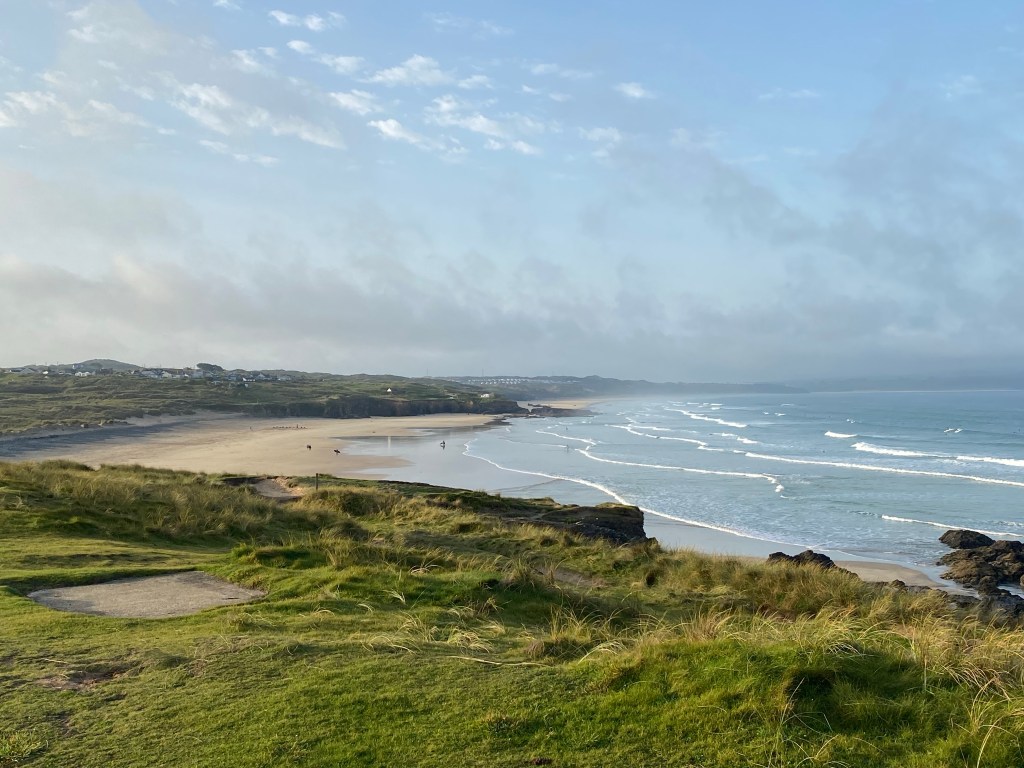
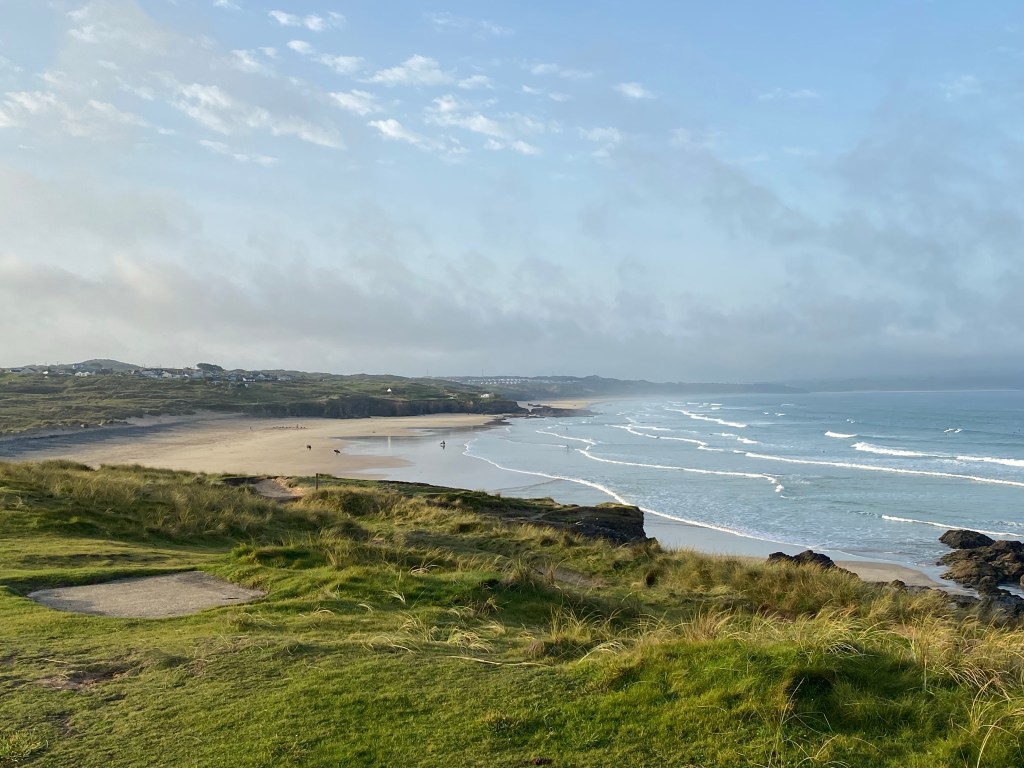
St Ives bay with the lifeguard lookout on the centre of image

SWCP St Ives September 25th

Lines off Porthmeor Beach

It’s only fifteen minutes since I said goodbye to Robert and I am walking towards Porthmeor Beach passing the world and their dogs on the way in. I find it funny how many people get nervous about their dogs approaching strangers on a walk but I guess that’s because I like dogs and I guess there are many people who don’t. Are there more people with dogs post-Covid? And have perhaps people got more irate with dog owners and their dogs post-Covid? Who knows.

On the way into St Ives a group of nine goldfinches flit here and there showing off flashes of yellow as they flick their wings. A posse of oystercatchers are peeping their sea sound and flying towards Carrick Du, the small headland that flanks Porthmeor beach and signals the entry into St Ives from the west.

Robert had said he’d seen surfers at St Ives. At Porthmeor the conditions are excellent. Surfline says it’s 5 to 8 feet and ‘fair to good’. The slick, black shapes – mini men – take off fast on the glassy green hulks flying down their faces, carving back up to the top before flying down again. The way they ride these beasts is not a battle – although for me it can feel like it sometimes – but an amazing symbiosis between a person and the sea. I’m always stunned by the variety of movement that good surfers can get from a sloping bank of water. There is something so joyful about it, even just to watch. It gives me pangs – how I’d love to be out there and how I wish I could get better at it.

On the beach and in the beach cafe many people look on agog including the lifeguards in their high-vis orange uniform. On the balcony at the cafe two trophies are lined up on the rail which explains the quality of the surfing.

Behind Porthmeor Beach is the grand entrance to Tate St Ives. It looks closed and seems a million miles away from the action on the beach. I check myself: trying to make a mental adjustment from the coast, the sea, the surfers to ‘culture’. Before I can do anything I need a cup of tea so I go to the cafe at the top of the gallery which must have as good a view – although not too similar – to the restaurant at the top of Tate Modern in London overlooking The Millennium Bridge and Blackfriars from the south bank of the Thames.

There are the same clean white walls as the rest of the building and windows everywhere. Some look out east over the old roofs of the town towards Downalong and Smeaton’s Pier (where Robert had stayed as a boy). The roofs could be a painting in themselves, the different angles and terracotta colours against the blue sea beyond evocative of somewhere Mediterranean. On the other side of the cafe there are more windows and a huge terrace facing west over Porthmeor with a perfect view of the sweep of the beach, the sea beyond and the surfers as they continue to cut and turn and fly along or off the back of the waves.

They have an exhibition of The Casablanca School of artists which is wonderfully bold and colourful but I am more interested in something that has a connection to here. In the main gallery space there are several interconnected rooms and when I start it is the first picture on display.

The style is instantly recognisable for being ‘naive art’ in other words the artist has had no conventional artistic training. There is no perspective in the painting with St Ives Head, the houses and ship on the sea seemingly flat with their background. It is the same view that had transfixed me just now standing on the steps outside and here represented by a man who lived and worked next door to the building I’m in and must have known that view as well as he would know the face of a lover.

The Hold House Port Mear Square Island Port Mear Beach by Alfred Wallis c. 1932

Alfred Wallis was a sailor and a fisherman. Incredibly, he didn’t start painting until he was 70 and then according to the short biog next to the painting “He lived largely in poverty so used discarded marine paints and grocery boxes that he found around the town.” What an image: this man of the sea suddenly finding a burst of creativity in his later years. He was a great inspiration to other artists living in Cornwall at the time who were exloring their own ideas of abstract art such as Barbara Hepworth and Ben Nicholson. The biog also states how “His paintings depict his experiences of coastal living and memories of working at sea.”

I wonder if I could say that my work is inspired by my “experiences of coastal living”. Probably not quite in the same league and is it coastal living? Coastal travelling? Coastal meandering? I don’t see a Wikipedia entry happening just yet.

When I look up Wallis later I realise he’s still looking at that view buried as he is ‘in Barnoon Cemetery overlooking St Ives Porthmeor Beach and the Tate St Ives gallery.’ (Wikipedia).

I once saw a question put to Andrew Marr in The New Statesman, apropos nothing in particular. ‘What is it to be human?’ Marr said it was to be creative in whatever way that might be. It might be creating a meal or creating children – not just by the fact of creation and giving birth but also nurturing them – or just the way we interpret the world around us.

The surfers are still at play. They’ll carry on until the light starts to fade and I disappear round St Ives Head. Heading along the lane that faces the beach I imagine an ageing man wandering these streets seeking out materials to reimagine or remind himself of that thing that had been a constant for him throughout his life. The sea.

SWCP – Gwithian to Godrevy Point October 7th 2023

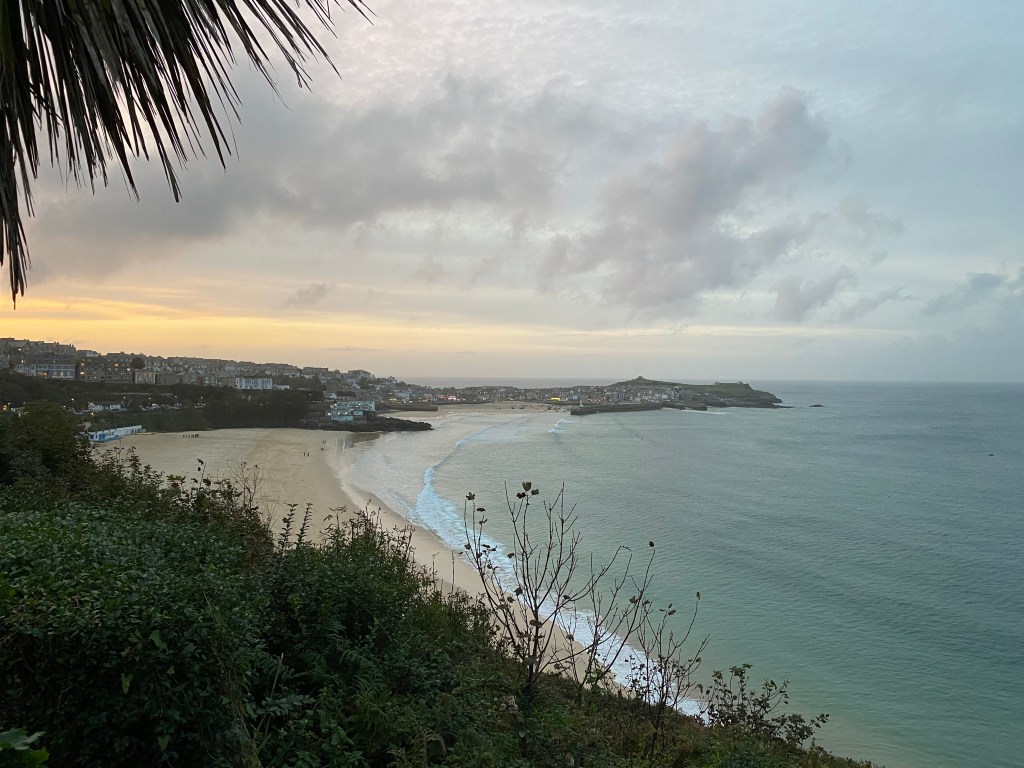
View south west across St Ives Bay from Godrevy

I am at Godrevy staring back along St Ives Bay enjoying the feeling of late summer sunlight on my face. On the rocks a group of 30 oystercatchers are also all facing west like a military parade, their black and white uniforms pristine and the bright orange of the beaks pointing downwards in diagonal lines like shouldered guns.

At Godrevy Point there is a Bronze Age barrow directly opposite Godrevy Island with a view of the great sweep of St Ives Bay: the dunes, the beaches and St Ives Head. You can see why the ancients would want to bury their dead here. If ever there was an inspiring spot to imagine your loved ones being transported to a life beyond this one this would be it.

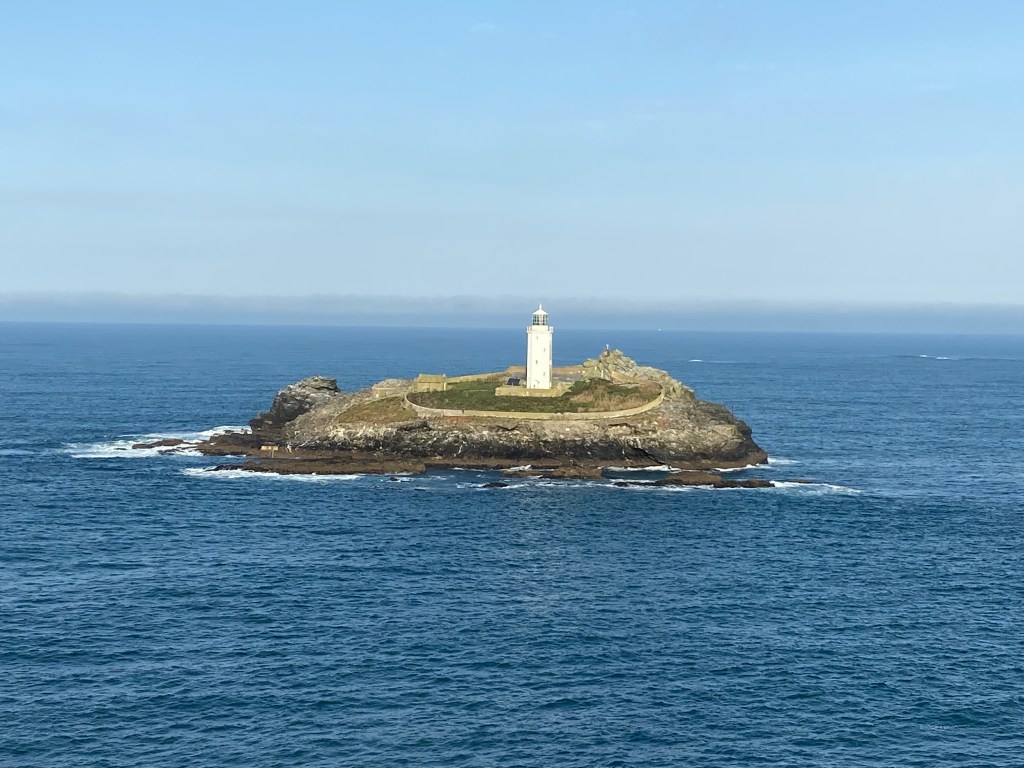
The island at Godrevy is not much more than a large rock with a little covering of grass in its middle on top of which sits the lighthouse. The 26 metre high octagonal tower of the Godrevy Lighthouse is there to warn vessels of the Stones reef which stretches from the island in the direction of St Ives.

Unfortunately, like many other rocks off the coast of Cornwall, this island has claimed the lives of various ships and their crews before the lighthouse was built in 1858. According to the Cornwall Guide “Given the number of casualties over the years, and no obligation to give the shipwrecked dead a proper burial until the 1800s, many an unfortunate sailor’s final resting place was simply in the dunes of the nearby beaches.”

It creates a sense of pathos when I think back to me struggling through the Towans two weeks ago.

The lighthouse also features in the Virginia Woolf’s novel ‘To the Lighthouse’.

Godrevy Island and lighthouse

It’s one of those moments. The morning sun is gaining strength and glimmers off the sea and the surf is brilliant white and the black shapes of surfers shine like unknown sea creatures and nothing seems wrong in the world although news stories coming from Israel this morning are a stark reminder that that is never true.

The wind is coming out of the west and seems to enter my being. It’s like plunging into cool water after being stuck for hours on end in a hot car. Why hasn’t someone written a good book about winds and their impact on people and places? Perhaps they have but I just haven’t heard of it.

Having gone round Godrevy Point, I am no longer accompanied by beaches but once again by cliffs that descend over a hundred feet to the rocks and froth of the churning sea. At Mutton Cove there is a short sand beach at the base of the cliffs.

Twenty brown seals are prostrate and unmoving on the beach. For a moment I think they might be dead until I see one of them doing that funny flopping up the beach like a person trying to crawl along the floor in a sleeping bag. There are signs with a woman’s face and a finger by her mouth saying ‘don’t disturb the sleeping seals’ and pictures of sleeping seals.

After this I pass a headland and stop to say hello to a chap sitting with pink trousers and a baseball cap with the letters RCYC on it. He is from Cornwall but spent 30 years in Sierra Leone.

We both agree what a beautiful day it is and get onto wildlife. Had I seen the choughs on the point he asked. Damn. No, I’d missed them. It must have been close to where I was sitting on the barrow. I had seen skylarks flitting about showing off that flash of white under the wings.

‘Choughs are Cornwall’s national bird’, he tells me and I say I know having been fascinated by them doing their funny up and down flight when I saw them near Zennor Head in February.

He says there were several of them flying about. After 10 minutes I say farewell and leave him to carry on enjoying the sun on his seat.

‘Nice to meet you’

‘Yes, and you’

And when I’m about 20 years away. ‘Look out for the choughs!’

‘Yes, I will!’

It’s getting warm and I put my bag down off the path and get changed into my shorts I bought from Asda for a tenner yesterday. What a relief.

Above the wonderfully named Castle Giver Cove I’m lost in thought. When I hear a whirring and a startling ding from a bicycle bell. A middle aged man is on a mountain bike coming purposefully along the path. He is in blue cycling Lycra but with the front open revealing a shining sweaty red chest around which is slung a solar panel. About 20 feet above him is a drone whirring away like an oversized insect.

‘Morning!’ he yells and I am already waiting off the path to let him through. Is he filming himself cycling? I assume so. An old couple are waiting at a gate also to let him pass. As we pass each other they both give me a half smile and half frown. It’s one expression short of rolling their eyes. Or maybe I’m just imagining it.

A little bit further on I hear the whirring of tyres and another man comes flying past with lots of mud spattered kit on. Behind him comes a blonde woman who thanks me and says “I’m not as fast as him”. I laugh and think to myself with a smile and I’m the slowest of the lot.

A bit further on I notice a fly landing on a mud stain on my hand and think nothing of it until I get off the path and onto the road. There’s that unmistakable stink. It’s not mud but dog shit. On the bottom of the rucksack and the strap and my hand and T shirt when I put my bag down in long grassto get changed. I restrain myself from not getting into a rage. It’s the new me apparently.

Thankfully I have a bit of tissue and water to get most of it off my bag. It makes me think about the amount of poo you see on the path or even more amazingly that which has been bagged in a dog poo bag and then left.

At the road near Hell’s Mouth I leave the path and turn back so that I’m heading west again. My mind is full of images of path and cliffs and sea that I’ve covered since I went pass Land’s End last year and thinking of all that is yet to come on my snail’s pace solo mission when I get back here in 2024.

SWCP: Carn Naun Point to Higher Burthallan September 25th

I’m having my lunch and watching a solitary magpie fuss about in the heather before it appears with a silvery squiggle in its mouth. The magpie flicks its head vigorously from side to side in a little blur of energy while the shining squiggle contorts into different shapes.

Surely that strategy doesn’t work to try and stun or kill a slow worm – for I’m sure that’s what it is although its scales are actually more gun metal grey than silver. It must be the reflection of the sun. I guess the bird is unused to discovering such a thing. As for the slow worm why hasn’t it performed its wonderful magic trick where it ‘automises’, in other words removes its tail as a decoy to distract a predator before it makes its getaway. I guess it didn’t have time.

Before I have time to wonder what the outcome of this mini drama will be the magpie suddenly flies out of sight, the legless lizard still in its mouth now curled up into a perfectly formed spiral.

It’s about 1pm and I’m at Pen Enys Point about a mile from Carn Naun Point where I stopped last time. That was Valentine’s Day this year. Seven months ago. That time it was choughs with their flashy red legs I was wondering at who like magpies were historically seen as troublemakers and in the chough’s case firestarters with their habit of stealing lit candles.

I remember when I reached Carn Naun Point wondering when I’ll reach Somerset and the end of the path. According to the SWCP distance calculator from St Ives (my next stop) to the end of the path at Minehead is 232.5 miles. If I take a break of 6 or 7 months between each visit and average 10 miles each walk it will be 11 years until I finish it. I will be 60. It has taken me over 7 years so far so perhaps completing 232.5 miles by the time I reach retirement age is a good target to aim for.

‘Come on slow coach’ as my dad used to say. No no, there is no rush. All in good time. It may not sound like much but taking it steady, going gently is the most valuable thing in my life right now.

Today feels like autumn: a stiff, fresh wind coming off the Atlantic and the sun appearing intermittently from behind large drifting clouds before disappearing again.

Below the cliffs near Pen Enys Point autumn swells are arriving at an angle to the land, rearing up and then breaking onto the rocks creating blindingly bright white surf. After each wave breaks the surf slides over itself in thin layers like cream being spread over a cake. The power of the waves stirs up sand from the bottom so beige clouds appear below the surface like small explosions. All around the sea is the colour of jade.

Sea froth near Pen Enys Point

Above Burthallan Cliff the path becomes a walkway of huge uneven rocks. Stepping from one to the other I notice a man with white hair and a walking stick sitting on the side looking askance at the path. He tries to stand up, his hand and arm wobbling as he leans on his stick and then sits down again.

When I reach him he asks me the way to Burthallan Lane ‘as I’ve got a bit lost’.

I will call him Robert. He has neat white hair, the forelock blown by the wind. He is diminutive and slightly hunched but his face is fresh and his eyes lively. He wears a shirt and slacks with Clarks shoes. His grey jumper is tied round his waist but slipping down, its neck almost touching the ground. Over his shirt he wears a Mountain Warehouse padded jacket.

He is from Risca near Newport. As we start walking I ask if I should call his daughter.

‘Oh no. Don’t do that. I’ll be in trouble.’

I imagine her reaction when he gets home.
For over thirty years he worked for the local government in Derby where he moved to with his wife. She had died two years ago. He tells me that he used to come to St Ives with his parents as a child and now he’s come back with his daughter and son-in-law. As a child he stayed in a place “in Downalong near Smeaton’s Pier. It was just a one-up-one -down place and we only had a basin to wash out of. Nothing else.”

“It was owned by a woman called Honor Stevens. There was a ship called the SS Alba. It was carrying coal from Wales and it was wrecked just off the island at St Ives.”

“There were 8 crew and 7 were lost. Honor lost her husband, her father and her brother that night. Some people just seem to have tragedy in their lives.”

Imagine it. How quickly our lives can change and how transformative that would have been for her. However he tells me she still always seemed cheerful despite her loss.

When I look it up later Wikipedia tells me that the SS Alba sank on January 31st 1938. Apparently the ship got caught in a northwesterly gale and the captain “mistook the lights of Porthmeor for the lights of St Ives, and Alba went aground on the Three Brothers Rocks.” The rocks are just off Porthmeor Beach on the western side of the town and according to a local guide, stivesbythesea.co.uk “all that now remains of it (the Alba) are the boilers which can be seen at low tide on Porthmeor Beach.”

All the crew (there were actually 23) were rescued by an RNLI boat but it was this boat that then turned over and 5 of the crew died, all of whom were Hungarian. Were Honor’s loved ones in a different wreck or had Robert just got his facts wrong? I’ll never know.

He asks me about my life and I tell him about the period of transition I’m in, leaving teaching and starting journalism. He tells me about a school his daughter works in which is Catholic and they have assemblies every morning. Somehow we get onto faith and I tell him about being brought up a Christian but now a non-believer although still a lover of some of the traditions of the church.

I lead him up the cliff to Burthallan Lane him linking arms with me when we have to walk over rocks and stopping frequently so he could catch his breath. Halfway up the cliff I offer to take his jumper and put it in my ruckcask. I wonder what he was thinking setting off on the coast path.

Near the top I ask how old he is. “I was born in 1932. I served the King and then the Queen doing my National Service.” 91 years old and mucking about on the coast path. I had to admire it even if it did seem a bit rash. I would be doing the same if I was lucky enough to make it to that age. Will I complete it before I reach 90? Who knows at this rate but if not it’d be something to be proud of: half a lifetime on the path!

At the top the path started to flatten out and I could see the beginning of a road beyond the gorse. Robert turned to me: “Oh, I know this now. For someone who said they didn’t have belief you’ve been more kind to me than many Christian people would be. I’ll remember this.” And so will I.

A pause as we shake hands and as I’m about to walk off he gives me a half smile and in his lilting Welsh voice:

“And now if you don’t mind I’ll have my jumper back. You can never be too sure about these Bristol people.” We laugh and turn at the same time.

When I get to the bottom of the cliff I finally get my first sight of St Ives and there is Porthmeor Beach and the grave of the ill fated SS Alba.

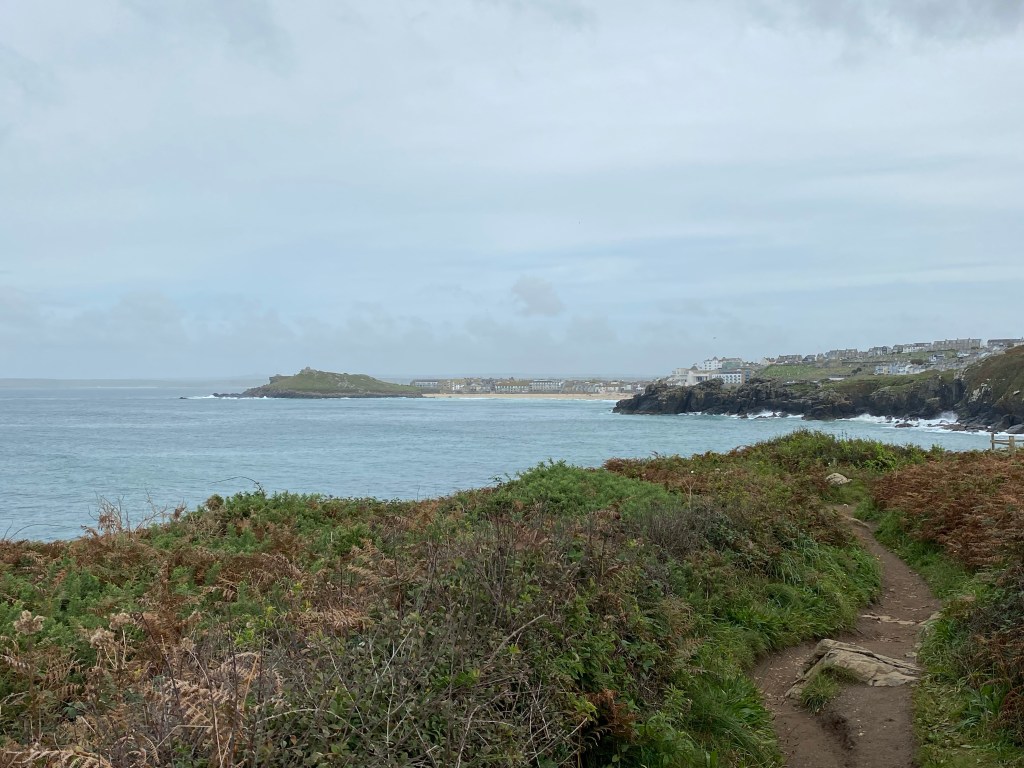
Porthmeor Beach and St Ives approached from the west

SWCP – Carbis Bay to Lelant September 26th 2023

Carbis Bay

I wake at 7 to the sound of excited shouts. It’s those first few seconds of waking – rising to the surface of consciousness- that I always find intriguing: the not knowing where I am and then the feel of cold air on my face and the sudden reminder that I am enshrouded in my bivvy bag, normally on some rocky outcrop.

The next thing I notice is the sound of the water dripping from the rocks and the high pitched squeak of a bird close to my head. When I push up my eye mask there are three bathers out at sea, half of a family whose other half stand on the beach and shout words of encouragement or mockery from the shore.

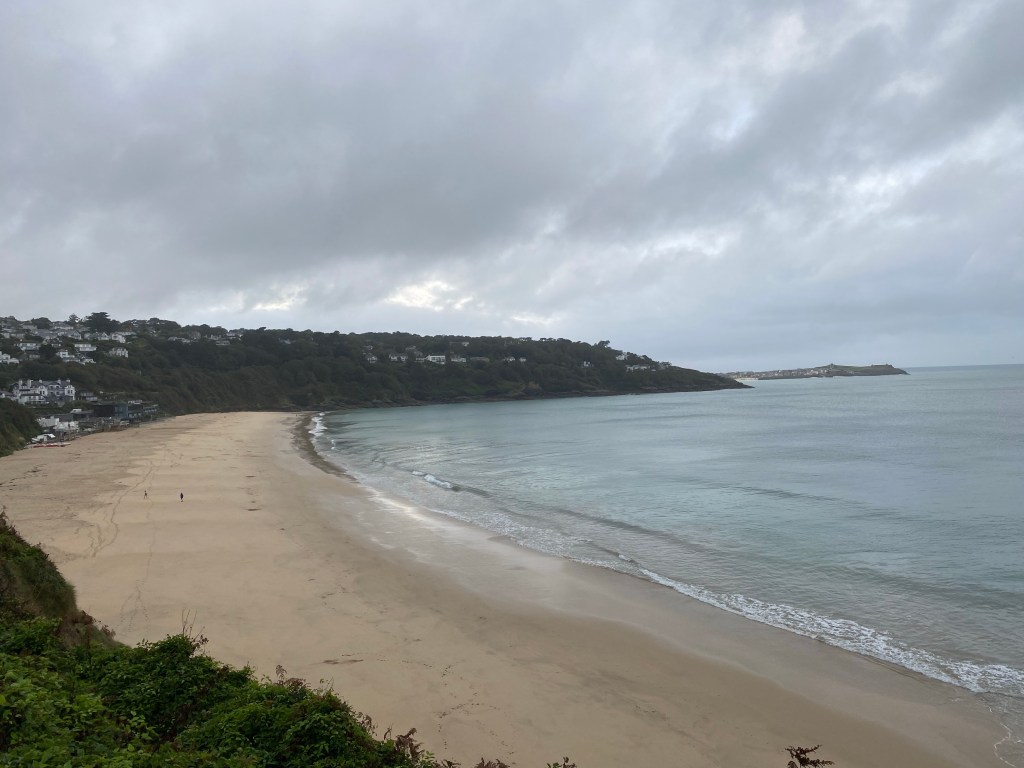
The beach at Carbis Bay is a gentle crescent of neat white sand bordering the glassy water of the sea. It’s nice to have a bit of company so early in the morning and it prompts me to join them in the gently lapping water. It’s cold and I’m immediately awake, listening to my breath amplified and thinking of little else.

View from my sleeping bag, Carbis Bay

Once I’m packed up and back on the path I have that sense of satisfaction from being immersed in the outdoors, a subversive pleasure from not being just outside but also a sense of being a sort of ‘outsider’, living briefly outside the normality of everyday life, a wanderer whose life is a journey where walking is one’s existence that continues uninterrupted apart from to stop and eat or lay down and sleep.

I am aware this is a conceit. I am only play acting or imagining being the solitary traveller who spends his life on the road – tomorrow night I’ll be tucked up in my bed and getting ready for work the next day – yet it is a fantasy that exerts a strong pull on my imagination so much so that I’ve done this for as long as I can remember: taken myself off with a map, a sleeping bag and no plan but to be alone outdoors.

The morning is overcast and still but the warmth of late summer has lingered like the glow after a lover’s touch on my skin. This coastline is distinctive for the huge swathes of sand that border it. At St Ives, Carbis Bay and then Porth Kidney Sands which is devoid of people and doesn’t appear to be real, like a print on a wall. This is only the start: from the mouth of the River Hayle sand dunes continue for several miles north east until they end at Godrevy Point.

Porth Kidney Sands

Along the low cliffs I wind through the dunes, the path a line of sand amongst whispering long grasses. The branch line that starts at St Austell and ends at St Ives hugs the path here, the half hourly train my only company. It is not quite 9am.

St Uny church in Lelant sits atop the dunes surrounded by a golf course. It is here that St Michael’s way passes through and for a short stretch shares the SWCP. It was a stopping off point for medieval pilgrims en route to Santiago de Compostela.

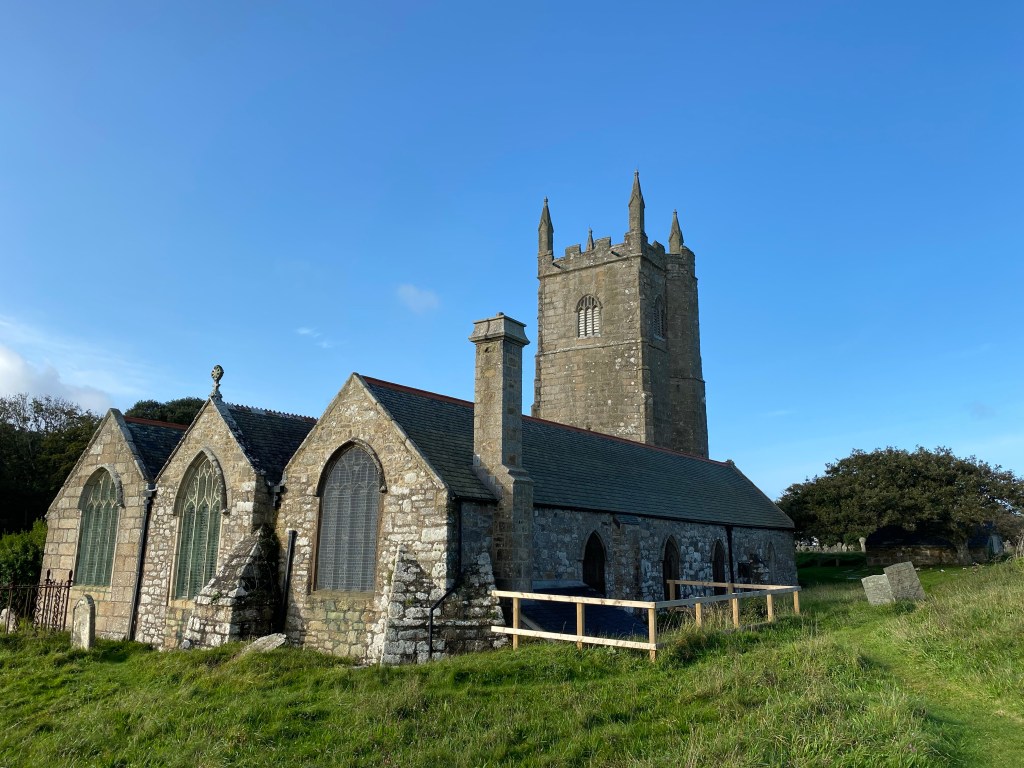
St Uny Church, Lelant

According to The British Pilgrimage Trust website ‘The route was created after the discovery of ancient shipping rosters proving that pilgrims historically came to Lelant by sea on their way to Santiago de Compostela, and travelled over land to Marazion to avoid the waters of Lands End.’

Many people walk the way today. There are St Michael’s Way passports where modern day pilgrims can get stamps en route to show their different stops.

Inside a local couple are vacuuming and polishing the floor and pews respectively. Over the sound of the hoover she says “We’ll have to do this for Harvest Festival too”. When is it I wonder? And have childhood memories of our local church in Suffolk and Sunday school with displays of fruit and vegetables and tins of preserved food in baskets.

According to an aged looking board in the church in the year 600 marked the ‘arrival of St Uny, St Ia & St Ana, Celtic missionaries. Lelant an important and prosperous port’

A Norman church was built in 1100. In 1549 came the reformation where Henry VIII seized all assets.

Then in 1590 ‘sand storms and wind. Harbour and estuary silted up. Begins to cover village between harbour and church.’

‘1700 village covered by sand. Vicarage uninhabitable.’

‘1750 marram grass planted. Sand dunes stabilised.’

I hadn’t expected the dunes – such an obvious and enormous presence here – to be a threat to the community. And the modest marram grass that hushed at me earlier, who would have guessed at its importance?

When I get outside the church the cloud cover has disappeared and it is bright and clear and the westerly wind smells clean. There is a stunted oak at one corner of the church, a small chapel and a few graves. I stand here while the leaves shiver and breathe above me. In August I went to the Ancient Greek site of Dodoni in the Pindos mountains in Northern Greece where worshippers of Zeus would come to worship under a holy oak and where an oracle would interpret the movement of the leaves to make prophesies.

Thankfully, today I’m in no mood for prophesying; I’m thinking of right now and nothing else. And on I go towards Hayle.

SWCP St Ives to Carbis Bay September 25th

I’ve been thinking a lot about walking slowly over the summer. I was walking the Monarch’s way. I was walking in the Pindos mountains in Northern Greece (to the bottom of the Vikos Gorge, the steepest gorge in the world) and just walking daily around Dorset, Somerset, Bristol or Suffolk.

On one of these walks it occurred to me how this ambling around observing, thinking, poking my nose in places or talking to strangers has been a sort of subconscious escape from the stressors that seem to get in the way of me being the calm, happy person I once was. And now I realise it is more than that: it is a way of making myself better.

Thinking back, as a child I was always slow; always told to keep up: either lagging behind the group or daydreaming. As I’ve said before I used to infuriate teachers because I was so often absent – mentally – preoccupied with important stuff like how light changes the appearance of leaves whilst I was supposed to learning about Pi or pronouncing ‘comment allez vous’.

And now I realise that when I was teaching – for the last fifteen years – I was always trying to keep up. There is always something to do next in teaching. When one thing is completed three more will spring up that need doing like now or in the near future. Any teacher can you tell this. And there are so many unknowns because you’re working with a group of teenagers who may or may not want to be in the room with you and have a huge variety of different characters and skills or needs. And of course this is what makes it one of the best jobs in the world but also stressful if – like me – you’re just a bit slow.

So I’ve been buzzing for years like a broken motor that won’t switch off. High on adrenaline most of the time, the fight or flight response kicking in regularly at work but then also regularly when not too.

So I’ve left teaching and I started a sleep improvement programme on September 7th. I can’t drink alcohol. I must do yoga and regular breathing exercises twice a day. I have to be strict with what I eat and not eat too late. I go to bed at the same time every night.

And I feel great. I feel normal. But normal is wonderful because now I realise I haven’t been feeling normal for years. I need to take it slowly. And the walking? Well it helps me slow down. It helps me not think ‘What next?’ ‘What about that thing I’ve got to remember to do?’ What have I forgotten?’ I’m not sure about the word mindful – it doesn’t seem to convey the right meaning for me – but that is what many people would say I m doing with my slow walking around the coast of south west England or along the paths where Charles II once fled or just wandering through woods or gazing up at the carved roofs or the vividly coloured windows of churches. Or being in the sea. It’s a form of waking dreaming and it’s helping me get the old me back again.

I have gone round St Ives Head and walking past the beach bar near Bamaluz Point I hear a man on a microphone say in a rousing voice “ladies and gentlemen please be upstanding for the bride and groom” and see them walking in from the outside into the function room above the day glow rugby balls and footballs and ice cream ads while the applause echoes within.

I turn into a little lane and realise I’m in Downalong. Cobbled streets wind between old grey stone buildings which appear like they have stood unchanged for years. This is where many of the oldest houses in St Ives are.

Pier House, Downalong, St Ives

I imagine how it would have been after the war when Robert used to stay here or before that when Alfred Wallis painted his flat houses and boats at Porthmeor.

St Ives is still buzzing even though the summer holidays have ended. A family make sand castles on the beach. Dogs frolick in the sand. The pubs and seafood bars are full. Bunting and the black and white flag Kernow flap in front of the beach restaurant

View beyond Smeaton’s Pier, St Ives

I pass through the bustle of holidaymakers enjoying the feeling of people around me but also looking forward to the solitude that I know will return soon once I leave the town.

I’m following the road that hugs the coast as St Ives creeps around the cliff edge. A half light appears over Smeaton’s Pier which catches the jade of the sea beyond the sea wall. I pass the vast expanse of sand that is Porthminster Beach and see one family bouncing up and down in the shallow water, screaming and whooping.

It’s approaching 8pm and it’s getting dark but I’m unphazed. I started a bit late and then helped Robert find his way home but time doesn’t matter – I have a sense that I could just carry on walking until my head starts to nod. In the twilight, as my senses adjust to the dark blanket being lowered over everything, there is a greater sense of being part of the near world as sight doesn’t become the primary sense being used. It seems to induce a sense of calm in me and for almost an hour I am walking without expectation or a sense of what lies ahead – only intent on putting one foot in front of the other.

St Ives twilight

The winding coast path is followed by the railway here that snakes its way around the coat like a toy train hooting and flashing cheerfully as it passes me by.

At about 8.45 I start descending the path into Carbis Bay which seems to be one big resort of various rather cosy looking chalets or that is how it appears from the path.

After the Carbis Bay resort the path gets lower and lower and I can make out the reflection of wet sand on the beach. I can hear water dripping from the cliffs onto the beach. Is this somewhere I could sleep? I’ve learnt there are two main factors for me to consider when sleeping out. A flat surface and being sheltered from the wind. Carbis Bay beach tonight seems to have both. I can see the lights of St Ives harbour reaching round to Bamaluz Point just west of due north where I passed the wedding earlier. If I sailed due north from here I would pass St David’s Head to the east visible from my little bark and end up in Wicklow south of Dublin.

I am cosy in my sleeping bag and out of the wind and as I drift off into the mini voyage of night time reverie I am aware of an ancient repetitive voice like an elongated out breath. It is the sea hushing me to sleep.

The Monarch’s Way, Chideock May 31st 2023

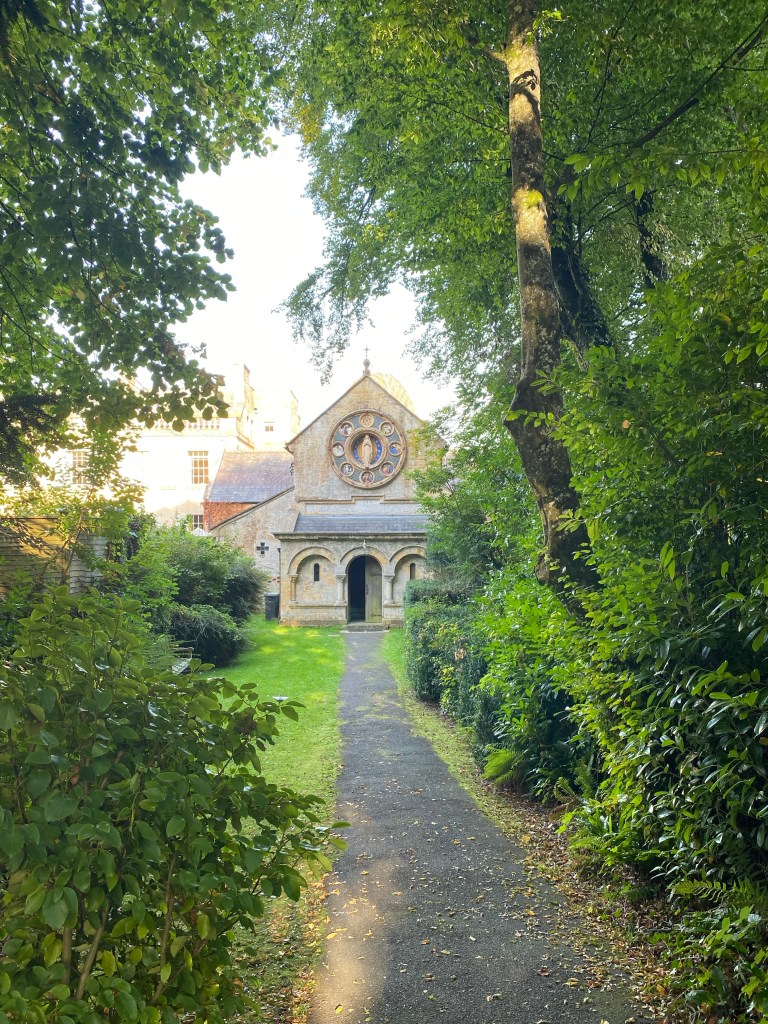
The approach to The Church of Our Lady, Queen of Martyrs, and St Ignatius, Chideock

Strictly speaking, I’m not on The Monarch’s Way but have come off it to return to my car and to spend some time in the company of a gem of a place hidden off a lane in south Dorset.

In my mind I still have images of giant wild boar, hidden cathedrals and coffin bearers walking down long paths in the Forest Dean described to me by the cheerful man with tattoos and his wife who were walking from West Bay to Golden Cap and had got lost en route. Brief encounters. Like all meetings, some are just infinitely better than others.

I pause and let the sounds of the near world return to my quietening mind. The gentle breathing of the trees, a male blackbird’s song and somewhere the gentle splashing of water.

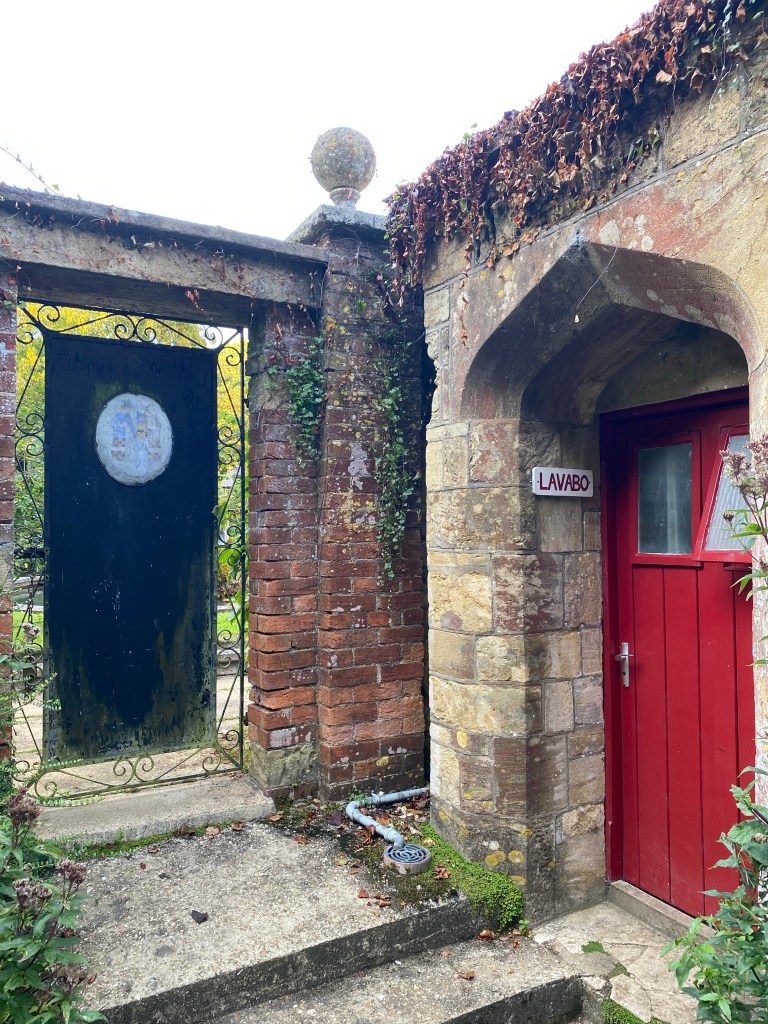
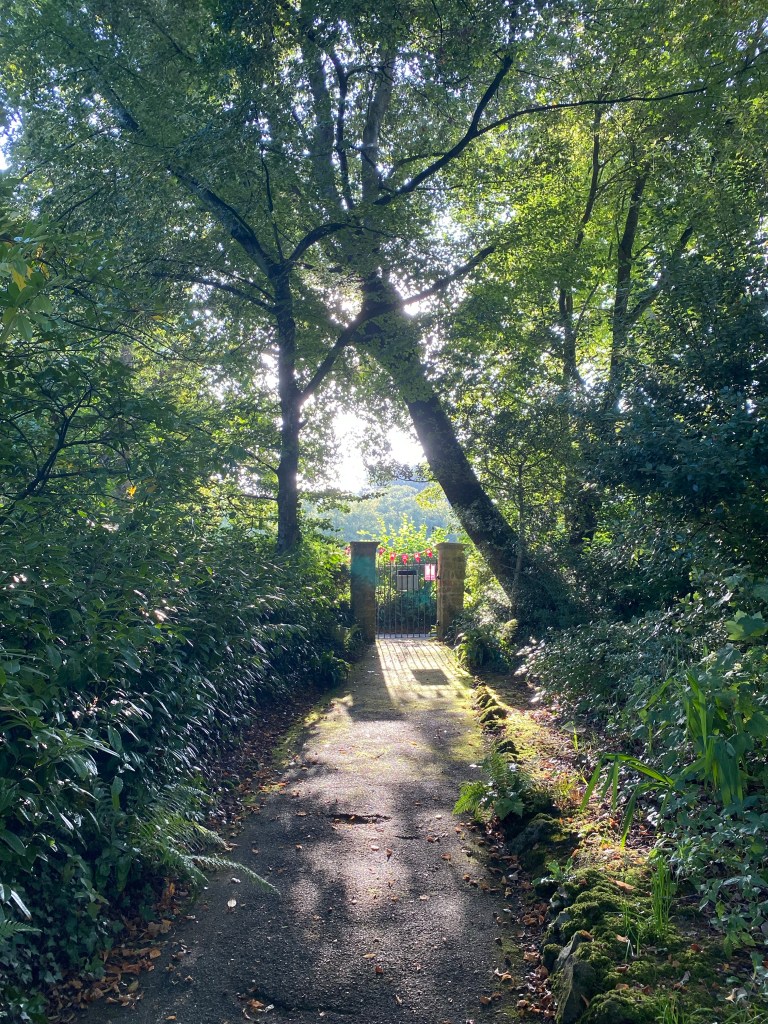
Through an iron foot gate a path leads through overhanging ash trees down to a church. The dip in the land and the framing of the trees and the coolness of the air create a sense of transition, a crossing over into a seemingly ‘other’ space, like entering a deep green pool. Grass borders the path and a wooden bench sits looking at the church porch. The path bends around to the left of the church front and stops at an arch with a red door with ‘Lavabo’ painted in red letters on a white wooden sign. Next to this a black metal gate built into the wall is a side entrance to the garden of Chideock Manor. From behind it I can hear the splashing of a fountain landing on stone and the excited shrieks of children jumping into a swimming pool.

Built in the grounds of Chideock Manor, The Church of our Lady, Queen of Martyrs, and St Ignatius is one of the most beautiful and unusual churches I have ever visited. It is not typical of an English church but more like something you might find in the back streets of Florence.

According to a leaflet inside the porch the church was built by Charles Weld whose family lived at the manor for two hundred years and was finished in 1872. “Weld designed the church in the Italian Romanesque style and did much of the work himself…The front of the church recalls the early churches of Tuscany.”

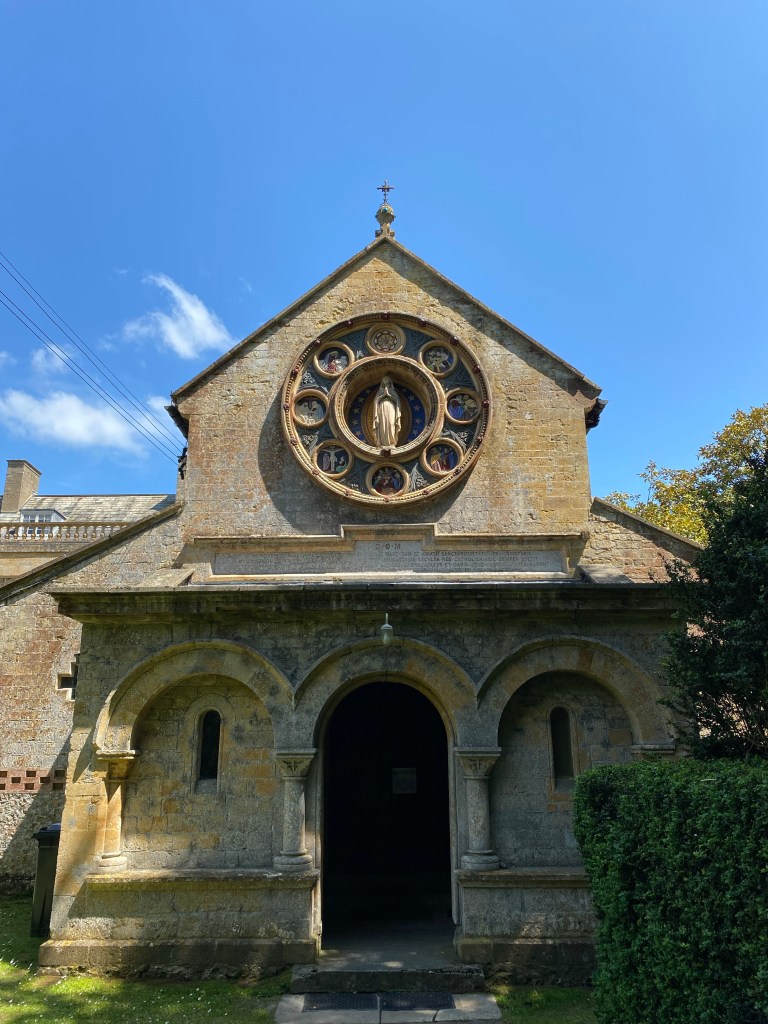
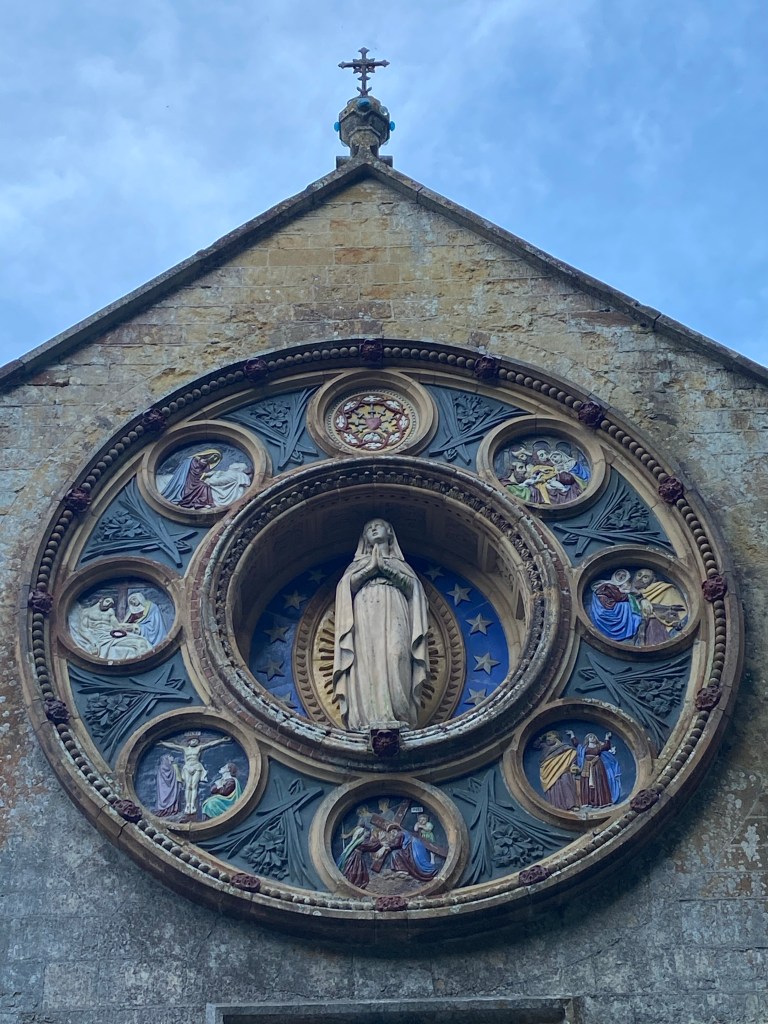
Above the entrance is a roundel made from painted terracotta which “features a statue of Our Lady, Queen of Martyrs, encircled by her Seven Sorrows.”

The terracotta roundel above the entrance

The leaflet goes on to reveal the poignant story behind the building of the church as this is a shrine to seven Chideock men who “were cruelly put to death for their Catholic faith between 1587 and 1642” after England officially adopted Anglicanism in 1559 and Catholicism in England was outlawed.

Originally this was the site of Chideock Castle built in 1380. In the late Middle Ages the castle was bought by the Arundell family. When Catholicism was banned they remained loyal to their faith and the castle was somewhere where Catholics could come and worship although it was illegal. The castle was captured and destroyed in the Civil War by the Roundheads on July 29th 1645 (six years before Charles II went on the run). It was then that the Arundells left. Locals continued to worship the old faith in a barn and the loft where masses were held in secret. The loft can still be accessed from the sacristy in the present day church by appointment.

It was in 1802 that Thomas Weld who owned Lulworth Castle bought the estate for his son Humphrey. It was he who according to the leaflet “built the present Manor House and turned the barn into a modest chapel.” It was Humphrey’s son, Charles, who converted the chapel into the wonderful church that I am in now.

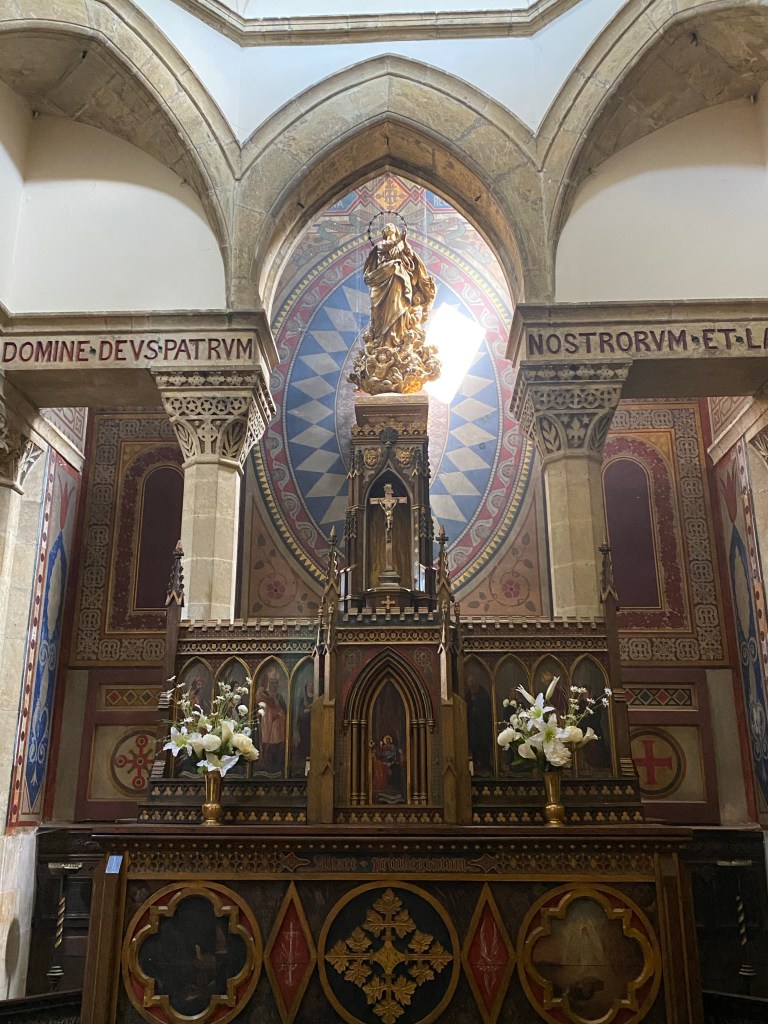
Inside my first impressions are of a well maintained church that one might see in a wealthy part of London. The nave is lined with beautifully carved arches above which are portraits of the martyrs. Beyond this lies the chancel wherein a Baroque statue of Our Lady is lit up by the sun streaming through the windows in the dome. One can’t help but imagine her rising up to heaven, on the day of her assumption being welcomed by the light of God.

The altar and statue of The Virgin Mary under the Dome in the Church of Our Lady

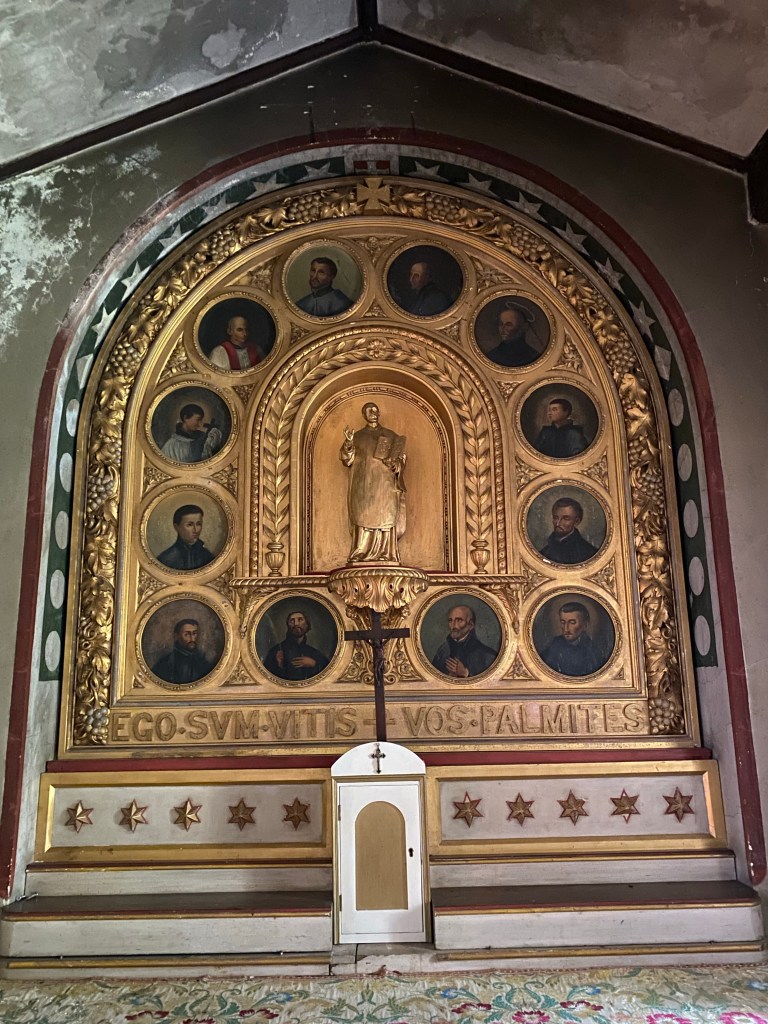
It seems like every feature has been thought of and designed with great attention the details. A wonderful altar sits in the south aisle of the church with a gold arch in which there are twelve portraits of men. Is this another tribute to the martyrs and if so why are there twelve men here?

Altar in the south aisle

On the north side a room that flanks the whole side of the nave with tables and chairs like a reading room and lots of literature related to the history of the church. It feels like a reading room. There are also all sorts of unusual souvenirs such as cannonballs from the civil war, huge mantraps on the wall and evidence of relics that apparently are kept here including a fragment of Thomas More’s hair shirt and a piece of the True Cross.

Not for the first time I wonder at the multiple treasures that are hidden across England but also these markers of our often violent past. Without realising it all the time I wander through places where blood was spilled, people were once persecuted for their beliefs and where many had to continue their God-given daily routines and rituals in fear of being discovered and executed. I think of Charles II and royalists loyal to him also on the run, in hiding and in fear of their lives at the end of the same civil war that destroyed the castle here and forced local Catholics to worship in the barn nine years after the last of the martyrs was executed. I think of those people in far flung places from here who today have to live their lives in fear just because of their beliefs or race or nationality.

For all this I am in awe of the incredible, delicate beauty of The Church of Our Lady. This little place has bestowed a sense of peace on me after my long walk. For once my mind is silent as I float through the light that is thrown down from the dome. I have a heightened awareness of the coolness of the nave, the great silence of the space and the smell of old wood as the martyrs look down on me, knowingly.

Foot gate to The Church of Our Lady, Chideock

The Monarch’s Way Axen Farm to North Chideock May 31st 2023

View from Axen Farm track south to Colmer’s Hill

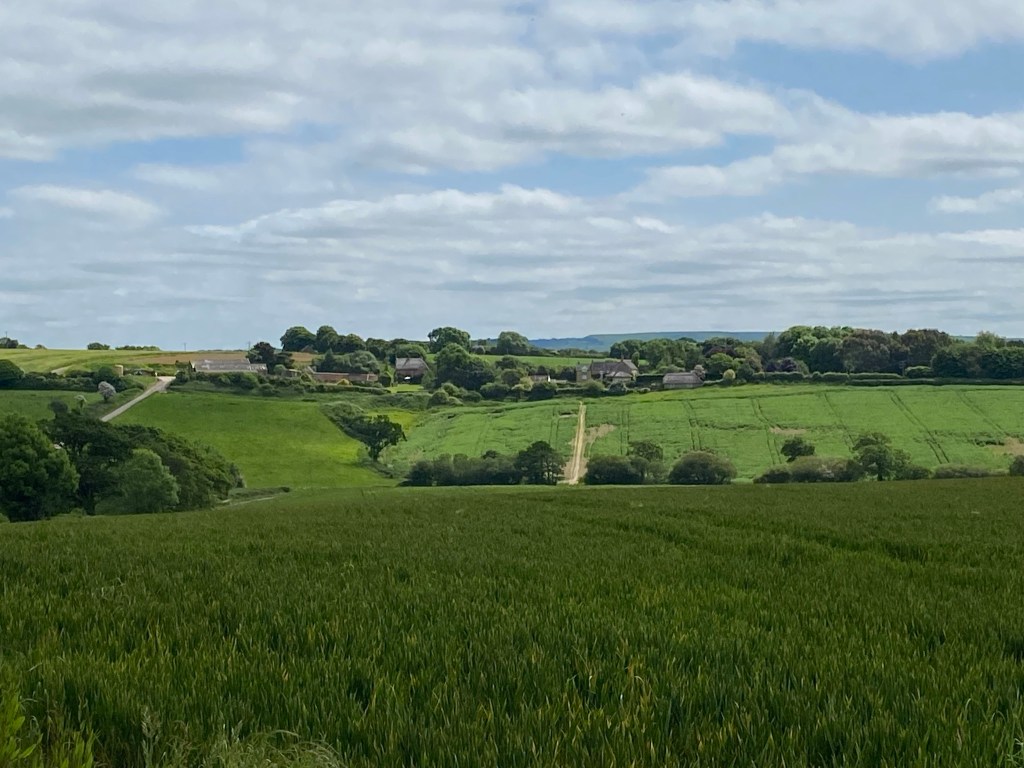
I’ve climbed the hill the other side of Bilshay Farm. I can just about see the place where I got lost in the sound of the beech leaves, the place with the figure floating through the field. I am walking west in a big loop as Charles II did after his attempt to get on a boat from Charmouth failed and he had to make a run for it back to the safety of the manor at Trent (I walked through there two years ago).

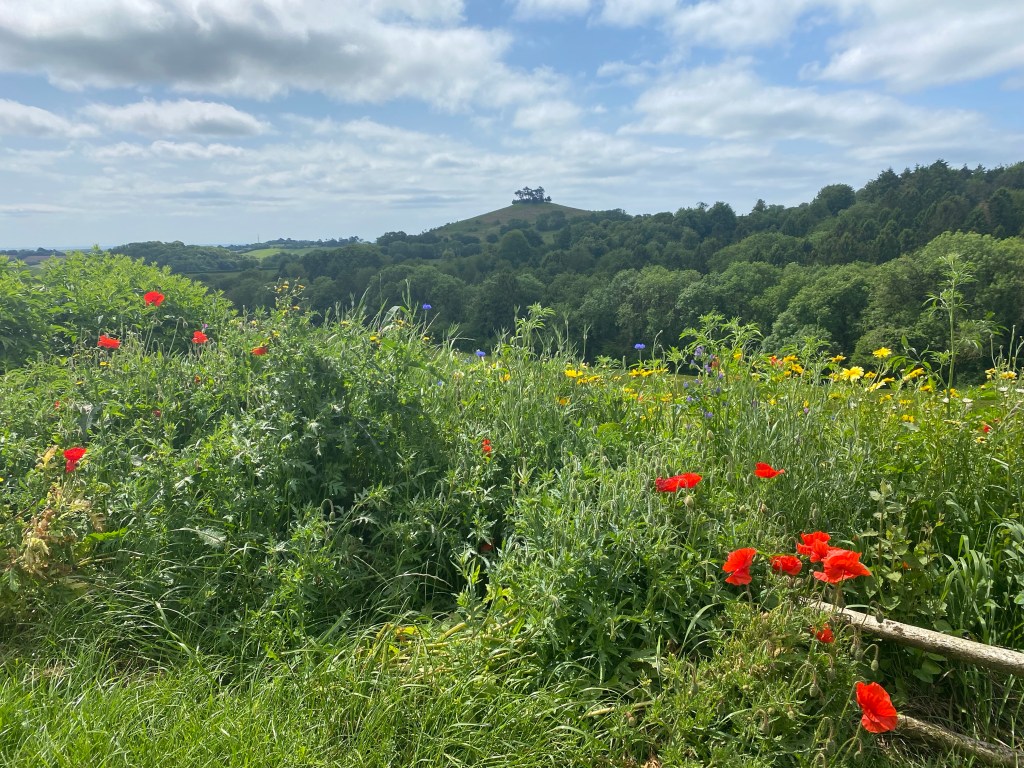
Here on the track to Axen Farm there is a seat made out of a tree trunk sawn in half lengthways to create a wide flat bench. I am looking over a bank of wildflowers towards the little copse on top of Colmer’s Hill and to the left – the south east – the sea and a ship a speck on the horizon. The flowers must have been planted deliberately, their impossibly bright blues, reds and yellows jaunty against the backdrop of the green of the Dorset hills. As I look towards the horizon something rises up indistinctly from the murky depths of my memory, something beyond description, which takes me back to being very young and driving and someone saying ‘Can you see the sea?’ Anticipation. Excitement. And something else I can’t quite put my finger on. Yes I can.

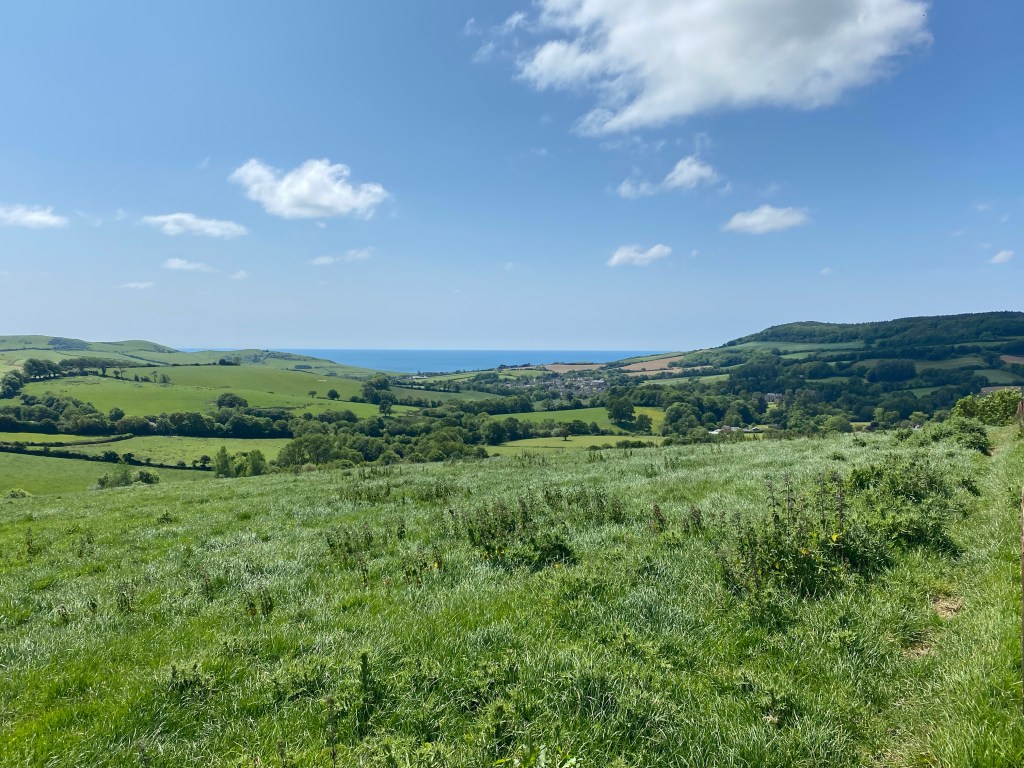
The line of the sea beyond Bridport

At Axen Farm, there are big barns surrounded by a concrete hard standing. There is CCTV with a sign saying that I am being watched. And there is an outside tap. I haven’t been able to fill my water bottle since last night. The beauty and magic of running water. It reminds me of that poem we used to teach by Imtiaz Dharker: ‘The sudden rush of fortune..the silver crashes to the ground’. I fill my bottle and wash my face and neck and when I’m done I nod briefly to the camera imagining how I look on a screen.

I turn at a right angle north up Henwood Hill. I slow down. There are almost 360 degree views of the curves of the hills below. I stand chest out and breathe in the wind the way dogs do when they face into and sniff wind. Chideock is towards the south west nestled into the hill surrounded by trees. All the buildings face north away from the sea.

Suddenly there are people. The first time I’ve come across anyone since I was harassed by the dogs at Bridport. First a man closely following a paper map. He seems quite tense with his little wire haired terrier beside him. He’s from Newton Abbott and is here looking for holloways, the many tracks in these parts that have sunk deep into the land after hundreds of years of use by pedestrians, carts and animals. He’s been inspired by Robert Macfarlane’s book ‘The Wild Places’ which he shows me in his trouser side pocket.

I was thinking of that book while I was under the beech earlier. Why? There was something in it that I remembered. Was it that he was walking around here? I had also been thinking about Rogue Male, Geoffrey Household’s brilliant spy thriller about being on the run from foreign agents in your own country and how Roger Deakin loved that book. In that book the protagonist hides in a hollow somewhere near Chideock, in other words somewhere around here. Deakin and Macfarlane came here once to seek out the place it was set.

The man from Devon was negative about the paths. ‘I’m glad I put my trousers on. The paths aren’t very well looked after. You get the impression you’re not very welcome here.’

I had that feeling briefly at Bridport but it’s all in the mind surely.

Charles II apparently also felt harassed in Bridport. After his opportunity to escape from Charmouth aboard a long boat never materialised (the captain of the boat’s wife had an inkling her husband was helping royalists and locked him in his room!), he and two others fled to Bridport only to find it full of soldiers. Instead of shying away as was advised the king decided on the opposite tactic. Charles wrote his own account of his stay there (he stayed at the George Inn, supposedly the best pub in Bridport at the time). He wrote how “we found the yard very full of soldiers. I alighted, and taking the horses thought it the best way to go blundering in amongst them, and lead them through the middle of the soldiers into the stable; which I did, and they were very angry with me for my rudeness.”

It transpires that Bridport had actually been a mainly Royalist supporting town during the civil war. Some years later when Charles’s eldest (illegitimate) son, James Scott, the Duke of Monmouth tried to start a rebellion against the then king James II in 1685 he met great resistance at Bridport where apparently “they encountered 1200 men from the local Royalist Dorset militia” (Wikipedia).

I leave the path at Venn Farm in North Chideock and meet a couple in their sixties from the Forest of Dean who had walked from a holiday park in West Bay and were asking for directions to Golden Cap. They are both full of energy and carefree chat. I take to them instantly. They both have West Country accents. They tell me about the problem wild boars cause in their village. ‘They’ll tear up your garden. Imagine something the size of a cow with little legs. If you hit one with your car it’d write it off.’

When they have babies they call them humbugs his wife tells me “because they have stripes.”

They tell me about Newland in the Forest of Dean called ‘The Cathedral of the Forest’ and the pub next door called The Ostrich. He tells me: “People would get buried there from Culford and they call the path the coffin trail because the people carrying the coffin would have to walk 3 or 4 miles to carry the coffin. Along the route are big stones where they would put the coffin down so that they could rest.” I promise to visit.

I say goodbye to them outside the Catholic Church in the grounds of Chideock Manor. His final line is ‘Are you looking for divine inspiration?’ With a laugh and a wave they walk on towards Golden Cap.

Monarch’s Way Pilsdon to Broadwindsor July 16th

Today is a Sunday and I am at Pilsdon Church just a few miles north of the Marshwood Vale and Chideock where I stopped in May. Since then I did a tramp at the end of June and slept out in a hollow under some trees overlooking Ryall while it rained as the last light of the day faded to black.

I didn’t sleep much and the following day the tramp became a trudge with my feet feeling like lead and the rigours of nettle stings and wet legs more of a frustration than normal. I ended up here at Pilsdon church in need of a rest. In the meadow next to the church there were two people in white with net covered heads attending to some bees, their movements slow and deliberate.

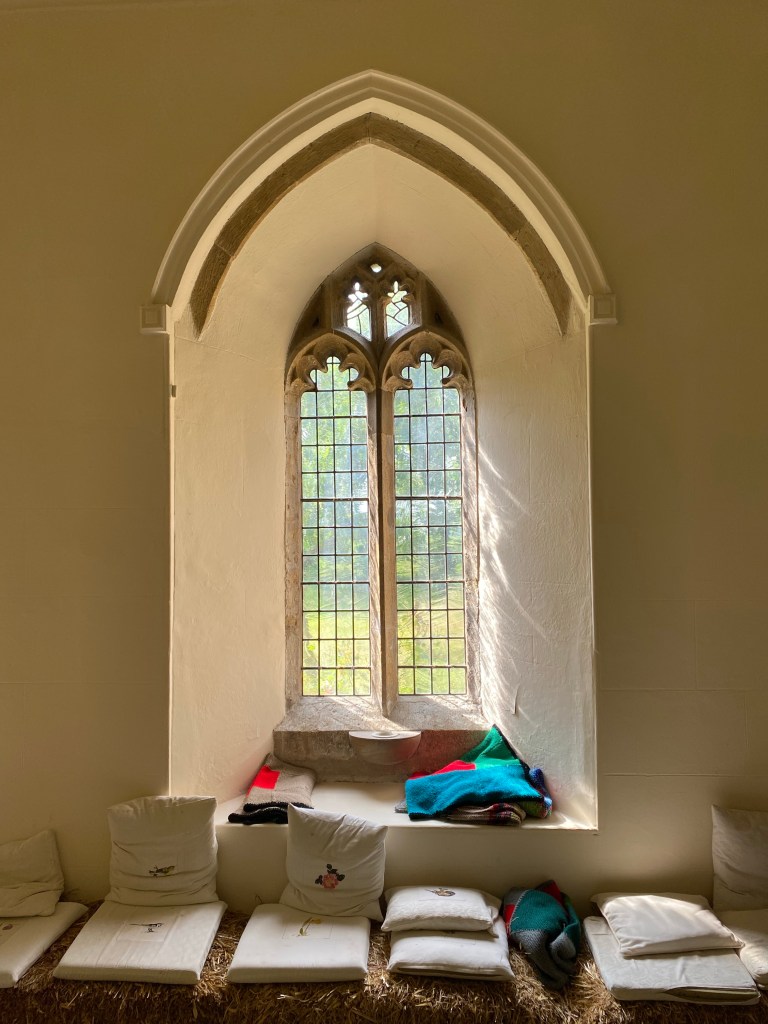
Inside the church there were no pews. Just hay bales lined neatly along the walls. I thought of people in the past who sought refuge in churches. I think of the young man who my dad once found sleeping in the church next to my parents’ house when he went to lock up. He left him to it and went to bed. I think of the now popular pastime of ‘champing’ (church camping) where people pay to sleep in churches.

To me there is something comforting about a church especially after wandering miles alone in an unknown landscape.

I lie down on the bale and feel the peace of my surroundings; there is a sense of calm in the otherwise birdlike flutter of my heart.

It soon dawns on me there is something different about this church. It feels a little more ‘private’ than a conventional parish church.

Pilsdon Church

In 1958 Percy and Gaynor Smith decided to establish a community at Pilsdon Manor (next door) modelled on Little Gidding, ‘the first Anglican community after Henry VIII’s dissolution of monasteries’ which was set up by Nicholas Ferrer in 1625.

According to The Pilsdon Community website ‘Since 1958 the Pilsdon Community has been offering a refuge to people in crisis, welcoming those from all backgrounds. Pilsdon is a community that shares a common life of prayer, hospitality and work’. At any one time there are 25 to 30 people living there who also work the farm. There is the manor, the church and a farm. They bake their own bread, grow their own vegetables and enjoy milk, butter and cream from their own herd.

The warden leads the community and they worship 4 times a day in the church. At Little Gidding the guests were said to have found the ‘’spirit of joy and serene peace’, a peace that continues today at Pilsdon’.

I park my car in their drive. There are middle aged men wandering around quietly. Mary must be in her thirties. She had been working and living here for 7 years. She talks about the benefits of ‘the steadying of a contemplative lifestyle’. She tells me how they live here not to seek an outcome or achievement but ‘living with the seasons’ and finding the joy and rewards of ‘living in the moment’. She had come from a stable, joyful background but says how she finds rewards in living alongside people who have suffered or experienced ‘relationships that have been broken’. She says how they follow the vision of Little Gidding and T.S. Eliot’s poem of the same name is about ‘returning to the start’ meaning we ‘end how we start’. It’s a little ambiguous but I think I know what she means.

She also says that it says a lot about their community that it has survived this long. Their vision is ‘worship, hospitality and work.’ They are a lay community so only the warden is ordained and they don’t have to make a pledge to an order like a monastic community.

However they are very much encouraged to focus on being part of the community and being there to work alongside each other. She herself has only one day off a week where she will leave the community.

In the church I meet Chris who turns out to be Mary’s husband. He tells me the pews were taken out many years ago to install underfloor heating. I say that must be the first church I’ve been to with it.

He tells me that on a Sunday people come from the local area to join the community in prayer.

I can’t help but think about the different ways we approach life. Here is a community of souls, many of them seeking help or solace, who have come to live in this corner of Dorset to live a life of contemplation and hard working alongside nature. It is a life similar to monks and ascetics of the past.

It is one of those moments when I have stumbled upon something which forces me to reassess and to try and learn from the not always usual lives of others. And it seems to be in keeping with my newfound openness to a simpler appreciation of the world around me. It is a reminder that life seems always to me to be about learning and surprising oneself and how in this moment the will to explore this adventure of path and life is stronger than ever.

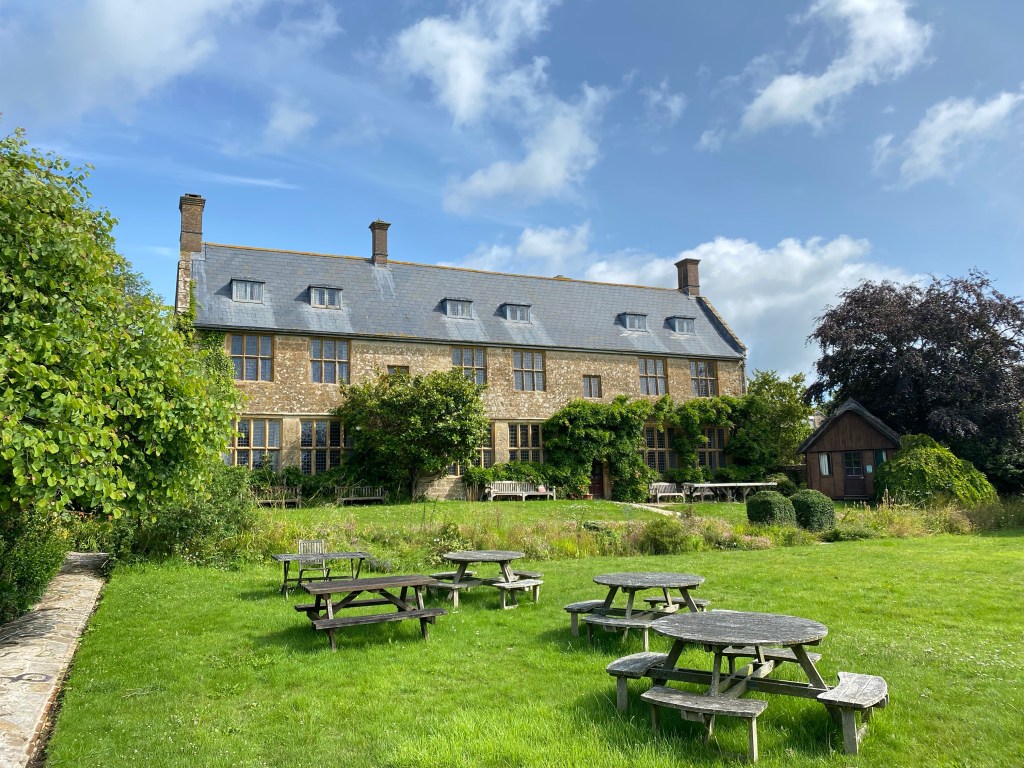
Pilsdon Manor

Monarch’s Way Bridport to North Chideock May 31st 2023

I’m two hours outside Bridport making my way around Dottery. It’s hard going. It’s overcast and there’s been a cold northerly blowing since I started yesterday. I did well to shelter from it last night although sometimes it found me out and felt its way into my sleeping bag and around my neck.

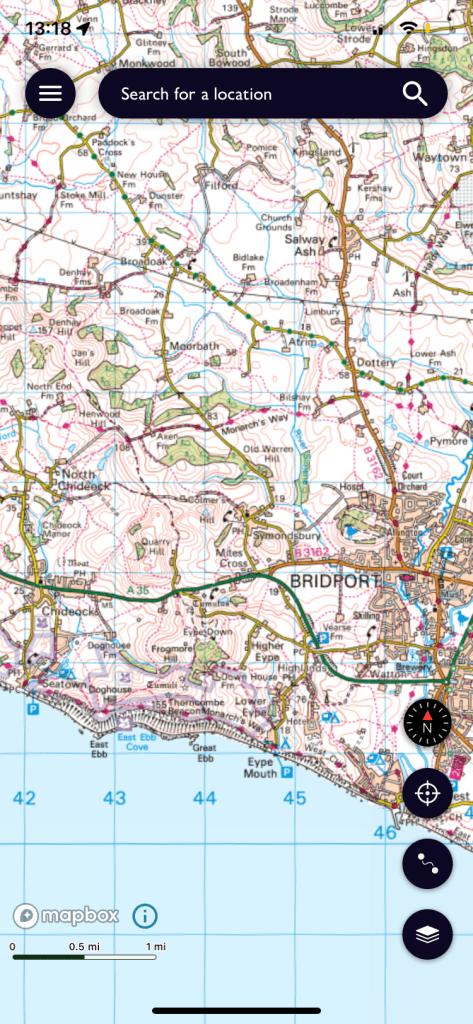
I woke up a few times in the night as is normally the way when I sleep out. I’ve walked seven kilometres since six o’clock and I’m starting to flag. On Bilshay Lane I stop by the gate next to a farm track and opposite a barn. It’s halfway down the dead end road to Bilshay Farm (see map). There is a corner gate which rises up into some long grass. The ground is flat and soft enough and I am under a big beech which shooshes me, its branches swinging in the wind lulling me into semi sleep and rest.

The Japanese have a name for the sound of the wind in pine trees. ‘Kigi ni fukukaze’ apparently ‘expresses a feeling of exquisite melancholy and solitude.’ It’s true that there is something more haunting about the sound of the wind through pines. Perhaps it’s the lack of leaves.

The English name for the wind in trees is Psithurism, from the Greek ‘psithyros’, to whisper meaning ‘a rustling or whispering sound such as leaves in a wind’. A brief journey around the internet takes me to a tree consultant’s website which has high praise for psithurism and refers to how ‘The naturalist author and founding member of the RSPB, W.H. Hudson, suggests in Birds and Man (1901), that psithurism is salubrious. He describes the sound of wind in the trees as “very restorative”’.

At this moment in time – perhaps more than ever before – I couldn’t agree more.

I am here almost an hour resting and looking up into the branches and the heart shaped leaves dance while the grass stems around me nod and bees pass overhead and a tiny spider crawls over my sleeve. At moments like these sometimes I feel like I could be in the grip of a strong hallucinogenic. I drift. I lose track of time. And I stay where I am while the whoosh of the leaves washes over me.

Beech trees blowing in the wind near Bilshay Farm

A well built man walks past wearing heavy boots and comes back half an hour later going back down the farm track. He has a Mediterranean appearance like the campesinos I used to see in the south of Spain. He wears an olive coloured jacket and heavy boots like a modern day Heathcliff. Ten minutes later I see him crossing through the green sea of a barley field. Only the top half of his body is visible as he floats through the greenness like a ghost, his hands held up as if gesturing to someone far away.

The walk from Bilshay Farm down to the river and up the winding chalk track the other side makes all the waiting worthwhile. The clouds start to break up. Patches of sunlight come and go on the green of the barley and pale brown of the earthy squares.

On the top I look back to the chalk track, the farm beyond. I am just able to see the side of the barn and the beech where I rested and came across the strange figure, the only person I’ve seen since Bridport. Now part of me wonders if it was a dream or vision. Then I think about these brief moments that come and go never to be repeated. And then I’m over the hill and into another valley.

View east towards Bilshay Farm

Curry Rivel June 27th

Back down to Home Farm to see Henry, Richard and Harry celebrate being awarded the Regional Barn Owl Award for the south west of England for ‘farmland conservation and positive environmental practices.’

There are probably thirty or forty of us, a mixture of farmers and conservationists (in the past you might not have put those two groups together) plus a few random people like me who are just interested (or nosy!).

We pile into various vehicles and head west down Currymead Lane.

We stand in the margin of a wheat field, part of a green swathe that borders the field as it does all of Henry’s land. Some people lean on long sticks, others stand in a rough semi circle, quiet while Henry waits to begin. He is dressed in a farmer’s shirt under a long grey wool tunic.

He explains how he has been keeping these margins around the arable fields for eighteen years. He was rewilding on a massive scale – they have over seven hundred acres of arable land – long before the rewilding movement. The margins are six metres wide and planted deliberately. He picks a stalk out of the ground which he explains is Yellow Rattle. My friend tells me that The Farming and Wildlife Advisory Group (FWAG) recommend this as a way of keeping long grasses at bay.

It soon becomes clear that Henry is talking to advise other farmers. The land agent from Dillington Estate near Ilminster is there and a couple of other local farmers, he tells me later.

‘We have created forty eight kilometres of margins. We do it almost on a daily basis.’ Later he tells us how any small corners, gateways or whatever can be used for wildflower meadows.

Its primary purpose is for conservation but they are also able to sell the seed for other people to grow their own wildflower meadows.

We move across the road and wander through another meadow thick with grasses and wild flowers.

‘This meadow has never been ploughed. It was owned by the last person to own a horse and cart in Curry Rivel. He also had an eye patch.’

This was Jack Eames, a bachelor who owned and farmed several fields around Curry. He was a friend of Grandpa’s who would often knock on the front door and let himself in saying ‘Anybody ‘ome?’ in his Somerset voice.

His eye patch was the result of a motorbike collision with a car in his twenties. One side of his face was also turned down like someone who has had a stroke. Jane tells me that he ‘had been very good looking before the accident.’

He lived on his own all his life at Southlea next to the old prison just down the road from me. When he died Grandpa found him the next day. He had fallen in the night and it ended up propped up next to the bed so it looked like he was kneeling saying his prayers. Every night Grandpa knelt beside his bed and prayed before going to bed.

Henry’s voice continues: “There are fifty one different species in this one meadow. A sign of an ancient meadow is quaking grass.” He picks it and shows us.

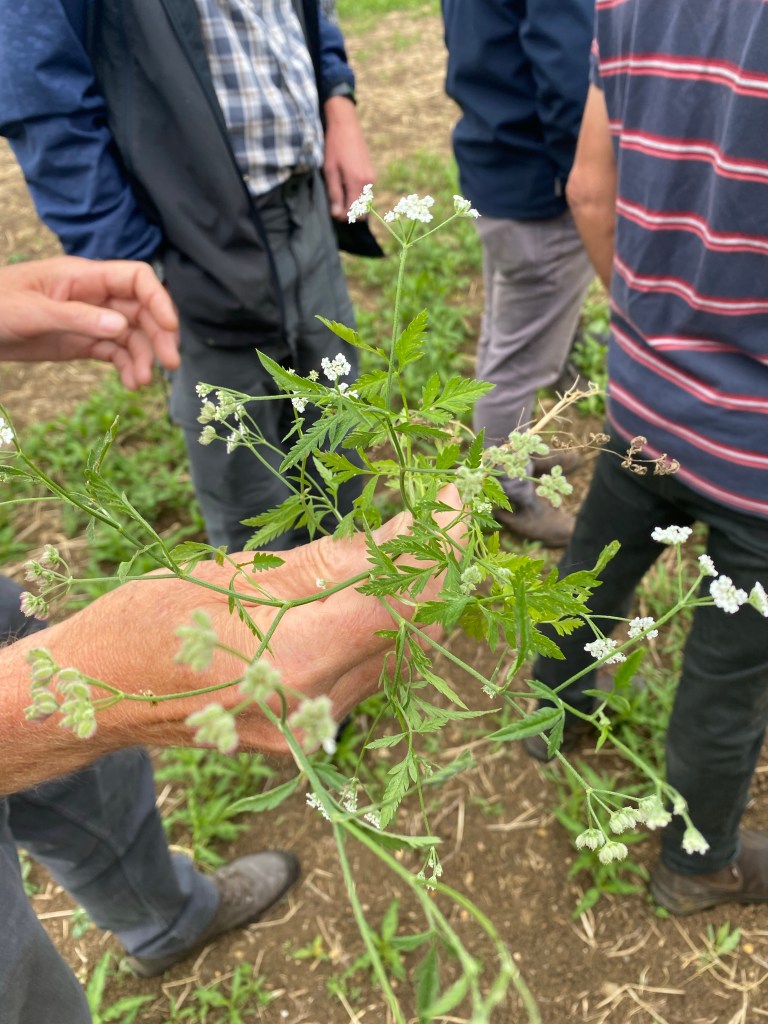
“Spreading hedge parsley is very rare and it would be a shame for it to die out on our watch.”

Someone shouts out “It’s even rarer now” and we laugh. He passes it around to us. We pass it slowly between us holding it up reverently, curiously.

Spreading hedge parsley

Apparently the impact on wildlife is “incremental and increases quickly.”

He explains “there are many marbled butterflies and more barn owls.”

There are huge bright green crickets leaping out around our feet. Henry says that “you might expect to see that in Costa Rica.”

“We have three pairs of lapwings but don’t know if they have fledged.” It’s refreshing to see a farmer that clearly cares about conservation. Jane tells me later that he had always been fascinated with wildlife ever since he was a little boy.

Afterwards Hugh Warmington presents the award to Henry. They give us burgers from the biggest barbecue I’ve ever seen. It’s a small trailer with two grills both about four feet long. There are vast bowls of local strawberries and a whole wheel of cheese from Barber’s near Shepton, the oldest cheddar cheese producer in the world and apple juice and cider produced here on the farm.

Homemade apple juice and cider amongst the orchards at Home Farm

Monarch’s Way Bridport May 31st

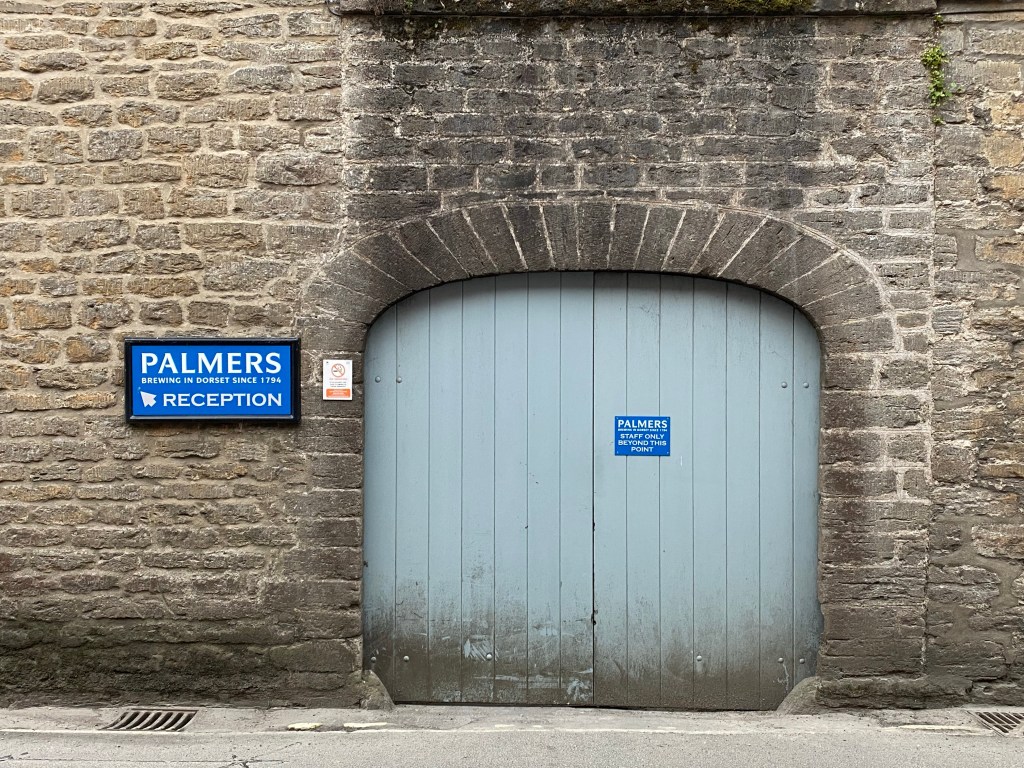
Palmer’s Brewery

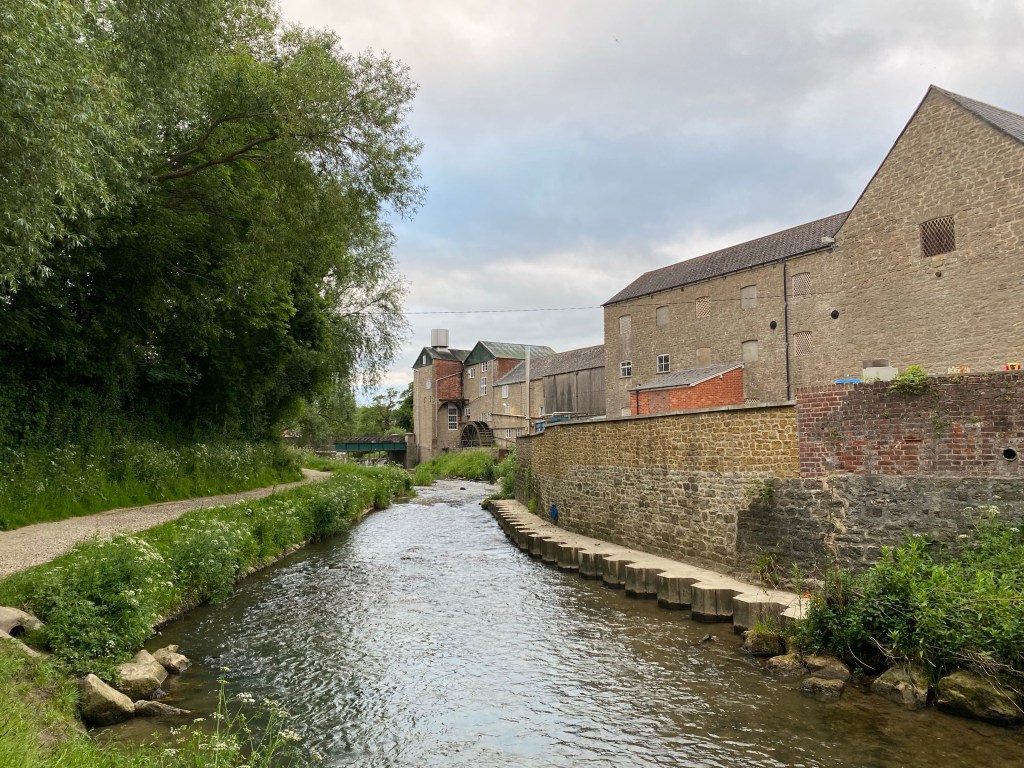
It’s just after 6 in the morning. I left my bed next to the A35 ten minutes ago, just a bit of flattened grass the only reminder of my brief sojourn. The Monarch’s Way hugs the river Brit as it meets Bridport. The first building in Bridport I come across is Palmer’s Brewery on the other side of the river. It is a sturdy grey stone building. Piles of pallets are stacked behind the river wall that must have been built at the same time as the building in 1794. Palmers can proudly claim that ‘Since then, there’s been non-stop brewing on this site.’

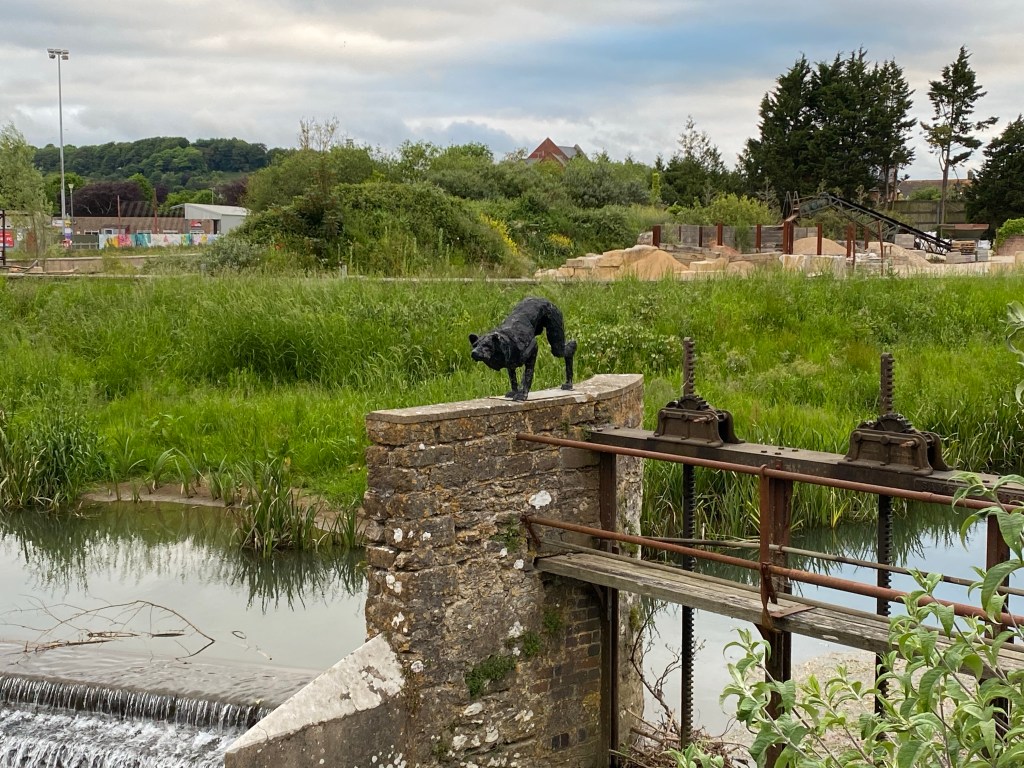
As I get closer there is a deep rush of water, the recognisable sound of a weir. There is a fish pass here donated by the Rivers Trust to the brewery and opened in 2011. It allows fish to pass up a ladder alongside the weir. A BBC article celebrated its opening and explained ‘The construction is designed to help salmon, brown trout and sea trout bypass a weir that has blocked their path since the late 1700s’

There is also a sculpture by Greta Berlin of a Stalking Dog poised looking over the fish pass. Perhaps waiting for a migrating salmon. Behind it is Bridport Football Club and what looks like the beginnings of a construction project.

Stalking dog overlooking the fish pass, Bridport

A solitary white dove flaps over and lands on the wall of the brewery. A man in a high vis jacket flies past me. Gritted teeth and white knuckles. Is he late for work? Otherwise the town appears asleep.

I am now heading inland. The Monarch’s Way does a great loop all the way back up to Yeovil.

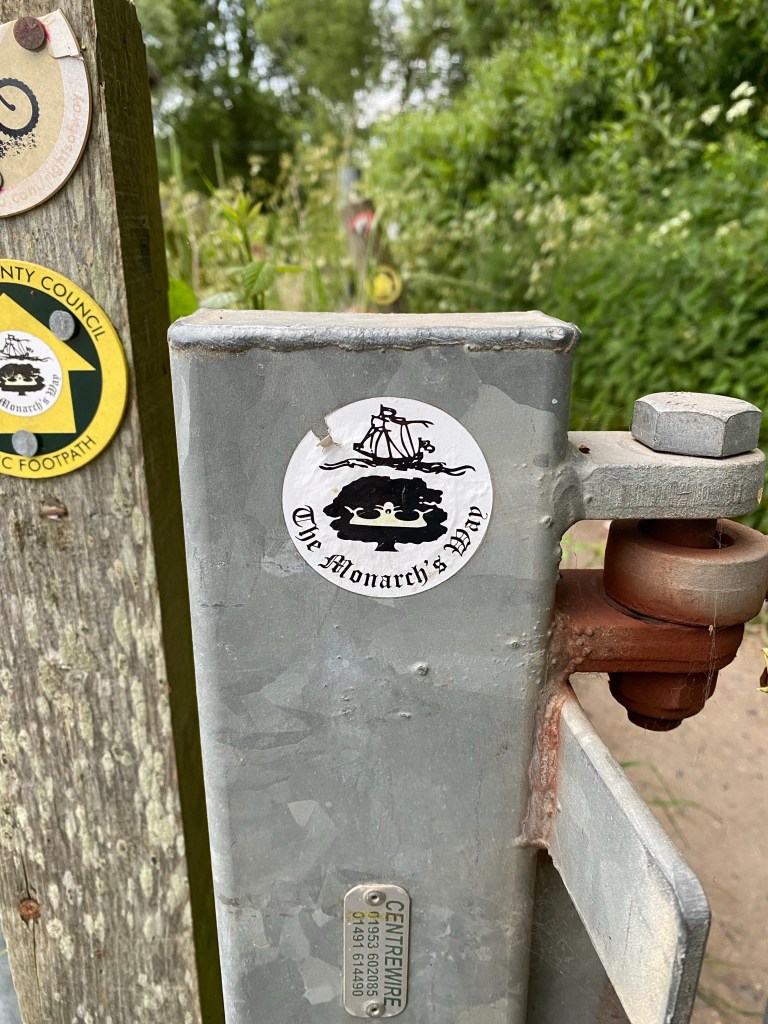
I always use the Ordnance Survey map app now with the ubiquitous red arrow. I feel rather sad and nostalgic for the old floppy pink maps that use to be jammed into my back pocket. It meant that I had to use some basic orienteering to pinpoint my location. But the OS app has become my stalwart guide on these solitary tramps. And also the ubiquitous Monarch’s Way signs that display The Surprise – a collier (coal ship) – that finally took Charles II off these shore into exile, the Crown and the Boscabel Oak, where he hid from Parliamentarian troops shortly after his defeat at the Battle of Worcester.

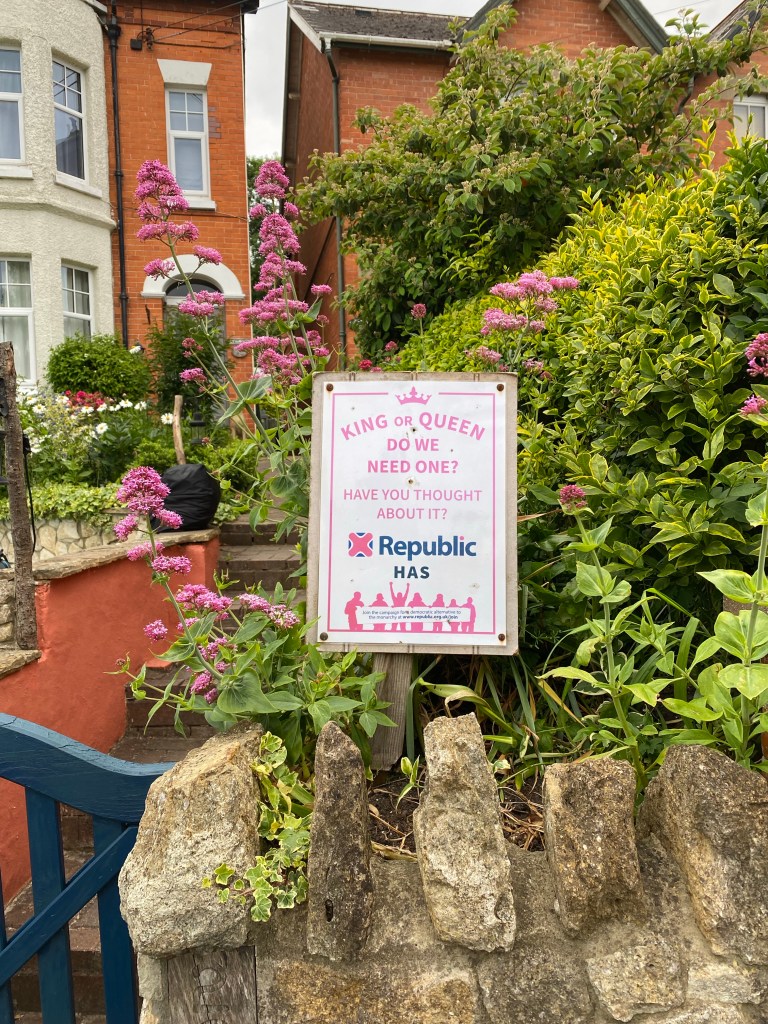
I am wandering through the sleeping back streets of Bridport. There are gardens with Tibetan prayer flags and a window with the oft seen blue and yellow of the Ukrainian flag, so much a sign of our times. Outside one semi-detached town house a sign reads ‘King or queen do we need one? Have you thought about it? Republic has’. While opposite another hand written sign simply says ‘Dracula June 14 16 17 Tickets £10’.

The route takes me through the ‘suburbs’ of Bridport. Cul-de-Sacs and estates where curtains are closed and hatchbacks are still parked in the drives. One is called King Charles way.

I have been head on into a constant northerly wind since I left West Bay. I did well to find a dry stone wall last night to get shelter. I’ve learnt my lesson from previous nights where the wind’s icy fingers manage to reach into my bag and get around my neck and shoulders. But now I’m cold. I get changed out of my shorts into jeans in the cemetery while neatly kept tombstones watch me in their serried ranks. A dog walker gives me a hard stare on the other side of the wall.

Is it just me or are people not very responsive in Bridport? Some say ‘morning’ but two women don’t look up at all. One man just nods. Maybe it’s the sight of someone with a rucksack, a woolly hat and pale blue socks that makes them hesitate. As Marie said when she found me looking at the view in the meadow where she has her sheep last week ‘I thought you were some weirdo’. Or maybe they’re last just half asleep like me.

A transition. How I love it when I get these surprises. In a moment – as I cross a stile – the town gives way to a field, its cloak of green a sudden refreshment on the eyes after the town.

As I’m listening to a song thrush do its repetitive high pitched peeping I’m trying to write it down when two dogs are running at me – a staffie and what the owner calls a sheppie. Barking loudly and snarling. I get a real shock. That spiky feeling in the chest and the adrenaline flying. I walk on as they get called back.

After ten minutes the owner asks me ‘do you mind if I go ahead of you so I can let him off? He’s a typical sheppie and can be a protect-y?’ A good excuse to stop for a rest. I love dogs but those two would have had me for sure.

Curry Rivel June 13th

The warmth has descended. Hover flies hang in the air like drones, their wings a blur beside their tiny bodies. They fly sideways in sudden bursts appearing and disappearing from the pools of light. Already there is a litter of crisp dead leaves across the path. The smell of the fir trees in the garden at May Tree House reminds me of being a boy aged 4 or 5 playing in my grandparents’ garden at Rose Cottage a few doors down. Riding mum’s old trike, hiding a cowboy’s revolver with ‘The Cisco Kid’ written along the barrel, playing on the olive green painted swing.

Isn’t it funny how certain memories are imprinted so strongly on our minds while so many more are lost?

I can feel the heat on my skin and the welcome coolness under the trees across the path. It seems hardly any time ago that I was here in the silent mist. And then again when the daffodils clustered along the roadside and path. Every year summer surprises me in the extent it transforms the near world.

Pigeons are cooing lazily. The path is cracked from the warmth. The tennis courts look unplayed on as always, the Wiltown House court’s net sagging forlornly in the middle.

I meet Mike by the back gate into Windmill Cottage. As we talk he bends automatically with secateurs to prune the ends off a tuft or head that is sticking out of the hedge in the same way barbers talk and snip simultaneously.

He tells me he’s been gardening in this garden for thirty years since “Mrs Lang first enquired about me.”He’d had a herd of cows which he would look after and milk but it became too complicated with all the checks and so on that had to be made on the cows. “So I decided I would do some gardening.” He pronounces gardening with a long “aaah” sound that goes down in tone, his voice quiet and soft and deliberate. An instantly recognisable Somerset accent.

He also used to rear pheasants for Anthony, Jane’s husband. He is from Hambridge, a mile from here but his uncle’s father was from Curry and was a sparmaker – spars being the thin bits of wood that staple the thatch down on thatched roofs.

He has gardened for some of the great and the good of the local area including a paper magnate, a retired ambassador and the boss of the local estate agents. However now he only does for those people he first started with. I think he is 85 (I’m sure he said he retired from dairy farming when he was 55).

When I arrive in the field on the other side of the house he is washing his arms with water from the hose before he carries on with his work. When I first bumped into him I notice he had cuts up his arms one with a plaster over that wasn’t sticking. He must have been pruning roses.

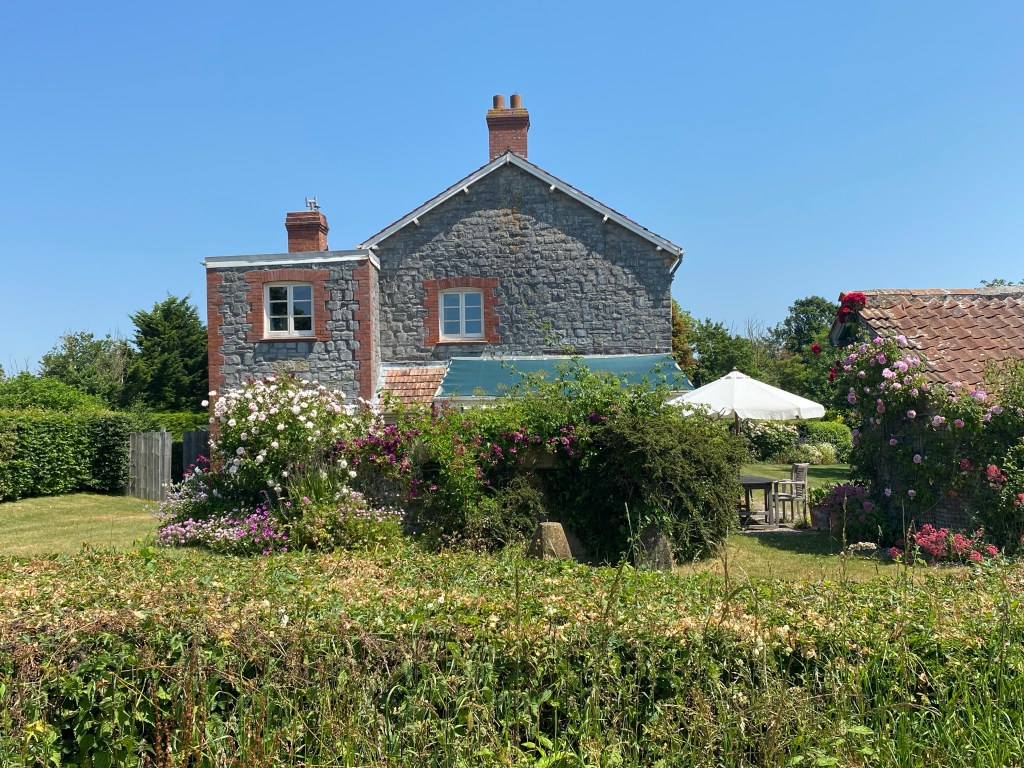
They are everywhere. Pale pink ones all over the wall of the old windmill base that gives the cottage its name. Large pink ones – a tone darker – those wonderful petals neatly folded into one another their centres brighter than the petals on the outside smothering the end wall of the barn. Then rich crimson ones rising vertically like a bouquet at the gable end of the barn. They would make a good buttonhole for a jazz singer.

Roses, Windmill Cottage

At the Furlong Lane meadow that looks down to the cricket pitch time has moved on. The chestnuts have lost their great white and pink candles. Their leaves are blotchy with brown spots. The buttercups have also gone on – their bright yellow lights put out. And the ewes and lambs have disappeared. And summer strides on.

Monarch’s Way Bridport to Chideock May 31st 2023

I wake up thinking I’m in bed but feel a dull ache in my shoulder which can only be from lying on the ground. Then I hear the cacophony of birdsong: jackdaws, pigeons, blue tits and blackbirds. A great enthusiastic greeting to the morning.

And then the roar of a lorry.

I’m next to a dry stone wall in a meadow. From under my eye mask I can see buttercups and elderflower, nettles and dried cow pats. Cows stroll past impossibly slowly. It’s like they’re floating in some strange meadow dreamworld.

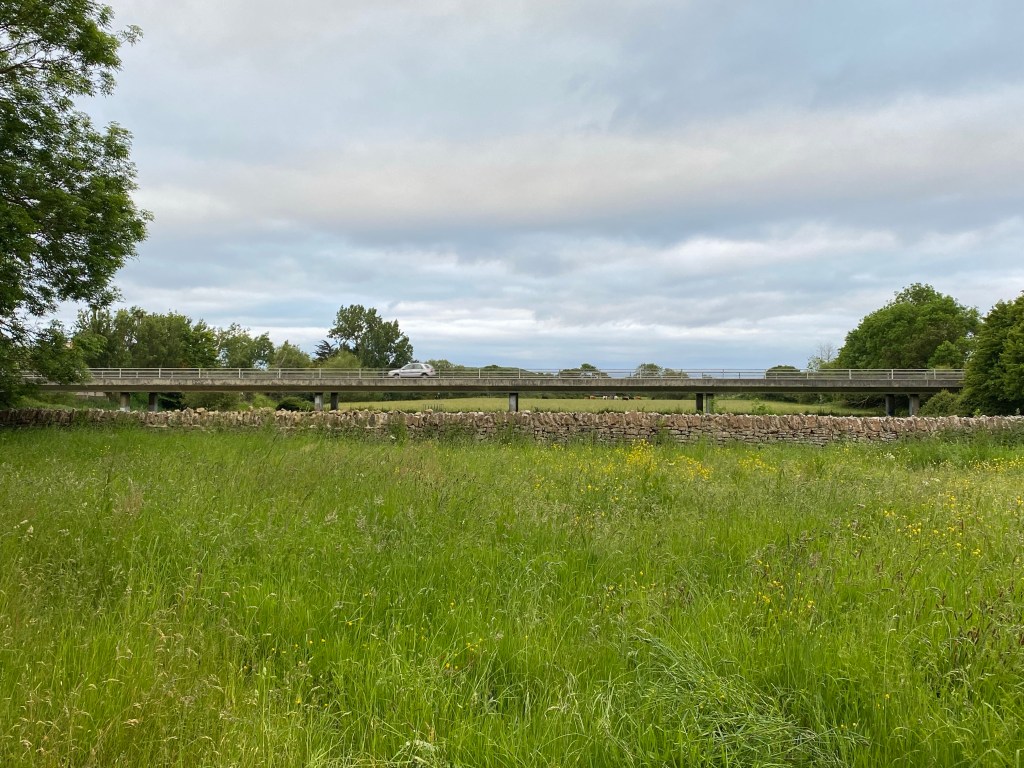
In the middle of this otherwise bucolic scene a low bridge carries the A35 just as it arrives at (or leaves) Bridport. A lorry with ‘Yang Ming Solent’ emblazoned on the side goes by and then a bus with its electric sign displaying ‘OUT OF SERVICE’. It’s about 5.30, always the time I wake up when sleeping out, normally woken by the dawn chorus. It’s the same today but the feathered choir has been joined by the altos and baritones of HGVs and public buses.

Dry stone wall and the A35 at Bridport

I met a couple last night having dinner next to me at Rise in West Bay who were celebrating what they called their ‘mini moon’. I had never heard of it. ‘A mini honeymoon’ they explained. People always seem interested and surprised at me sleeping outside in a field. Sarah was South African. ‘Oh, it’s like Jim Broadbent in that film where he walks to see a friend who is dying. He sleeps rough’, she tells me. Later I realise she’s talking about The Pilgrimage of Harold Fry. The other story people often refer to when I tell them about my walks is The Salt Path. Again a story about old people, terminal illness and sleeping out. I have to admit I listened to the audiobook when Dad was dying and found it too self indulgent in its self sympathy. He survived. Dad didn’t. Do I sound angry? Maybe I was at the time.

Not long ago it would be quite common to see people sleeping on the side of the road or in fields in the countryside in England. A hundred years ago it wouldn’t have been unusual to see a man lying prostrate under a hedge: a travelling salesman, an itinerant farm worker or a tramp. Or someone who’d had a skinful at the local pub and passed out on the way home. Although the comparison isn’t wholly accurate – I am in a sleeping bag and bivvy bag and do it out of choice. As it is today, for some people it is because they have no alternative.
Apparently sleeping out in a sleeping bag and no tent now has a name: bivvying. It’s another bit of language that is new to me.

When I turn my back on the road, I could be looking at a scene from an oil painting. If John Constable were here I think he might check his step and think about reproducing it. A little whitewashed house with cottage garden roses looks across a buttercup meadow while a chalk path bends gently to join it at its side. And behind me the A35 traffic carries on regardless.
Yesterday I started from where I left off just east of Golden Cap. I left the car at Chideock and crossed fields in blazing sunshine to get to the wooden sign where I was two weeks ago. It was a beautiful day. I went for a swim at Seatown. I climbed Thorncombe Beacon. I admired views of Portland Bill while the wind blew through me. But I wasn’t feeling it. I trudged on and took no notes. Funny how that happens sometimes.

Today, although I haven’t had much sleep and my legs are stinging from an accidental encounter with some nettles when I went for a pee in the night, I feel brand new.

I brush my teeth, spitting out bright white splashes onto the offending nettles from the night before. And 5 minutes later I’m hoicking my rucksack on and crunching along the white path towards the cottage smiling at the self sufficiency of just being alone with my bed in a bag and and the continued rhythm of walking for miles and miles and miles with only the path and my footsteps to think about.

The Monarch’s Way – Broom Cliff to Golden Cap May 23rd 2023

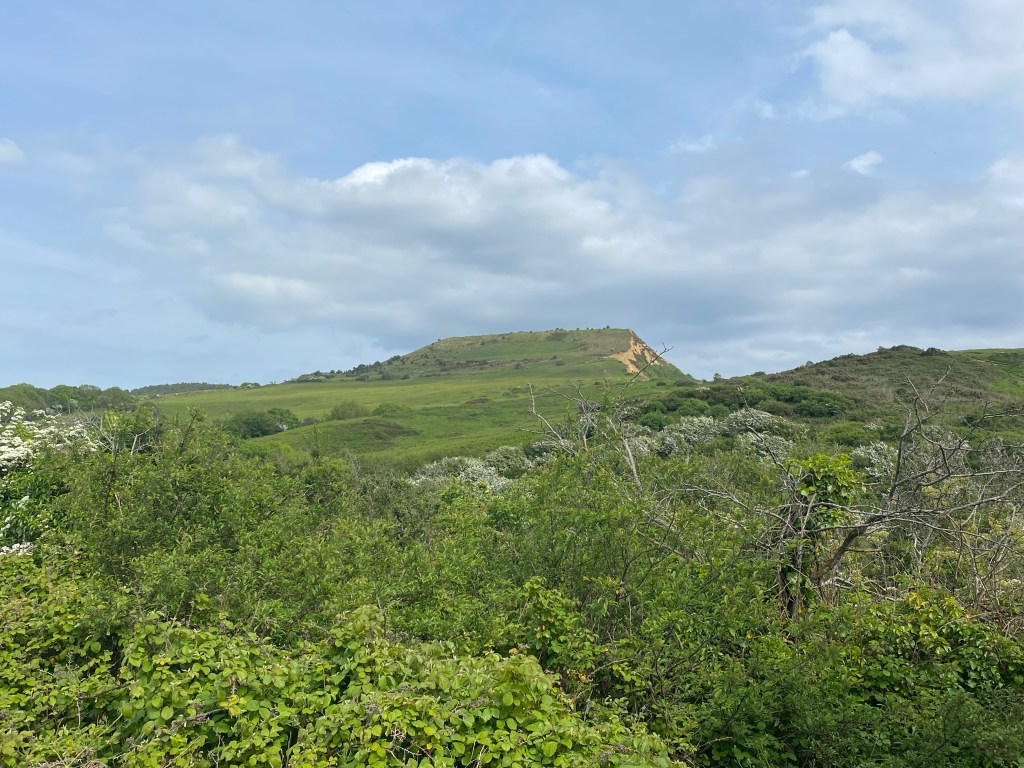
Golden Cap

This would be the first time I would have been on the Monarch’s Way since September the 18th last year. It was the day before the Queen’s funeral. I can still remember the sense of a nation in mourning: flags at half mast; everyone talking about ‘she’ or ‘her’.

Here I am three weeks after the King’s coronation at the start of the second carolean era following in the footsteps of the man who gave his name to the first carolean era.

For twenty five years Charles II ruled over this land but it so easily might never have happened. He was incredibly lucky to escape with his life in 1651 walking and riding along these ways and often hampered by the ineptitude of his friend Lord Wilmot, charged with aiding Charles’s flight but who was something of a liability. It didn’t much help that Wilmot refused to wear a disguise and was often indiscreet and forgetful, on one occasion leaving a black purse of gold coins (Charles’s emergency cash) in a random house where he’d been staying the night before. As Richard Ollard puts it in his book The Escape of Charles II ‘The King’s choice of Wilmot as his companion and chief agent…was the only mistake he made in the whole affair.’ Charmouth – my last port of call back in September – was supposed to be the original setting off point for Charles’s escape to France but the boat never turned up. Instead he would have to travel to Shoreham in Sussex from where he finally left on October 15th 1651 aboard a coal boat.

It’s eighteen degrees and overcast as I pull into the National Trust car park at Langdon Hill. Campions, buttercups, cow parsley, and bluebells rear out of the roadside verges.

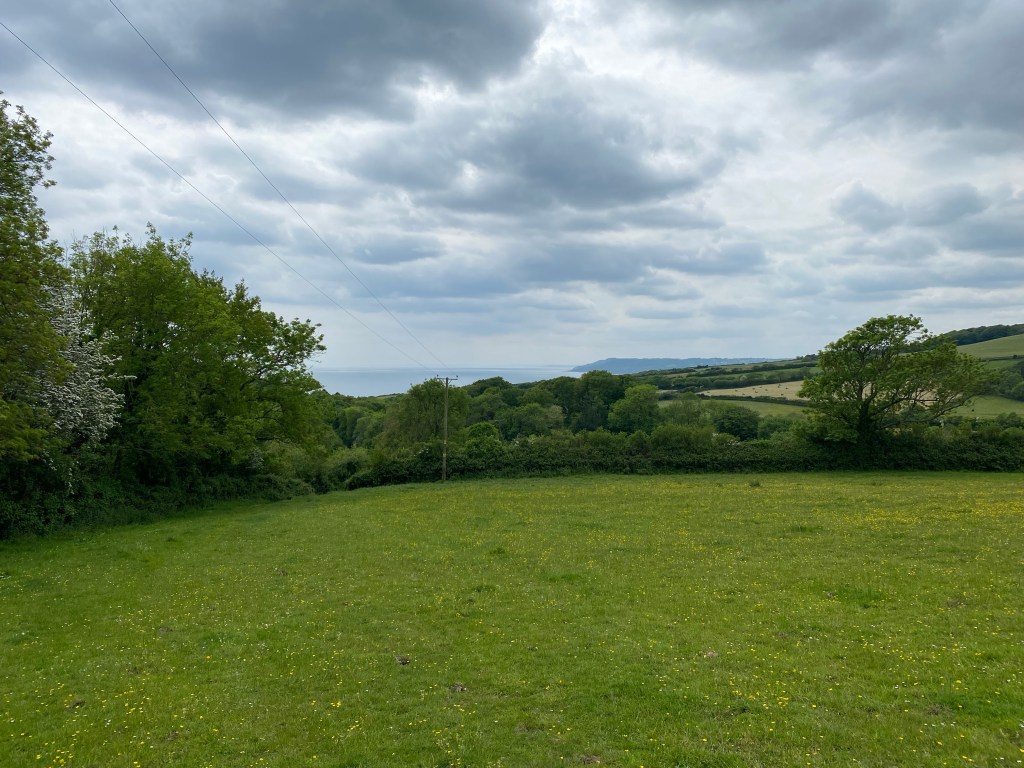
As I turn off the road the sea is below the valley, still and smooth and grey. It might be the bottom edge of the sky but coloured a darker shade of grey.

There is no one about. I feel that familiar warm feeling of me being alone with the world while everyone goes about their daily business: trucks roaring on the A35, a farmer ploughing his field, a jet overhead. Down here there’s just me and the birds and the bees.

I descend into the deep green light of a wood. I feel a sudden coolness like being plunged underwater and then am instantly hit with the overpowering smell of wild garlic. A green corrugated shepherd’s hut is secreted away on the edge of the wood.

Meadow gate en route to Broom Cliff

Minutes later I appear into a meadow where fluffy bits of down from trees float across like slow moving insects. There is the gurgling of a brook. A buzzing of a bee. The whispering of leaves. No human made sound. And I feel like I’m in a waking dream.

When I get to Broom Cliff to reach the Monarch’s Way the sea has the gentlest of ripples on its surface. No boats. No bathers. I see the familiar sticker on the stile – the oak tree with the crown and the ship that he sailed on – and I know I’m in the right place. How I love those stickers. There must be thousands along the Monarch’s Way. It’s a better marked route than any other that I’ve been on.

Campions and foot bridge en route to Golden Cap

After half an hour I start the climb to Golden Cap and stop. As I look back towards Lyme Regis there is a small patch of sea that glitters.I stop and sit. As ever the slowest walker. Other hikers walk past me keenly looking at their phones.

Here I am on the lower flanks of Golden Cap almost exactly five years since I walked over it on the South West Coast Path. And now I’m going the other way on the Monarch’s Way.

It’s funny. I remember that summer of 2018 or parts of it. I was struggling to sleep, and decided to leave my then school after ten years. I remember the sense of liberation and relief. And then I continued teaching at a different school and the insomnia never went away. And here I am five years later leaving school for good. And suddenly I feel like something that’s been bearing down on me for a long time has fallen away, that suddenly I am a little lighter. And incredibly for the first time in years the week before last I started to fall asleep normally, naturally. I’m still flushed with joy on those mornings – not always – that I wake up after a night when I had a relatively normal night’s sleep.

Here on Golden Cap feels like one of those moments when something is about to happen. I wonder if I’ll come back here in five years and see if I was right. Places illustrate my memories. I feel like my life is a series of moments that I always remember through the landscapes that I was surrounded by. Standing here I wonder if in his later years Charles II remembered the lush hills and hidden holloways of Dorset at a time when his life was taking the strangest of turns.

Lyme Regis from the side of Golden Cap

Curry Rivel May 16th.

There has been a rush of colour in the garden outside the cottage: it’s as if I can almost sense the urgency of the flowers as they unfurl themselves in the sun. There is a spray of forget-me-nots along the border. And in just the last few days the irises have appeared near the front door, their rich purple flowers sticking upright like a gentleman’s silk handkerchief in a suit breast pocket. In meadows and fields around the village buttercups have appeared in their thousands. When the sunlight hits them it creates a shimmering liquid gold reflection onto the grass around them.

I stroll up the path with the tennis courts. First past the old grass one at the back of Wiltown House where Grandpa played all those years ago then past the modern concrete court at the back of May Tree House where my uncle used to play. Neither seem to be used now. Cow parsley and campion reach out and bow before me like a coronation congregation. The wind is still icy but life is at play.

On my way back down Furlong Lane I take a few minutes to look at the wild flower meadow and Curry Rivel cricket pitch beyond. There are several gazebos set up.

View towards the cricket pitch from Furlong Lane

When I wander down I see Henry the farmer and a group of volunteers getting ready to welcome a bus load of year 3 and 4s into the cricket pitch field. This is part of the Kingfisher Project set up in Devon by Ted Hughes and Michael Morpurgo in 1992 to teach young people about farming and conservation. Spontaneously I’m allowed to volunteer ‘shepherding’ a group of eight year old boys from Wellington.

It seems to me the most idyllic scene. Children wandering about a buttercup covered meadow looking for and learning about bees and pollination. There are giant horse chestnuts in the background still holding their lanterns of white flowers like a traditional Christmas tree with candles.

The children go from from one little station to another (under the gazebos) and get practical lessons on farming and wildlife. They start with wheat. Henry shows them where it’s grown and what it looks like. He tells us all to pick a stalk of young wheat and try chewing the bottom of the stalk. The group of seven boys look doubtful to begin with but then start to buy into it.

‘What can you taste?’ Henry urges.

‘Melon’, one boy suggests.

‘Yep, a lot of people say that’ Henry says and continues a brief lesson on photosynthesis and how the stalk creates sugar. The boys – still chewing – are attentive.

Next we see the wheat ears when they are ready for harvest. The boys get to hold the grain and grind it in a mini grinding mill to make flour. Then they can see it made into drop scones by Maurice using rapeseed oil taken from the rapeseed visible on the farm. One boy gets more interested in the drop scones to the detriment of everything else.

We then get to see glass tanks manned by Dion. Now 84 his parents were refugees in the Second Workd War. He came here as a boy and has never left. He has all sorts of wonderful surprises: a dragonfly larva – a sinister looking creature which if enlarged would be very effective in a horror movie. The boys recoil instinctively and then become intrigued. Next slow worms coiling themselves round one boy’s hands. And a baby grass snake beautifully speckled with its tiny tongue flicking in and out.

‘That’s how we know it’s a snake’, Dion tells us.

Recently a rare bee – the wonderfully named Shrill Cader Bee – was found in this meadow. There are only two or three other places where it inhabits, the bee people under their gazebo tell me.

‘In fact it’s rather boring looking’, Henry tells me quietly. It has a grey brown body unlike the wonderful jaunty fur coat of the bumble bee.

What a find, this little learning experience about nature on my doorstep. I will volunteer next May when it happens again. In the meantime those children will go back to their schools and create a project based on one topic from what they’ve been looking at today. They’ll be judged back in Henry’s barn at the end of term. I hope I can be there. He told me how difficult it is being a judge with the amount of work that goes into their projects and the enthusiasm with which they present them and knowing that some always walk away disappointed.

The Kingfisher Trust programme was started in Devon but now is prolific all over the south west of England. I like to think that Ted Hughes, that great poet of nature, would be proud of what he created 30 years after he started it.

Maurice teaching about the uses of wheat with the help of some drop scones

SWCP. Zennor to Carn Naun Point February 14th 2023

Hills behind Zennor Head

Jackdaws, my only consistent company around the Western tip of Cornwall, fly fast and straight over the cliffs from some crag, their glossy black bodies perfectly still as they disappear over the edge. I’m facing north into the wind at Zennor Head. It’s morning and I am alone on the path.

Turning east I disturb another pair of what I assume to be jackdaws who fly off in a funny looping motion, up a few feet and then down a few feet. It looks rather ridiculous.

Suddenly the sun catches a flash of bright red beak. Not jackdaws. Choughs.

The elusive red-billed chough – not to be confused with the Alpine chough – is a symbol of Cornwall, appearing on the Cornish coat of arms. Here is one of the few places in the UK where they nest and here is at the furthest west of their range. Unfortunately their numbers have declined as a result of human activity so that they are now categorised as “vulnerable” in Europe.

It is something I have thought about a lot but not seen til now. I read that this bird used to have a reputation for fire raising as it was thought that, like magpies, the choughs would like to take small objects from houses like burning wood or lit candles with which they would start fires with in people’s roofs or haystacks. A Cornish tradition also has it that King Arthur was transformed into one. They do have something regal about them. Rather wonderfully the collective noun for choughs is a chattering or clattering.

At Carn Naun Point there is a trig point and the wind blows stronger from the west. I can see the next stretch of coastline that I will tramp: St Ives Bay and beyond that Godrevy Point and Island with its lighthouse and then beyond that the land reaching north into the sea finishing at St Agnes Head. As it has been since the start the path before me is a path of the imagination where all the landmarks are places from a dream and where I carry on and on as if forever. How old will I be when I reach Devon? Or Somerset for that matter.Those imagined places are the spark that keeps bringing me back to the path. They are my greatest inspiration. In ‘The Summer Isles’ the travel writer Philip Marsden sails up the western coast of Ireland and Scotland looking for the real and the mythical Summer Isles in Scotland. Marsden says how “the ability to believe in places that are invisible, to build stories around them and inhabit them, remains the defining attribute of our species”.

Path at Carn Naun Point and Godrevy Point and St Agnes Head on the horizon

I turn inland and feel buoyed by the softer walking of green fields. The path today was tricky. At Wicca Pool the path ended at a jumble of huge rocks the size of fridge freezers which lead a hundred metres up the side of the hill. A couple in their seventies were coming down, nonchalantly leaping from one to the other. At least it confirmed where the path was. The woman smiled at me. ‘Morning. It gets a bit easier up there.’

I come down a hill through a small plantation of bamboos to Treveal Mill, a beautiful grey house built next to a stream which splashes over rocks while a young black Labrador runs about barking excitedly. Little human touches here seem to sit well in the setting. There is a summer house with a sign on it saying ‘live life’.

Summer house, Treveal Mill

On the way out past the hill there are bees with colourful signs indicating to the passer-by their existence. Buoys are used as decorations. I pass the owner. Something about his dress suggests an artist. When I say what a lovely spot he turns and says ‘apart from the noise’, a reference to the happy Labrador and ‘enjoy’.

Bees, Treveal Mill

At Lower Tregerthen I pass by stone walls covered in moss and bare trees, the wind whooshing through their branches. Several goldfinches chase each other around the treetops chattering in high pitched song. There is a whole bush of winter roses, like perfect pink button holes for a wedding and still the odd campion near the path. Flowers in winter. It’s time to return to Zennor to the church to say farewell to the mermaid and a few words for Dad. Next time – whenever that is – I’ll get to St Ives.

Lower Tregerthen

Curry Rivel March 21st

A sudden return to Winter today. Rain all morning and the cottage gloomy within. Strips of water can be seen down on the moors and I’m never without my woolly hat and snood. In the early afternoon lashing winds arrive that whip the trees and telephone wires along the road sending the rooks up into the air flapping and complaining.

Julian is here to mend the gutters and the windows, the one filled with moss and overflowing and the other cracked as a result of Winter’s ravages.

I go up to the rectory to meet Reverend Scott and Mark the young curate, Scott’s dog collar just visible under a Champion hoody and Mark’s visible against a sky blue shirt above his skinny jeans and Converse. The faces of the modern rural church.

They both talk about the challenges facing the clergy. Their benefice is about to expand and the benefice’s population will double in number. They’re keen to encourage small church reading groups where people can engage with proper theological discussion of the bible and they see the need for more lay people to help in the community such as in care homes. Scott also suggested that the churches need to be looked after by a dedicated conservation group and not by parish councils as communities don’t have the time, expertise or money to maintain them. It’s an interesting and serious discussion and I hope will make an engaging post for The Tablet.

Richard pops round from next door to see if Julian can look at his windows. He’s very open about lonely he is since he lost Cindy a few years ago.

He came round to see mum on Saturday. Still tall and straight backed as no doubt the Navy fashions you to be. He told us how every house in Wiltown has a well and this is where its name derives from. It was the first time I’d heard this.

He also talked openly about Cindy in the knowledge that Mum and him have that in common now: them both carers for their spouses and now both widowed.

She had motor neurone disease. Thankfully her brain was the last part of her to be affected.

Richard said that one day at the hospice after she’d been deteriorating for quite a while the doctor came to see her. He asked her ‘How are we doing today?’ To which she replied ‘I’m fed up. I want to go now.’

Then they gave her more painkillers until she faded away.

I expect this happens more than people let on. It would be good to be allowed the choice if it came to it.

The blue fuzz of flowers that adorned the top field have gone without a trace. The taster of spring week might have been nothing more than a dream. Above the field the sky is blue but above the Blackdowns it’s a threatening murky grey.

At the bottom field cloud shadows race over the field ahead of me briefly darkening the field and Jane’s house for a few seconds before they are returned to the light. On the road from Curry to Hambridge the sunlight briefly glints off a car like an inland lighthouse flashing a split second light. It’s a strange day and I’m left longing for the warmth and life that seems to have been missing for so long.

Curry Rivel March 14th

Today at last there is a hint of Spring. The wind is up. It still has its chill but the sun is warm. Clouds are everywhere: great hulks, thin streaks and little puffs like that look like they’ve appeared from a cartoon steam engine stream across the sky. They all come and then go in less than a minute. And as one of those giants passes over the sun lights up the near world like a great aperture being opened. On the corner of Stoney Lane, where I used to sit on the gate as a child, a pigeon flaps about amongst the blossom sending petals spiralling onto the road.

Only a few of the rooks are cawing in the trees today opposite the entrance to Wiltown Farm. In the small yard beside the barn, sheep with their winter coats on mill about calling to each other. They suddenly clamour and gather as Marie appears from amongst them. As she closes the gate they stick their heads through the metal bars calling after her.

The daffodils are now at their best, their great trumpets facing outwards as if about to produce a fanfare for the changing of the season. And on the barn behind them the owl and the pussycat look down the hill to Hambridge.

Daffodils outside the Owl and the Pussycat Barn

Mum is here at the cottage doing some gardening. She’ll teach me later the names of the plants I don’t know: Bride’s Veil, Pulmonaria and Japonica, all of them already displaying their colours of white, blue and an ox blood red.

The sun is stronger. I imagine it encouraging the sap to rise and I have a new spring in my step. A pair of yellow brimstones flit up and down the new laurel hedge on the path past the tennis court at May Tree House.

Jane’s gardener is wheeling the barrow to the front garden when I get to the top. I say morning to him from two metres behind him but he plods on his shoulders hunched.

When I get home Mum tells me he’s almost the same age as her. She’s 92.

A light blue fuzz has appeared over the field as it curves west. It wasn’t here last week. It’s the same colour of the pale blue of the sky as it reaches the horizon. They are hundreds of small blue flowers quivering in the wind.

As I cross over into the bottom fiekd

As I cross over into the bottom field and head south, a billion blades of grass flutter and shimmer in the sun above one enormous bank of cloud that stretches from east to west for as far as the eye can see. The grass stems flicker like sea glitter.

At Windmill Cottage Jane is in her conservatory chatting to another lady with grey hair in her conservatory. At the front of the house there are two pairs of honey coloured saddle stones standing like sentries at each corner of her lawn . Around their feet the pink flowers and floppy leaves of elephants’ ears dance in the wind. Along the border between them are clumps of grape hyacinths and all along the drive a profusion of daffodils nod to each other happily in the sun.

Grass glitter on the bottom field looking south to Burrow Hill