I thought I wasn’t doing to write about this but it’s unavoidable. My father is dying. We found out at the end of August and he has been given 3 months so we’ll be lucky if he is with us at Christmas. It’s glioblastoma, a stage 4 cancer, or in layman’s terms a brain tumour. Untreatable, unbeatable and life changing: for him – clearly – but for us too.
Every other weekend I come back to Suffolk, the county of my birth to be with him and care for him. There’s not much I can do but help him try to walk to the loo or to where we eat in the kitchen and just be there and talk. We’ve always been good at that and thank goodness we still can. He is affected physically – he gets weaker by the day – but mercifully his mind remains in tact (for the moment). Although what it must be like for him, what he must be thinking I can’t begin to imagine.
That path which he has always been master of now leads him to the cliff edge.
Each weekend I try to keep a couple of hours free to walk the coast. I love walking coast paths. The SWCP is my real goal but Mum and Dad are in Suffolk so I have substituted it with the Suffolk Coast Path.
I started at Bawdsey Quay at the start of September and I don’t know how far I’ll get. I don’t even know where it ends. That’s not the point. It’s the elemental escape that it affords me.
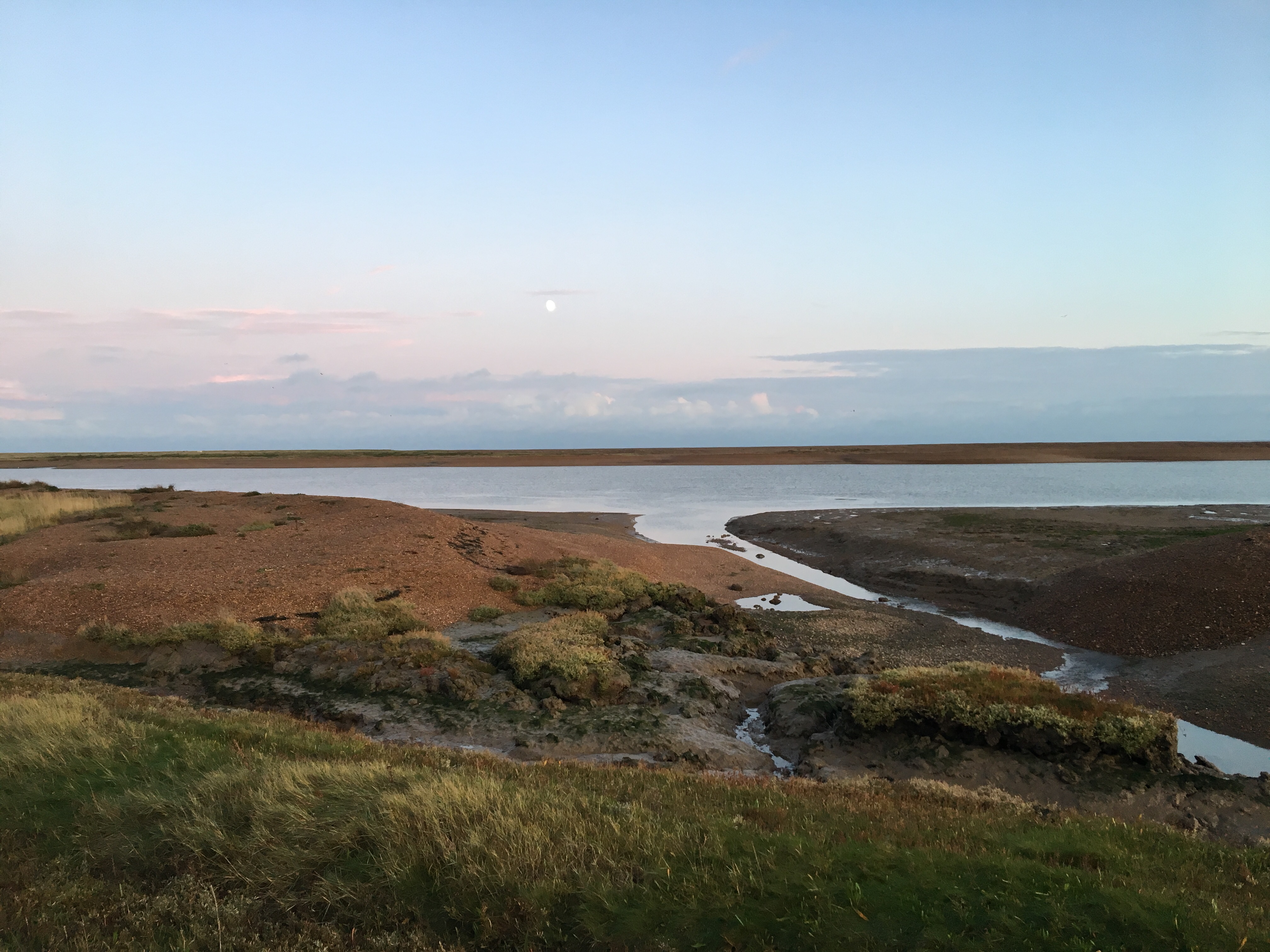
It’s cold as I dump the car on the winding dead end road to Shingle Street, the coastguard cottages starting to be silhouetted against the sky and the moon already above the sea and the Eastern horizon although it’s only 4 O’Clock. I’m still getting used to the day ending so quickly, darkness arriving too quick.
I walk from the road along a stream that joins the River Alde as it reaches the end of its winding journey and joins the sea. Sandbanks rise just a couple of feet above the water where the mouth is and crowds of birds – cormorants I think – stand like a remembrance parade facing the sea. 2 oystercatchers rise up out of the stream making their loud ‘peeping’ sound, no doubt disturbed by my rubber booted tread.
Lots of lines this evening. The many lines of small water courses meeting the river. The line of the bank this side of the tidal river. The low flat line of Orford Ness – now 10 miles long – and just a brown stripe between the river and the sea. The line of the sea as it reaches the sky. Horizon. And finally, beyond that a line of a low bank of clouds, its points highlighted by the pink of the disappearing sun. And above the lines the solitary pale orb, brighter in the cold and, as if by design, a thin line of cloud is settled above her with the symmetry of an eye and eyebrow.
‘Art thou pale for weariness, of climbing heaven and gazing on the earth wandering companionless.’
It’s heart breakingly, life affirmingly beautiful and I shudder at the thought of age and infinity and our lack of understanding.
The grass bank is a sea wall and follows the curves of the river. Holleseley marshes are on my left as I walk North, the sea on my right. I can see 2 orange beaked geese poking their heads up from behind some rushes. A pair, like the oystercatchers, and on alert at my presence. A bit further along is the thin bent shape of an egret, gleaming white in the twilight. I still always feel a little surprised at seeing one. Didn’t they only used to live in much hotter climes like Africa and India? Perhaps I’m wrong.
The light is leaving the Western Sky and I tighten my scarf and pull down my wool hat to keep out the cold.
I pass a birdwatcher and we say quiet hellos to each other.
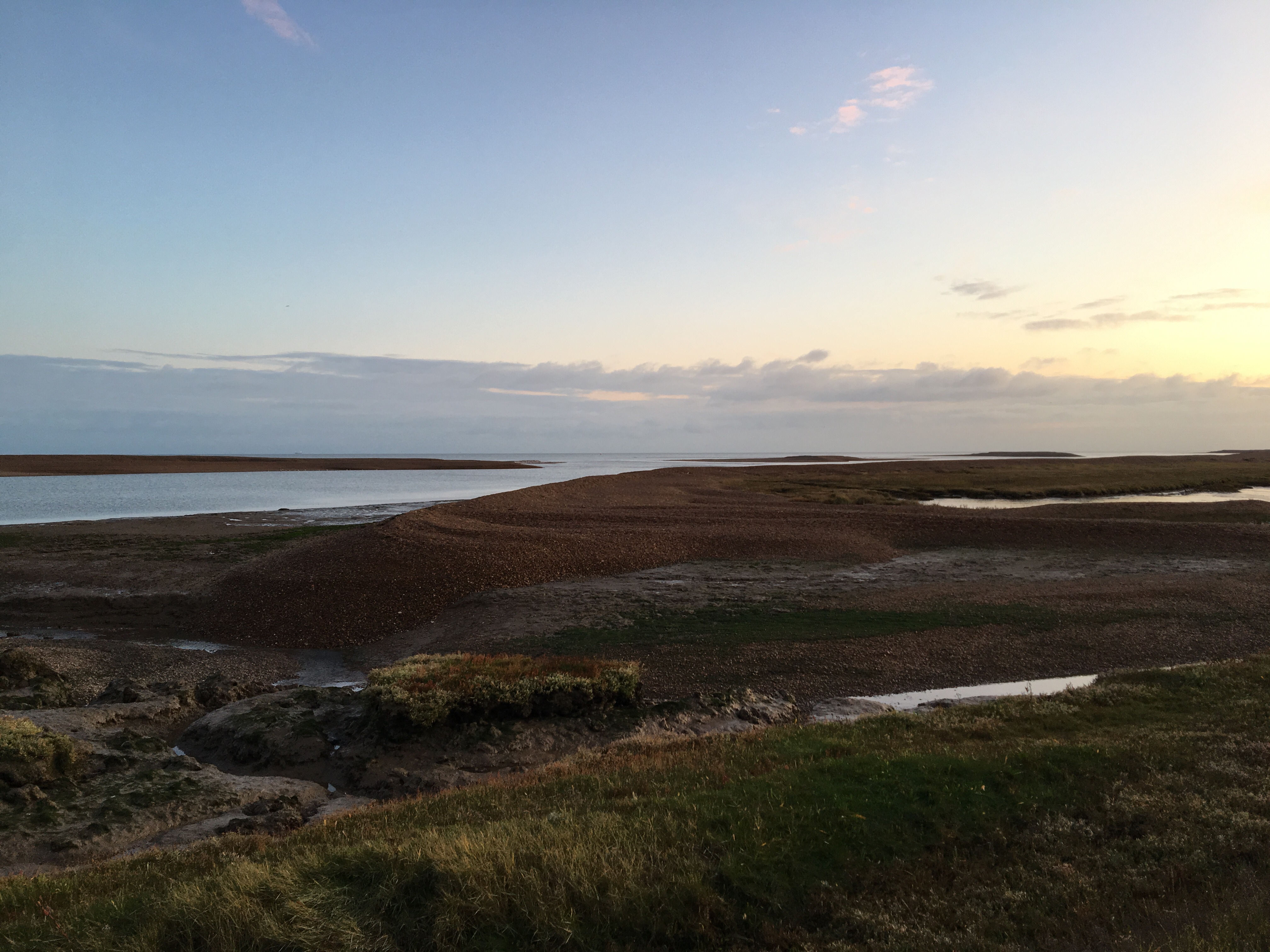
To the North, miles up the Ness I can see the jaunty red and white of the lighthouse on the Ness, like a bath toy and the strange Eastern temple-like structures of the ‘pagodas’, a strange word for these buildings which tested triggers for weapons with the ability for unimaginable destruction during the Cold War.
Less incongruous but still in stark contrast to the simple beauty of the flat lines of the landscape around me lies the Hollesley Bay Prison just on the edge of the marshes. It started its life as a borstal in 1938 and for years was a young offenders institution. It still is that but also confines adults too. As I turn my back on the sea across the marshes I can see that it’s made up of several buildings like an army camp or university campus, a dull orange light emanating from it.
Another dramatic transition. From the wildness of the flat Eastern sea and sky to this strangely positioned ‘other’ community. I suddenly arrive from the track into the heart of it. High fences. A meeting of roads. And no one about. They’re all inside (of course). It has a strange feel. A guarded community. But, hold on, here’s 2 young men on the side of the road smoking and chatting carefully in the half light. They watch me approach with the half expectant, half cautious attitude of those used to being avoided or ignored.
I look up as I pass and look at them.’Hiya’, I say.
The white boy takes a drag and say ‘You all right mate?’ He gives me a smile and after I’ve gone I can hear him and his mate laugh. I find out later from mum that it’s an open prison.
The lights are behind me and the natural light is returning and the dark shapes of trees on the roadside. The last light of the sun is off to my right as I head South back towards the car. I think about going back to see Dad and one of his old army buddies who has driven from London with a bottle of Champagne to have one last blast together.
A squat silent black silhouette flies over my head. It’s a tawny owl. Like a fat stealth bomber.
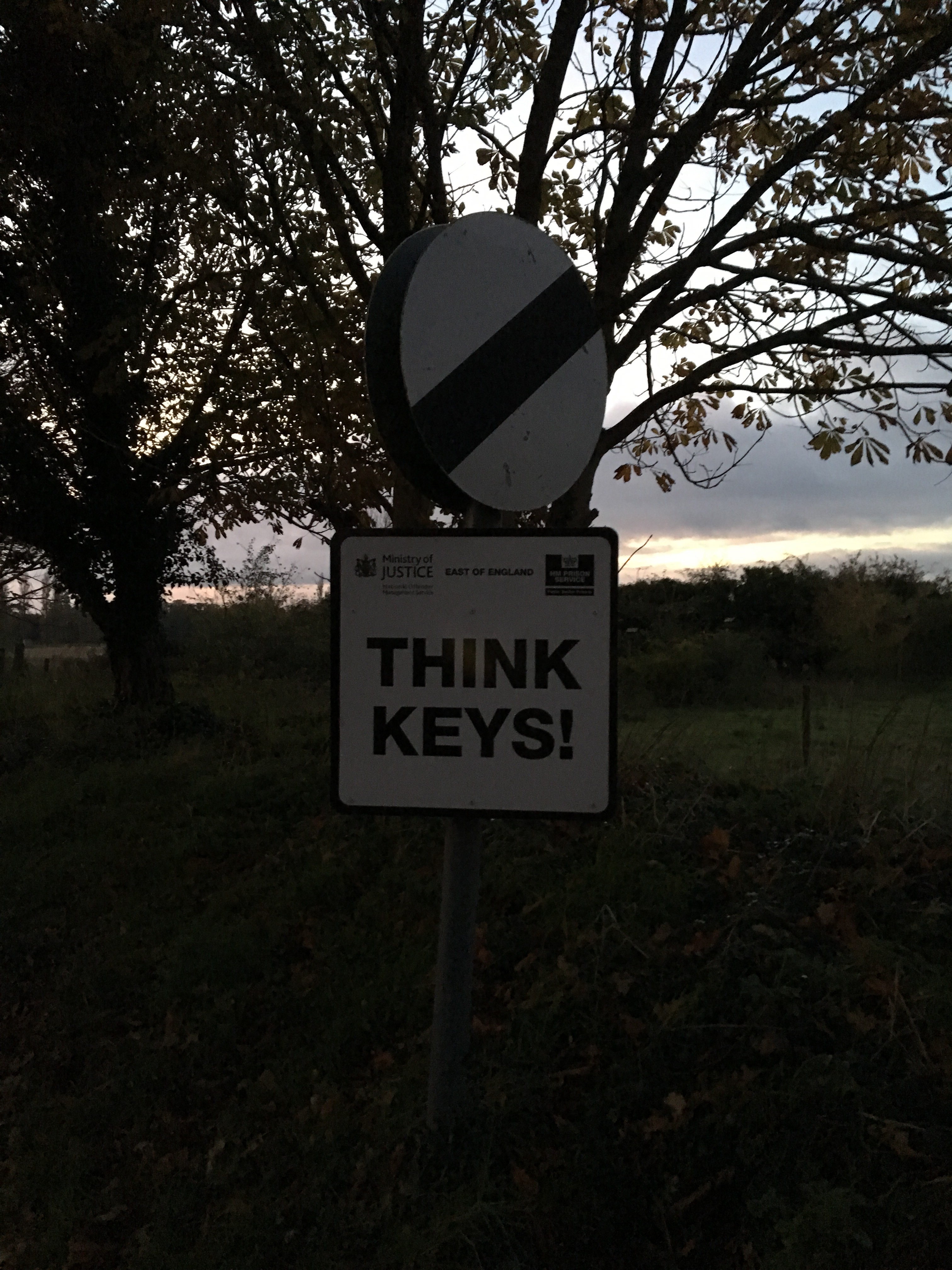
As I reach the end of the Hollesley Bay colony a sign that I’ve never seen before. It’s so without embarassment and must be meant for the prison guards. Isn’t it? I laugh out loud as I imagine someone having forgotten, cursing, and then streams of teenagers running across the marshes, running towards the moon and the sea and the cloudbanks.


 The Slow Walker