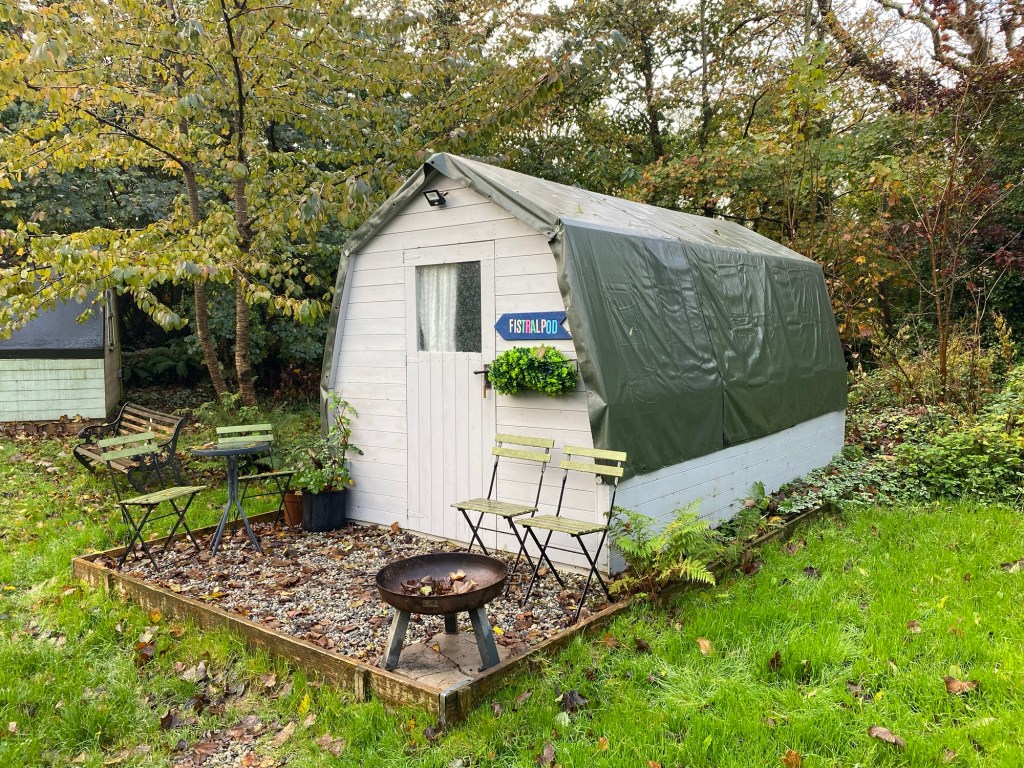
I sleep soundly in my little cabin near Newlyn East until I am shaken awake at 4.30 by a cockerel crowing about 2 metres from my head. It’s still raining, the pattering constant on the leaves in the trees surrounding me.
I find the breakfast room, a small whitewashed barn – or probably an old dairy – with old surfboards resting on the rafters and an aquarium bubbling away in the corner. One end of the room is a kitchen and there are plastic tubs of cereal, a kettle and a fridge for guests to make their own breakfast. Bits of printed A4 are stuck up around the place. One tells of how a local film was shot here called The Chocolate Club. Another tells the local story of St Newlina.
Apparently she was a local girl betrothed to a nobleman but refused to marry him as she was ‘pious and god fearing’. Apparently he flew into a rage and struck her head off. The story goes that where her head fell a spring appeared. ‘It was said he beheaded her a quarter of a mile due south of St Newlyn East. The sacred spring at Penhallow House is believed to be the exact spot where she was most brutally murdered and its waters are said to have healing properties as well as magical abilities for nourishing, wellness and fertility.’ The church in the village was rededicated in 1259 and since has been known as St Newlina.
A wren comes in briefly to watch me having my breakfast before flitting off. A superstitious person might suggest the wren is my spirit guide. One appeared beside me on the path yesterday just as I joined it above the Watergate Bay Hotel. It seems everywhere I go there he is – the wren – landing close by, twitching, turning, watching before flying away, his short, sharp squeak emanating from some hidden place.
I arrive at the small village of Trevarrian to pick up from where I left off yesterday. I wait in the car thinking of nothing until a shower rains itself out.
On the way across a field to the path campions shiver under a hedge, their pink star-shaped flowers shiny with rainwater.
Less than half an hour later I’ve gone round Berryl’s Point and am looking down at Mawgan Porth. When I stop on the side of the cliff it seems I am surrounded by typical sights and sounds of the Cornish coast. A small blue fishing boat out at sea heaves from side to side, the pink bubbles of its buoys visible on its stern. Below there are distant screams of children in the sea – half excited, half alarmed – barking dogs and the indistinct burble of a tannoy on the back of a white RNLI pick up in the middle of the beach. A mass of beginner surfers with multi-coloured boards stand in the surf while 4 more experienced guys are taking waves from a break that starts from a large rock at the south end of the cove below me.
Light seems to be gathering strength in the sky and the wetness of the path starts to turn a pale blue as I descend.
The beach is thronging with half term activity. Dogs hurtle to and fro doing that most doggy of pastimes: chasing sticks. At the back of the beach a family sit quietly on deckchairs in front of a purple tent that declares ‘Trespass’. Good advice that. A boy and a girl are both stuck into books while an elder boy at the front eats a roll and looks out to sea. A mother sits amongst them drinking coffee from a Thermos mug. They all look to be lost in their own thoughts. A fourth child in a yellow beanie and grey hoody is building an enormous sand dam that curves in an elongated C around the front of the family as if protecting them from some imaginary incoming tide or tsunami. And not a mini screen in sight.
Near Pendarves Point there is an old wall that must have once been a drystone wall, the stones arranged in a herringbone pattern but built into earth so that great bulbous lumps of grass or moss have grown all over it. It is a living wall. To me it now appears more like a rampart around an ancient field closure. There is something comic about its ‘blobbiness’ but I suppose it still does the same job but without the need for repair. It gets me thinking about how human intervention in a landscape can combine with nature to produce positive outcomes.

A few weeks ago I went to hear the nature writer John Lewis-Stempel give a talk in Taunton about his new book ‘England: A Natural History’. He gave examples of how management of the land in England has resulted in some of the most interesting biodiversity in the world. He gave the example of deer parks which were introduced by the Normans and reached their ‘heyday’ in 1350 when it was estimated there were between two to three thousand in England, equivalent to 2% of England’s land surface.
The greatest achievements of deer parks is to preserve our ancient oak trees. Apparently we have more ancient oaks than any other country in Europe and Lewis-Stempel points out that ‘35% of all oaks in England with a girth greater than 19 feet are associated with medieval deer parks’. He also emphasises their importance to biodiversity saying ‘Such old oaks are universes in themselves, abodes to more than 1,000 species of fauna and flora’ and as such uses this to warn against the popular recent trend of rewilding. These oaks wouldn’t survive as long or grow to the same extent when they grow in woods or forests. It is thanks to the management of the land that they have been able to prosper.
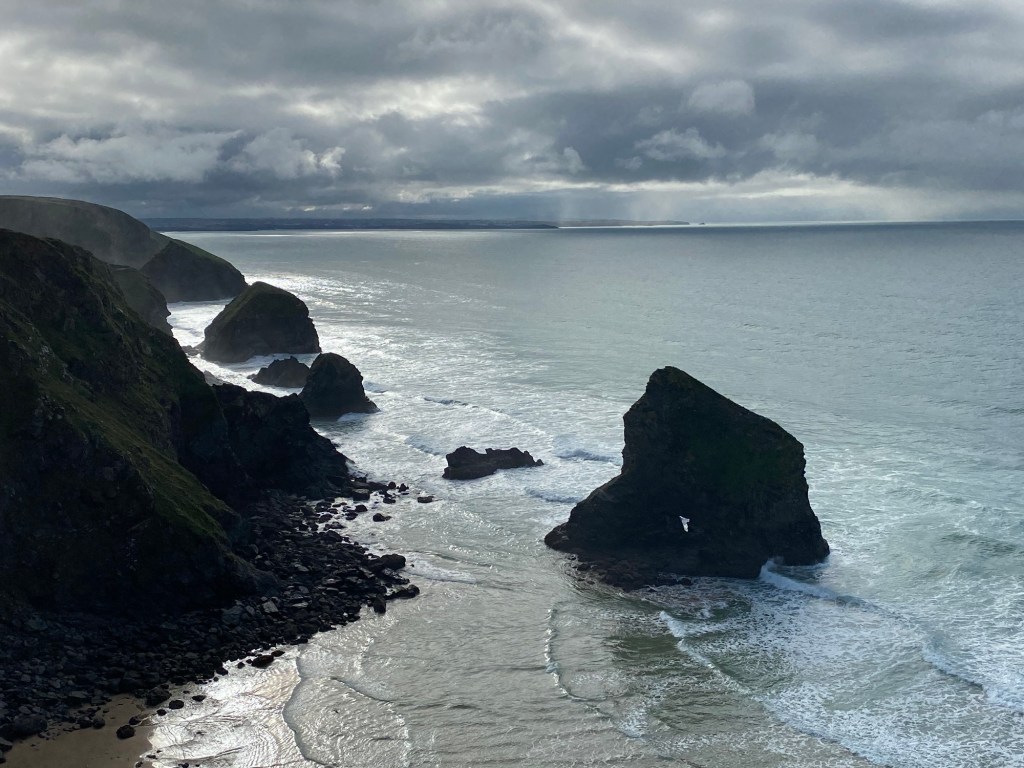
Above Pendarves Point I reach one of those rare moments where the walking has become so light that I can hardly feel the ground. Away to the west sunbeams angle down onto Towan Head and Newquay lighting it up like it’s on the stage of the sea as if to say ‘Now you’ve gone, don’t forget me.’ And the wind seems to breathe with me. In me. I start humming that Nick Cave song, ‘Jubilee Street’. What does he sing as the guitars get heavier and heavier at the end?
‘I’m transforming, I’m vibrating, I’m glowing
I’m flying, look at me now
I’m flying, look at me now’
And onwards I roll towards Park Head.
 The Slow Walker