I wake to the feeling of cool air on my face, feeling the dawn before I see it. It always takes me back to camping trips as a boy – that initial strangeness of waking up OUTDOORS, as exciting as the feeling of waking up in a new country.
I sit up in my sleeping bag and let the sea air slowly bring me round. My breathing is slow, my mind blank. I want to prolong my dream state, reaching back to dredge up the strange images that were thrown onto the screen of my nighttime mind, dreams somehow always more vivid when sleeping out. Now I can’t remember what was going on, just that I was travelling somewhere.
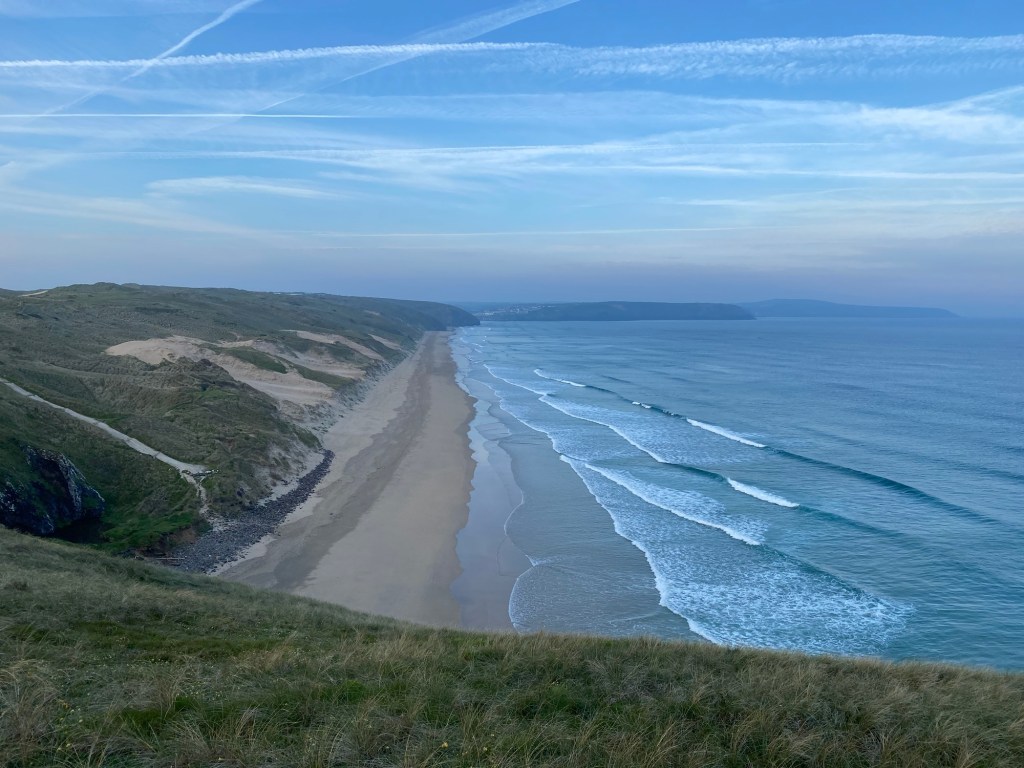
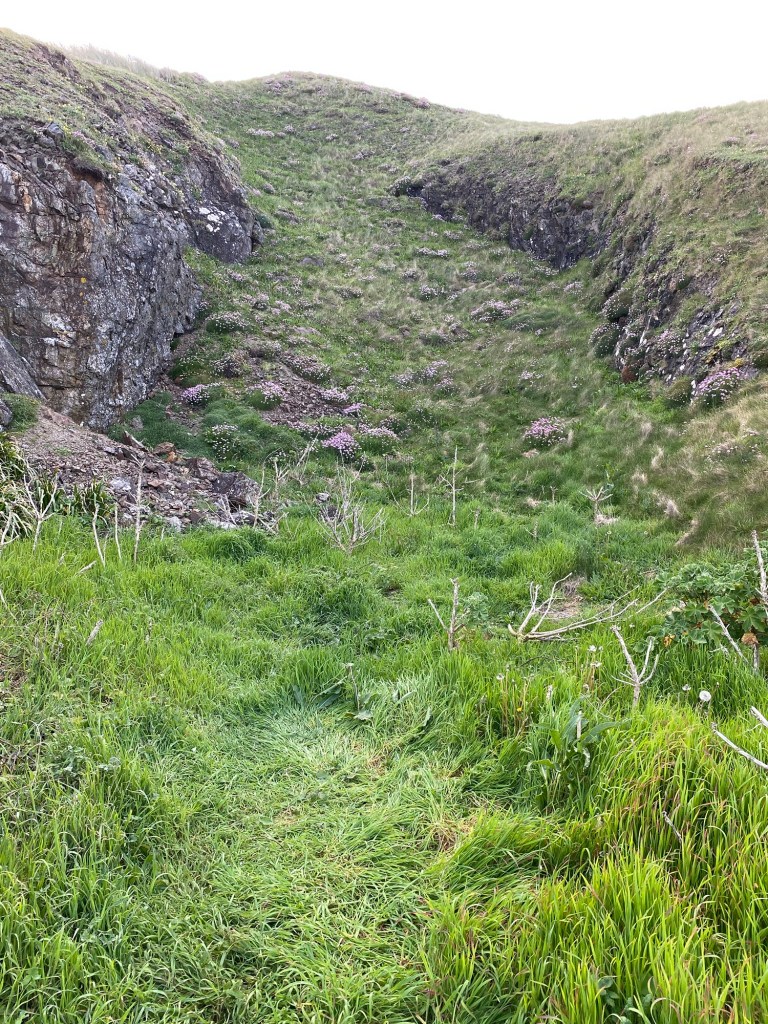
I am in a small, narrow bowl in the land, granite and tussocky grass rising up behind me. After an hour of looking in the fading light last night it was the most sheltered spot I could find. In front of me there is as good a view as any beachside villa. Leading in a line at roughly 1 o’clock west from me where I sit the path threads its way to the end of Ligger Point. Ahead the sea is a dark blue until it meets a zone of haze where it merges with the pale blue of the sky. To my left Perran Beach stretches about 3 miles south towards Perranporth where a few lights still blink in the half light.
I have woken up to lines. Below me dark creases in the sea emerge a few hundred metres out and then break into creamy white lines. Similar lines form, break and thin out all the way back to Perranporth. There are also lines above – a huge X has been painted on the blue canvas of the sky, the vapour trails of planes flying from the west silently marking their passage with their wakes. Where have they come from? The Americas? It must be as there is nothing else west of here.
My bivvy bag is wet and covered with little yellow snails drawn by the moisture at night. Once I’ve done my best of brushing off the snails I am quick to get packed (I’m dressed already).
A long distance runner with a baseball cap and arms covered with tattoos appears from nowhere. He has a double take when he sees me, no doubt looking a bit early morningish.
‘Morning’ he says between breaths then adds ‘You all right?’
‘Yes, thank you’.
I smile at the camaraderie shared fleetingly on the path.
My mind is cast back to yesterday. Perranporth was in full summertime swing like it was mid August. The weather was unseasonably warm – well into the twenties – and people had gone berserk. The beach was heaving. Wind breaks. Romping dogs. Ice creams. Barbecues. Music. People would run into the sea (me included) only to remember it’s early May and realise the water temperature is still in the teens. Minutes later they’d be running back again shining and glowing and grinning.
The sounds of Perranporth slowly faded away as I padded barefoot up Perran Beach, surfers and the dropping sun my only company. Step after step in the damp sand. Thousands of my footprints fading back into the low mist that was starting to settle over the beach. The sun got lower and started to lose its shape like molten metal and finally dropped below the line of the sea. And then I was alone. It took me another hour to make my way up the steep slopes of Ligger Point, a stiffness starting to creep into the backs of my legs before I found the small scoop in the land.

As I walk along the narrow hulk of Ligger Point I hear the lilting, high-pitched song of a sky lark. There is something immediately uplifting about it. At dusk last night when the light was almost all gone a solitary skylark sang on and on over one of the headlands looking over Perran Beach. I could still hear him 10 minutes after I’d passed singing his intricate melody. When I was feeling a bit panicked about finding a place to sleep it lifted my mood and felt like some company in this otherwise remote spot.
I think of another of Ronnie Blythe’s pieces about the Essex/Suffolk countryside that he wrote about so perfectly for so long: ‘Returning, the larks cover me with their song. Decade after decade, since Edmund or whoever it was, these dizzy birds in the blue air making a singing canopy for the early toilers’. Well today I’m one of those ‘early toilers’ and I think of Ronnie looking down on me from a pastoral other place saying with a smile ‘Yes, that’s right.’
I return to my breathing and think of the many times I alternate between the sounds of my breathing, the ‘breathing’ of the sea as the waves meet the land and the sound of the wind. On the path those sounds are a constant. Before I reached Perranporth yesterday I stood for ages staring at Shag Rock where I could see and hear water sloshing lazily over the rock and see the soft rise and fall of water. Then every few seconds a great blast of spray would be ejected from a hole in the base of the cliff somewhere just out of sight, so similar in sight and sound to the spouting of a whale, that sudden release of air they make when exhaling from their blowhole. I had a strange moment where I envisaged myself walking on the back of the land as if it was some vast and ancient beast.

After Ligger Point I come across the sad, abandoned Nissen huts of Penhale Camp. They are a bleak grey against the morning sky. Windows are boarded up and those that aren’t are often broken. It’s spread over a large area between Ligger Point and Holywell, the size of a big sized village.
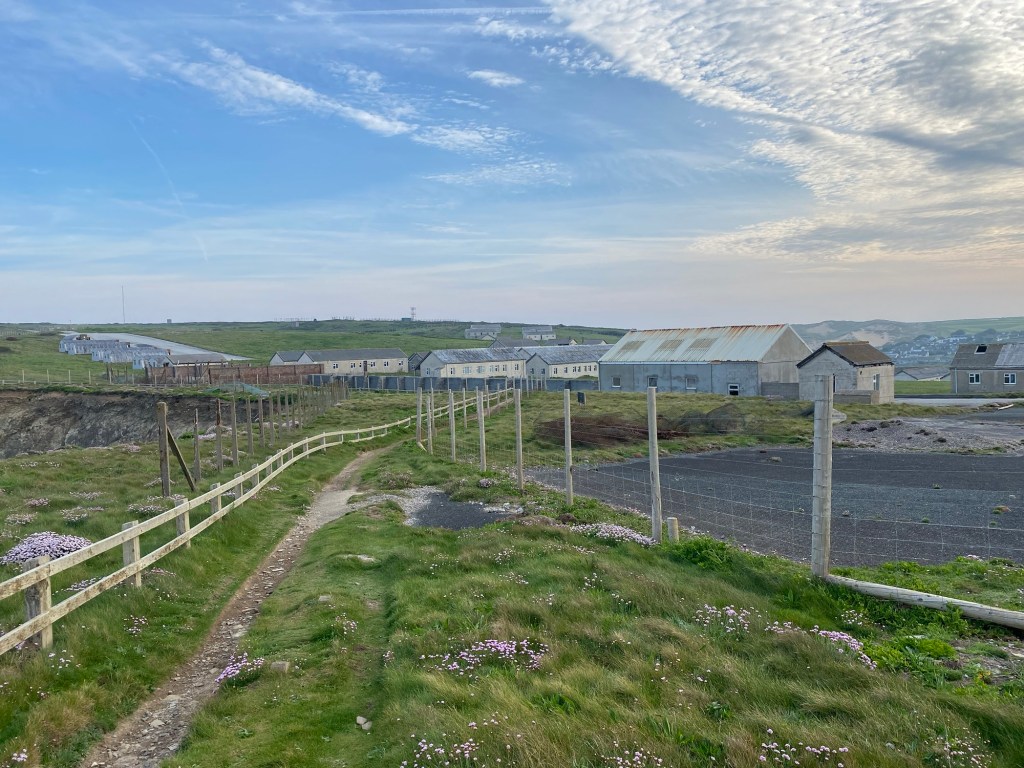
I notice a developer must have bought up this land and have staked their claim by putting up a sleek sign advertising their name, Cabu. It stands out in stark contrast to the abandoned and broken buildings that surround it.
Later I find an article from Cornwall Live written in 2022 that reveals there has been a battle going on between the developers who want to build a holiday camp and ‘the friends of Penhale’ over 400 people “concerned with the ecology of the site”. There’s some interesting stuff in the article. Apparently the Nissen huts were built in 1943 by the United States Army Corps of Engineers ‘as part of the buildup to Operation Overlord, the D-Day landings’. 23 people were killed here when it was bombed by the Luftwaffe.
The article continues ‘When peering through the broken windows one can see bedside tables and cabinets left abandoned and half broken, while some of the buildings also sports signs warning not to disturb the various species of bats which roost inside.’
Apparently the site is home to all sorts of rare flowers and animals such as bats, barn owls and my new friend, the chough.
Not all of it is abandoned. Behind the fence there are more up to date buildings surrounded by razor wire and CCTV cameras. According to the article ‘these are rumoured to be active listening posts for enemy submarines’.
It all adds to the rather surreal and spooky atmosphere of certain parts of Cornwall.
This isn’t uncommon. My dad always said he found something unsettling about the Cornish landscape. And the writer Tim Hannigan, author of the excellent ‘The Granite Kingdom’ about Cornwall, its identity and its representation throughout history told me that DH Lawrence was intrigued by the landscape near Zennor but Katherine Mansfield was disturbed by it and swore never to return.
As I turn away from the abandoned wartime camp, as if just waiting in the wings for his cue, another chough comes boldly striding along the cliff top next to the path. I can’t believe it. Having been looking for them for years I manage to see 2 less than 24 hours apart. He makes a brief croak while he looks this way and that.The bright red of his beak and legs are striking next to the shiny black of his head and body. It’s the most wonderfully bold matching colour combo and I wish I had a better camera to try and do him justice.

 The Slow Walker