
The seasons are embroiled in an ongoing battle with no end in sight. Weeks have now gone by where spring has slowly tried to free itself from the cold grip of winter so that it can start its annual journey. Yet it can’t quite make it. Primroses and dandelions get buffeted by icy blasts of wind. Horse chestnuts wear their full dress of enormous leaves and pink and white flowered panicles but others look like they’ve hardly started and their bare branches lean into and away from each other clattering like rowdy teenagers waiting outside a shop.
As soon as the blackbird starts his cheery tune or the blossom declares ‘I am ready – look at me’ as it sparkles in the sun, yet another cold gust or downpour will chase the blackbird from his tree or fling the little flowers from their branches in a stream of white. Every day Winter seems to proclaim ‘I am still in charge here’ and our hearts sink and we grumble and then rebuild our hopes for the following day.
Yet today – despite the cold – the sun shines and all of nature is trying its best to be bright.
I am in Hardington Mandeville, a few miles south west of Yeovil and heading due north on The Monarch’s Way before it turns east to follow the footsteps of Charles II when he had to return to his safe house with the Wyndhams at Trent just north of Yeovil after failing to escape from Charmouth. As a result the path does a huge loop and I find myself in similar territory to 3 years ago and closer to home.
Ahead of me slopes spread west towards Crewkerne. Blades of grass quiver. The brightness of the green makes me stop and breathe. Beyond the predominant blue above green, bright yellows catch the eye: a line over there below the horizon, a small square there behind some trees. Oilseed rape. The yellow appears as small painted patches on an otherwise green canvas.
I start and then deliberately stop. My temples are throbbing slightly and eyes a bit sore from an early start. Hearing myself breathe and tuning in to sounds while trying to tune out of thoughts. A lawnmower. A plane. The chattering of sparrows. The low hum of the breeze around my head.
I thought I was onto something when I discovered walking slowly / slow walking as a way of not just appreciating the world in as absorbed a way as possible but also as a way of slowing myself down to make me a happier, healthier person. I only discovered recently that it is a ‘thing’: a way to meditate that involves slowly walking. They say for many people the movement can make it easier than meditating sitting or lying down.
So without knowing it I discovered a way to do what I love best but improve my mental and physical health at the same time. It’s a happy thought. I just have to be careful not to lose myself completely and veer off the path and fall off a cliff, go down the wrong road or into someone’s garden! Getting lost is always happening to me and it’s all part of the journey.
Sheep with angelic faces greet me just outside the hamlet of Lyatts. This breed seem bulkier than many of their brethren with woolly legs like a plump gentleman with plus fours and wool that surrounds their beautifully pale faces and broad platipus-like tails. After a brief glance they bolt and go back to their chewing further up the hill. I remember John, the farm labourer in his seventies I worked with once on a flower seed farm in Suffolk. Sometimes he would stop and rest on his hoe while he looked at the cows. ‘Might be quite nice just sitting their all day a-chewing.’
After a scotch egg and apple for lunch I lie down in the long grass overlooking Lyatts. It seems to hold me and its blades gleam and shiver all around me. Someone in the valley hammers a piece of wood. A car is turning. A small plane lazily passes over. The wind passes back and forth over my face while small clouds pass south at snail’s pace. At one stage I am aware of nothing. What am I? Am I conscious? Is there me? Where is time? And then I drift back and nothing has changed but the clouds.
In fact after Lyatts I do take a wrong turn. I see an arrow and a path going straight up a hill which I charge up to the top of before checking the map. Oh well – every mistake can provide some benefit, I think, as I admire the view before going back down.
I walk another mile. Past a huge new building – all horizontal lines and metres and metres of glass behind a high wall. It could be a Bond villain’s lair apart from the name ‘Waterfalls’ which somehow doesn’t seem right. In a barn young calves are mooing for food. Their heavy breathing seems so deep in tone for for their size and their pale pink tongues appearing out of the side of their mouths curl upwards snakelike to lick my outstretched finger.
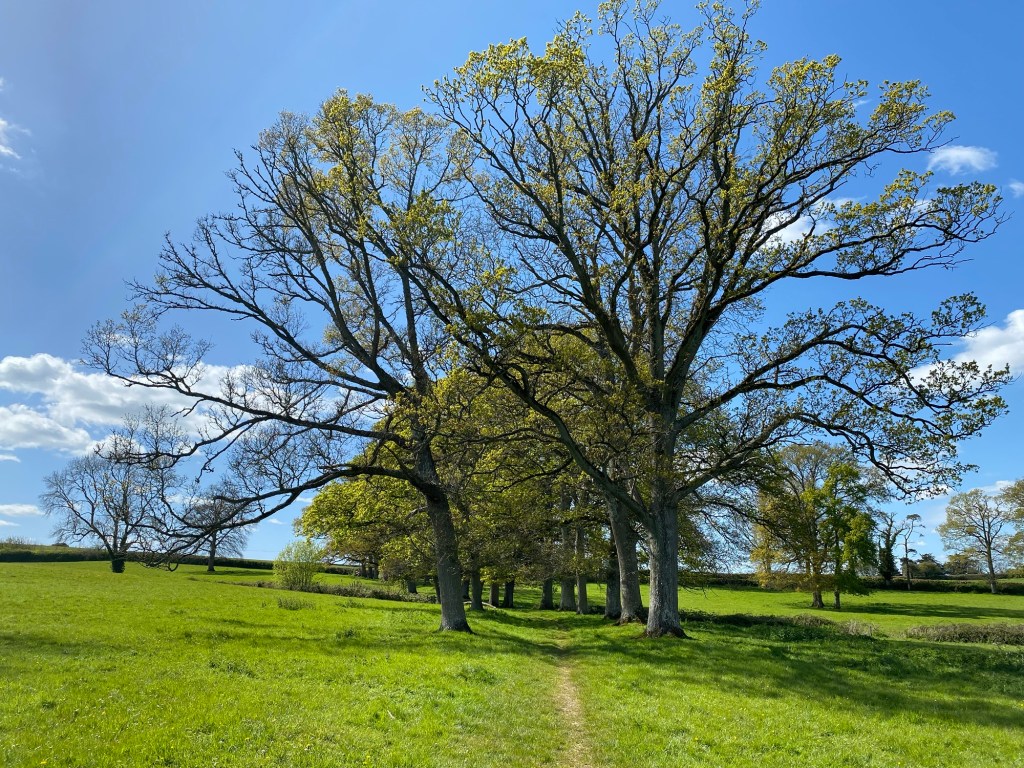
I cross a road and an avenue of oaks guides the way through the grounds of Coker Court. I smile at myself sitting on one of the great bulges on the side of a trunk and try to imagine time through oak time: the slow growing of the years and the many different seasons they have weathered. If they could think surely they would be very meditative beasts!
At last I reach my place of today’s mini pilgrimage, St Michael’s and All Angels church, East Coker. It is at the top of a hill next to Coker Court. The church looks down upon the village and its graveyard is surrounded by dry stone walls. East Coker is where Michael Eliot had lived and worked as a cordwainer (a shoemaker) before he emigrated to America in 1670. T.S. Eliot was born in St Louis in 1888, a descendant of Michael Eliot of East Coker. St Michael’s and All Angels is now famous for having Eliot the poet’s ashes interred here.
Eliot wrote the poem ‘East Coker’ during World War 2 as a way of getting back into writing poetry after he thought he’d lost his ability. According to my old friend Wikipedia ‘The poem discusses time and disorder within nature that is the result of humanity following only science and not the divine.’ It must have been inspired or influenced by the chaotic state of the world in 1940.
A specially written guide about Eliot in the church says that he visited the church at least twice before the war and that it is likely that his decision to have his ashes put here ‘was about the closing of a circle, returning to the place in England where his family roots lay.’ It also says how ‘the village in the poem ‘has been seen as a metaphor of an idyll of a lost way of life’.
In one corner at the back of the church is a memorial to the poet with a cross, some flowers and a photo of him. Below a window in the west wall is a plaque which says:
‘Of your charity pray for the repose of the soul of Thomas Stearns Eliot, poet 26th September 1888 – 4th January 1965 & Esme Valerie Eliot his loving and beloved wife 1926 – 2012.’
At the top and bottom of the plaque are those much quoted lines from East Coker that I also saw earlier on a sign welcoming me to the village:
‘In my beginning is my end’
‘In my end is my beginning’
It is the same sentiment that Mary quoted to me at the Pilsdon community in Dorset when I passed it on the Monarch’s Way in July of last year. The community had been modelled on Nicholas Ferrer’s Anglican community at Little Gidding in the 17th century. She had talked about the benefits of a ‘contemplative lifestyle’ and ‘living with the seasons’. Like Eliot she seemed to believe in a circle of life where our lives are a small part of something much bigger.
Eliot had written another poem ‘Little Gidding’ in 1942. It along with East Coker makes up the ‘Four Quartets’. Like East Coker it is concerned with past, present and future and the need for renewal and salvation.

Not for the first time I think about the great gift of churches and the wonderful secrets they keep. It shouldn’t matter if you’re religious or not. These places are important for being a place for reflection or contemplation away from the stresses and distractions of everyday life. Yet they are also a place to remember our dead, to celebrate past lives and our stories and art. They are like mini museums and there are still 16,000 of them in use in England and Wales.
Unfortunately many of them are at risk of being abandoned as Christianity becomes less relevant but let’s hope we are able to protect and continue to love them as other people have done for hundreds of years.
 The Slow Walker