I wake up slowly, softly in my bed at The Ship that looks over Mousehole Harbour. The first thing I’m aware of – apart from the quiet of the room and the cries of seagulls outside the window – is the great sense of relief, that I’ve made it through the night again without resorting to some sort of sleep aid.
For years my relationship with bed and sleep has become unharmonious to the point that I have spent countless nights acutely aware of the dark hours passing by, imagining the world turning slowly, heavily until at last I would wrench myself out of bed and start the day, my mind normally shrouded in a fog of intense fatigue.
In the last few months and having made some quite drastic changes to my lifestyle my nights have started to change. I have persuaded myself that going to bed is something not to dread but to look forward to and waking up like this and realising it’s 7.30am and not 1.30am and that I’ve slept through the night is the most simple, wonderful feeling.
It’s a Saturday morning and the mattress of the sky is still covered with the same grey blanket that was there yesterday. It seems to make the world seem stiller.
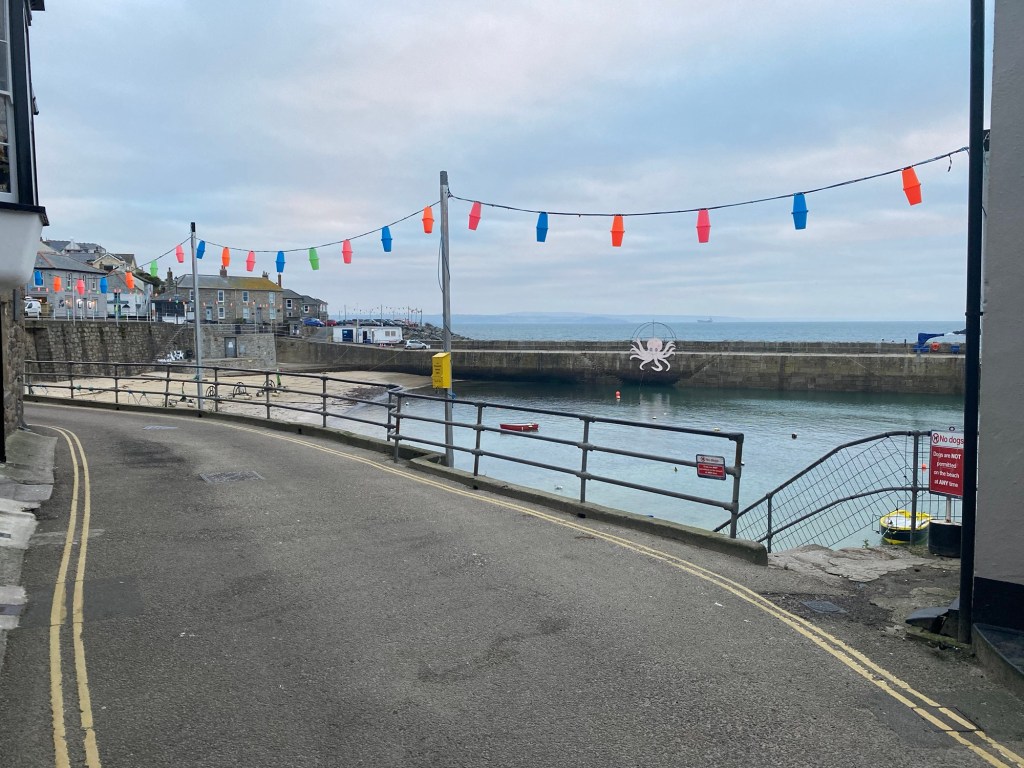
Around Mousehole Harbour there is a distinctly early January feel to the village: a shop and the bakery both have workmen doing renovations, a person with a dog says good morning and otherwise the unlighted windows of houses stare vacantly out to sea.
Yet there is a jaunty air to the harbour. The famous Mousehole harbour lights are still in place. Strings of bright blue and orange lanterns adorn the road that rings the harbour. A cartoonish, pink Octopus uncurls its tentacles on the side of the sea wall. And on the beach an enormous dragon made out of wood and painted boards lies on the beach while eight men in high vis jackets stand around it waiting to carry it up the sea steps until next year. In the background the long line of The Lizard is a thin blue band between the sea and the sky.
I am the only person having breakfast in The Ship. The woman serving me breakfast has the typical unabashed friendliness that I’ve often associated with the Cornish. She is from St Austell but moved to Mousehole to be with her partner.
‘The best decision I ever made’, she tells me.
The Mousehole illuminations are famous. Local artist Joan Gilchrest was the first to put a string of lights beside the harbour in 1963 and the Mousehole Harbour Lights display has become bigger and bigger so that thousands of people now visit them every year. These days there are wonderful designs such as boats and animals that light up the village and must be magical when seen from the sea.

In a storm on December 19th 1981 the local lifeboat, the Solomon Browne based at nearby Penlee Lifeboat Station set out in an to attempt to rescue the passengers and crew of The Union Star whose engines had failed 8 miles east of Wolf Rock. The conditions that night were incredibly fierce with hurricane force winds of up to 100mph and 60 feet waves. The 8 crew of the lifeboat – all of them from Mousehole – and all those on board The Union Star lost their lives.
Ever since then the Mousehole Lights are turned off on December 19th every year to remember those who were carried off that night.
I ask my host about this and she tells me most of the families of the crew are still here. The landlord of The Ship at the time was one of those who went down with the lifeboat.
‘Weather permitting, the families will go out on that date and lay a wreath on the spot where it happened’, she tells me.
I think the oft repeated thought of the mixed relationship villages that depend on the sea have with the beast they live beside, only too aware of its changeable, unpredictable nature.
When I arrive at Portreath nothing has changed. The grey and the cold and the biting northerly wind is a facsimile of yesterday and I set out with a smile at the continuity of this great walk and the never knowing when I’ll finish it. I don’t care. It’s about being in the here and now rather than treating it as a prize or achievement.
At Portreath housing is clustered around the harbour. A man with chest waders digs, I guess, for clams in the sand with a pitchfork.
A steep hill carries the road and path out of Portreath and when the path leaves the road black bushes of thorns accompany me with faded cans of Stella resting beneath them and a black bin liner that has been shredded by sea winds so that it looks like a hideous black cobweb amongst the branches.
Like many times over the last seven and a half years I track my progress on the coast path by the headlands that stick out into the sea behind me. Godrevy Point is still visible but St Ives Head is fading into the ubiquitous grey like the memories of all those other places that I once anticipated reaching and then left behind.

A stonechat watches me quizzically on top of the old broken fence that follows the path, immaculate with his tan breast and distinctive white collar and black head.
Inland from the coast after Portreath is dominated by the old airfield on Nancekuke Common now abandoned but with its white futuristic dome once used for radar. It falls out of sight as I descend into the cove known as Sally’s Bottom where the path drops steeply down the cliffs and rises up via steps on the other side. It’s so steep it looks like a crooked rope ladder hanging down the hillside.
I am listening to myself breathing aware of the impact it has on me if I slow it down. I’m not thinking anything. Just watching and listening. Before I know it I am at the top of the next hill pausing for breath and wondering at what I was thinking in the few minutes it took me to go down one side and up the other. I don’t know and not for the first time I thank the vastness of the landscape and the calm it induces in me.
And soon I’ve moved on to realising I won’t make Porthtowan today and heading inland and back to the car. It doesn’t matter. The path will always be here and if I’m an old man when I finally complete it so be it. Until the next time.

 The Slow Walker