It’s only fifteen minutes since I said goodbye to Robert and I am walking towards Porthmeor Beach passing the world and their dogs on the way in. I find it funny how many people get nervous about their dogs approaching strangers on a walk but I guess that’s because I like dogs and I guess there are many people who don’t. Are there more people with dogs post-Covid? And have perhaps people got more irate with dog owners and their dogs post-Covid? Who knows.
On the way into St Ives a group of nine goldfinches flit here and there showing off flashes of yellow as they flick their wings. A posse of oystercatchers are peeping their sea sound and flying towards Carrick Du, the small headland that flanks Porthmeor beach and signals the entry into St Ives from the west.
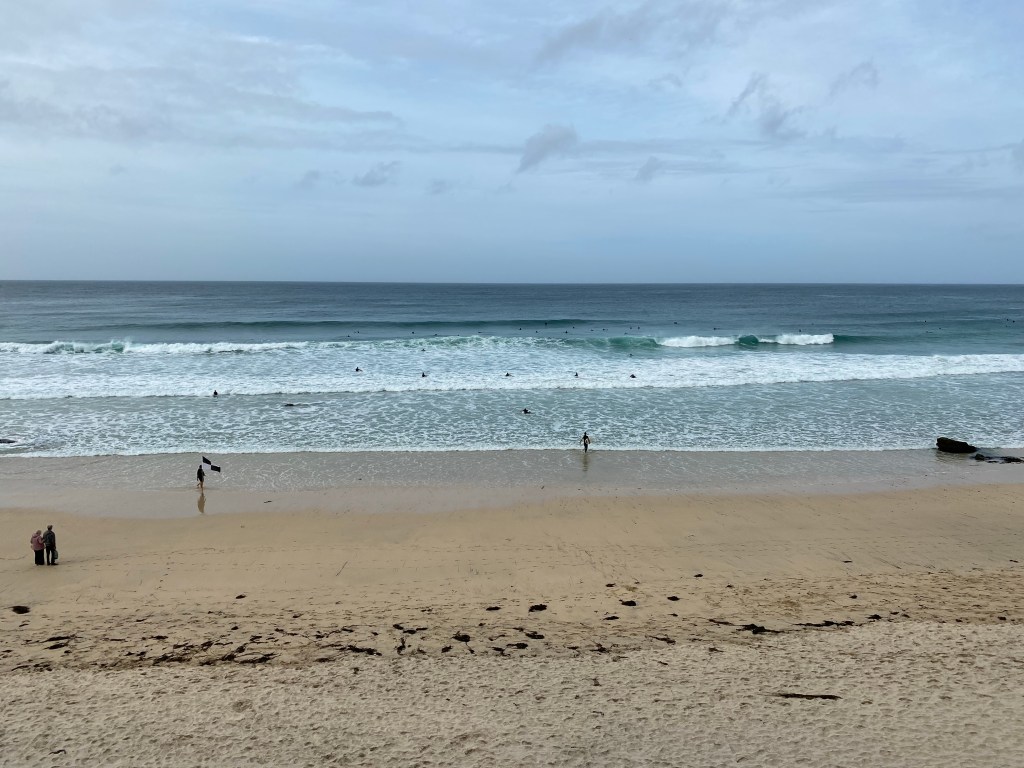
Robert had said he’d seen surfers at St Ives. At Porthmeor the conditions are excellent. Surfline says it’s 5 to 8 feet and ‘fair to good’. The slick, black shapes – mini men – take off fast on the glassy green hulks flying down their faces, carving back up to the top before flying down again. The way they ride these beasts is not a battle – although for me it can feel like it sometimes – but an amazing symbiosis between a person and the sea. I’m always stunned by the variety of movement that good surfers can get from a sloping bank of water. There is something so joyful about it, even just to watch. It gives me pangs – how I’d love to be out there and how I wish I could get better at it.
On the beach and in the beach cafe many people look on agog including the lifeguards in their high-vis orange uniform. On the balcony at the cafe two trophies are lined up on the rail which explains the quality of the surfing.
Behind Porthmeor Beach is the grand entrance to Tate St Ives. It looks closed and seems a million miles away from the action on the beach. I check myself: trying to make a mental adjustment from the coast, the sea, the surfers to ‘culture’. Before I can do anything I need a cup of tea so I go to the cafe at the top of the gallery which must have as good a view – although not too similar – to the restaurant at the top of Tate Modern in London overlooking The Millennium Bridge and Blackfriars from the south bank of the Thames.
There are the same clean white walls as the rest of the building and windows everywhere. Some look out east over the old roofs of the town towards Downalong and Smeaton’s Pier (where Robert had stayed as a boy). The roofs could be a painting in themselves, the different angles and terracotta colours against the blue sea beyond evocative of somewhere Mediterranean. On the other side of the cafe there are more windows and a huge terrace facing west over Porthmeor with a perfect view of the sweep of the beach, the sea beyond and the surfers as they continue to cut and turn and fly along or off the back of the waves.
They have an exhibition of The Casablanca School of artists which is wonderfully bold and colourful but I am more interested in something that has a connection to here. In the main gallery space there are several interconnected rooms and when I start it is the first picture on display.
The style is instantly recognisable for being ‘naive art’ in other words the artist has had no conventional artistic training. There is no perspective in the painting with St Ives Head, the houses and ship on the sea seemingly flat with their background. It is the same view that had transfixed me just now standing on the steps outside and here represented by a man who lived and worked next door to the building I’m in and must have known that view as well as he would know the face of a lover.

Alfred Wallis was a sailor and a fisherman. Incredibly, he didn’t start painting until he was 70 and then according to the short biog next to the painting “He lived largely in poverty so used discarded marine paints and grocery boxes that he found around the town.” What an image: this man of the sea suddenly finding a burst of creativity in his later years. He was a great inspiration to other artists living in Cornwall at the time who were exloring their own ideas of abstract art such as Barbara Hepworth and Ben Nicholson. The biog also states how “His paintings depict his experiences of coastal living and memories of working at sea.”
I wonder if I could say that my work is inspired by my “experiences of coastal living”. Probably not quite in the same league and is it coastal living? Coastal travelling? Coastal meandering? I don’t see a Wikipedia entry happening just yet.
When I look up Wallis later I realise he’s still looking at that view buried as he is ‘in Barnoon Cemetery overlooking St Ives Porthmeor Beach and the Tate St Ives gallery.’ (Wikipedia).
I once saw a question put to Andrew Marr in The New Statesman, apropos nothing in particular. ‘What is it to be human?’ Marr said it was to be creative in whatever way that might be. It might be creating a meal or creating children – not just by the fact of creation and giving birth but also nurturing them – or just the way we interpret the world around us.
The surfers are still at play. They’ll carry on until the light starts to fade and I disappear round St Ives Head. Heading along the lane that faces the beach I imagine an ageing man wandering these streets seeking out materials to reimagine or remind himself of that thing that had been a constant for him throughout his life. The sea.
 The Slow Walker