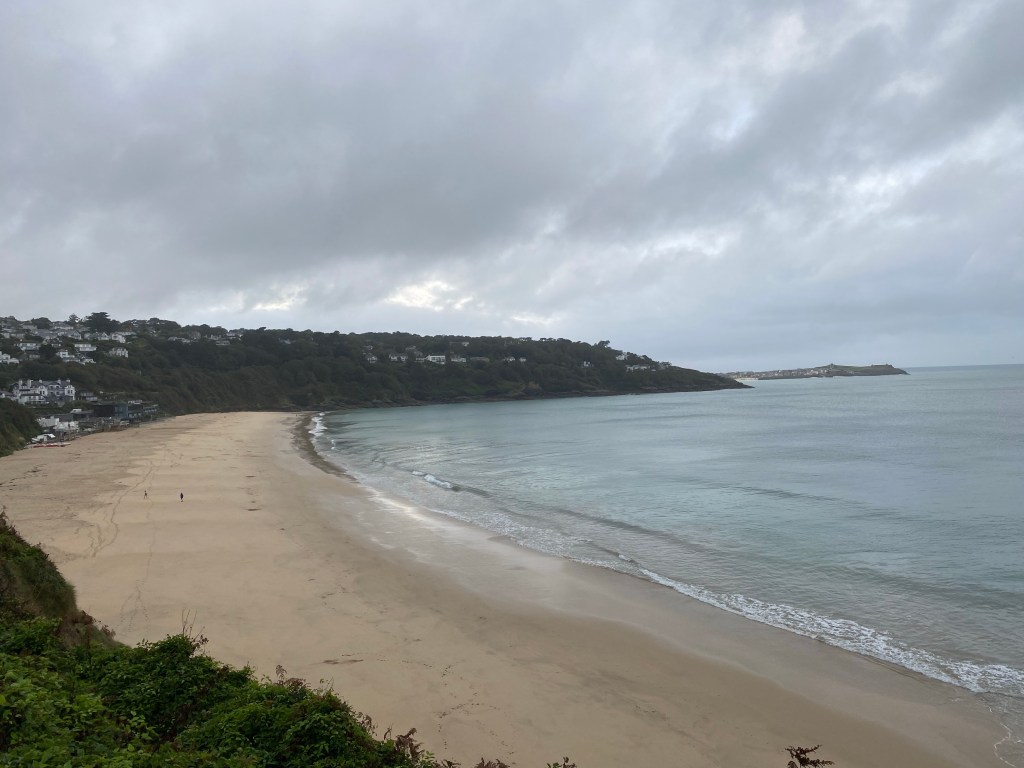
I wake at 7 to the sound of excited shouts. It’s those first few seconds of waking – rising to the surface of consciousness- that I always find intriguing: the not knowing where I am and then the feel of cold air on my face and the sudden reminder that I am enshrouded in my bivvy bag, normally on some rocky outcrop.
The next thing I notice is the sound of the water dripping from the rocks and the high pitched squeak of a bird close to my head. When I push up my eye mask there are three bathers out at sea, half of a family whose other half stand on the beach and shout words of encouragement or mockery from the shore.
The beach at Carbis Bay is a gentle crescent of neat white sand bordering the glassy water of the sea. It’s nice to have a bit of company so early in the morning and it prompts me to join them in the gently lapping water. It’s cold and I’m immediately awake, listening to my breath amplified and thinking of little else.
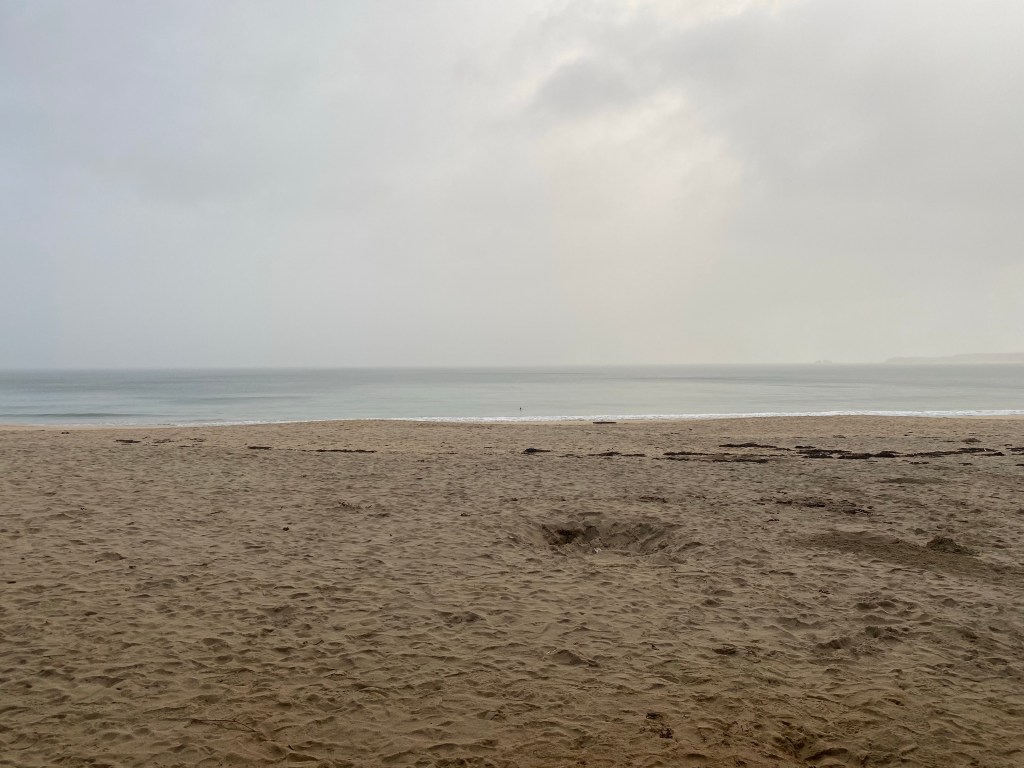
Once I’m packed up and back on the path I have that sense of satisfaction from being immersed in the outdoors, a subversive pleasure from not being just outside but also a sense of being a sort of ‘outsider’, living briefly outside the normality of everyday life, a wanderer whose life is a journey where walking is one’s existence that continues uninterrupted apart from to stop and eat or lay down and sleep.
I am aware this is a conceit. I am only play acting or imagining being the solitary traveller who spends his life on the road – tomorrow night I’ll be tucked up in my bed and getting ready for work the next day – yet it is a fantasy that exerts a strong pull on my imagination so much so that I’ve done this for as long as I can remember: taken myself off with a map, a sleeping bag and no plan but to be alone outdoors.
The morning is overcast and still but the warmth of late summer has lingered like the glow after a lover’s touch on my skin. This coastline is distinctive for the huge swathes of sand that border it. At St Ives, Carbis Bay and then Porth Kidney Sands which is devoid of people and doesn’t appear to be real, like a print on a wall. This is only the start: from the mouth of the River Hayle sand dunes continue for several miles north east until they end at Godrevy Point.

Along the low cliffs I wind through the dunes, the path a line of sand amongst whispering long grasses. The branch line that starts at St Austell and ends at St Ives hugs the path here, the half hourly train my only company. It is not quite 9am.
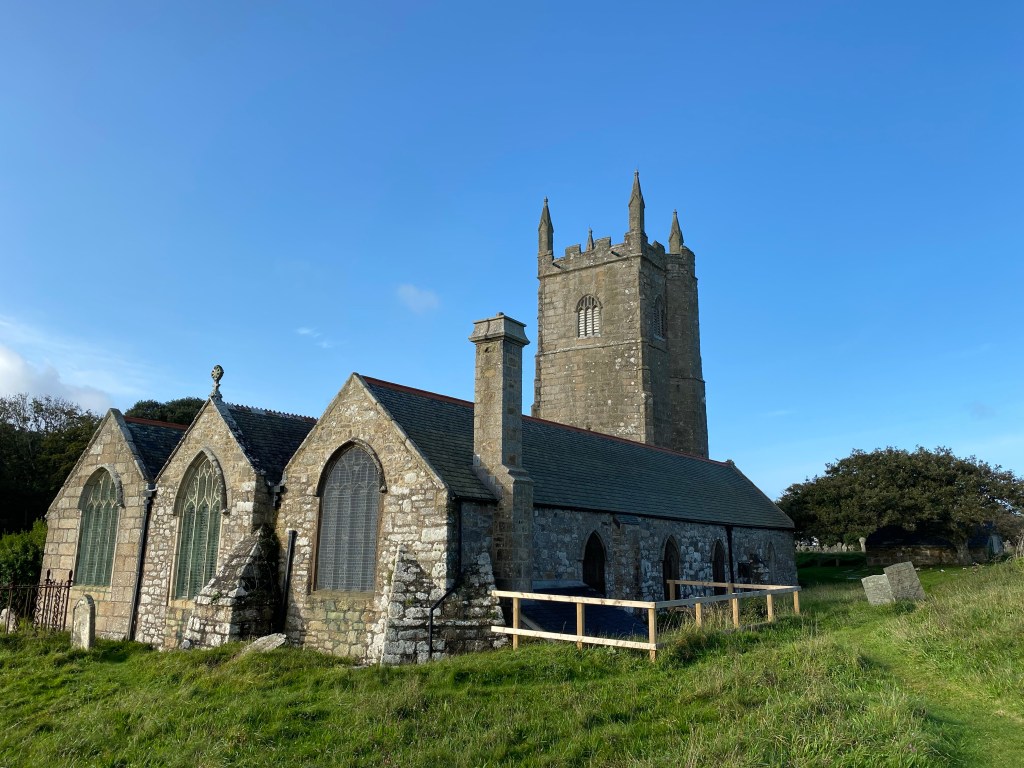
St Uny church in Lelant sits atop the dunes surrounded by a golf course. It is here that St Michael’s way passes through and for a short stretch shares the SWCP. It was a stopping off point for medieval pilgrims en route to Santiago de Compostela.
According to The British Pilgrimage Trust website ‘The route was created after the discovery of ancient shipping rosters proving that pilgrims historically came to Lelant by sea on their way to Santiago de Compostela, and travelled over land to Marazion to avoid the waters of Lands End.’
Many people walk the way today. There are St Michael’s Way passports where modern day pilgrims can get stamps en route to show their different stops.
Inside a local couple are vacuuming and polishing the floor and pews respectively. Over the sound of the hoover she says “We’ll have to do this for Harvest Festival too”. When is it I wonder? And have childhood memories of our local church in Suffolk and Sunday school with displays of fruit and vegetables and tins of preserved food in baskets.
According to an aged looking board in the church in the year 600 marked the ‘arrival of St Uny, St Ia & St Ana, Celtic missionaries. Lelant an important and prosperous port’
A Norman church was built in 1100. In 1549 came the reformation where Henry VIII seized all assets.
Then in 1590 ‘sand storms and wind. Harbour and estuary silted up. Begins to cover village between harbour and church.’
‘1700 village covered by sand. Vicarage uninhabitable.’
‘1750 marram grass planted. Sand dunes stabilised.’
I hadn’t expected the dunes – such an obvious and enormous presence here – to be a threat to the community. And the modest marram grass that hushed at me earlier, who would have guessed at its importance?
When I get outside the church the cloud cover has disappeared and it is bright and clear and the westerly wind smells clean. There is a stunted oak at one corner of the church, a small chapel and a few graves. I stand here while the leaves shiver and breathe above me. In August I went to the Ancient Greek site of Dodoni in the Pindos mountains in Northern Greece where worshippers of Zeus would come to worship under a holy oak and where an oracle would interpret the movement of the leaves to make prophesies.

Thankfully, today I’m in no mood for prophesying; I’m thinking of right now and nothing else. And on I go towards Hayle.
 The Slow Walker