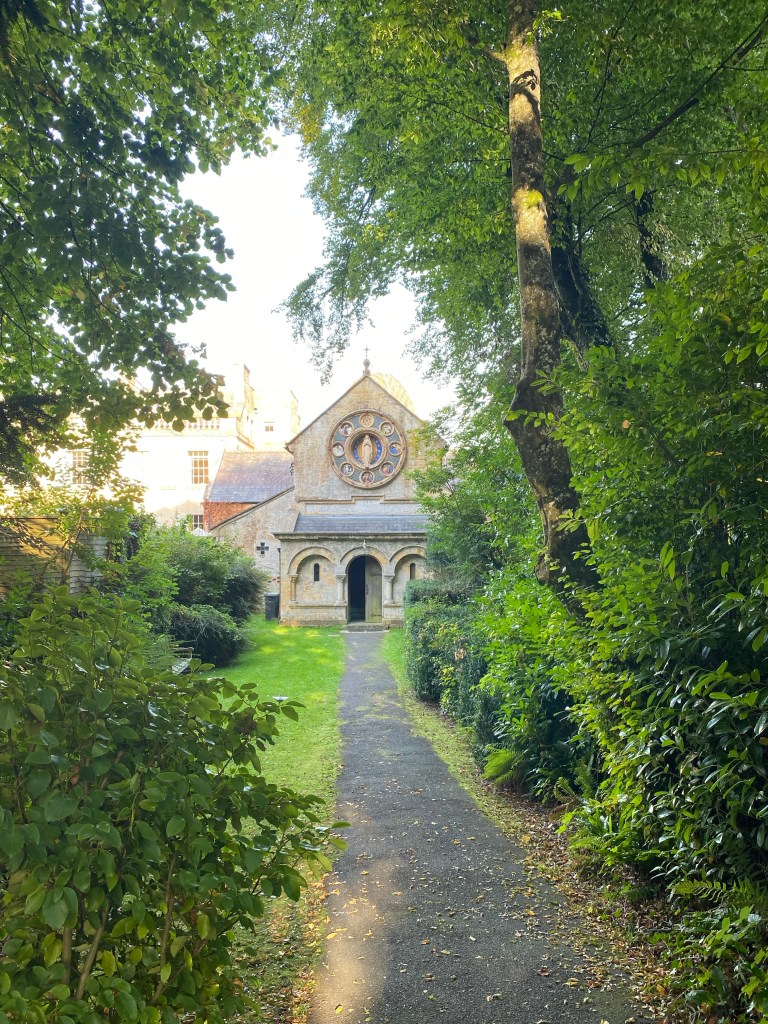
Strictly speaking, I’m not on The Monarch’s Way but have come off it to return to my car and to spend some time in the company of a gem of a place hidden off a lane in south Dorset.
In my mind I still have images of giant wild boar, hidden cathedrals and coffin bearers walking down long paths in the Forest Dean described to me by the cheerful man with tattoos and his wife who were walking from West Bay to Golden Cap and had got lost en route. Brief encounters. Like all meetings, some are just infinitely better than others.
I pause and let the sounds of the near world return to my quietening mind. The gentle breathing of the trees, a male blackbird’s song and somewhere the gentle splashing of water.
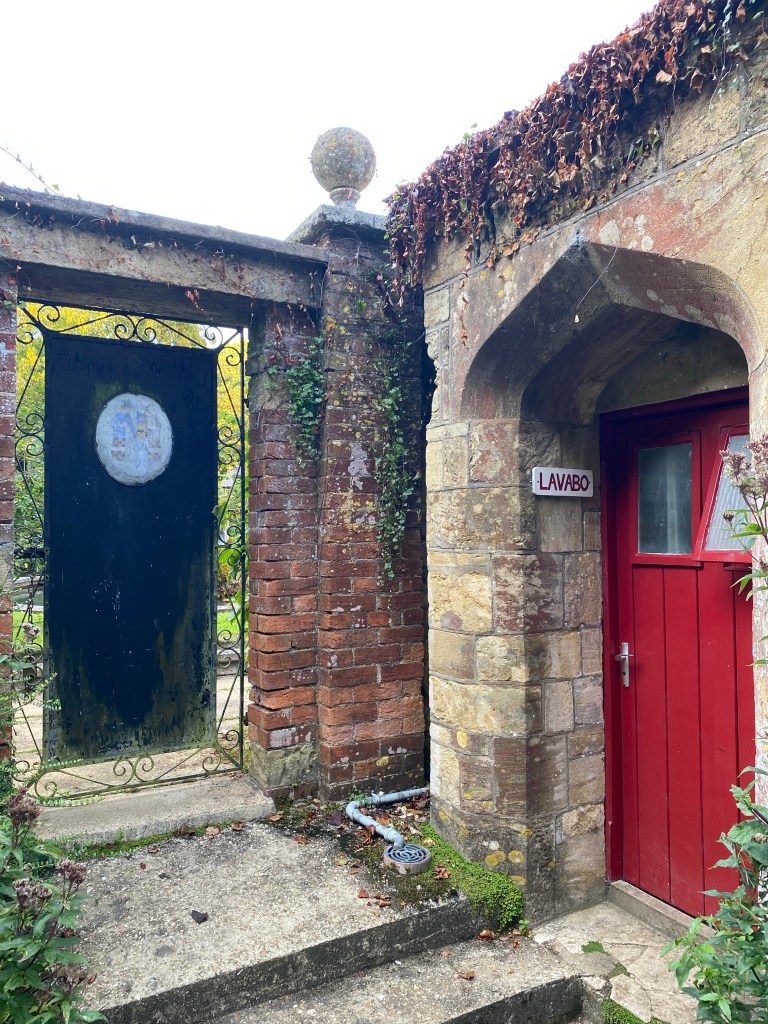
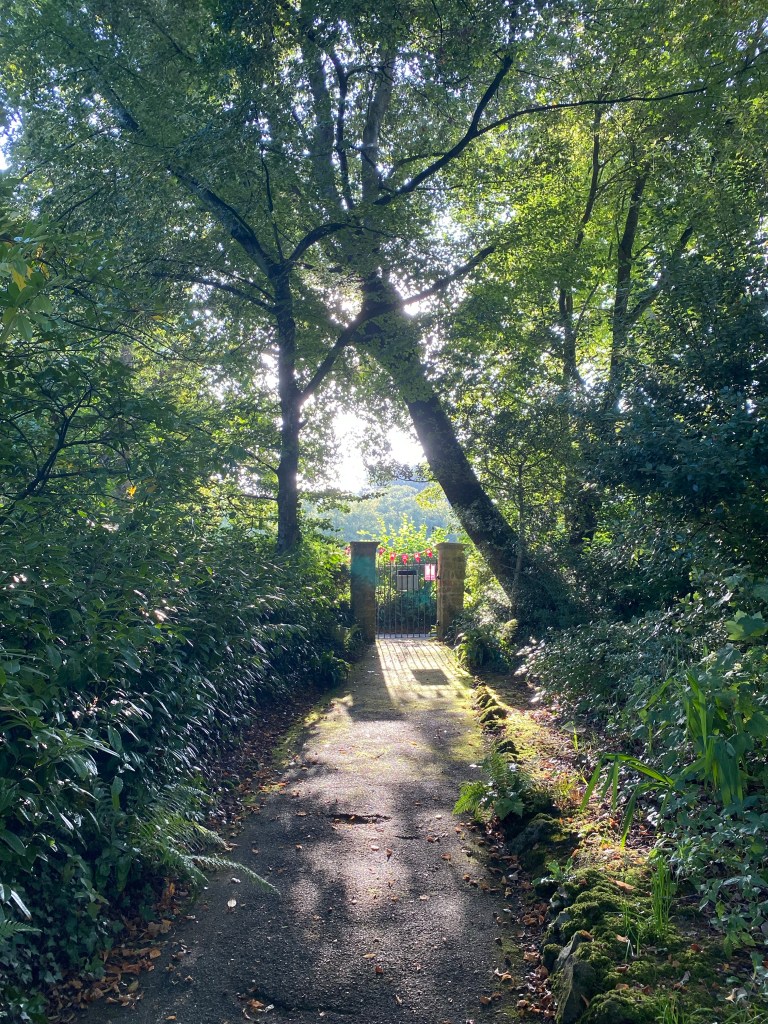
Through an iron foot gate a path leads through overhanging ash trees down to a church. The dip in the land and the framing of the trees and the coolness of the air create a sense of transition, a crossing over into a seemingly ‘other’ space, like entering a deep green pool. Grass borders the path and a wooden bench sits looking at the church porch. The path bends around to the left of the church front and stops at an arch with a red door with ‘Lavabo’ painted in red letters on a white wooden sign. Next to this a black metal gate built into the wall is a side entrance to the garden of Chideock Manor. From behind it I can hear the splashing of a fountain landing on stone and the excited shrieks of children jumping into a swimming pool.
Built in the grounds of Chideock Manor, The Church of our Lady, Queen of Martyrs, and St Ignatius is one of the most beautiful and unusual churches I have ever visited. It is not typical of an English church but more like something you might find in the back streets of Florence.
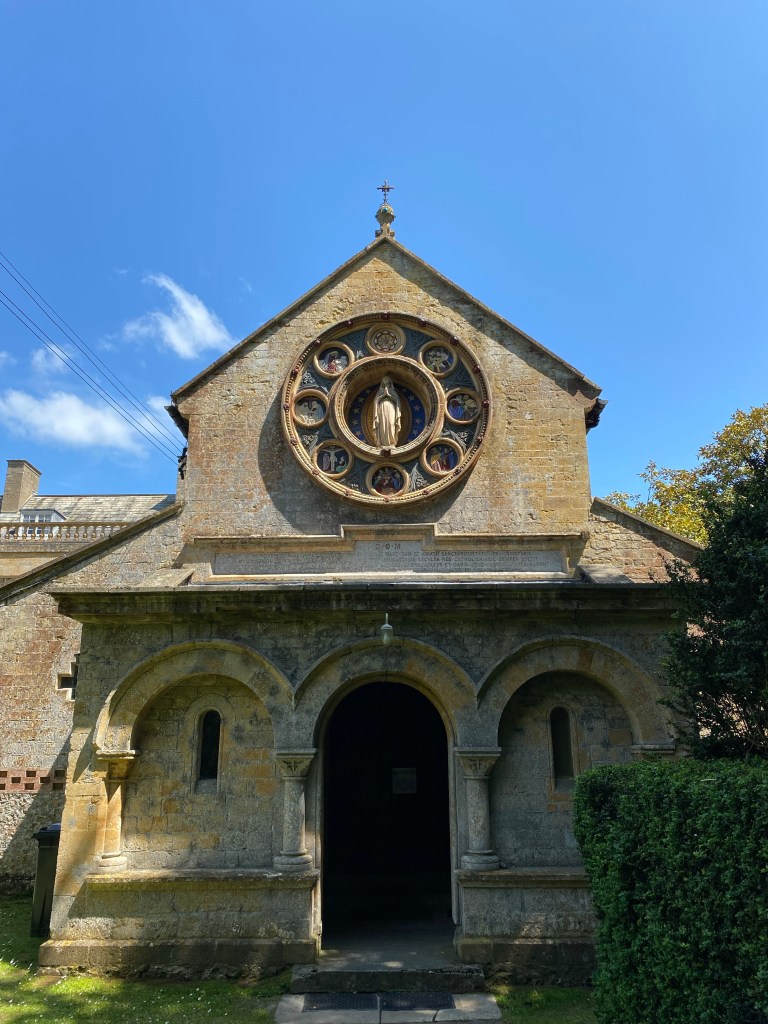
According to a leaflet inside the porch the church was built by Charles Weld whose family lived at the manor for two hundred years and was finished in 1872. “Weld designed the church in the Italian Romanesque style and did much of the work himself…The front of the church recalls the early churches of Tuscany.”
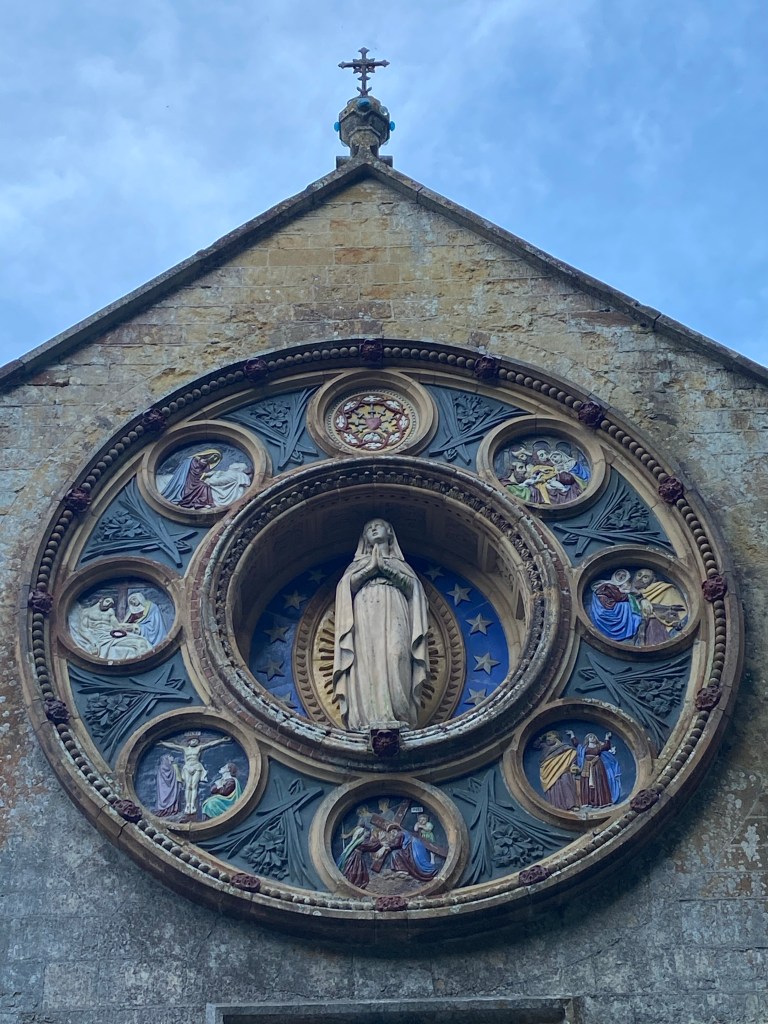
Above the entrance is a roundel made from painted terracotta which “features a statue of Our Lady, Queen of Martyrs, encircled by her Seven Sorrows.”
The leaflet goes on to reveal the poignant story behind the building of the church as this is a shrine to seven Chideock men who “were cruelly put to death for their Catholic faith between 1587 and 1642” after England officially adopted Anglicanism in 1559 and Catholicism in England was outlawed.
Originally this was the site of Chideock Castle built in 1380. In the late Middle Ages the castle was bought by the Arundell family. When Catholicism was banned they remained loyal to their faith and the castle was somewhere where Catholics could come and worship although it was illegal. The castle was captured and destroyed in the Civil War by the Roundheads on July 29th 1645 (six years before Charles II went on the run). It was then that the Arundells left. Locals continued to worship the old faith in a barn and the loft where masses were held in secret. The loft can still be accessed from the sacristy in the present day church by appointment.
It was in 1802 that Thomas Weld who owned Lulworth Castle bought the estate for his son Humphrey. It was he who according to the leaflet “built the present Manor House and turned the barn into a modest chapel.” It was Humphrey’s son, Charles, who converted the chapel into the wonderful church that I am in now.
Inside my first impressions are of a well maintained church that one might see in a wealthy part of London. The nave is lined with beautifully carved arches above which are portraits of the martyrs. Beyond this lies the chancel wherein a Baroque statue of Our Lady is lit up by the sun streaming through the windows in the dome. One can’t help but imagine her rising up to heaven, on the day of her assumption being welcomed by the light of God.
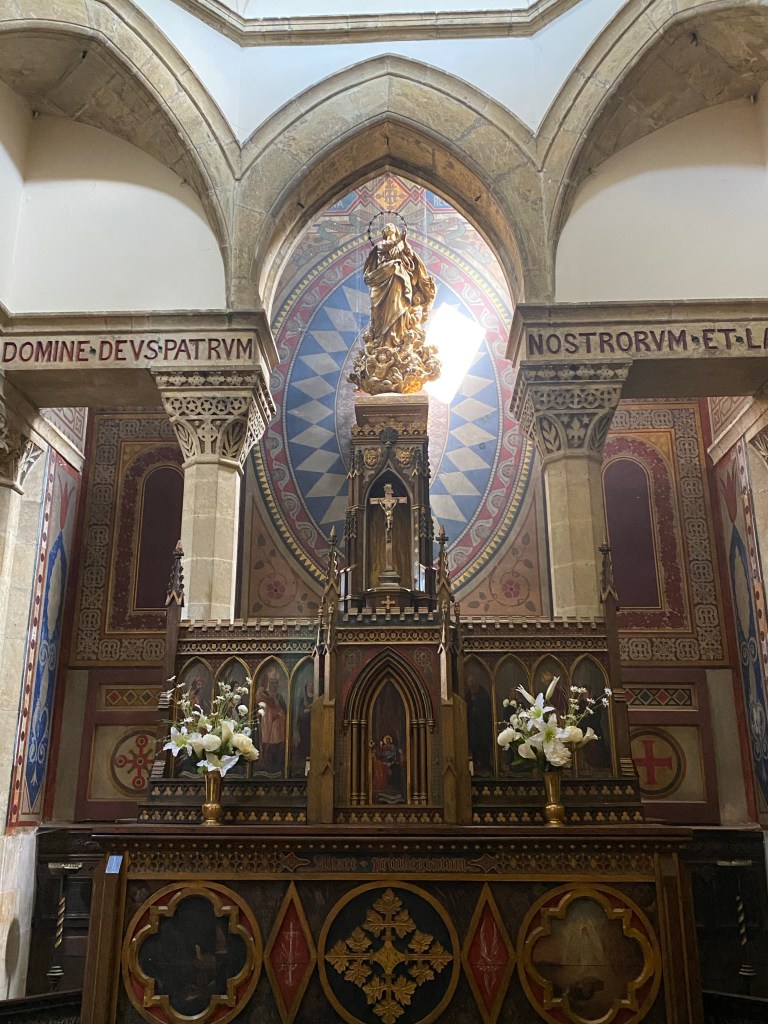
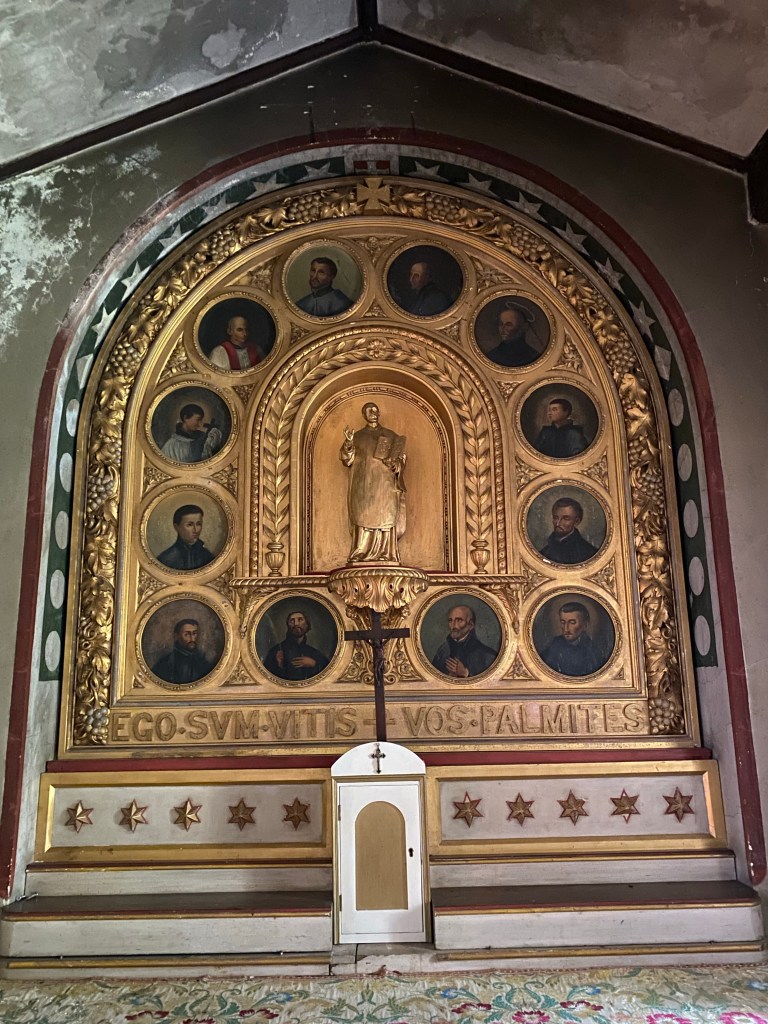
It seems like every feature has been thought of and designed with great attention the details. A wonderful altar sits in the south aisle of the church with a gold arch in which there are twelve portraits of men. Is this another tribute to the martyrs and if so why are there twelve men here?
On the north side a room that flanks the whole side of the nave with tables and chairs like a reading room and lots of literature related to the history of the church. It feels like a reading room. There are also all sorts of unusual souvenirs such as cannonballs from the civil war, huge mantraps on the wall and evidence of relics that apparently are kept here including a fragment of Thomas More’s hair shirt and a piece of the True Cross.
Not for the first time I wonder at the multiple treasures that are hidden across England but also these markers of our often violent past. Without realising it all the time I wander through places where blood was spilled, people were once persecuted for their beliefs and where many had to continue their God-given daily routines and rituals in fear of being discovered and executed. I think of Charles II and royalists loyal to him also on the run, in hiding and in fear of their lives at the end of the same civil war that destroyed the castle here and forced local Catholics to worship in the barn nine years after the last of the martyrs was executed. I think of those people in far flung places from here who today have to live their lives in fear just because of their beliefs or race or nationality.
For all this I am in awe of the incredible, delicate beauty of The Church of Our Lady. This little place has bestowed a sense of peace on me after my long walk. For once my mind is silent as I float through the light that is thrown down from the dome. I have a heightened awareness of the coolness of the nave, the great silence of the space and the smell of old wood as the martyrs look down on me, knowingly.
 The Slow Walker