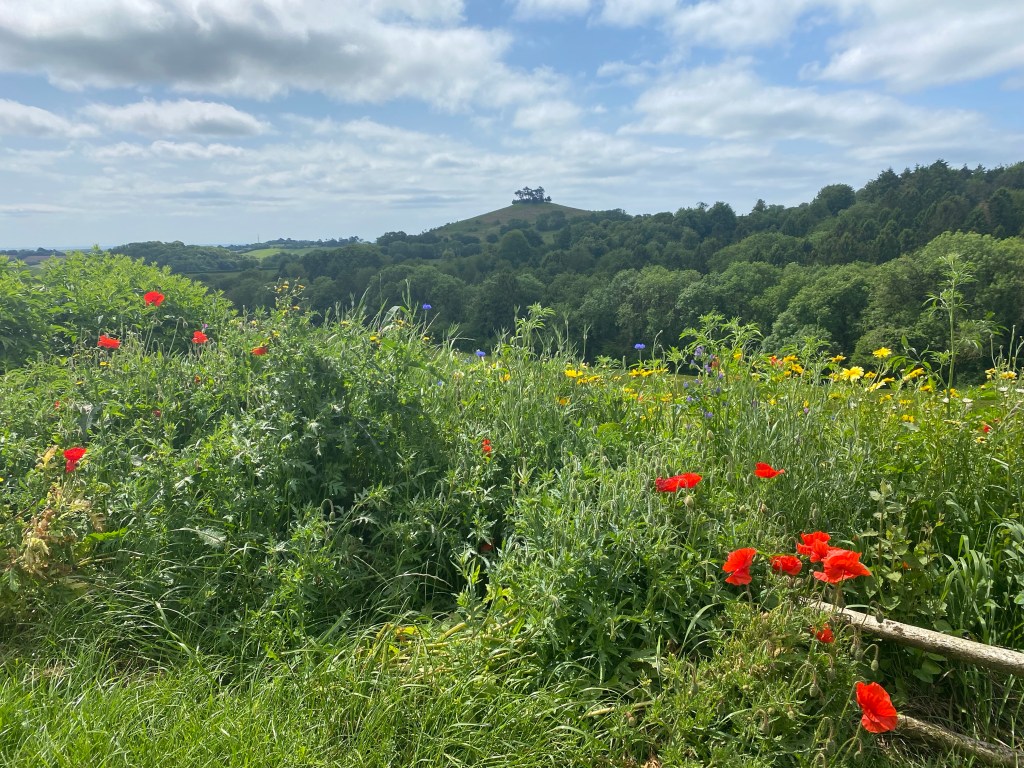
I’ve climbed the hill the other side of Bilshay Farm. I can just about see the place where I got lost in the sound of the beech leaves, the place with the figure floating through the field. I am walking west in a big loop as Charles II did after his attempt to get on a boat from Charmouth failed and he had to make a run for it back to the safety of the manor at Trent (I walked through there two years ago).
Here on the track to Axen Farm there is a seat made out of a tree trunk sawn in half lengthways to create a wide flat bench. I am looking over a bank of wildflowers towards the little copse on top of Colmer’s Hill and to the left – the south east – the sea and a ship a speck on the horizon. The flowers must have been planted deliberately, their impossibly bright blues, reds and yellows jaunty against the backdrop of the green of the Dorset hills. As I look towards the horizon something rises up indistinctly from the murky depths of my memory, something beyond description, which takes me back to being very young and driving and someone saying ‘Can you see the sea?’ Anticipation. Excitement. And something else I can’t quite put my finger on. Yes I can.
At Axen Farm, there are big barns surrounded by a concrete hard standing. There is CCTV with a sign saying that I am being watched. And there is an outside tap. I haven’t been able to fill my water bottle since last night. The beauty and magic of running water. It reminds me of that poem we used to teach by Imtiaz Dharker: ‘The sudden rush of fortune..the silver crashes to the ground’. I fill my bottle and wash my face and neck and when I’m done I nod briefly to the camera imagining how I look on a screen.
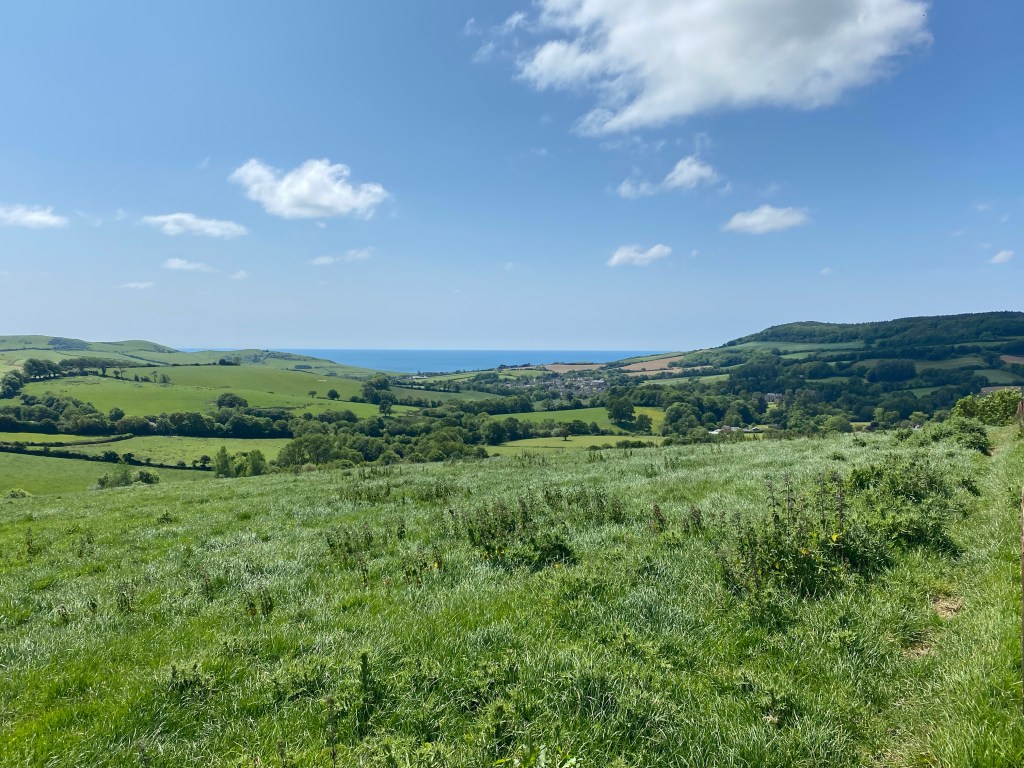
I turn at a right angle north up Henwood Hill. I slow down. There are almost 360 degree views of the curves of the hills below. I stand chest out and breathe in the wind the way dogs do when they face into and sniff wind. Chideock is towards the south west nestled into the hill surrounded by trees. All the buildings face north away from the sea.
Suddenly there are people. The first time I’ve come across anyone since I was harassed by the dogs at Bridport. First a man closely following a paper map. He seems quite tense with his little wire haired terrier beside him. He’s from Newton Abbott and is here looking for holloways, the many tracks in these parts that have sunk deep into the land after hundreds of years of use by pedestrians, carts and animals. He’s been inspired by Robert Macfarlane’s book ‘The Wild Places’ which he shows me in his trouser side pocket.
I was thinking of that book while I was under the beech earlier. Why? There was something in it that I remembered. Was it that he was walking around here? I had also been thinking about Rogue Male, Geoffrey Household’s brilliant spy thriller about being on the run from foreign agents in your own country and how Roger Deakin loved that book. In that book the protagonist hides in a hollow somewhere near Chideock, in other words somewhere around here. Deakin and Macfarlane came here once to seek out the place it was set.
The man from Devon was negative about the paths. ‘I’m glad I put my trousers on. The paths aren’t very well looked after. You get the impression you’re not very welcome here.’
I had that feeling briefly at Bridport but it’s all in the mind surely.
Charles II apparently also felt harassed in Bridport. After his opportunity to escape from Charmouth aboard a long boat never materialised (the captain of the boat’s wife had an inkling her husband was helping royalists and locked him in his room!), he and two others fled to Bridport only to find it full of soldiers. Instead of shying away as was advised the king decided on the opposite tactic. Charles wrote his own account of his stay there (he stayed at the George Inn, supposedly the best pub in Bridport at the time). He wrote how “we found the yard very full of soldiers. I alighted, and taking the horses thought it the best way to go blundering in amongst them, and lead them through the middle of the soldiers into the stable; which I did, and they were very angry with me for my rudeness.”
It transpires that Bridport had actually been a mainly Royalist supporting town during the civil war. Some years later when Charles’s eldest (illegitimate) son, James Scott, the Duke of Monmouth tried to start a rebellion against the then king James II in 1685 he met great resistance at Bridport where apparently “they encountered 1200 men from the local Royalist Dorset militia” (Wikipedia).
I leave the path at Venn Farm in North Chideock and meet a couple in their sixties from the Forest of Dean who had walked from a holiday park in West Bay and were asking for directions to Golden Cap. They are both full of energy and carefree chat. I take to them instantly. They both have West Country accents. They tell me about the problem wild boars cause in their village. ‘They’ll tear up your garden. Imagine something the size of a cow with little legs. If you hit one with your car it’d write it off.’
When they have babies they call them humbugs his wife tells me “because they have stripes.”
They tell me about Newland in the Forest of Dean called ‘The Cathedral of the Forest’ and the pub next door called The Ostrich. He tells me: “People would get buried there from Culford and they call the path the coffin trail because the people carrying the coffin would have to walk 3 or 4 miles to carry the coffin. Along the route are big stones where they would put the coffin down so that they could rest.” I promise to visit.
I say goodbye to them outside the Catholic Church in the grounds of Chideock Manor. His final line is ‘Are you looking for divine inspiration?’ With a laugh and a wave they walk on towards Golden Cap.
 The Slow Walker