Back down to Home Farm to see Henry, Richard and Harry celebrate being awarded the Regional Barn Owl Award for the south west of England for ‘farmland conservation and positive environmental practices.’
There are probably thirty or forty of us, a mixture of farmers and conservationists (in the past you might not have put those two groups together) plus a few random people like me who are just interested (or nosy!).
We pile into various vehicles and head west down Currymead Lane.
We stand in the margin of a wheat field, part of a green swathe that borders the field as it does all of Henry’s land. Some people lean on long sticks, others stand in a rough semi circle, quiet while Henry waits to begin. He is dressed in a farmer’s shirt under a long grey wool tunic.
He explains how he has been keeping these margins around the arable fields for eighteen years. He was rewilding on a massive scale – they have over seven hundred acres of arable land – long before the rewilding movement. The margins are six metres wide and planted deliberately. He picks a stalk out of the ground which he explains is Yellow Rattle. My friend tells me that The Farming and Wildlife Advisory Group (FWAG) recommend this as a way of keeping long grasses at bay.
It soon becomes clear that Henry is talking to advise other farmers. The land agent from Dillington Estate near Ilminster is there and a couple of other local farmers, he tells me later.
‘We have created forty eight kilometres of margins. We do it almost on a daily basis.’ Later he tells us how any small corners, gateways or whatever can be used for wildflower meadows.
Its primary purpose is for conservation but they are also able to sell the seed for other people to grow their own wildflower meadows.
We move across the road and wander through another meadow thick with grasses and wild flowers.
‘This meadow has never been ploughed. It was owned by the last person to own a horse and cart in Curry Rivel. He also had an eye patch.’
This was Jack Eames, a bachelor who owned and farmed several fields around Curry. He was a friend of Grandpa’s who would often knock on the front door and let himself in saying ‘Anybody ‘ome?’ in his Somerset voice.
His eye patch was the result of a motorbike collision with a car in his twenties. One side of his face was also turned down like someone who has had a stroke. Jane tells me that he ‘had been very good looking before the accident.’
He lived on his own all his life at Southlea next to the old prison just down the road from me. When he died Grandpa found him the next day. He had fallen in the night and it ended up propped up next to the bed so it looked like he was kneeling saying his prayers. Every night Grandpa knelt beside his bed and prayed before going to bed.
Henry’s voice continues: “There are fifty one different species in this one meadow. A sign of an ancient meadow is quaking grass.” He picks it and shows us.
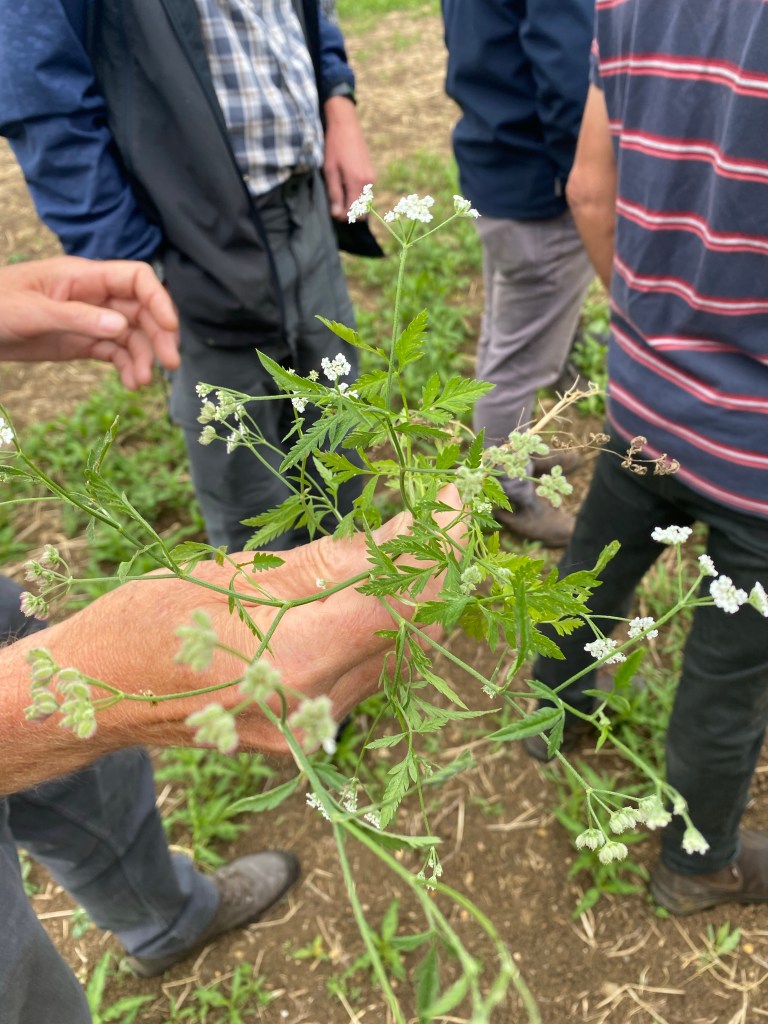
“Spreading hedge parsley is very rare and it would be a shame for it to die out on our watch.”
Someone shouts out “It’s even rarer now” and we laugh. He passes it around to us. We pass it slowly between us holding it up reverently, curiously.
Apparently the impact on wildlife is “incremental and increases quickly.”
He explains “there are many marbled butterflies and more barn owls.”
There are huge bright green crickets leaping out around our feet. Henry says that “you might expect to see that in Costa Rica.”
“We have three pairs of lapwings but don’t know if they have fledged.” It’s refreshing to see a farmer that clearly cares about conservation. Jane tells me later that he had always been fascinated with wildlife ever since he was a little boy.
Afterwards Hugh Warmington presents the award to Henry. They give us burgers from the biggest barbecue I’ve ever seen. It’s a small trailer with two grills both about four feet long. There are vast bowls of local strawberries and a whole wheel of cheese from Barber’s near Shepton, the oldest cheddar cheese producer in the world and apple juice and cider produced here on the farm.

 The Slow Walker