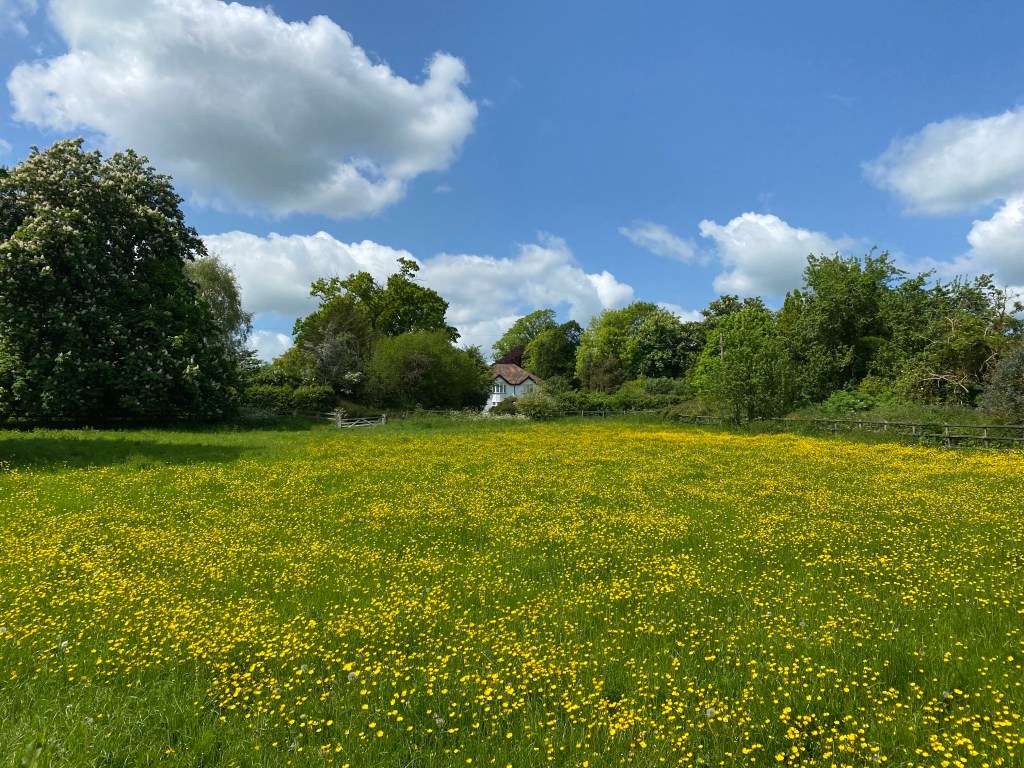
There has been a rush of colour in the garden outside the cottage: it’s as if I can almost sense the urgency of the flowers as they unfurl themselves in the sun. There is a spray of forget-me-nots along the border. And in just the last few days the irises have appeared near the front door, their rich purple flowers sticking upright like a gentleman’s silk handkerchief in a suit breast pocket. In meadows and fields around the village buttercups have appeared in their thousands. When the sunlight hits them it creates a shimmering liquid gold reflection onto the grass around them.
I stroll up the path with the tennis courts. First past the old grass one at the back of Wiltown House where Grandpa played all those years ago then past the modern concrete court at the back of May Tree House where my uncle used to play. Neither seem to be used now. Cow parsley and campion reach out and bow before me like a coronation congregation. The wind is still icy but life is at play.
On my way back down Furlong Lane I take a few minutes to look at the wild flower meadow and Curry Rivel cricket pitch beyond. There are several gazebos set up.
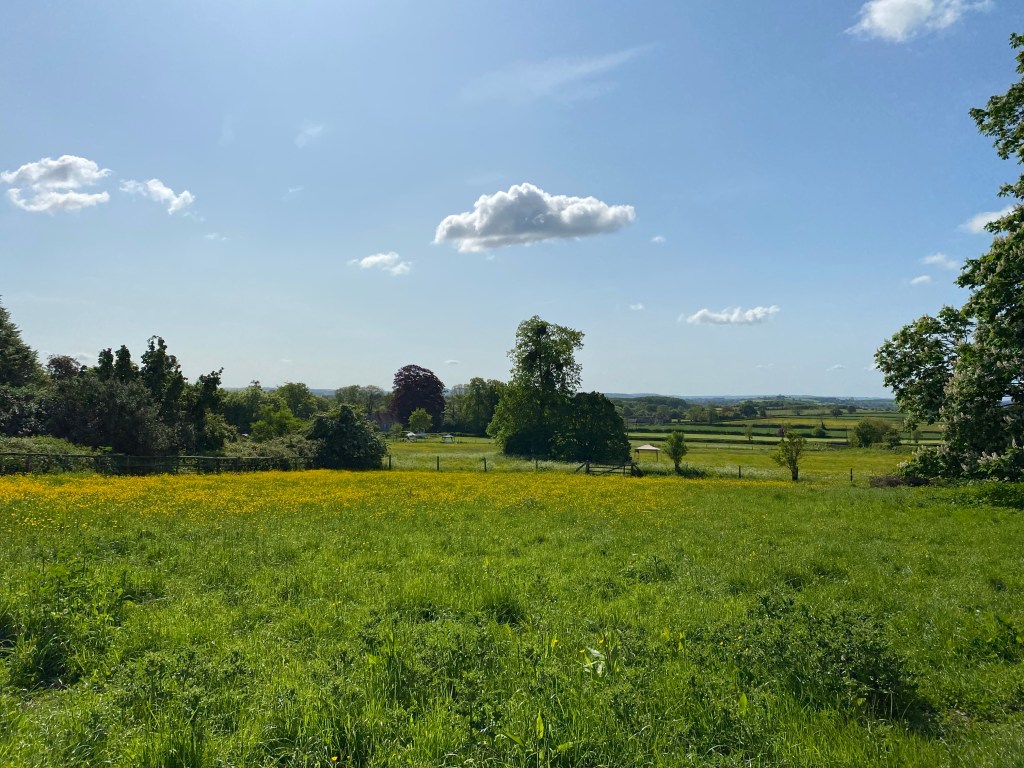
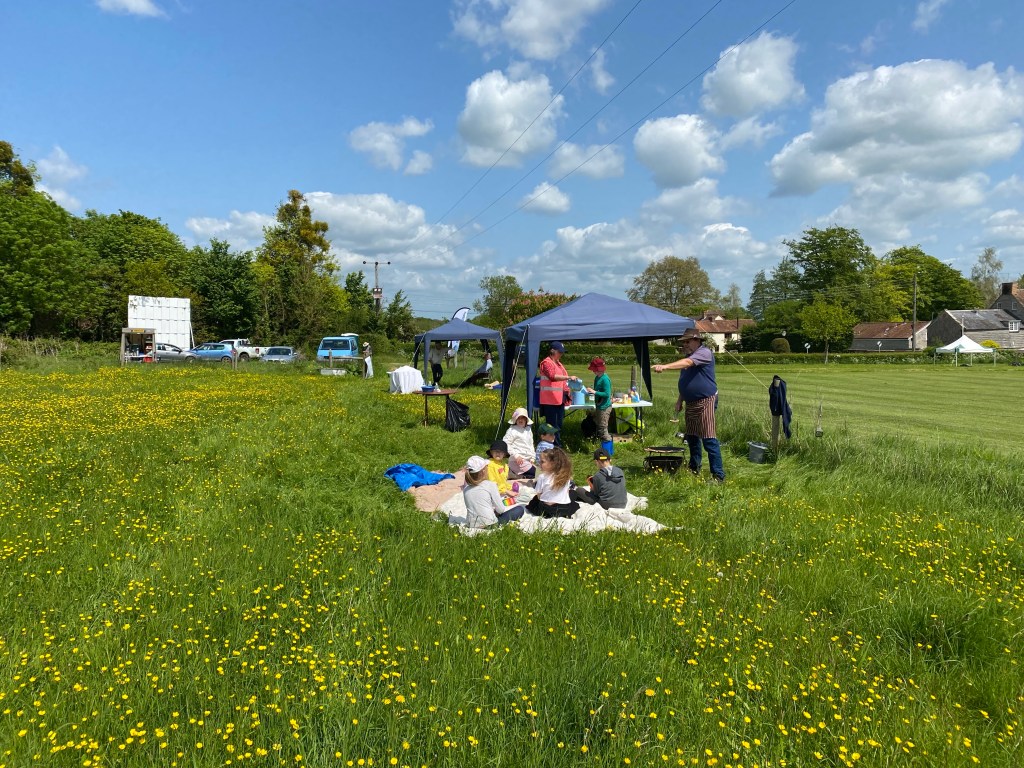
When I wander down I see Henry the farmer and a group of volunteers getting ready to welcome a bus load of year 3 and 4s into the cricket pitch field. This is part of the Kingfisher Project set up in Devon by Ted Hughes and Michael Morpurgo in 1992 to teach young people about farming and conservation. Spontaneously I’m allowed to volunteer ‘shepherding’ a group of eight year old boys from Wellington.
It seems to me the most idyllic scene. Children wandering about a buttercup covered meadow looking for and learning about bees and pollination. There are giant horse chestnuts in the background still holding their lanterns of white flowers like a traditional Christmas tree with candles.
The children go from from one little station to another (under the gazebos) and get practical lessons on farming and wildlife. They start with wheat. Henry shows them where it’s grown and what it looks like. He tells us all to pick a stalk of young wheat and try chewing the bottom of the stalk. The group of seven boys look doubtful to begin with but then start to buy into it.
‘What can you taste?’ Henry urges.
‘Melon’, one boy suggests.
‘Yep, a lot of people say that’ Henry says and continues a brief lesson on photosynthesis and how the stalk creates sugar. The boys – still chewing – are attentive.
Next we see the wheat ears when they are ready for harvest. The boys get to hold the grain and grind it in a mini grinding mill to make flour. Then they can see it made into drop scones by Maurice using rapeseed oil taken from the rapeseed visible on the farm. One boy gets more interested in the drop scones to the detriment of everything else.
We then get to see glass tanks manned by Dion. Now 84 his parents were refugees in the Second Workd War. He came here as a boy and has never left. He has all sorts of wonderful surprises: a dragonfly larva – a sinister looking creature which if enlarged would be very effective in a horror movie. The boys recoil instinctively and then become intrigued. Next slow worms coiling themselves round one boy’s hands. And a baby grass snake beautifully speckled with its tiny tongue flicking in and out.
‘That’s how we know it’s a snake’, Dion tells us.
Recently a rare bee – the wonderfully named Shrill Cader Bee – was found in this meadow. There are only two or three other places where it inhabits, the bee people under their gazebo tell me.
‘In fact it’s rather boring looking’, Henry tells me quietly. It has a grey brown body unlike the wonderful jaunty fur coat of the bumble bee.
What a find, this little learning experience about nature on my doorstep. I will volunteer next May when it happens again. In the meantime those children will go back to their schools and create a project based on one topic from what they’ve been looking at today. They’ll be judged back in Henry’s barn at the end of term. I hope I can be there. He told me how difficult it is being a judge with the amount of work that goes into their projects and the enthusiasm with which they present them and knowing that some always walk away disappointed.
The Kingfisher Trust programme was started in Devon but now is prolific all over the south west of England. I like to think that Ted Hughes, that great poet of nature, would be proud of what he created 30 years after he started it.
 The Slow Walker