
Jackdaws, my only consistent company around the Western tip of Cornwall, fly fast and straight over the cliffs from some crag, their glossy black bodies perfectly still as they disappear over the edge. I’m facing north into the wind at Zennor Head. It’s morning and I am alone on the path.
Turning east I disturb another pair of what I assume to be jackdaws who fly off in a funny looping motion, up a few feet and then down a few feet. It looks rather ridiculous.
Suddenly the sun catches a flash of bright red beak. Not jackdaws. Choughs.
The elusive red-billed chough – not to be confused with the Alpine chough – is a symbol of Cornwall, appearing on the Cornish coat of arms. Here is one of the few places in the UK where they nest and here is at the furthest west of their range. Unfortunately their numbers have declined as a result of human activity so that they are now categorised as “vulnerable” in Europe.
It is something I have thought about a lot but not seen til now. I read that this bird used to have a reputation for fire raising as it was thought that, like magpies, the choughs would like to take small objects from houses like burning wood or lit candles with which they would start fires with in people’s roofs or haystacks. A Cornish tradition also has it that King Arthur was transformed into one. They do have something regal about them. Rather wonderfully the collective noun for choughs is a chattering or clattering.
At Carn Naun Point there is a trig point and the wind blows stronger from the west. I can see the next stretch of coastline that I will tramp: St Ives Bay and beyond that Godrevy Point and Island with its lighthouse and then beyond that the land reaching north into the sea finishing at St Agnes Head. As it has been since the start the path before me is a path of the imagination where all the landmarks are places from a dream and where I carry on and on as if forever. How old will I be when I reach Devon? Or Somerset for that matter.Those imagined places are the spark that keeps bringing me back to the path. They are my greatest inspiration. In ‘The Summer Isles’ the travel writer Philip Marsden sails up the western coast of Ireland and Scotland looking for the real and the mythical Summer Isles in Scotland. Marsden says how “the ability to believe in places that are invisible, to build stories around them and inhabit them, remains the defining attribute of our species”.

I turn inland and feel buoyed by the softer walking of green fields. The path today was tricky. At Wicca Pool the path ended at a jumble of huge rocks the size of fridge freezers which lead a hundred metres up the side of the hill. A couple in their seventies were coming down, nonchalantly leaping from one to the other. At least it confirmed where the path was. The woman smiled at me. ‘Morning. It gets a bit easier up there.’
I come down a hill through a small plantation of bamboos to Treveal Mill, a beautiful grey house built next to a stream which splashes over rocks while a young black Labrador runs about barking excitedly. Little human touches here seem to sit well in the setting. There is a summer house with a sign on it saying ‘live life’.
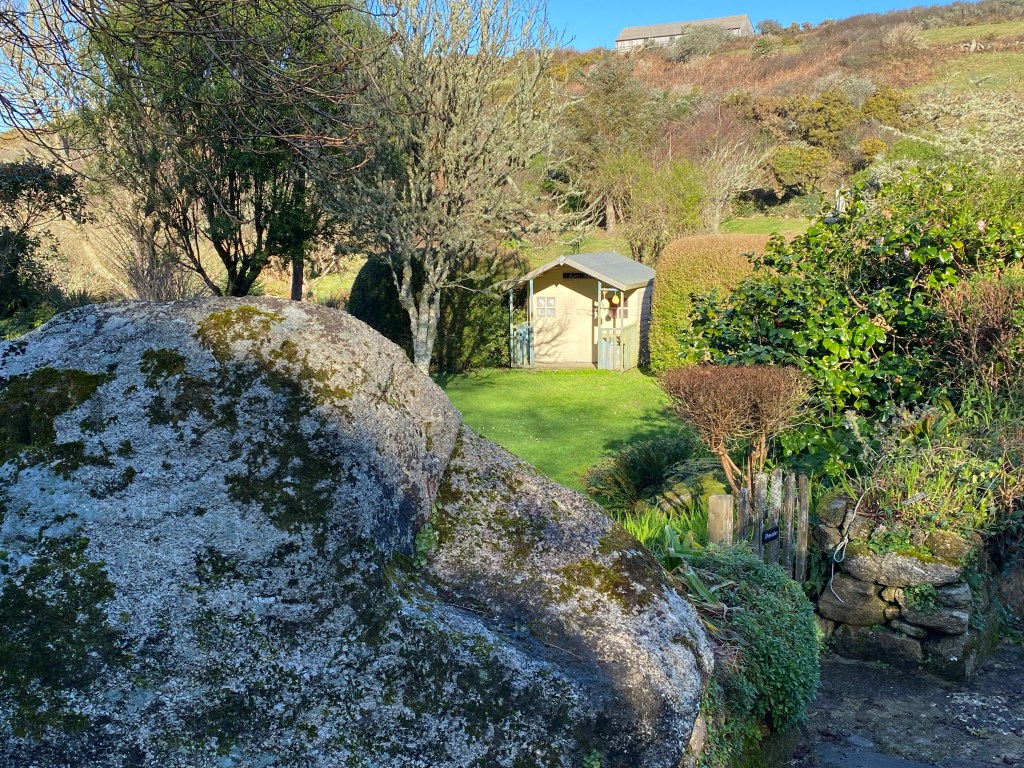
On the way out past the hill there are bees with colourful signs indicating to the passer-by their existence. Buoys are used as decorations. I pass the owner. Something about his dress suggests an artist. When I say what a lovely spot he turns and says ‘apart from the noise’, a reference to the happy Labrador and ‘enjoy’.

At Lower Tregerthen I pass by stone walls covered in moss and bare trees, the wind whooshing through their branches. Several goldfinches chase each other around the treetops chattering in high pitched song. There is a whole bush of winter roses, like perfect pink button holes for a wedding and still the odd campion near the path. Flowers in winter. It’s time to return to Zennor to the church to say farewell to the mermaid and a few words for Dad. Next time – whenever that is – I’ll get to St Ives.

 The Slow Walker