
As I arrive at the bridge over the River Parrett at Muchelney the near world transforms. The sky and abundant water are granite grey while lines of greens and oranges of the grass and plants are thrown into vivid detail and shocking brightness by the sudden emergence of the sun. The colours are saturated; they are absurdly bright. Seagulls are white handkerchiefs fluttering over the abbey. I stand stock still trying to adjust to the change in my consciousness like being in the grip of a strong hallucinogenic. Moments later the light is turned off, the world is returned to neutral tones and I’m left staring at the watery fields in a bit of a daze.

At this time of year down here the water gets everywhere. In winter it’s as profuse as the land it smothers. Roger Deakin, who wrote beautifully about water, observed how on the Somerset Levels ‘Every village here has a Frog Lane, and a sign that says ‘Road liable to flooding’.
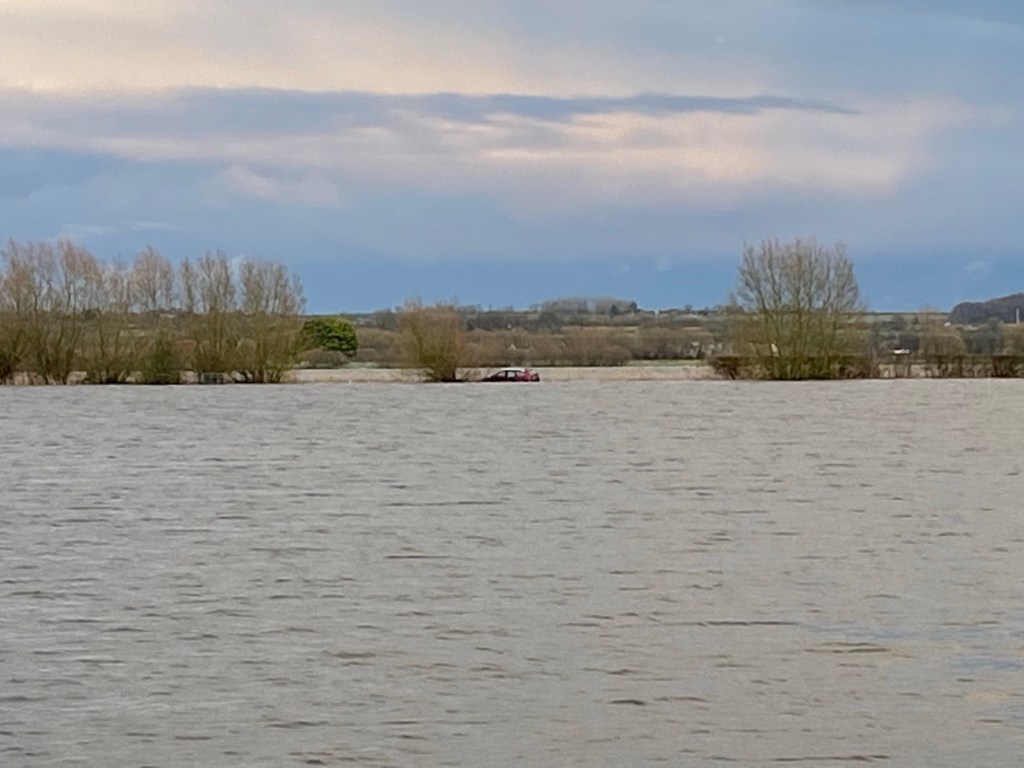
The water confuses the mind’s eye. Fields are now lakes. Raised land become islands or long spits. Roads are drains, the trees or hedgerows the only thing to mark them out as ways. It’s hard to distinguish waterway from meadow. In the middle distance a half submerged car is nestled in between a line of willows that marks the road between Muchelney and Langport.
Sea birds come in their hundreds and bob about making their peeping and clicking and wheezing calls and I imagine I could be in a coastal town or village.
It’s beautiful yet chaotic. Roads are closed. Houses and communities become stranded. In January 2014 Muchelney made the national and international news when it became cut off for days on end after storms battered the UK over Christmas and new year.
Many houses were flooded and an RNLI boat was the only way in or out. I remember local residents on the news berating a representative from The Environment Agency because the dredging of the waterways had been neglected in the interests of conservation and this had exacerbated the extent of the flooding. Thousands of acres of the Somerset levels remained underwater for all of January. Several people lost their lives.
For hundreds of years people have been trying to drain these low lying lands. I walk south along the river across Thorney Moor to Midelney. ‘Ey’ is old English for island, thus Thorney, Midelney, Muchelney and, of course, Athelney where King Alfred hid from the Vikings a few miles north of here and, as legend has it, burnt the cakes of the woman whose house he was sheltering in because he was so preoccupied with planning on how to defeat the invaders. He eventually did.
A kingfisher flies low and straight over the river like a blue dart. Seagulls fuss up into the air and then settle again on the standing water briefly making dissatisfied squawking sounds before returning to a sense of calm.
Snowy blobs could be buoys or puffballs until one transforms itself, its wings splayed and a long neck uncurls itself and points up to the sky. Swans. Forty or fifty of them. Thorney Moor is one sheet of water, their trees and telegraph poles the only indication that this isn’t normal. Although of course it is. This land has carried water since before the memories of man. As Edward Thomas put it ‘when gods were young’.
The river suddenly bends – like a swan’s neck. Now I’m heading west towards Curry Rivel, the tower on the skyline beyond the river is the same one the boys forced a cow up back in the day, making it stagger up the circular staircase to the top where it stood surveying Sedgemoor from eighty feet above the ground. It’s the same tower where my grandfather, as a young man, was made to walk around the ledge at the top by his elder brothers.

Egrets are also here, one walking in its lanky, cautious manner like a tall school master. Egrets are members of the heron family which were traditionally compared to priests.
It’s getting dark. A huge mass of grey is looming from the west. I imagine myself soon to be drenched by it in the dark. My heart beats faster. I can only give in to it.
Grey ground. Grey sky.
Twenty minutes later I’m in it. Pock, pock, pock on my waterproof. It feels almost like night but then the sky gets lighter again. Once I’ve given into it who cares? Darkness and wetness can’t hurt you. Walking after dark is the ultimate rebellion. I think of might walking at boarding school. Night walking – not intentionally- on Rasol Pass in the Himalayas. Waking the coast path at night. If walking alone in the wilds is a thrill then that thrill is doubled at night.

The first star appears in the dirty blue orange of the western sky. Pulsing. Blinking. Is it Venus? I think so. For a brief time I think I might be lost until I see headlights lighting up the lane between Muchelney and Curry Rivel.
As I come back to the bridge at Muchelney the full moon rises out of the great blanket of cloud that has just passed over me. To its right is the silhouette of Muchelney church. There are myriad lines of moon glitter on the flooded field and in the narrow line of white light a submerged gateway. I stand at the bridge watching the swirls and sloshing and feel the great weight of the water beneath me before I turn and head for home.

 The Slow Walker