The first thing I notice when I wake is the last thing I remember before falling asleep: the constant shh…shhh…shhhh of the waves. Like a mother calming her baby. Once again I feel accompanied. Less lonely than when I wake alone in Clifton.
This desire for lone walking seems to have always been there.
As early as I can remember I was mucking about outside. Yes I would go fishing and cycling with friends but often I would just wander around the garden and the back of the church with a stick. I remember hiding in bushes and feeling the wind breathing through me and in me. I believed it was the breath of God.
Forty years later I get the same fizz in unexpected places. Like on a January evening: when no one is out and I go for a late swim in the outdoor pool at Bristol Lido. I’m blessed to have it literally around the corner. A sense of being outside the norm, of living on the edge, even if ever so slightly, and the yearning for an adventure, however small.
Cosy and alone, my eyes slowly follow the line of my wormlike body to the cliff edge beyond my feet out across the grey mass and towards the low line of the Lizard. A line of orange appears over that line, brightens and then fades like a blush. Aside from this the world is grey.
The stings are still throbbing but getting back into the rhythm of the walk will distract me.
The light feels weak. A lone fishing boat bobs about half a mile out to sea, its port and starboard lights twinkling as it rocks from side to side.
After rounding the headland of Carn-du, I’m walking north west away from the sea and towards the land around Lamorna Cove. It’s just gone 7.30.

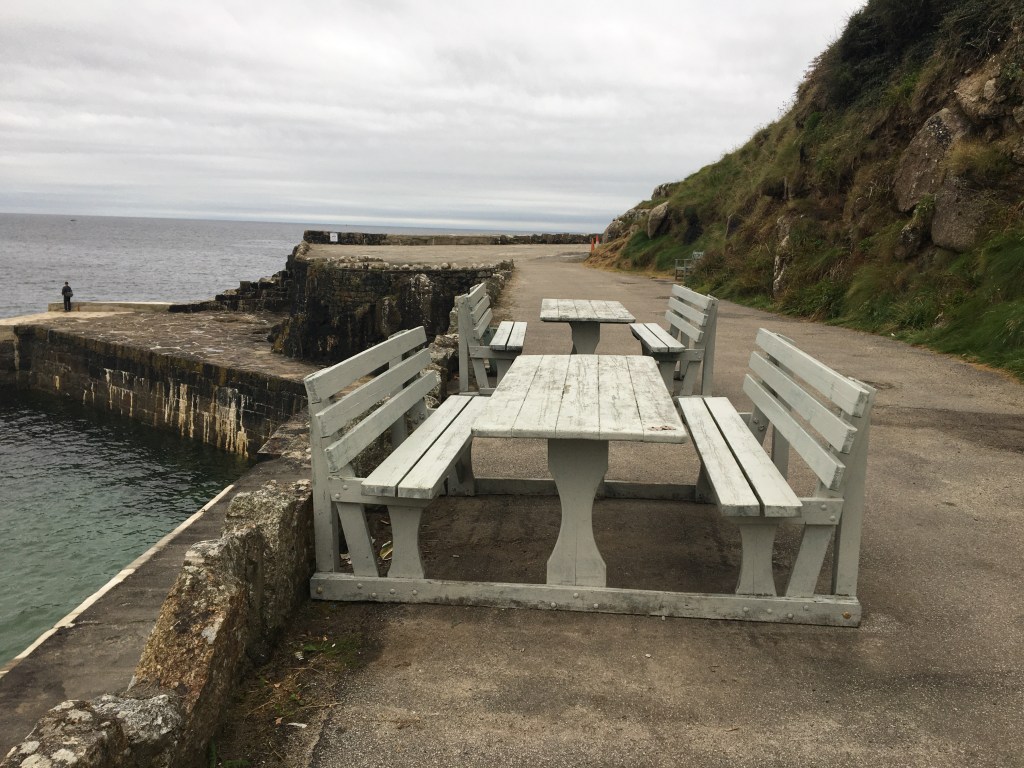
Lamorna seems unassuming. A small cove where a band of boulders seem to tumble into the sea. At the western end of the beach the line of a road gently drops from the greenery of the valley and ends at a quay and sea wall that carry along the coastline and the path. Cottages – some white, some grey – are dotted about the hillside.
As I arrive I notice cosmos, hydrangeas and campions growing beside the path.
When I get to the quay a well built man in his sixties is ambling along with his dogs.
His name is Derek. He is from Bristol and has retired to Lamorna.
‘It’s all AONB (Area of Outstanding Natural Beauty) here so you can’t build on it. For years they washed the soil off for tin using the local stream. Placer mining they called it.’
‘Since the start of the Bronze Age people have been mining tin. There’s been three and a half thousand years of it.’
‘You can see evidence of it on Bodmin Moor too. They would move big piles of stones so that they could work the land.’
He asks me if I know Lamorna Birch.
‘Er, is it a type of local wood used in the building of the cottages?’
‘No’, Derek tells me slowly.
‘That came from a boat shipwrecked in the bay.’
Originally from Cheshire, Samuel John ‘Lamorna’ Birch was a painter and member of the Newlyn school of artists who ended up living in Lamorna. When I look up his name on Wikipedia I find the following explanation ‘At the suggestion of fellow artist Stanhope Forbes Birch adopted the soubriquet “Lamorna” to distinguish himself from Lionel Birch, an artist who was also working in the area at that time.’ Apparently Birch created over 20,000 paintings in his lifetime. His favourite subject was the cove that we’re looking over. He died aged 85 in 1955 in Penzance.
Derek and I chat for probably half an hour. Maybe longer. My sense of timing is pleasantly skewed when out like this. I hesitantly put my hand out to shake his. Covid conscious. He grips it and says ‘Bye then.’
I have a moment of poignancy. As Derek’s back disappears round the corner of the quay into the old quarry I’m suddenly struck by the knowledge I’ll never speak to him again. The urge to chat for longer is strong but not as much as the urge to be alone with the wind, the sea and the sky. As it ever was.
 The Slow Walker