
Lovely to wake up in fresh sheets in a strange bed in a strange town. It’s like the first morning waking up on a holiday.
I lie staring at the ceiling thinking about the people of Penzance. A few weeks ago I heard an item on Radio 4 about how during lockdown house prices in this part of Cornwall had risen more than they had in London. A woman was speaking to the news presenter about the price of living in Penzance. ‘I grew up here, have always lived here but now myself and many like me just can’t afford to live here. I’m not sure I ever will…’
When I get up I sense something has changed overnight. The light coming through the blinds of my room is paler, weaker. I can hear the slish, slish of tyres moving slowly along wet streets.
I imagine myself waking on the path like I did yesterday morning. I would be a bedraggled caterpillar, my bright body darkened by patches of wet, my eye mask – cold and wet – stuck to my head. For all my dreamy days waking up next to the path I have to admit it’s nice to have a lie in and a hot shower.
Sky, sea, mist are a uniform grey white. St Michael’s Mount seems a ghostly outcrop like something in a dream. Boats move silently, sails furled. There is no wind. All is still. The sea is as smooth as polished stone. I feel like a figure could step out of the monastery and walk over it to meet me, me watching him all the way til we meet here on the sea wall. I slow my breathing like I have learnt to do at night when I can’t sleep. I stare out to the ocean to where it disappears at the edge.
The graceful white shape of the Scillonian glides out of Mount’s Bay ferrying passengers from Penzance to the Isles of Scilly. She is the third boat to carry the Scillonian name and made her first voyage in 1977. When I went to those islands in 2009 I went via helicopter. It went out of use a few years ago. In 2019 I crossed over in a force seven gale aboard the classic ketch, Leader. All the other passengers took to their beds while I just about stayed on my feet or my knees up on deck.
I return to the place where I left the path yesterday. It’s a bit of tarmac between the station and the sea wall. Every time this happens I have little bubbles of excitement inside me. What is it? The continuity of the path. It’s like it’s always going to be there. Like a partner for life.
It’s also the variety. Yesterday when I started it was a dusty brown line along the cliffs outside Porthleven. Today it’s a slick piece of tarmac surrounded by roads and passengers getting ready to board trains and buses.
Two ladies bob in the glassy water off the promenade. Everything is so so still. It’s like the world is holding its breath. I am walking in slow motion. Everything I look at is like a slowed down film. I take a double take. When I look at the water it could be vapour.

I amble on. There’s no rush. The road passes the protected boats harboured inside their wall. I pass big warehouses. The road turns a sharp right and the road angles along the line of the coast to Newlyn.
The triangular Jubilee Pool arrives abruptly on my left. Opened in 1935 it is now a grade 1 listed building. It’s not open yet. Young life guards arrive in their red hoodies. It’s just before 9. A young woman uses a high pressure hose to wash down the walkways.
Roger Deakin swam in it as recorded in his book about swimming around the UK, Waterlog: ‘With its dramatic ocean-liner decks, stainless steel fittings, steps and tubular railings, the Jubilee Pool is highly theatrical.’ The grey stillness heightens the sense of drama.
Stillness can sometimes be more powerful than a storm. I visited the writer Ronnie Blythe at his home, Bottengoms, this Summer. During a break in our conversation he turned to me and said simply ‘It’s so still.’ I looked out of the window and a petal fell silently off a rose. I felt like I had sunk into a trance. Roger Deakin had visited Ronnie just as I had many years before.

The wide promenade that connects Penzance and Newlyn is quiet. Another sea wall marks the start of Newlyn harbour, a big fishing port.
Newlyn has traditionally been a poor town. This is what attracted members of the so called Newlyn School of artists to come here in the 1880s. This and the good light and an abundance of inexpensive models (many of them fishermen). I wonder what they thought of those ‘Down from Londons’ back then.
After another hairy journey around Lizard Point in 2014 we put in at Newlyn that evening and spent the night there. It is just as I remember it. The sound of clanking machinery as trawlers make their repairs. The strong smell of fish. Men in yellow boots hose down the floors of the long market building.
According to the Newlyn Harbour website ‘Newlyn is one of the largest fishing ports in the UK. With our strategic geographic location, we are proud to offer round-the-clock refuge to those vessels that fish the Southwest Approaches.’ The harbour master’s office displays the ‘times of high water’ on two clocks while a seagull stands guard.
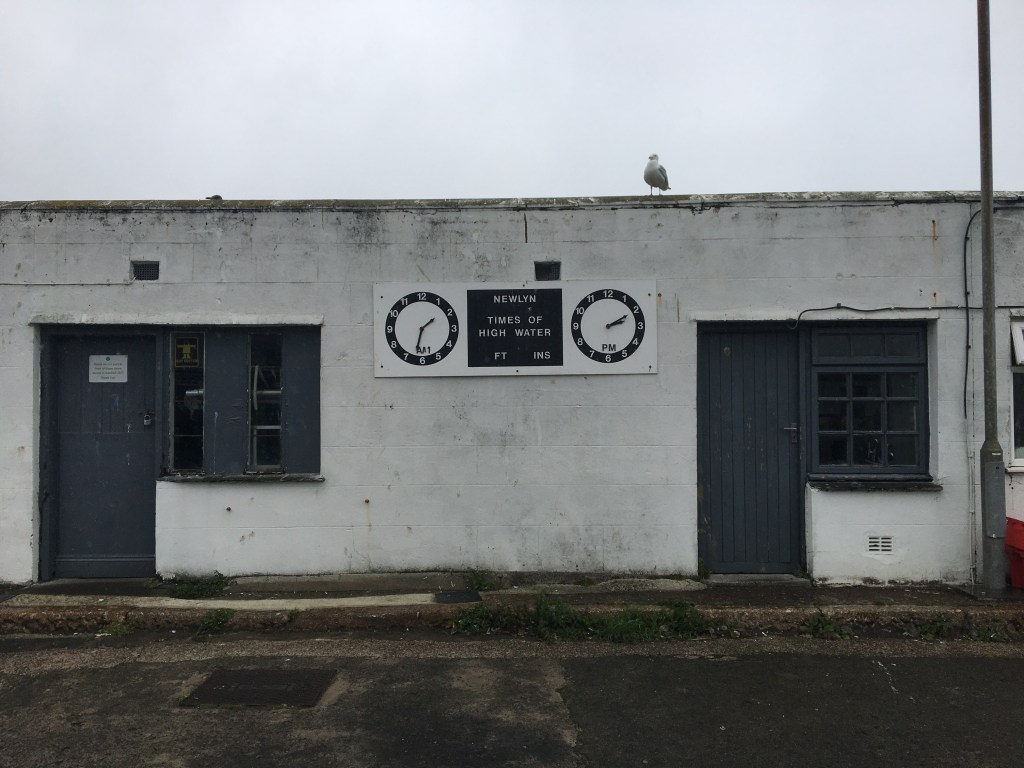
These things are just the same as they were on my last visit. Other parts of the town are different.
There is a quality coffee shop, a cheese and charcuterie shop and a smart looking ‘greengrocers’. Yet the chandlers and The fish shop opposite the harbour are still here too.

I stop here. Sometimes I just know the time is right. Waiting for the bus back to Penzance and then to get back to Porthleven I notice a sticker:
‘No more second homes!!!! Increase council tax on vacant holiday homes. Limits on Air B n Bs. Stop the destruction of Cornwall.’ Until the next time..

 The Slow Walker