Depart about 8 past the cliffs of Conachair where I looked over the edge yesterday. The cliffs where the fulmar slaughter would take place.
8.50 Across to Boreray, Stac Lee a giant lump of granite crisscrossed with fissures where the gannets sit in rows or else wheel in great circles over the top. This is the largest gannet colony in the world.
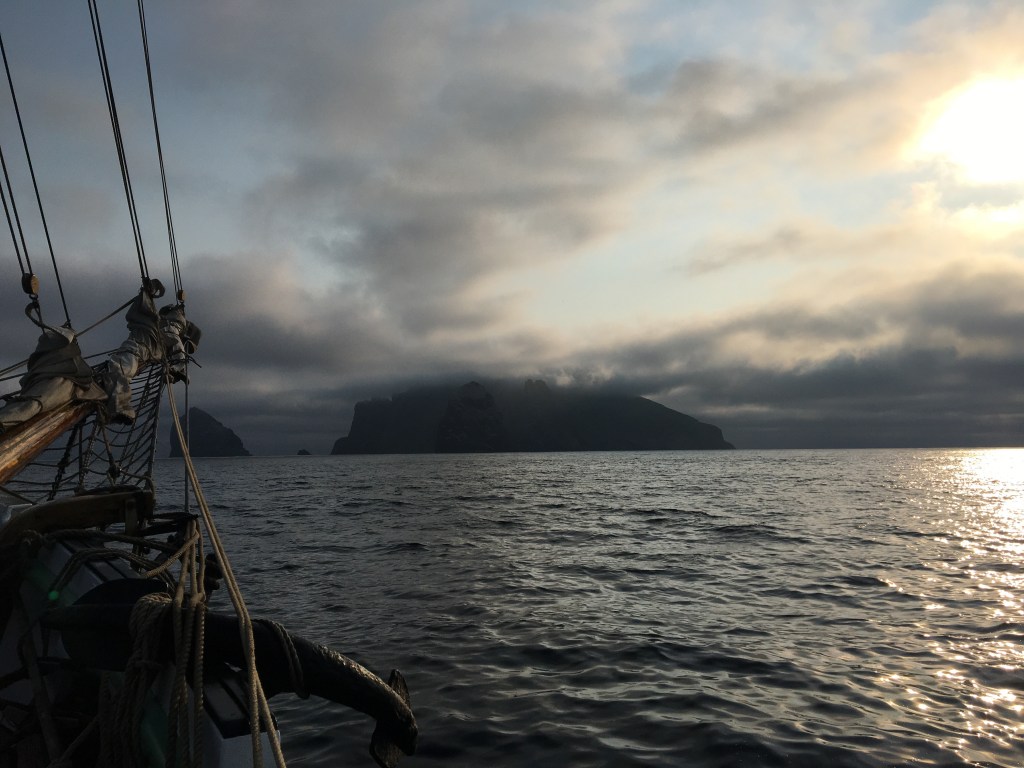
There is a loud cawing but none of them are feeding. They must do that further out at sea where they dive missile like into the ocean with such velocity it makes a huge fump sound and sends up plumes of spray. Likewise with Stac an Armin.
The men of St K would take their one boat over here and try and try to jump onto a shelf and find something to moor onto, the swell often making the boat rise 14/15 feet at a time.

Hirta recedes into the distance a brown and green mass half lit by sun half covered in cloud.
Nikki ‘there’s not enough wind. It’ll just make us roll so we’re going to carry on motoring. It’s 60 miles to the Sound of Harris. Back onto our watches. We are in the same groups of 4 as on the crossing over.’
Grey skies and a keener breeze than we’ve felt so far. Good visibility. Temperature can drop v quickly at sea and standing about it’s easy to get cold even with jumper, fleece you need proper sailing wear. Big canvas red jacket Dremtech Plus Guy Cotten. It must be XXL but I’m grateful for the loan from the crew.
10.45 6 sails up including main, jibs and mizzen. Ketch means mainsail is at front.

Crew constantly kept busy, sanding, varnishing, painting. The skipper is keen to put them to task. She says ‘they should be always thinking about what job needs doing next. I shouldn’t have to tell them.’
If they are not preparing food, they are sanding, painting, polishing brass, retarring the rigging.
Nikki: ‘Bessie Ellen was the last of the West Country cargo ships. There are only 3 left in existence. Where you’re sleeping there would be room for 150 tonnes of cargo. During the war she went to Denmark and carried on being a cargo boat (under a different name) until I brought her back in 2000.’
Owain: ‘most of produce is from local stockists around Oban. The local wholesaler delivers it to the boat.’
Nikki is a skilled cook as well as skipper. Big meals – cod loin in tomato and parsley, duck casserole with lentils, scallops and good local smoked salmon for lunch, excellent cheese board. Then cakes: sticky toffee with pecans, apple tart, etc. Despite working on pulling up sails, pulling down sails, folding sails, tiring sails, swimming, walking I am putting on weight! Who cares?
On a course 100 degrees just off East.
12.30 we sight land: Pabbay (the Northern one) and Shellay. Little else to see apart from the sea. A white bottle that looks like it might be for detergent floats by. I saw another plastic bottle earlier but that’s the only flotsam I’ve seen so far.
Engine goes off for the first time about 2pm. We are sailing properly with all sails full and heaving at the creaking ropes.
Turning starboard into Sound of Harris
Jibs start to flap.
Alice ‘Bring in the jib. Leave one turn on.’ One of us sweating the other tailing.
‘Make fast.’
The same with flying jib.
1700 passing through sound of Harris with South Harris off port bow. Smattering of houses close to coast. Again no trees. Many other small and low islands off to starboard. Many marker buoys. Narrow passage.
Bring down all sails. Learn how to fold sails by grabbing folds and then wrapping it up like Big sausage and hung up. Same with mainsail.
We arrive at Rodel on southernmost point of Harris about 6. Hidden natural Harbour. No other boats and just a few houses here or there. We take the tender over to the sweetest little harbour with a stone jetty, a house and an old hand powered crane. It seems like no one uses this little mini Harbour but who knows?

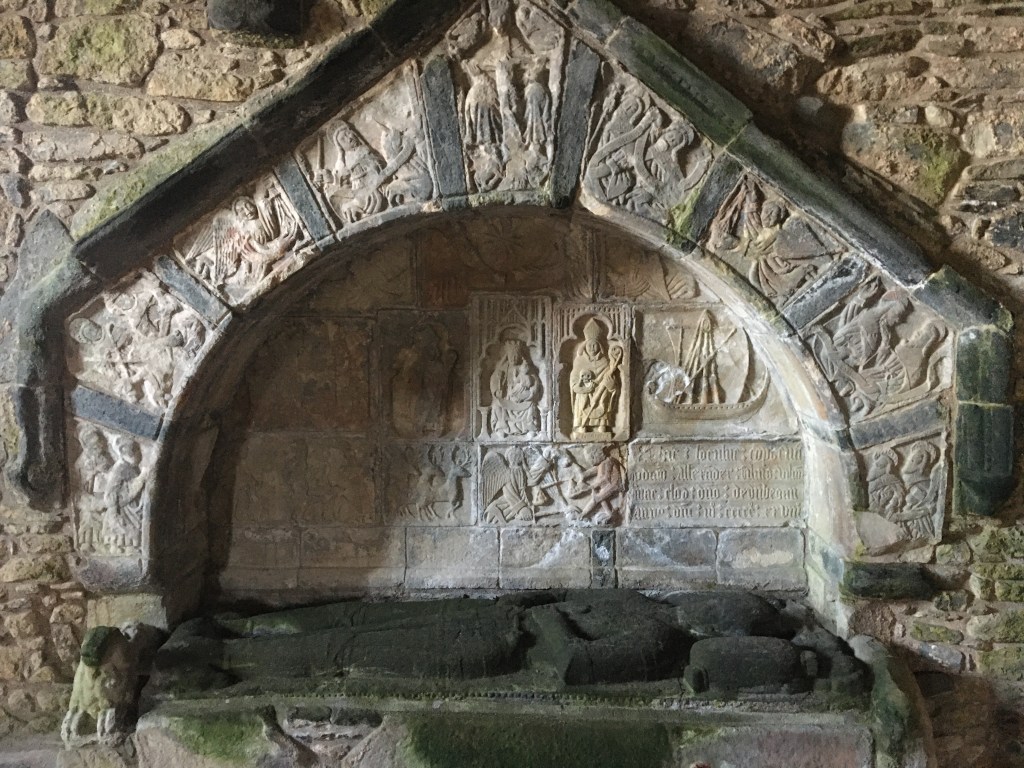
A little way up the hill is St Clement’s church. It’s dark stone and empty inside without pews or altar but this is the resting place of many of the Mcleods the same clan who for years owned St Kilda. They were also known to be brutal warriors. The man laid to rest in the main tomb here was known for killing 398 men, women and children by lighting a fire at the mouth of a cave they were hiding in and suffocating them to death.
Two tombs show figures like prostate like warriors. One is surrounded by engraved panels of important scenes: the holy trinity at the top, an angel blowing an instrument and a sail boat – a Birlinn – which would have been a sign of wealth and status.

 The Slow Walker