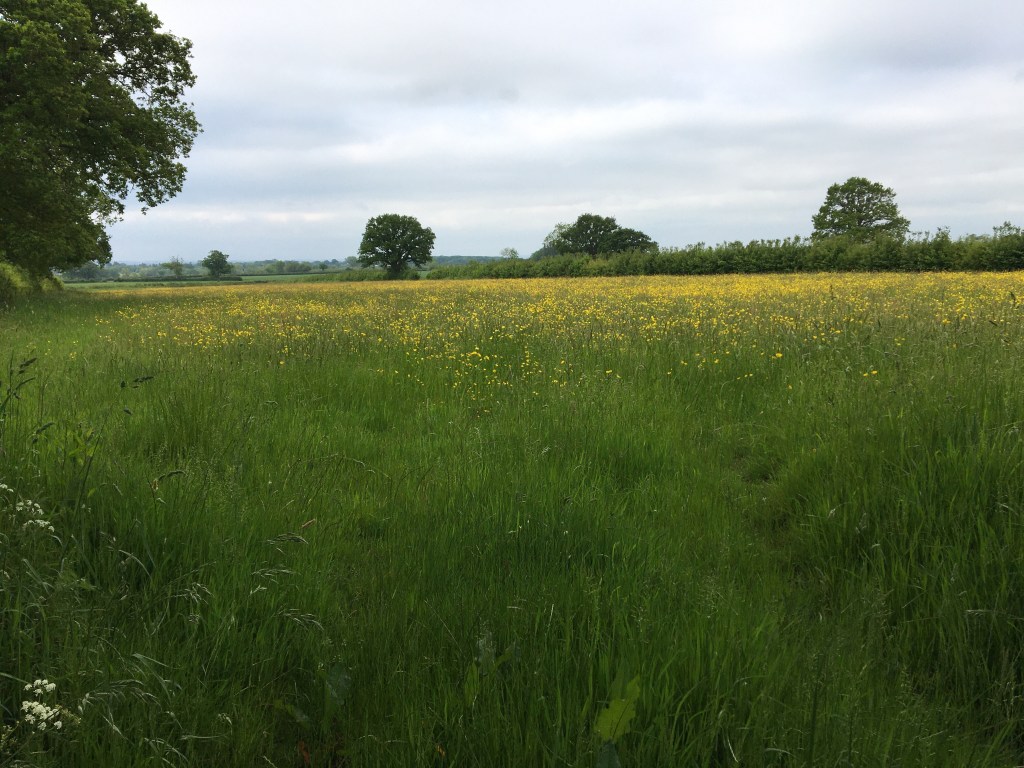
I am in another yellow meadow in North Wootton near Wells. I associate these golden pockets with Somerset at this time of year. Here more than anywhere they seem to be in abundance. The Monarch’s Way skirts two sides of it. Someone has mown these edges to make it easier for people to walk around it. The yellow appears a stronger gold in the evening sun. I stand shielding my eyes against the brightness. There is a sudden blur out of the corner of my right eye.
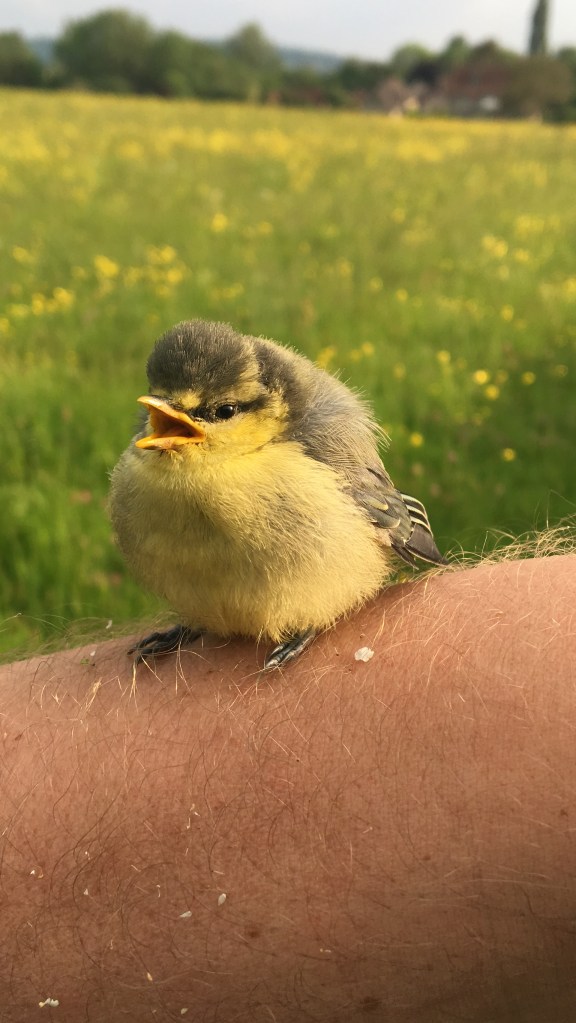
A little ball of fluff is perched on my forearm. It’s yellow like the field behind it. It’s a baby blue tit. It sits there for at least 2 minutes turning its head from side to side and cheaping the same shrill notes every 10 seconds or so. It has the recognisable urgency of a baby calling for its mother. When it opens its beak to sing I can see its throat is bright orange like an open flower. I throw it in the air and it flies confidently into the nearest tree.
That night I make my bed near Worthy Farm at Pilton, home to probably the most famous festival on the planet. No festival this year, though. There is a field the size of a football pitch recently mown. The ground is a bit bumpy but level. I stick to the edge and find a spot under a horse chestnut. I make a basic bottom mat of long grass ripped up and lain sideways. I imagine it like rushbearing where reeds would be lain on the floors of churches in the middle ages. There is the pungent smell of manure and the sound of techno being played somewhere close. I can also hear traffic roar on the A37 nearby. I have had better and worse places to sleep. It doesn’t matter. I watch the chestnut flowers in the tree above me and soon I’m asleep.
The following morning is cold and grey. I am up and on the path by 5. Yet I can’t get into my stride. Pylons and road noise seem to impede my progress. Climbing through Sticklinch and up Pennard Hill is a trudge. At this hour I see no one. I pass cottages with open windows and closed curtains. At the top of Pennard Hill the way turns East along a drove.
Suddenly I see two hares in two minutes. One I meet face to face on the drove. The next I turn to look into a gateway and there he was shrinking into himself his head brought into his body his ears suddenly flat against his head. Those huge eyes watchful, wary. Then he is bouncing away silently.
I walk all morning. I always follow The Monarch’s Way markers: little stickers with the crown in an oak tree beneath a galleon. One to represent the tree in Boscobel Wood where Charles II hid shortly after the Battle of Worcester. The other to represent his flight to safety. They are everywhere these way markers: on stiles and gate posts, on road signs and lamp posts. Often the pennant on top of the galleon will be used as an arrow, directing me to which direction or angle the path will take. These are my only constant as I tramp on.

 The Slow Walker