I always intended to finish the coast path and reach Lowestoft before the end of the Summer holidays. It would mean I would end it pretty much exactly a year after Pa was first diagnosed with Glioblastoma. I hoped there would be a neatness to it. I didn’t expect anything else – just the satisfaction of a route completed.
Today I only expected to get as far as Kessingland, a place one vowel short of having one of the sweetest place names ever. But what I’ve realised with these walks is how, like in life, there is often little point in making predictions.
I’m excited about my return to Covehithe. Guess what? It’s another magnificent day. Warm and cloudless, the sky a deep Mediterranean blue. There aren’t so many cars today.
Here I am back at the church within the abbey walls. The road rolls past. There’s a barrier across the road and then it starts to narrow as the hedgerows encroach on both sides. It looks like a path but I know it’s a road.If you look closely you can see the tarmac and you used to be able to see the road markings down the middle. It goes in a straight line until it stops at the cliff edge. And there is nothing but the tea-coloured North Sea. Where did this road go? However much I try, I can’t imagine where it went, what shape it took, how long ago or what else was here.
I can only see the road ending and the sea.

From the end of the road I turn left North along the cliff top. The sand cliffs are honey coloured and crumbling. There isn’t a designated path here, I don’t think. There’s no sign for one and nothing marked on the map but people are still walking along here.
A couple look at me expectantly as if they are probably having that same thought: are we doing something we shouldn’t? Is this person going to tell me off? In the ‘new normal’ of our Covid world I sometimes notice a heightened wariness or anxiety of those around us. We have become used to seeing people as either a potential threat, either a carrier or a critic, someone who might report you for not abiding by the latest restrictions.
I only walk a couple of hundred metres before I notice a small landslide in the cliffs to my right. It offers a perfect way down to the beach and I rush down it, making a final leap onto the sand and pebbles of Covehithe beach.
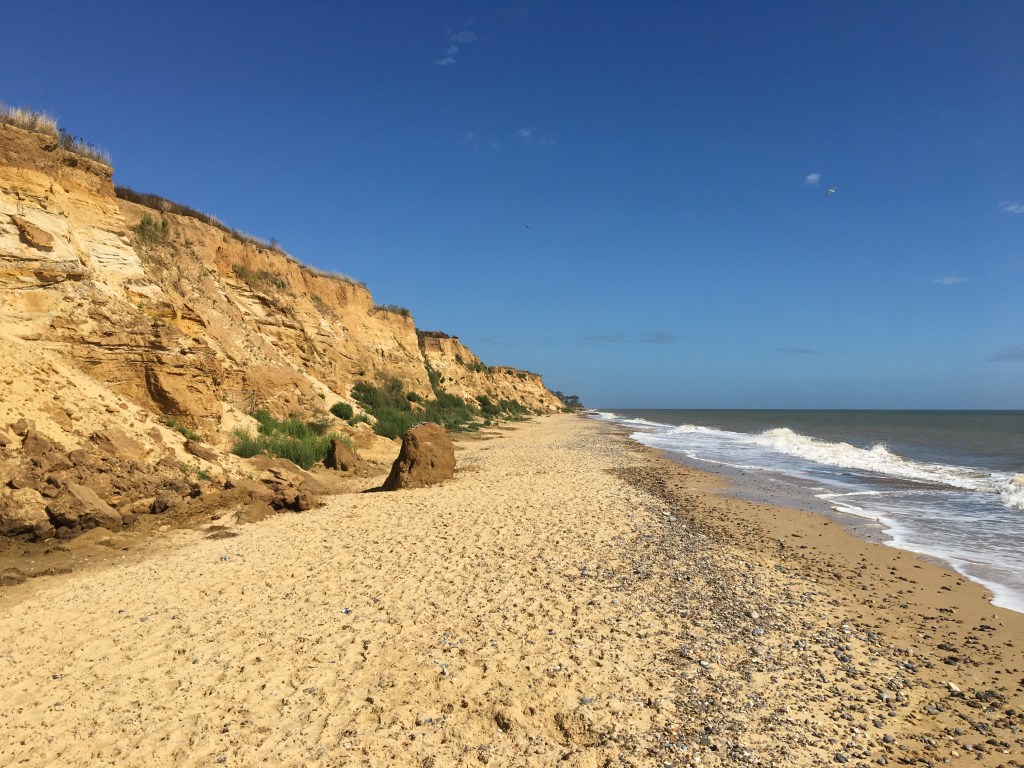
Sand martins nest here and create many holes in the soft cliff face so that it appears like honeycomb. They are one of the earliest to arrive (March) but also the first to leave (August) so they are reaching the end of their long Summer sojourn.

I am progressing North as always, getting close to Benacre Broad and here are more of the strange beach trees that inhabit Covehithe beach. There are a family up here using the old skeletal branches as a washing line for drying all their swimming gear and towels.

And now it is a wilderness. As foreign and timeless as life itself. Those trees will slowly get paler and smoother and then get washed away. As little and subtle as a breath. And I keep walking.
There are more reminders of defences here and the unstoppable force of the North Sea. Just as the trees are half buried in the sand so an old World War 2 pill box lies at an angle almost wholly swallowed up by the ever shifting sand.

Passing Benacre Broad to my left the beach opens up and flattens out as it stretches North. Soon I am at Kessingland Level, another area of marshland where the Hundred River spills out into the sea. Here are more reminders of the constant battle to protect this part of the coast.
Huge bags of sand are being used to create sea walls. You see them everywhere here. Then they are covered with long lengths of carpet-like material. Unfortunately, this eventually gets ripped up by storms and left in great swathes along the East Anglian Coast.
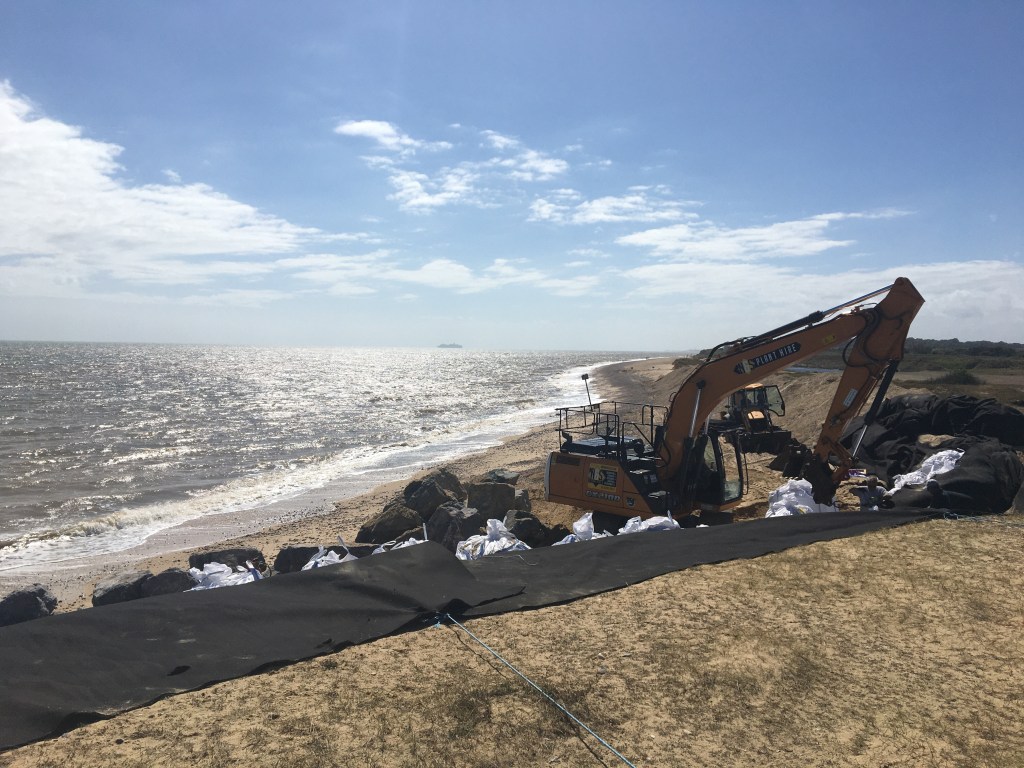
Kessingland arrives soon after. Here the beach is sand bordered by a broad strip of scrubby, bumpy land that reaches the town. There is something faintly surreal about this place. It has all the air of a purpose built resort. It feels unlike anywhere I have been through yet on the coast path. Transient, a bit tacky, a bit soulless.
My assumption is that it’s mainly a holiday destination but in fact an information board tells me there’s a permanent population here of 4200 which then doubles during the Summer months. Apparently it used to have a huge herring fishing industry here, even greater than Lowestoft, and Sir Rider Haggard used to holiday here.
The path here briefly becomes a concrete track reminscent a storm drain in LA. The sun is still high. It is only mid afternoon and Lowestoft shimmers on the horizon. There lies the end of the path. It’s one of those many those ‘toss a coin’ moments that I have when I’m walking alone. How I love it – the devil may care attitude of a person endowed with time and freedom to use that time as he wants.
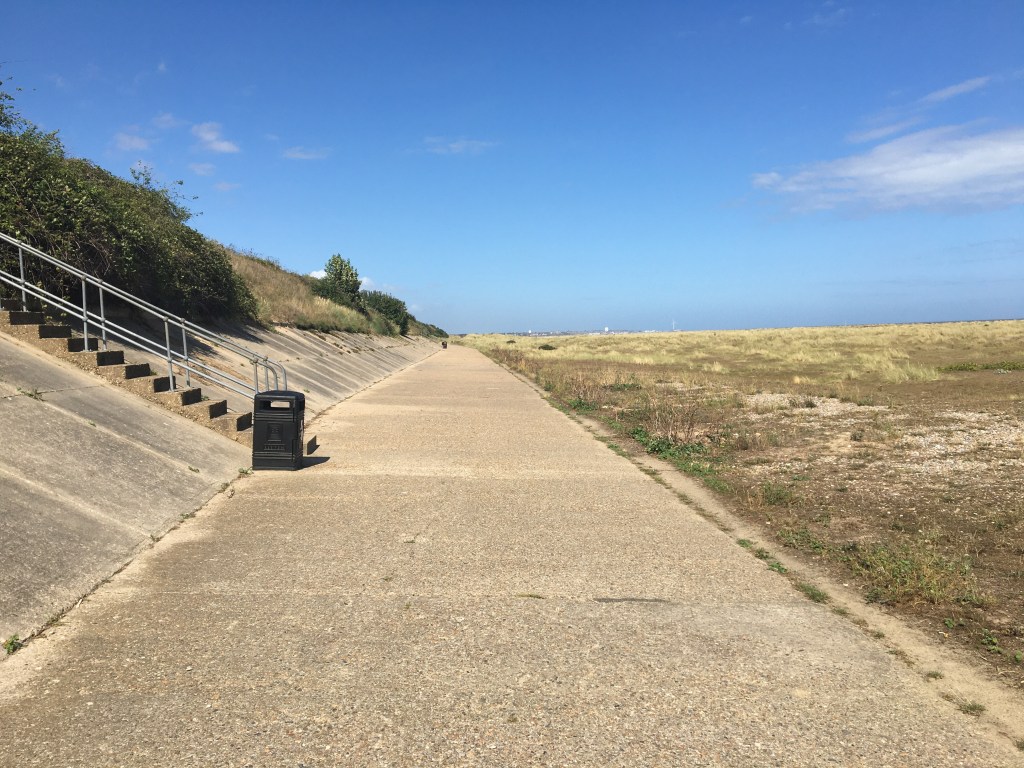
Yet another transition as I leave the holiday homes, caravans and dog walkers behind. Always happier away from the crowds. It seems like I’ve been running away from people most of my life. Being sent away to school at 8 made me independent and solitary in a way that has stayed with me for good.
A sudden turn of the corner or crossing a stile and a totally new scene can unfold. Here is a quintessential late Summer Suffolk scene. The pale yellow stubble, pale blue sky and slightly weaker light a reminder of so many previous Summer ends. Yet this one so much weirder. Another gone and that slightly sickening thought of the return to school. Yet I must move on. Every episode must come to an end and this one is almost done.

This is a fleeting moment. Minutes later I am wandering up the drive of a huge holiday park towards the road into Lowestoft. I am entering a different phase – I can feel the effects of getting closer to Lowestoft: busier roads, more people, adverts, litter.
I pass another caravan park and stop to take a photo of washing on a line animated by the East wind, only half aware of a white Range Rover with tinted windows somewhere in the background. As I walk away from the washing line the Range Rover pulls up ahead of me, the tinted passenger window slowly whirrs down while at the same time a huge, tattooed man beckons me silently and threateningly towards him with his index finger.
What is this? We’re easily within earshot of each other but I respond with my own signing, looking behind me before pointing a finger at myself. ‘Me?’ I hope it communicates before I shout out ‘What’s up?’
‘You taking photos of kids?’
‘No, I was taking a photo of this washing line.’
I don’t know which of us sounds more crazy.
He points behind him and I think he’s imagining kids playing on the grass near the washing line but there aren’t any. It’s only then I realise that he’s talking about the kids in the back of his car.
Even if I was a predatory paedophile, would I really be taking photos of children in public? Where do these people get their ideas from? I curse and walk on.

I am now on the A12 entering Lowestoft somewhere that – although I’ve been in Suffolk on and off most of my life – I’ve never been to before. Dad knew it. I can remember him in a dark suit heading off to work. He was a sales rep in those days and Lowestoft would be one of the many places he used to do business.
I pass the sign that welcomes me to Lowestoft ‘Britain’s most Easterly town’ and at the first roundabout turn right, back towards the sea. Forever by the sea.
This is actually Pakefield Cliffs and beach. I’m not in Lowestoft proper yet. This is quieter and more gentile.

There is something bygone and unspoilt about this place. There are a few families and couples sitting in deck chairs and a woman on a horse.

Further on little fishing huts, faded dinghies and rusty winches are strewn here and there. Just here this is a working – not a pleasure – beach. It reminds me of Sizewell. The look of it might have been the same 40 or 50 years ago.

There’s a curve to the coast here. Everything follows the same stretched out inverted S – a beautiful, curvaceous sibilance drawing me North like a slowly let out breath. The path follows the curve and so do the multi-coloured beach huts swinging slowly round until they disappear at a point where the beach seems to meet the sea like topographical art.

There’s something rather refined and old school about Pakefield. There’s another imperceptible change and suddenly I’m in the wide streets of Lowestoft. This is the first time that I really feel like I’ve walked through a town. The path passes through Aldeburgh but it just brushes the outskirts, passing The Red House, Benjamin Britten’s old place before reaching South Warren and then the sea.
After 10 minutes on the streets yet again I’m heading back towards the sea past a bowls green and tennis courts and onto a wide pedestrianised promenade. I am pulled up short.
On the right is a wide band of perfect sand, a long continuous soft beige scarf that drapes itself along the coast. It is possibly one of the most beautiful beaches in the UK.
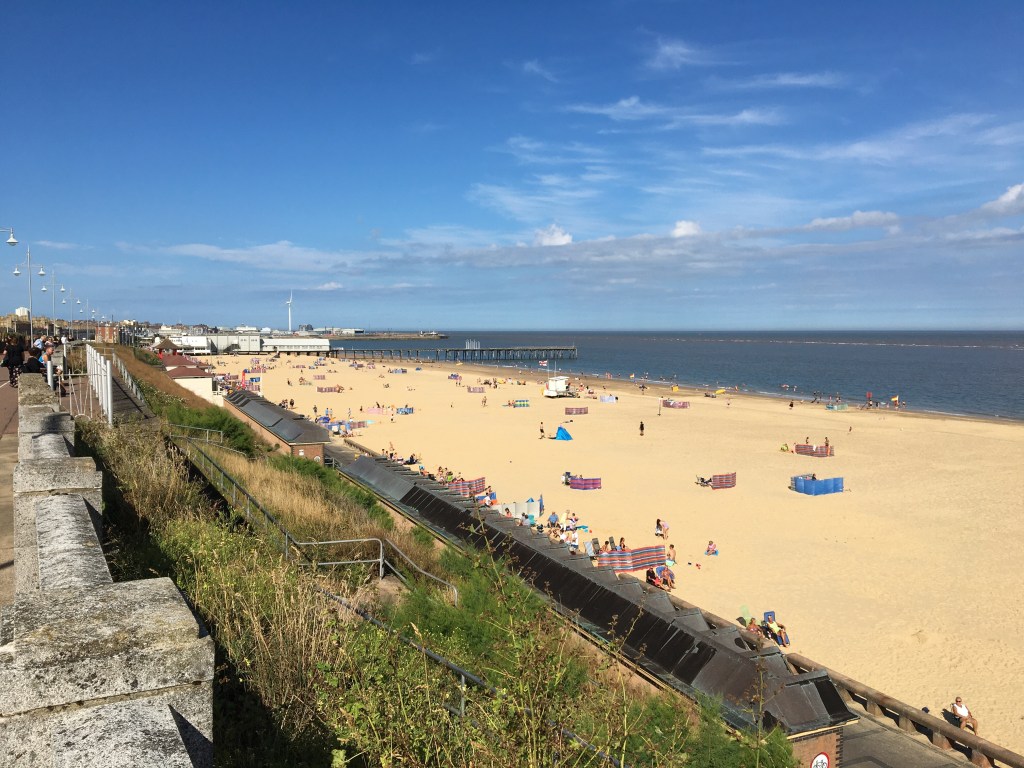
All the world and their mums are out in force today. It’s a surreal end to my journey after so much flatness, bareness, greyness.
The promenade, rust red like a cycle lane carries on towards the first of the piers, Claremont Pier, where people are gathered in groups doing all those things that we associate with a British seaside resort: eating ice creams, drinking beer, playing on the amusements. There is a police presence here. Is that due to Covid?
It seems fitting somehow that everything feels so very different from last year. It’s taken me a year to come to terms with Dad’s diagnosis, decline, death and aftermath. Yet now I feel like I’m moving on.
A little bit further on I start to feel the end drawing nearer. South Pier is a white line half a mile ahead. The end of the path.
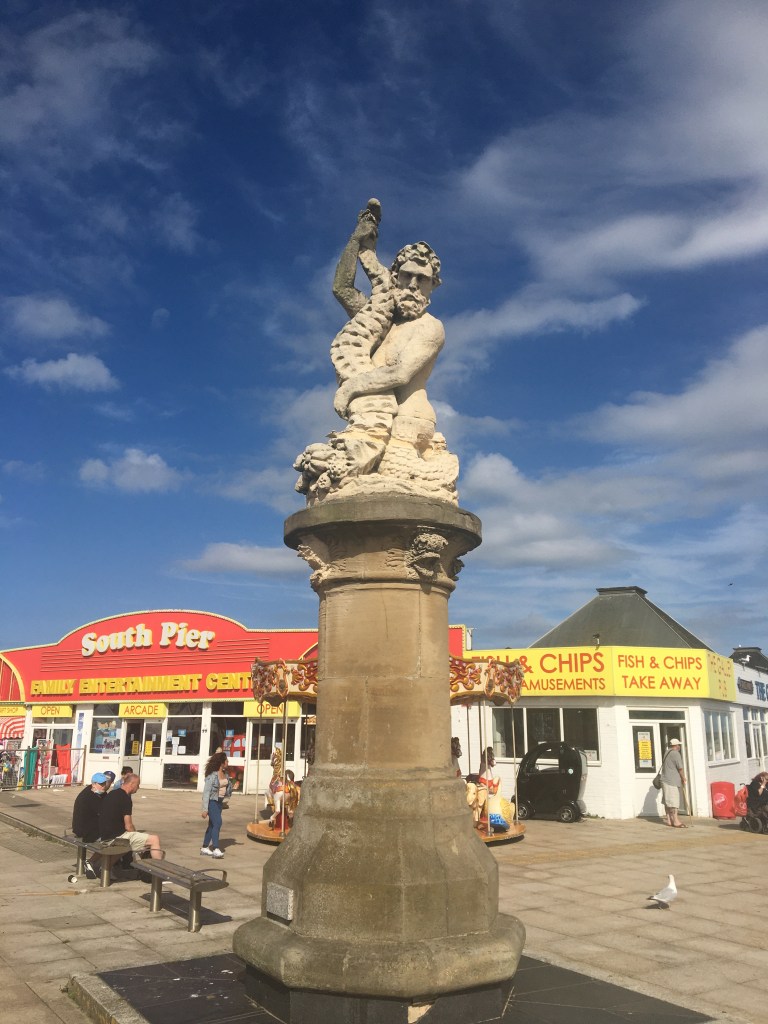
I pass a rather weather-beaten but impressive statue of Triton on the esplanade. The statue was commissioned in 1849 and designed by John Thomas. He is holding a cornucopia and surrounded by dolphin heads.
As the son of the Greek god of the sea, Poseidon, he seems a fitting emblem to finish my walk where the sea has almost always been my constant companion. I stand and stare at him for a whole ten minutes.

The South Pier is suddenly just ahead of me and I slow down and stop. Suddenly hesitant. Like the change in the path – the transition – I have that sad feeling of never being able to go back. We are always creating the past, it unfurls behind us like vague tracks in the sand, disappearing into our memories which in turn, will fade.
It’s that mixed feeling of exhilaration and sadness when a brief phase of my life has come to an end, like the end of the school year or the end of a trip abroad.
Without even realising it I am at the end. At South Pier. I mill about and for a while I appear at a loss as to where to go. I look at the amusements. I stare into the worn old eyes of the second triton, he so mighty but somehow reduced, holding forth in front of the amusements and the fish and chip shops.
I look back the way I’ve come but I can only see streets and people swarming along the promenade. I flick back through my mental photo album of the last 11 months. The strange twists and turns. Have I learnt more? I guess only what comes with experience and growing older…..
Grief. What was once like a stabbing pain in the heart and intense shock like a moment of violence or a car crash has become diminished by time. What was once an open wound is now a dull ache underneath the skin. I wait for time to dull the bad memories and leave me with the good. And as it always has, the path has helped – has taken me away from that which disturbs me, away from myself. Footsteps placed one before the next. Thoughts growing. Mind lost. It’s a glorious healing and if I’ve learnt anything it has been to rinse every last little drop of the time that has been allowed me. Who knows where to next?
I draw my gaze from the statue, say a word for Dad and head towards the bus stop that’ll take me south back to his home.
 The Slow Walker