3 weeks since Dad left us and strangely I don’t feel much. It was so intense at the start, as it progressed and at the end that the actual aftermath has been relatively calm. The rollercoaster has slowly ground to a halt.
Lockdown continues to offer a new strangeness but one that is definitely easing. The early weeks of uncertainty and anxiety have given way to acceptance and an enjoyment of the near world and at least we can travel for the day. Where am I now? In the small patches of forest North of Dunwich Heath and about to do a circuit of Dunwich.
Yet another sun-soaked day, something which should never be taken for granted in a country with a hundred types of weather.
I pull over on the road between Westleton and Dunwich used now to the abundance of cyclists, joggers and walkers that proliferate wherever we are. What else to do? A straight track goes South via Mount Pleasant to rejoin the coast path where I said farewell last time. Anticipation. Like with the SWCP when I rejoin the path I say out aloud ‘Back again’ and if there’s a wooden footpath I’ll slap it to signify I’m back en route.
The path winds through a mix of trees, many of them pine, the smell exotic and reminiscent of the Mediterranean and more specifically Greece. There’s also a profusion of rhododendrons in the undergrowth: wiry branches and purple flowers under the dappled light. What Ted Hughes referred to as ‘like a brass band in India.’

Houses start to appear amidst the trees and before I know it I’m on the road into Dunwich. I see a few couples in their seventies classed as Covid ‘vulnerable’. Some of them look self aware as though they’re worried that people will object to them being outside. 2 couples talk to each other from either side of the path 2 metres apart.
‘Sorry’, says the woman sheepishly as I walk between them.
‘Don’t worry’, I reply. I don’t care. People should trust each other to be sensible.
The road bends left into the village and I carry on a dead end road into Greyfriars wood which borders the cliff edge. It is unusual to have woodland this close to the sea as trees have only a limited tolerance to salt in the atmosphere.
How I love the surprise of a transition in landscape and from the dark, scrubbiness of the wood I am suddenly in a large meadow with a long flint wall bordering the path to the cliff edge.
This is what’s left of Greyfriars Friary, really the only surviving building from the original town of Dunwich. Built in the 13th and 14th centuries it was then dissolved in 1538. Much of the surrounding wall, including the gate survives but little else. In 1289, in a way portending the fate of the rest of the town, the friary was moved inland as a result of coastal erosion.
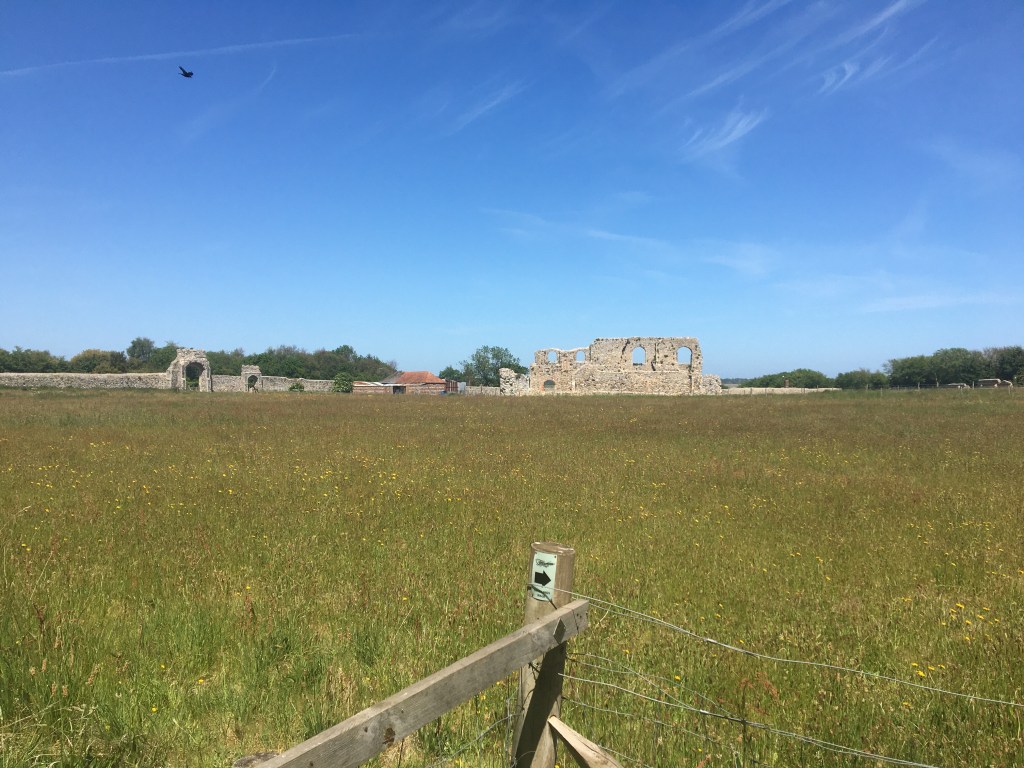
There are a couple meticulously trying to reimagine how the friary would have looked but l walk on preferring to be alone.
I can hear the gentle whooshing of the waves to my right as the path turns North once again along the cliff edge.
As I’m about to enter another walking thought dream, I’m stopped in my tracks. Barely visible amidst the undergrowth – overgrown and only 2 or 3 metres from the cliff edge – lies a gravestone. It is the last grave from the graveyard of the last of Dunwich’s original churches, All Saints.
The ever moving cliff edge here reached the walls of the church in 1904 and one part of the town gave in to the sea in 1922. One of the buttresses of the tower was saved and can now be seen in the graveyard of St James’s at the Western end of the village along with a photo of All Saints teetering on the brink.
Apparently it was a common site over the years for the erosion to reveal the bones of those long since laid to rest and for them to tumble out onto the beach. The gravestone itself is that of Jacob Forster and its inscription reads ‘In memory of Jacob Forster who departed this life March 12th 1796 Aged 38 years’ After all these years at rest I wonder how many more Jacob has before he too ends up in the sea.

In the 2011 census Dunwich’s population was said to be 183 but at its height in the 13th century Dunwich was an international port with a fleet of ships that was similar size to London’s port in the 14th century. During the Anglo-Saxon period it is generally recognised that Dunwich was the capital of the Kingdom of the East Angles.
Towards the end of the 13th century, though, its vulnerability became apparent. Storm surges twice destroyed whole buildings and swept them out to sea. A large storm in 1347 swept 400 houses out to sea. Almost all of the quite substantial town that existed in the 13th century is now under silt in the North Sea including all 8 churches that once stood here.
The famous legend still exists to this day that at certain tides you can still here a church bell ringing out at sea.
I have often felt myself floating in the light brown waters off Dunwich beach listening to the ebb and flow of pebbles on the sea floor like sand falling through an egg timer and thought about all that is out there somewhere buried beneath the waves.
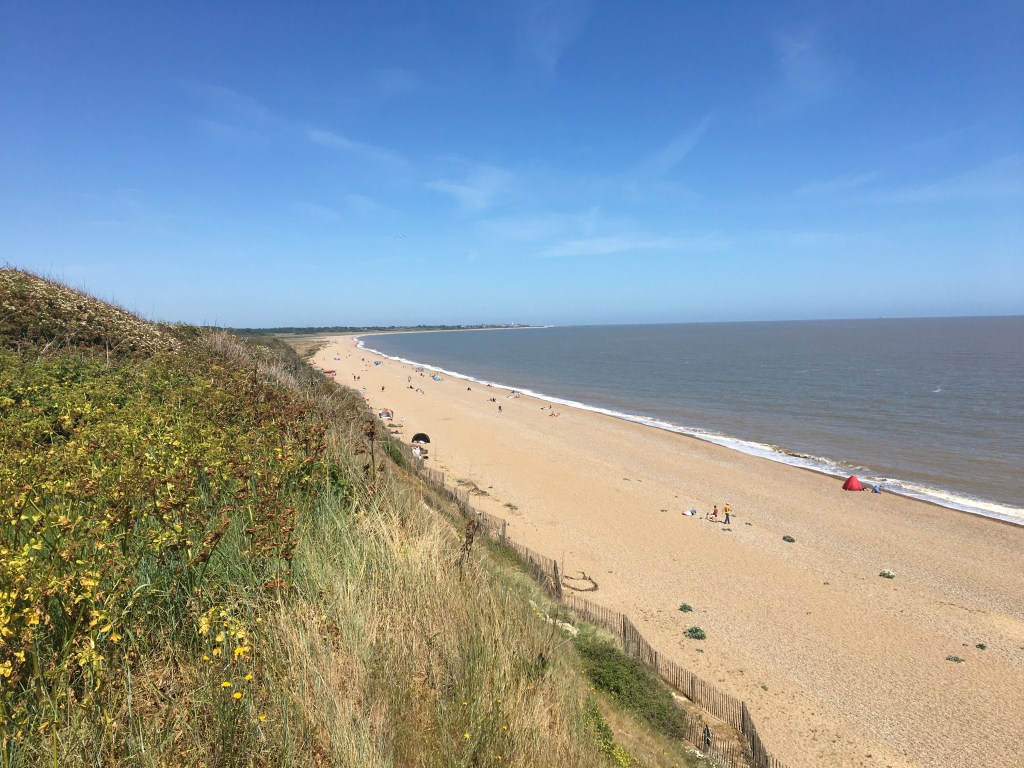
When I arrive at the beach and car park people are everywhere. Families and couples on the beach and in the car park. Spread out as per normal, queueing for fish and chips or eating ice creams.
The holiday feel of lockdown continues as the sun consistently shines and we all wonder ‘When will this end?’
 The Slow Walker