How much can the world change in so short a time? A new vocabulary has suddenly emerged: pandemic, lockdown, restrictions, Coronavirus, Covid-19. This is something which is affecting all of us and will do for many years to come. It is historic. A once in a hundred year event.
Having become used to the idea that coastal walking would be consigned to that box of banned activities due to the Coronavirus pandemic – like going for a pint or having a picnic – it was with wondrous surprise that I discovered last week I could drive to go for a walk.
It is fortunate that I was in Suffolk. Fortunate in so far as I can get to the coast in half an hour. Fortunate in that we seem to have experienced uninterrupted sunshine for the last month, since the early days of lockdown.
When I pulled into my well-used parking space on the dead end road in Thorpeness, I experienced the faint exhilaration of doing something that might be subversive, a bit like going for a midnight swim in a public swimming pool. Should I be here? What would I say if I were stopped? Would the residents look askance at someone who clearly didn’t live here?
Saying and receiving cheerful hellos to two old ladies, I followed the road which became a track which became a path.
And here I was again.
The change from walking close to home was intense. I’d forgotten how much I feed off the hugeness, the epic drama of the sea. Even if I was Prometheus on his rock, despite the eternity of pain, at least my mind would always be intrigued by the mysterious beauty of that other world.
And amidst these Covid days, a strange wave of ecstasy rolled over me until I spun around on my toes and shouted and pumped the air with my fist over and over like a tennis champ winning a tournament.

And as I walk and I taste the salt air and feel the wind and stare into the myriad ripples and creases and overlapping wavelets, something else quickly becomes apparent. Nothingness.
No planes. No boats. No ships. No one.
I’m aware of the constant sound of dry leaves in the windswept bushes along the coast path and the hypnotic swooshing of waves. Is this what’ll be left after we’ve gone? I try to recall Betjeman:
‘And all the time the waves, the waves, the waves
Chase, intersect and flatten on the sand
As they have done for centuries, as they will
For centuries to come, when not a soul
Is left to picnic on the blazing rocks,
When England is not England, when mankind
Has blown himself to pieces. Still the sea,
Consolingly disastrous, will return
While the strange starfish, hugely magnified,
Waits in the jewelled basin of a pool.’
A pandemic makes us all philosophical, sure, but you know it’ll be business as usual when this is all over.
The flat heath or common stretches briefly out of the top of Thorpeness towards the pill box where the path turns sneakily onto the beach. I am a little boy again running through this passage between two worlds desperate to see the sea.
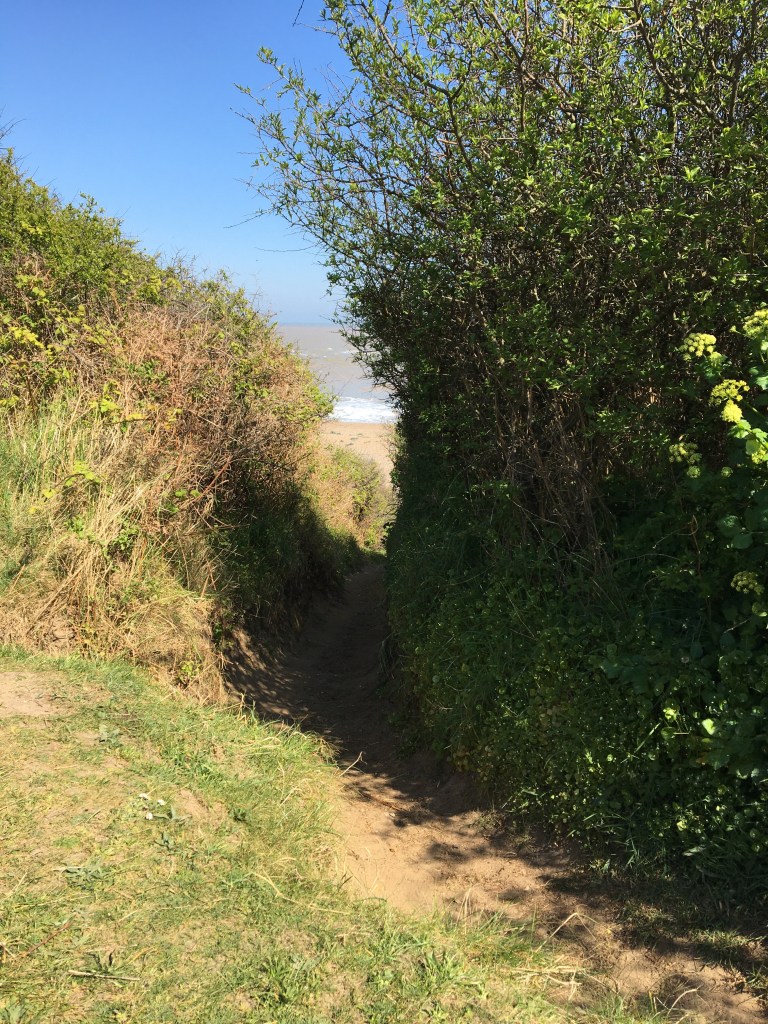
Now I’m walking North across the beach, the path a sandy line that weaves between grey green sea kale that grows here. Before long the path starts to follow the sandy cliff line that runs parallel to the beach.
Some steps lead up to the left of the path towards a tiny and battered old wooden gate. I walk up the steps. A long flint covered house faces across a lawn towards me and the sea. Ness House.
Dating from the 19th century, at one stage this would have been the only building between what was then the small hamlet of Thorpeness and Sizewell Gap, long before the power station was even an idea.
The building is long and might have been grand once. It has shingle facing. With its large windows and lawn facing onto the North Sea, it reminds me of nostalgic love stories set over a seemingly endless Summer at the seaside during some indistinct golden age. I’m thinking of ‘The Camomile Lawn’ and probably something else whose name eludes me right now.
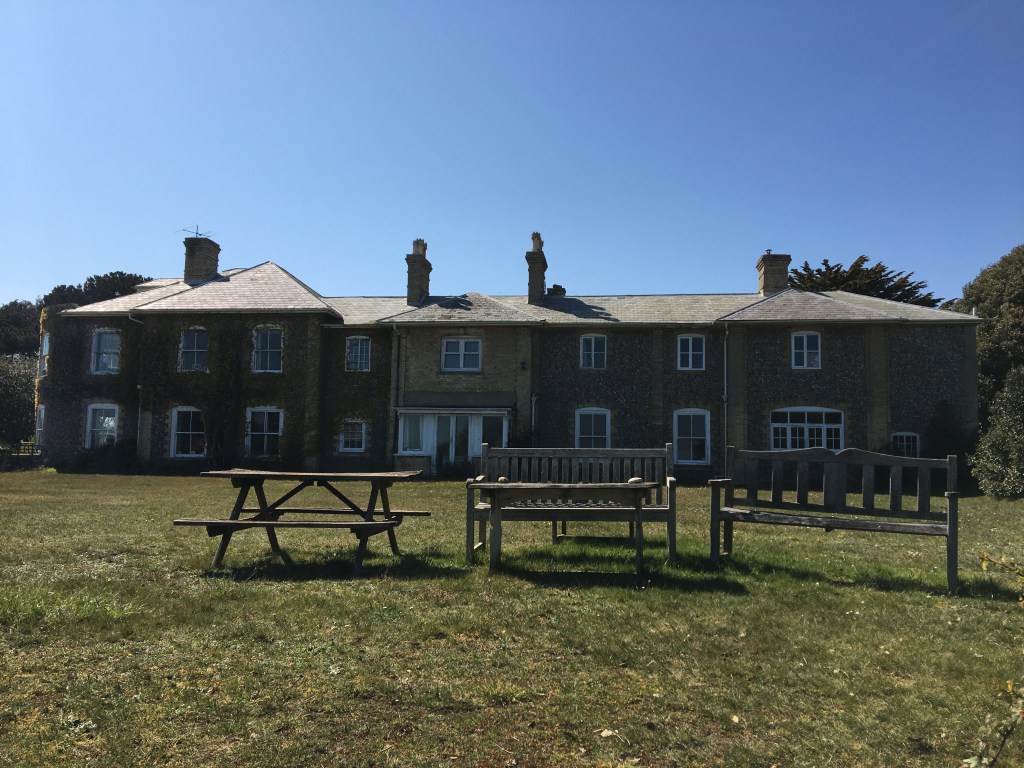
I can’t tell if anyone still lives here but there’s a faded, dilapidated look that suggests not. The paintwork is ancient and weeds grow extensively out of the window sills. I creep towards the house and notice a tall lamp in one room, piled up board games in another. I return quickly to the path, aware of invading someone’s privacy. Trespassing.
Later I find out that it’s no longer in private hands but is a centre for the physically and mentally handicapped. It might account for the air of faded grandeur.
The path continues following the beach northwards. The sea and sky are so expansive to the right of me that it feels like the end of the world and if I carry on I might just fall off the edge of it. However I know there’s a big surprise up ahead.
Great hedgerows of gorse start to border the path, bright yellow and smelling of coconut oil or the sex wax that surfers rub onto their boards for grip.

How relieving it is to be out here in all this space away from the smells of toilet, detergent and the congested breathing of my poor dying pa. How long now? No point guessing. He’s beyond talk, beyond comprehension, not even looking anymore. Just sleeping. And that is a blessing: no pain and at home. It’s what he and mum had decided from the beginning.
The gorse becomes thicker now, startlingly bright and there beyond is the behemoth so incongruous in this wild and windswept place.

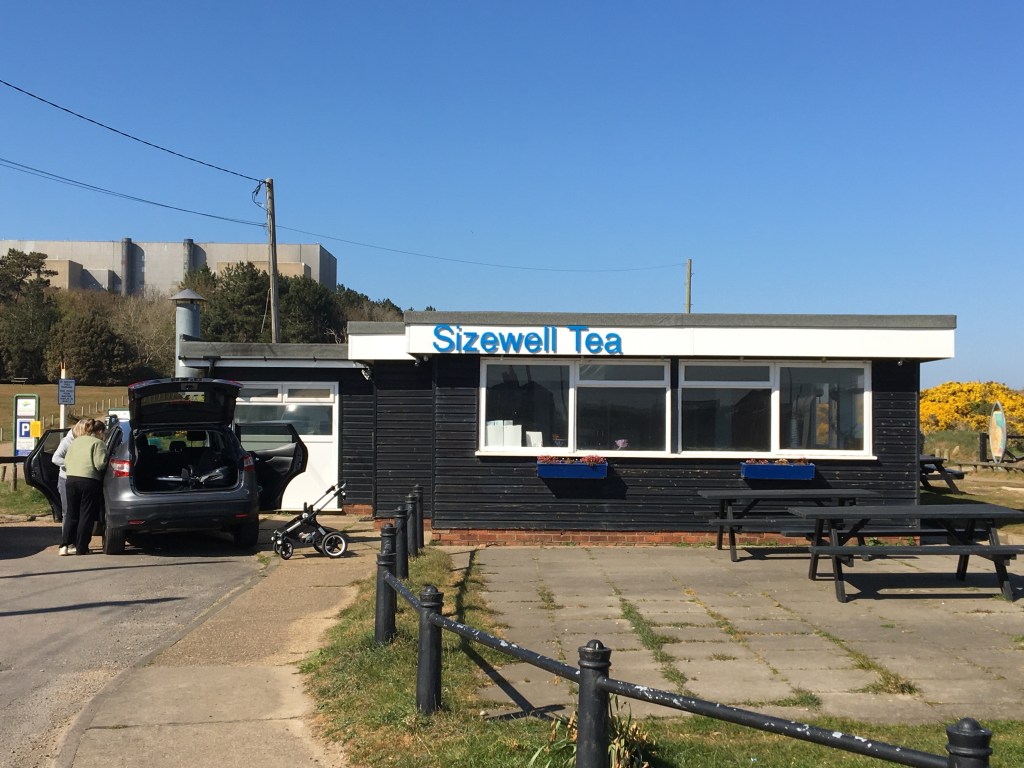
Apart from the vast power station, Sizewell or so I imagine, appears to be little unchanged as to how it was a century ago. Tiny fisherman’s cottages with painted brickwork face east. A coast guard’s cottage with look out tower and a right angled window for a 180 degree view of the sea sits squat and blocky painted defiantly black. Several small fishing boats are pulled up on the beach now redundant as a result of Covid. I notice a fisherman pottering about. I expect there’s still mending and making that can still be done while ashore.
Two couples have met up in 4x4s in the car park and I say hello while at the same time half aware that they might be breaking restrictions. Who cares? Trust people to be sensible. I’m reminded of an old friend of mine who’s uncle – a huge discus thrower-like man – had a cottage in Sizewell. It was tiny and one of the closest to the power station. It was called ‘Why Worry’.
 The Slow Walker