
There’s a stark beauty to the Suffolk coastline. In fact many might question that it’s even beauty. In certain places on certain days it is the lack of definition – the emptiness – that is profoundly moving. Maybe it’s just my state of mind.
Dad would have walked along here, I’m sure. He loved walking and conservation. He spent many years working for The Suffolk Wildlife Trust. He’s Suffolk born and bred and there’s still so much I want to ask him. I’ve made several recordings of us chatting but there’s never enough time and often now he’s too tired.
I cast my mind back to August and the beginning of September.
At the start of the Summer holidays Dad seemed a bit distant, forgetful and prone to mental blanks. I wondered if he was just getting older. He’s 79 after all. After I went to Greece I’d hoped he’d be better and sometimes he was but then at others he would sit in silence with a faraway look in his eye which I hadn’t seen before.
In the last week of the holidays – the last week of August – we started to notice other little quirks of behaviour which were outside the norm: while Mum and I talked about my brother, he confused him for my brother-in-law. Was it his hearing? Was it dementia? And in the afternoon he would sit in his deckchair in the sun outside the conservatory looking at the ground and then look up at me – that intense gaze he’s always had, unflinching but also somehow now unknowing. There was something about those moments that I couldn’t bear and I’d leave the house and run away to the sea.
Incredibly we had arranged a family photo shoot for Wednesday August 28th, the first time we’d ever done something like this. It was a present from us children to him and mum for their Golden Wedding back in April. There we all were – Mum and Dad, the children, husbands and wives and grandchildren – now sitting in a row with champagne in the conservatory saying cheers to the camera. Then wandering round the garden swinging my little niece, her face alive or bouncing my nephew, still too young to comprehend the pathos of the situation. All of us in scenes of family joy, with genuine attachment, but with our minds somewhere else wondering what was going on.
And now here were Mum and Dad standing close together, holding each other in the vegetable garden , his vegetable garden with the runner beans that were too late because he’d forgotten to plant them until later in the season, and him suddenly looking old and frail and me having to look away with that feeling like something is caught in my throat and the now familiar heat in the eyes.
It was so lucky that we timed it then to have those photos but I suppose there’s no getting away from that will always be a reminder of the start of the end.
That same day – weird to think of it now – we had a meeting with mum about their lasting power of attorney but it was also a moment where the 4 of us agreed that it was clear something was wrong and that he needed to be checked out.
The following day – Thursday – mum got active and they started a whole round of tests at the GP. One day that week – I can’t remember which – he had been mowing and had fallen over. Was it the Thursday? I think it might have been. Then it happened again the following day when he was unlocking the church.
Friday was the last day of the Summer holidays (or the last day at home before going back to Bristol). It was always a sad day anyway – a reminder of the days of being a schoolboy and having to go away to a boarding school I hated. I was woken up by mum, her climbing the little staircase to the room next to the attic where I’ve slept since I was 7 years old.
She told me calmly that Dad had fallen over while trying to get out of bed and he couldn’t get himself up off the floor and she didn’t have the strength to help him up. My father, always strong and unphazed, was lying prostrate next to the bed. ‘Oh J, this is ridiculous’, he said to me with his face turned sideways on their cream carpet.
The GP decided that he had to be admitted to hospital and they called an ambulance to take him. My last day of the Summer I watched him walk himself into the back of the ambulance, well dressed and handsome as he always has been, and sit down on the little seat they have behind the driver. I said goodbye and drove back to Bristol in silence.
Not knowing a diagnosis when you know something is wrong is dreadful. Your brain tells you not to think the worst when all along your brain is thinking the worst. And it really couldn’t have been much worse. Glioblastoma is a particularly aggressive form of brain cancer that affects or infects only 1 or 2 in every 100,000 people. But what a thing: by the end of my first week back at school they had spotted it, diagnosed it and it had grown to 6cm long in 2 months. ‘It is the size of an egg’ Mum told me over the phone. The image makes me feel sick.To think that throughout this lovely Summer, where I’ve felt so good about life and had such fun, that thing was quietly but rapidly growing, waiting to be discovered and then turn our world upside down. It would have started at the beginning of July when we first noticed he wasn’t his usual self.
I drove straight from school on Thursday evening 5 days after he’d first been admitted and still without a prognosis although we knew it was a brain tumour. Walking through the door I tried to sound chirpy: ‘Hi!’ expecting it to be mum on her own. This would be how it would be some day soon.
‘Hallo!’
Dad was home. That was a surprise. Mum caught me before I walked down the corridor to hug him. She looked frightened.
‘They’ve said he can come home but it doesn’t look good. He’ll explain.’
I sat on the sofa in the same place and the same room where we have gathered for almost 40 years: birthdays, Christmas, parties for their friends or ours or just a place to be together to chat or watch TV.
They sat in armchairs one on each side of me and spelled it out between them, clearly worried how I would react.
‘It’s very aggressive.’
‘Treatment is difficult and could be risky.’
Pause
‘They say 3-6 months, possibly a year if they can operate.’
There is no noticeable effect on me. The room doesn’t start spinning. The clocks keep ticking. We keep talking as we normally would.
But everything has changed.
This is what countless generations of people who have come before have had to endure. The loss of someone close. It’s so simple, so obvious. It’s everything that I’ve read about or seen on stage or screen but nothing can prepare you for it. Already I see my life up to this point as an innocent, unknowing time. Who was the poet who talked about how we throw away our youth like toffee wrappers? What do we know about life? Nothing. How woefully unprepared we are for this entire misadventure. They don’t tell you these things in school but one day life will let you down and you won’t know how good something is until it’s gone.
****
I set off from where I ended up 2 weeks ago at the end of a dirt track next to the prison car park. There’s a strange satisfaction I get from arriving back at exactly the same place wondering how I was then and what has happened since. The continuity of the path and the passing of time. Arriving here once again I had driven through the prison buildings and fences of Hollesley Bay Colony with big signs ‘No access to inmates’ and not a soul about. No people on the paths. No cars in the car parks.
How I like this. The cosiness of being alone with my thoughts on a Winter’s day.
The greyness is strange, distorting the edges of reality. Sheep grazing in a field merge with their background. A ship out at sea, not far from the coast appears as a ghostly vast lego block, more like an upturned table than a ship. Sky, river and sea are all grey. The sky has such subtle changes of the same colour it is almost impossible to tell, let alone describe.
Trudging across Hollesley Marshes wrapped up in my thoughts I am immediately aware of the sea’s crashing out of sight to the East. It sounds like white noise in a wind tunnel. Something is making the sound bend. The bank in front of me hides the end of the land.
The greyness is manmade too. Sea defences appear at random, lurking on the edge of the path. Further back on the path near Bawdsey a whole pill box had ended up on the beach half sunk in the sand, its corners sticking up awkwardly and out at a strange angle. It’s now the sea that poses the biggest threat here.
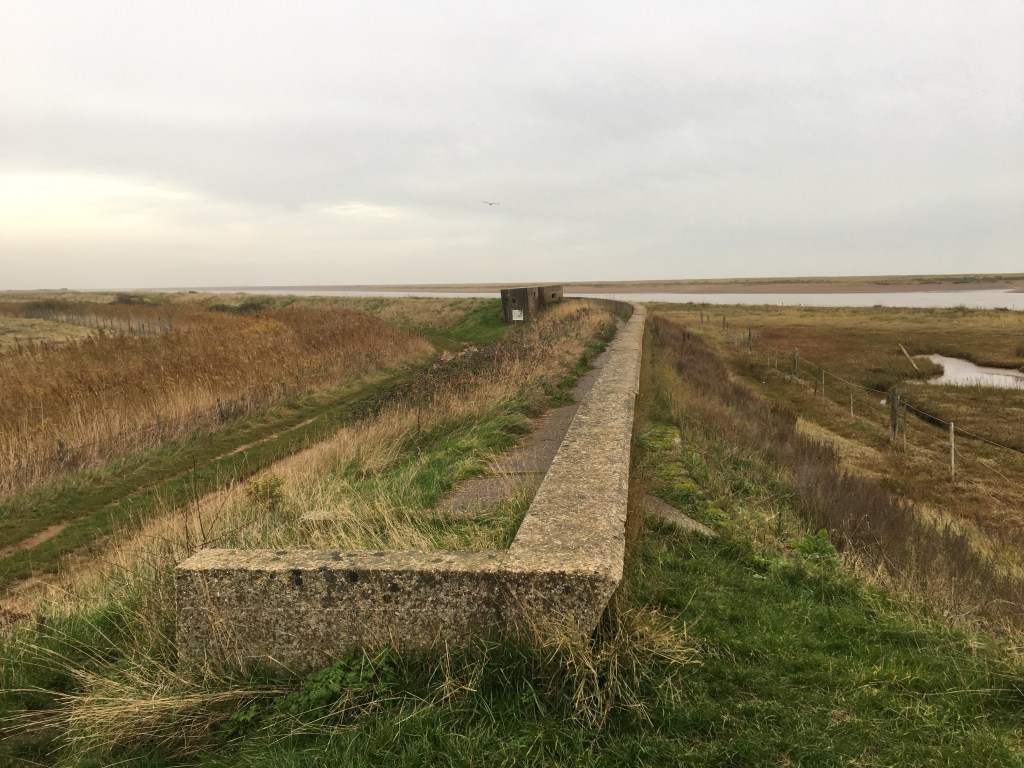
I quicken my pace. It’s mild today but I want to get into the groove of walking and then the thoughts will start to become louder and clearer. It will clear the thoughts of home where Dad lies silent in his armchair.
I stick to the narrow spine of the grass bank that follows the river as it rushes down from Aldeburgh.
The only colour apart from the grass is a fisherman, bright orange in a wooden dinghy with an outboard turning around in the river far ahead in the distance.
The wind is to my back from the South and a slight change in the sky suddenly reveals some light above me. My mood changes. I have one of those moments. Time is frozen and I’m entranced by the wind and light. Not thinking, just feeling. It reminds me of hiding from the winter wind in a bush when I was little like a young leveret or bird. I feel the same now as I did then.
A transition. Something new. Simpson’s Saltings is a 25 hectare nature reserve consisting of marshland and beaches but is home to many important and rare species of plants.
I run down through the sea campion to the beach and jump into the pebbles turning south into the wind. There is something here that breaks the smooth lines of beach, water and plants. Upturned boats and a winch left for the Winter.

Onwards, Northwards. A boy runs past me and then stops behind another pill box on the path to get his breath back. Then shouting suddenly ‘Ella, Come on!’ before suddenly turning inland towards a line of trees although there is no path. I have a thought about the fearlessness of youth.
After the trees, I turn my back on the sea and cross a narrow channel parallel to the river. A transition and another Suffolk scene: a flat field stretching to a thin line of trees, skeletal dark forms filled with a mass of black birds silhouetted against the sky. My immediate assumption was that they were crows or rooks but, as I saw a flock coming into land, I realised they were cormorants with their white underbellies and yellow throats.
The great bird lover and writer Adam Nicolson has referred to the cormorant as ‘the most sinister bird in English literature’, a reference to the cormorant being mentioned in ‘Paradise Lost’ but also, according to Nicolson, ‘Aristophanes, Plutarch, Chaucer, Erasmus, Shakespeare: everyone has given this bird his evil part’. Being faced by this wall of black shapes sitting amidst the bareness of the trees in the fast fading light did produce a little rush in my chest. I carry on.
Like the last time I had the same incongruous experience of going from the wildness and openness of sea, beach, marsh, meadow to the starkness of fence, barbed wire, CCTV, prison block as the path passes the main detention centre at Hollesley.
Yet somehow there is a conjoining. It seems absolutely obvious that the prison – grey, austere, remote – should be here on this featureless East Anglian shore. There is a certain symbiosis to these 2 seemingly alien environments. They’re made for each other.
The light has all but gone apart from a pale patch over the Western horizon. Head bowed I arrive back at the car. Refreshed somehow I’m ready to return home to have a drink with Dad and tell him what I’ve seen and done. I know he’ll be polite and genuinely interested but it must tear him up – he, the wildlife lover, the explorer – knowing that he’ll never do anything like that again. How would you stop yourself thinking that it’s all downhill from here?
I always kick myself when I first arrive home and automatically ask ‘Are you OK?’ To which he always responds in the same frank, honest way with no pity for himself:
‘Not really.’
 The Slow Walker